ICHRA for 2027: Your Notice Deadline Is October 3
Planning an ICHRA for January 1, 2027? Federal law requires notice at least 90 days before the plan year starts: October 3, 2026. See the math and calendar.
The short version
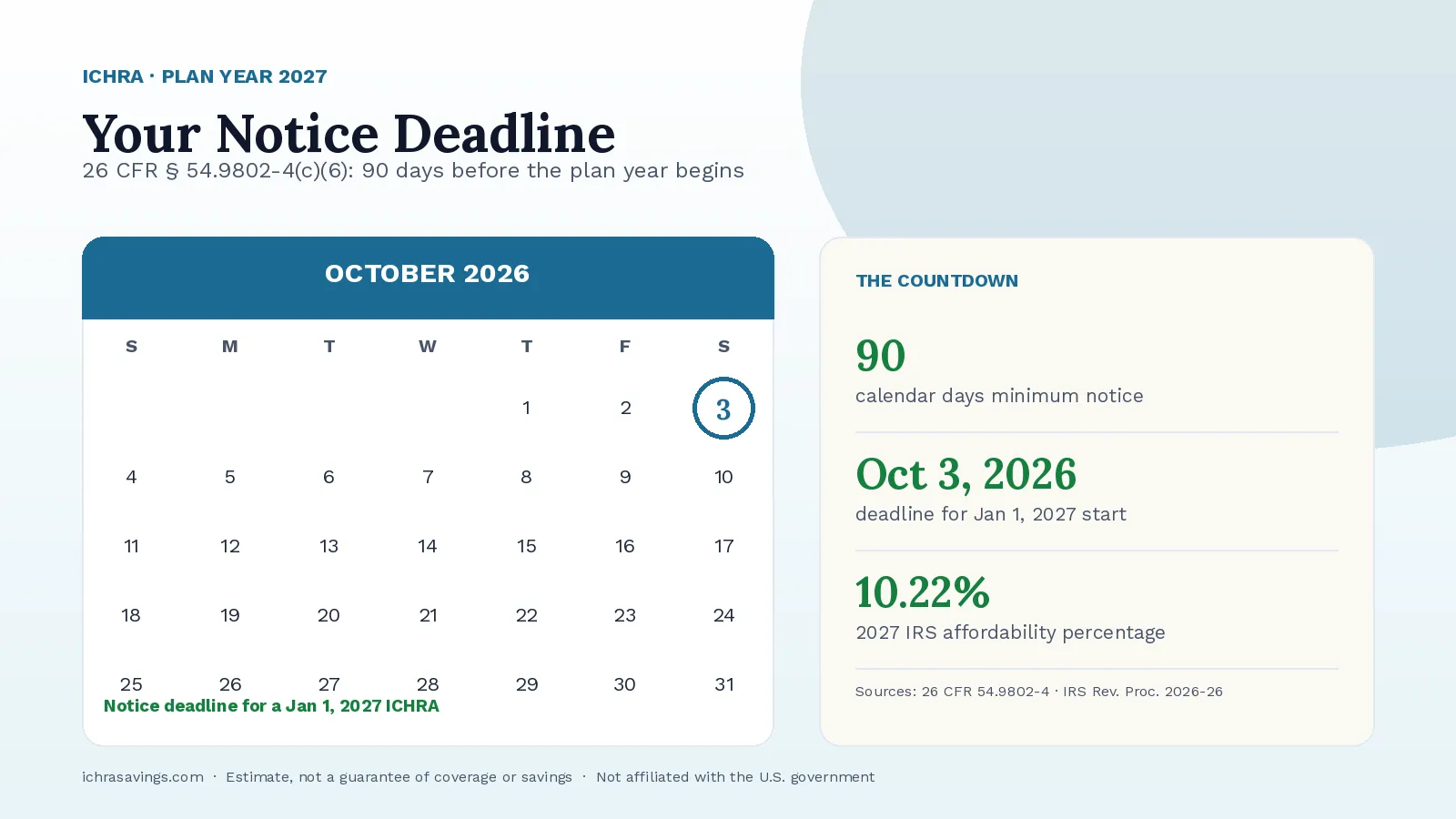
- Want an ICHRA effective January 1, 2027? Federal rule requires employee notice at least 90 calendar days earlier: October 3, 2026.
- The rule is 26 CFR 54.9802-4(c)(6)(i)(A). It applies to every ICHRA plan year start date, not just January 1.
- New hires and brand-new employers get separate, later timing under 26 CFR 54.9802-4(c)(6)(i)(B) and (c)(6)(i)(C).
- Check whether your county even qualifies before you spend a week on paperwork. That takes minutes, not weeks.
Do you need to send a notice for 2027?
If you want an Individual Coverage HRA, or ICHRA, in place for a plan year starting January 1, 2027, federal regulations require you to give every eligible employee written notice at least 90 calendar days before that start date. Counting back 90 days from January 1, 2027 lands on October 3, 2026. If your notice has not gone out by then, you cannot legally treat those employees as covered under the ICHRA on day one of the plan year.
That is the whole answer if your plan year runs on the calendar. It gets more useful once you know why the rule exists, what it actually requires, and what a missed deadline costs you in practice, which is what the rest of this guide works through.
Why one regulation controls the whole calendar
The notice requirement is not a best practice or a vendor recommendation. It is a specific federal regulation: 26 CFR § 54.9802-4(c)(6), part of the 2019 rule that created the ICHRA (Treasury, Labor, and HHS final rule, Federal Register document 2019-12571, 84 FR 28888, published June 20, 2019). The subsection that sets the clock, (c)(6)(i)(A), requires the notice "at least 90 calendar days before the beginning of each plan year" for any participant who is eligible to participate on day one of that plan year.
The point of the rule is not paperwork for its own sake. An ICHRA offer changes whether an employee can claim a premium tax credit on the ACA marketplace, a decision they need real time to think through, shop plans against, and act on before their own coverage lapses. Ninety days is Treasury's judgment about how much runway that decision actually needs. Employers who try to compress it, sending a notice 30 or 45 days out, are not just cutting it close; they are outside the rule, full stop.
Three terms matter here, and they get used loosely elsewhere, so define them once. The plan year is the 12-month period your ICHRA runs on, chosen by you; it does not have to be a calendar year. Eligible participant means an employee in a class you have chosen to offer the ICHRA to, once any waiting period has run. The premium tax credit, sometimes called an ACA subsidy, is the federal subsidy that lowers marketplace premiums for lower- and middle-income households; accepting an affordable ICHRA generally requires waiving it for that coverage period, which is exactly what the notice has to explain in plain terms.
Picture one employee to see why the timing matters and is not just a formality. Say she is currently on the ACA marketplace with a premium tax credit knocking $200 a month off her bill, and her employer's ICHRA notice arrives on November 15 for a January 1 start. She now has 47 days, not 90, to work through whether the ICHRA's reimbursement covers her current plan, whether accepting it forces her to drop the subsidy she is relying on, whether a different plan on the exchange fits her reimbursement better, and whether to act at all during the individual-market open enrollment window that closes in mid-January. Ninety days gives her two full marketplace-shopping cycles to make that call calmly. Forty-seven does not. That gap is the entire reason the rule is written as a floor, not a suggestion, and why regulators did not leave the exact interval up to each employer's judgment.
It also is not a one-time formality even for an employer who already runs an ICHRA. The 90-day clock resets every plan year, because 26 CFR 54.9802-4(c)(6)(i)(A) applies to "each plan year," not just the first one. If you started an ICHRA on January 1, 2026, you still owe a fresh notice by October 3, 2026 for the plan year beginning January 1, 2027, even if nothing about the plan design is changing. Employers who treat the notice as a launch-day task, done once and filed away, are the ones most likely to miss it on renewal, because there is no carrier reminder letter the way there is for a group plan's annual renewal.
Your 2027 notice-deadline calendar
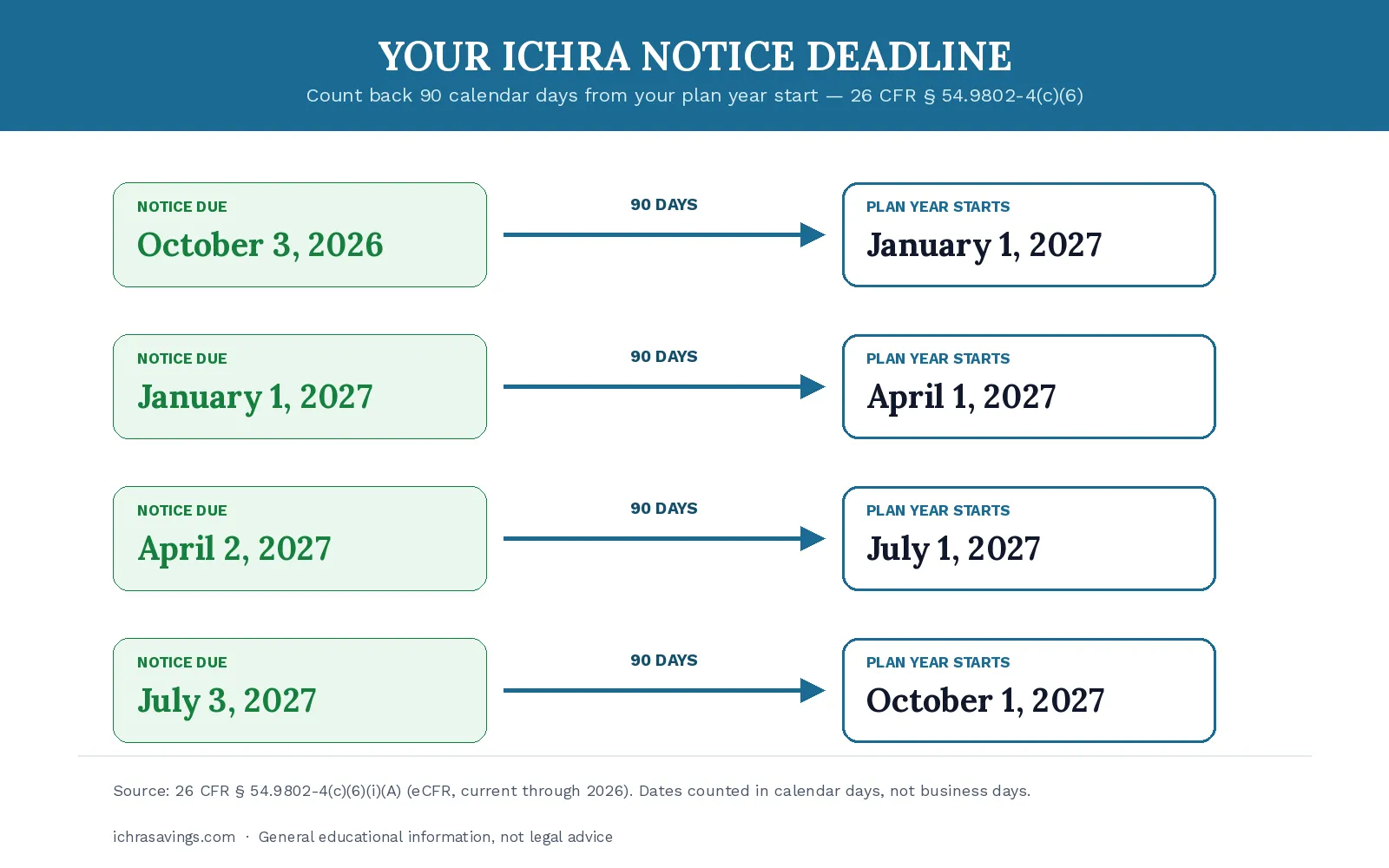
Most employers run a calendar-year plan, but the 90-day rule applies to any plan year start date you choose. Here is the deadline for the four common quarterly start dates, each counted back 90 calendar days under 26 CFR 54.9802-4(c)(6)(i)(A).
| If your ICHRA plan year starts | Notice is due no later than | Advance required |
|---|---|---|
| January 1, 2027 | October 3, 2026 | 90 days |
| April 1, 2027 | January 1, 2027 | 90 days |
| July 1, 2027 | April 2, 2027 | 90 days |
| October 1, 2027 | July 3, 2027 | 90 days |
Source: 26 CFR § 54.9802-4(c)(6)(i)(A) (eCFR, current through 2026); dates computed by counting back 90 calendar days, not business days, from each plan-year start date.
Your renewal date does not have to be January 1
If October 3 has already passed by the time you read this, you are not locked out of 2027. Moving your ICHRA plan year to April 1, July 1, or October 1, 2027 resets the clock to whichever date on the table above applies, and none of those require you to run a partial year on your existing group plan first.
What waiting a year actually costs
Missing the window does not just delay a project. It locks you into one more full renewal cycle on whatever you are currently paying. KFF put the median proposed premium increase for small businesses with ACA-compliant plans at 11 percent for 2026, based on preliminary rate filings from 318 insurers across all 50 states and DC (KFF, "How Much and Why Premiums Are Going Up for Small Businesses in 2026," published September 24, 2025; national). A small employer paying $12,000 a year per employee in group premium is looking at roughly $1,320 more per employee if that trend holds into the next renewal, money that buys nothing new; it is the same coverage at a higher price.
Compare that to what an ICHRA does to the same line item. You are not negotiating a renewal percentage with a carrier every year. You choose a monthly contribution, and it stays what you set it at until you decide to change it. The chart below is illustrative, not a projection for your business, but it shows the structural difference: one line moves on someone else's schedule, the other moves on yours.
Small-group renewal trend vs. an ICHRA budget you control
Illustrative shape of the comparison for one plan year. Not a projection for any specific employer.
Small-group figure: KFF, median proposed 2026 premium increase for small-business ACA-compliant plans, national, published September 24, 2025. https://www.kff.org/health-costs/how-much-and-why-premiums-are-going-up-for-small-businesses-in-2026/
The affordability number that decides your budget
Before the notice can say anything useful, you need a contribution number, and that number is bounded by an IRS affordability test most employers use the federal poverty line, or FPL, safe harbor to satisfy. Two federal figures drive it for a 2027 plan year, and both change every year, so neither one is safe to remember from a prior post.
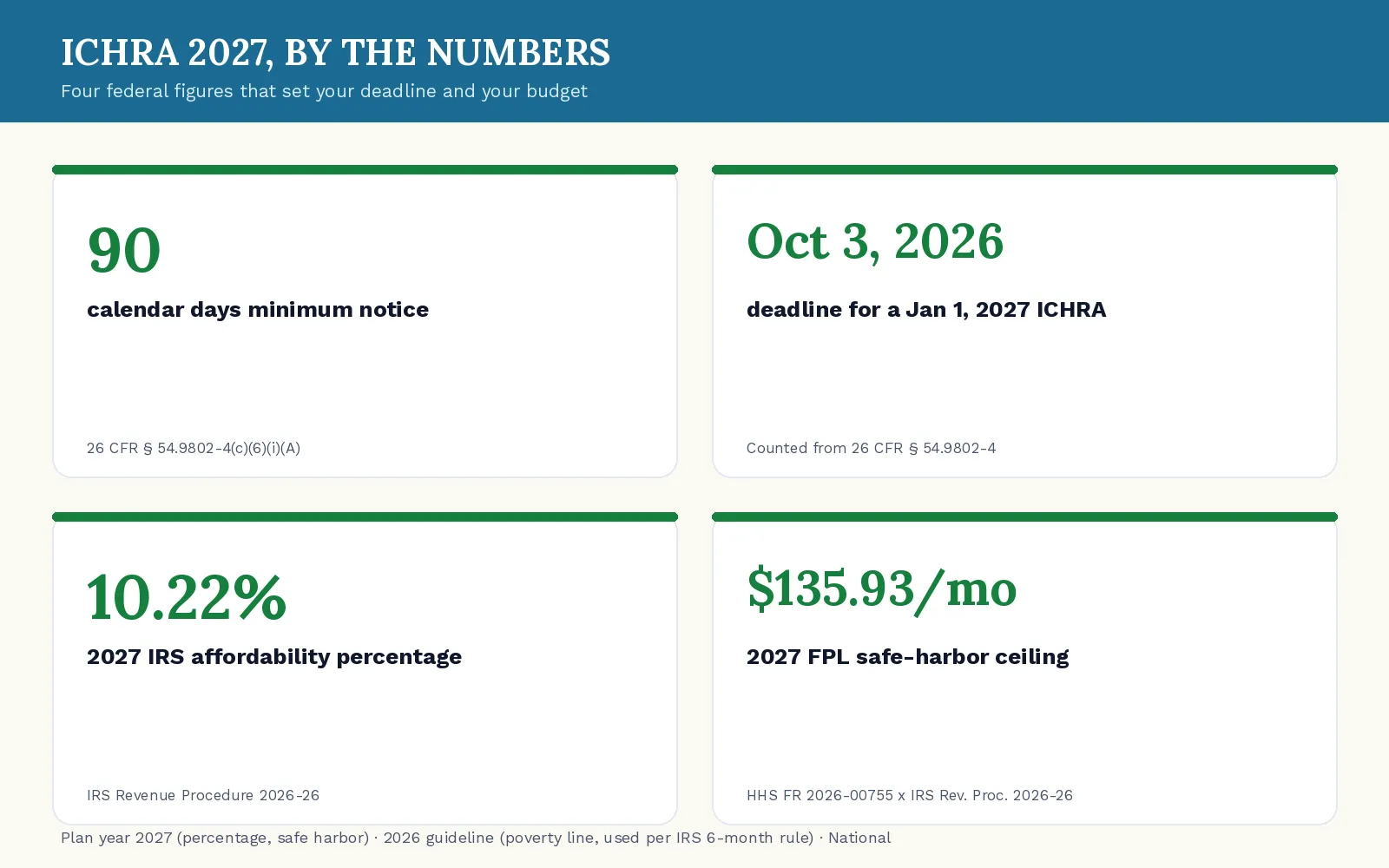
The IRS set the required contribution percentage for plan years beginning in 2027 at 10.22 percent, the first time it has crossed 10 percent, in Revenue Procedure 2026-26 (IRS, published July 21, 2026; national). Separately, HHS updated the 2026 federal poverty guideline for a household of one in the 48 contiguous states and DC to $15,960 a year, in a Federal Register notice published January 15, 2026 (HHS, document 2026-00755; 48 contiguous states and DC). Employers are permitted to use the FPL guideline in effect roughly six months before their plan year begins, which for a January 1, 2027 plan year means this January 2026 figure, not one that will not exist until January 2027.
Multiply those together and divide by 12, and a 2027 ICHRA that reimburses at least the lowest -cost silver plan in an employee's county is automatically treated as affordable under the FPL safe harbor if the employee's required monthly contribution toward that plan does not exceed:
The math
$15,960 (2026 FPL, single) × 10.22% (2027 required contribution %) ÷ 12 months = $135.93 a month
This is a ceiling on the employee's required contribution, not a floor on your ICHRA reimbursement. If the lowest-cost silver plan in an employee's county costs more than your contribution plus this amount, the offer may fail the safe harbor for that employee. Sources: IRS Rev. Proc. 2026-26 (irs.gov/pub/irs-drop/rp-26-26.pdf); HHS Federal Register notice 2026-00755 (govinfo.gov/content/pkg/FR-2026-01-15/pdf/2026-00755.pdf). Plan year 2027.
This is exactly the kind of number that belongs in your notice, and exactly the kind of number you cannot get right by guessing. Run it for your own county's silver benchmark before you finalize a contribution amount, not after.
Check your county before you send anything
Here is the step employers skip, and it is the one that should come first. The affordability math above tells you whether an ICHRA offer is legally compliant. It does not tell you whether an ICHRA is actually a better deal than what you are paying now, and that answer depends entirely on where your employees live. Our dataset currently covers 32 states, comparing 2026 individual-market benchmark premiums against small-group benchmark premiums, county by county.
Two real counties from that dataset show why a single national number would mislead you, even within the same state.
| County | Individual benchmark | Small-group benchmark | Estimated savings |
|---|---|---|---|
| Cabarrus County, NC | $688.02/mo | $859.85/mo | 20.0% · $2,062/yr per employee |
| Madison County, IL | $651.73/mo | $812.76/mo | 19.8% · $1,932/yr per employee |
| Cook County, IL | $592.70/mo | $593.02/mo | 0.1% · essentially no gap |
Source: ICHRA Savings county dataset, src/data/qualified_counties.json, cross-verified against CMS public-use marketplace files. Plan year 2026. Figures are estimates, not quotes, and are not a guarantee of savings for any specific employer.
Madison County and Cook County are both in Illinois. One shows a real, estimated 20-percent-range spread; the other shows almost none. If your workforce sits in a Cook-County-like market, spending three weeks building a compliant ICHRA notice may not be worth the effort this year, and that is a completely legitimate outcome. Small group can be the right answer. The only way to know which case you are in is to look up your own counties, which takes about ten seconds on the savings map, before you invest a single hour in the paperwork below.
A worked example: a 40-person company checks the math
Numbers move faster than descriptions, so here is a full pass with one hypothetical company, built from the sourced figures above. Say a 40-employee professional services firm in Cabarrus County, North Carolina is currently paying an average $850 a month per employee for small-group coverage, close to this county's $859.85 small-group benchmark. That is $10,200 per employee a year, or $408,000 across the company.
Path one: renew small group again. Apply the KFF national median trend of 11 percent for 2026 and the company's renewal moves to roughly $9,435 a year per employee before any further increase for 2027, a jump of about $37,320 across 40 employees for one plan year, for identical coverage.
Path two: move to an ICHRA for 2027. Cabarrus County's estimated 2026 rate spread puts the individual-market benchmark at $688.02 a month against that same $859.85 small-group benchmark, a 20 percent gap. If the company sets its ICHRA contribution at the FPL safe-harbor ceiling worked out above, roughly $ 135.93 of required employee contribution room built into the silver benchmark, most employees in this county could get to an affordable plan on a contribution meaningfully below the $850 the company pays today, while still clearing the IRS affordability test. The company sets that number once; it does not move because a carrier filed a new rate.
Two things matter about this example beyond the arithmetic. First, none of it works without the county check: swap Cabarrus for a county where the individual market trades above small group, and path two gets worse, not better. Second, none of it works without the calendar above: this company only captures a full 2027 plan year of the difference if its notice goes out by October 3, 2026. Miss it, and the $37,320 small-group increase in path one happens regardless, while path two slides a full year.
The three exceptions to the 90-day rule
The 90-day requirement in 26 CFR 54.9802-4(c)(6)(i)(A) is the default, but the regulation carves out two situations where a different clock applies, plus one that matters for companies formed late in the year.
- New hires and other mid-year eligible employees. Under (c)(6)(i)(B), anyone who is not eligible to participate at the start of the plan year gets the notice "no later than the date on which the HRA may first take effect" for them. A person hired in June for a January 1 plan year does not need 90 days of advance notice; they need it by the date their ICHRA coverage can start.
- Brand-new employers. Under (c)(6)(i)(C), if your company was established fewer than 120 days before the ICHRA's first plan year begins, you only have to provide notice as soon as practicable. This is for genuine startups launching benefits for the first time, not a workaround for an existing employer that put off the decision.
- Notice content, not just timing, has requirements too. Under (c)(6)(ii), a compliant notice has to describe the ICHRA's terms, the maximum reimbursement and any proration rules, which dependents are eligible, the effect on premium tax credit eligibility, and the requirement to maintain individual health coverage. The Department of Labor's optional Individual Coverage HRA Model Notice covers all of these, and using it in good faith and on time is treated as compliance with the content rule.
One more thing worth saying plainly: the notice is a legal document, not a sales page. A notice that promises employees they will "save money" or "keep their same plan for less" is overpromising something the employer cannot actually guarantee, because the answer depends on the plan each employee individually picks. The safest, most accurate language states the dollar contribution, points employees to the marketplace to shop for themselves, and is honest that outcomes vary by household. That is also, not coincidentally, the standard this site holds itself to in every county figure it publishes.
A late notice to an existing employee is not fixable after the fact
The exceptions above are narrow and specific. They do not apply to a company that has been operating for years and simply ran out of time to finalize its ICHRA design. If that is your situation, the honest options are to push your plan year start date to a later quarter, or to run one more renewal on your current plan while you prepare properly for the date that follows.
A ten-week runway that actually works
Ninety days sounds generous until you count backward from it, because the notice is the last step, not the first one. Design, affordability modeling, and class structure all have to be settled before a notice can be accurate. Here is roughly how the runway breaks down for a January 1, 2027 start.
- Now through mid-September 2026: check your counties and set the budget. Confirm the rate spread where your people actually live, county by county rather than at a headquarters address, then model the FPL safe harbor math above against your real county's silver benchmark. Decide roughly how many dollars a month you can commit per employee class before you touch the notice language, because the notice cannot be finished without a number in it.
- Mid-September: finalize employee classes, if you are using them. Class definitions and their minimum-size rules have to be locked before the notice can describe them accurately; changing a class after the notice goes out means a corrected notice, which eats into the runway you just spent five weeks building.
- Late September: draft the notice and route it for review. Use the DOL model notice as your baseline and fill in your specific dollar amounts, eligible dependents, and effective date. If you have a benefits attorney or a TPA, this is the point to get a second set of eyes on the affordability language, not after employees already have it in hand.
- By October 3, 2026: deliver the notice to every eligible participant. Written, dated, and sent, meaning employees actually have it in front of them, not just drafted and sitting in a folder on your desktop. Keep proof of delivery; email with a read receipt or a signed acknowledgment is the common approach.
- October through December: run open enrollment and support the marketplace shop. Most employees moving to an ICHRA have never shopped the individual market before; this is where rollouts succeed or fail on the human side, not the legal side. Budget real time for one-on-one questions, not just a group presentation.
- January 1, 2027: coverage and reimbursements begin. Have your substantiation and reimbursement workflow tested before the first paycheck cycle, not during it. Employees need to know exactly what documentation triggers a reimbursement before their first premium payment is due.
What if your plan year already started, or you missed a date
Two situations come up constantly once employers start working the timeline above. The first is a company already mid-way through a calendar-year small-group plan that wants to switch to an ICHRA the moment that plan renews, rather than waiting for the next January 1. There is no rule forcing you to align an ICHRA to the calendar year at all; pick the plan year that starts the day your current coverage would otherwise renew, then count back 90 days from that date using the same method as the table above.
The second is simpler and less forgiving: October 3, 2026 has already passed by the time you are reading this, and January 1, 2027 is off the table for participants who have not received notice. There is no retroactive fix, no expedited-notice provision, and no employer-side waiver in the regulation. The two honest paths are the ones described earlier: shift the plan year start to April 1, July 1, or October 1, 2027, using the matching deadline from the table, or spend the extra months building the ICHRA correctly and treat the delay as the cost of getting it right instead of rushed.
Where ICHRA Savings fits
We built the county savings map specifically so this decision does not eat your runway. Before anything else, check whether your county is one where an ICHRA estimate actually beats small group: ichrasavings.com/ichra-savings-map. That answer takes minutes, and it should come before any of the calendar work above, not after it. If the county math works, we help with the design and setup work described in this guide: setting a contribution against the affordability math for your actual county, choosing whether employee classes make sense for your workforce, and building the notice and reimbursement workflow around the dates that apply to your plan year.
If you are earlier in the process and just want to understand the mechanics before talking to anyone, start with how ICHRA works. If your renewal is already in hand and you are working against a real deadline, a short conversation is worth more than another week of research: ichrasavings.com/book.
What you get out of any of this is not a guaranteed saving; nobody can promise that for your specific business, and we will tell you plainly if your counties do not support it. What you get is a real answer, built from your own county's numbers instead of a national average, early enough that a 90-day deadline is a plan on a calendar instead of a scramble in September.
The 90-day notice is the easy part once you have already decided. Most employers lose the runway to the decision itself, not the paperwork.
Mike MooreQuestions employers actually ask
What happens if we miss the October 3, 2026 deadline for a January 1, 2027 ICHRA?
You cannot legally start the ICHRA on January 1 for participants who did not get 90 days notice under 26 CFR 54.9802-4(c)(6)(i)(A). Most employers in this position push their plan year start to April 1, 2027, which resets the notice deadline to January 1, 2027, or they run one more year of small-group renewal while they prepare properly. Sending a rushed, incomplete notice to hit the date is worse than delaying, because a defective notice can undermine the affordability determination for every employee who relied on it.
Does the 90-day notice have to be a specific federal form?
No. The Department of Labor publishes an optional Individual Coverage HRA Model Notice, and using it in good faith and on time is treated as compliance with the content requirement in 26 CFR 54.9802-4(c)(6)(ii). You can also draft your own notice, but it must cover the same required elements: the ICHRA terms, the maximum reimbursement amount and any proration rules, which dependents are eligible, the effect on premium tax credit eligibility, and the individual coverage requirement.
We are a brand-new company. Do we still need 90 days?
Not necessarily. Under 26 CFR 54.9802-4(c)(6)(i)(C), an employer that is first established fewer than 120 days before the ICHRA plan year begins only has to provide the notice as soon as practicable after establishing the plan. This exists for genuine startups, not for an existing employer that simply waited too long to decide.
Can we send the notice to new hires later than 90 days out?
Yes. Under 26 CFR 54.9802-4(c)(6)(i)(B), anyone not eligible to participate at the start of the plan year, including a new hire added mid-year, must receive the notice no later than the date the ICHRA can first take effect for them. The 90-day rule only applies to participants who are eligible on day one of the plan year.
Does sending the notice on time guarantee our ICHRA is affordable?
No. The notice deadline and the affordability test are two separate requirements. Timely notice is a procedural obligation; affordability is a dollar calculation comparing your contribution to the FPL safe harbor or the employee's actual household income. You can send a perfectly timed notice attached to an unaffordable contribution amount. Model the affordability math before you finalize the dollar figure that goes in the notice.
Is the notice deadline the same as the deadline to decide whether ICHRA even makes sense for us?
No, and this is where employers lose the most time. The county-level rate spread that decides whether ICHRA beats small group in your area is public data you can check in minutes. The 90-day clock is about paperwork timing once you have decided. Do the county check first; it should not be the thing eating your runway.
What if our current group plan renews on a date other than January 1?
Your ICHRA plan year does not have to match your prior group plan's renewal date, and it does not have to be a calendar year at all. Employers sometimes choose a July 1 or October 1 start specifically to buy themselves more runway after a late renewal decision. Whatever date you pick, count back 90 calendar days from it, not business days, to find your notice deadline.
Sources
- 26 CFR § 54.9802-4(c)(6), Individual Coverage HRA notice requirement — law.cornell.edu/cfr/text/26/54.9802-4
- Treasury/DOL/HHS final rule, Federal Register document 2019-12571, 84 FR 28888 (June 20, 2019)
- IRS Revenue Procedure 2026-26, 2027 required contribution percentage (10.22%) — irs.gov/pub/irs-drop/rp-26-26.pdf
- HHS, Annual Update of the HHS Poverty Guidelines, Federal Register notice 2026-00755 (Jan. 15, 2026) — govinfo.gov/content/pkg/FR-2026-01-15/pdf/2026-00755.pdf
- KFF, "How Much and Why Premiums Are Going Up for Small Businesses in 2026" (Sept. 24, 2025) — kff.org/health-costs/how-much-and-why-premiums-are-going-up-for-small-businesses-in-2026
- ICHRA Savings county dataset, src/data/qualified_counties.json, plan year 2026, cross-verified against CMS public-use marketplace files
- DOL Individual Coverage HRA Model Notice — dol.gov, EBSA rulemaking 1210-AB87