ICHRA and COBRA in 2026: What Employers Actually Owe
An ICHRA counts as a group health plan under COBRA. See the 20-employee rule, the 102% premium cap, and what a departing employee can keep in 2026.
The short version
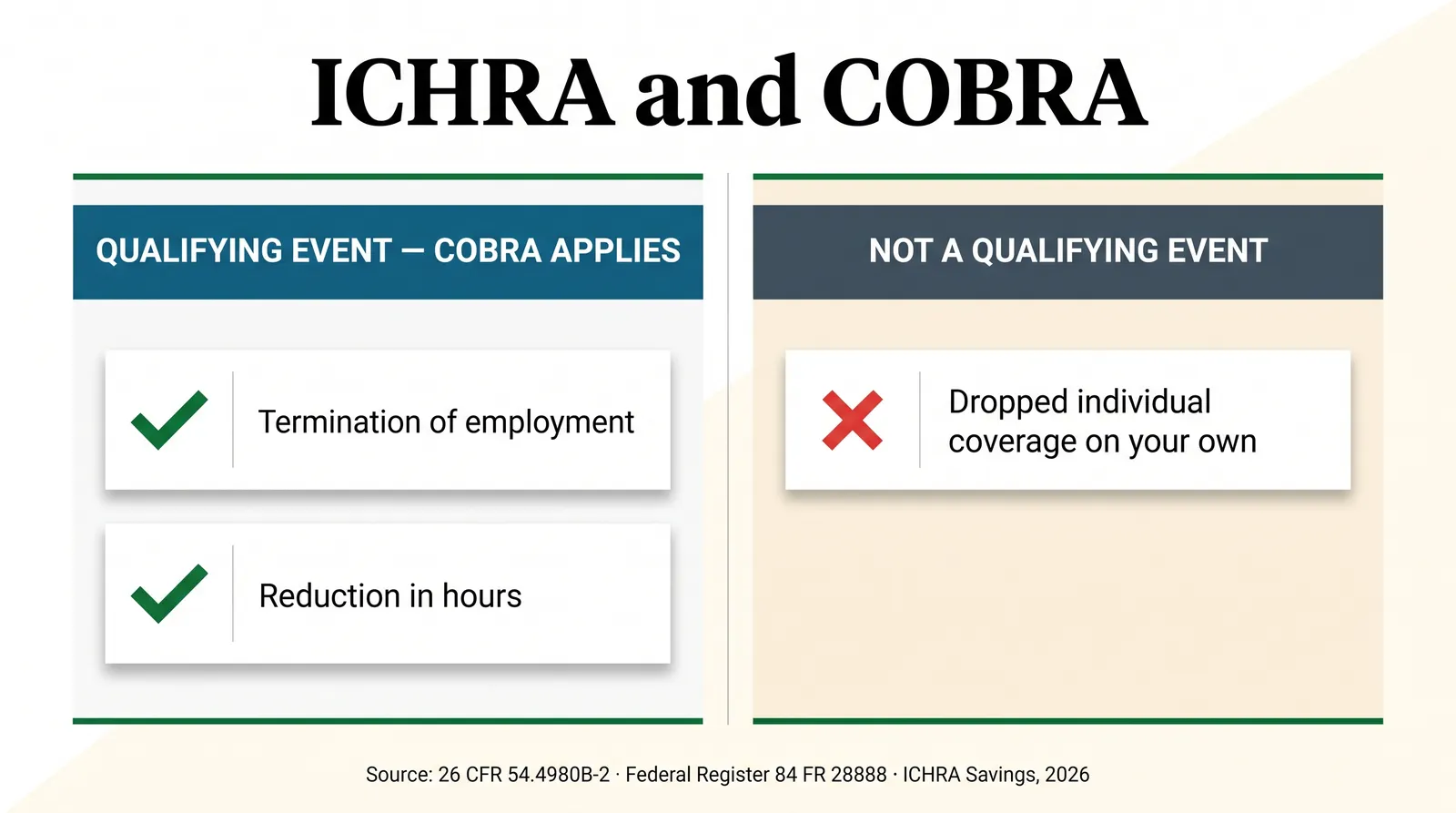
- Yes. An ICHRA is a group health plan for COBRA purposes, and employers with 20 or more employees generally owe continuation rights on it the same as any other group plan (IRS Notice 2002-45; Federal Register 84 FR 28888).
- What continues is the allowance, not the individual insurance policy. The employee's own marketplace or off-marketplace plan is theirs regardless of COBRA.
- Losing ICHRA eligibility only because someone dropped their individual coverage is not a qualifying event. Termination of employment or a reduction in hours is.
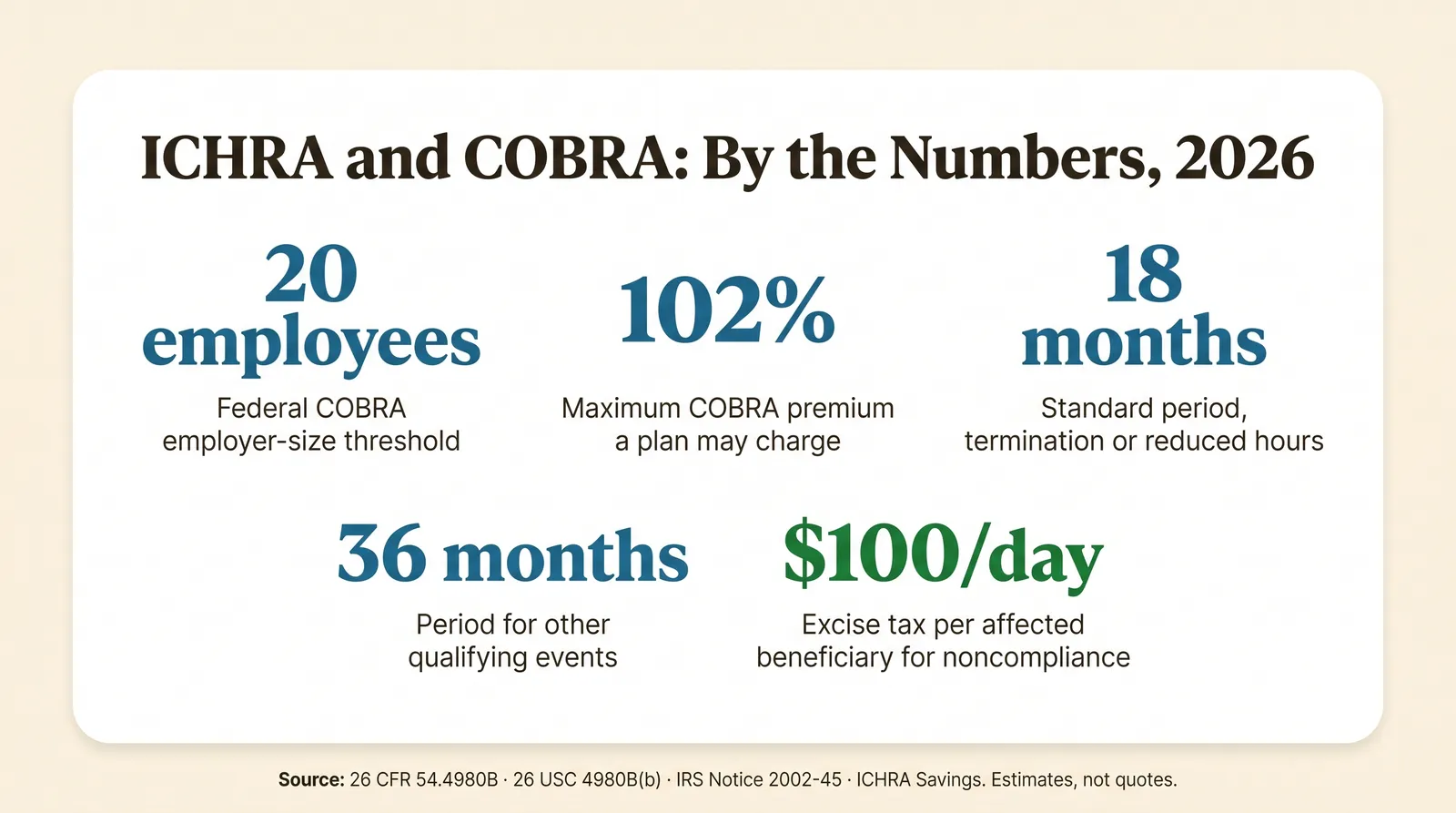
- The charge is capped at 102% of the plan's cost, coverage runs 18 to 36 months depending on the event, and getting it wrong carries a federal excise tax of $100 a day per affected person.
Does an ICHRA owe COBRA when someone leaves?
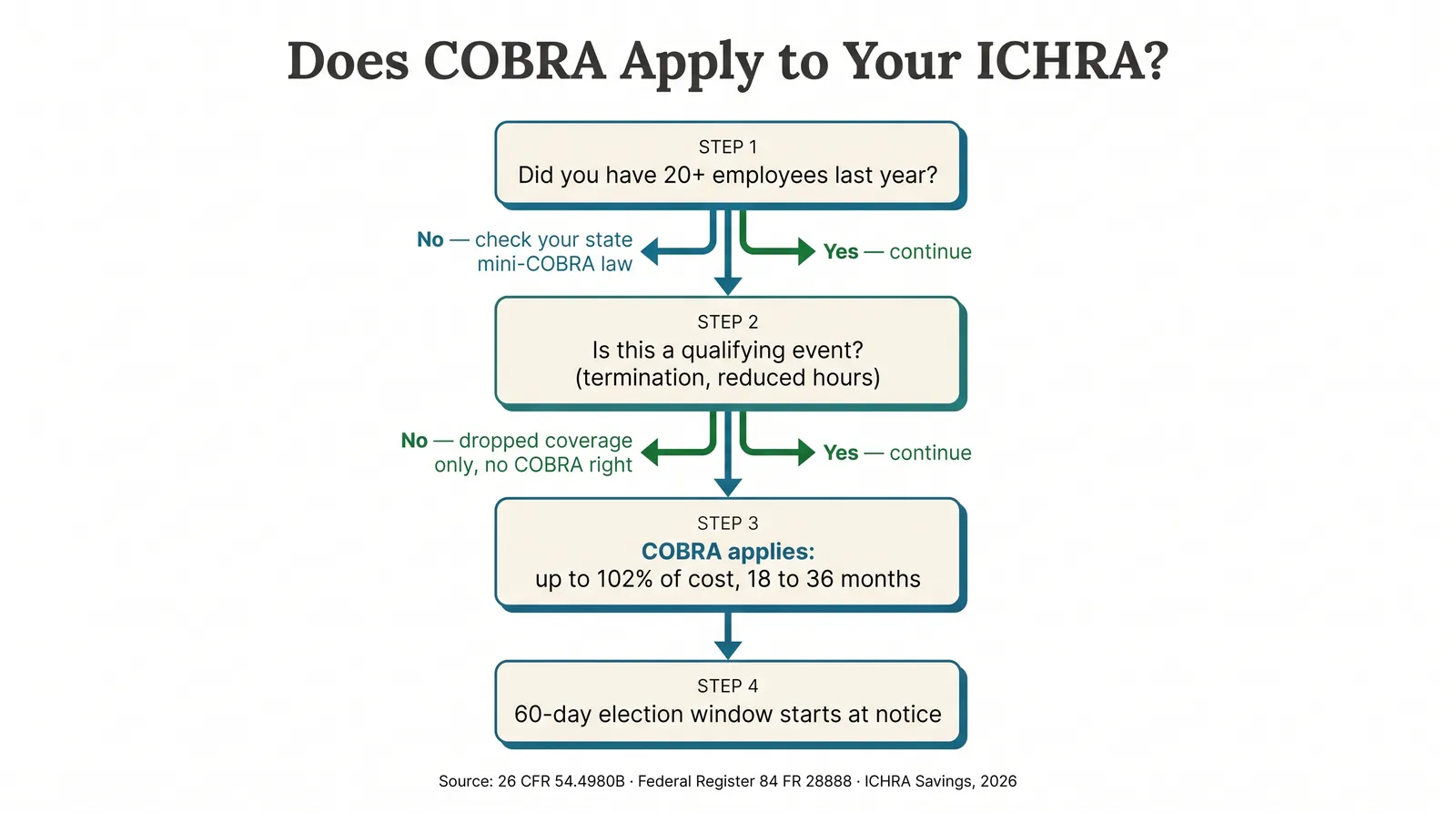
Yes, if your company had 20 or more employees on more than half its typical business days last year. An Individual Coverage HRA, the employer-funded arrangement that reimburses employees tax-free for the individual health coverage they buy on their own, is a group health plan in the eyes of federal law, and group health plans are the thing COBRA applies to. The IRS said so directly in 2002, in the notice that first gave HRAs their modern shape, and the Departments of the Treasury, Labor, and Health and Human Services said it again in 2019, in the final rule that created the ICHRA specifically. Neither has changed since.
What is easy to miss is what actually continues. It is not the employee's health insurance policy — that policy belongs to them, was purchased in their own name, and keeps running whether or not they elect anything. What COBRA continues is your allowance: the dollar amount you were crediting to their ICHRA every month, available to reimburse the premiums and other eligible medical costs they keep paying after they walk out the door.
There is also a carve-out written into the ICHRA rule that a lot of employers assume exists but that does not: if an employee loses ICHRA eligibility only because they let their own individual coverage lapse, that is not a COBRA qualifying event. The rest of this article walks through why the obligation exists, what actually continues, who is exempt, what it costs on both sides of the transaction, and how to administer it without guessing.
Your best employee just gave two weeks' notice
Here is the version of this question that shows up in a real inbox. You run a 34-person company. Your operations manager, three years in, just told you she is leaving for a job closer to home. Payroll asks the obvious question: what happens to her ICHRA? You have been crediting her class $450 a month for two years. She has not used all of it every month. Does the unused balance just vanish on her last day? Does she have some right to keep the reimbursements going, and if so, for how long, and who administers that, and what happens if you get it wrong?
The honest answer is that you likely already owe her something here, and it is not optional. If your company crossed the 20-employee mark last year, she has a federal right to elect continuation of that ICHRA allowance, on largely the same terms COBRA has applied to group health plans since 1986. Most employers who have never run a traditional group plan simply never encountered this question before switching to an ICHRA, because a nine-person startup with no group plan history has no reason to have thought about COBRA at all. The moment you cross 20 employees and offer an ICHRA, that changes.
If you are the departing employee reading this instead of the employer, the practical version of this question — what you can keep, what it will cost you, and whether it is worth electing — is covered later in this article, and there is a page written from your side of the desk if you want more general background: what an ICHRA means for you.
What COBRA actually requires
COBRA is the Consolidated Omnibus Budget Reconciliation Act of 1985, a federal law that requires most group health plans to offer a temporary continuation of coverage to employees and their covered family members after certain events cause them to lose it. The people who gain this right are called qualified beneficiaries. The events that trigger it are called qualifying events, and the list is specific: termination of employment for any reason other than gross misconduct, a reduction in hours that drops someone out of an eligible class, divorce or legal separation from a covered employee, a covered employee's death, a dependent child aging out of eligibility, or a covered employee becoming entitled to Medicare while a spouse or dependent remains otherwise eligible.
COBRA is not free continuation. The employer or plan can charge up to 102% of what the coverage actually costs the plan, and the qualified beneficiary pays the entire amount out of pocket, with no employer subsidy required. What COBRA guarantees is the right to keep paying for the same coverage on close to the same terms, not a discount and not a handout.
Two federal agencies split enforcement. The Department of Labor and the IRS both have a hand in COBRA: the DOL enforces the notice and disclosure obligations under ERISA, and the IRS enforces the underlying continuation-coverage rules and the excise tax for noncompliance under 26 U.S.C. § 4980B. For a private-sector employer, the operative regulations sit at 26 CFR § 54.4980B-1 through 54.4980B-10, and that is where the specific numbers in this article come from.
Why an ICHRA counts as a group health plan
It can feel counterintuitive that a plan whose entire design is to get employees off a traditional group plan and onto individual coverage would itself be treated as a group health plan. But the legal test for "group health plan" under § 4980B does not turn on whether the plan buys insurance directly. It turns on whether the employer is providing medical care benefits to employees, directly or through reimbursement, by reason of employment. An HRA does exactly that: the employer funds it, only the employer funds it, and it reimburses employees for their medical care expenses. That is enough to make it a group health plan, regardless of whether the employee's underlying policy is an individual marketplace plan the employer never touches.
The IRS made this explicit for HRAs generally in 2002: "An HRA is a group health plan generally subject to the COBRA continuation coverage requirements," reads Notice 2002-45, Part VII, and it goes on to describe exactly how an HRA satisfies that requirement. When the Treasury, Labor, and HHS built the specific ICHRA framework in 2019, they did not carve ICHRA out of that treatment. The final rule discusses ICHRA and COBRA directly, confirming that "individual coverage HRA benefits are generally subject to COBRA protections, such that, for example, some employees could elect to use accumulated funds for up to 18 months after separation from service."
None of this touches the individual insurance policy itself. Nothing about COBRA requires the insurer that sold your former operations manager her individual plan to do anything different. Her policy is not a COBRA plan; her ICHRA allowance is. That distinction is the single most useful thing to hold onto in this entire topic, because it is where most of the confusion starts.
| Rule | What it says | Source |
|---|---|---|
| Who is covered | Private employers with 20+ employees on more than half of typical business days in the prior calendar year | 26 CFR § 54.4980B-2, Q&A-5 |
| Maximum charge | Up to 102% of the applicable premium (100% of cost plus a 2% administrative markup) | 26 CFR § 54.4980B-8, Q&A-1 |
| Standard coverage period | 18 months for termination or reduced hours; 29 months with a disability extension | 26 CFR § 54.4980B-7, Q&A-4 |
| Other qualifying events | 36 months for divorce, death, or a dependent aging out | 26 CFR § 54.4980B-7, Q&A-4 |
| Penalty for noncompliance | $100 per day, per affected qualified beneficiary (excise tax) | 26 U.S.C. § 4980B(b) |
| ICHRA-specific carve-out | Losing ICHRA eligibility solely for dropping individual coverage is not a qualifying event | Federal Register, 84 FR 28888 (June 20, 2019) |
What a departing employee can actually keep
The IRS answered this precisely in Notice 2002-45: an HRA satisfies COBRA by continuing "the maximum reimbursement amount for an individual at the time of the COBRA qualifying event," and increasing that amount at the same time and by the same increment the plan increases it for everyone else still on staff, minus whatever gets reimbursed along the way. In plain terms, your former employee keeps access to whatever balance was available to her on her last day, and that balance keeps growing on the same schedule as if she had stayed, for as long as she keeps paying the COBRA premium and stays within her maximum coverage period.
This is genuinely different from COBRA on a traditional group medical plan, where what continues is an insurance policy with real claims exposure — hospital stays, surgeries, prescriptions, the works. What continues on an ICHRA is a reimbursement ceiling. The former employee still has to actually incur and substantiate eligible expenses, typically her individual-market premium, to get money back. COBRA does not hand her a check; it keeps the door open for her to keep submitting the same kind of claims she was submitting as an active employee.
One more IRS detail worth knowing if you administer this yourself: the applicable premium does not have to vary person by person based on how much balance someone happens to have left. The IRS's own example in Notice 2002-45 involves two departing employees with $500 and $5,000 remaining in their HRA balances, and both can be charged the same COBRA premium, because the rule permits a single blended rate for all similarly situated qualified beneficiaries. That simplifies administration considerably, and it is also the reason the worked example later in this article treats the COBRA charge as a flat percentage of the monthly allowance rather than something that has to be recalculated for every departing employee's specific balance.
Her individual policy is not affected either way
Whether or not your former employee elects COBRA on the ICHRA, her individual health insurance policy keeps running on its own terms, billed directly by her carrier, subject to its own renewal date and its own rules. COBRA has nothing to do with whether she stays insured. It only decides whether she keeps getting reimbursed for what she is already paying.
The one thing that is not a qualifying event
Here is the carve-out that trips up more employers than any other part of this topic. An ICHRA is conditioned on the participant maintaining individual health insurance coverage. If an employee stops paying their premium and lets that policy lapse, they lose ICHRA eligibility — but the Treasury, Labor, and HHS were explicit in the 2019 final rule that this specific kind of loss of eligibility does not create a COBRA right. The regulators' own language: "the loss of eligibility to participate in an individual coverage HRA due to the failure of the individual to maintain individual health insurance coverage does not create a right to COBRA or other group continuation coverage in the individual coverage HRA."
The distinction the rule draws is between something that happens to the employee's relationship with your company and something that happens entirely on the insurance side. A reduction in hours that moves someone into a class you do not offer the ICHRA to is a qualifying event, and so is outright termination. An employee who simply stops paying for their own individual plan, while still employed in an ICHRA-eligible class, has not experienced anything that touches their employment status at all — they made a decision about their own insurance, and the ICHRA rule does not treat that as something you, as the plan sponsor, owe continuation coverage for.
This matters in practice because it is easy to conflate "lost ICHRA eligibility" with "qualifying event" when they happen to the same person around the same time. Ask which one actually caused the loss of eligibility. If it is a job-status change, you likely owe COBRA. If it is purely a coverage lapse the employee caused on their own, you likely do not.
If you have fewer than 20 employees
Federal COBRA does not reach you. The small-employer exception in 26 CFR § 54.4980B-2, Q&A-5 excludes any plan sponsored by an employer that normally employed fewer than 20 employees during the preceding calendar year, counting both full-time and part-time common-law employees (part-time counted proportionally). If your headcount crosses 20 partway through a year, the exception generally ends immediately for a plan that grows into it by adding a larger employer, and phases out at the start of the next calendar year for ordinary headcount growth — worth confirming with your ICHRA administrator the year you cross the line either direction.
Being outside federal COBRA is not automatically the end of the analysis. A number of states run their own continuation-coverage laws, often called mini-COBRA, that reach smaller employers federal law does not touch. California is a clear example: its Cal-COBRA law, under California Insurance Code § 10128.55 and related provisions, applies to employers with 2 to 19 employees and provides up to 36 months of continuation coverage, according to the California Department of Insurance. If your company operates in California, or in any state with a similar law, check that state's specific rule before concluding a small headcount means no obligation at all. Every state's mini-COBRA law is different, and some apply only to insured plans rather than self-funded arrangements like an ICHRA, so the answer genuinely depends on where you are.
What COBRA on an ICHRA actually costs
Put a number on the 102% cap. Say your company sets a monthly ICHRA allowance for a class of employees, and someone in that class is terminated. Under the blended-premium approach IRS Notice 2002-45 permits, many ICHRA administrators price the COBRA charge at 102% of that monthly allowance, treating the allowance itself as the "cost" of the arrangement being continued. On a $600 monthly allowance, that works out to $612 a month — the former employee pays $612 to keep access to up to $600 a month in reimbursements, an arithmetic gap of $12 a month that covers the plan's administrative cost of running continuation coverage at all.
That gap is the reason the answer to "should I elect this?" is not automatically yes. Compare it to COBRA on a traditional small-group medical plan, where the employer had been absorbing most of the actual insurance premium. The 2025 KFF Employer Health Benefits Survey, published October 22, 2025, puts the national average total premium for employer-sponsored family coverage at $26,993 a year, or about $2,249 a month, of which covered workers themselves contributed an average of $6,850 a year toward the total. At 102%, COBRA on that family premium runs about $2,294 a month — the departing employee now has to cover the employer's share too, on top of the 2% markup, which is exactly why COBRA on a traditional group plan has a reputation for being expensive. Self-only coverage runs lower: the same 2025 survey puts the national average total premium for single coverage at $9,325 a year, about $777 a month, or $793 a month at the 102% COBRA rate.
An ICHRA changes that comparison, because there usually is no employer-absorbed insurance premium sitting behind the number. The employer's "cost" of the arrangement is simply the allowance it chose to fund, which is very often set below what a full family group premium would have cost in the first place. That is why COBRA on an ICHRA allowance tends to be a smaller, more legible number than COBRA on a traditional group plan, and also why it is worth running the actual math rather than assuming either "COBRA is always worth it" or "COBRA is never worth it."
The practical decision rule for a departing employee: electing COBRA on the ICHRA makes the most sense when the plan reimburses more than the individual-market premium alone (many ICHRA plan documents also cover other substantiated medical expenses under IRC § 213(d)), when the allowance is scheduled to increase before the coverage period runs out, or when there is a meaningful unused balance already sitting in the account. It tends not to be worth it when the balance is thin and the only real goal is to keep paying an individual-market premium the employee can already keep paying on their own, with or without COBRA, because that policy was never contingent on the employer relationship in the first place.
What it costs you to get this wrong
Failing to offer COBRA when it is owed is not a paperwork slip with no teeth. 26 U.S.C. § 4980B(b) sets a federal excise tax of $100 for each day a group health plan fails to satisfy COBRA's continuation-coverage requirements, charged per affected qualified beneficiary, running from the date the failure begins until it is corrected (or, if the failure is not discovered and corrected earlier, for up to six months past the point coverage would otherwise have ended). Two affected people for even a modest stretch of noncompliance adds up fast: 60 days times $100 times two beneficiaries is $12,000, and that is before accounting for the separate exposure a denied qualified beneficiary can raise directly under ERISA if they sue to enforce their COBRA rights.
This tax is self-reported, on IRS Form 8928, which means there is no third party who checks your COBRA compliance for you unless something goes wrong and someone complains. The failure that most often triggers this is not a deliberate refusal — it is an employer who never realized their ICHRA counted as a group health plan for COBRA purposes in the first place, crossed 20 employees at some point without updating their process, or assumed (incorrectly) that COBRA only applies to insured group medical plans and not to a self-funded reimbursement arrangement.
Where this goes wrong
- Assuming an ICHRA is exempt from COBRA because it is not insurance. The legal test is whether the employer provides medical-care benefits by reason of employment, not whether an insurer is involved.
- Not noticing when headcount crosses 20. A company that grew from 18 to 22 employees over a year may not realize it is now inside federal COBRA.
- Treating a coverage lapse as a qualifying event. It is not, on its own — check whether the underlying cause was a job-status change.
- Charging more than 102%, or a different premium for different balances. Both can put the arrangement out of compliance with 26 CFR § 54.4980B-8.
- Skipping the state mini-COBRA question below 20 employees. Federal exemption does not automatically mean no state-law obligation.
How to actually administer this
- Confirm your employee count for the prior calendar year. Count full-time and part-time common-law employees; part-time employees count proportionally based on hours worked.
- Identify the actual qualifying event. Termination, reduction in hours moving someone out of an eligible class, divorce, death, or a dependent aging out all count. A pure coverage lapse does not.
- Send the COBRA election notice within the required window. Most ICHRA third-party administrators generate this automatically, but the employer remains the plan sponsor of record and is ultimately responsible for it happening.
- Give the qualified beneficiary 60 days to elect. That is the standard federal election window, running from whichever is later: the date of the qualifying event or the date the election notice is provided.
- Price the premium at no more than 102% of the plan's cost, using a consistent, defensible method (a blended rate applied to all similarly situated beneficiaries satisfies the IRS's own example in Notice 2002-45).
- Track the maximum coverage period. 18 months for termination or reduced hours, 29 with a disability extension, 36 for other qualifying events, and stop reimbursing once that window closes or the balance runs out, whichever comes first.
- Check your state's mini-COBRA law if you are under 20 employees. Do not assume federal exemption is the end of the analysis.
An ICHRA takes your company out of the insurance business. It does not take you out of the COBRA business.
Mike MooreA worked example: Johnson County, Kansas
Put real county numbers behind the arithmetic above. For the 2026 plan year, our qualified-counties dataset puts Johnson County, Kansas — the Kansas City metro suburbs, covering Overland Park, Olathe, and Shawnee — at an individual-market benchmark premium of $624 a month against a small-group benchmark of $803, an estimated 22.3% gap worth roughly $2,143 per employee per year. Say an employer here set its ICHRA allowance for one employee class near the individual-market benchmark, and a covered employee in that class is later terminated.
If the plan prices COBRA continuation at 102% of that $624 allowance, the former employee's monthly charge runs about $636. Compare that to what COBRA would have cost if the same employer had instead kept a traditional small-group plan priced at the county's $803 benchmark: 102% of that figure is about $819 a month — noticeably higher, because a traditional group premium usually reflects a much larger employer subsidy than an ICHRA allowance does, and COBRA requires the departing employee to absorb the whole thing plus the 2% markup.
Johnson County is also a useful stand-in for the underlying savings question that has nothing to do with COBRA. Nationally, 894 of the 1309 counties in our dataset clear a $100-a-month individual-versus-small-group gap for the 2026 plan year — a reminder that the COBRA question in this article and the "does ICHRA save us money in the first place" question are separate calculations, and a company should run both rather than assuming one answers the other.
22.3%
Johnson County, KS estimated ICHRA savings, 2026
$636
Illustrative monthly COBRA charge on a Johnson County-sized ICHRA allowance
$2,294
102% COBRA on the 2025 national average family group premium
894
Of 1309 tracked counties clearing the $100/mo bar, 2026
See Kansas's full county breakdown →. If your team sits somewhere else, the same dataset covers every state we track — check your own county before assuming Johnson County's numbers apply to you.
How ICHRA Savings helps
Our county-level dataset answers the question that comes before any of this: whether an ICHRA beats small-group coverage in your specific county in the first place. It does not administer your COBRA obligations — that is a plan-document and administrator question, not a rate-spread question — but the two show up in the same conversation constantly, because an employer deciding whether to move to an ICHRA is usually also the employer who will eventually have a departing employee ask about it. Before anything else, check whether your county is one where the underlying math works: explore the savings map.
Questions employers actually ask
Does an ICHRA trigger COBRA obligations?
Yes, for employers that had 20 or more employees on more than half of their typical business days in the prior calendar year. The IRS treats an ICHRA as a group health plan for COBRA purposes (IRS Notice 2002-45, Part VII), and the 2019 ICHRA final rule confirms the same treatment applies specifically to Individual Coverage HRAs (Federal Register, 84 FR 28888, June 20, 2019). Employers under the 20-employee threshold are generally exempt from federal COBRA, though some states impose a similar "mini-COBRA" rule of their own.
What exactly does a former employee get to keep, the insurance policy or the allowance?
The allowance, not the insurance policy. The individual health plan a departing employee bought on the marketplace or off it belongs to them personally and was never tied to your company, so it continues on its own regardless of what they do about COBRA. COBRA continuation of an ICHRA lets them keep receiving reimbursements from the HRA itself, up to the maximum amount available at the time they left, growing at the same rate it would have if they were still on staff.
Does someone who drops their individual health plan get a right to COBRA?
No. The 2019 ICHRA final rule is explicit that losing ICHRA eligibility solely because an individual failed to maintain their individual health insurance coverage is not a COBRA qualifying event. COBRA rights attach to events like termination of employment or a reduction in hours that removes someone from an ICHRA-eligible class, not to a participant simply letting their own policy lapse.
How much can we charge for COBRA continuation of an ICHRA?
Up to 102% of the applicable premium under 26 CFR 54.4980B-8, the same cap that applies to any COBRA continuation coverage. For an HRA, IRS guidance allows the premium to be calculated as one blended figure applied equally to every similarly situated qualified beneficiary, rather than a different number for each person’s specific remaining balance (IRS Notice 2002-45, Part VII).
How long does the continuation last?
Eighteen months for a termination of employment or a reduction in hours, extendable to 29 months if a qualified beneficiary meets the Social Security disability-extension rules. Other qualifying events, such as divorce or a dependent aging out, carry a 36-month maximum (26 CFR 54.4980B-7, Q&A-4).
What happens if we get this wrong?
The federal excise tax for COBRA noncompliance is $100 per day, per affected qualified beneficiary, for each day the plan is out of compliance (26 U.S.C. § 4980B(b)). It is a self-reported tax employers owe on Form 8928, separate from any private lawsuit a denied beneficiary could bring under ERISA.
We have fewer than 20 employees. Are we completely off the hook?
Under federal law, generally yes — the small-employer exception in 26 CFR 54.4980B-2, Q&A-5 excludes you. Some states run their own continuation-coverage law that reaches smaller employers, so check your state’s rule before assuming nothing applies. California’s Cal-COBRA law, for example, reaches employers with 2 to 19 employees and runs for up to 36 months (California Department of Insurance).
Is electing COBRA on an ICHRA actually worth it for the departing employee?
Run the math before assuming yes. Because the premium is capped at 102% of the plan’s cost, and for many ICHRAs that cost tracks closely to the monthly allowance itself, a departing employee who elects continuation is often paying close to what they get back in reimbursements, sometimes slightly more. It tends to be worth electing when the plan reimburses more than premiums alone, when the allowance is set to grow, or when the employee expects real out-of-pocket medical costs beyond their premium. It is worth skipping when the balance is small and the employee’s only real need is to keep paying their own individual-market premium, which they can already do without COBRA.
Sources
- IRS Notice 2002-45, Part VII, "COBRA Continuation Coverage" (HRAs are group health plans generally subject to COBRA; the maximum-reimbursement-amount continuation method; the blended-premium example)
- Federal Register, "Health Reimbursement Arrangements and Other Account-Based Group Health Plans" (document 2019-12571, published June 20, 2019 — the ICHRA final rule; the COBRA carve-out for coverage-lapse eligibility loss; the 18-month accumulated-funds example)
- 26 CFR § 54.4980B-2, Electronic Code of Federal Regulations, Q&A-5 (the fewer-than-20-employees small-employer exception and how employees are counted)
- 26 CFR § 54.4980B-8, Electronic Code of Federal Regulations, Q&A-1 (the 102% maximum COBRA premium)
- 26 CFR § 54.4980B-7, Electronic Code of Federal Regulations, Q&A-4 (the 18-month, 29-month, and 36-month maximum coverage periods)
- 26 U.S.C. § 4980B(b), Office of the Law Revision Counsel, U.S. House of Representatives (the $100-per-day excise tax for COBRA noncompliance)
- California Department of Insurance, health insurance FAQ (Cal-COBRA: employers with 2 to 19 employees, 36-month maximum coverage period)
- KFF, "2025 Employer Health Benefits Survey" (national average annual premiums: $9,325 single coverage, $26,993 family coverage)
- KFF, "Annual Family Premiums for Employer Coverage Rise 6% in 2025..." (published October 22, 2025; worker contribution share of $6,850 toward family coverage)
- ICHRA Savings qualified-counties dataset, 2026 plan year (Johnson County, KS and national county-qualification figures)