ICHRA in Celina, Ohio 2026: Mercer County 60.4%
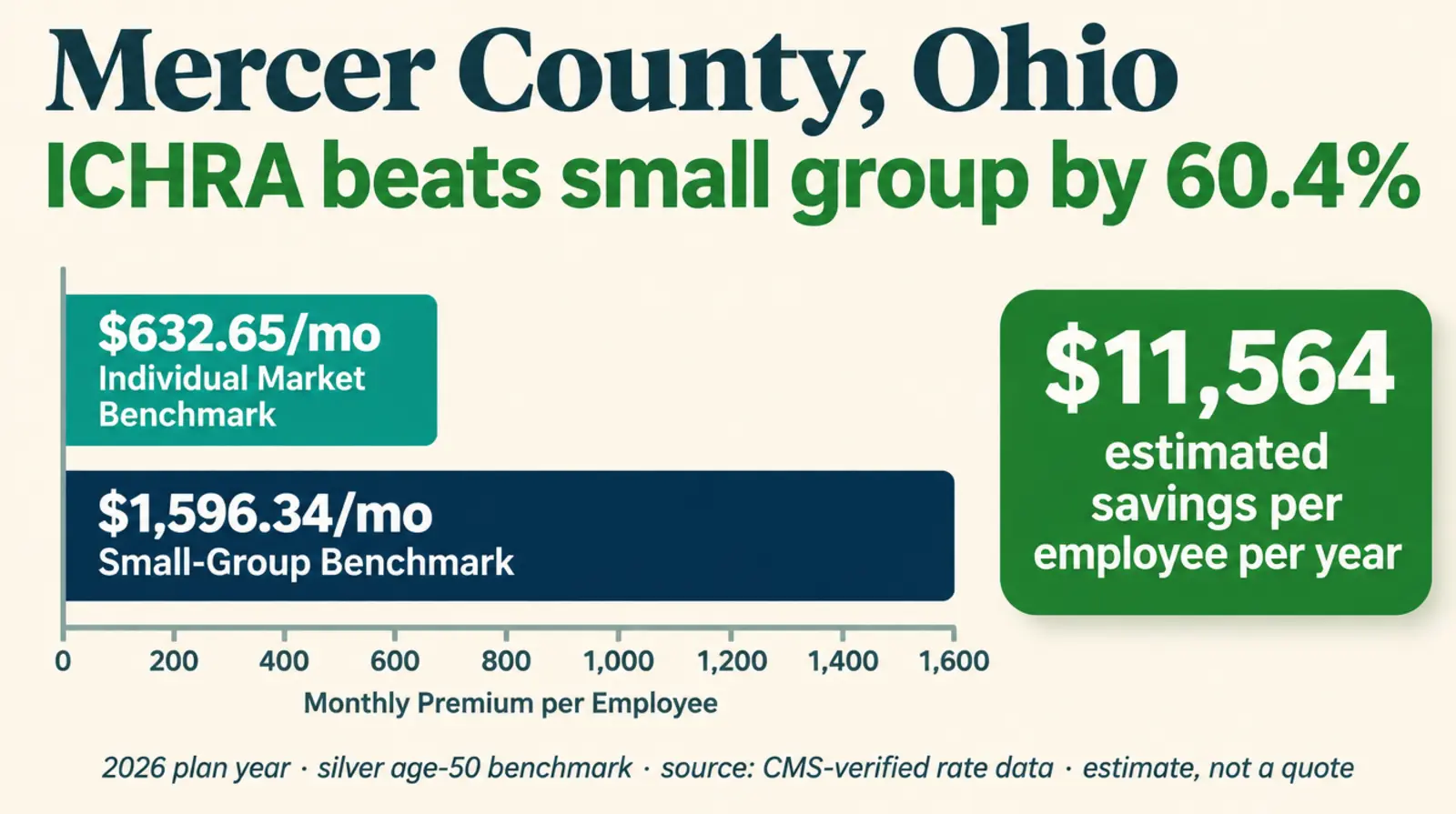
Mercer County's 2026 benchmark runs an estimated 60.4% below small group, about $11,564 a year per employee in Ohio's farm country. Sourced data.
The short version
- Mercer County's 2026 individual-market benchmark runs an estimated 60.4% below the small-group benchmark, about $11,564 per employee per year — tied exactly with six neighboring counties (Allen, Auglaize, Hancock, Hardin, Paulding, and Van Wert) that share the same Ohio rating area.
- That 60.4% ranks 19th of Ohio's 88 counties by percentage and 6th by dollar savings, well above the state's 54.9% average.
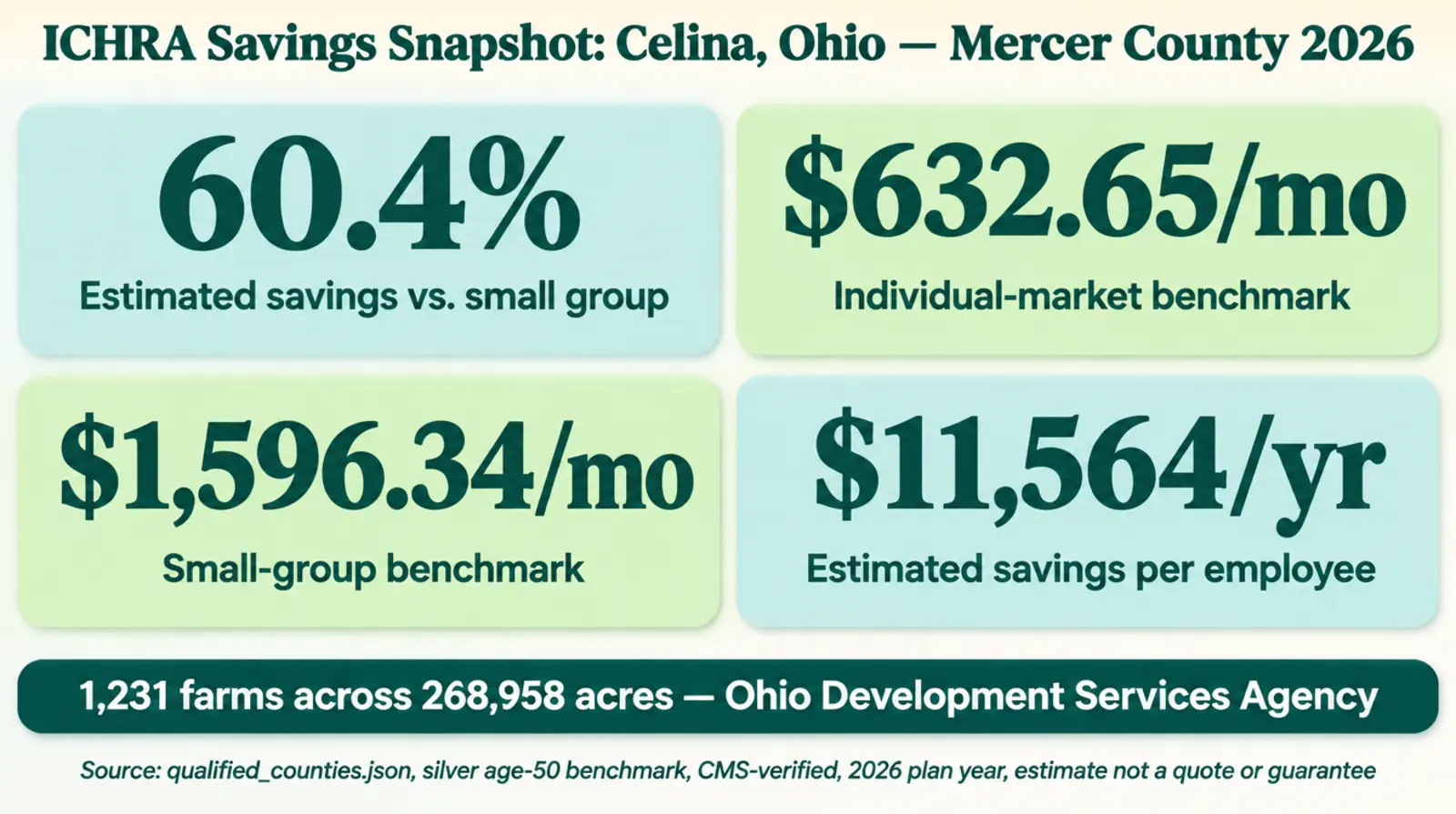
- Mercer County is one of Ohio's most farm-dependent counties: 1,231 farms on 268,958 acres, with 80.5% of $631,612,000 in annual cash receipts coming from livestock and livestock products, per the Ohio Development Services Agency.
- The county's private sector runs on 1,011 establishments averaging about 17.4 employees each — and its farm sector specifically averages only about 13.1 employees per establishment — the exact size class that rarely clears a small-group carrier's participation bar.
- An estimated 7.2% of Mercer County residents under 65 still lacked health insurance, per the same state profile, even with the county's relatively strong 92.8% coverage rate.
- Qualifying is not the same as a guaranteed saving for your business; the honest limits are covered later in this article.
Does ICHRA beat small group in Celina, Ohio?
Yes, by one of the wider margins in the state. An ICHRA (Individual Coverage Health Reimbursement Arrangement, now also referred to by HealthCare.gov as a CHOICE Arrangement) is an IRS-defined arrangement that lets an employer set a fixed monthly reimbursement amount and let each employee buy their own individual-market plan with it, tax-free. In Mercer County, the Ohio county that contains the city of Celina, the 2026 individual-market benchmark premium runs an estimated 60.4% below the small-group benchmark premium, according to a county-by-county comparison built from Ideon rate data and cross-verified against CMS public-use marketplace files.
In dollars, that's $11,564 a year per employee — good for 6th place among Ohio's 88 qualifying counties by dollar savings, and 19th by percentage. It clears our $ 100-a-month qualifying bar with room to spare, and it sits well above Ohio's statewide average of roughly 54.9% across all 88 counties in our dataset, a range that runs from 38.8% in Summit County (Akron) up to 63% in the state's strongest counties. Mercer County is near the top of that range, not the middle — but the percentage is only half the story here. The other half is who actually runs the businesses in a county built this heavily on farms and small shops, covered in detail below.
60.4%
Estimated Mercer County savings vs. small group
7-county tie
Shared Ohio rating-area benchmark
42K
Mercer County residents in our dataset
$11,564
Est. Mercer County savings per employee, per year
The employer problem this is actually solving
A feed-and-grain supplier, a hog or poultry operation, or a small machine shop outside Celina usually isn't weighing ICHRA against its current group plan. It's weighing ICHRA against offering nothing at all, because a crew of six or ten people never came close to the headcount a small-group carrier wants to see. Per the Ohio Development Services Agency's own county profile, Mercer County's private sector runs on 1,011 establishments averaging about 17.4 employees apiece. Look specifically at the farm sector — the category the state groups under "Natural Resources and Mining" — and the average establishment employs only about 13.1 people, even while the county's farms together generate $631,612,000 a year in cash receipts. A lot of revenue, moved by very small crews: exactly the profile that struggles hardest to get a group quote in the first place.
That shows up in the coverage numbers too, even in a county that does relatively well on insurance overall. An estimated 92.8% of Mercer County residents under 65 had health insurance of some kind, per Census-based figures compiled in that same state profile — which still leaves an estimated 7.2% without any coverage at all. In a county of 42K people, that's thousands of residents, many of them almost certainly working for one of the small farm operations or shops this article is about.
That's the specific gap an ICHRA is built to close here. The federal rule sets no minimum or maximum contribution and no participation percentage to clear when ICHRA is the only benefit offered, which matters most to exactly the kind of small, first-time-benefits employer Mercer County has in abundance: a farm supplier, a grain elevator, or a family machine shop that can afford a real, fixed monthly number, even if that number was never going to stretch to a traditional group policy.
Where a 60 percent number like this actually comes from
Sixty percent sounds like a marketing number, so it's worth being specific before going further: it isn't one. It's the plain output of comparing two separately filed sets of insurance rates for the same place. Ohio's individual market and its small-group market are priced by different carriers filing different rates for the same geography, and that gap moves county by county and rating area by rating area. In Summit County, covered below, the gap narrows to 38.8%. In Mercer County and the six counties that share its rating area, the gap runs 60.4%, one of the wider spreads in the state.
Nothing about an employer's own circumstances changes that gap one way or the other; it exists in the filed rates whether or not any particular business in Celina ever hears about it. What changes is whether an employer actually captures it, by funding reimbursements at or near the individual-market benchmark instead of trying to buy a small-group policy that costs more for the exact same geography — or, as is common here, by offering nothing because a group policy was never realistic to begin with.
How an ICHRA (now also called CHOICE) actually works
Before the Mercer County numbers mean anything, it helps to be precise about what's being compared, since most of the confusion around ICHRA comes from skipping this step.
An ICHRA is an employer-funded health reimbursement arrangement created by a 2019 final rule from the IRS and Treasury, the Department of Labor, and HHS, published at 84 Fed. Reg. 28888 on June 20, 2019, effective August 19, 2019, and applicable to plan years beginning on or after January 1, 2020. HealthCare.gov now also refers to the same structure as a CHOICE Arrangement; the mechanics and the federal rules haven't changed, only the public-facing name. Instead of choosing one group health plan for everyone, the employer sets a fixed monthly reimbursement amount, and each employee uses that money to buy an individual-market plan of their own choosing, then submits proof of coverage (substantiation) to get reimbursed tax-free.
The comparison behind every number in this article rests on two specific prices for a given county and rating area — the geographic zone insurance regulators use to set premiums, usually a cluster of neighboring counties. The individual-market benchmark premium is the second-lowest-cost silver-level plan available in that rating area to a representative 50-year-old enrollee. "Silver" refers to one of four ACA metal levels (bronze, silver, gold, platinum) describing how costs split between premium and out-of-pocket spending, not the quality of care. This is the same type of benchmark the federal government uses to calculate premium tax credits, which is why it's a defensible number to build a comparison on rather than one insurer's list price. The small-group benchmark premium is the equivalent figure built from comparable small-group plan filings for that same rating area. When the individual benchmark is lower, the county "qualifies," and the gap between the two is the estimated per-employee savings if the employer funds ICHRA at that benchmark level.
Two more terms matter once an employer is actually deciding whether to switch. The affordability safe harbor is the test that decides whether the ICHRA offer counts as "affordable" under IRS rules — for plan years beginning in 2026 that test runs against a Required Contribution Percentage of 9.96% of household income (IRS Rev. Proc. 2025-25, Section 3.02), up from 9.02% in 2025. Get the contribution amount wrong relative to that threshold and an employer can trigger a penalty tied to the employer mandate, the ACA requirement that applies to ALEs (applicable large employers, generally 50 or more full-time-equivalent employees). Smaller, non-ALE employers aren't subject to that mandate at all, which covers the overwhelming majority of Mercer County's farm suppliers, grain operations, and family-run shops.
One structural piece matters here as much as the rate spread itself: an employer can define different employee classes — HealthCare.gov's current list includes full-time, part-time, or seasonal status, employees under a collective bargaining agreement, salaried versus hourly staff, employees still in a waiting period, non-resident immigrants with no U.S.-based income, work location, and combinations of those — and offer a different contribution, or no ICHRA at all, to each class. A Celina-area operation that staffs a year-round production crew alongside seasonal harvest labor can offer a meaningfully different ICHRA design to each group, something a single group policy can't do. What an employer cannot do is offer the same class of employees a choice between ICHRA and a traditional group plan; it's one or the other, per class, not both at once for the same people. Within a class, reimbursements can still vary by age, up to a 3-to-1 ratio, and by number of dependents.
Mercer County's rate spread, in dollars
Here is the actual 2026 benchmark comparison for Mercer County, home to the city of Celina. The individual-market benchmark premium is $632.65 a month. The small-group benchmark premium, built from comparable small-group plan filings for the same rating area, is $1596.34 a month. That's a gap of $963.69 a month, or $11,564 a year, per employee, an estimated 60.4% in favor of the individual market.
See the full Ohio savings breakdown for every qualifying county, or the national savings map to look up a specific county by name.
The seven-county rating area Celina shares its benchmark with
Mercer County's 60.4% isn't a coincidence of similar nearby pricing — it's identical, to the cent, across six neighboring counties as well, because all seven sit in the same federal rating area in west-central Ohio. An employer headquartered in Celina with staff living in or around Lima, Wapakoneta, Findlay, Kenton, Paulding, or Van Wert doesn't need seven different calculations; everyone runs on the same $632.65 individual and $1596.34 small-group monthly benchmark for 2026.
| County | Population (dataset) | Individual benchmark | Small-group benchmark | Savings vs. small group |
|---|---|---|---|---|
| Allen (Lima) | 102K | $632.65 | $1596.34 | 60.4% |
| Auglaize (Wapakoneta) | 46K | $632.65 | $1596.34 | 60.4% |
| Hancock (Findlay) | 75K | $632.65 | $1596.34 | 60.4% |
| Hardin (Kenton) | 31K | $632.65 | $1596.34 | 60.4% |
| Mercer (Celina) | 42K | $632.65 | $1596.34 | 60.4% |
| Paulding (Paulding) | 19K | $632.65 | $1596.34 | 60.4% |
| Van Wert (Van Wert) | 29K | $632.65 | $1596.34 | 60.4% |
Source: ICHRA Savings county dataset, 2026 plan year, silver age-50 benchmark.
That's a combined 344,025 residents in our dataset sharing one number, spanning six different county seats and a real mix of economies — from Lima's refinery-and-manufacturing base to the smaller farm towns of Paulding and Van Wert. A reminder that even inside one shared rating area, the kind of employer doing the hiring can look very different county to county, something worth checking before assuming your own business looks like a typical profile for the region.
Where Mercer County sits in Ohio's 88-county range
Every one of Ohio's 88 counties clears our $100-a-month qualifying threshold for 2026 — a far more universal result than most states in our dataset show. That makes Ohio a useful place to compare Mercer County against the state's largest, best-known counties, not to ask whether they qualify, since they all do, but to see how Mercer's margin stacks up.
| County (city) | Population | Savings vs. small group | Monthly gap |
|---|---|---|---|
| Franklin (Columbus) | 1,318,149 | 59.6% | $885.37 |
| Cuyahoga (Cleveland) | 1,256,620 | 48.6% | $617.80 |
| Hamilton (Cincinnati) | 827,671 | 62.3% | $889.57 |
| Montgomery (Dayton) | 536,121 | 58.3% | $834.47 |
| Lucas (Toledo) | 430,014 | 57.0% | $792.87 |
| Stark (Canton) | 374,199 | 41.1% | $391.03 |
| Summit (Akron) | 539,361 | 38.8% | $369.41 |
| Mercer (Celina) | 42K | 60.4% | $963.69 |
All 88 Ohio counties in our dataset qualify at 2026 rates, averaging 54.9%, from a low of 38.8% to a high of 63%. Mercer sits well above the state average.
Franklin County (Columbus), Ohio's most populous county, shows a notably narrower percentage spread than Mercer County — 59.6% against Mercer's 60.4%. The point here isn't that smaller, more rural counties automatically win bigger; it's that a county's size tells you almost nothing about where it lands in Ohio's range, and Mercer happens to sit near the strong end of it.
A farm-and-small-shop county, by the numbers
Celina became the seat of Mercer County when the county organized under an April 1, 1820 act of the Ohio legislature, and the county's population grew from 39,443 residents at the 1990 census to 42,528 by the 2020 count — a modest 7.8% increase over three decades, well below the growth many Ohio metro counties saw over the same period — per the Ohio Development Services Agency's county profile, which compiles the Census Bureau's own decennial figures. Celina itself was home to 10,935 residents in the 2020 count, the largest of the county's incorporated places.
That same profile puts Mercer County's private sector at 1,011 establishments employing an average of 17,592 people, at an average weekly wage of $790 — about 17.4 employees per establishment on average. Manufacturing alone accounted for 98 of those establishments and 6,635 jobs, roughly 37.7% of the county's entire private-sector employment, at a weekly wage of $918, a 16.2% premium over the private-sector county average. Construction paid even more, at $1037 a week, a 31.3% premium.
Agriculture is where Mercer County stands apart. The same profile classifies 81.96% of the county's land as cultivated cropland — one of the highest shares in Ohio — across 1,231 farms covering 268,958 acres. Those farms generated $631,612,000 in total cash receipts in the reporting year, with $508,302,000 — 80.5% of the total — coming from livestock and livestock products rather than the $123,310,000 from crops, a split consistent with the hog, poultry, and dairy operations common across this part of west-central Ohio. Yet the county's own "Natural Resources and Mining" employment figures, which capture farm establishments in Ohio's labor statistics, show just 46 establishments and 604 jobs — an average of only about 13.1 employees per farm establishment. Hundreds of millions of dollars in receipts, moved by very small crews.
The same source reports that an estimated 92.8% of Mercer County residents aged 0 to 64 had health insurance of any kind — a relatively strong number for a rural Ohio county — which still leaves an estimated 7.2% without it. Median household income in the county is $62,952, per the same profile. Mercer County also sits on the Indiana state line and is home to Grand Lake St. Marys, widely described as Ohio's largest inland lake entirely within the state, built in the 19th century as a feeder reservoir for the Miami and Erie Canal — a detail that matters less for the insurance math than it does for understanding that this is a county built around water, farmland, and small industry, not a single dominant employer.
A county of small shops and small farms
1,011 private-sector establishments average about 17.4 employees each, and farm establishments average only about 13.1, per the Ohio Development Services Agency.
Manufacturing pays a real premium
Private-sector manufacturing jobs here pay 16.2% above the county's private-sector average, per the same QCEW-era data.
A real coverage gap, even in a strong-insurance county
An estimated 7.2% of residents under 65 still had no health insurance at all, despite the county's 92.8% overall coverage rate.
The affordability test, and what it costs to get wrong
A benefit only counts as a benefit, in the IRS's eyes, if it's "affordable" — and getting that test wrong is the single most common way an employer turns a good-news savings story into a compliance problem. For plan years beginning in 2026, the Required Contribution Percentage under IRC § 36B(c)(2)(C)(i)(II) is 9.96% of household income, set by IRS Rev. Proc. 2025-25, Section 3.02 — up from 9.02% for 2025, one of the larger year-over-year jumps in the percentage's history, confirmed in a compliance bulletin from HUB International that cites the same revenue procedure.
Most small employers don't have, and shouldn't ask for, every employee's household income. That's what the IRS's safe harbors are for — three alternative tests an employer can use instead, each a defensible stand-in for the real income test. The federal poverty line safe harbor is the simplest for a small, first-time-benefits employer: an offer is treated as affordable if the employee's required monthly contribution for self-only coverage doesn't exceed 9.96% of the federal poverty line for a household of one, divided by 12. The federal poverty guideline for a single person in the 48 contiguous states and DC, published January 17, 2025 and in effect within six months of a January 1, 2026 plan year start, is $15,650 a year, per the Federal Register (90 FR 5917, FR Doc. 2025-01377). Run the math on that figure and the 2026 FPL safe-harbor cap comes out to roughly $129.90 a month.
Put plainly: a Mercer County employer funding an ICHRA at the $633-ish individual-market benchmark, and charging the employee little or nothing net of that contribution, clears the FPL safe harbor with real room to spare. The risk shows up when an employer sets the contribution too low relative to a cheap benchmark plan, leaving the employee's net cost above that $129.90-a-month line — which is a modeling exercise worth doing before the contribution amount is locked in, not after.
Here's the math
2025 FPL for one person, used for 2026 plan years: $15,650 a year ÷ 12 = $1,304 a month. Multiply by 9.96% and the FPL safe-harbor cap on an employee's own net monthly cost for 2026 is $129.90. An ICHRA offer that leaves a Mercer County employee paying at or below that figure for the benchmark plan is affordable under this safe harbor, full stop, regardless of what that employee's actual household income happens to be.
Ohio's small-group participation rule, close up
Small-group health insurance isn't sold to individual employees one at a time; it's underwritten as a pool, and a carrier can require a minimum share of a company's eligible employees to actually enroll before it will issue the policy at all. Ohio Revised Code § 3924.03(E)(1), read directly, confirms that the state's must-offer requirement for small-employer carriers "shall not be construed to preclude a carrier from establishing employer contribution rules or group participation rules," as allowed under state law. The statute defines a group participation rule as a requirement on the minimum number of employees or dependents who must enroll, measured against the employer's eligible workforce, and an employer contribution rule as a requirement on the minimum employer premium share — but it does not itself set a specific percentage; that's left to each carrier's own filed rules.
The practical effect for a small Celina-area employer is the same regardless of the exact number a given carrier sets: a farm supplier or machine shop with seven or nine employees, some of whom are already covered through a spouse's plan, a parent's plan, or Medicaid, can fail a carrier's enrollment floor even with a perfectly viable business behind it. An ICHRA sidesteps that specific problem entirely, since no participation requirement applies to it when it's the only benefit offered.
If a group quote already fell through on participation
If you've already tried to set up small-group coverage for a Mercer County business and a carrier's enrollment-percentage rule blocked the quote — common when several employees are already covered as a dependent, a spouse, or through Medicaid — that's a specific, common signal that an ICHRA is worth pricing out next.
A worked example for a Celina employer offering coverage for the first time
Here's what the Mercer County numbers look like applied to a real headcount. Assume a small farm-equipment dealer or metal fabricator outside Celina — the kind of business that staffs a steady year-round crew with a handful of seasonal hires at harvest — with 9 employees and no history of offering health benefits.
Here's the math
The 2026 small-group benchmark in Mercer County is $1596.34 a month per employee. Buying small-group coverage for all 9 employees at that benchmark rate would run an estimated $172,405 a year — a number that explains why a shop this size often never gets a group plan off the ground in the first place.
The 2026 individual-market benchmark is $632.65 a month. Funding an ICHRA for the same 9 employees at that benchmark level runs an estimated $68,326 a year — a bigger number than offering nothing, but a gap of $104,079 below what small-group coverage would have cost the same shop for the same people.
This is illustrative math built from real 2026 county rate data and a hypothetical headcount. It is not a quote, and it assumes the employer sets the ICHRA contribution at the benchmark level, which is a design choice, not a requirement. A lower contribution is allowed; the federal rule sets no minimum. Your actual number depends on your employees' ages, exact home counties, and the plans they choose once they're shopping with their own budget.
At a larger size, a Mercer County employer that crosses 50 full-time-equivalent employees enters ALE territory under the employer mandate, which changes the calculus without changing the underlying county math. The same Mercer County benchmark comparison applies, but an ALE has to run the affordability safe-harbor test carefully for every employee class, since an ICHRA offer judged "unaffordable" for even a handful of lower-paid employees can trigger an employer-mandate penalty. That's not a reason to avoid ICHRA at that size; it's a reason to model the affordability test before setting a contribution amount, which our eligibility guide walks through in detail.
How ICHRA adoption is actually growing
Mercer County's numbers sit inside a national adoption trend that keeps compounding. The HRA Council's fifth annual report, Growth Trends for ICHRA & QSEHRA, Vol. 5 (released August 12, 2026), found that ICHRA-covered lives alone surpassed 500,000 nationally at the start of 2026, not counting thousands more QSEHRA-covered lives, spread across more than 20,000 U.S. businesses now offering ICHRA or QSEHRA. Adoption among applicable large employers (ALEs) more than doubled year over year, but the report's own data shows small businesses still account for the majority of this year's adoption.
The number that matters most for a small Mercer County business: more than two-thirds of small businesses adopting ICHRA, per the same report, had previously offered no health coverage at all. For a first-time-benefits employer in a county built on establishments averaging 17.4 employees — and farm operations averaging barely 13.1 — the realistic comparison usually isn't "ICHRA versus our current group plan." It's "ICHRA versus nothing," which is a much easier case to make than it sounds once the two benchmark numbers are sitting side by side.
Setting up an ICHRA in Mercer County
Ohio does not layer state-specific ICHRA rules on top of the federal framework. The same IRS, Department of Labor, and HHS final rule that governs ICHRA everywhere applies here. What determines whether a Celina-area rollout goes smoothly:
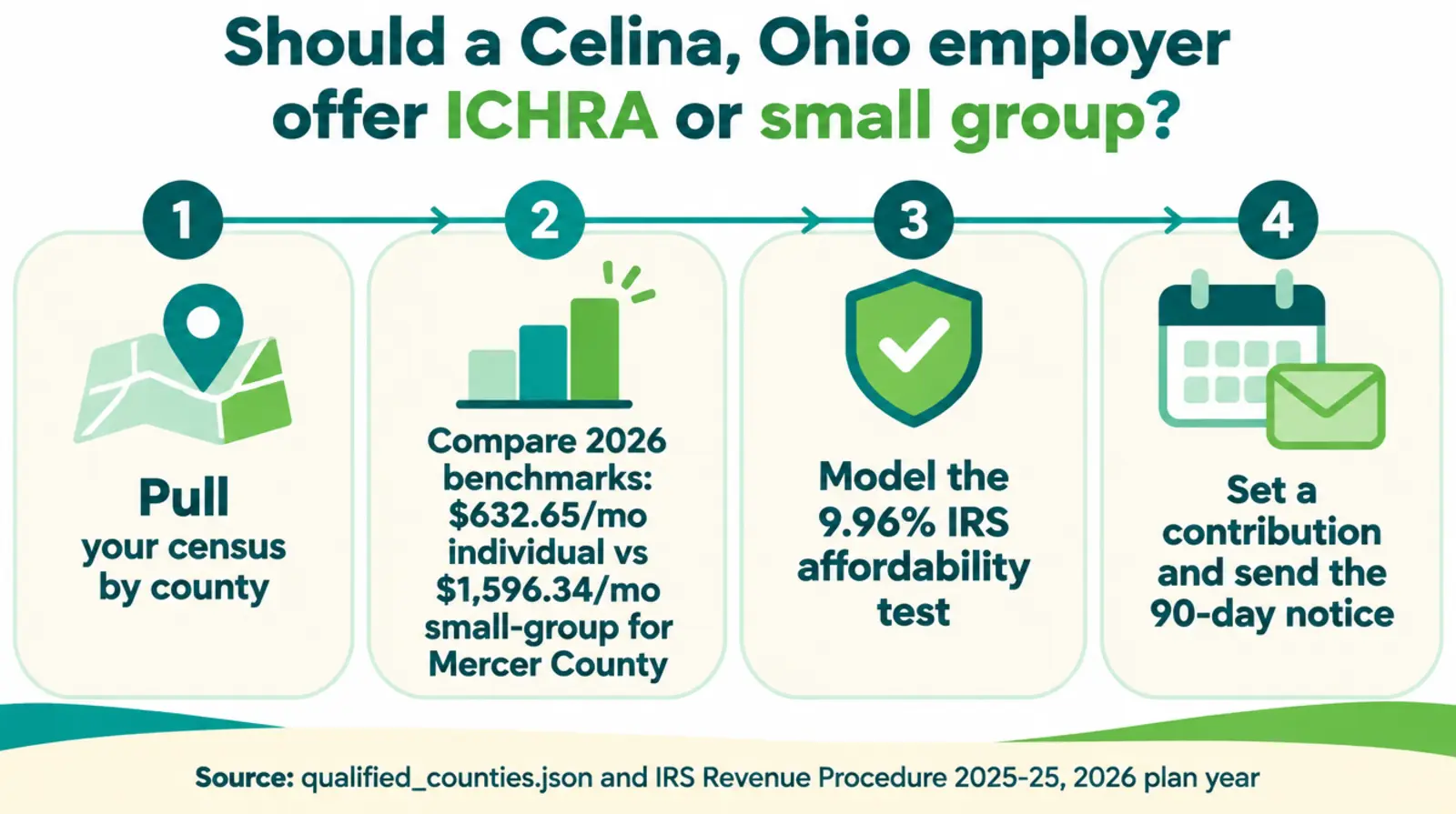
- Pull your census by county, not by office address. A company headquartered in Celina with staff living in Van Wert or Paulding County shares the same numbers — but a company with staff further out, in Franklin or Cuyahoga County, prices against a different, though still qualifying, comparison.
- Decide your contribution level deliberately, not by default. Nothing requires funding at the individual-market benchmark; a lower, still-meaningful contribution is often the realistic starting point for a first-time-benefits employer.
- Model affordability before you set a contribution. Check the contribution against the 9.96% Required Contribution Percentage for 2026, using the FPL safe harbor if you don't want to collect household-income data.
- Check every employee's actual county on the savings map. Even inside a shared rating area, it's worth confirming each employee's home county before you model a rollout.
- Send the required notice on time. Eligible employees need written notice at least 90 days before the plan year starts, with specific required content.
- Budget for onboarding support. Employees who have never shopped the individual market, including seasonal and part-time farm labor, need real guidance the first time through.
See our full ICHRA setup timeline for the detailed rollout plan, including the exact notice content requirements, and our ICHRA vs small-group decision guide if you're still weighing whether to switch at all. Before anything else, it's worth checking whether your county is one where this works at all: the national savings map takes about ten seconds to search.
If your employer just offered you an ICHRA
This guide is written for the employer side of the decision, but if you're a Mercer County employee who was just told your benefit is changing, or offered one for the first time, the short version is: you'll get a fixed monthly amount and shop for your own plan on the individual market instead of picking from an employer group menu. Our guide for employees walks through what to expect.
The honest limits of this data
A qualifying county is not a guarantee for your business
- A benchmark comparison is not your actual quote. The $1596.34 Mercer County figure is a small-group benchmark built from filed rates, not your specific carrier's quote for your specific group.
- Ohio's participation requirement is carrier-set, not state-fixed. Ohio Rev. Code § 3924.03(E)(1) confirms carriers may set group participation and contribution rules, but the statute does not itself publish a specific enrollment percentage; that number varies by carrier and filing.
- Establishment and insurance figures are drawn from an older county profile. The Ohio Development Services Agency's Mercer County profile compiles 2019-era QCEW and ACS data inside a 2021-edition document; we could not locate a more current Census or BLS breakout for Mercer County specifically, so treat the establishment-count, agriculture, and insurance-rate figures as directionally current, not this year's exact numbers.
- The agricultural cash-receipts figure is a county total, not a per-farm number. It reflects the whole county's farm economy, including large livestock operations whose receipts don't translate into proportionally large payrolls.
- Rates move every plan year. A carrier entering or leaving the rating area can shift either side of this comparison. Recheck before every renewal, not just once.
- Waiving the premium tax credit is part of the deal. An employee whose ICHRA offer is deemed affordable generally cannot also claim a marketplace subsidy for that month. Model both sides before assuming the reimbursement is pure upside for the employee.
A nine-person farm-equipment dealer outside Celina was never going to absorb a full small-group premium on its first try. Mercer County's rate spread is one of Ohio's stronger numbers — but the bigger reason to look at ICHRA here isn't the percentage. It's that the plan makes a first health benefit affordable for an employer that was never going to get one through the group market at all.
Mike MooreIf your renewal letter is already sitting on your desk, or you're weighing a first benefit for your team and want to work through the numbers with someone, it's worth a conversation: book time with our team. If you'd rather work through the mechanics on your own first, start with how ICHRA works and come back when you have questions.
How these numbers are calculated
Every county savings figure in this article comes from the same dataset that powers our savings map, not a survey or a sales estimate. For each county, we compare a 2026 individual-market benchmark premium — the second-lowest-cost silver plan available to a representative 50-year-old enrollee — against a small-group benchmark premium built from comparable small-group plan filings for that rating area. Both figures come from Ideon, a licensed insurance rate-data provider, and are cross-verified against CMS public-use marketplace files before publication. A county "qualifies" for our dataset when the individual benchmark sits below the small-group benchmark by at least $100 a month; the percentage and dollar figures in this article are the gap between those two numbers, expressed as an annual per-employee figure at 12 times the monthly difference.
The population, establishment, wage, agriculture, and insurance-coverage figures for Mercer County come from the Ohio Development Services Agency's "Ohio County Profiles: Mercer County" (2021 edition), which compiles the U.S. Census Bureau's 2020 decennial count alongside 2019-era Quarterly Census of Employment and Wages (QCEW) and American Community Survey (ACS) figures, read directly from the agency's own PDF.
The 2026 Required Contribution Percentage (9.96%) comes from IRS Revenue Procedure 2025-25, Section 3.02, read directly from the IRS's own PDF, and corroborated against a compliance bulletin published by HUB International that cites the same revenue procedure and the prior year's 9.02% figure. The federal poverty guideline used for the 2026 FPL safe harbor ($15,650 for one person, 48 contiguous states and DC) comes from the Federal Register's "Annual Update of the HHS Poverty Guidelines," 90 FR 5917 (Jan. 17, 2025), FR Doc. 2025-01377, read directly via govinfo.gov. Ohio Revised Code § 3924.03 was read directly from the Ohio Legislature's own codes.ohio.gov. The HRA Council adoption figures come from its own August 12, 2026 press release, read directly. We've kept these data sources clearly separate throughout this article rather than blending them into one number.
Three limitations are worth stating plainly. First, benchmark premiums are built around a representative enrollee profile, so an unusually young or unusually old workforce will see a different real-world spread than the county figure implies. Second, these are benchmark plans, not every plan on the market; an employee who chooses a richer or leaner plan than the benchmark will see a different premium, though the relative spread tends to hold directionally. Third, rates are filed and refreshed annually, so a county that qualifies for 2026 is not guaranteed to show the same gap for 2027 if a carrier enters or exits that market.
Questions Celina employers actually ask
Does ICHRA beat small-group insurance in Celina, Ohio?
Yes. Celina is the county seat of Mercer County, and the county's 2026 individual-market benchmark premium runs an estimated 60.4% below the small-group benchmark, about $11,564 per employee per year. That ranks 19 of Ohio's 88 counties by percentage and 6th by dollar savings — well above Ohio's own statewide average of about 54.9%, making Mercer County one of the stronger results in a state where nearly every county already qualifies.
Why does Mercer County price identically to six other Ohio counties?
Ohio prices health insurance by federal rating area, not by county. A rating area is a geography covering a cluster of neighboring counties that all get filed the identical benchmark price for a given plan year. Mercer County's rating area also covers Allen (Lima), Auglaize (Wapakoneta), Hancock (Findlay), Hardin (Kenton), Paulding, and Van Wert counties — a combined 344,025 residents in our dataset. An employer headquartered in Celina with staff living anywhere across that seven-county area runs on the identical $632.65 individual and $1596.34 small-group monthly benchmark for 2026.
Does every Ohio county qualify for ICHRA savings, or is Mercer an outlier?
Every one of Ohio's 88 counties clears our $100-a-month qualifying threshold for 2026, from a low of 38.8% in Summit County (Akron) to a high of 63% in several counties farther north. Mercer County's 60.4% sits well above the statewide average. Ohio is unusual among the states in our dataset precisely because the win is this universal; the question for an Ohio employer usually isn't whether ICHRA beats small group, it's by how much, and for Mercer County the answer is "a lot."
How much can a Celina employer expect to save?
Using 2026 benchmark data, the estimated gap in Mercer County is $963.69 a month, or $11,564 a year, per employee. For a 9-person shop, funding ICHRA contributions at the individual-market benchmark level instead of trying to buy small-group coverage at the benchmark level works out to roughly $104,079 a year in aggregate estimated savings. This is illustrative math from public rate data, not a projection of what any specific employer will actually pay.
What happens to my employees' premium tax credit if I offer an ICHRA?
An employee who is offered an affordable ICHRA generally becomes ineligible for a premium tax credit for any month that offer applies, whether or not they accept it. Affordability is measured against the IRS's Required Contribution Percentage, which is 9.96% of household income for plan years beginning in 2026, up from 9.02% in 2025 (IRS Rev. Proc. 2025-25, Section 3.02). That tradeoff is real and worth modeling before you set a contribution amount for any Mercer County employee who currently buys an individual-market plan with a subsidy attached.
Can a nine-person farm supplier or machine shop realistically afford to offer health benefits for the first time?
That depends entirely on which benchmark it is pricing against. Funding an ICHRA for 9 employees at Mercer County's 2026 individual-market benchmark runs an estimated $68,326 a year in total contributions. Buying small-group coverage for the same 9 people at the small-group benchmark runs an estimated $172,405 a year — a gap of $104,079. A shop that could never clear the second number is often within reach of the first one, which is the specific calculation worth running before assuming benefits are out of budget.
What is the federal poverty line safe harbor, and what does it mean for 2026?
It's one of three IRS-approved shortcuts for proving an ICHRA offer is "affordable" without checking every employee's actual household income. Under the FPL safe harbor, an offer is affordable if the employee's required monthly contribution for self-only coverage doesn't exceed 9.96% of the federal poverty line for a household of one, divided by 12. The federal poverty guideline for a single person in the 48 contiguous states and DC, in effect within six months of a Jan. 1, 2026 plan year, is $15,650 a year (Federal Register, 90 FR 5917, Jan. 17, 2025), which puts the 2026 FPL safe-harbor cap at roughly $129.90 a month. An employer whose ICHRA contribution leaves the employee's net premium at or below that figure has a simple, defensible affordability test, without pulling anyone's pay stub.
Is Mercer County really more agricultural than most of Ohio?
By land use, yes. An estimated 81.96% of Mercer County's land is classified as cultivated cropland, per the Ohio Development Services Agency's county profile — one of the highest shares of any Ohio county. The county counts 1,231 farms covering 268,958 acres, with total agricultural cash receipts of $631,612,000 in the reporting year, 80.5% of it from livestock and livestock products rather than crops — consistent with the hog, poultry, and dairy operations common in this part of west-central Ohio. That same profile's "Natural Resources and Mining" employment category, which captures farm establishments, shows just 46 establishments averaging only about 13.1 employees each, even though the sector produces hundreds of millions of dollars in receipts a year — small headcounts moving a lot of money, which is a very specific signal for how ICHRA tends to fit.
Sources
- IRS Revenue Procedure 2025-25 — Required Contribution Percentage, plan years beginning in 2026 (9.96%), Section 3.02
- HUB International, "ACA Affordability Percentage Sees Big Increase for 2026" — corroborating the 9.96% figure and the 9.02% prior-year rate
- Federal Register, "Annual Update of the HHS Poverty Guidelines", 90 FR 5917 (Jan. 17, 2025) — 2025 federal poverty guidelines, 48 contiguous states and DC, used for the 2026 FPL safe harbor
- Ohio Development Services Agency, "Ohio County Profiles: Mercer County" (2021 edition) — population, establishments, employment, wages, agriculture, and insurance coverage
- Ohio Revised Code § 3924.03 — small-employer carrier group participation and employer contribution rules
- 84 Fed. Reg. 28888 — ICHRA final rule, Departments of the Treasury/IRS, Labor, and Health and Human Services (June 20, 2019)
- HealthCare.gov, "CHOICE Arrangements" — participation, employee-class, and age-variance rules
- HRA Council, "Growth Trends for ICHRA & QSEHRA, Vol. 5" (Aug. 12, 2026)
- County-level premium comparison: ICHRA Savings county dataset, 2026 plan year (Ideon rate data, cross-verified against CMS public-use marketplace files)