ICHRA in Chillicothe, Ohio 2026: Ross County 51.3%
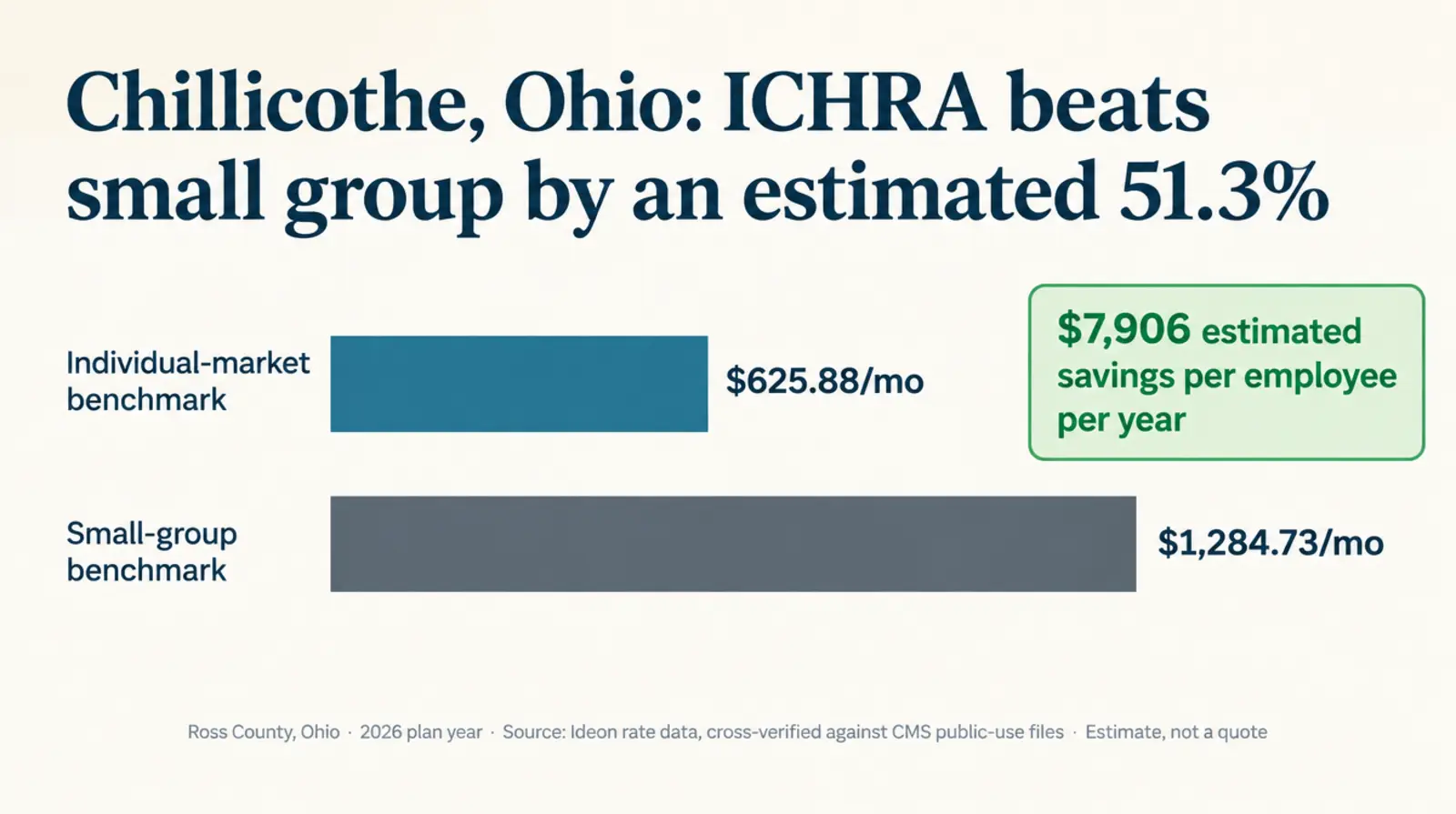
Ross County's 2026 benchmark runs an estimated 51.3% below small group, about $7,906 a year per employee. See the Chillicothe, Ohio data, sourced.
The short version
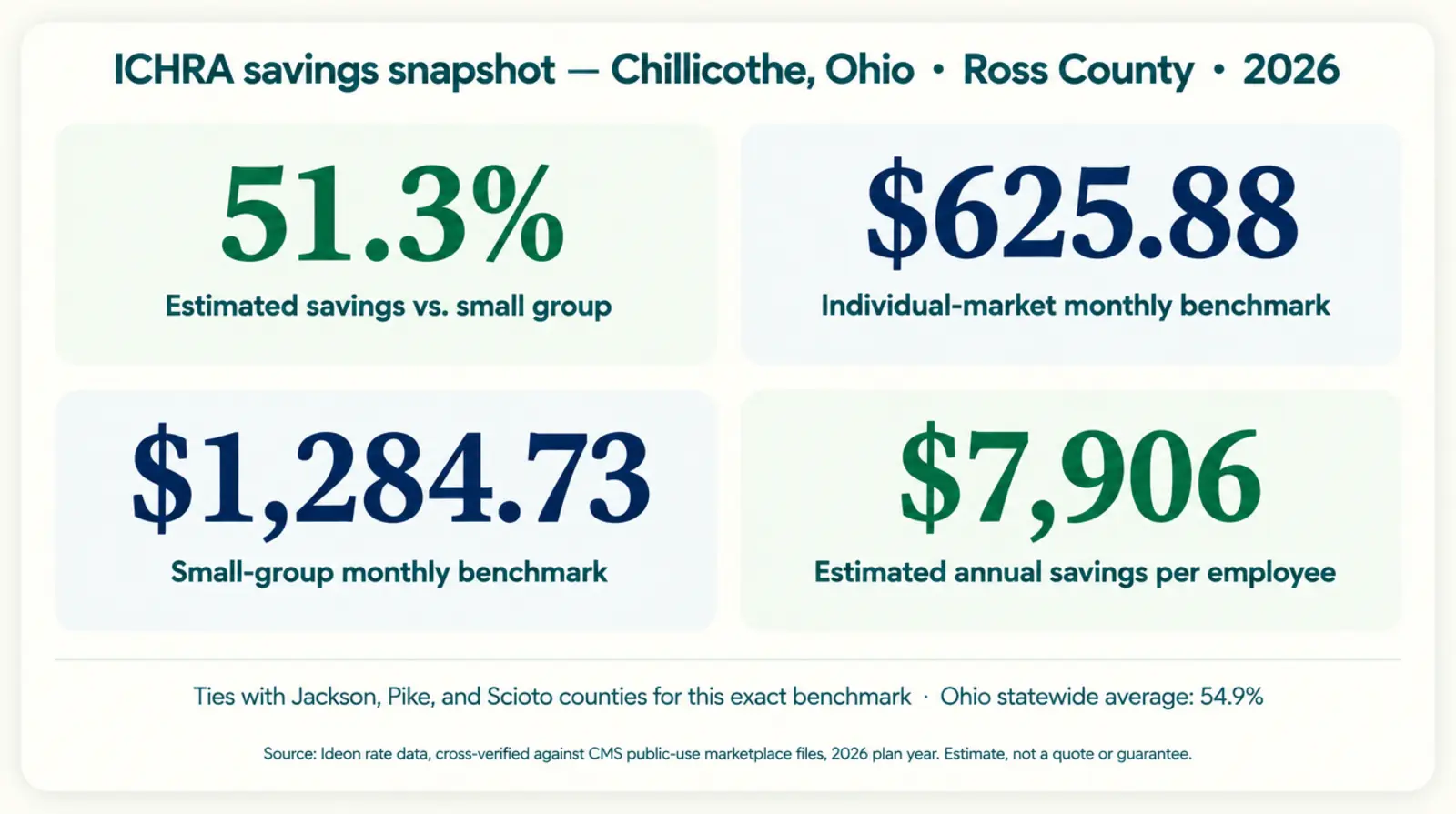
- Ross County's 2026 individual-market benchmark runs an estimated 51.3% below the small-group benchmark, about $7,906 per employee per year — above the statewide average of 54.9%, though not Ohio's top percentage.
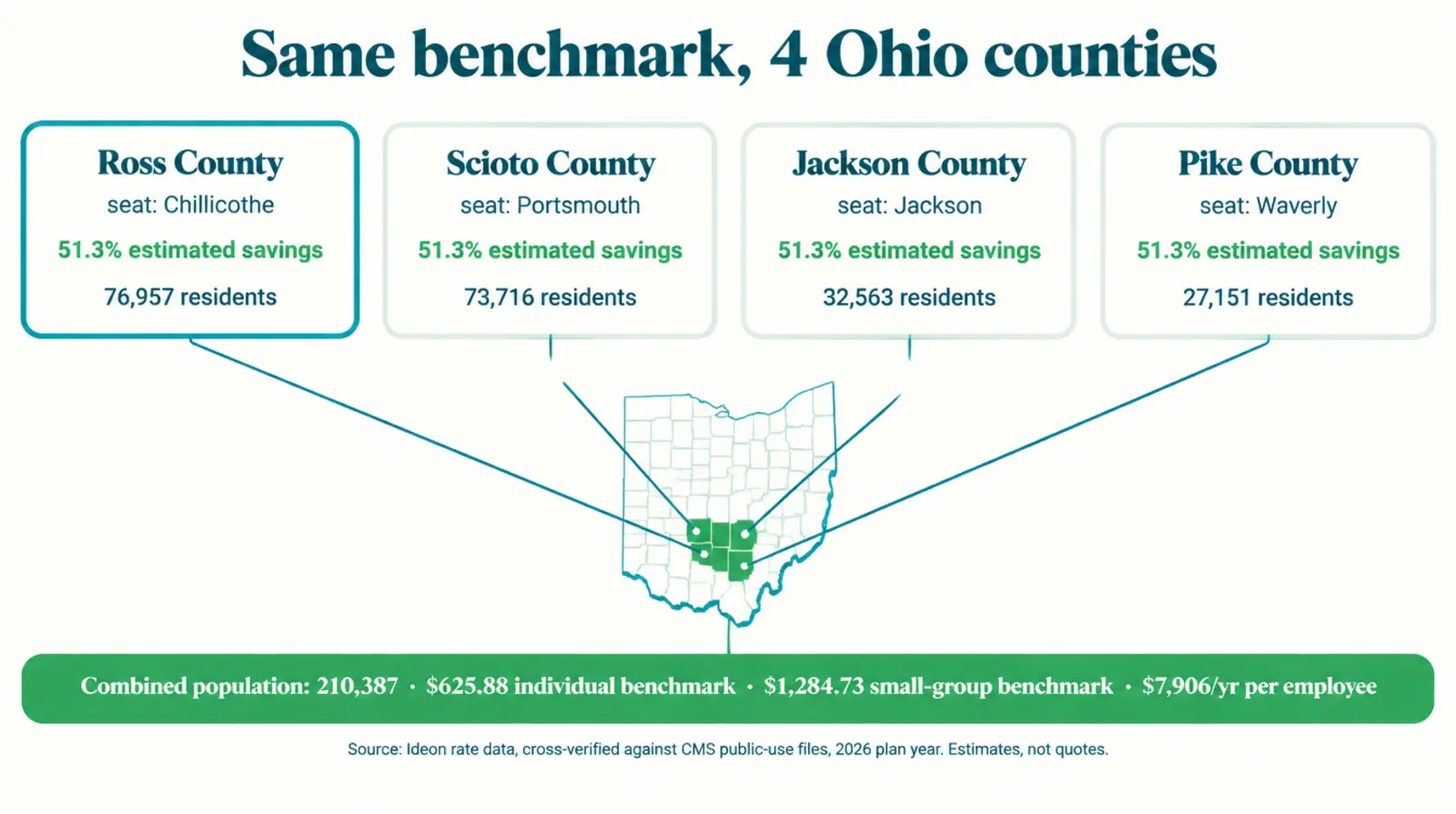
- Ross's benchmark is shared, to the cent, with Scioto (Portsmouth), Jackson (Jackson), and Pike (Waverly) counties — a four-county rating area of roughly 210,387 residents in our dataset. None of the three has its own article on this site yet.
- Chillicothe, the county seat and Ohio's first and third state capital, lost its largest paper mill in August 2025 — about 826 jobs, per the governor's office — while Kenworth's local truck plant keeps roughly 2,500 people on payroll a few miles away.
- That combination raises the local hiring bar for a different reason than most of the county profiles on this site: it's not two thriving giants setting the pace, it's one giant that's still hiring and a labor market with several hundred recently displaced, experienced workers in it.
- On raw dollars, Ross isn't a top-tier Ohio county — Morrow County posts a wider per-employee figure. The honest limits are covered later, not glossed over.
Does ICHRA beat small group in Chillicothe, Ohio?
Yes. An ICHRA (Individual Coverage Health Reimbursement Arrangement, now also referred to by HealthCare.gov as a CHOICE Arrangement) is an IRS-defined arrangement that lets an employer set a fixed monthly reimbursement amount and let each employee buy their own individual-market plan with it, tax-free. In Ross County, the Ohio county that contains the city of Chillicothe, the 2026 individual-market benchmark premium runs an estimated 51.3% below the small-group benchmark premium, according to a county-by-county comparison built from Ideon rate data and cross-verified against CMS public-use marketplace files.
That 51.3% ties Ross with 3 other Ohio counties — Scioto, Jackson, and Pike — and sits above the 54.9% average across all 88 counties statewide. In dollars it's $7,906 a year per employee, ranking 68th of 88 counties on that measure — middling for Ohio, not exceptional, which this article will keep saying plainly rather than inflating. Of the 1,309 counties nationwide in our dataset, every one of Ohio's 88 counties clears the $100-a-month gap we use as the floor for including a county at all, and Ross sits comfortably, if not spectacularly, inside that range.
51.3%
Estimated Ross County savings vs. small group
4-county tie
Ross's shared rating area
77K
Ross County residents in our dataset
$7,906
Est. Ross County savings per employee, per year
The employer problem this is actually solving
A ten-person machine shop, home-health agency, or accounting office near downtown Chillicothe is working a labor market that looks different than it did two years ago. In August 2025, Pixelle Specialty Solutions shut its Chillicothe paper mill for good, ending roughly 826 jobs at a facility that had run under one name or another — Mead, then Glatfelter, then Pixelle — for more than 200 years. A few miles away, Kenworth's truck-assembly plant, open since 1974 and still running at roughly 2,500 employees, keeps hiring.
That's not the usual version of this pain. Most of the county profiles on this site describe a small employer competing against one or two thriving large employers for the same hires. Ross County's version is messier and, in a specific way, more urgent: a deep pool of skilled, experienced workers lost a union-scale benefits package overnight, and they're now choosing between retraining, relocating, or taking a job at a small local employer that has never offered health coverage at all. The employer who can put a real, tax-free benefit on the table — even a modest one — has a genuine opening with candidates who know exactly what they gave up.
Why 2026 and 2027 renewals keep landing high
For Ross County employers who already carry a small-group plan, the renewal letter has been getting heavier for two straight years, and that isn't a local quirk. Nationally, small-group insurers filed a median proposed premium increase of 14% for the 2027 plan year, across 295 insurers filing in all 50 states and the District of Columbia, according to the Peterson-KFF Health System Tracker's brief published August 6, 2026 — up from an 11% median across 318 insurers for the 2026 plan year, per the same tracker's brief published September 24, 2025. Fifty-nine percent of insurers proposed 2027 increases between 10% and 20%.
Ohio's individual market tells a similarly pointed story. healthinsurance.org's Ohio marketplace guide, citing ACA Signups analysis, reports an average unsubsidized rate increase of 19.8% for 2026, calculated before any premium tax credit, alongside a drop from 13 to 11 participating insurers statewide after Aetna and AultCare exited the individual market at the end of 2025. Separately, KFF's own tracking of national ACA marketplace competition found that the average number of insurers participating per state fell from 9.6 in 2025 to 9.0 in 2026, and that the number of counties served by only a single ACA issuer nationwide jumped from 93 to 165 — a shift KFF ties largely to Aetna CVS's exit from 17 states and other insurer departures following the expiration of enhanced premium tax credits at the end of 2025.
None of that changes the underlying mechanic that makes ICHRA work in a county like Ross: what matters isn't whether either market's prices went up in isolation, it's whether individual rates rose relative to small-group rates in the same county and rating area. Ross's gap has held for the entire 2026 plan year regardless of which direction each market moved on its own.
How an ICHRA (now also called CHOICE) actually works
Before the Ross County numbers mean anything, it helps to be precise about what's being compared, since most of the confusion around ICHRA comes from skipping this step.
An ICHRA is an employer-funded health reimbursement arrangement created by a 2019 final rule from the IRS and Treasury, the Department of Labor, and HHS, published at 84 Fed. Reg. 28888 on June 20, 2019, effective August 19, 2019, and applicable to plan years beginning on or after January 1, 2020. HealthCare.gov now also refers to the same structure as a CHOICE Arrangement; the mechanics and the federal rules haven't changed, only the public-facing name. Instead of choosing one group health plan for everyone, the employer sets a fixed monthly reimbursement amount, and each employee uses that money to buy an individual-market plan of their own choosing, then submits proof of coverage (substantiation) to get reimbursed tax-free. The employer isn't picking a plan for a dozen different households; the employer is funding a budget, and the employee is doing the shopping.
The comparison behind every number in this article rests on two specific prices for a given county and rating area — the geographic zone insurance regulators use to set premiums, usually a cluster of neighboring counties. The individual-market benchmark premium is the second-lowest-cost silver-level plan available in that rating area to a representative 50-year-old enrollee. "Silver" refers to one of four ACA metal levels (bronze, silver, gold, platinum) describing how costs split between premium and out-of-pocket spending, not the quality of care. This is the same type of benchmark the federal government uses to calculate premium tax credits, which is why it's a defensible number to build a comparison on rather than one insurer's list price. The small-group benchmark premium is the equivalent figure built from comparable small-group plan filings for that same rating area. When the individual benchmark is lower, the county "qualifies," and the gap between the two is the estimated per-employee savings if the employer funds ICHRA at that benchmark level.
Two more terms matter once an employer is actually deciding whether to switch. The affordability safe harbor is the test that decides whether the ICHRA offer counts as "affordable" under IRS rules — for plan years beginning in 2026 that test runs against a Required Contribution Percentage of 9.96% of household income (IRS Rev. Proc. 2025-25), rising to 10.22% for plan years beginning in 2027 (IRS Rev. Proc. 2026-26). Get the contribution amount wrong relative to that threshold and an employer can trigger a penalty tied to the employer mandate, the ACA requirement that applies to ALEs (applicable large employers, generally 50 or more full-time-equivalent employees). Smaller, non-ALE employers aren't subject to that mandate at all, which covers most of the small Chillicothe-area shops and practices described above — Kenworth is the exception in this county, not the rule.
One structural piece is often misunderstood: an employer can define different employee classes — for example, full-time versus part-time, or by geographic rating area — and offer different benefits to each class, subject to federal minimum-size rules for some class types. What an employer cannot do is offer the same class of employees a choice between ICHRA and a traditional group plan; it's one or the other, per class, not both at once for the same people. Within a class, reimbursements can still vary by age, up to a 3-to-1 ratio, and by number of dependents, per HealthCare.gov's current CHOICE Arrangement guidance.
Ross County's rate spread, in dollars
Here is the actual 2026 benchmark comparison for Ross County, home to the city of Chillicothe. The individual-market benchmark premium is $625.88 a month. The small-group benchmark premium, built from comparable small-group plan filings for the same rating area, is $1284.73 a month. That's a gap of $658.85 a month, or $7,906 a year, per employee, an estimated 51.3% in favor of the individual market.
A four-county rating area, none of it published before
Ross County's 51.3% is identical, to the cent, to three other Ohio counties: Scioto (Portsmouth), Jackson (Jackson), and Pike (Waverly). Unlike several of the Ohio rating areas already covered on this site, none of these four counties has had its own article until now — the full four-county table is below.
See the full Ohio savings breakdown for every county, or the national savings map to look up a specific county by name.
Why Ross shares its benchmark with three other counties
This is the detail that makes Ross County worth its own page. Its benchmark comparison doesn't just resemble its neighbors in the Appalachian foothills of south-central Ohio — it's identical, to the cent, across four counties at once.
| County | Population (dataset) | Individual benchmark | Small-group benchmark | Savings vs. small group |
|---|---|---|---|---|
| Ross (Chillicothe) | 77K | $625.88 | $1284.73 | 51.3% |
| Scioto (Portsmouth) | 74K | $625.88 | $1284.73 | 51.3% |
| Jackson (Jackson) | 33K | $625.88 | $1284.73 | 51.3% |
| Pike (Waverly) | 27K | $625.88 | $1284.73 | 51.3% |
All four counties share the identical 2026 benchmark comparison because they sit in the same marketplace rating area.
That's a combined 210,387 residents in our dataset sharing one number. An employer headquartered in Chillicothe with staff living across Portsmouth (Scioto), Jackson (Jackson), or Waverly (Pike) doesn't need four different calculations; everyone runs on the same $625.88 individual and $1284.73 small-group monthly benchmark for 2026.
How Ross compares to Ohio's biggest counties
Some of Ohio's largest counties by population — Franklin (Columbus), Hamilton (Cincinnati), Montgomery (Dayton), Lucas (Toledo), and Butler — show a wider percentage spread than Ross County's 51.3%. Others — Cuyahoga (Cleveland), Summit (Akron), and Stark (Canton) — show a narrower one. That split is a useful reminder that a county's size or economic weight doesn't predict its savings number; it reflects how each rating area's carriers happened to price small-group versus individual coverage for 2026. Check your own county, not a regional headline number, before you model a rollout.
| County (city) | Population | Savings vs. small group | Est. annual savings / employee |
|---|---|---|---|
| Franklin (Columbus) | 1,318,149 | 59.6% | $10,624 |
| Cuyahoga (Cleveland) | 1,256,620 | 48.6% | $7,414 |
| Hamilton (Cincinnati) | 827,671 | 62.3% | $10,675 |
| Summit (Akron) | 539,361 | 38.8% | $4,433 |
| Montgomery (Dayton) | 536,121 | 58.3% | $10,014 |
| Lucas (Toledo) | 430,014 | 57.0% | $9,514 |
| Butler (Hamilton, Ohio) | 388,327 | 62.3% | $10,675 |
| Stark (Canton) | 374,199 | 41.1% | $4,692 |
| Ross (Chillicothe) | 77K | 51.3% | $7,906 |
How Ohio's 88 counties break down by savings tier
How Ohio's 88 counties break down by savings tier
Number of counties in each savings band, 2026 plan year. Source: ICHRA Savings county dataset (Ideon rate data, cross-verified against CMS public-use files).
Ross sits in the "50-60%" band, Ohio's largest, alongside 45 other counties. Illustrative and rounded; not an offer of insurance or a guarantee of savings.
Forty-six of Ohio's 88 counties — more than half — fall in the 50-to-60% band where Ross sits, which is also where most of Ohio's larger metro counties land: Columbus, Cincinnati, Dayton. Twenty-two counties clear 60%, mostly smaller, rural rating areas in north-central and southwestern Ohio. Only 6 counties statewide post a spread under 40%, including two of Ohio's biggest, Akron's Summit County and Canton's Stark County, both shown in the table above. Ross is a representative Ohio county on this measure, not an outlier in either direction.
Chillicothe's economy: a lost paper mill, a 2,500-job truck plant, and two capital-city stints
Chillicothe had 22,059 residents at the 2020 census, per the U.S. Census Bureau, and it carries a genuinely unusual history for an Ohio county seat its size: it was the first and third capital of Ohio. The city served as the capital of the remnant Northwest Territory starting in 1800, hosted Ohio's 1802 constitutional convention, and was the state capital from 1803 to 1810 and again from 1812 to 1816, per the city's Wikipedia summary, before Columbus took over permanently. On the north edge of town, the National Park Service manages Hopewell Culture National Historical Park, preserving one of the largest concentrations of Native American earthworks in the country, a site that predates the city by roughly 2,000 years.
That civic and historical weight sits alongside a present-day economy that's been through a hard stretch. Pixelle Specialty Solutions ran a paper mill inside Chillicothe under one owner's name or another — Mead, then Glatfelter, then Pixelle — for more than 200 years before announcing its closure in April 2025. State lawmakers, including Sen. Bernie Moreno, won a temporary pause, but the mill shut down for good in August 2025, ending work for 826 employees, per Ohio Gov. Mike DeWine's office as reported by WSAZ. Ohio's Rapid Response team stepped in to connect affected workers with unemployment benefits and reemployment services.
A few miles from downtown, Kenworth Truck Company has run a truck-assembly plant since March 4, 1974, and still employs about 2,500 people, per coverage of the plant's 50th anniversary in March 2024. Workers there have built more than 780,000 trucks since the plant opened, and Kenworth itself calls it one of the largest employers in Ross County. Two more large institutional employers round out the local economy without the same kind of single-point exposure: Adena Regional Medical Center and the Chillicothe VA Medical Center both anchor substantial health-system workforces in the city, and the Ross Correctional Institution and Chillicothe Correctional Institution, both state prisons, add a further layer of public-sector employment that a mill closure doesn't touch.
Per the Bureau of Labor Statistics' Quarterly Census of Employment and Wages, Ross County (area code 39141) reported 1,549 establishments and an average employment of 28,735 across 2025, at an average weekly wage of $1,138 and an average annual pay of $59,197. That 2025 figure captures the year the Pixelle closure was announced and underway, which is one reason this article treats the county's labor market as actively shifting rather than settled.
Ohio's first and third capital
Chillicothe served as the capital of the Northwest Territory from 1800 and as Ohio's state capital from 1803-1810 and 1812-1816, before Columbus took over for good.
~826 jobs lost, August 2025
A 200-plus-year-old paper mill — Mead, then Glatfelter, then Pixelle — closed for good, per the governor's office's figure as reported by WSAZ.
Same price as three neighbors
Ross County's benchmark comparison is identical to Scioto, Jackson, and Pike counties, to the cent.
Ohio's group participation rule, and why there's no state-set ceiling
Small-group health insurance isn't sold to individual employees one at a time; it's underwritten as a pool, and a carrier can require a minimum share of a company's eligible employees to actually enroll before it will issue the policy at all. Ohio law defines this mechanic in Ohio Revised Code § 3924.03(E)(1), which defines a "group participation rule" as "a requirement relating to the minimum number of employees or dependents" that must be enrolled relative to a specified percentage or number of eligible individuals or employees of an employer. The same subsection permits a small-group carrier to establish such a rule "as allowed under the law of this state," but the statute itself does not cap the percentage a carrier is allowed to require statewide.
In practice, that means a Chillicothe-area employer shopping small-group coverage may see a different minimum-participation requirement from one carrier to the next, confirmed plan by plan rather than published in one place. A ten-person shop with a part-timer, a new hire still inside a waiting period, or an employee already covered through a spouse's job at Kenworth or one of the hospitals can end up short of whatever bar a given carrier sets, even though every one of those employees technically has coverage somewhere.
An ICHRA (or CHOICE Arrangement, per HealthCare.gov's current naming) sidesteps the mechanic entirely when it's the only benefit offered. Per HealthCare.gov, there is no participation-percentage requirement at all in that case — generally, employers of any size can offer one if they have at least one eligible employee who isn't a self-employed business owner or the owner's spouse. There are also no annual minimum or maximum contribution requirements. A minimum class size only applies when an employer offers a CHOICE Arrangement to one employee class while also offering a traditional group plan to a different class: 10 employees for employers with fewer than 100 total employees, 10% of the workforce for 100 to 200 employees, and 20 employees for more than 200. Those class-size rules don't apply at all to an employer offering only a CHOICE Arrangement, which describes most Ross County small businesses outside Kenworth, Adena, and the VA.
If a group quote already fell through on participation
If you've already tried to set up small-group coverage in the Chillicothe area and a carrier's participation requirement blocked the quote, that's a specific, common signal that an ICHRA is worth pricing out next, since the mechanic that blocked you doesn't apply to it when it's the only benefit you offer.
A worked example for a Ross County employer
Here's what the Ross County numbers look like applied to a real headcount. Assume a 10-employee Chillicothe-area company currently renewing a small-group plan priced at this year's Ross County benchmark.
Here's the math
The 2026 small-group benchmark in Ross County is $1284.73 a month per employee, or $15416.76 a year. The 2026 individual-market benchmark is $625.88 a month, or $7510.56 a year. The difference is $7,906 a year per employee. For a 10-person company, funding ICHRA contributions at the benchmark level instead of renewing small group works out to an estimated $79,062 a year in aggregate savings.
This is illustrative math built from real 2026 county rate data and a hypothetical headcount. It is not a quote, and it assumes the employer sets the ICHRA contribution at the benchmark level, which is a design choice, not a requirement. Your actual number depends on your employees' ages, exact home counties, and the plans they choose once they're shopping with their own budget.
The same arithmetic scales down to a smaller shop: a 5-person print shop or dental practice near downtown Chillicothe that has never offered benefits at all, and is now trying to hire from a labor pool that includes recently laid-off Pixelle machine operators. That company could fund an ICHRA at the $625.88 individual benchmark and offer a real, tax-free benefit for about $3129 a month in total contributions, or roughly $37,553 a year for the whole company — a genuine first benefit offered to every eligible employee, with no enrollment percentage to clear.
At the other end of the size range, a 55-employee Ross County company crosses into ALE territory under the employer mandate, which changes the calculus without changing the underlying county math. The same Ross County benchmark comparison applies, but an ALE has to run the affordability safe-harbor test — against the 9.96% threshold for 2026 or 10.22% for 2027 — carefully for every employee class, since an ICHRA offer judged "unaffordable" for even a handful of lower-paid employees can trigger an employer-mandate penalty. That's not a reason to avoid ICHRA at 55 employees; it's a reason to model the affordability test before setting a contribution amount, which our eligibility guide walks through in detail.
How ICHRA adoption is actually growing
Ross County's numbers sit inside a national adoption trend that keeps compounding. The HRA Council's fifth annual report, Growth Trends for ICHRA & QSEHRA, Vol. 5 (data current through January 31, 2026, released August 12, 2026), found that ICHRA-covered lives surpassed 500,000 nationally at the start of 2026, spread across more than 20,000 U.S. businesses now offering ICHRA or QSEHRA, drawing on reporting from 17 HRA Council member organizations. The same report found that Applicable Large Employers are now the fastest-growing segment of ICHRA adoption, with ALE uptake more than doubling on average year over year.
The number that matters most for the small Chillicothe-area business this article opened on: more than two-thirds of small businesses offering ICHRA, and 93% of those newly offering QSEHRA in 2026, had previously offered no health coverage options at all. For most small Ross County businesses, the realistic comparison usually isn't "ICHRA versus our current group plan." It's "ICHRA versus offering nothing while a deep, newly available pool of experienced workers decides where to take their next job," which is a much easier case to make than it sounds.
Setting up an ICHRA in Ross County
Ohio does not layer state-specific ICHRA rules on top of the federal framework. The same IRS, Department of Labor, and HHS final rule that governs ICHRA everywhere applies here. What determines whether a Chillicothe-area rollout goes smoothly:
- Pull your census by county, not by office address. A company headquartered in Chillicothe with staff living in Scioto, Jackson, or Pike counties shares the same numbers — but a company with staff further out, in Pickaway or Highland counties, needs to check that county's own figure separately.
- Check every employee's actual county on the savings map. Even inside a shared rating area, it's worth confirming each employee's home county before you model a rollout.
- Model affordability before you set a contribution. The reimbursement level decides whether an employee keeps or waives premium tax credit eligibility, against the 9.96% (2026) or 10.22% (2027) Required Contribution Percentage.
- Define employee classes carefully, if you use them. Class rules carry minimum-size requirements and cannot offer the same class a choice between ICHRA and group coverage.
- Send the required notice on time. Eligible employees need written notice at least 90 days before the plan year starts, with specific required content.
- Budget for onboarding support, especially for recently displaced workers. Employees who have never shopped the individual market on their own — including former Pixelle employees new to a company — need guidance, once, at enrollment.
See our full ICHRA setup timeline for the detailed rollout plan, including the exact notice content requirements, and our eligibility guide for the affordability test itself. Before anything else, it's worth checking whether your county is one where this works at all: the national savings map takes about ten seconds to search.
If your employer just offered you an ICHRA
This guide is written for the employer side of the decision, but if you're a Ross County employee who was just told your benefit is changing — or you're weighing a job offer from a small employer against the group plan you'd have had at a larger one — the short version is: you'll get a fixed monthly amount and shop for your own plan on the individual market instead of picking from an employer's group menu. Our guide for employees walks through what to expect.
The honest limits of this data
A real county number is not a guarantee for your business
- Ross isn't a top-tier Ohio number, and this article doesn't pretend otherwise. Morrow County posts a far wider per-employee dollar figure, $12,121 a year, and Erie County posts a wider percentage spread at 63.0%. Check the full Ohio breakdown before assuming Ross is the strongest case nearby.
- A benchmark comparison is not your actual renewal. The $1284.73 Ross County figure is a small-group benchmark built from filed rates, not your specific carrier's quote for your specific group.
- Kenworth doesn't set the small-group market price here. A plant that size almost certainly self-insures or negotiates its own group rate directly with a carrier; the small-group benchmark this article uses reflects plans filed for smaller employers, not what Kenworth actually pays.
- An older or higher-risk workforce changes the real-world math. Benchmark premiums are built around a representative 50-year-old enrollee; a company with a younger average age could see a different real-world spread than the headline figure implies.
- Rates move every plan year. A carrier entering or leaving the rating area can shift the comparison for 2027; recheck before every renewal, not just once.
- Waiving the premium tax credit is part of the deal. An employee whose ICHRA offer is deemed affordable generally cannot also claim a marketplace subsidy for that month. Model both sides before assuming the reimbursement is pure upside for the employee.
Chillicothe was Ohio's capital before Columbus existed as a city. None of that history changes what a five-person accounting firm near the courthouse square is actually up against this year: a labor market that just lost its biggest non-institutional employer and still has to compete with a 2,500-person truck plant down the road. A fixed, employer-funded ICHRA budget doesn't erase that gap, but it's a real, tax-free benefit a small Chillicothe business can afford to put on the table right now, without waiting for the next renewal cycle to force the question.
Mike MooreIf your renewal letter is already sitting on your desk and you're working against a deadline, it's worth a conversation before you sign: book time with our team. If you'd rather work through the mechanics on your own first, start with how ICHRA works and come back when you have questions.
How these numbers are calculated
Every county savings figure in this article comes from the same dataset that powers our savings map, not a survey or a sales estimate. For each county, we compare a 2026 individual-market benchmark premium — the second-lowest-cost silver plan available to a representative 50-year-old enrollee — against a small-group benchmark premium built from comparable small-group plan filings for that rating area. Both figures come from Ideon, a licensed insurance rate-data provider, and are cross-verified against CMS public-use marketplace files before publication. A county "qualifies" for our dataset when the individual benchmark sits below the small-group benchmark by at least $100 a month; the percentage and dollar figures in this article are the gap between those two numbers, expressed as an annual per-employee figure at 12 times the monthly difference.
The population figures for Ross, Scioto, Jackson, and Pike counties come from the same county dataset. The Bureau of Labor Statistics' Quarterly Census of Employment and Wages reports 1,549 establishments, an average employment of 28,735, an average weekly wage of $1,138, and an average annual pay of $59,197 for Ross County (area code 39141) across 2025 — broader labor-market context for the county, not a figure used in the savings calculation itself.
The national small-group figures (11% median for 2026 across 318 insurers; 14% median for 2027 across 295 insurers), the national insurer-participation figures (9.6 to 9.0 issuers per state; 93 to 165 single-issuer counties), Ohio's own marketplace figures (19.8% average 2026 increase, 13 to 11 participating insurers), the IRS affordability percentages, the HRA Council adoption figures, Chillicothe's population and capital-city history, the Hopewell Culture National Historical Park, the Pixelle mill closure figures, and the Kenworth plant facts each come from separately published, independent sources, not from our own county dataset, and describe national, statewide, or local context rather than the Ross-specific benchmark comparison above. We've kept these data sources clearly separate throughout this article rather than blending them into one number.
Three limitations are worth stating plainly. First, benchmark premiums are built around a representative enrollee profile, so an unusually young or unusually old workforce will see a different real-world spread than the county figure implies. Second, these are benchmark plans, not every plan on the market; an employee who chooses a richer or leaner plan than the benchmark will see a different premium, though the relative spread tends to hold directionally. Third, rates are filed and refreshed annually, so a county that qualifies for 2026 is not guaranteed to show the same gap for 2027 if a carrier enters or exits that market.
Questions Ross County employers actually ask
Does ICHRA beat small-group insurance in Chillicothe, Ohio?
Yes. Chillicothe is the county seat of Ross County, and the county's 2026 individual-market benchmark premium runs an estimated 51.3% below the small-group benchmark, about $7,906 per employee per year. Ross ties with three other Ohio counties — Jackson, Pike, and Scioto — for this exact benchmark. It's a solid, above-average number, not Ohio's statewide-high percentage; that distinction belongs to a six-county cluster in north-central Ohio at 63.0%.
Why does Ross County price identically to three other counties?
Ohio prices health insurance by federal rating area, a geography covering a cluster of neighboring counties that all get filed the identical benchmark price for a given plan year. Ross County's rating area also covers Scioto (Portsmouth), Jackson (Jackson), and Pike (Waverly) counties — a combined population of roughly 210,387 residents in our dataset. An employer with a Chillicothe office and staff living across any of those four counties doesn't need four different calculations; all of them run on the identical $625.88 individual and $1284.73 small-group monthly benchmark for 2026.
How much can a Ross County employer expect to save?
Using 2026 benchmark data, the estimated gap in Ross County is $658.85 a month, or $7,906 a year, per employee. For a 10-person company, that is roughly $79,062 a year in aggregate estimated savings if the employer funds ICHRA contributions at the benchmark level instead of renewing small group. This is illustrative math from public rate data, not a projection of what any specific employer will actually pay.
Is Ross County among Ohio's highest savings percentages?
No, and this article says so plainly. Ross County's 51.3% sits squarely in the state's largest savings band, 50 to 60%, which holds 46 of Ohio's 88 qualifying counties. It's comfortably above the 54.9% statewide average, but it ranks 68th of 88 Ohio counties on raw annual dollars, well behind Morrow County's statewide-widest $12,121. A real, worthwhile number — not the state's most dramatic one.
What happened to the Pixelle paper mill in Chillicothe, and does it affect this analysis?
Pixelle Specialty Solutions announced in April 2025 that it would close its Chillicothe paper mill, affecting 826 employees according to the governor's office, and the plant shut down that August after a brief pause attempt by state lawmakers. It doesn't change the benchmark math in this article, which is built from 2026 individual-market and small-group rate filings, not employment data. But it changes the local stakes: a county that just absorbed several hundred displaced manufacturing workers has a deeper-than-usual pool of experienced people looking for a reason to take a job at a small employer that can't match a union-scale benefits package on its own.
Why did my 2026 or 2027 small-group renewal come in higher than expected?
Nationally, small-group insurers filed a median proposed premium increase of 14% for the 2027 plan year, across 295 insurers filing in all 50 states and the District of Columbia, per the Peterson-KFF Health System Tracker's brief published August 6, 2026 — up from an 11% median across 318 insurers for the 2026 plan year, per the same tracker's brief published September 24, 2025. Fifty-nine percent of insurers proposed 2027 increases between 10% and 20%. On Ohio's individual-market side specifically, healthinsurance.org's Ohio marketplace guide reports an average unsubsidized rate increase of 19.8% for 2026.
What happens to my employees' premium tax credit if I switch to ICHRA?
An employee who is offered an affordable ICHRA generally becomes ineligible for a premium tax credit for any month that offer applies, whether or not they accept it. Affordability is measured against the IRS's Required Contribution Percentage, which is 9.96% of household income for plan years beginning in 2026 (Rev. Proc. 2025-25) and rises to 10.22% for plan years beginning in 2027 (Rev. Proc. 2026-26). Model that test before you set a contribution amount for any Ross County employee currently receiving marketplace subsidies.
Does the Kenworth plant's size change what a small Chillicothe employer should do?
No, but it changes what you're competing against. Kenworth's Chillicothe plant employs about 2,500 people and almost certainly self-insures or negotiates its own group rate directly with a carrier — a different mechanism than the small-group benchmark this article uses, which reflects plans filed for smaller employers. A five-person Chillicothe business isn't trying to replicate Kenworth's benefits budget; it's trying to offer something real enough to compete for the same labor pool, on a fraction of the headcount and none of the HR department.
Sources
- Peterson-KFF Health System Tracker, "How Much and Why Premiums Are Going Up for Small Businesses in 2027" (Aug. 6, 2026)
- Peterson-KFF Health System Tracker, "How Much and Why Premiums Are Going Up for Small Businesses in 2026" (Sep. 24, 2025)
- KFF, "How Has Insurer Participation in the ACA Marketplaces Changed in 2026?"
- healthinsurance.org, "Ohio Health Insurance Marketplace" guide
- IRS Revenue Procedure 2025-25 — Required Contribution Percentage, plan years beginning in 2026 (9.96%)
- IRS Revenue Procedure 2026-26 — Required Contribution Percentage, plan years beginning in 2027 (10.22%)
- 84 Fed. Reg. 28888 — ICHRA final rule, Departments of the Treasury/IRS, Labor, and Health and Human Services (June 20, 2019)
- HealthCare.gov, "CHOICE Arrangements" — participation, class-size, and age-variance rules
- Ohio Legislative Service Commission, Ohio Revised Code § 3924.03(E)(1) — definition of "group participation rule" for small-employer health benefit plans
- HRA Council, press release: "Strong ICHRA Growth Among Large Employers Strengthens ACA Marketplace and Risk Pool" (Aug. 12, 2026)
- HRA Council Data Reporting Hub
- U.S. Bureau of Labor Statistics, Quarterly Census of Employment and Wages — Ross County, Ohio (area code 39141), 2025 annual averages
- WSAZ, "More than 800 jobs to be impacted by paper mill closure" (Apr. 17, 2025)
- The Trucker, "Kenworth's Chillicothe, Ohio manufacturing plant celebrates 50 years of operation" (Mar. 5, 2024)
- National Park Service, Hopewell Culture National Historical Park
- Wikipedia, "Chillicothe, Ohio" — population, capital-city history, Hopewell Culture park
- Wikipedia, "Ross County, Ohio" — county seat, population, neighboring counties
- Wikipedia, "List of counties in Ohio" — 88 counties
- County-level premium comparison: ICHRA Savings county dataset, 2026 plan year (Ideon rate data, cross-verified against CMS public-use marketplace files)