ICHRA in Dalton, Georgia 2026: Whitfield County 38.6%
Whitfield County's 2026 benchmark runs an estimated 38.6% below small group, about $5,474 a year per employee. See the Dalton, Georgia data, sourced.

The short version
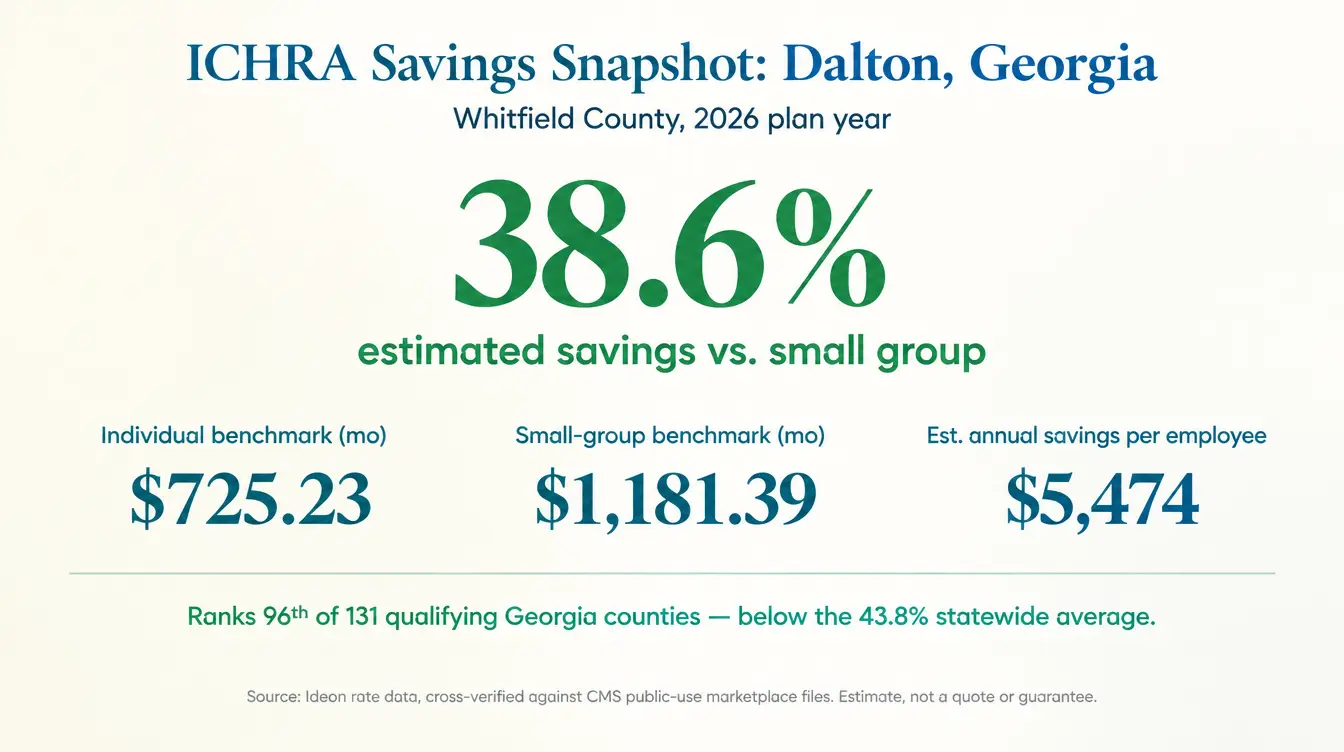
- Whitfield County's 2026 individual-market benchmark runs an estimated 38.6% below the small-group benchmark, about $5,474 per employee per year — below Georgia's 43.8% average, ranking 96th of 131 qualifying counties.
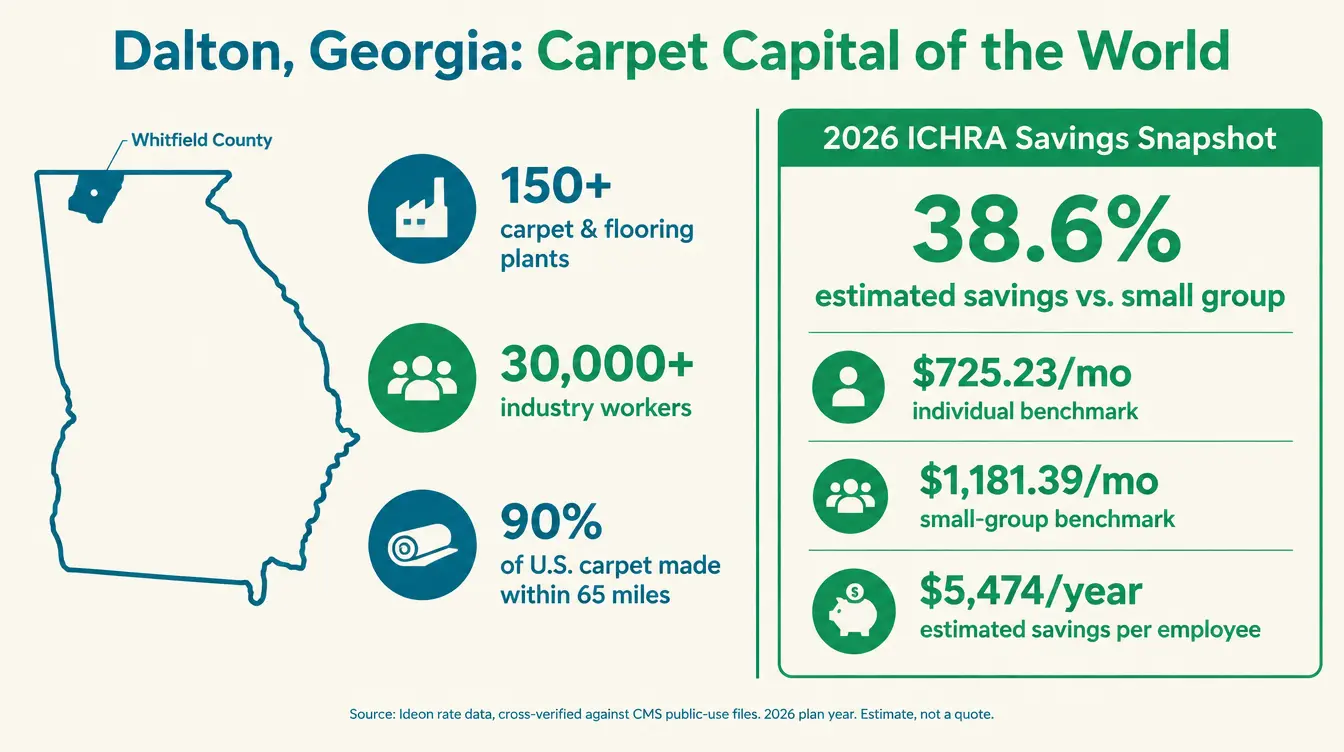
- Dalton, the county seat, is known as the "Carpet Capital of the World" — per Wikipedia's account of the industry, home to more than 150 carpet and flooring plants and over 30,000 industry workers in the Whitfield County area.
- Metro Atlanta's four biggest counties — Fulton, Gwinnett, Cobb, and DeKalb — don't qualify at all for 2026; their benchmark gap sits just under this site's $100-a-month floor.
- Georgia's own individual market rose an average 34.6% for 2026 and insurers have filed a further 20.7% weighted increase for 2027, even as Whitfield's relative spread versus small group has held for the full 2026 plan year.
- This is a real, usable Georgia county number — not Georgia's strongest case, and this article says so directly rather than dressing it up.
Does ICHRA beat small group in Dalton, Georgia?
Yes, modestly. An ICHRA (Individual Coverage Health Reimbursement Arrangement, now also referred to by HealthCare.gov as a CHOICE Arrangement) is an IRS-defined arrangement that lets an employer set a fixed monthly reimbursement amount and let each employee buy their own individual-market plan with it, tax-free. In Whitfield County, the Georgia county that contains the city of Dalton, the 2026 individual-market benchmark premium runs an estimated 38.6% below the small-group benchmark premium, according to a county-by-county comparison built from Ideon rate data and cross-verified against CMS public-use marketplace files.
That 38.6% sits below the 43.8% average across all 131 of Georgia's qualifying counties, ranking 96th of 131 on percentage and 96th on raw annual dollars. In dollars it's $5,474 a year per employee — real money for a small business, and well clear of the $100-a-month gap this site uses as the floor for including a county at all, but not the standout case. This article isn't going to pretend Whitfield is Georgia's best example; it's a genuine, middling-to-modest one, and that distinction matters if you're deciding whether a rollout is worth the effort here.
38.6%
Estimated Whitfield County savings vs. small group
96 of 131
Georgia county rank by savings %
103K
Whitfield County residents in our dataset
$5,474
Est. Whitfield County savings per employee, per year
The employer problem this is actually solving
A ten-person accounting firm, dental practice, or logistics broker in Dalton is hiring out of a labor market that looks nothing like most small American towns. Whitfield County's economy isn't spread across a dozen mid-sized employers; it's dominated by a handful of enormous flooring manufacturers. Dalton has been known for more than a century as the "Carpet Capital of the World," and per Wikipedia's account of the industry, the county is home to more than 150 carpet and flooring plants, employing more than 30,000 people in the Whitfield County area, with over 90% of the functional carpet made anywhere on earth produced within a 65-mile radius of the city.
That concentration cuts both ways for a small local employer. On one hand, it means a deep, skilled manufacturing and logistics labor pool lives nearby. On the other, it means every small business in Dalton is recruiting against mill-scale employers that can fund group benefits at a volume no ten-person shop can match. A small employer here isn't trying to out-benefit Shaw Industries or Mohawk Industries; it's trying to offer something real enough, on a fraction of the headcount, to give a candidate a reason to say yes anyway. A fixed, employer-funded ICHRA budget is exactly that kind of real, affordable, tax-free offer — it doesn't have to match a mill's benefits package to matter to the person deciding between two job offers.
Why 2026 and 2027 renewals keep landing high
For Whitfield County employers who already carry small-group coverage, the renewal letter has been getting heavier, and Georgia's own market explains a good share of why. The state's individual-market premiums rose an average of 34.6% for the 2026 plan year, per healthinsurance.org's Georgia marketplace guide, citing ACA Signups analysis published October 16, 2025 — a jump the guide attributes largely to the expiration of enhanced federal premium tax credits at the end of 2025. For 2027, Georgia insurers have filed a weighted average proposed increase of 20.7%, per the same guide's citation of ACA Signups' final analysis published September 25, 2026, with individual insurer requests ranging from 12.2% (AMGP Georgia Managed Care) to 27.4% (CareSource). Eight insurers will sell through Georgia Access for 2027, down from nine in 2026: Cigna and UnitedHealthcare are exiting the state's marketplace at the end of 2026, while Antidote Health Plan is joining. Open enrollment for 2027 coverage runs November 1, 2026 through January 15, 2027.
Small-group renewals are climbing for reasons that aren't Georgia-specific. Nationally, insurers filed a median proposed premium increase of 14% for the 2027 small-group plan year, across 295 insurers filing in all 50 states and the District of Columbia, according to the Peterson-KFF Health System Tracker's brief published August 6, 2026. Fifty-nine percent of those insurers proposed increases between 10% and 20%.
None of that changes the underlying mechanic that makes ICHRA work (or not) in a county like Whitfield: what matters isn't whether either market moved in isolation, it's whether individual rates rose relative to small-group rates in the same county and rating area. Whitfield's gap has held for the entire 2026 plan year regardless of which direction each market moved on its own, which is exactly why this article treats the benchmark comparison, not the headline increase percentages, as the number that actually matters to a Dalton employer's decision.
How an ICHRA (now also called CHOICE) actually works
Before the Whitfield County numbers mean anything, it helps to be precise about what's being compared, since most of the confusion around ICHRA comes from skipping this step.
An ICHRA is an employer-funded health reimbursement arrangement created by a 2019 final rule from the IRS and Treasury, the Department of Labor, and HHS, published at 84 Fed. Reg. 28888 on June 20, 2019, effective August 19, 2019, and applicable to plan years beginning on or after January 1, 2020. HealthCare.gov now also refers to the same structure as a CHOICE Arrangement; the mechanics and the federal rules haven't changed, only the public-facing name. Instead of choosing one group health plan for everyone, the employer sets a fixed monthly reimbursement amount, and each employee uses that money to buy an individual-market plan of their own choosing, then submits proof of coverage (substantiation) to get reimbursed tax-free. The employer isn't picking a plan for a dozen different households; the employer is funding a budget, and the employee is doing the shopping.
The comparison behind every number in this article rests on two specific prices for a given county and rating area — the geographic zone insurance regulators use to set premiums. The individual-market benchmark premium is the second-lowest-cost silver-level plan available in that rating area to a representative 50-year-old enrollee. "Silver" refers to one of four ACA metal levels (bronze, silver, gold, platinum) describing how costs split between premium and out-of-pocket spending, not the quality of care. This is the same type of benchmark the federal government uses to calculate premium tax credits, which is why it's a defensible number to build a comparison on rather than one insurer's list price. The small-group benchmark premium is the equivalent figure built from comparable small-group plan filings for that same rating area. When the individual benchmark is lower, the county "qualifies," and the gap between the two is the estimated per-employee savings if the employer funds ICHRA at that benchmark level.
Two more terms matter once an employer is actually deciding whether to switch. The affordability safe harbor is the test that decides whether the ICHRA offer counts as "affordable" under IRS rules — for plan years beginning in 2026 that test runs against a Required Contribution Percentage of 9.96% of household income (IRS Rev. Proc. 2025-25), rising to 10.22% for plan years beginning in 2027 (IRS Rev. Proc. 2026-26). Get the contribution amount wrong relative to that threshold and an employer can trigger a penalty tied to the employer mandate, the ACA requirement that applies to ALEs (applicable large employers, generally 50 or more full-time-equivalent employees). Smaller, non-ALE employers aren't subject to that mandate at all, which covers most of Dalton's small professional-services and retail businesses outside the big flooring mills.
One structural piece is often misunderstood: an employer can define different employee classes — for example, full-time versus part-time, or by geographic rating area — and offer different benefits to each class, subject to federal minimum-size rules for some class types. What an employer cannot do is offer the same class of employees a choice between ICHRA and a traditional group plan; it's one or the other, per class, not both at once for the same people. Within a class, reimbursements can still vary by age, up to a 3-to-1 ratio, and by number of dependents, per HealthCare.gov's current CHOICE Arrangement guidance.
Whitfield County's rate spread, in dollars
Here is the actual 2026 benchmark comparison for Whitfield County, home to the city of Dalton. The individual-market benchmark premium is $725.23 a month. The small-group benchmark premium, built from comparable small-group plan filings for the same rating area, is $1181.39 a month. That's a gap of $456.16 a month, or $5,474 a year, per employee, an estimated 38.6% in favor of the individual market.
See the full Georgia savings breakdown for every county, or the national savings map to look up a specific county by name. Before anything else, it's worth ten seconds to check whether your own employees' counties are among the ones where this actually works.
How Whitfield compares to other Georgia counties
Several other Georgia counties already covered on this site post a noticeably wider spread than Whitfield's 38.6%. That's a useful reminder that a county's population or economic weight doesn't predict its savings number; it reflects how each rating area's carriers happened to price small-group versus individual coverage for 2026. Check your own county, not a regional headline figure, before you model a rollout.
| County (city) | Population | Savings vs. small group | Est. annual savings / employee |
|---|---|---|---|
| Dougherty (Albany) | 85,038 | 52.4% | $8,754 |
| Lowndes (Valdosta) | 118,257 | 53.3% | $8,610 |
| Floyd (Rome) | 98,541 | 49.0% | $7,519 |
| Bibb (Macon) | 156,554 | 44.3% | $6,389 |
| Houston (Warner Robins) | 164,117 | 44.3% | $6,389 |
| Muscogee (Columbus) | 204,572 | 39.2% | $5,579 |
| Richmond (Augusta) | 206,153 | 34.0% | $4,370 |
| Hall (Gainesville) | 204,953 | 24.2% | $2,462 |
| Chatham (Savannah) | 296,266 | 31.3% | $4,038 |
| Whitfield (Dalton) | 103K | 38.6% | $5,474 |
Every county here clears the $100-a-month qualifying floor, but the spread varies widely within Georgia.
How Georgia's qualifying counties break down by savings tier
How Georgia's 131 qualifying counties break down by savings tier
Number of counties in each savings band, 2026 plan year. Source: ICHRA Savings county dataset (Ideon rate data, cross-verified against CMS public-use files).
Whitfield sits in the "30-40%" band, Georgia's largest among qualifying counties, alongside 44 others. Illustrative and rounded; not an offer of insurance or a guarantee of savings.
Forty-five of Georgia's 131 qualifying counties fall in the 30-to-40% band where Whitfield sits — the largest single tier. Forty-three counties clear 50%, led by Ben Hill County's statewide-widest 53.3%. Not one Georgia county in our dataset clears 60%, which separates Georgia from states like Ohio, where dozens of counties exceed that mark. And four of Georgia's most populous counties — Fulton, Gwinnett, Cobb, and DeKalb, the heart of metro Atlanta — show an identical $97.53-a-month gap (11.5%), just under the $100 floor this site uses to call a county qualifying at all. Whitfield is a representative Georgia county on this measure: below the state's own average, well above Atlanta's, nowhere near the state's top tier.
Dalton: the Carpet Capital of the World, and what sits behind that name
Dalton's identity as a manufacturing town goes back to a wedding gift. In 1895, a teenager named Catherine Evans Whitener made a tufted bedspread as a gift, and the tufting technique she used eventually grew into the area's tufted-carpet industry, per Wikipedia's history of the city. More than a century later, Dalton is still widely called the "Carpet Capital of the World," home to more than 150 carpet, rug, and vinyl-flooring plants. Per that same account, the industry employs more than 30,000 people across the Whitfield County area, and more than 90% of the functional carpet produced anywhere in the world comes from within a 65-mile radius of the city — an extraordinary geographic concentration for a single manufacturing sector.
Whitfield County's population stood at 102,864 at the 2020 census and is estimated at 106,212 as of 2025, per the U.S. Census Bureau's figures as reflected on Wikipedia's "Whitfield County, Georgia" page. The city of Dalton itself counted 34,417 residents at the 2020 census, estimated at 35,322 in 2025. The carpet and flooring industry hasn't been immune to downturns — the same Wikipedia account notes Dalton lost roughly 4,600 jobs between June 2011 and June 2012, among the worst one-year losses of any U.S. city during that stretch, per the U.S. Department of Labor figures it cites — but major manufacturers have continued investing in the region since, and the area's current fourth-largest manufacturer is a solar-panel plant rather than a flooring company, a sign the local economy has diversified somewhat beyond carpet alone even while keeping its best-known identity.
Per the U.S. Bureau of Labor Statistics' Quarterly Census of Employment and Wages, as reported in its Southeast regional news release on Georgia county wages (published June 10, 2025), Whitfield County's average weekly wage stood at $1,092 for the fourth quarter of 2024, with December 2024 employment of 58,236 — below the statewide Georgia average weekly wage of $1,391 for the same period. That gap between the local and state average wage is itself a reason a real, tax-free health benefit carries extra weight for a Whitfield County household: a dollar of tax-free ICHRA reimbursement buys more relative security in a market paying somewhat below the state's typical wage.
150+ carpet and flooring plants
Dalton has been known as the Carpet Capital of the World for more than a century, tracing to a single 1895 tufted bedspread, per Wikipedia's account of the city's history.
30,000+ industry jobs, one 65-mile radius
More than 90% of the world's functional carpet is produced within 65 miles of Dalton — an unusual degree of single-industry geographic concentration.
Wages below the Georgia average
Whitfield County's Q4 2024 average weekly wage of $1,092 trails the statewide average of $1,391, per BLS data.
Georgia's small-group rules, and why ICHRA sidesteps them
Small-group health insurance isn't sold to individual employees one at a time; it's underwritten as a pool. Georgia law, at O.C.G.A. § 33-30A-1, defines a "small employer" as an actively operating business with a genuine employer-employee relationship that has had no fewer than two and no more than 50 eligible employees on at least half its working days in the preceding calendar quarter. Within that size band, carriers routinely set their own minimum-participation requirements as a condition of issuing a policy at all — a share of eligible employees that must actually enroll, confirmed plan by plan rather than published in one statewide rule.
In practice, that means a Dalton-area employer shopping small-group coverage may see a different minimum-participation requirement from one carrier to the next. A ten-person shop with a part-timer, a new hire still inside a waiting period, or an employee already covered through a spouse's job at one of the flooring mills can end up short of whatever bar a given carrier sets, even though every one of those employees technically has coverage somewhere.
An ICHRA (or CHOICE Arrangement, per HealthCare.gov's current naming) sidesteps the mechanic entirely when it's the only benefit offered. Per HealthCare.gov, there is no participation-percentage requirement at all in that case — generally, employers of any size can offer one if they have at least one eligible employee who isn't a self-employed business owner or the owner's spouse. There are also no annual minimum or maximum contribution requirements. A minimum class size only applies when an employer offers a CHOICE Arrangement to one employee class while also offering a traditional group plan to a different class: 10 employees for employers with fewer than 100 total employees, 10% of the workforce for 100 to 200 employees, and 20 employees for more than 200. Those class-size rules don't apply at all to an employer offering only a CHOICE Arrangement, which describes most Whitfield County small businesses outside the large manufacturers.
If a group quote already fell through on participation
If you've already tried to set up small-group coverage in the Dalton area and a carrier's participation requirement blocked the quote, that's a specific, common signal that an ICHRA is worth pricing out next, since the mechanic that blocked you doesn't apply to it when it's the only benefit you offer.
A worked example for a Whitfield County employer
Here's what the Whitfield County numbers look like applied to a real headcount. Assume a 10-employee Dalton-area company currently renewing a small-group plan priced at this year's Whitfield County benchmark.
Here's the math
The 2026 small-group benchmark in Whitfield County is $1181.39 a month per employee, or $14176.68 a year. The 2026 individual-market benchmark is $725.23 a month, or $8702.76 a year. The difference is $5,474 a year per employee. For a 10-person company, funding ICHRA contributions at the benchmark level instead of renewing small group works out to an estimated $54,739 a year in aggregate savings.
This is illustrative math built from real 2026 county rate data and a hypothetical headcount. It is not a quote, and it assumes the employer sets the ICHRA contribution at the benchmark level, which is a design choice, not a requirement. Your actual number depends on your employees' ages, exact home counties, and the plans they choose once they're shopping with their own budget.
The same arithmetic scales down to a smaller shop: a 5-person print shop or insurance agency near downtown Dalton that has never offered benefits at all. That company could fund an ICHRA at the $725.23 individual benchmark and offer a real, tax-free benefit for about $3626 a month in total contributions, or roughly $43,514 a year for the whole company — a genuine first benefit offered to every eligible employee, with no enrollment percentage to clear.
At the other end of the size range, a 55-employee Whitfield County company crosses into ALE territory under the employer mandate, which changes the calculus without changing the underlying county math. The same Whitfield County benchmark comparison applies, but an ALE has to run the affordability safe-harbor test — against the 9.96% threshold for 2026 or 10.22% for 2027 — carefully for every employee class, since an ICHRA offer judged "unaffordable" for even a handful of lower-paid employees can trigger an employer-mandate penalty. That's not a reason to avoid ICHRA at 55 employees; it's a reason to model the affordability test before setting a contribution amount, which our eligibility guide walks through in detail.
How ICHRA adoption is actually growing
Whitfield County's numbers sit inside a national adoption trend that keeps compounding. The HRA Council's fifth annual report, Growth Trends for ICHRA & QSEHRA, Volume Five: 2025-2026 (released August 12, 2026), found that more than 20,000 U.S. businesses now offer an ICHRA or QSEHRA in 2026, up from roughly 13,000 in 2025, covering more than 500,000 employees and their dependents, drawing on reporting from 17 HRA Council member organizations that the council estimates covers 75% to 80% of total market activity. The same report found that employers with 1,000 or more employees — Applicable Large Employers, in ACA terms — grew their ICHRA adoption 178% year over year, the fastest-growing segment, while employers with 500 to 999 employees grew 105%.
The number that matters most for the small Dalton-area business this article opened on: the report also found that the majority of small businesses newly offering ICHRA or QSEHRA in 2026 had previously offered no health coverage options at all. For most small Whitfield County businesses, the realistic comparison usually isn't "ICHRA versus our current group plan." It's "ICHRA versus offering nothing while trying to hire against three or four of the largest flooring manufacturers in the world," which is a much easier case to make than it sounds.
Setting up an ICHRA in Whitfield County
Georgia does not layer state-specific ICHRA rules on top of the federal framework. The same IRS, Department of Labor, and HHS final rule that governs ICHRA everywhere applies here. What determines whether a Dalton-area rollout goes smoothly:
- Pull your census by county, not by office address. A company headquartered in Dalton with staff living in a different Georgia rating area needs that county's own figure, not Whitfield's.
- Check every employee's actual county on the savings map. Even within Georgia, the spread varies from the low 20s to the low 50s; don't assume a statewide number.
- Model affordability before you set a contribution. The reimbursement level decides whether an employee keeps or waives premium tax credit eligibility, against the 9.96% (2026) or 10.22% (2027) Required Contribution Percentage.
- Define employee classes carefully, if you use them. Class rules carry minimum-size requirements and cannot offer the same class a choice between ICHRA and group coverage.
- Send the required notice on time. Eligible employees need written notice at least 90 days before the plan year starts, with specific required content.
- Budget for onboarding support. Employees who have never shopped the individual market on their own need guidance, once, at enrollment — especially in a county where most existing coverage has historically come through a handful of large employers.
See our full ICHRA setup timeline for the detailed rollout plan, including the exact notice content requirements, and our eligibility guide for the affordability test itself. If your renewal letter is already sitting on your desk and you're working against a deadline, it's worth a conversation before you sign: book time with our team.
If your employer just offered you an ICHRA
This guide is written for the employer side of the decision, but if you're a Whitfield County employee who was just told your benefit is changing, the short version is: you'll get a fixed monthly amount and shop for your own plan on the individual market instead of picking from an employer's group menu. Our guide for employees walks through what to expect.
The honest limits of this data
A real county number is not a guarantee for your business
- Whitfield is a below-average Georgia county, and this article doesn't pretend otherwise. Baker County posts a wider per-employee dollar figure, $8,754 a year, and Ben Hill County posts a wider percentage spread at 53.3%. Check the full Georgia breakdown before assuming Whitfield is the strongest nearby case.
- A benchmark comparison is not your actual renewal. The $1181.39 Whitfield County figure is a small-group benchmark built from filed rates, not your specific carrier's quote for your specific group.
- The big flooring mills don't set the small-group market price here. Employers that size almost certainly self-insure or negotiate their own group rate directly with a carrier; the small-group benchmark this article uses reflects plans filed for smaller employers.
- An older or higher-risk workforce changes the real-world math. Benchmark premiums are built around a representative 50-year-old enrollee; a company with a younger average age could see a different real-world spread than the headline figure implies.
- Rates move every plan year. A carrier entering or leaving the rating area, or Georgia's continuing double-digit individual-market increases, can shift this comparison for 2027; recheck before every renewal, not just once.
- Waiving the premium tax credit is part of the deal. An employee whose ICHRA offer is deemed affordable generally cannot also claim a marketplace subsidy for that month. Model both sides before assuming the reimbursement is pure upside for the employee.
Dalton didn't become the Carpet Capital of the World because it had an easy labor market. It got that name because a handful of mills grew large enough to define an entire region's economy, and every small business nearby has been competing with that scale ever since. A fixed, employer-funded ICHRA budget doesn't change that competitive gap, but it's a real, tax-free benefit a five-person Dalton business can put on the table today, without waiting on a renewal cycle or trying to match a mill's benefits budget to be taken seriously by a candidate.
Mike MooreBefore anything else, it's worth checking whether your own employees' counties are among the ones where this actually works: the national savings map takes about ten seconds to search. If you'd rather work through the mechanics on your own first, start with how ICHRA works and come back when you have questions.
How these numbers are calculated
Every county savings figure in this article comes from the same dataset that powers our savings map, not a survey or a sales estimate. For each county, we compare a 2026 individual-market benchmark premium — the second-lowest-cost silver plan available to a representative 50-year-old enrollee — against a small-group benchmark premium built from comparable small-group plan filings for that rating area. Both figures come from Ideon, a licensed insurance rate-data provider, and are cross-verified against CMS public-use marketplace files before publication. A county "qualifies" for our dataset when the individual benchmark sits below the small-group benchmark by at least $100 a month; the percentage and dollar figures in this article are the gap between those two numbers, expressed as an annual per-employee figure at 12 times the monthly difference.
The population figures for Whitfield County and Dalton come from the U.S. Census Bureau, as reported on Wikipedia's "Whitfield County, Georgia" and "Dalton, Georgia" pages (accessed October 24, 2026). The carpet-industry plant count, worker count, and 65-mile production-radius figures come from the same Wikipedia account of Dalton's history and economy, and are not independently dated to a single year within that source; we've flagged that limitation here rather than attaching a false precision to them. The Bureau of Labor Statistics' Quarterly Census of Employment and Wages, via its Southeast regional news release on Georgia county employment and wages (published June 10, 2025), supplies the fourth-quarter-2024 average weekly wage and employment figures for Whitfield County — broader labor-market context, not a figure used in the savings calculation itself.
Georgia's own marketplace figures (34.6% average 2026 increase; 20.7% weighted 2027 proposed increase; 9 insurers in 2026 falling to 8 in 2027), the national small-group figure (14% median for 2027 across 295 insurers), the IRS affordability percentages, the HRA Council adoption figures, and the Georgia small-employer statutory definition each come from separately published, independent sources, not from our own county dataset, and describe national, statewide, or local context rather than the Whitfield-specific benchmark comparison above. We've kept these data sources clearly separate throughout this article rather than blending them into one number.
Three limitations are worth stating plainly. First, benchmark premiums are built around a representative enrollee profile, so an unusually young or unusually old workforce will see a different real-world spread than the county figure implies. Second, these are benchmark plans, not every plan on the market; an employee who chooses a richer or leaner plan than the benchmark will see a different premium, though the relative spread tends to hold directionally. Third, rates are filed and refreshed annually, so a county that qualifies for 2026 is not guaranteed to show the same gap for 2027 if a carrier enters or exits that market.
Questions Whitfield County employers actually ask
Does ICHRA beat small-group insurance in Dalton, Georgia?
Yes, though not by as wide a margin as several other Georgia counties already covered on this site. Dalton is the county seat of Whitfield County, and the county's 2026 individual-market benchmark premium runs an estimated 38.6% below the small-group benchmark, about $5,474 per employee per year. That's below Georgia's 43.8% average across its 131 qualifying counties, ranking 96th of 131 on percentage. It's a real, usable number, not a dramatic one, and this article says so plainly rather than inflating it.
Why is Whitfield County's percentage lower than nearby Georgia counties?
Georgia prices health insurance by federal rating area, and Whitfield's individual-market and small-group benchmarks for 2026 are $725.23 and $1181.39 a month, respectively — a narrower spread than rating areas covering Albany (52.4%), Valdosta (53.3%), or Rome (49.0%). That's simply how each rating area's carriers happened to file individual and small-group rates for 2026; it isn't a sign that Whitfield's data is less reliable, only that its particular spread is more modest.
How much can a Whitfield County employer expect to save?
Using 2026 benchmark data, the estimated gap in Whitfield County is $456.16 a month, or $5,474 a year, per employee. For a 10-person company, that is roughly $54,739 a year in aggregate estimated savings if the employer funds ICHRA contributions at the benchmark level instead of renewing small group. This is illustrative math from public rate data, not a projection of what any specific employer will actually pay.
Does metro Atlanta qualify for ICHRA savings the way Whitfield County does?
No, and this is worth knowing before assuming every Georgia county works the same way. Fulton, Gwinnett, Cobb, and DeKalb counties — the core of metro Atlanta — all show an identical 2026 benchmark gap of just $97.53 a month (11.5%), below the $100-a-month floor this site uses to call a county "qualifying." Whitfield County's $456.16-a-month gap is more than four and a half times wider. Check your own county on the map rather than assuming a statewide answer.
What does Dalton's carpet-industry concentration mean for a small local employer?
It means the labor market is unusually dominated by a handful of large manufacturers. Dalton is widely known as the "Carpet Capital of the World," home to more than 150 carpet plants, and per Wikipedia's account of the industry, more than 30,000 people work in Whitfield County's carpet and flooring sector, with over 90% of the functional carpet made worldwide produced within a 65-mile radius of the city. A ten-person Dalton business isn't competing with another ten-person business for hires; it's competing with mill-scale employers that can offer union-adjacent benefits packages, which makes a real, tax-free ICHRA contribution a meaningfully bigger deal here than in a more diversified local economy.
What happens to my employees' premium tax credit if I switch to ICHRA?
An employee who is offered an affordable ICHRA generally becomes ineligible for a premium tax credit for any month that offer applies, whether or not they accept it. Affordability is measured against the IRS's Required Contribution Percentage, which is 9.96% of household income for plan years beginning in 2026 (Rev. Proc. 2025-25) and rises to 10.22% for plan years beginning in 2027 (Rev. Proc. 2026-26). Model that test before you set a contribution amount for any Whitfield County employee currently receiving marketplace subsidies.
Why did my 2026 or 2027 Georgia health insurance renewal come in higher than expected?
Georgia's individual-market premiums rose an average of 34.6% for 2026, per healthinsurance.org's Georgia marketplace guide citing ACA Signups analysis published October 16, 2025 — a jump the guide ties largely to the expiration of enhanced federal premium tax credits at the end of 2025. For 2027, Georgia insurers have filed a weighted average proposed increase of 20.7%, per the same guide citing ACA Signups' September 25, 2026 final analysis, with individual insurer requests ranging from 12.2% to 27.4% and two carriers, Cigna and UnitedHealthcare, exiting the state's Georgia Access marketplace at the end of 2026. On the small-group side specifically, nationwide insurers filed a median proposed increase of 14% for 2027, across 295 insurers in all 50 states and the District of Columbia, per the Peterson-KFF Health System Tracker's brief published August 6, 2026, with 59% of insurers proposing increases between 10% and 20%.
Is Georgia a good state for ICHRA overall, or does it depend heavily on county?
It depends heavily on county, more than most states on this site. 131 of Georgia's counties clear our $100-a-month qualifying floor for 2026, with an average savings of 43.8% among them, ranging from Ben Hill County's statewide-widest 53.3% down to the low-20s. But metro Atlanta's four largest counties don't qualify at all. Whitfield's 38.6% sits below the state average — real money, not a top-tier Georgia number, and this article isn't going to pretend otherwise.
Sources
- healthinsurance.org, "Georgia Health Insurance Marketplace" guide, citing ACA Signups analysis (Oct. 16, 2025 and Sep. 25, 2026)
- Peterson-KFF Health System Tracker, "How Much and Why Premiums Are Going Up for Small Businesses in 2027" (Aug. 6, 2026)
- IRS Revenue Procedure 2025-25 — Required Contribution Percentage, plan years beginning in 2026 (9.96%)
- IRS Revenue Procedure 2026-26 — Required Contribution Percentage, plan years beginning in 2027 (10.22%)
- 84 Fed. Reg. 28888 — ICHRA final rule, Departments of the Treasury/IRS, Labor, and Health and Human Services (June 20, 2019)
- HealthCare.gov, "CHOICE Arrangements" — participation, class-size, and age-variance rules
- Georgia Code § 33-30A-1 — definition of "small employer" for small-employer health insurance reform
- HRA Council, "Growth Trends for ICHRA & QSEHRA, Volume Five: 2025-2026" (released Aug. 12, 2026)
- U.S. Bureau of Labor Statistics, "County Employment and Wages in Georgia – Fourth Quarter 2024" (Jun. 10, 2025)
- Wikipedia, "Dalton, Georgia" — carpet industry, population, history
- Wikipedia, "Whitfield County, Georgia" — county seat, population, neighboring counties
- County-level premium comparison: ICHRA Savings county dataset, 2026 plan year (Ideon rate data, cross-verified against CMS public-use marketplace files)