ICHRA in Findlay, Ohio 2026: Hancock County 60.4%
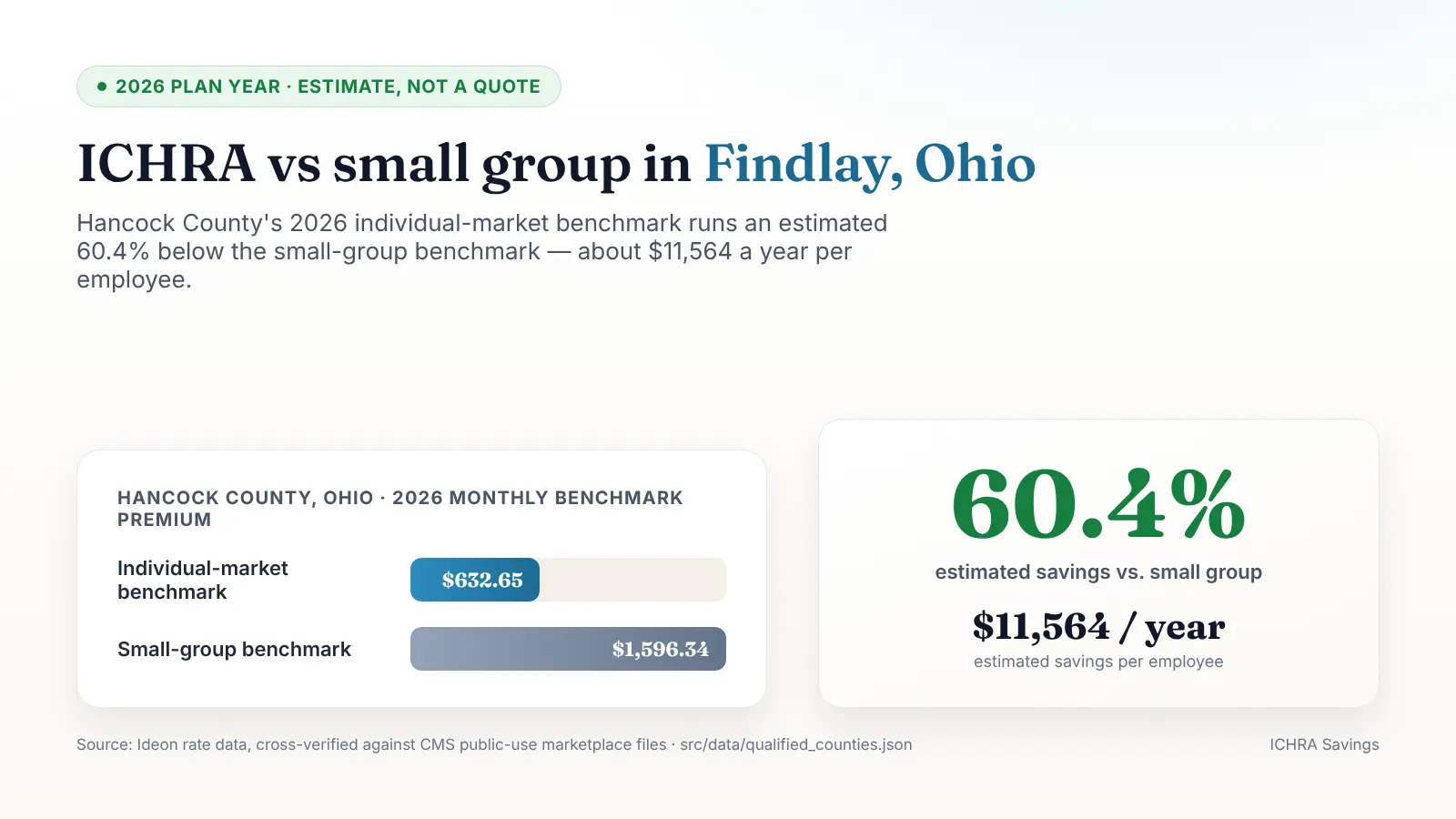
Hancock County's 2026 benchmark runs an estimated 60.4% below small group, about $11,564 a year per employee. See the Findlay, Ohio data, sourced.
The short version
- Hancock County's 2026 individual-market benchmark runs an estimated 60.4% below the small-group benchmark, about $11,564 per employee per year — above Ohio's statewide average of 54.9%, and the 4th-largest dollar gap of Ohio's 88 counties.
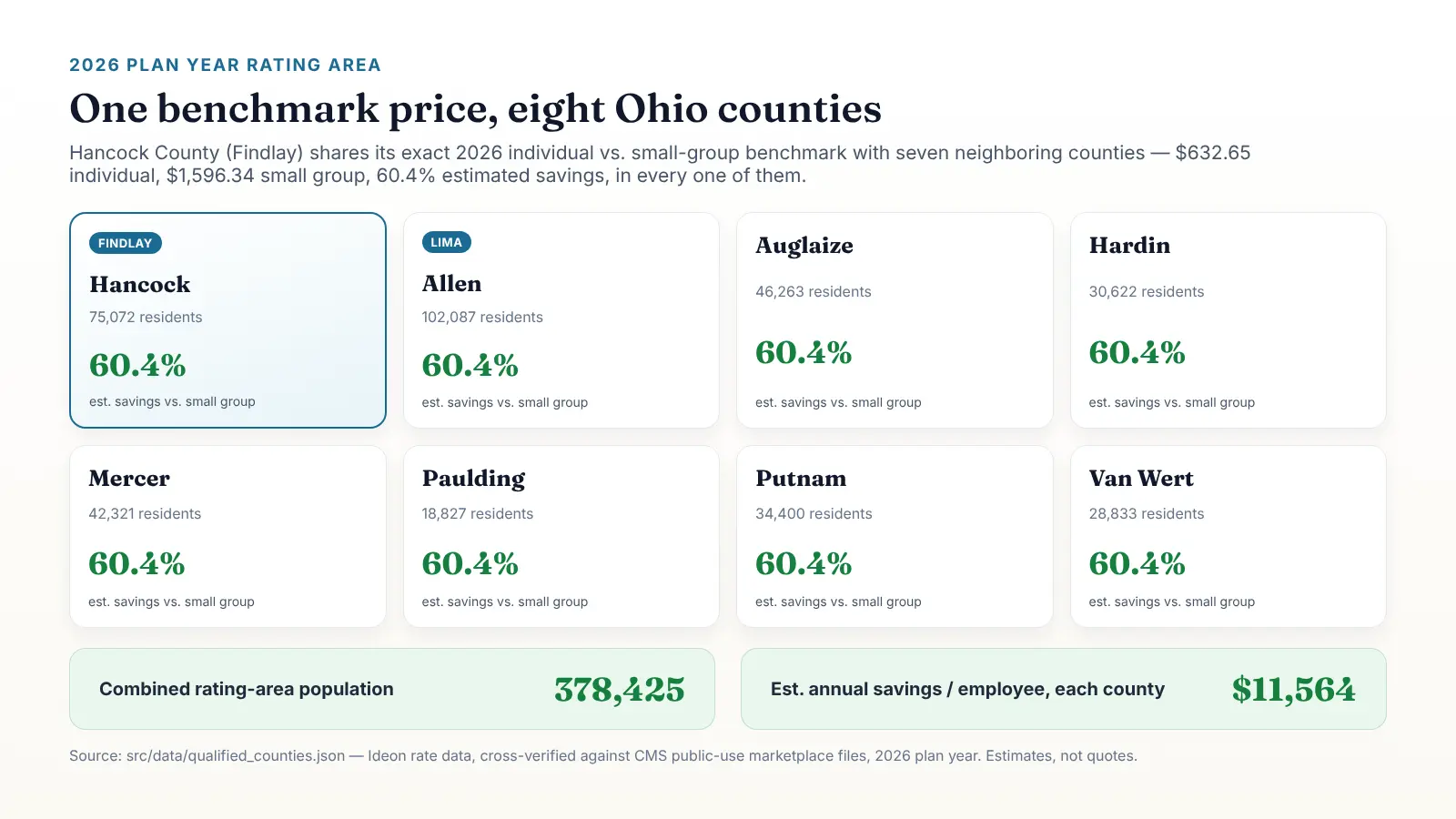
- Hancock's benchmark is shared, to the cent, with seven neighboring counties — Allen, Auglaize, Hardin, Mercer, Paulding, Putnam, and Van Wert — a rating area of roughly 378K people.
- Findlay's economy runs on three large, well-benefited anchors: Blanchard Valley Regional Health Center, Marathon Petroleum Corporation, and Whirlpool Corporation. None of the three needs this comparison; the smaller businesses around them do.
- Ohio isn't a borderline state the way some others are — all 88 Ohio counties clear our $100-a-month qualifying floor for 2026, and Hancock sits well above the middle of that list.
- Qualifying is not the same as guaranteed savings for your business. The honest limits are covered later, including where this comparison breaks down for a specific workforce.
Does ICHRA beat small group in Findlay, Ohio?
Yes, and the margin is one of the stronger ones we've found anywhere in Ohio. An ICHRA (Individual Coverage Health Reimbursement Arrangement, now also referred to by HealthCare.gov as a CHOICE Arrangement) is an IRS-defined arrangement that lets an employer set a fixed monthly reimbursement amount and let each employee buy their own individual-market plan with it, tax-free. In Hancock County, the Ohio county that contains Findlay, the 2026 individual-market benchmark premium runs an estimated 60.4% below the small-group benchmark premium, according to a county-by-county comparison built from Ideon rate data and cross-verified against CMS public-use marketplace files.
That 60.4% ranks 17 out of Ohio's 88 counties on percentage spread, above the statewide average of 54.9%. In raw dollars it ranks even higher: 4 of 88 counties statewide, at $11,564 a year per employee — a bigger per-employee gap than Ohio's largest, best-known metro counties show for their own residents, a comparison worth seeing in full later in this article.
Of the 1,309 counties nationwide in our dataset, every one of Ohio's 88 counties clears the $100-a-month gap we use as the floor for including a county at all. Hancock isn't just inside that list — it sits comfortably in the upper third of it, both on percentage and on dollars.
60.4%
Estimated Hancock County savings vs. small group
4/88
Rank by dollar savings among Ohio counties
75K
Hancock County residents
$11,564
Est. Hancock County savings per employee, per year
The employer problem this is actually solving
Findlay calls itself "Flag City, USA," per the city's own civic branding, and its economy has spent more than a century built around a few very large employers rather than a broad base of mid-sized ones. Marathon Oil operated out of Findlay from 1905 until it relocated its headquarters to Houston in 1990; its former subsidiary, Marathon Petroleum Corporation, became an independent company in 2011 and kept its headquarters in Findlay, according to Wikipedia's entry on the company. Cooper Tire & Rubber Company was founded in Findlay in 1914 and remained headquartered there for over a century before Goodyear acquired it in 2021. Whirlpool Corporation runs a dishwasher manufacturing plant in Findlay that is described, in the same source, as the largest dishwasher production plant in the world.
The City of Findlay's own 2024 Annual Comprehensive Financial Report puts numbers on that concentration. As of December 31, 2024, Hancock County's ten largest employers were Blanchard Valley Regional Health Center (3,165 employees, 27.53% of the reported top-10 total), Marathon Petroleum Corporation (2,159, 18.78%), Whirlpool Corporation (1,930, 16.79%), Goodyear (895, 7.79%, the former Cooper Tire operation), Findlay City Schools (865, 7.53%), the University of Findlay (548, 4.77%), Lowe's Distribution Center (511, 4.44%), Kohl's Distribution Center (507, 4.41%), Hancock County government (466, 4.05%), and Ball Metal (449, 3.91%) — a reported top-10 total of 11,495 jobs.
None of those ten organizations is shopping for the kind of small-group renewal this article is built around. A regional health system with over 3,100 employees, a Fortune 500 refiner's headquarters, and a global appliance manufacturer's flagship plant all run large-group benefits programs as a matter of scale — the same is generally true of a public school district and a county government. What's left, and what this article is actually for, is the layer of businesses around those ten: the independent clinics and diagnostic practices that refer to or contract with Blanchard Valley without being owned by it, the logistics and maintenance contractors that service the Marathon and Whirlpool campuses without being on their payroll, and the retail, hospitality, and professional-services firms competing for workers in a county where the ten biggest employers already offer real benefits. A twelve-person HVAC contractor or a fifteen-person accounting firm in Hancock County watches Blanchard Valley and Marathon run full benefits packages and concludes either that a group plan is out of reach at its size, or that it genuinely can't afford to offer anything at all — and loses candidates to the businesses around it that can. That's the pain this article answers: not "our renewal is too expensive," though that's covered too, but "we offer nothing, and we're losing people to companies that do."
Why 2026 and 2027 renewals keep landing high
For the Findlay-area employers who already carry a small-group plan, the renewal letter has been getting heavier for two straight years, and that isn't a local quirk. Nationally, small-group insurers filed a median proposed premium increase of 14% for the 2027 plan year, across 295 insurers filing in all 50 states and the District of Columbia, according to the Peterson-KFF Health System Tracker's brief published August 6, 2026 — up from an 11% median across 318 insurers for the 2026 plan year, per the same tracker's brief published September 24, 2025. Fifty-nine percent of insurers proposed 2027 increases between 10% and 20%.
Ohio's individual market tells a similarly pointed story. healthinsurance.org's Ohio marketplace guide, updated August 23, 2026, reports that 11 insurers offered ACA marketplace plans in Ohio for 2026, with an average unsubsidized rate increase of 19.8%, calculated before any premium tax credit. Separately, KFF's own tracking of national ACA marketplace competition found that the average number of insurers participating per state fell from 9.6 in 2025 to 9.0 in 2026, and that the number of counties served by only a single ACA issuer nationwide jumped from 93 to 165 — a shift KFF ties largely to Aetna CVS's exit from 17 states and other insurer departures following the expiration of enhanced premium tax credits at the end of 2025.
None of that changes the underlying mechanic that makes ICHRA work in a county like Hancock: what matters isn't whether either market's prices went up in isolation, it's whether individual rates rose relative to small-group rates in the same county and rating area. Hancock's gap has held for the entire 2026 plan year regardless of which direction each market moved on its own.
How an ICHRA (now also called CHOICE) actually works
Before the Hancock County numbers mean anything, it helps to be precise about what's being compared, since most of the confusion around ICHRA comes from skipping this step.
An ICHRA is an employer-funded health reimbursement arrangement created by a 2019 final rule from the IRS and Treasury, the Department of Labor, and HHS, published at 84 Fed. Reg. 28888 on June 20, 2019, effective August 19, 2019, and applicable to plan years beginning on or after January 1, 2020. HealthCare.gov now also refers to the same structure as a CHOICE Arrangement; the mechanics and the federal rules haven't changed, only the public-facing name. Instead of choosing one group health plan for everyone, the employer sets a fixed monthly reimbursement amount, and each employee uses that money to buy an individual-market plan of their own choosing, then submits proof of coverage (substantiation) to get reimbursed tax-free. The employer isn't picking a plan for fifteen different households; the employer is funding a budget, and the employee is doing the shopping.
The comparison behind every number in this article rests on two specific prices for a given county and rating area — the geographic zone insurance regulators use to set premiums, usually a cluster of neighboring counties. The individual-market benchmark premium is the second-lowest-cost silver-level plan available in that rating area to a representative 40-year-old enrollee. "Silver" refers to one of four ACA metal levels (bronze, silver, gold, platinum) describing how costs split between premium and out-of-pocket spending, not the quality of care. This is the same benchmark the federal government uses to calculate premium tax credits, which is why it's a defensible number to build a comparison on rather than one insurer's list price. The small-group benchmark premium is the equivalent figure built from comparable small-group plan filings for that same rating area. When the individual benchmark is lower, the county "qualifies," and the gap between the two is the estimated per-employee savings if the employer funds ICHRA at that benchmark level.
Two more terms matter once an employer is actually deciding whether to switch. The affordability safe harbor is the test that decides whether the ICHRA offer counts as "affordable" under IRS rules — for plan years beginning in 2026 that test runs against a Required Contribution Percentage of 9.96% of household income (IRS Rev. Proc. 2025-25), rising to 10.22% for plan years beginning in 2027 (IRS Rev. Proc. 2026-26). Get the contribution amount wrong relative to that threshold and an employer can trigger a penalty tied to the employer mandate, the ACA requirement that applies to ALEs (applicable large employers, generally 50 or more full-time-equivalent employees). Smaller, non-ALE employers aren't subject to that mandate at all, which covers most of the contractors and small practices described above.
One structural piece is often misunderstood: an employer can define different employee classes — for example, full-time versus part-time, or by geographic rating area — and offer different benefits to each class, subject to federal minimum-size rules for some class types. What an employer cannot do is offer the same class of employees a choice between ICHRA and a traditional group plan; it's one or the other, per class, not both at once for the same people.
Hancock County's rate spread, in dollars
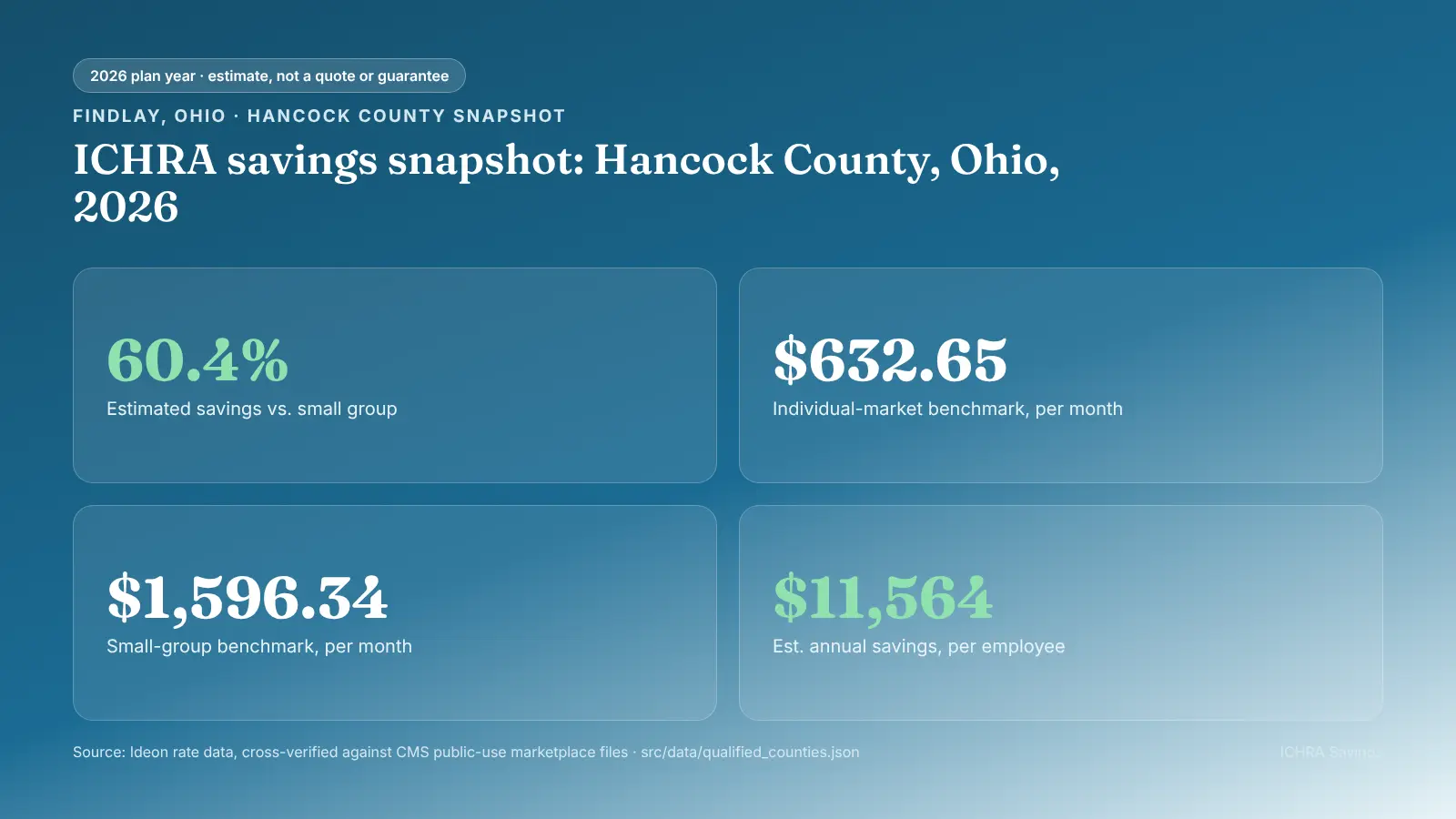
Here is the actual 2026 benchmark comparison for Hancock County, the county that contains Findlay. The individual-market benchmark premium is $632.65 a month. The small-group benchmark premium, built from comparable small-group plan filings for the same rating area, is $1596.34 a month. That's a gap of $963.69 a month, or $11,564 a year, per employee, an estimated 60.4% in favor of the individual market.
A top-tier number, not a modest one
Hancock County's 60.4% sits above Ohio's 54.9% statewide average, and its dollar figure, $11,564 a year per employee, ranks 4th of the state's 88 counties. That's real money for a 15- or 20-person company, and it's near the top of what Ohio's own dataset shows anywhere in the state.
See the full Ohio savings breakdown for every county, or the national savings map to look up a specific county by name.
Why Hancock's dollar figure beats Ohio's biggest counties
It would be easy to assume a bigger city means a bigger savings number. Hancock County, with 75K residents, is a fraction of the size of Ohio's largest counties — and its per-employee dollar savings beats every one of them.
| County (city) | Population | Savings vs. small group | Est. annual savings / employee |
|---|---|---|---|
| Franklin (Columbus) | 1,318,149 | 59.6% | $10,624 |
| Cuyahoga (Cleveland) | 1,256,620 | 48.6% | $7,414 |
| Hamilton (Cincinnati) | 827,671 | 62.3% | $10,675 |
| Summit (Akron) | 539,361 | 38.8% | $4,433 |
| Montgomery (Dayton) | 536,121 | 58.3% | $10,014 |
| Lucas (Toledo) | 430,014 | 57.0% | $9,514 |
| Butler (Hamilton) | 388,327 | 62.3% | $10,675 |
| Stark (Canton) | 374,199 | 41.1% | $4,692 |
| Hancock (Findlay) | 75K | 60.4% | $11,564 |
Every one of Ohio's eight most populous counties — home to Columbus, Cleveland, Cincinnati, Akron, Dayton, Toledo, the city of Hamilton, and Canton — shows a lower per-employee dollar savings than Hancock County does. That's not a knock on those counties; it reflects how each rating area's carriers happened to price small-group versus individual coverage for 2026, which has little to do with a county's size or economic weight. It is the clearest illustration in this dataset of why a statewide or metro-level average can mislead: check your own county, not a regional headline number, before you model a rollout.
How Ohio's 88 counties break down by savings tier
Number of counties in each savings band, 2026 plan year. Source: Ideon rate data, cross-verified against CMS public-use files.
Hancock sits in the top "60%+" band. Illustrative and rounded; not an offer of insurance or a guarantee of savings.
The eight-county rating area that shares this number
Hancock County doesn't stand alone. It sits inside one of the largest shared-pricing clusters we've found anywhere in Ohio: a federal rating area that also covers Allen, Auglaize, Hardin, Mercer, Paulding, Putnam, and Van Wert counties, all carrying the exact same 2026 benchmark comparison — a $632.65 individual benchmark against a $1596.34 small-group benchmark, the same 60.4% spread and the same $11,564 estimated annual savings per employee, in every one of the eight. Combined, the eight counties hold an estimated 378K residents. A Findlay-based employer with staff commuting in from any of the other seven doesn't need to run a separate calculation for them — the same math applies across the shared rating area.
Allen County, the largest of the eight by population at 102K residents and home to Lima, already has its own dedicated guide on this site — see ICHRA in Lima, Ohio for that county's full local context. The table below shows all eight.
| County | Population | Individual benchmark | Small-group benchmark | Savings vs. small group |
|---|---|---|---|---|
| Hancock (Findlay) | 75K | $632.65 | $1596.34 | 60.4% |
| Allen (Lima) | 102K | $632.65 | $1596.34 | 60.4% |
| Auglaize | 46K | $632.65 | $1596.34 | 60.4% |
| Hardin | 31K | $632.65 | $1596.34 | 60.4% |
| Mercer | 42K | $632.65 | $1596.34 | 60.4% |
| Paulding | 19K | $632.65 | $1596.34 | 60.4% |
| Putnam | 34K | $632.65 | $1596.34 | 60.4% |
| Van Wert | 29K | $632.65 | $1596.34 | 60.4% |
Why three well-benefited employers don't solve this for everyone else
Hancock County's private economy is unusually concentrated around a handful of large institutions. Per the City of Findlay's 2024 financial report, Blanchard Valley Regional Health Center, Marathon Petroleum Corporation, and Whirlpool Corporation together account for 7,254 of the 11,495 jobs reported across the county's top 10 employers — well over half. Add Findlay City Schools and the University of Findlay, and public-sector and higher-education employment accounts for another 1,413 jobs in the same list.
None of those institutions is shopping for the kind of small-group plan this article is built around. A regional health system with over 3,100 employees runs its own large-group benefits program as a matter of scale. A Fortune 500 refiner's corporate headquarters and a flagship global-manufacturing plant operate under large-employer benefit structures of their own. What's left — and what this article is actually for — is the layer of smaller businesses around them: independent medical and dental practices that refer patients to Blanchard Valley without being owned by it, logistics and maintenance contractors that service the Marathon campus and the Whirlpool plant without being on their payroll, and the restaurants, retailers, and professional-services firms competing for labor in a county where the ten largest employers already offer real benefits.
Blanchard Valley, Marathon, and Whirlpool don't need this comparison. The clinics, contractors, and shops that supply and surround them do — and Hancock County's number is one of the strongest in the state, not a marginal one.
Mike MooreOhio's group participation rule, and why there's no state-set ceiling
Small-group health insurance isn't sold to individual employees one at a time; it's underwritten as a pool, and a carrier can require a minimum share of a company's eligible employees to actually enroll before it will issue the policy at all. Ohio law defines this mechanic in Ohio Revised Code § 3924.03(E)(1), which states that "'group participation rule' means a requirement relating to the minimum number of employees or dependents that must be enrolled in relation to a specified percentage or number of eligible individuals or employees of an employer." The same subsection permits a small-group carrier to establish such a rule "as allowed under the law of this state," but the statute itself does not cap the percentage a carrier is allowed to require statewide.
In practice, that means a Hancock County employer shopping small-group coverage may see a different minimum-participation requirement from one carrier to the next, confirmed plan by plan rather than published in one place. A twelve-person machine shop with a part-timer, a new hire still inside a waiting period, or an employee already covered through a spouse at Blanchard Valley or Marathon can end up short of whatever bar a given carrier sets, even though every one of those employees technically has coverage somewhere.
An ICHRA (or CHOICE Arrangement, per HealthCare.gov's current naming) sidesteps the mechanic entirely when it's the only benefit offered. Per HealthCare.gov, there is no participation-percentage requirement at all in that case — generally, employers of any size can offer one if they have at least one eligible employee who isn't a self-employed business owner or the owner's spouse. There are also no annual minimum or maximum contribution requirements. A minimum class size only applies when an employer offers a CHOICE Arrangement to one employee class while also offering a traditional group plan to a different class: 10 employees for employers with fewer than 100 total employees, 10% of the workforce for 100 to 200 employees, and 20 employees for more than 200. Those class-size rules don't apply at all to an employer offering only a CHOICE Arrangement, which describes most Hancock County small businesses.
If a group quote already fell through on participation
If you've already tried to set up small-group coverage in the Findlay area and a carrier's participation requirement blocked the quote, that's a specific, common signal that an ICHRA is worth pricing out next, since the mechanic that blocked you doesn't apply to it when it's the only benefit you offer.
A worked example for a Findlay employer
Here's what the Hancock County numbers look like applied to a real headcount. Assume a 16-employee Findlay company currently renewing a small-group plan priced at this year's Hancock County benchmark.
Here's the math
The 2026 small-group benchmark in Hancock County is $1596.34 a month per employee, or $19156.08 a year. The 2026 individual-market benchmark is $632.65 a month, or $7591.80 a year. The difference is $11,564 a year per employee. For a 16-person company, funding ICHRA contributions at the benchmark level instead of renewing small group works out to an estimated $185,028 a year in aggregate savings.
This is illustrative math built from real 2026 county rate data and a hypothetical headcount. It is not a quote, and it assumes the employer sets the ICHRA contribution at the benchmark level, which is a design choice, not a requirement. Your actual number depends on your employees' ages, exact home counties, and the plans they choose once they're shopping with their own budget.
The same arithmetic scales down to the kind of company this article opened on: a 6-person independent clinic or contractor near Blanchard Valley or the Marathon campus that has never offered benefits at all. That company could fund an ICHRA at the $632.65 individual benchmark and offer a real, tax-free benefit for about $ 3796 a month in total contributions, or roughly $ 45,551 a year for the whole company — a genuine first benefit offered to every eligible employee, with no enrollment percentage to clear.
At the other end of the size range, a 55-employee Findlay company crosses into ALE territory under the employer mandate, which changes the calculus without changing the underlying county math. The same Hancock County benchmark comparison applies, but an ALE has to run the affordability safe-harbor test — against the 9.96% threshold for 2026 or 10.22% for 2027 — carefully for every employee class, since an ICHRA offer judged "unaffordable" for even a handful of lower-paid employees can trigger an employer-mandate penalty. That's not a reason to avoid ICHRA at 55 employees; it's a reason to model the affordability test before setting a contribution amount, which our eligibility guide walks through in detail.
How ICHRA adoption is actually growing
Hancock County's numbers sit inside a national adoption trend that keeps compounding. The HRA Council's fifth annual report, Growth Trends for ICHRA & QSEHRA, Vol. 5 (released August 12, 2026, data current through January 31, 2026), found that ICHRA-covered lives surpassed 500,000 nationally at the start of 2026, spread across more than 20,000 U.S. businesses now offering ICHRA or QSEHRA. Adoption among applicable large employers (ALEs) more than doubled year over year, the fastest-growing segment in the report.
The number that matters most for the Findlay employer this article opened on — the small clinic, contractor, or shop that has never offered coverage, or couldn't get a group quote to go through: over two-thirds of small businesses offering ICHRA had previously offered no health coverage options at all, and 93% of small employers newly adopting QSEHRA in 2026 had never offered coverage before. For most small Hancock County businesses, the realistic comparison usually isn't "ICHRA versus our current group plan." It's "ICHRA versus offering nothing," which is a much easier case to make than it sounds.
New coverage, not a switch
Over two-thirds of small ICHRA employers had never offered coverage before.
500,000+ lives covered nationally
ICHRA-covered lives surpassed 500,000 at the start of 2026, across 20,000+ businesses.
Large employers are following
ALE adoption more than doubled year over year, the fastest-growing segment.
Setting up an ICHRA in Findlay
Ohio does not layer state-specific ICHRA rules on top of the federal framework. The same IRS, Department of Labor, and HHS final rule that governs ICHRA everywhere applies here. What determines whether a Findlay rollout goes smoothly:
- Pull your census by county, not by office address. A company headquartered in Findlay with staff living in Allen, Auglaize, or any of the other six rating-area counties shares the same numbers — but a company with staff further out may not.
- Check every employee's actual county on the savings map. Even in a state where every county qualifies, the percentage and dollar figures vary meaningfully by rating area — this step is still worth ten seconds per employee.
- Model affordability before you set a contribution. The reimbursement level decides whether an employee keeps or waives premium tax credit eligibility, against the 9.96% (2026) or 10.22% (2027) Required Contribution Percentage.
- Define employee classes carefully, if you use them. Class rules carry minimum-size requirements and cannot offer the same class a choice between ICHRA and group coverage.
- Send the required notice on time. Eligible employees need written notice at least 90 days before the plan year starts, with specific required content.
- Budget for onboarding support. Employees who have never shopped the individual market on their own need guidance, once, at enrollment.
See our full ICHRA setup timeline for the detailed rollout plan, including the exact notice content requirements, and our eligibility guide for the affordability test itself. Before anything else, it's worth checking whether your county is one where this works at all: the national savings map takes about ten seconds to search.
If your employer just offered you an ICHRA
This guide is written for the employer side of the decision, but if you're a Hancock County employee who was just told your benefit is changing, the short version is: you'll get a fixed monthly amount and shop for your own plan on the individual market instead of picking from your employer's group menu. Our guide for employees walks through what to expect.
The honest limits of this data
A strong county average is not a guarantee for your business
- A benchmark comparison is not your actual renewal. The $1596.34 Hancock County figure is a small-group benchmark built from filed rates, not your specific carrier's quote for your specific group.
- Most of Hancock County's workforce already has real benefits. Blanchard Valley, Marathon, Whirlpool, the schools, and the university together employ a large share of the county, and none of them is this article's audience. The realistic addressable market is smaller than the county's total headcount.
- An older or higher-risk workforce changes the real-world math. Benchmark premiums are built around a representative 40-year-old enrollee; a company with an older average age could see a different real-world spread than the headline figure implies.
- Rates move every plan year. A carrier entering or leaving the rating area can shift the comparison for 2027; recheck before every renewal, not just once.
- Waiving the premium tax credit is part of the deal. An employee whose ICHRA offer is deemed affordable generally cannot also claim a marketplace subsidy for that month. Model both sides before assuming the reimbursement is pure upside for the employee.
- Participation-minimum relief is a structural point, not a guarantee of enrollment. ICHRA removes the carrier-side participation percentage when it's the only benefit offered, but employees still have to actually use their reimbursement to buy a plan for the arrangement to do them any good.
If your renewal letter is already sitting on your desk and you're working against a deadline, it's worth a conversation before you sign: book time with our team. If you'd rather work through the mechanics on your own first, start with how ICHRA works and come back when you have questions.
How these numbers are calculated
Every county figure in this article comes from the same dataset that powers our savings map, not a survey or a sales estimate. For each county, we compare a 2026 individual-market benchmark premium — the second-lowest-cost silver plan available to a representative enrollee, the same benchmark the federal government uses to calculate premium tax credits — against a small-group benchmark premium built from comparable small-group plan filings for that rating area. Both figures come from Ideon, a licensed insurance rate-data provider, and are cross-verified against CMS public-use marketplace files before publication. A county "qualifies" for our dataset when the individual benchmark sits below the small-group benchmark by at least $100 a month; the percentage and dollar figures in this article are the gap between those two numbers, expressed as an annual per-employee figure at 12 times the monthly difference. Hancock County's population figure (75K) comes from the same underlying county dataset used across the site; Findlay's own city population (40,313 at the 2020 census, an estimated 40,370 in 2025) comes separately from U.S. Census Bureau data as compiled in Wikipedia's "Findlay, Ohio" entry.
The national small-group figures (11% median for 2026 across 318 insurers; 14% median for 2027 across 295 insurers), the national insurer-participation figures (9.6 to 9.0 issuers per state; 93 to 165 single-issuer counties), Ohio's own marketplace figures (11 insurers, 19.8% average 2026 increase), the IRS affordability percentages, the HRA Council adoption figures, the City of Findlay's principal-employer figures, and the fact that Ohio has 88 counties (per Wikipedia's "List of counties in Ohio") each come from separately published, independent sources, not from our own county dataset, and describe national, statewide, or local context rather than the Hancock-specific benchmark comparison above. We've kept these data sources clearly separate throughout this article rather than blending them into one number.
The Bureau of Labor Statistics' Quarterly Census of Employment and Wages reports 1,954 establishments, an average employment of 43,831, and an average weekly wage of $1,247 for Hancock County (area code 39063) across 2025 — broader labor-market context for the county, not a figure used in the savings calculation itself.
Three limitations are worth stating plainly. First, benchmark premiums are built around a representative enrollee profile, so an unusually young or unusually old workforce will see a different real-world spread than the county figure implies. Second, these are benchmark plans, not every plan on the market; an employee who chooses a richer or leaner plan than the benchmark will see a different premium, though the relative spread tends to hold directionally. Third, rates are filed and refreshed annually, so a county that qualifies for 2026 is not guaranteed to show the same gap for 2027 if a carrier enters or exits that market.
Questions Findlay employers actually ask
Does ICHRA beat small-group insurance in Findlay, Ohio?
Yes, comfortably. Findlay is the county seat of Hancock County, and Hancock's 2026 individual-market benchmark premium runs an estimated 60.4% below the small-group benchmark, about $11,564 per employee per year. That ranks 17 of Ohio's 88 counties by percentage, above the statewide average of 54.9%, and 4 of 88 by raw dollar savings — one of the largest dollar gaps in the state, bigger than what Columbus, Cleveland, Cincinnati, or Akron show for their own counties.
Why does Hancock County share its exact benchmark with seven other counties?
Ohio prices health insurance by federal rating area, a geography covering a cluster of neighboring counties that all get filed the identical benchmark price for a given plan year — the pattern our dedicated guide to Ohio's rating areas explains in full. Hancock's rating area is one of the largest we've found in the state: it also covers Allen, Auglaize, Hardin, Mercer, Paulding, Putnam, and Van Wert counties, an area of roughly 378K residents that all share the identical $632.65 individual and $1596.34 small-group benchmark for 2026.
How much can a Findlay-area employer expect to save?
Using 2026 benchmark data, the estimated gap in Hancock County is $963.69 a month, or $11,564 a year, per employee. For a 16-person company, that is roughly $185,028 a year in aggregate estimated savings if the employer funds ICHRA contributions at the benchmark level instead of renewing small group. This is illustrative math from public rate data, not a projection of what any specific employer will actually pay.
Are Blanchard Valley, Marathon Petroleum, or Whirlpool employees covered by this comparison?
Not really, and that's by design. Per the City of Findlay's 2024 Annual Comprehensive Financial Report (Table 16, Principal Employers, as of December 31, 2024), Blanchard Valley Regional Health Center (3,165 employees), Marathon Petroleum Corporation (2,159), and Whirlpool Corporation (1,930) are Hancock County's three largest private employers, together accounting for more than 60% of the city's top-10 reported employment base. Organizations that size run their own large-group benefits programs as a matter of scale. This article is written for the independent clinics, logistics firms, contractors, and smaller manufacturers that operate around those three anchors without being part of them.
What happened to Cooper Tire's spot on Findlay's top-employer list?
It disappeared. The same City of Findlay financial report shows Cooper Tire & Rubber Company as Hancock County's third-largest employer in 2015, with 1,575 workers (13.56% of the top-10 total). By the 2024 report, Cooper Tire doesn't appear in the top 10 at all — Goodyear does, at 895 employees (7.79%), reflecting Goodyear's 2021 acquisition of the Findlay-headquartered tire maker, founded there in 1914. Blanchard Valley Regional Health Center more than doubled its headcount over the same nine years, from 1,536 to 3,165, moving from fourth place to first.
Why did my 2026 or 2027 small-group renewal come in higher than expected?
Nationally, small-group insurers filed a median proposed premium increase of 14% for the 2027 plan year, across 295 insurers filing in all 50 states and the District of Columbia, per the Peterson-KFF Health System Tracker's brief published August 6, 2026 — up from an 11% median across 318 insurers for the 2026 plan year, per the same tracker's brief published September 24, 2025. Fifty-nine percent of insurers proposed 2027 increases between 10% and 20%. On Ohio's individual-market side specifically, healthinsurance.org's Ohio marketplace guide (updated August 23, 2026) reports an average unsubsidized rate increase of 19.8% for 2026, across the 11 insurers offering ACA marketplace plans in the state.
Does Ohio impose any state-specific ICHRA rules?
No. ICHRA is a federal HRA structure created by a 2019 final rule from the IRS and Treasury, the Department of Labor, and HHS (84 Fed. Reg. 28888, published June 20, 2019, effective August 19, 2019, applicable to plan years beginning on or after January 1, 2020), and it works the same way in Ohio as in any other state. Ohio does set its own rules for how small-group carriers structure participation requirements, under Ohio Revised Code § 3924.03, but that affects group-plan underwriting, not any ICHRA compliance requirement, which remains entirely federal.
What happens to my employees' premium tax credit if I switch to ICHRA?
An employee who is offered an affordable ICHRA generally becomes ineligible for a premium tax credit for any month that offer applies, whether or not they accept it. Affordability is measured against the IRS's Required Contribution Percentage, which is 9.96% of household income for plan years beginning in 2026 (Rev. Proc. 2025-25) and rises to 10.22% for plan years beginning in 2027 (Rev. Proc. 2026-26). Model that test before you set a contribution amount for any Hancock County employee currently receiving marketplace subsidies.
Sources
- Peterson-KFF Health System Tracker, "How Much and Why Premiums Are Going Up for Small Businesses in 2027" (Aug. 6, 2026)
- Peterson-KFF Health System Tracker, "How Much and Why Premiums Are Going Up for Small Businesses in 2026" (Sep. 24, 2025)
- KFF, "How Has Insurer Participation in the ACA Marketplaces Changed in 2026?"
- healthinsurance.org, "Ohio Health Insurance Marketplace" guide (updated Aug. 23, 2026)
- IRS Revenue Procedure 2025-25 — Required Contribution Percentage, plan years beginning in 2026 (9.96%)
- IRS Revenue Procedure 2026-26 — Required Contribution Percentage, plan years beginning in 2027 (10.22%)
- 84 Fed. Reg. 28888 — ICHRA final rule, Departments of the Treasury/IRS, Labor, and Health and Human Services (June 20, 2019)
- HealthCare.gov, "CHOICE Arrangements" — participation and class-size rules; naming update from "Individual Coverage HRA"
- Ohio Legislative Service Commission, Ohio Revised Code § 3924.03(E)(1) — definition of "group participation rule" for small-employer health benefit plans
- HRA Council, "Growth Trends for ICHRA & QSEHRA, Vol. 5" (Aug. 12, 2026)
- City of Findlay, Ohio, Annual Comprehensive Financial Report for the Year Ended December 31, 2024 — Table 16, Principal Employers, current year and nine years ago
- Wikipedia, "Findlay, Ohio" — population figures, Marathon Petroleum and Cooper Tire corporate history, Whirlpool plant
- Wikipedia, "List of counties in Ohio" — 88 counties
- U.S. Bureau of Labor Statistics, Quarterly Census of Employment and Wages — Hancock County, Ohio (area code 39063), 2025 annual averages
- County-level premium comparison:
src/data/qualified_counties.json, 2026 plan year (Ideon rate data, cross-verified against CMS public-use marketplace files)