ICHRA for First-Time Benefits: A 2026 Cost Guide
How much a 5 to 50 employee business actually pays to offer health benefits for the first time with an ICHRA in 2026, using IRS, KFF, and county-level data.
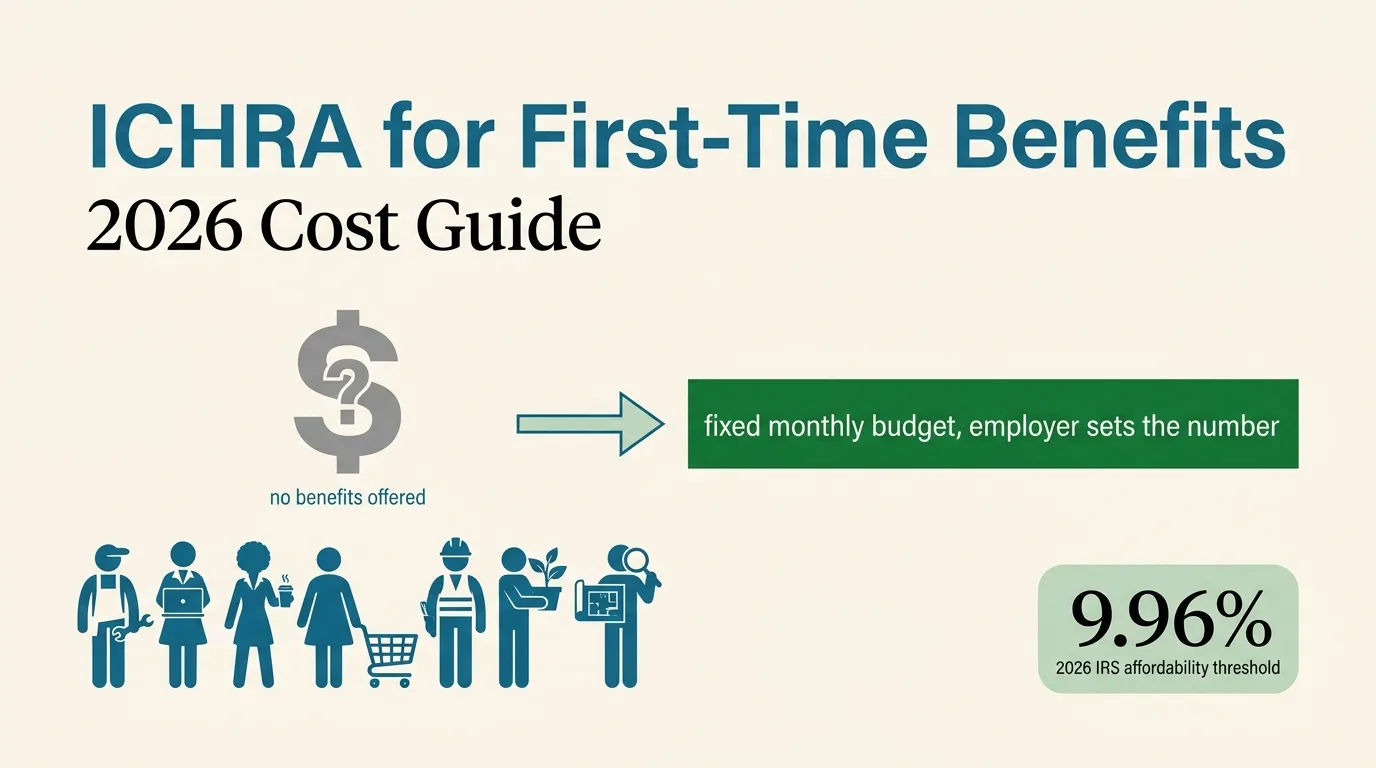
The short version
- There is no minimum headcount. Per HealthCare.gov, any employer with at least one non-owner employee can offer an ICHRA.
- The 2026 IRS affordability threshold is 9.96% of household income, per IRS Revenue Procedure 2025-25, and its dollar-based shortcut, the FPL safe harbor, works out to an estimated $129.90 a month, using the 2025 federal poverty guideline of $15,650 for one person.
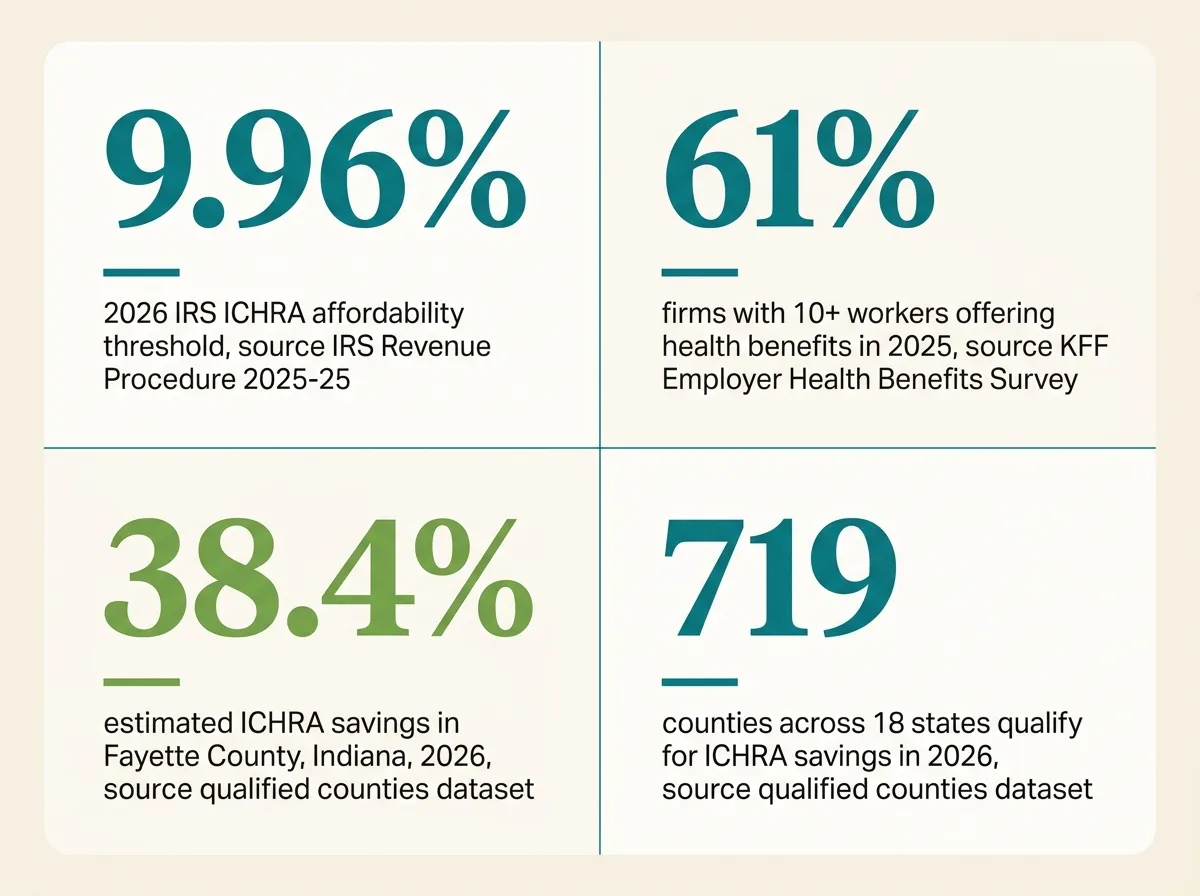
- Whether an ICHRA beats a first small-group plan on price is a county question. Our dataset shows 719 qualifying counties across 18 states for 2026, and plenty of counties that do not qualify.
- Only 59% of firms with fewer than 200 workers offered any health benefit in 2025, versus 97% of firms with 200 or more, per KFF. Most businesses reading this are in the group that has never offered anything.
- Starting an ICHRA generally means an employee waives premium tax credit eligibility for any month an affordable offer applies. Model that before choosing a number.
What a first ICHRA budget actually costs
If your business has never offered health coverage, the honest short answer is this: a first ICHRA contribution can be set anywhere from roughly $100 a month per employee up to a full county benchmark premium, and what it actually costs you depends far more on where your employees live than on any national average. Two numbers do most of the work in that decision. The first is the 2026 IRS affordability threshold, which Revenue Procedure 2025-25 sets at 9.96% of household income for plan years beginning in 2026, the highest that percentage has ever been. The second is your county's individual-market benchmark premium, the actual price of a mid-tier individual plan where your team lives, which our dataset tracks for 719 counties across 18 states.
Put those two together and a $250-a-month-per-employee ICHRA can be more than enough in a low-cost Midwest county and clearly short in an expensive New York suburb. There is no single right number for "a first benefit." There is a right number for your specific counties, and the rest of this guide works through how to find it, using figures pulled directly from the IRS, HHS, and KFF this year, not last year's numbers or a vendor's rounded estimate.
The affordability floor
9.96% of household income for 2026, or an estimated $129.90 a month under the FPL shortcut.
The local price
What an individual plan actually costs in your employees' specific counties, which our data tracks directly.
Your own budget ceiling
What you can actually afford as a fixed monthly number, chosen once and controlled by you going forward.
The 39% of small firms offering nothing
Most articles about employee benefits are written for a company that already has a plan and is deciding whether to switch it. This one is not. It is written for the business that has never offered anything, and there are more of those than the trade press usually admits. According to KFF's 2025 Employer Health Benefits Survey, a national survey of employers with 10 or more workers fielded between January and July 2025, 61% of firms with 10 or more employees offered health benefits to at least some of their workers in 2025. That means 39% did not. Firms with 200 or more workers offer benefits at a 97% rate; firms with fewer than 200 workers offer them at a 59% rate. Most small businesses in the United States are on the "does not offer" side of that split, not the "offers" side, no matter how it feels from inside a single company that already has a plan.
That gap is not just a benefits problem. It is a hiring problem. When a candidate is weighing two similar-sized job offers and one comes with any form of health coverage and the other does not, the business offering nothing is competing on salary alone, in a labor market where salary is not the only thing people are pricing. It also tends to compound: the KFF survey found that among firms with 10 to 199 workers that do not currently offer benefits, 2% say they are "very likely" and 16% say they are "somewhat likely" to offer an ICHRA specifically within the next two years. Put together, that is 18% of non-offering small firms already circling this exact decision, which tells you the business reading this article right now is not an outlier. It is part of a real, measurable shift.
ICHRA already shows up in the "offers nothing" data
Per the same KFF survey, 9% of firms that do not otherwise offer health benefits already provide some employees funds to buy non-group coverage, the mechanism an ICHRA formalizes, compared to 4% of firms that offer a traditional group plan. For a business with no existing plan to protect or unwind, an ICHRA is frequently the more natural starting point than building a small-group plan from zero.
Why small employers skip benefits in the first place
It is rarely because owners do not want to offer something. Three structural reasons show up again and again in the KFF data and in what we hear directly from employers.
The sticker price is real. The average annual premium for employer-sponsored family coverage nationally was $26,993 in 2025, per KFF, and covered workers at firms with 10 to 199 employees already pay an average of $8,889 of that themselves for family coverage, higher than the $6,227 average at larger firms. For a five-person company, underwriting even a modest share of a group premium for every employee is a real line item, and it moves every year at the carrier's discretion, not the employer's.
Small-group participation rules bite hardest at low headcounts. Most fully-insured small-group carriers require a minimum share of eligible employees to enroll, often around 70 to 75%, before they will issue or renew a policy. At five or ten employees, losing two people to a spouse's plan or to opting out can tip a company below that threshold and put the whole group plan at risk. This is a structural reason smaller firms disproportionately skip group coverage altogether rather than fight to keep a plan alive.
Nobody wants to be the one who picked the plan that failed someone. With a single group plan, the employer chooses the carrier, network, and drug formulary for every employee, which means the employer also owns it when that plan does not cover a particular doctor or medication an employee needs. That is an uncomfortable position for a business owner who is not a benefits professional, and it is one reason "we will figure this out later" becomes the default.
An ICHRA removes the second and third reasons almost entirely: there is no carrier participation minimum, and the employer sets a dollar budget rather than picking a plan. It does not remove the first reason, the sticker price, but it does let the employer choose exactly how much of that price to carry, instead of accepting whatever a group renewal quotes.
What an ICHRA actually is, in plain terms
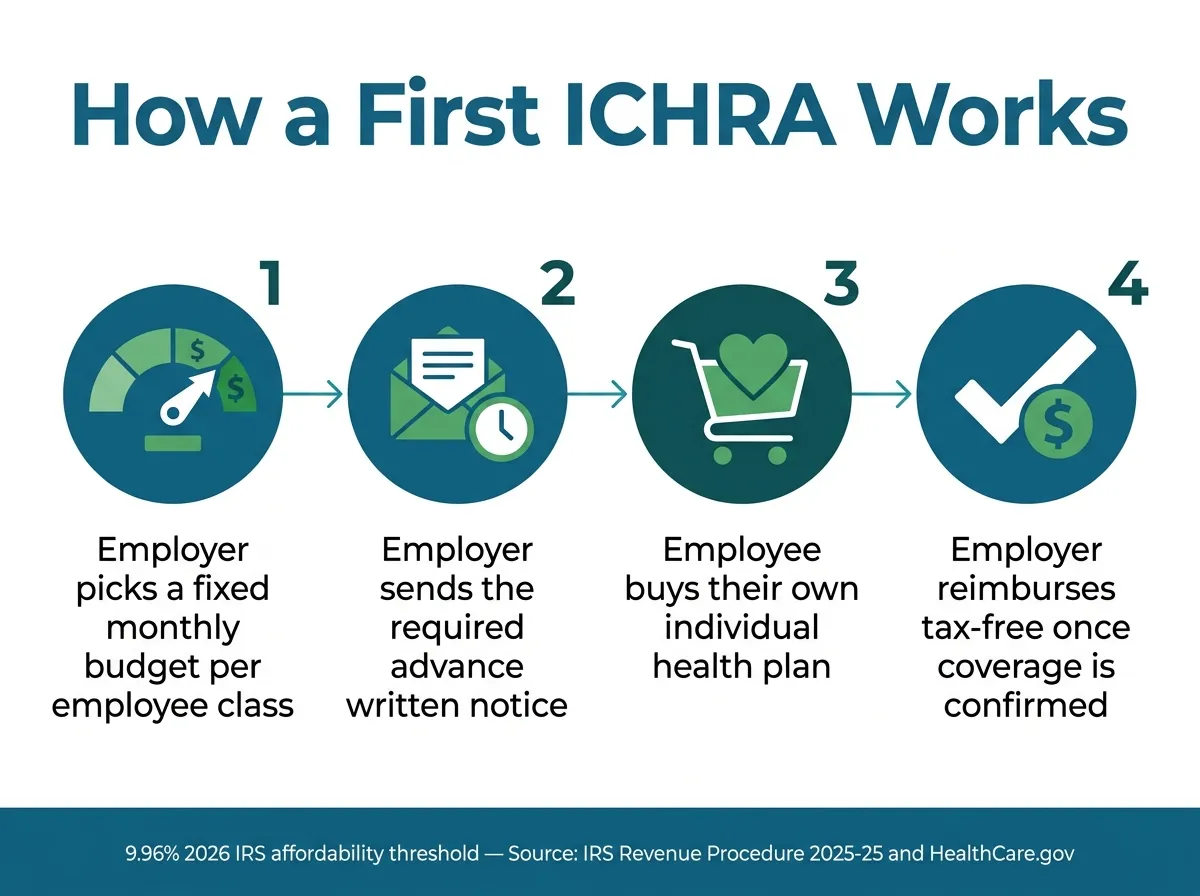
ICHRA stands for Individual Coverage Health Reimbursement Arrangement. It is not an insurance policy and not a product ICHRA Savings or any broker invented; it is a type of account-based benefit created by a 2019 federal rule from the Treasury Department, the Department of Labor, and the Department of Health and Human Services. The mechanics are simple even though the compliance language around them is not: the employer picks a fixed monthly dollar amount, employees use that amount to buy their own individual health insurance plan on or off the Marketplace, and the employer reimburses them, tax-free, up to the amount they were allotted, once they show proof they actually have coverage. Per HealthCare.gov, employers "provide tax-free reimbursements to employees for qualified medical expenses up to a set annual amount," and there are "no annual minimum or maximum contribution requirements" imposed by the federal government on that number.
A few more terms worth defining once, since they come up throughout the rest of this guide and the compliance language rarely explains them in order:
- Employee class. A permitted way to split your workforce for benefits purposes, such as full-time versus part-time, salaried versus hourly, or by geographic rating area. You can offer an ICHRA to one class and a group plan, or nothing, to another, but you cannot let the same class choose between an ICHRA and a group plan.
- Affordability. A federal test that determines whether an ICHRA offer is considered "affordable" for a given employee, based on what that employee would still have to pay out of pocket for the lowest-cost self-only silver plan available to them after your contribution. The threshold for 2026 is 9.96% of household income.
- Premium tax credit (PTC). The ACA subsidy that lowers what someone pays for Marketplace coverage based on income. An employee cannot use both a PTC and an affordable ICHRA offer in the same month; they have to pick one.
- Substantiation. The process of an employee showing proof of individual coverage, typically once at enrollment and then annually, before an ICHRA can reimburse them. Most employers use a third-party administrator to automate this rather than collecting documents by hand.
- FPL safe harbor. One of three IRS-approved shortcuts employers can use to prove an ICHRA offer is affordable without checking every employee's actual income. It is explained in detail in the next two sections.
The 2026 numbers behind this decision
Table 1 collects the sourced national figures behind this article. Read the KFF figures as market context for what a first benefit typically looks like, and the IRS and HHS figures as the two inputs that decide whether any specific ICHRA contribution counts as affordable.
| Figure | Value | Geography | Source |
|---|---|---|---|
| Firms with 10+ workers offering health benefits, 2025 | 61% | National | KFF 2025 Employer Health Benefits Survey |
| Offer rate, firms under 200 workers vs. 200+ workers, 2025 | 59% vs. 97% | National | KFF 2025 Employer Health Benefits Survey |
| IRS required contribution percentage, plan years beginning 2026 | 9.96% | National | IRS Rev. Proc. 2025-25; confirmed independently by HealthCare.gov |
| 2025 federal poverty guideline, household of one, 48 states + DC | $15,650 | 48 contiguous states + DC | Federal Register Vol. 90, No. 11 (HHS) |
| Derived 2026 FPL safe-harbor monthly amount | $130/mo | 48 contiguous states + DC | Calculated: FPL × 9.96% ÷ 12 (IRS + HHS inputs above) |
| Average annual single-coverage premium, 2025 | $9,325 | National | KFF 2025 Employer Health Benefits Survey |
| Average annual family-coverage premium, small firms (10–199 workers), 2025 | $26,054 | National | KFF 2025 Employer Health Benefits Survey |
| Average worker contribution, family coverage, small firms, 2025 | $8,889 | National | KFF 2025 Employer Health Benefits Survey |
| Firms not offering benefits that already fund ICHRA-style non-group coverage, 2025 | 9% | National | KFF 2025 Employer Health Benefits Survey |
| Non-offering small firms (10–199) "likely" to adopt ICHRA within 2 years, 2025 | 18% | National | KFF 2025 Employer Health Benefits Survey |
Affordability threshold: IRS Revenue Procedure 2025-25 (published July 18, 2025), for plan years beginning in calendar year 2026, independently confirmed on HealthCare.gov's individual coverage HRA page. Poverty guideline: Federal Register, Vol. 90, No. 11 (Jan. 17, 2025), Annual Update of the HHS Poverty Guidelines. Premium and offer-rate figures: KFF, 2025 Employer Health Benefits Survey (fielded January–July 2025).
9.96%
2026 IRS required contribution percentage
$130
Estimated 2026 FPL safe-harbor amount, per month
59%
Firms under 200 workers offering any benefit, 2025
719
Counties where ICHRA currently beats small group, 2026
The affordability math, worked out
This is the part most first-time employers skip, and it is the part that actually decides your number. The IRS gives employers three approved ways to prove an ICHRA offer is affordable. The simplest for a business with no existing payroll-based testing in place is the federal poverty line (FPL) safe harbor, and it is worth walking through in full because every other section of this article leans on it.
Start with the 2026 required contribution percentage: 9.96%, set by IRS Revenue Procedure 2025-25 for plan years beginning in calendar year 2026. Multiply that by the poverty guideline for a household of one in the 48 contiguous states and DC, which HHS set at $15,650 for 2025 in the Federal Register notice used for this calculation, then divide by 12 months:
The FPL safe-harbor calculation
$15,650 (2025 FPL, household of one) × 9.96% (2026 required contribution percentage) ÷ 12 months = $130 a month
That number, an estimated $129.90 a month for 2026, is the most an employee can be asked to pay out of pocket for the lowest-cost self-only silver plan available to them, after your ICHRA contribution, for the offer to count as automatically affordable under this safe harbor. It does not matter what the employee actually earns. If their net cost after your contribution stays at or under that figure, the offer clears the bar for every employee in that class, which is exactly why this shortcut exists: it lets a small employer set one contribution number without collecting or verifying anyone's income.
The practical formula for a first-time employer is then: set your contribution at or above your county's individual-market benchmark premium minus $130. If your benchmark plan costs $400 a month, a contribution of roughly $270 or more keeps every employee's net cost at or under the safe harbor. If your benchmark plan costs $650 a month, you need roughly $520 or more to clear the same bar. The next section walks this through with real county numbers instead of round ones.
Affordable is not the same as free, and it is a real tradeoff
Per HealthCare.gov, once an ICHRA offer is affordable, "the employee and their household members won't be eligible for the premium tax credit on Marketplace coverage, even if they don't use the Health Reimbursement Arrangement." An unaffordable offer lets the employee choose between the ICHRA and a subsidy, but not both. Neither path is automatically better for a given employee; it depends on their income and household size, which is exactly why this is not a decision to make on the employer's math alone.
Same budget, three counties, three outcomes
Here is the part a national average cannot show you. Suppose three otherwise identical small businesses each decide to fund a first-time ICHRA at exactly $320 a month per employee, a round number that sounds reasonable on its face. What that $320 actually buys, and whether it clears the affordability bar, depends entirely on where their employees live.
| County | Individual-market benchmark | Employee net cost after contribution | Clears $129.90 FPL safe harbor? |
|---|---|---|---|
| Fayette County, IN | $320/mo | $0/mo | Yes, well under |
| Amelia County, VA | $278/mo | $0/mo | Yes, but close |
| Nassau County, NY | $638/mo | $318/mo | No, over the line |
Source: src/data/qualified_counties.json, 2026 plan year (Ideon rate data,
cross-verified against CMS public-use marketplace files). Individual-market benchmark is
the second-lowest-cost silver plan for a representative enrollee, the same benchmark the
federal government uses to calculate premium tax credits. Illustrative math, not a
projection for any specific employer or employee's actual income.
In Fayette County, Indiana, that $320 covers almost the entire benchmark premium, leaving employees a net cost of about $0 a month, comfortably under the safe harbor. In Amelia County, Virginia, the same dollar amount still clears the bar, but with far less room. In Nassau County, New York, that $320 does not come close; the net cost after contribution runs to about $318 a month, well above the $130 threshold, so the offer would not qualify as automatically affordable under this safe harbor without a meaningfully larger contribution or a different affordability test. Three identical businesses, one identical decision, three different real-world outcomes. That is the entire argument for checking your own counties before setting a number.
Individual-market benchmark premium by county, 2026
Monthly, second-lowest-cost silver benchmark, per employee
Source: src/data/qualified_counties.json, 2026 plan year. Estimates, not
quotes.
A worked example: 12 employees, first benefit ever
Take a 12-person business in Fayette County, Indiana, that has never offered health coverage, deciding between starting a small-group plan and starting an ICHRA. The dataset shows a 2026 individual-market benchmark of $320 a month against a small-group benchmark of $520 a month for that county, an estimated 38.4% spread, or $2,392 a year per employee.
Example: a 12-person Fayette County employer's first benefit
Funding each employee at the county's individual-market benchmark of $320 a month through an ICHRA costs 12 × $320 × 12 months = $46,123 a year, a fixed number the employer chooses once. Starting a small-group plan at the same county's $520-a-month benchmark instead would run 12 × $520 × 12 months = $74,825 a year, before any carrier renewal increase the following year. The estimated gap is $28,702 a year across the group in this county alone. This is an illustrative comparison built from the county dataset, not a quote for any specific business; a real small-group quote depends on this group's age mix and a carrier's underwriting.
Note what this example does not claim. It does not say every 12-person business saves this exact amount, and it does not say Fayette County is representative of Indiana as a whole. Indiana has 75 qualifying counties in this dataset with an average estimated savings of 33%, a real range around that average, and, like every state in this dataset, some counties that come far closer to break-even than Fayette County does. See the rest of Indiana's counties on our Indiana savings page.
When ICHRA is not the right first benefit
It would be easy to end the article here on the strength of the Fayette County numbers. That would also be misleading, and this site exists specifically because the county data sometimes says the opposite. A few situations where an ICHRA is probably not the right first move:
- Your county's individual market runs at or above small-group rates. Nassau County, New York, in the worked comparison above, is not one of our 719 qualifying counties on a pure price basis at low contribution levels; the individual-market benchmark there runs high enough that the price argument for ICHRA weakens considerably. Entire states, including Florida, currently show zero qualifying counties in this dataset, a fact we have covered directly rather than smoothing over.
- You have fewer than 50 employees and QSEHRA fits your headcount better. A QSEHRA (Qualified Small Employer HRA) caps reimbursements at a lower federal dollar limit than an ICHRA but comes with simpler rules for a business under 50 employees that wants the smallest possible administrative footprint for a genuinely first benefit.
- Your team is concentrated in one place and a group plan quote comes in low. If most of your employees live and work in the same county and a broker returns a competitive small-group quote, the multi-state flexibility an ICHRA offers is not buying you much, and a familiar single plan can be the simpler first year.
None of this means ICHRA is a bad idea in general. It means the right first benefit is a county-specific answer, the same way it is for a business switching an existing plan, and a first-time employer has exactly as much reason to check the map before committing as anyone else.
A first-time rollout, in order
- Pull your census by county. Not by headquarters, by where each employee actually lives, since both the affordability math and the county benchmark vary locally.
- Check your specific counties on the savings map. Ten minutes tells you whether the rest of this process is worth starting, before a single conversation with a broker.
- Pick a contribution using the FPL safe-harbor math above. Set the number before you announce anything, not after employees start asking what "affordable" means for them.
- Decide if you need employee classes. A first-time single-class rollout is simpler; only split classes if you have a genuine reason, such as full-time versus part-time workers.
- Line up a substantiation and reimbursement workflow. Most first-time employers use a third-party administrator rather than collecting proof of coverage by hand.
- Send the required advance written notice. Employees need it before the new plan year begins; work backward from your target start date. Our step-by-step setup timeline covers this window in full.
- Budget time for employee onboarding, once. Most of your team has likely never shopped an individual health plan before. A short walkthrough of the county's options prevents most of the confusion that sinks first-year rollouts.
Run the county check before the affordability math
The FPL safe-harbor formula only matters if your county's individual-market benchmark makes an ICHRA worth doing in the first place. Check that first: Check your county on the savings map →
Where first-time rollouts go wrong
The mistakes that show up most in a first year
- Picking a round contribution number without checking the county benchmark. $300 a month sounds generous everywhere and is not equally generous anywhere.
- Skipping the affordability test entirely. It determines whether every employee keeps or waives premium tax credit eligibility, and getting it wrong creates a bigger problem than the one being solved.
- Assuming a national savings figure applies to your specific county. It is a local question. Always check your own counties.
- No onboarding help for employees new to the individual market. This is where first-time rollouts succeed or fail, far more often than the underlying math.
- Sending the required notice too late. A short notice window is one of the most common, and most avoidable, compliance errors in a first launch.
A first health benefit does not have to be a group plan. It has to be a number you can actually afford, set correctly for the county your employees live in.
Mike MooreChecking your own counties
Everything in this article about the IRS affordability math is a federal, structural fact; it applies the same way no matter where your business is located. Whether an ICHRA is actually the cheapest way to offer a first benefit is not structural. It depends on the individual-market and small-group benchmark premiums in each county your employees live in, which is exactly what our savings map and county dataset are built to show, for the 2026 plan year.
Before anything else, check your county
Before deciding between a small-group quote and a first ICHRA, check whether your specific counties are ones where this actually saves money: Check your county on the savings map →. If you want the mechanics laid out before talking to anyone, start with how ICHRA works.
What this does not guarantee
Read this before setting a contribution amount
- This is not tax, legal, or HR advice. Whether an ICHRA or a small-group plan is the right first benefit for your business depends on facts this article cannot see.
- The FPL safe-harbor figure is a calculation, not an official published dollar amount. It is derived here from the 2025 HHS poverty guideline and the 2026 IRS required contribution percentage, both cited directly; confirm the current figure with a benefits attorney or administrator before relying on it for a compliance decision.
- County benchmark premiums are market estimates, not underwritten quotes. A real small-group or individual-market quote for your specific workforce can land above or below the benchmark shown here.
- Taking an ICHRA generally means an employee waives premium tax credit eligibility for any month an affordable offer applies. See our ACA subsidy cliff guide for the income thresholds involved.
- None of the figures in this article are an offer of insurance, a quote, or a guarantee of savings, coverage, or tax outcome for any specific employer or employee.
How these numbers are calculated
The 2026 affordability percentage comes directly from IRS Revenue Procedure 2025-25, published July 18, 2025, which sets the Section 36B required contribution percentage at 9.96% for plan years beginning in calendar year 2026, independently confirmed on HealthCare.gov's individual coverage HRA page, which cites the same 9.96% figure for the same plan year. The FPL safe-harbor dollar figure is not published as a single number by the IRS; it is calculated here by multiplying the 2025 HHS poverty guideline for a household of one in the 48 contiguous states and DC, $15,650, published in the Federal Register on January 17, 2025, by the 9.96% required contribution percentage, then dividing by 12 months, which produces the estimated $130-a-month figure used throughout this article. The premium, offer-rate, and adoption figures come from KFF's 2025 Employer Health Benefits Survey, a national survey of 1,862 randomly selected employers with 10 or more workers, fielded January through July 2025. The county figures come from the same dataset that powers our savings map: a 2026 individual-market benchmark premium (the second-lowest-cost silver plan available to a representative enrollee, the same benchmark the federal government uses to calculate premium tax credits) compared against a small-group benchmark premium built from comparable small-group filings for that rating area, both from Ideon, a licensed insurance rate-data provider, cross-verified against CMS public-use marketplace files before publication.
One limitation worth stating plainly: the FPL safe-harbor figure in this article is a derived calculation from two official inputs, not a number the IRS publishes directly in dollar form for ICHRA purposes. Use it to understand the mechanism and estimate a starting contribution, and confirm the exact figure and its application to your specific plan with a benefits attorney or a qualified ICHRA administrator before finalizing a compliance decision.
Questions first-time employers ask
How many employees do we need before we can offer an ICHRA?
One. Per HealthCare.gov, "employers of any size can offer an individual coverage Health Reimbursement Arrangement, if they have at least one employee who isn’t a self-employed business owner or the spouse of a self-employed owner." There is no federal minimum headcount and no participation percentage to hit, unlike a small-group plan, which typically needs a carrier-set share of eligible employees enrolled to stay in force.
What is a reasonable first ICHRA contribution for a business that has never offered benefits?
There is no single right number, but two figures anchor a reasonable starting point: your county’s individual-market benchmark premium (what a typical plan actually costs where your employees live) and the 2026 FPL safe-harbor amount of about $129.90 a month, which is the most an employee can be asked to pay out of pocket for the offer to count as automatically affordable. Many first-time employers set a contribution between those two figures rather than guessing.
Do our employees lose their ACA premium tax credit if we start an ICHRA?
It depends on whether the offer is affordable for that employee. Per HealthCare.gov, if the ICHRA is deemed affordable, "the employee and their household members won’t be eligible for the premium tax credit on Marketplace coverage, even if they don’t use the Health Reimbursement Arrangement." If it is unaffordable, the employee can decline the ICHRA and keep their subsidy instead, but cannot have both. This is the single most important thing to model before setting a dollar amount, and it is true regardless of your county’s savings math.
Is an ICHRA actually cheaper than starting a small-group plan for the first time?
Sometimes, and it is a county question, not a universal one. Our dataset shows an estimated 20 to 62 percent savings for ICHRA over small-group benchmark rates in 719 qualifying counties across 18 states for the 2026 plan year, but plenty of counties are not on that list. Check your specific counties before assuming either direction; a business in a high-savings Indiana county and a business in a marginal Virginia county can reach opposite conclusions with the same headcount.
What is the FPL safe harbor and why would a first-time employer use it?
It is one of three IRS-approved shortcuts for proving an ICHRA offer is affordable, and it is the simplest one for a business that has never run payroll-based affordability testing before. Instead of checking each employee’s actual household income, you set the contribution so that no employee’s net monthly cost for the lowest-cost self-only silver plan in their area exceeds the federal poverty line safe-harbor amount, currently an estimated $129.90 a month for 2026 (see the worked math below). Clear that bar and the offer is deemed affordable for every employee automatically, regardless of what any individual employee actually earns.
How long does it take to get a first ICHRA running?
Plan on 60 to 90 days from decision to launch, mostly driven by a required advance written notice to employees before the new plan year begins. Our step-by-step timeline in "How to Set Up an ICHRA Plan" walks through the notice window, class design, and enrollment sequencing in more detail than fits here.
Can we offer an ICHRA to only some employees and nothing to others, our first year?
You can use permitted employee classes, such as full-time versus part-time or salaried versus hourly, to offer an ICHRA to one class and nothing, or a different benefit, to another. You cannot let the same class of employee choose between an ICHRA and a traditional group plan; the class rules and their minimum-size requirements are specific enough that a first-time employer should work them through with a benefits attorney or a qualified administrator rather than improvising.
What if our county is not one of the 719 that currently qualify?
Then the honest answer, and the one this site is built to give you, is that an ICHRA is probably not your cheapest first benefit right now. A modest small-group plan, a QSEHRA if you have fewer than 50 employees, or simply waiting a plan year while rates move are all legitimate options. Run your own counties before committing either way; the savings map exists specifically so a business does not have to guess.
Sources
- IRS, Revenue Procedure 2025-25 (July 18, 2025)
- Federal Register, "Annual Update of the HHS Poverty Guidelines," Vol. 90, No. 11 (Jan. 17, 2025)
- KFF, "2025 Employer Health Benefits Survey" (Oct. 22, 2025)
- HealthCare.gov, "Individual coverage Health Reimbursement Arrangements"
- ICHRA final rule: Departments of the Treasury/IRS, Labor, and Health and Human Services (2019–2020)
- County-level premium comparison:
src/data/qualified_counties.json, 2026 plan year (Ideon rate data, cross-verified against CMS public-use marketplace files)