ICHRA in Maryland 2026: Rural Counties Win, Suburbs Barely
All 24 Maryland counties beat small group with ICHRA in 2026, from 26.4% on the Shore to a marginal 16.4% near DC. See the county data, sourced.
The short version
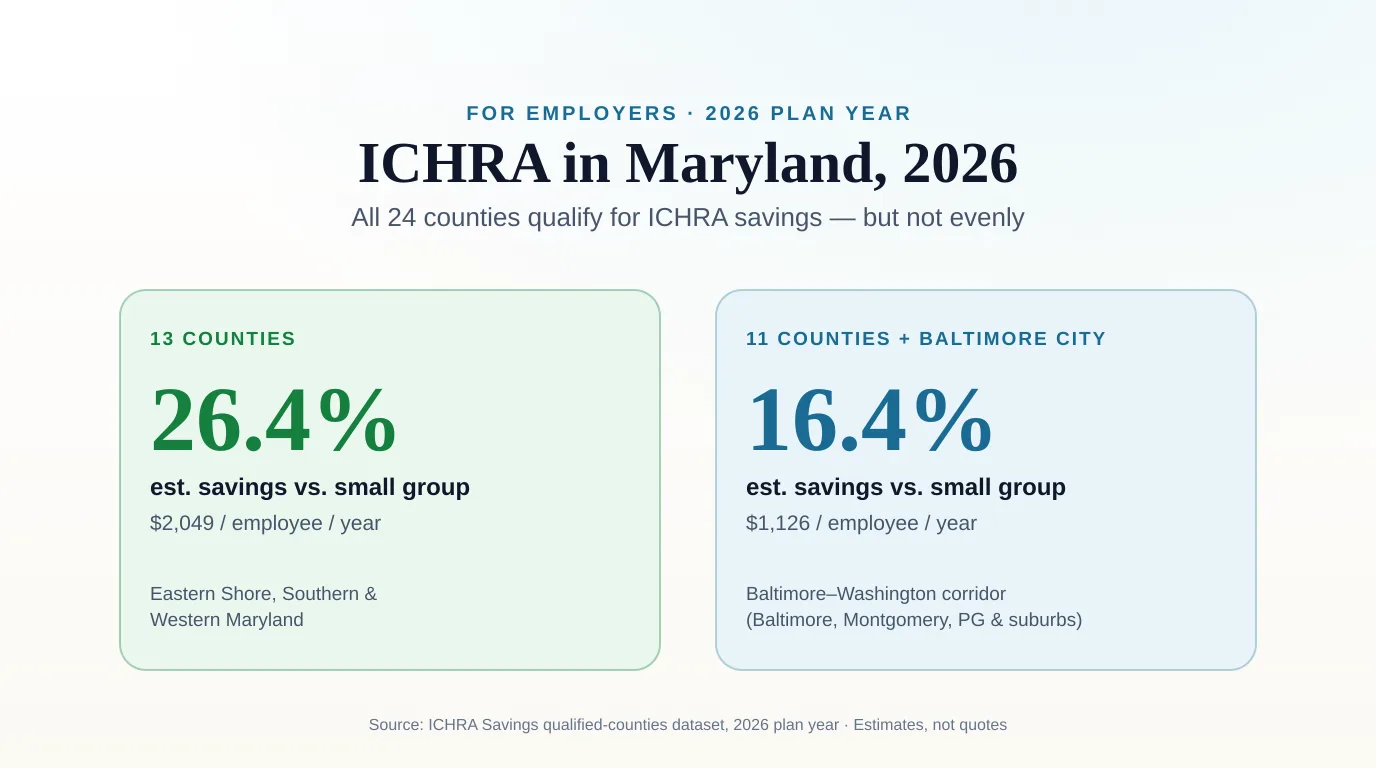
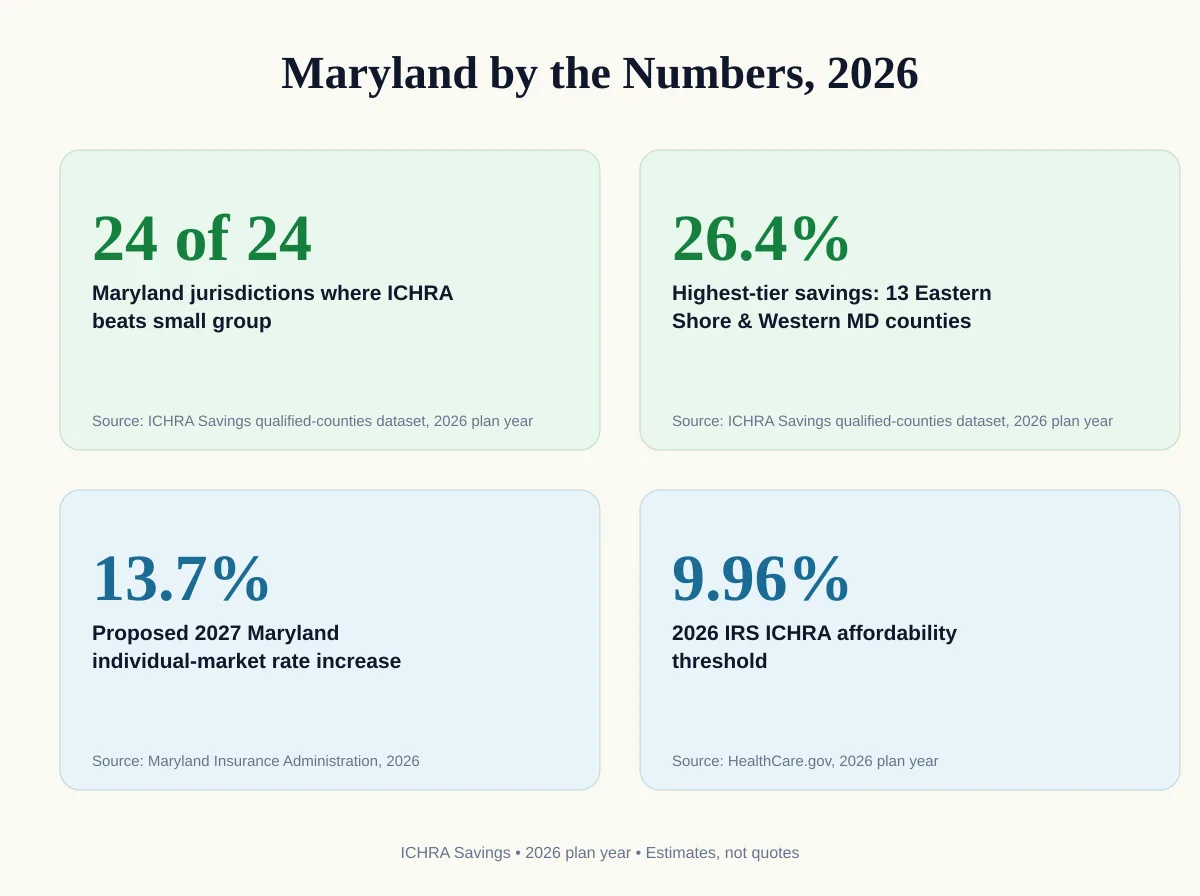
- All 24 of Maryland's jurisdictions, its 23 counties plus Baltimore City, show a 2026 individual-market benchmark premium below the small-group benchmark. But the win splits into exactly two tiers.
- Thirteen counties, mostly the Eastern Shore and Western Maryland, show an estimated 26.4% spread, about $2,049 a year per employee. The other 11 counties plus Baltimore City, the Baltimore-Washington corridor holding 87% of the state's population, show an estimated 16.4% spread, about $94 a month, $1,126 a year.
- Maryland's carriers have proposed a 13.7% average 2027 individual-market rate increase and a 13.1% average 2027 small-group increase, according to the Maryland Insurance Administration.
- Maryland runs a CMS-approved reinsurance program that holds its individual-market benchmark premium, $414 a month in 2026, well below the $625 national average.
Does ICHRA beat small group in Maryland?
Yes, everywhere, though not by the same amount. An ICHRA (Individual Coverage Health Reimbursement Arrangement) shows a lower 2026 individual-market benchmark premium than small-group in all 24 of Maryland's jurisdictions, its 23 counties plus Baltimore City, based on a county-by-county comparison built from the ICHRA Savings qualified-counties dataset for the 2026 plan year. Maryland is one of 32 states in our national dataset with at least one qualifying county, and its 24 jurisdictions make up about 2% of the 1309 counties nationwide where the math currently favors ICHRA.
That headline is also the least useful sentence in this article. A jurisdiction "qualifying" only means the individual-market number sits below the small-group number, and Maryland's 24 jurisdictions split cleanly into two groups that tell very different stories. In Montgomery County, home to Bethesda and Rockville and the state's largest jurisdiction by population, the 2026 spread is 16.4%, about $94 a month, or $1,126 a year per employee. In Washington County, home to Hagerstown, the same comparison shows a 26.4% spread, $2,049 a year per employee, nearly double the Montgomery County figure. Both jurisdictions are technically "qualifying." They describe two different conversations for an employer. If you haven't worked through the general ICHRA-versus-small-group decision yet, our decision guide walks through the framework this article applies specifically to Maryland.
24
Maryland jurisdictions where the individual benchmark undercuts small group in 2026
13
Counties in the higher-savings tier, at an estimated 26.4%
6.2M
Marylanders living in a technically qualifying jurisdiction
$1,626
Average estimated savings per employee, per year, across all 24 jurisdictions
What ICHRA actually is, in plain terms
An ICHRA, or Individual Coverage Health Reimbursement Arrangement, is a way for an employer to give employees a fixed monthly amount, tax-free, to buy their own health insurance on the individual market instead of enrolling them in a company-sponsored group plan. According to HealthCare.gov, an employer of any size can offer one as long as it has at least one employee who isn't the business owner or the owner's spouse, and there is no annual minimum or maximum contribution requirement. The employer sets a budget once a year; the employee picks whatever plan fits them, on Maryland Health Connection or off it, and gets reimbursed for the premium and, if the employer allows it, other qualified medical expenses.
A few terms matter enough to define here, since most ICHRA confusion traces back to one of them. QSEHRA (Qualified Small Employer HRA) is a similar but separate arrangement limited to employers with fewer than 50 full-time-equivalent employees and a federal annual reimbursement cap; ICHRA has no employer-size limit and no federal dollar cap. The affordability safe harbor is the IRS test, 9.96% of household income for 2026, that decides whether an employee's ICHRA is considered "affordable," which in turn decides whether they can still claim a premium tax credit. An employee class is a group of workers defined by an IRS-permitted factor, such as full-time versus part-time status or geographic location, that lets an employer offer different ICHRA terms, or a group plan, to different segments of its workforce, as long as it follows the class-size and non-discrimination rules. Substantiation is the paperwork requirement: before reimbursing an employee, the employer or its administrator has to confirm the person actually has qualifying individual coverage and that the specific expense is real, typically through a receipt or a carrier-issued proof-of-coverage document.
None of that mechanism changes county to county. What changes is the number on the other side of the comparison: how much a given county's small-group market charges relative to Maryland's flat, reinsurance-supported individual-market benchmark. That's the number this article is actually about.
Why Maryland's rates moved
If your small-group renewal is due for 2027, Maryland's own regulator has already told you roughly what to expect. Maryland's health carriers have proposed an average 13.7% increase for 2027 individual-market plans and an average 13.1% increase for 2027 small-group plans, according to the Maryland Insurance Administration's July 2026 rate-filing announcement. The individual-market request ranges from 12.0% to 14.6% across six carriers, covering roughly 482,000 Marylanders; the small-group request ranges from 4.1% to 20.7% across eight carriers. The Maryland Insurance Commissioner held a public hearing on these filings on July 23, 2026, with final decisions expected in September 2026.
That follows a 2026 plan year that already ran hot. Full-price individual-market premiums rose an average 13.4% for 2026, and one carrier, Aetna, exited the individual market entirely after 2025, leaving five carriers and pushing roughly 5,000 enrollees to find replacement coverage, according to healthinsurance.org's Maryland marketplace summary. Maryland's experience sits inside a national pattern, not a state-specific one. KFF's May 2026 analysis of the ACA marketplace found the average net premium payment across all marketplace enrollees nationally rose 58%, from $113 a month in 2025 to $178 a month in 2026, driven mostly by the expiration of enhanced federal premium tax credits at the end of 2025, the same expiration behind both Maryland's own 2026 jump and its 2027 filings.
| Metric | Maryland | Detail |
|---|---|---|
| Proposed 2027 individual-market rate increase | 13.7% average (range 12.0% to 14.6%) | 6 carriers, ~482,000 Marylanders affected |
| Proposed 2027 small-group rate increase | 13.1% average (range 4.1% to 20.7%) | 8 carriers |
| 2026 individual-market carriers | 5 carriers (Aetna exited after 2025) | ~5,000 enrollees needed replacement coverage |
| IRS affordability threshold | 9.96% of household income | 2026 plan year, national |
| Metric | Figure | Detail |
|---|---|---|
| Maryland 2026 avg. marketplace benchmark premium | $414/month | Up from $365/month in 2025 |
| National 2026 avg. marketplace benchmark premium | $625/month | Maryland runs $211 below the U.S. average |
| National net premium paid, all enrollees | $178/month, up 58% from $113 | 2025 to 2026 |
Why this matters to an employer, not just an individual
A rising small-group renewal is a fixed cost that keeps moving whether or not your headcount or claims experience changes. An ICHRA doesn't make Maryland's underlying medical costs go away, but it replaces an unpredictable annual renewal number with a monthly contribution you set and control.
The Shore and the mountains versus the corridor
Maryland's 24 qualifying jurisdictions split into two groups, and the split is unusually clean. Our dataset shows a single flat individual-market benchmark, $477.35 a month, across every Maryland jurisdiction for 2026. What moves is the small-group side. Thirteen counties, running from the Eastern Shore through Southern Maryland and into the Western Maryland mountains, show a small-group benchmark of $648.14 a month, a 26.4% spread. The other eleven counties plus Baltimore City, essentially the Baltimore-Washington corridor, show a small-group benchmark of $571.22 a month, a 16.4% spread, about $94 a month.
Maryland's insurance regulator recognizes four state-defined geographic rating areas for its individual and small-group markets, per CMS's published summary: a Baltimore-metro area, an Eastern Shore and Southern Maryland area, a Washington-suburbs area covering Montgomery and Prince George's Counties, and a Western Maryland area. Those four legal boundaries don't map onto our two-tier benchmark split county for county, since not every carrier prices every rating area differently in every market. What the data does show plainly is that the state's most populous corridor, Baltimore City and its ring of suburban counties plus the D.C. suburbs, consistently prices small-group coverage closer to the individual-market floor than the rest of the state does.
| County | Population | Savings vs. small group | Est. annual savings / employee |
|---|---|---|---|
| Montgomery County | 1,056,910 | 16.4% | $1,126 |
| Prince George's County | 957,189 | 16.4% | $1,126 |
| Baltimore County | 850,737 | 16.4% | $1,126 |
| Anne Arundel County | 588,109 | 16.4% | $1,126 |
| Baltimore city | 584,548 | 16.4% | $1,126 |
| Howard County | 332,011 | 16.4% | $1,126 |
| Frederick County | 273,829 | 16.4% | $1,126 |
| Harford County | 261,059 | 16.4% | $1,126 |
| Carroll County | 173,225 | 16.4% | $1,126 |
| Charles County | 167,035 | 16.4% | $1,126 |
Nine of Maryland's ten most populous jurisdictions sit in the smaller-spread corridor tier. That is not a reason to write off ICHRA if your company sits in one of them. It is a reason to model the actual number for your county instead of assuming the 20 to 62 percent range you may have seen elsewhere in ICHRA marketing applies to you. That range is real, and it applies in qualified counties, but the Baltimore-Washington corridor in 2026 is not where the biggest wins in this dataset show up.
Maryland's two-tier small-group benchmark, against one flat individual benchmark
Monthly benchmark premiums, 2026 plan year. Source: ICHRA Savings qualified-counties dataset.
Illustrative and rounded; not an offer of insurance or a guarantee of savings. Figures from the ICHRA Savings qualified-counties dataset, 2026 plan year.
See the full Maryland savings breakdown for every county, or the national savings map to check a specific county by name.
Where the biggest savings actually are
The thirteen counties worth an employer's closest attention run along the Eastern Shore, into Southern Maryland, and up into the Western Maryland mountains: Allegany, Caroline, Cecil, Dorchester, Garrett, Kent, Queen Anne's, St. Mary's, Somerset, Talbot, Washington, Wicomico and Worcester. Every one of them shows an identical estimated 26.4% spread for 2026, $2,049 a year per employee. That includes Worcester County, home to Ocean City, and Washington County, home to Hagerstown, two of the more populous counties in this group.
| County | Population | Savings vs. small group | Est. annual savings / employee |
|---|---|---|---|
| Washington County | 154,645 | 26.4% | $2,049 |
| St. Mary's County | 113,814 | 26.4% | $2,049 |
| Cecil County | 103,876 | 26.4% | $2,049 |
| Wicomico County | 103,815 | 26.4% | $2,049 |
| Allegany County | 68,161 | 26.4% | $2,049 |
| Worcester County | 52,827 | 26.4% | $2,049 |
| Queen Anne's County | 50,316 | 26.4% | $2,049 |
| Talbot County | 37,663 | 26.4% | $2,049 |
| Caroline County | 33,320 | 26.4% | $2,049 |
| Dorchester County | 32,557 | 26.4% | $2,049 |
| Garrett County | 28,856 | 26.4% | $2,049 |
| Somerset County | 24,672 | 26.4% | $2,049 |
| Kent County | 19,289 | 26.4% | $2,049 |
| County | Population | Savings vs. small group | Est. annual savings / employee |
|---|---|---|---|
| Montgomery County | 1,056,910 | 16.4% | $1,126 |
| Prince George's County | 957,189 | 16.4% | $1,126 |
| Baltimore County | 850,737 | 16.4% | $1,126 |
| Anne Arundel County | 588,109 | 16.4% | $1,126 |
| Baltimore city | 584,548 | 16.4% | $1,126 |
| Howard County | 332,011 | 16.4% | $1,126 |
| Frederick County | 273,829 | 16.4% | $1,126 |
| Harford County | 261,059 | 16.4% | $1,126 |
| Carroll County | 173,225 | 16.4% | $1,126 |
| Charles County | 167,035 | 16.4% | $1,126 |
| Calvert County | 93,244 | 16.4% | $1,126 |
The pattern is consistent with a dynamic our county data shows across nearly every state we've mapped: denser metro corridors, with more small-group carrier competition and a bigger bench of employers already offering group coverage, tend to price small-group insurance closer to the individual-market floor than a thinner, more rural market does. A landscaping company in Cumberland or a seafood processor on the Eastern Shore is looking at a meaningfully different ICHRA case than an identical business headquartered in Rockville or downtown Baltimore.
Every jurisdiction in Maryland technically clears the bar for ICHRA in 2026. Only 13 of them clear it by enough to change how you run your business.
Mike Moore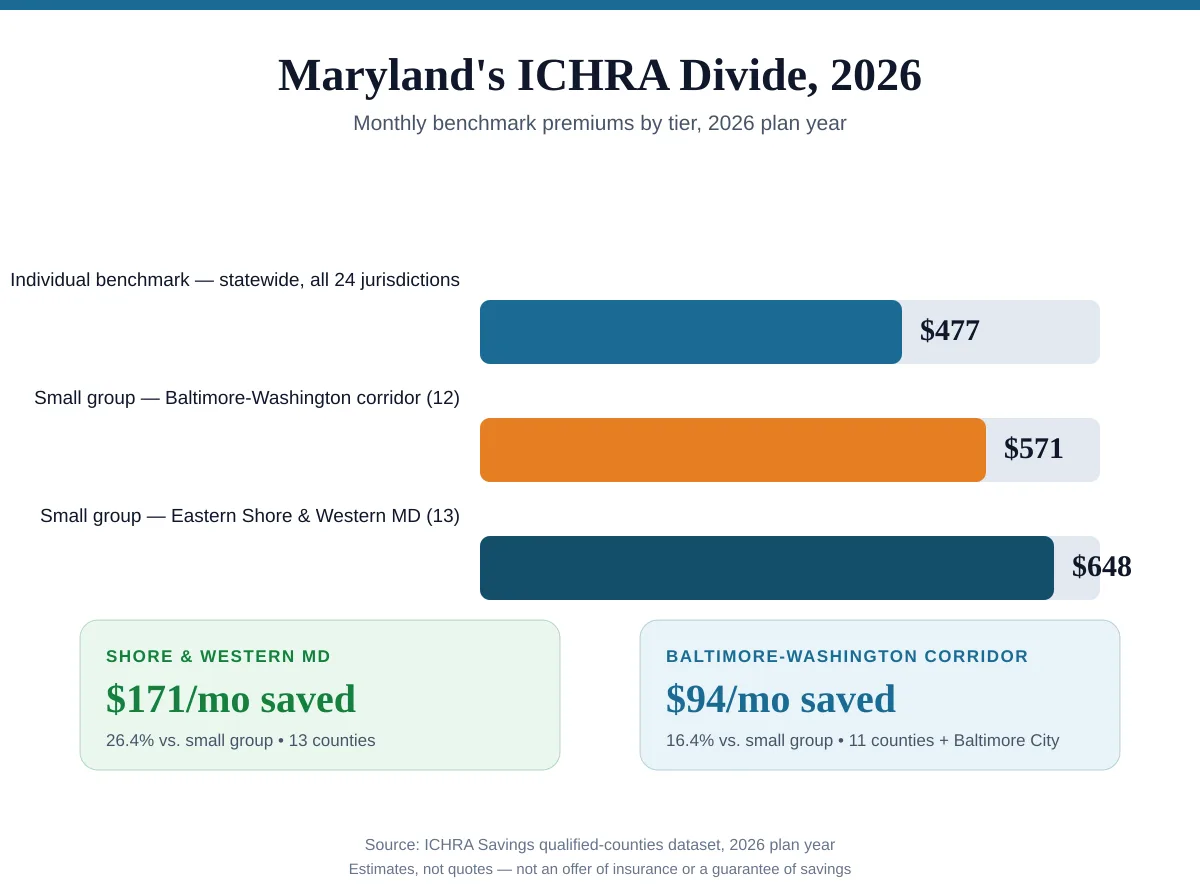
A worked example: Montgomery versus Washington County
Here's what the county-level math actually looks like for a small employer with a split Maryland workforce, using real 2026 rate data for a lower-spread corridor county and a higher-spread rural one. Assume a 20-employee company with 12 employees in Montgomery County and 8 employees in Washington County (Hagerstown).
Here's the math
In Montgomery County, the 2026 individual-market benchmark premium is $477.35/month against a small-group benchmark of $571.22/month, a savings of $93.87/month, or $1,126 a year per employee. In Washington County, the individual-market benchmark is the same $477.35/month against a higher small-group benchmark of $648.14/month, a savings of $170.79/month, or $2,049 a year per employee, nearly double the Montgomery County figure.
For this hypothetical 20-person company: 12 employees × $1,126 (Montgomery) + 8 employees × $2,049 (Washington) = an estimated $29,913 a year in aggregate savings, using benchmark-level ICHRA contributions. This is an illustrative estimate using real county rate data and a hypothetical headcount split. Your actual result depends on your employees' ages, exact counties and the plan levels they choose.
Notice what this example does not do: report a single statewide "Maryland saves X%" figure. A headline like that would flatten a company with mostly Bethesda-based staff and a company with mostly Eastern Shore staff into the same number, when their actual outcomes differ by a wide margin. That is the entire argument for checking counties individually rather than trusting a state average.
A remote or hybrid company spreads that same math across more points. Take a 15-person Maryland company with five employees in Baltimore city, five in Anne Arundel County, and five in Worcester County (Ocean City), a realistic mix for a company that started in Baltimore and picked up remote or coastal hires as it grew. At benchmark-level ICHRA contributions, the Baltimore City and Anne Arundel employees are each worth an estimated 5 × $1,126 = $5,632 a year in aggregate savings, and the Worcester County employees, at 26.4%, add an estimated $10,247. None of those figures individually tells the whole story, and none of them is the number a company like this should quote to its board. The sum of all three, county by county, is the only honest number.
The affordability test, worked out
Whatever your county-level spread looks like, an ICHRA contribution still has to clear the IRS affordability test to determine whether your employees keep access to a premium tax credit. For the 2026 plan year, HealthCare.gov states the required contribution percentage at 9.96%: an ICHRA is considered affordable if the employee's monthly cost for the self-only, lowest-cost silver plan in their area, after the employer's reimbursement, is less than 9.96% of one-twelfth of the employee's household income.
Here's the math on affordability
Take a Maryland employee earning $42,000 a year, anywhere in the state, since the individual-market benchmark is flat statewide. Under the 2026 required contribution percentage of 9.96%, their household's contribution toward the lowest-cost silver plan is considered affordable if it does not exceed $348.60 a month (9.96% of $42,000, divided by 12). Maryland's 2026 individual-market benchmark premium is $477.35 a month. If the employer's ICHRA contribution covers $150 of it, the employee's remaining share is $327.35 a month, under the $348.60 affordability line. That ICHRA is affordable for this employee, which means they must use it instead of a premium tax credit for that month. A thinner contribution changes the answer fast, which is why modeling this test against your actual census, not a rule of thumb, has to happen before you set a contribution amount.
Say this plainly to employees
Taking an employer's ICHRA contribution generally means an employee waives the federal premium tax credit for that month, unless the ICHRA is unaffordable under the IRS test, in which case they can decline it and keep shopping the marketplace with a subsidy instead. Anyone modeling their own numbers needs to understand which side of that line they're on before they decide.
Maryland's reinsurance program and what it does not change
Maryland runs a state-based individual-market reinsurance program, established in 2019 and federally approved through 2028, which reimburses insurers for a share of high-cost enrollee claims so that full-price individual premiums stay lower than they would otherwise be. It is a meaningful part of why Maryland's 2026 average marketplace benchmark premium, $414 a month, runs $211 below the $625 national average, according to KFF's state benchmark-premium tracker. Maryland also expanded a separate state-funded Premium Assistance program for 2026 that backfills some or all of the enhanced federal subsidy loss for marketplace enrollees under 400% of the federal poverty level, with roughly 177,000 enrollees receiving that state subsidy in early 2026, per healthinsurance.org's Maryland marketplace summary.
For an employer thinking about ICHRA, both programs are worth knowing about but don't change the federal math. Reinsurance is one reason Maryland's individual-market benchmark is low and flat statewide, which is part of why the ICHRA spread here depends almost entirely on the small-group side of the comparison. The state premium-assistance program applies to individuals shopping the marketplace on their own with a subsidy; it does not apply to, or interact with, an employer's ICHRA contribution, which is a separate, employer-funded benefit governed entirely by federal rules.
If you offer nothing today
Most of this article compares an ICHRA against an existing small-group renewal, because that comparison is where the county-level percentage figures come from. But the more common real-world decision for a lot of small Maryland employers isn't ICHRA versus group. It's ICHRA versus nothing. Group health plans typically require a minimum share of eligible employees to actually enroll, often 70% or more, before a carrier will issue or renew the policy. A five-person landscaping company in Cumberland, a three-person accounting practice in Salisbury, or a ten-person brewery in Frederick can struggle to hit that participation threshold even when the owner wants to offer coverage, because a couple of employees are already on a spouse's plan or on Medicaid.
ICHRA has no participation minimum and no employer-size floor. HealthCare.gov states plainly that an employer of any size can offer one, down to a single eligible employee. That changes the real comparison for a lot of small Maryland businesses from "is our county's spread big enough to switch" to "can we offer a real, tax-advantaged benefit at all, at whatever monthly amount we can actually afford." A $150-a-month ICHRA contribution in a corridor county with a modest spread is still $1,800 a year in tax-free help toward an employee's coverage, and it's a real benefit line on a job posting in a labor market where competing employers, especially larger ones down the road, already offer something.
Setting up an ICHRA in Maryland
Maryland does not add state-specific ICHRA rules on top of the federal framework; the same IRS, DOL and HHS final rule that governs ICHRA everywhere applies here, and the setup sequence is identical to any other state. The steps that determine whether a Maryland rollout goes smoothly:
- Pull your census by county, not by office address. A Baltimore-headquartered company with field staff on the Eastern Shore has two very different rate-spread stories.
- Check each employee's county on the savings map. Don't assume a statewide average applies, and don't assume a Montgomery County address rules out savings for your whole team.
- Model affordability using the 2026 threshold. At 9.96% of household income, the required contribution percentage changes how much an ICHRA contribution needs to cover to count as affordable.
- Define employee classes carefully, if you use them. An employee class is a group defined by an objective factor the IRS permits, such as full-time versus part-time status, geographic location, or salaried versus hourly work, that lets an employer offer different benefits to different groups of workers. Class rules carry minimum-size requirements and cannot offer the same class a choice between ICHRA and group coverage.
- Send the required notice on time. Eligible employees need written notice at least 90 days before the plan year starts, with specific required content.
- Budget for onboarding support. Employees who have never shopped Maryland Health Connection on their own need guidance, once, at enrollment.
See our full ICHRA setup timeline for the detailed rollout plan, including the exact notice content requirements.
Run your counties first
Before scheduling a single meeting, look up every county where you have employees on the savings map. If your Maryland workforce sits mostly in the Baltimore-Washington corridor, you have a different, more modest conversation ahead than an employer centered on the Eastern Shore or Western Maryland.
The honest limits of this data
Read this before you model your own numbers
- The corridor's $94-a-month spread is real but modest. If your workforce sits mostly in Montgomery, Prince George's, Baltimore City, or the surrounding suburban counties, that is the honest number to model, not the 26.4% figure that applies elsewhere in the state.
- "Qualifying" is not the same as "worth doing." Weigh a modest spread alongside the other reasons employers choose ICHRA, like offering a first benefit at all or removing a participation minimum.
- Rates move every plan year. Maryland's proposed 13.1% small-group and 13.7% individual-market increases for 2027 have not been finalized as of this writing; recheck before every renewal, not just once.
- Older or higher-risk workforces change the calculation. Individual-market premiums are age-rated, which can narrow or widen real-world savings for an older or younger team relative to the county-average figures here.
- A qualifying county is not a guarantee of savings for your specific workforce. It means the benchmark comparison favors ICHRA; model your actual census before committing.
How these numbers are calculated
Every county figure in this article comes from the ICHRA Savings qualified-counties dataset, the same data that powers our savings map, not from a survey or a sales estimate. For each of Maryland's 24 jurisdictions, we compare a 2026 individual-market benchmark premium, a representative individual-market plan premium for that jurisdiction, against a small-group benchmark premium built from comparable small-group plan pricing for the same rating area. A jurisdiction "qualifies" when the individual benchmark sits below the small-group benchmark; the percentage and dollar savings figures in this article are the gap between those two numbers, expressed as an annual per-employee figure at 12 times the monthly difference.
Three limitations are worth stating plainly. First, benchmark premiums are built around a representative enrollee profile, so an unusually young or unusually old workforce will see a different real-world spread than the county average implies. Second, these are benchmark plans, not every plan on the market; an employee who chooses a richer or leaner plan than the benchmark will see a different premium, though the relative spread tends to hold directionally. Third, rates are filed and refreshed annually, so a jurisdiction that qualifies for 2026 is not guaranteed to show the same spread for 2027, especially with Maryland's proposed 13.1% to 13.7% increases still pending regulator approval. We rebuild this dataset each plan year rather than reusing prior-year figures, and we recommend employers do the same before every renewal.
Questions Maryland employers actually ask
Does ICHRA beat small-group insurance everywhere in Maryland?
All 24 of Maryland's jurisdictions, its 23 counties plus Baltimore City, show a 2026 individual-market benchmark premium below the small-group benchmark in our dataset. But the size of that win splits cleanly into two groups. Thirteen counties, mostly the Eastern Shore and Western Maryland, show an estimated 26.4% spread, about $2,049 a year per employee. The other 11 counties plus Baltimore City, essentially the Baltimore-Washington corridor, show an estimated 16.4% spread, about $1,126 a year, roughly $94 a month. That $94 figure is real but it is modest, and we say so plainly rather than lead with the bigger number alone.
Why do Montgomery, Prince George's, and Baltimore City show a smaller spread than the rest of the state?
Maryland's individual market carries a state-funded reinsurance program, approved by CMS through 2028, that holds full-price individual premiums down statewide, and our dataset shows a single flat individual-market benchmark of $477.35 a month across every Maryland jurisdiction for 2026. What changes county to county is the small-group side: the Baltimore-Washington corridor's small-group benchmark runs lower than the Eastern Shore's and Western Maryland's, which narrows the ICHRA spread there even though the individual-market number never moves. A denser corridor with more small-group carrier competition tends to hold small-group premiums closer to the individual-market floor than a thinner rural market does.
How much can an Eastern Shore or Western Maryland employer expect to save?
Thirteen counties, including Worcester (Ocean City), Wicomico (Salisbury), Washington (Hagerstown), and Garrett (Deep Creek Lake), all show an identical estimated 26.4% spread for 2026, about $2,049 a year per employee using benchmark premiums. That is a real number worth modeling, but it is still an estimate built from public rate data, not a quote, and your actual result depends on your employees' ages and the plans they choose.
What is happening to Maryland health insurance rates for 2027?
Maryland's health carriers have proposed a 13.7% average increase for 2027 individual-market plans and a 13.1% average increase for small-group plans, according to the Maryland Insurance Administration. The individual-market request ranges from 12.0% to 14.6% across six carriers; the small-group request ranges from 4.1% to 20.7% across eight carriers. The Maryland Insurance Commissioner held a public hearing on these filings on July 23, 2026, with final decisions expected in September 2026.
Does Maryland impose any state-specific ICHRA rules?
No. ICHRA is a federal HRA structure created by an IRS, DOL and HHS final rule, and it works the same way in Maryland as in any other state. Maryland does not layer additional ICHRA-specific requirements on top of the federal rule, though standard state insurance-producer licensing still applies to anyone advising employees on plan selection.
Does offering an ICHRA affect my employees’ premium tax credit?
Generally, yes. If your ICHRA contribution is considered affordable under the IRS test (9.96% of household income for 2026), the employee must use the ICHRA and cannot also claim a premium tax credit for that month. If the contribution is not affordable, the employee can decline the ICHRA and keep shopping the marketplace with a subsidy instead, but cannot use both at once for the same coverage.
What does Maryland's state premium subsidy have to do with my ICHRA decision?
Nothing directly, but it is worth knowing about. Maryland funds its own Premium Assistance program through Maryland Health Connection, which for 2026 covers 100% of the lost enhanced federal subsidy for marketplace enrollees at or below 200% of the federal poverty level, and 50% of it for enrollees between 250% and 400% of the federal poverty level. That program applies to individuals shopping the marketplace on their own; it does not apply to, or change, an employer's ICHRA contribution, which is a separate, employer-funded benefit.
Where can I check whether my specific Maryland county qualifies?
Use the savings map. It shows the 2026 individual-market and small-group benchmark premiums side by side for any Maryland county, so you can see the estimated spread for wherever your employees actually live, whether that is downtown Bethesda or a farm outside Salisbury.
We don't offer any health benefit today. Does the corridor's smaller spread even matter?
Less than you'd think. If your company has never offered group coverage, the honest comparison isn't ICHRA versus your current plan's percentage savings, it's ICHRA versus offering nothing at all. ICHRA has no participation minimum and no employer-size floor, so even a Montgomery County business in the lower-spread tier can offer a real, tax-free monthly contribution toward an employee's own individual-market plan. The county percentage matters more once you're comparing ICHRA against an existing small-group renewal you're trying to beat.
Sources
- Maryland Insurance Administration, "Health Carriers Propose Affordable Care Act Premium Rates for 2027" (2026)
- CMS, "Maryland Geographic Rating Areas"
- KFF, "What We Know So Far About 2026 ACA Marketplace Enrollment, Premiums, and Deductibles" (May 19, 2026)
- KFF State Health Facts, "Marketplace Average Monthly Benchmark Premiums"
- HealthCare.gov, "Individual coverage Health Reimbursement Arrangements"
- healthinsurance.org, "Maryland Health Insurance Marketplace: 2026 ACA Coverage Guide"
- IRS, "Health Reimbursement Arrangements (HRAs)"
- ICHRA Savings qualified-counties dataset, 2026 plan year (
src/data/qualified_counties.json) - ICHRA final rule: Departments of the Treasury/IRS, Labor, and Health and Human Services (2020)