ICHRA Opt-Out Cash: The 2026 Affordability Trap
Paying employees cash to skip your ICHRA can blow your affordability test. See the IRS rule, the 2027 penalty, and a real county example, sourced this year.
The short version
- Yes, you can offer employees cash for declining your ICHRA — but an unconditional opt-out payment generally must be added back into that employee's required contribution for affordability purposes (IRS Notice 2015-87, Q&A-9).
- The ICHRA contribution itself is not the same thing. HRA money reduces the required contribution; a separate cash sweetener increases it. Confusing the two is the whole mistake.
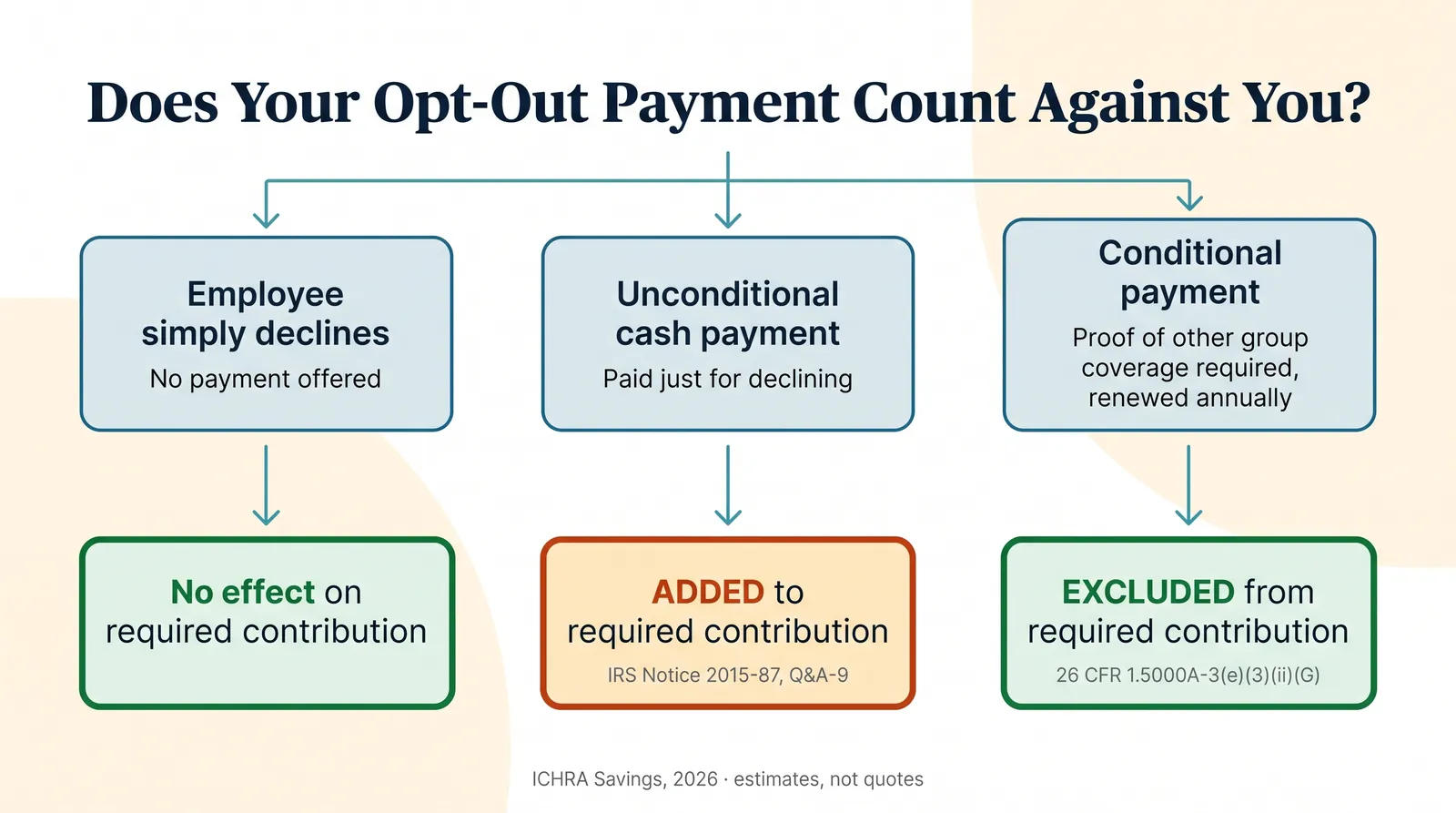
- A payment conditioned on proof of other group coverage, not individual-market coverage, can avoid the problem — but a plain "decline and take the cash" offer cannot.
- The employer cost only bites applicable large employers, and only when a specific employee's coverage actually goes unaffordable and that employee actually draws a premium tax credit.
Can you pay employees cash to skip your ICHRA?
Yes, you can offer it. Whether it is free to offer is a different question, and the answer is usually no. An Individual Coverage HRA, the arrangement where you fund a fixed monthly amount an employee uses to buy their own individual health coverage tax-free, already comes with a built-in right to decline it every year. Layering a cash payment on top of that decline — the way a lot of employers used to sweeten a group-plan opt-out — runs into a separate IRS rule that most employers have never heard of, because it was written for traditional group coverage, not for ICHRA.
The rule, from IRS Notice 2015-87, treats an unconditional cash opt-out payment the same way it treats a salary reduction: as money the employee gives up to get coverage, which means it gets added back into what "coverage costs them" when the IRS checks whether your offer was affordable. Add enough of it, and an ICHRA that cleared the affordability bar on its own can fail the test the moment the opt-out payment goes on the table, whether or not a single employee actually takes the cash.
The rest of this article walks through why the ICHRA contribution and a cash opt-out payment are treated as opposites by federal tax law, what the one legitimate opt-out ICHRA law actually requires, a worked example with real county numbers, what it costs when the math breaks, and the three ways to structure a decline option that will not come back to bite you.
You already do this with your group plan
Here is the version of this question that actually shows up in a real conversation. You ran a small-group plan for years and offered a $150-a-month payroll credit to anyone who could prove they were covered on a spouse's plan and skipped your group coverage. It saved you money on people who did not need your plan, everyone understood it, and nobody ever questioned it. Now you are switching those same employees to an ICHRA, and your instinct is to keep doing the same thing: offer cash to whoever declines.
That instinct is where the trouble starts. A traditional group plan and an ICHRA are both "eligible employer-sponsored plans" for tax purposes, so the opt-out payment rule applies to both the same way. What is different is that an ICHRA already has its own built-in credit for employees, the HRA contribution itself, and stacking a second, separate cash credit on top of it interacts with your affordability math in a way a simple group-plan opt-out never had to worry about, because a group plan usually has more room to spare.
If you are the one deciding whether to take an opt-out payment instead of your employer's ICHRA, the practical version of this question — what you give up, what you are owed either way, and whether the cash is actually worth it — is covered in the fix section below, and there is a page written from your side of the desk if you want more general background: what an ICHRA means for you.
Two different pots of money, two different rules
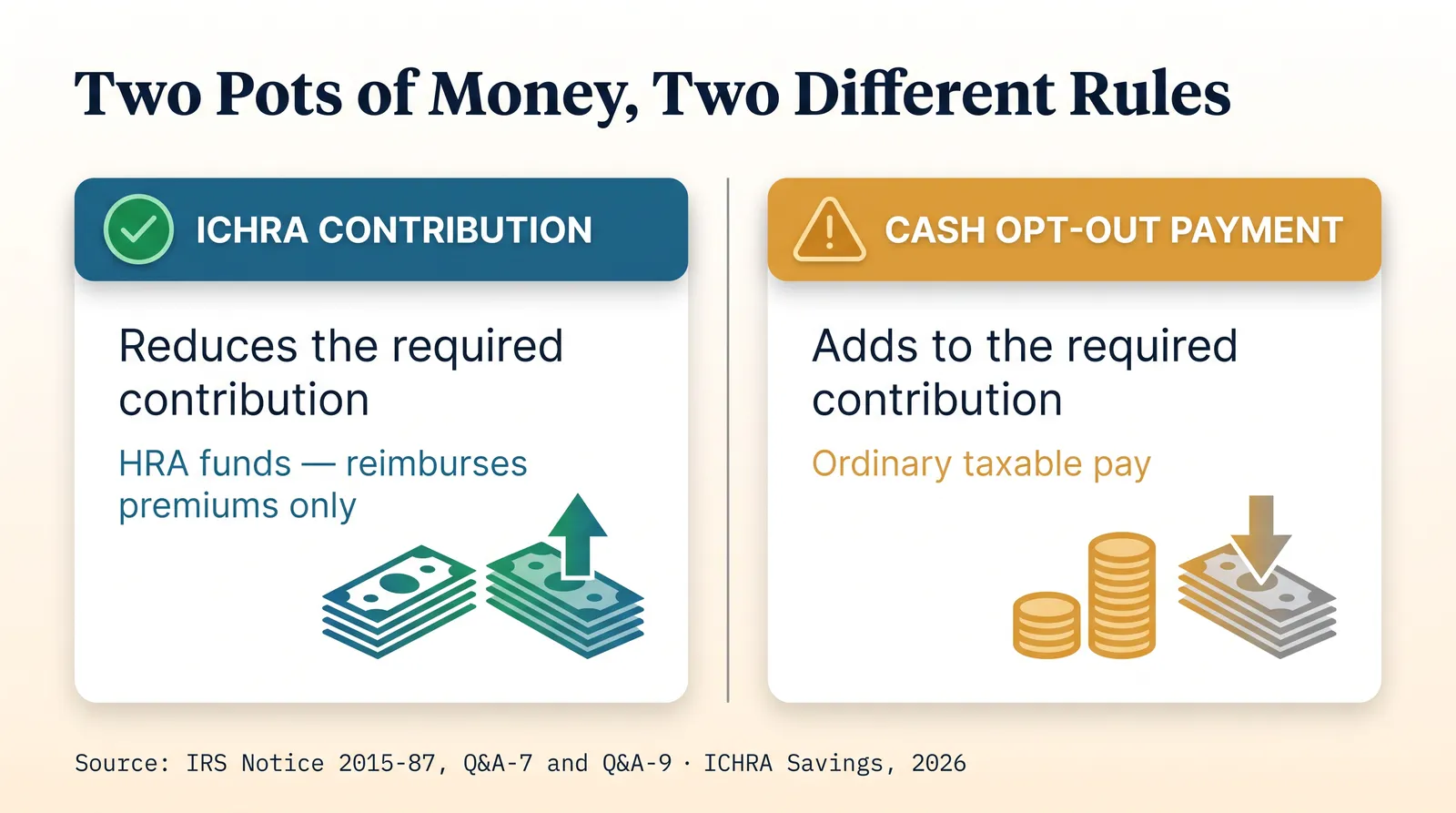
An ICHRA contribution and a cash opt-out payment look similar from a spreadsheet, both are dollars you are willing to spend on an employee's benefit decision, but the IRS treats them as opposite in effect. Understanding why requires two definitions.
Required contribution is the technical term for what an employee has to give up, in dollars, to get affordable coverage. Under 26 U.S.C. § 5000A(e)(1)(B) and the regulations that implement it, it is the portion of the premium the employee would pay for self-only coverage, whether through salary reduction or otherwise. This is the number the IRS actually tests against the affordability percentage, not the sticker price of the plan.
An HRA contribution reduces that number. Under Notice 2015-87, Q&A-7, an amount an employee can use to pay premiums for an eligible employer-sponsored plan, which includes an ICHRA used to buy individual coverage, is treated as an employer contribution and is subtracted from the required contribution, dollar for dollar. That is the entire mechanism behind how an ICHRA makes coverage affordable in the first place.
An unconditional opt-out payment increases that same number. Under Notice 2015-87, Q&A-9, a payment available only if an employee declines coverage and cannot be used to pay for that coverage is analyzed the opposite way: as compensation the employee forgoes to take the coverage, exactly like a salary reduction. The notice's own illustration makes the mechanism plain: an employee who pays $200 a month for coverage, offered an extra $100 a month for declining it, has an effective required contribution of $300, not $200, because taking the coverage costs them the $100 they would have otherwise received.
| Question | ICHRA contribution | Cash opt-out payment |
|---|---|---|
| What it can be used for | Substantiated individual premiums and eligible medical expenses only | Anything — it is ordinary taxable compensation |
| When it is paid | Every plan year, regardless of the employee's choice | Only if the employee declines coverage |
| Effect on required contribution | Reduces it, dollar for dollar (Notice 2015-87, Q&A-7) | Increases it, dollar for dollar, if unconditional (Notice 2015-87, Q&A-9) |
| Can it ever be cashed out | No — forfeited if unused, never paid as taxable cash | Yes — that is the entire point of the payment |
| Governing test | 26 U.S.C. §§ 5000A(e)(1)(B), 36B(c)(2)(C) | IRS Notice 2015-87, Q&A-9; proposed 26 CFR § 1.5000A-3(e)(3)(ii)(G) |
Why the ICHRA money itself can never be cash
A separate confusion worth clearing up before going further: the ICHRA contribution itself cannot be converted into cash, ever, for any employee, under any circumstances. This is not a plan-design choice an employer makes; it is baked into what makes an HRA an HRA in the first place. IRS guidance on cafeteria-plan flex contributions describes the same underlying principle from a different angle, requiring that a qualifying "health flex contribution" be an amount "the employee may not opt to receive... as a taxable benefit" (IRS Notice 2015-87, Q&A-8). An arrangement that lets a participant take the money instead of using it for medical care is not a health reimbursement arrangement under the tax code; it is compensation, and it gets taxed like compensation.
That is a completely different question from whether you can offer a separate cash payment tied to the decision to decline the ICHRA. You can, structurally. What you cannot do is take the ICHRA balance itself and hand a departing or declining employee the equivalent in cash. If an employee does not use their allowance, it is forfeited, not paid out. Any "cash option" you offer has to be its own, distinct arrangement, funded separately, and that separateness is exactly what triggers the required-contribution question this article is about.
The one opt-out ICHRA law actually requires
Every ICHRA has to build in an opt-out right whether or not you ever consider paying cash for it. Under 26 CFR § 54.9802-4(c)(4), an eligible participant "must be permitted to opt out of and waive future reimbursements... from the HRA once, and only once, with respect to each plan year," generally before the plan year starts, with a similar right built in for anyone who becomes newly eligible mid-year and again upon termination of employment. This requirement exists so an employee who would rather chase a marketplace subsidy, or who already has coverage through a spouse, is never trapped inside your ICHRA against their interest.
That built-in right costs you nothing extra. An employee who declines simply does not draw against the allowance you set aside for them; you are not required to pay them anything for exercising a right the federal rule already hands them. The moment you add a cash sweetener on top of that free, already-mandatory decline right, you have created a second, optional arrangement, and it is that second arrangement, not the ICHRA itself, that the opt-out payment rule reaches.
The opt-out right is not the same thing as an opt-out payment
"Opt out" and "opt-out payment" get used almost interchangeably in casual conversation, and that habit is exactly what causes this mistake. The opt-out right is free and mandatory. An opt-out payment is optional, costs money, and carries the affordability consequence described in this article. Keep the two separated in your own head before you design anything.
The real trap: what a cash sweetener does to your math
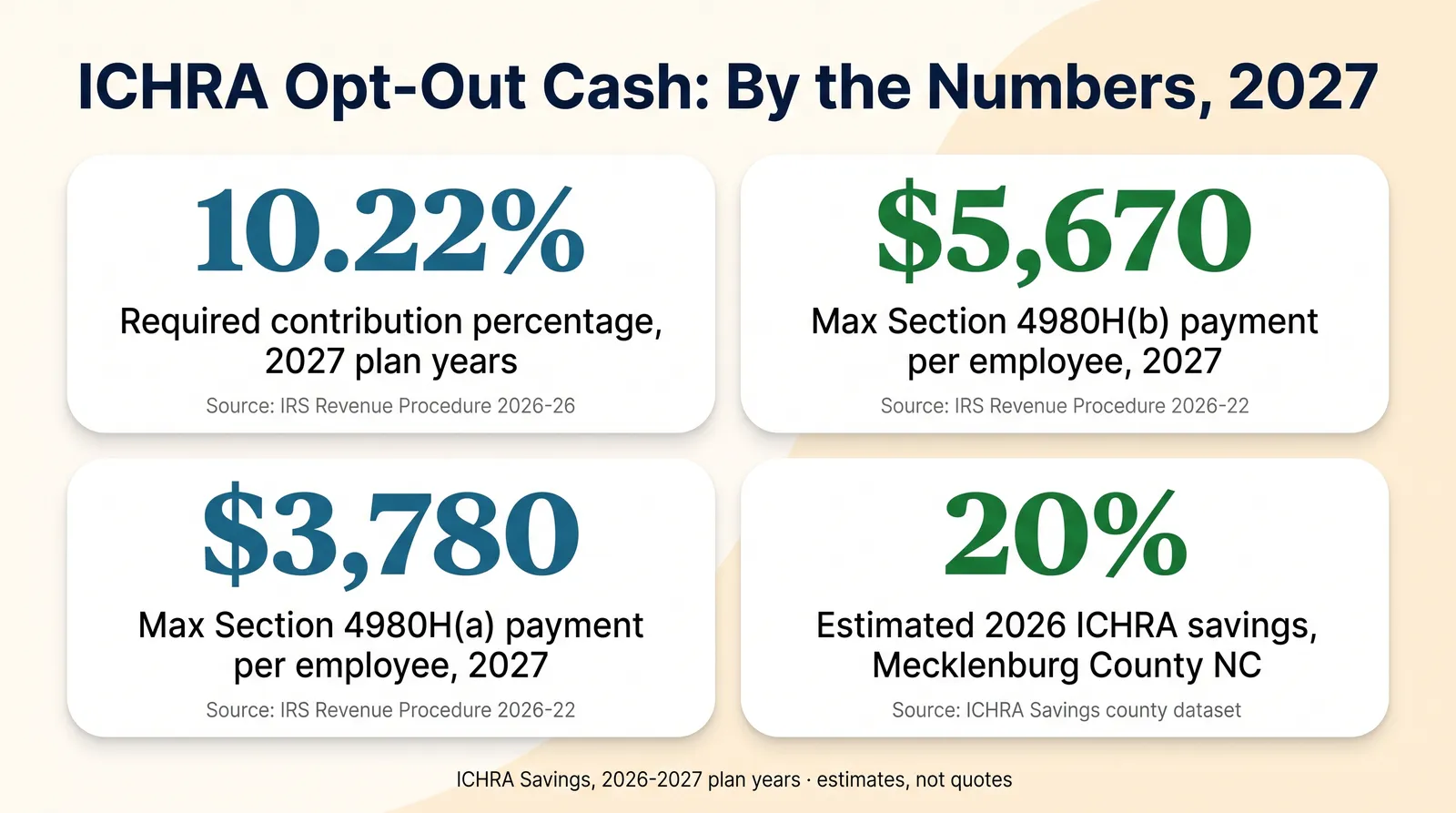
An ICHRA offer is "affordable" for a given employee, for purposes of both the employee's premium tax credit eligibility under 26 U.S.C. § 36B and, for larger employers, the shared responsibility payment under § 4980H(b), when that employee's required contribution does not exceed the required contribution percentage of their income or wages. For plan years beginning in 2027, that percentage is 10.22%, the highest figure since the test's inception, set by the IRS in Revenue Procedure 2026-26.
Nothing about that test cares what your ICHRA contribution "should" cover in the abstract. It cares about one number: the required contribution, run through the calculation described above. When you add an unconditional cash opt-out payment, you are not creating a new, separate line item the IRS ignores. You are adding directly to the same number the affordability test uses, on top of whatever the HRA contribution already reduced it to.
The IRS's own worked example, carried through from Notice 2015-87 into the 2016 proposed regulations under REG-109086-15, shows exactly how mechanical this is: an employee required to contribute $3,000 a year for self-only coverage, offered an additional $500 a year to decline it, has a required contribution of $3,500, "regardless of whether [the employee] enrolls in the eligible employer-sponsored plan or declines to enroll and is paid the opt-out payment" (Federal Register, 81 FR 44571, July 8, 2016). The payment counts against affordability whether or not a single person ever actually takes it. Offering it is enough.
The opt-out payment counts against affordability the moment you offer it, whether or not a single employee ever takes the cash.
IRS Notice 2015-87, Q&A-9; 81 Fed. Reg. 44571 (July 8, 2016)Why this rule is "proposed" and still applies to you
A fair question at this point: if this is a "proposed" regulation, does it actually bind you? The honest answer, sourced rather than softened: Treasury and the IRS published this treatment first as sub-regulatory guidance in Notice 2015-87, then as a formal notice of proposed rulemaking on July 8, 2016 (REG-109086-15, 81 FR 44557), stating at the time that they "anticipate[d] finalizing these regulations prior to the end of 2016." That final regulation has never been issued.
What has not lapsed is the underlying guidance. Notice 2015-87 explicitly told employers that, for any unconditional opt-out arrangement adopted after December 16, 2015, they should already be including the payment in the required contribution for premium tax credit and individual mandate purposes, and the proposed 2016 regulations reaffirmed that position while inviting, and then never finalizing, further comment. Absent a superseding rule, this is the position the IRS and Treasury have taken publicly and never withdrawn, and it is the standard the benefits compliance industry, and this article, treats as the operative one. Any ICHRA opt-out payment an employer sets up now was, by definition, adopted long after that 2015 cutoff, so none of the narrow transition relief in the notice applies to it.
A worked example: Mecklenburg County, North Carolina
Numbers make this concrete. Mecklenburg County, home to Charlotte, is one of 21 North Carolina counties where an ICHRA estimate currently beats small-group coverage, with an estimated 20% spread for the 2026 plan year: an individual-market benchmark premium of $688 a month against a small-group benchmark of $860, a gap of $172 a month, or an estimated $2,062 a year per employee (ICHRA Savings qualified-counties dataset, 2026 plan year).
Picture a Charlotte-area employer with a mixed hourly and salaried team, offering an ICHRA contribution of $520 a month toward that $688 benchmark plan. For a full-time hourly employee earning $15.00 an hour, this employer uses the rate-of-pay affordability safe harbor: 130 hours times the hourly rate produces a monthly wage base of $1,950, and 10.22% of that base is an affordability ceiling of $199 a month for 2027 plan years.
The employee's required contribution before any opt-out payment is the benchmark premium minus the ICHRA contribution: $688 − $520 = $168 a month. That clears the $199 ceiling with room to spare — the plan is affordable, and this employee is not eligible for a premium tax credit while the offer stands.
Now the employer, following the same habit they used with their old group plan, adds an unconditional $100-a-month cash payment for anyone who declines the ICHRA. Under Notice 2015-87, Q&A-9, that payment is added straight back into the required contribution: $168 + $100 = $268 a month. That figure exceeds the $199 ceiling by $69. The exact same ICHRA offer, with the exact same $520 contribution, has flipped from affordable to unaffordable, for every employee in that class, purely because of a cash option nobody may ever actually use.
Required contribution before and after an unconditional opt-out payment
Mecklenburg County, NC benchmark plan, hypothetical $520/mo ICHRA, $15.00/hr rate-of-pay safe harbor, 2027 threshold
Hypothetical worked example for illustration. Source for county premiums: ICHRA Savings qualified-counties dataset, 2026 plan year. Not an offer of insurance, a quote, or a guarantee of savings.
What it costs when the math breaks
Nothing happens automatically the instant the math flips. The consequence requires two more things to actually occur. First, the affected employee has to go to the marketplace, enroll in a qualified health plan, and receive an advance premium tax credit, which they are now eligible for precisely because your offer became unaffordable under § 36B. Second, if your company is an applicable large employer, 50 or more full-time employees including full-time equivalents in the prior year, that employee's premium tax credit triggers an assessable payment under 26 U.S.C. § 4980H(b).
For plan years beginning in 2027, that payment is capped at $5,670 per affected full-time employee for the year, or $473 a month, the indexed figure the IRS published in Revenue Procedure 2026-22. The related § 4980H(a) payment, for employers that fail to offer coverage to enough of their workforce at all rather than failing the affordability test on one plan, runs higher still, at $3,780 per full-time employee, minus the first 30, for the year. Both figures are up from their 2026 levels, part of a broader trend of the ESRP indexing rising as national health-expenditure growth accelerates.
10.22%
Required contribution percentage, 2027 plan years (IRS Rev. Proc. 2026-26)
$5,670
§ 4980H(b) payment per affected employee, 2027 (IRS Rev. Proc. 2026-22)
$3,780
§ 4980H(a) payment per full-time employee minus 30, 2027
50+
Full-time-equivalent employees to be an applicable large employer
Look closely at that mechanism and one detail matters more than the dollar figure: the affordability failure is what opens the door to the employee's subsidy eligibility in the first place. Before the opt-out payment existed, this same employee was blocked from a premium tax credit because their ICHRA offer was affordable. The opt-out payment does not just risk a penalty; it is the specific act that makes the employee eligible for the subsidy that then triggers the penalty. Nothing about it was hidden from view. It was created by the employer's own plan design.
The three ways to structure this correctly
None of this means you cannot give employees a decline option with financial teeth. It means you have three real paths, and only one of them is a trap.
- Do not offer a separate cash payment at all. The ICHRA's built-in opt-out right already lets an employee decline for free. If your goal is simply to avoid trapping anyone in coverage they do not want, you already have that covered under 26 CFR § 54.9802-4(c)(4) without spending another dollar or touching your affordability math.
- Condition the payment on proof of other group coverage, renewed every year. Under the treatment proposed at 26 CFR § 1.5000A-3(e)(3)(ii)(G), an "eligible opt-out arrangement" — one where the employee must provide reasonable evidence, such as an attestation, that they and everyone in their expected tax family already have minimum essential coverage other than individual-market coverage, refreshed at least once a plan year — does not increase the required contribution. A spouse's employer plan qualifies. An employee's own marketplace policy does not.
- If you offer it unconditionally anyway, model the affordability hit before you launch it, not after. Run the required contribution with the opt-out payment added, against the current required contribution percentage, for your lowest-paid affected employee, using whichever safe harbor you rely on. If it clears with real room to spare, an unconditional payment can still work. If it does not, you now know before an employee ever files for a subsidy, not after an IRS letter arrives.
The cheapest fix is usually the first one
Most employers who add a cash opt-out to an ICHRA are trying to solve a problem the ICHRA already solves for free. Before you build a conditional arrangement or run the math on an unconditional one, ask whether you need the payment at all.
If you are not an applicable large employer
Everything about the § 4980H(b) penalty is specific to applicable large employers, generally 50 or more full-time-equivalent employees in the prior calendar year, under 26 CFR § 54.4980H-1(a)(4). If your company sits below that line, an affordability failure will not generate a payment from you directly.
The affordability test itself, though, is not an ALE-only concept. It governs premium tax credit eligibility under 26 U.S.C. § 36B for every employee at every size of employer, because that section asks whether the individual was offered affordable, minimum-value coverage, not whether the employer crossed 50 employees. A small employer who adds an unconditional opt-out payment and blows affordability will not get a bill from the IRS, but an employee who believed they had no marketplace option, or who took a subsidy they were not actually eligible for once the corrected math is applied, can end up owing money back at tax time. Getting this right protects your people even when it does not directly protect your balance sheet.
How ICHRA Savings helps
The county-level data behind this site answers a different question than the one this article covers: whether an ICHRA beats small-group coverage where your employees actually live in the first place. It does not replace a benefits attorney or a TPA's plan-design review for a question this specific to your workforce, wage structure, and any opt-out payment you are considering. What it does give you is the starting number, the benchmark premium your county actually supports, so the affordability math above is not a guess. Before anything else, check whether your county is one where the underlying arithmetic works: explore the savings map.
Questions employers actually ask
Can I pay an employee cash for declining my ICHRA?
You can offer a separate cash payment conditioned on the employee declining ICHRA coverage, but it is not free of consequences. An unconditional opt-out payment — one paid just for declining, with no other requirement — generally must be added back into that employee’s required contribution for ACA affordability purposes (IRS Notice 2015-87, Q&A-9). That can turn an otherwise affordable ICHRA offer into an unaffordable one.
Is the ICHRA contribution itself the same thing as an opt-out payment?
No, and confusing the two is the root of this mistake. The ICHRA contribution is HRA money: it can only reimburse substantiated individual health insurance premiums and medical expenses, and it reduces the employee’s required contribution dollar for dollar (Notice 2015-87, Q&A-7). A cash opt-out payment is ordinary taxable compensation paid only if the employee declines coverage, and it increases the required contribution instead of reducing it.
Does adding an opt-out payment always blow affordability?
No. It only matters when the added amount pushes the employee’s required contribution over the required contribution percentage of their wages, 10.22% for plan years beginning in 2027 (IRS Rev. Proc. 2026-26). An employer with wide affordability headroom can absorb a modest opt-out payment. One running close to the line, which is common when a contribution is set to the minimum needed to clear the threshold, cannot.
What is a "conditional" or "eligible" opt-out arrangement, and does it avoid the problem?
Yes, if structured correctly. Under the treatment IRS and Treasury proposed in 2016, an opt-out payment conditioned on the employee proving they have other minimum essential coverage, such as a spouse’s employer plan, does not increase the required contribution the way an unconditional payment does (proposed 26 CFR § 1.5000A-3(e)(3)(ii)(G), Federal Register 81 FR 44557). The proof requirement has to be real and renewed at least annually, and individual-market coverage does not count as the qualifying "other coverage."
Were these opt-out payment regulations ever finalized?
No. Treasury and the IRS proposed them in July 2016 and said they expected to finalize the rule before the end of that year, but as of this writing no final regulation has been issued. Notice 2015-87 remains the operative guidance, and both the IRS and the benefits-compliance industry treat its Q&A-9 test as the standard employers should follow in the meantime.
What happens if we get this wrong and we have 50 or more full-time employees?
You risk an assessable payment under 26 U.S.C. § 4980H(b): $5,670 per full-time employee per year for plan years beginning in 2027, or $472.50 a month, but only for a full-time employee who actually receives a premium tax credit through the marketplace (IRS Rev. Proc. 2026-22). It is not automatic; it triggers only when the affordability failure and the subsidy both actually happen for a specific employee.
We have fewer than 50 employees. Does any of this apply to us?
The employer penalty under § 4980H does not, because that section only reaches applicable large employers. The affordability test itself still does, because it governs whether your employees keep or lose premium tax credit eligibility under 26 U.S.C. § 36B regardless of your size. Getting it wrong at a small employer will not cost you a penalty, but it can cost an employee a subsidy they were counting on, or hand them a surprise repayment at tax time.
Is it simpler to just not offer a cash opt-out at all?
For most employers, yes. The ICHRA design already includes a mandatory annual opt-out right at no extra cost to you (26 CFR § 54.9802-4(c)(4)), so an employee who wants to decline already can. Layering a cash sweetener on top solves a problem the ICHRA structure does not actually have, and it is the single most common way employers accidentally reopen an affordability question they thought was closed.
Sources
- IRS Notice 2015-87, "Further Guidance on the Application of the Group Health Plan Market Reform Provisions..." Part III, Q&A-7 (HRA contributions reduce the required contribution), Q&A-8 (the "cannot be received as a taxable benefit" test for a health flex contribution), and Q&A-9 (unconditional opt-out payments increase the required contribution; the $200/$100 worked example)
- Federal Register, "Premium Tax Credit NPRM VI" (REG-109086-15, 81 FR 44557-44576, July 8, 2016 — the proposed regulations on opt-out arrangements, including the $3,000/$500 = $3,500 worked example and the "eligible opt-out arrangement" conditional-payment carve-out; never finalized)
- 26 CFR § 54.9802-4(c)(4), Electronic Code of Federal Regulations (the mandatory annual ICHRA opt-out right)
- IRS Revenue Procedure 2026-26 (the 10.22% required contribution percentage for plan years beginning in 2027)
- IRS Revenue Procedure 2026-22 (the $3,780 and $5,670 indexed § 4980H(a) and § 4980H(b) payment amounts for 2027)
- ICHRA Savings qualified-counties dataset, 2026 plan year (Mecklenburg County, NC and North Carolina qualifying-county figures)