ICHRA in Pennsylvania 2026: 2027 Rates Already Up 17%
Pennsylvania's 2027 individual-market rates are already filed up 17.1%, on top of a 21.5% 2026 hike. See where ICHRA still saves, county by county.
The short version
- Pennsylvania's individual market was approved for a 21.5% average rate increase for 2026, and insurers have already filed for a 17.1% average increase for 2027 — small group rose 12.7% for 2026, with 11.5% already filed for 2027.
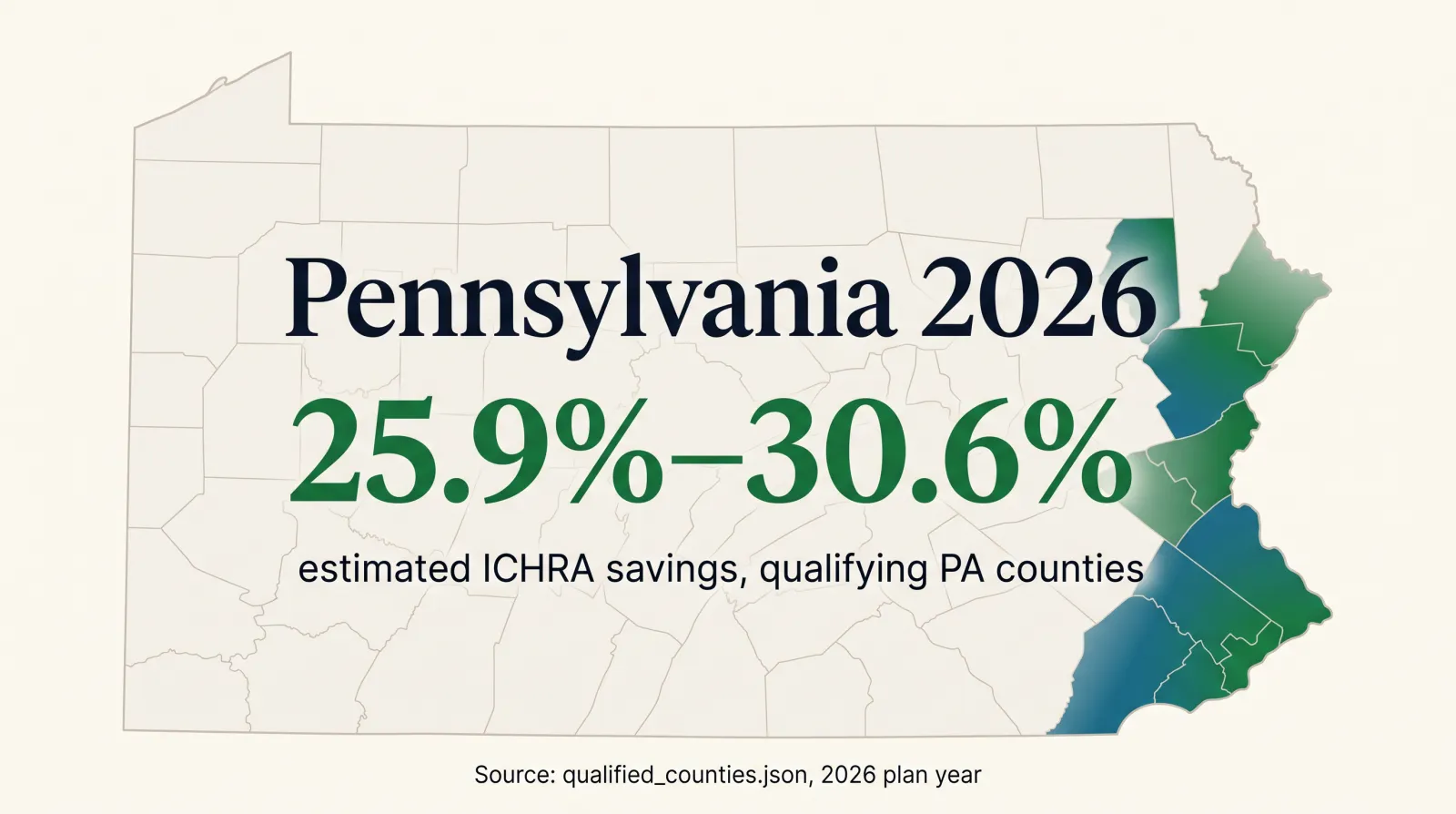
- ICHRA currently shows a rate-spread advantage in 9 of Pennsylvania's 67 counties: the Philadelphia corridor (25.9% estimated), the Lehigh Valley (27.7%), and the Poconos (30.6%), covering roughly 4.7 million people.
- Nationally, the median proposed 2027 marketplace premium increase is 14%, following an 18% median increase for 2026 — the highest in nearly a decade.
- The other 58 Pennsylvania counties, including Allegheny (Pittsburgh), do not currently show that same rate-spread advantage on this year's numbers.
- These are estimates from 2026 benchmark rate data, not quotes, and starting an ICHRA generally means an employee waives the premium tax credit for that month.
Does ICHRA beat small group in Pennsylvania?
In nine counties, yes, on the numbers behind this site's 2026 dataset. The Philadelphia corridor — Philadelphia, Bucks, Delaware and Montgomery counties — shows an individual-market benchmark premium of $243.73 a month against a small-group benchmark of $328.72 a month, a spread of $84.99 a month, or an estimated 25.9% over the year. Run that out to $1,019.88 a year per employee, and that is before anyone in your company has opened a 2027 renewal letter.
Here is the part that is easy to miss if you only read the statewide headline: most of Pennsylvania does not currently qualify. Of the state's 67 counties, only nine show a small-group benchmark priced above the individual-market benchmark, and all nine sit in three clusters in the eastern part of the state — the Philadelphia metro, the Lehigh Valley, and the Poconos. Pittsburgh's Allegheny County and the rest of the state currently price the other way, which is exactly the kind of detail a statewide average hides and a county-by-county map does not.
Your county's rate spread
How individual-market premiums compare to small-group premiums where each employee lives, not where your office is registered.
Whether your renewal is about to happen again
Pennsylvania insurers have already filed 2027 rate requests. Knowing the number before your broker calls changes the conversation.
Whether you offer anything today
Comparing ICHRA to a small-group renewal and comparing ICHRA to no benefit at all are two different decisions with two different answers.
Who this is actually for
Three different Pennsylvania employers read an article like this, and it is worth being honest about all three up front, because the arithmetic is not the same for any of them.
The first already renewed small-group coverage for 2026 and is still absorbing that number. They want to know whether the next renewal, the one built around the rates already filed for 2027, is worth waiting for or worth getting ahead of.
The second offers nothing at all, usually because a full small-group plan felt out of reach for a 6- to 20-person company, and the owner has been quietly worried about losing candidates to a competitor down the street that offers even a modest benefit. That employer is not choosing between ICHRA and small group. They are choosing between ICHRA and nothing, and the arithmetic below works out very differently for that decision than it does for the first employer.
The third employer is in Pittsburgh, Erie, Scranton, or one of the other 58 Pennsylvania counties this article's headline number does not currently apply to. That employer deserves a straight answer too: on this year's rate data, the pure cost-savings case made here is specific to nine counties in the eastern part of the state, and pretending otherwise would undercut the one thing this site is supposed to be reliable about.
Why Pennsylvania premiums keep rising
A few terms are worth defining once, since the rest of this article leans on them. A rate filing is the formal proposal an insurer submits to a state regulator — in Pennsylvania, the Pennsylvania Insurance Department (PID) — requesting permission to charge a new premium for the coming plan year. A rating area is a geographic zone, usually a group of counties, that a state uses to set a single premium scale; it is why several neighboring Pennsylvania counties in this article show identical benchmark premiums. The individual-market benchmark premium is the second-lowest-cost silver plan available to a representative enrollee in a given rating area — the same figure the federal government uses to calculate premium tax credits. The small-group benchmark premium is the comparable figure built from small-group plan filings for that same rating area.
According to the Pennsylvania Insurance Department, the drivers behind the increases described in this article are rising medical and prescription-drug costs, new federal rules affecting marketplace enrollment, and the expiration of enhanced federal premium tax credits at the end of 2025. The department's October 2025 announcement quoted Insurance Commissioner Michael Humphreys describing the effect plainly: "Congress's inaction is driving uncertainty and leading to higher costs for Pennsylvanians." The same announcement gave a household-level example of the enhanced-credit expiration alone pushing one couple's annual premium from $7,032 to $35,712 before accounting for the underlying rate increase.
The Peterson-KFF Health System Tracker's July 8, 2026 analysis of 2027 filings breaks the national pattern into two separate effects. The underlying medical trend — the rising cost of hospital care, physician visits and prescription drugs — had a median of 10% across the insurers it reviewed, which the brief calls the primary driver. On top of that, insurers separately estimated that the loss of enhanced premium tax credits would add roughly 4 percentage points to 2027 premiums, because healthier enrollees are expected to leave the marketplace as their subsidies shrink or disappear, leaving insurers with a smaller, sicker remaining risk pool to price around. One insurer's filing, quoted in the brief, put it directly: enhanced subsidies "expired...while we observe an increase in 2026 open enrollment...we anticipate a reduction in the overall market size...lead[ing] to increased average statewide morbidity in 2027."
What actually happened to your 2026 renewal
If your company renewed small-group coverage for 2026, here is the statewide context for the number you got. The Pennsylvania Insurance Department approved an average 21.5% weighted increase for the individual market and an average 12.7% increase for the small-group market, according to its October 14, 2025 announcement. That small-group figure was itself reduced from an initial average request of 13.1% after the department's review process blocked $50.1 million in what it described as unjustified premium increases. The largest single small-group increase approved was Highmark Care Benefits, at 21.85%.
Nationally, the Center on Health Insurance Reforms (CHIR) at Georgetown University found that the median proposed 2026 marketplace premium increase was 18%, which it described as the highest in nearly a decade — nearly triple the median proposed increases of 6% in 2024 and 7% in 2025. Pennsylvania's approved individual-market figure of 21.5% sits above that national median.
What's already filed for 2027
This is the part of the story most 2026 renewal conversations do not yet include. On July 23, 2026, the Pennsylvania Insurance Department announced that individual-market insurers had filed 2027 rate requests averaging a weighted 17.1% increase, and small-group insurers had filed requests averaging 11.5%. Filings were submitted May 15, 2026; public comment is open through August 22, 2026, and final approved rates are expected in the fall of 2026 for January 2027 coverage.
The individual-market filings vary widely by carrier. Ambetter Health filed for the largest increase, 40.90%, followed by Keystone Health Plan Central at 33.83% and Highmark Benefits Group at 21.40%. On the lower end, Geisinger Health Plan filed for 10.46% and UPMC Health Network for 12.03%.
| Carrier | 2027 filed increase |
|---|---|
| Ambetter Health | 40.90% |
| Keystone Health Plan Central | 33.83% |
| Highmark Benefits Group | 21.40% |
| Partners Insurance Company | 20.51% |
| QCC Insurance Company | 19.88% |
| Capital Advantage Assurance | 18.32% |
| Health Partners Plans | 15.90% |
| Highmark Inc | 16.16% |
| UPMC Health Plan Inc | 15.82% |
| Oscar Health Plan | 15.39% |
| Keystone Health Plan East | 14.68% |
| Geisinger Quality Options | 12.95% |
| UPMC Health Network | 12.03% |
| Geisinger Health Plan | 10.46% |
Source: Pennsylvania Insurance Department, "Shapiro Administration Receives Proposed 2027 Health Insurance Rates" (Jul. 23, 2026). Filed requests, not final approved rates; Pennsylvania, individual market, plan year 2027.
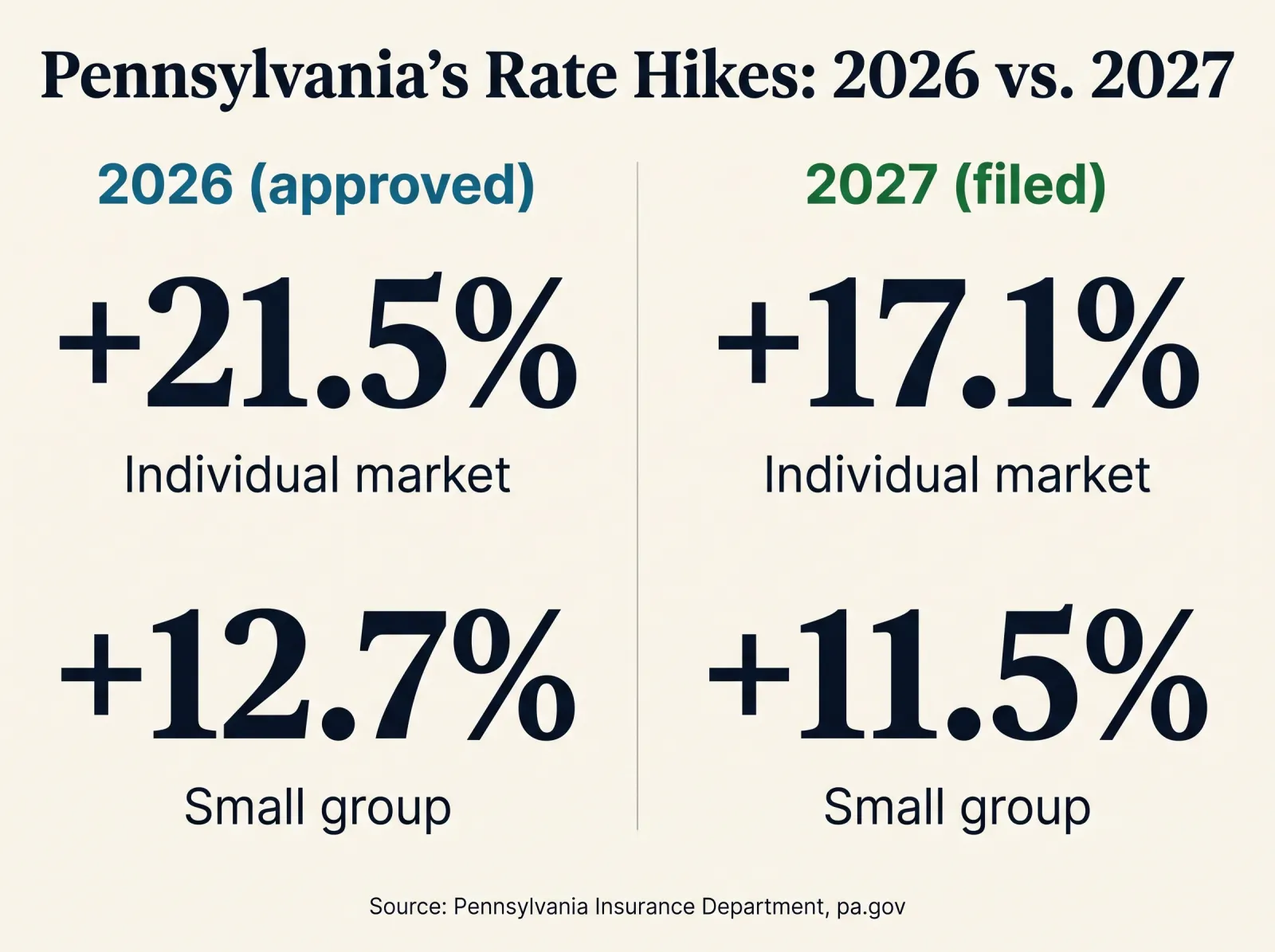
Requested is not the same as approved. In 2026, the department cut the small-group request from 13.1% to 12.7% and denied $50.1 million in increases outright, so the 17.1% and 11.5% filed for 2027 could still move by the time final rates publish this fall. But the direction of travel, two years running, has been the same: a double-digit request followed by a double-digit approval, even after the state's review process trims it back.
Is this just Pennsylvania, or everywhere?
It is national, and the timing is not a coincidence. CHIR's June 18, 2026 analysis of the earliest state filers for 2027 found a range from 6.5% in Vermont to 22.4% in Washington State, based on preliminary numbers, since most states' 2027 rates were not due to federal regulators until mid-July and were not fully public until the end of July. By the time the Peterson-KFF Health System Tracker published its broader analysis on July 8, 2026, covering 77 insurers across 16 states and Washington, D.C., the national median proposed 2027 increase stood at 14% — lower than 2026's 18% median, but still a second consecutive year of double-digit proposed increases, which CHIR's researchers flagged as unusual against the 6% and 7% medians of the two years before that.
| Measure | Pennsylvania | National |
|---|---|---|
| Individual market, 2026 (approved Oct. 14, 2025) | +21.5% | 18% median proposed (2026, CHIR) |
| Small group market, 2026 (approved Oct. 14, 2025) | +12.7% | No single national small-group figure published for this comparison |
| Individual market, 2027 (filed, announced Jul. 23, 2026) | +17.1% | 14% median proposed (2027, 77 insurers/16 states+DC, Peterson-KFF) |
| Small group market, 2027 (filed, announced Jul. 23, 2026) | +11.5% | Range 6.5%–22.4% across early-filing states (CHIR) |
Sources: Pennsylvania Insurance Department (Oct. 14, 2025; Jul. 23, 2026); Georgetown University Center on Health Insurance Reforms (Jun. 18, 2026); Peterson-KFF Health System Tracker (Jul. 8, 2026). Figures are weighted or median averages as noted by each source.
If your Pennsylvania renewal already stung in 2026, the honest reading of these two filings is that the next one is not likely to feel materially different in kind, even though the requested percentage is a bit lower than last year's. The question worth asking before that renewal letter arrives is whether a fixed ICHRA contribution, priced against your employees' actual counties, would cost less for the same plan year. The next three sections work through where that is true in Pennsylvania today, and where it currently is not.
Philadelphia's four-county corridor: the math
Table 3 below is generated directly from this site's county dataset, not typed by hand. It covers Philadelphia County and its three immediate collar counties — Bucks, Delaware and Montgomery — which currently price identically because they sit inside the same CMS-defined rating area for individual and small-group filings.
| County | Individual benchmark (mo.) | Small-group benchmark (mo.) | Estimated spread | Est. annual savings/employee | Population |
|---|---|---|---|---|---|
| Philadelphia | $244 | $329 | 25.9% | $1,020 | 1,593,208 |
| Bucks | $244 | $329 | 25.9% | $1,020 | 645,163 |
| Delaware | $244 | $329 | 25.9% | $1,020 | 575,312 |
| Montgomery | $244 | $329 | 25.9% | $1,020 | 856,399 |
Source: src/data/qualified_counties.json, 2026 plan year (Ideon rate data,
cross-verified against CMS public-use marketplace files). Estimates, not quotes; actual
results depend on your workforce.
Philadelphia County alone holds 1,593,208 people in this dataset, and the four-county corridor together holds 3,670,082. That combination — a large, dense metro where the individual-market benchmark still sits meaningfully below the small-group benchmark — is a genuinely useful one, since most of the country's highest-percentage qualifying counties are thin, rural counties with small population bases. Philadelphia's 25.9% spread is lower than some of those rural counties elsewhere in the dataset, but it applies to nearly 3.7 million people rather than a few thousand.
Estimated ICHRA savings spread, Pennsylvania's three qualifying clusters
2026 plan year, individual-market benchmark vs. small-group benchmark premiums
Source: qualified_counties.json, 2026 plan year. Estimates, not quotes; not a
guarantee of savings for any specific employer.
9
of 67 Pennsylvania counties currently qualifying
4.7M
People in those nine counties combined
30.6%
Highest spread, Monroe & Carbon counties
2026
Plan year in the dataset
Lehigh Valley and the Poconos: two more rating areas
Outside the Philadelphia corridor, two more clusters currently qualify, each priced under a different rating area than Philadelphia and than each other.
| County | Individual benchmark (mo.) | Small-group benchmark (mo.) | Estimated spread | Est. annual savings/employee | Population |
|---|---|---|---|---|---|
| Lehigh | $283 | $392 | 27.7% | $1,305 | 374,110 |
| Northampton | $283 | $392 | 27.7% | $1,305 | 314,299 |
| Schuylkill | $283 | $392 | 27.7% | $1,305 | 143,201 |
| County | Individual benchmark (mo.) | Small-group benchmark (mo.) | Estimated spread | Est. annual savings/employee | Population |
|---|---|---|---|---|---|
| Monroe | $258 | $372 | 30.6% | $1,367 | 168,128 |
| Carbon | $258 | $372 | 30.6% | $1,367 | 65,018 |
Source: src/data/qualified_counties.json, 2026 plan year (Ideon rate data,
cross-verified against CMS public-use marketplace files). Estimates, not quotes.
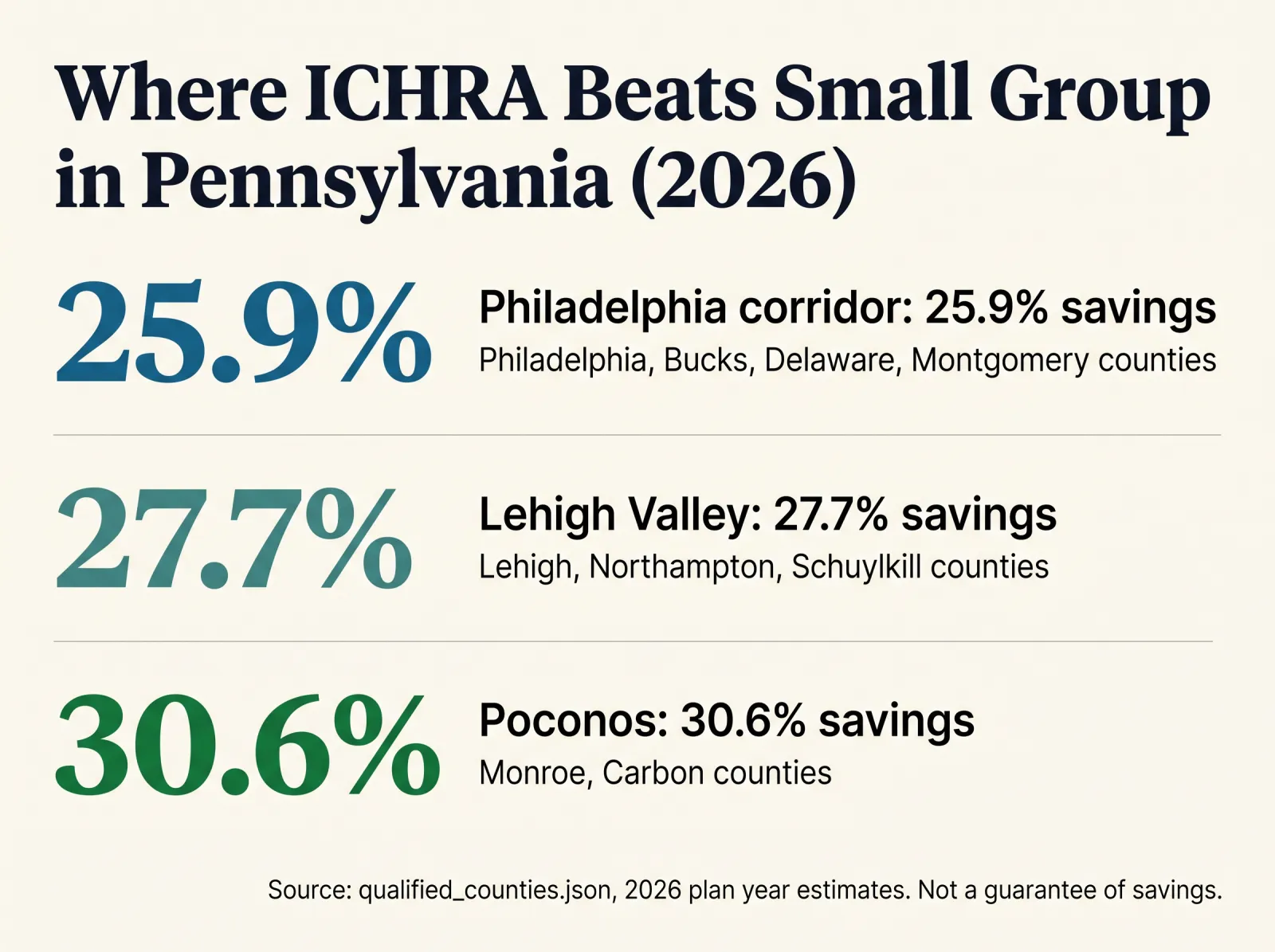
Notice that the Poconos, the smallest cluster by population at 233,146 people, shows the largest percentage spread at 30.6%, while the much larger Philadelphia corridor shows the smallest spread at 25.9%. That is a common and easy-to-misread pattern in this dataset: percentage spread and population size do not move together, and a company with a multi-county Pennsylvania workforce needs to check each county its employees actually live in rather than applying one county's number to the whole team.
How an ICHRA actually works, mechanically
An Individual Coverage HRA, or ICHRA, is a federal HRA structure created by a 2020 final rule from the IRS, the Department of Labor and HHS. It lets an employer of any size, including a single employee, set a fixed monthly reimbursement amount instead of buying a group insurance policy. Employees use that allowance to buy their own individual-market plan — on the ACA marketplace or off it — and submit proof of coverage, called substantiation, to get reimbursed tax-free.
An employee class is a permitted way of grouping employees (full-time versus part-time, salaried versus hourly, or by geographic rating area, among others) so an employer can offer different ICHRA terms to different classes. The affordability test is the calculation that decides whether a given ICHRA contribution counts as "affordable" under IRS rules for a specific employee, which in turn decides whether that employee keeps eligibility for a premium tax credit. None of these mechanics are Pennsylvania-specific; they apply the same way in every state.
The savings shown in this article are a rate-spread effect, not a discount or a subsidy the employer is somehow accessing. In the Philadelphia corridor, the benchmark individual-market plan currently costs less per month than the benchmark small-group plan. An employer who sets an ICHRA contribution near the individual benchmark is funding real coverage at a lower monthly cost than the small-group alternative, for that specific county, for that specific plan year. If the spread narrows or reverses when carriers refile for 2027, so does the savings case, which is exactly why the filed-rate figures earlier in this article matter alongside the county data: a Philadelphia-area small-group renewal facing an 11.5% filed increase for 2027 changes this comparison, even if the individual-market side of the equation does not move by the same amount.
Employee classes are where a multi-county Pennsylvania workforce shows up in plan design. A professional-services firm with staff split between Philadelphia and the Lehigh Valley might use a rating-area class, since the federal rule permits classes defined by geography, given that those two areas price under different benchmarks. What an employer cannot do is offer the same employee class a choice between the ICHRA and a traditional group plan; the class has to get one or the other, cleanly, which is one of the more common places a first-time rollout goes wrong.
Two worked examples
The arithmetic below uses the Philadelphia corridor and Bucks County benchmark figures from Table 3. Both examples are illustrative, not a projection for any specific business, and are built purely to show how the math works.
Example A: a 15-person Montgomery County company that offers nothing today
Funding each employee at the Montgomery County individual benchmark of $243.73 a month costs 15 × $243.73 × 12 months = $43,871.40 a year, or $2,924.76 per employee. Setting up small-group coverage at the same county's benchmark of $328.72 a month would cost 15 × $328.72 × 12 months = $59,169.60 a year. The gap, $15,298.20 a year in this illustrative comparison, is the same $1,019.88-per-employee figure from Table 3, scaled to 15 people. For a company offering no benefit at all today, the ICHRA side of that comparison is the one worth pricing against your actual hiring budget.
Example B: a 30-person Bucks County firm renewing small-group coverage into 2027
Start from Bucks County's small-group benchmark, $328.72 a month per employee. Apply Pennsylvania's filed 2027 small-group increase of 11.5%: $328.72 × 1.115 = $366.64 a month, up $37.92, or $455.04 a year per employee. Across 30 employees, that filed increase alone would add an estimated $13,651 to the annual bill, if approved at the filed level. Funding an ICHRA instead, at Bucks County's individual benchmark of $243.73 a month ($2,924.76 a year per employee), would cost 30 × $2,924.76 = $87,742.80 a year in total, versus 30 × $366.64 × 12 = $131,990.40 for the renewed group plan at the filed 2027 rate — a difference of roughly $44,248 a year in this illustrative comparison, or about $1,475 per employee. That figure is higher than the flat $1,019.88 Table 3 number because it also captures the filed 2027 renewal increase this employer would otherwise be absorbing, on top of the existing 2026 spread.
Neither example is a promise about what your renewal, your workforce, or your actual carrier quote will show. They combine this site's benchmark figures with a separately sourced, not-yet-final rate-filing percentage to demonstrate the mechanics, not to forecast your bill.
How ICHRA adoption is actually growing
ICHRA is not a niche product anymore. The HRA Council's "Growth Trends for ICHRA & QSEHRA 2024-2025" report, based on anonymized data voluntarily shared by fifteen member organizations through January 2025, found that small, non-ALE ICHRA adoption grew 52% year over year among founding members, while aggregate large-employer (ALE) adoption grew 34%, with some large-employer cohorts up 49%. The same report found that 83% of employers who started an ICHRA or QSEHRA in 2025 had never previously offered any coverage — we found that figure in only that one report, so we are stating it plainly rather than implying it is independently confirmed elsewhere.
That growth curve matters in Pennsylvania because of who is not currently covered. Nationally, 59% of firms with 10 to 199 workers offer health benefits at all, compared with 97% of firms with 200 or more workers, according to KFF's 2025 Employer Health Benefits Survey, published October 22, 2025. Flip that small-firm figure around: an estimated 41% of companies in that size band offer nothing, nationally, in 2025. The real competitor to ICHRA in most of Pennsylvania's small-business economy is not small group. It is nothing.
52%
YoY growth, small/non-ALE ICHRA adoption (HRA Council founding members)
34%
YoY growth, aggregate large-employer (ALE) adoption
83%
2025 ICHRA/QSEHRA employers with no prior coverage offered
Offering nothing, or renewing small group
- Either no benefit at all, or a renewal number set by the carrier and the state's rate review
- Another filed increase already on the table for 2027
- Participation minimums can block a plan before price is even the issue
- One plan and network has to suit everyone, across every county your team lives in
VariableOr zero
Running an ICHRA in a qualifying Pennsylvania county
- Cost is the contribution you choose, informed by your employees' actual counties
- No carrier participation minimum to hit
- Each employee buys locally, whether that's Philadelphia, the Lehigh Valley, or the Poconos
- Reimbursement workflow replaces annual renewal shopping
FixedBudget set by you
Setting up an ICHRA in Pennsylvania
The rules are federal, so a Pennsylvania rollout follows the same sequence as anywhere else in the country. The order matters more than most employers expect.
- Pull your census by county. Not by headquarters address — by where each employee actually lives, since Philadelphia, the Lehigh Valley and the Poconos each carry their own benchmark, and most of the rest of the state currently prices the other way.
- Check the spread for every county your team lives in. The tables above cover the nine qualifying counties; the savings map covers the rest of Pennsylvania.
- Model affordability before setting a contribution amount. The reimbursement level decides whether each employee keeps premium tax credit eligibility.
- Define employee classes carefully, if you use them. Class rules have minimum-size requirements and hard constraints under the federal rule.
- Send the required advance employee notice on time. Late notice creates real compliance problems, not just an awkward conversation.
- Budget for onboarding support. Employees who have never shopped the individual market need guidance once, not ongoing hand-holding.
Run the county check first
Before anything else, check whether your specific Pennsylvania counties are ones where this works. Ten minutes on the savings map tells you whether the rest of this process is worth starting: Check your county on the savings map →
The honest limits of this data
Qualifying in these nine counties is not a guarantee for your business
- 58 of Pennsylvania's 67 counties do not currently show this same advantage. Allegheny County (Pittsburgh) and most of the state currently price with the small-group benchmark at or below the individual-market benchmark, so the cost-savings case made in this article does not currently extend statewide.
- A benchmark comparison is not your actual renewal. The $328.72 Bucks County figure is a small-group benchmark built from filed rates, not your carrier's specific quote for your specific group.
- Older or higher-risk workforces change the math. Individual-market premiums are age-rated more steeply in some rating areas than small-group premiums, which can narrow real-world savings for an older team.
- Rates move every plan year. With a 17.1% individual-market increase and an 11.5% small-group increase already filed for 2027 in Pennsylvania, this comparison could shift meaningfully once those rates are finalized this fall; recheck before every renewal, not just once.
- Taking an ICHRA generally means waiving the premium tax credit for that month. For an employee close to the 400% FPL subsidy cliff, that trade-off deserves its own conversation before enrollment — see our ACA subsidy cliff guide for the income thresholds by household size.
ICHRA is not better than small group everywhere in Pennsylvania. In nine counties, on this year's numbers, it clearly is — and the only way to know if that holds for your own workforce, in your own county, is to check.
Mike MooreHow these numbers are calculated
Every county figure in this article comes from the same dataset that powers our savings map, not a survey or a sales estimate. For each county, we compare a 2026 individual-market benchmark premium — the second-lowest-cost silver plan available to a representative enrollee, the same benchmark the federal government uses to calculate premium tax credits — against a small-group benchmark premium built from comparable small-group plan filings for that rating area. Both figures come from Ideon, a licensed insurance rate-data provider, and are cross-verified against CMS public-use marketplace files before publication. A county "qualifies" when the individual benchmark sits below the small-group benchmark; the percentage and dollar figures in this article are the gap between those two numbers, expressed as an annual per-employee figure at 12 times the monthly difference.
The Pennsylvania and national rate-filing figures (21.5%, 12.7%, 17.1%, 11.5%, 18%, 14%, and the 6.5%–22.4% state range) come from separately published, externally sourced analyses — the Pennsylvania Insurance Department, the Georgetown University Center on Health Insurance Reforms, and the Peterson-KFF Health System Tracker — not from our own county dataset, and they describe filed or approved carrier rate changes, not the benchmark premiums used in the county comparison above. We have kept those sources clearly separate throughout this article rather than blending them into one number.
Three limitations are worth stating plainly. First, benchmark premiums are built around a representative enrollee profile, so an unusually young or unusually old workforce will see a different real-world spread than the county figure implies. Second, these are benchmark plans, not every plan on the market; an employee who chooses a richer or leaner plan than the benchmark will see a different premium, though the relative spread tends to hold directionally. Third, rates are filed and refreshed annually, and Pennsylvania's 2027 filings are not yet final, so a county that qualifies for 2026 is not guaranteed to qualify, or to qualify by the same margin, for 2027.
Questions Pennsylvania employers actually ask
Does ICHRA beat small-group insurance in Pennsylvania?
In 9 of Pennsylvania's 67 counties, yes, on the current 2026 benchmark comparison: Philadelphia, Bucks, Delaware and Montgomery counties (an estimated 25.9% spread), Lehigh, Northampton and Schuylkill counties (27.7%), and Monroe and Carbon counties (30.6%). In the other 58 counties, including Allegheny County (Pittsburgh), the small-group benchmark currently prices at or below the individual-market benchmark, so ICHRA does not currently show a rate-spread advantage there. These are estimates from 2026 plan-year rate data, not quotes, and your actual result depends on your employees' ages and the plans they choose.
Why did my 2026 Pennsylvania small-group renewal come in so high?
Pennsylvania's small-group carriers were approved for an average 12.7% rate increase for 2026, down from an initial average request of 13.1% after the Pennsylvania Insurance Department blocked $50.1 million in what it called unjustified increases, according to the department's October 14, 2025 announcement. The individual market fared worse, approved at a 21.5% average weighted increase. The department cited new federal enrollment rules, rising medical and prescription costs, and the expiration of enhanced premium tax credits as drivers.
Is Pennsylvania about to see another rate increase in 2027?
Insurers have already filed for one. On July 23, 2026, the Pennsylvania Insurance Department announced that individual-market insurers requested a weighted average 17.1% increase for plan year 2027, and small-group insurers requested 11.5%. Those are requests, not final numbers; the department can reduce them, as it did for 2026, and final approved rates are expected in the fall of 2026. Public comment is open through August 22, 2026.
Is this a Pennsylvania-only problem, or is it happening everywhere?
It is national. The median proposed 2026 marketplace premium increase was 18%, the highest in nearly a decade, up from 6% in 2024 and 7% in 2025, according to Georgetown University's Center on Health Insurance Reforms. Early 2027 filings collected by the same research center in mid-June 2026 ranged from 6.5% in Vermont to 22.4% in Washington State. A separate July 8, 2026 analysis from the Peterson-KFF Health System Tracker put the national median proposed 2027 increase at 14% across 77 insurers in 16 states and Washington, D.C., citing both rising medical costs and a sicker remaining risk pool after enhanced premium tax credits expired.
What happens to my employees' premium tax credit if we start an ICHRA?
An employee who is offered an affordable ICHRA generally becomes ineligible for a premium tax credit for any month that offer applies, whether or not they accept it. With the enhanced premium tax credits gone and the 400% FPL subsidy cliff back for 2026 coverage, that trade-off is worth walking through before enrollment. Our separate guide on the ACA subsidy cliff covers the income thresholds by household size.
We have never offered any health benefit. Does ICHRA make sense for a 10-person Pennsylvania company?
It is one of the more realistic entry points. Nationally, 59% of firms with 10 to 199 workers offer health benefits at all, versus 97% of firms with 200 or more workers, per KFF's 2025 Employer Health Benefits Survey. The HRA Council found that 83% of employers who started an ICHRA or QSEHRA in 2025 had never previously offered coverage. An ICHRA lets a small employer set a monthly contribution of any size, with no carrier participation minimum to hit.
Does Pennsylvania add any state-specific rules on top of the federal ICHRA regulation?
No. ICHRA is a federal HRA structure created by a 2020 final rule from the IRS, the Department of Labor and HHS, and it works the same way in Pennsylvania as in any other state. The Pennsylvania Insurance Department reviews individual and small-group carrier rate filings, but it does not layer ICHRA-specific requirements on top of the federal rule.
What about Pittsburgh and the rest of Pennsylvania, where the county does not currently qualify?
Allegheny County and most of the rest of the state currently show a small-group benchmark at or below the individual-market benchmark, meaning the rate-spread case for ICHRA is weaker or absent there on this year's numbers. That does not mean ICHRA is unavailable — it still removes participation minimums and gives an employer a fixed, predictable budget — but the pure cost-savings argument used in this article does not currently apply outside the nine counties covered here. Check your own county on the savings map rather than assuming a statewide answer.
Where can I check the numbers for my specific Pennsylvania county?
Use the savings map to look up any Pennsylvania county by name. It shows the 2026 individual-market and small-group benchmark premiums side by side, so you can see the estimated spread, or the lack of one, before modeling a rollout for your own workforce.
Sources
- Pennsylvania Insurance Department, "Pennsylvania Insurance Department Releases Affordable Care Act 2026 Health Insurance Rates" (Oct. 14, 2025)
- Pennsylvania Insurance Department, "Shapiro Administration Receives Proposed 2027 Health Insurance Rates" (Jul. 23, 2026)
- Georgetown University Center on Health Insurance Reforms, "Early Signals Suggest a Second Year of Double-Digit Marketplace Premium Increases" (Jun. 18, 2026)
- Peterson-KFF Health System Tracker, "How Much and Why ACA Marketplace Premiums Are Going Up in 2027" (Jul. 8, 2026)
- KFF, "2025 Employer Health Benefits Survey" (Oct. 22, 2025)
- HRA Council, "Growth Trends for ICHRA & QSEHRA, Vol. 4" (data through Jan. 2025)
- U.S. Census Bureau, QuickFacts: Pennsylvania (67-county count)
- ICHRA final rule: Departments of the Treasury/IRS, Labor, and Health and Human Services (2020)
- County-level premium comparison:
src/data/qualified_counties.json, 2026 plan year (Ideon rate data, cross-verified against CMS public-use marketplace files)