ICHRA in Sioux City, Iowa 2026: Woodbury County 20%
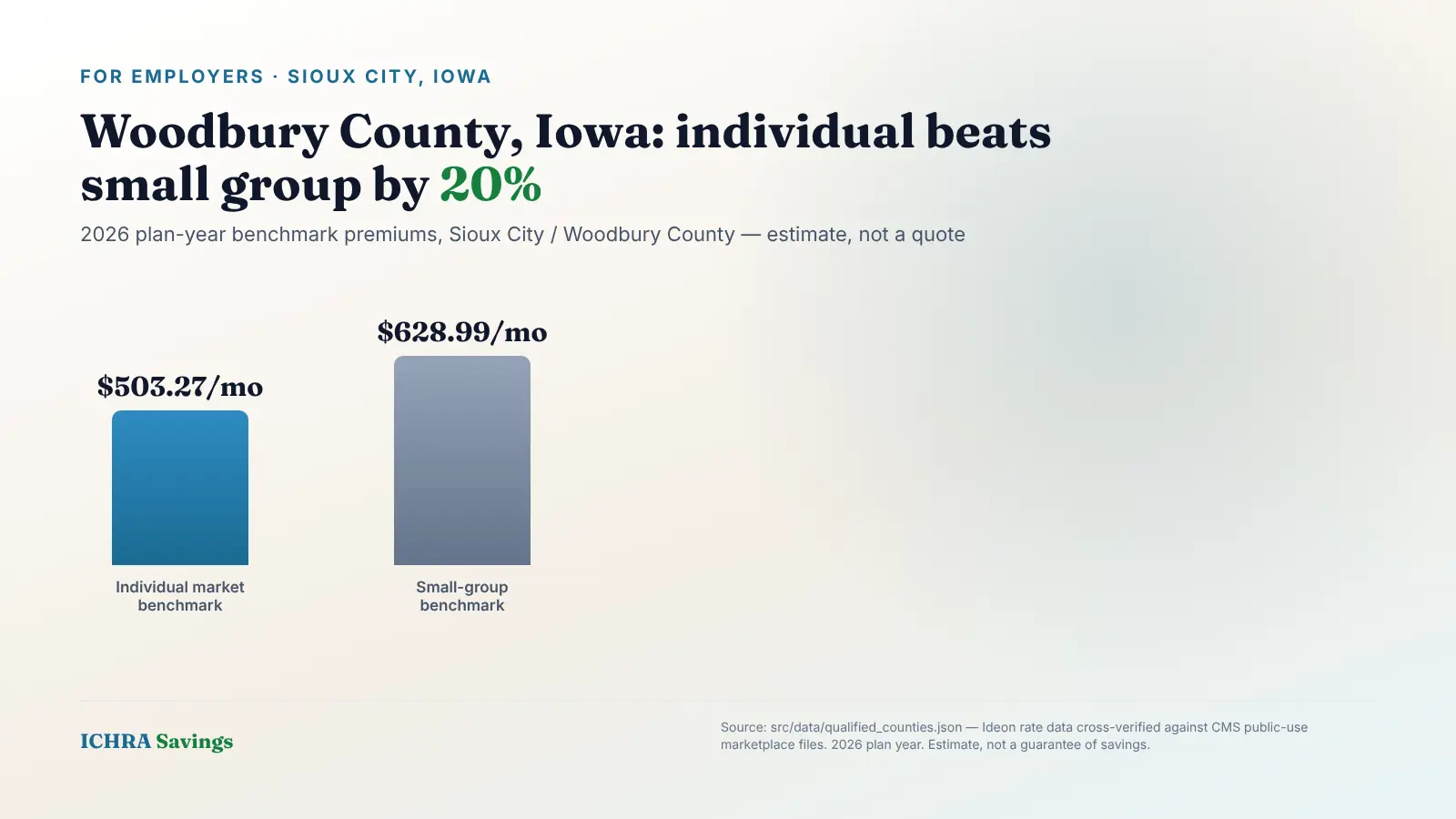
Woodbury County's 2026 benchmark runs an estimated 20% below small group, about $1,509 a year per employee. Sourced Sioux City, Iowa data for employers.
The short version
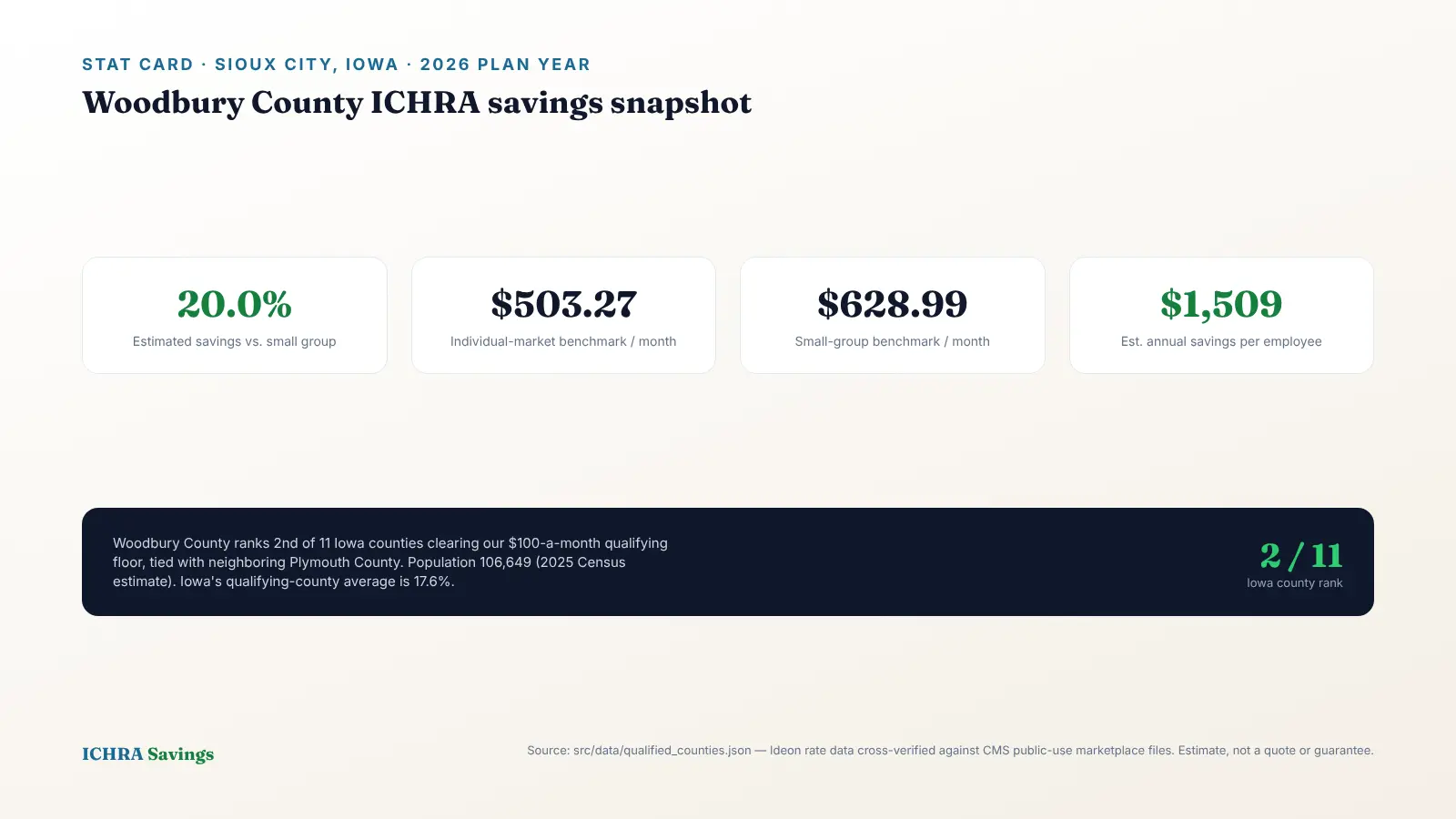
- Woodbury County's 2026 individual-market benchmark runs an estimated 20.0% below the small-group benchmark, about $1,509 per employee per year — ranking 2nd of the 11 Iowa counties that clear our $100-a-month qualifying floor, well above Iowa's qualifying-county average of 17.6%.
- Woodbury's benchmark is shared, to the cent, with Plymouth County — a combined population of roughly 131,147 residents in our dataset.
- Sioux City's economy was built on the stockyards and meatpacking, lost that center in 2002, and rebuilt around Tyson Fresh Meats, Seaboard Triumph Foods, and a mix of healthcare, education, and retail employers.
- Only 11 of Iowa's 99 counties clear our $100-a-month qualifying floor for 2026 — this is not a state where every county works, which is exactly why checking your own county matters.
- Qualifying is not the same as guaranteed savings for your business. The honest limits are covered later, including where this comparison breaks down for a specific workforce.
Does ICHRA beat small group in Sioux City, Iowa?
Yes, and it's a genuinely new entry for Iowa rather than a repeat of a county we've already covered. An ICHRA (Individual Coverage Health Reimbursement Arrangement, now also referred to by HealthCare.gov as a CHOICE Arrangement) is an IRS-defined arrangement that lets an employer set a fixed monthly reimbursement amount and let each employee buy their own individual-market plan with it, tax-free. In Woodbury County, the Iowa county that contains the city of Sioux City, the 2026 individual-market benchmark premium runs an estimated 20.0% below the small-group benchmark premium, according to a county-by-county comparison built from Ideon rate data and cross-verified against CMS public-use marketplace files.
That 20.0% ranks 2nd out of the 11 Iowa counties that clear our $100-a-month qualifying floor, well above the qualifying-county average of 17.6%. In dollars it's $1,509 a year per employee, tied for 2nd of 11 statewide with Plymouth County, because both sit inside the same federal rating area. Of Iowa's 99 counties total, only 11 clear the $100-a-month gap we use as the floor for including a county at all — Iowa is a state where checking your specific county actually matters, not a state where the answer is the same everywhere.
20.0%
Estimated Woodbury County savings vs. small group
2/11
Rank by percentage savings among qualifying Iowa counties
106K
Woodbury County residents in our dataset
$1,509
Est. Woodbury County savings per employee, per year
The employer problem this is actually solving
Sioux City isn't a town that's never had big employers. It's a town built almost entirely around one industry — livestock and meatpacking — that peaked a century ago and then had to rebuild more than once. The Sioux City stockyards opened in 1894 and grew into one of the largest livestock markets in the country: at their 1924 peak they handled an estimated 3.7 million hogs in a single year, more than Iowa's entire human population that year, per the Deseret News' March 28, 2002 report on the yards' closing. As recently as 1973, Sioux City sold more livestock than any other stockyards in the world. Rising land values, property taxes that reached roughly $4,000 a month on the site, and a farm economy that shifted toward refrigerated trucking and packers buying straight from farmers closed the stockyards for good in 2002, ending thousands of jobs tied to the yards and the meatpacking and rendering businesses around them.
That's the backdrop a small Sioux City employer operates against today. The city's largest employer now is Tyson Fresh Meats, with an estimated 4,500 workers, or 10.77% of citywide employment, per the City of Sioux City's 2020 Annual Comprehensive Financial Report as cited in Wikipedia's summary of the city. Seaboard Triumph Foods, a newer pork processor, employs an estimated 2,400 (5.74%). Neither is a small operation, and both come with the kind of dedicated HR department, group-plan broker relationship, and benefits budget that a six-person bookkeeping firm or an eighteen-person home-health agency simply doesn't have. A small employer competing for workers against Tyson, Seaboard Triumph, the school district, or either of the city's two hospital systems isn't competing against other startups; it's competing against employers with benefits infrastructure built for thousands of people.
Going without any benefit at all isn't a neutral choice in that labor market; it's a standing disadvantage against the employers that can afford group medical as a matter of course. An ICHRA, funded at even a modest level, is a way to show up in that competition without pricing out a group plan the business was never going to qualify for favorably at ten or fifteen employees anyway.
Why Iowa's 2026 and 2027 renewals look different from the rest of the country
For Woodbury County employers who already carry a small-group plan, the national backdrop is the same one every state is dealing with. Nationally, small-group insurers filed a median proposed premium increase of 14% for the 2027 plan year, across 295 insurers filing in all 50 states and the District of Columbia, per the Peterson-KFF Health System Tracker's brief published August 6, 2026 — up from an 11% median across 318 insurers for the 2026 plan year, per the same tracker's brief published September 24, 2025. Fifty-nine percent of insurers proposed 2027 increases between 10% and 20%.
Iowa's individual-market side, though, is running a somewhat different story than most of the country. Per the Kaiser Family Foundation's 2026 brief on insurer participation in the ACA marketplaces, the national average number of issuers per state fell from 9.6 in 2025 to 9.0 in 2026 — the first decline since 2018, driven largely by Aetna CVS exiting the marketplaces. The number of single-issuer counties nationally jumped from 93 to 165. Against that national contraction, Iowa was one of only four states that gained an insurer for 2026 (alongside Alabama, Louisiana, and Washington), per the same KFF brief. On rates specifically, healthinsurance.org's Iowa marketplace guide (updated July 2, 2026) reports six carriers selling 2026 plans, including new entrant Avera Health Plans, at an average approved increase of roughly 15.3% for 2026 (citing ACA Signups' tracking of final gross rate changes). For 2027, Medica is exiting Iowa's individual market entirely, leaving five carriers — Oscar, Wellmark, UnitedHealthcare, Iowa Total Care, and Avera — with a weighted average proposed increase of about 6.7% before subsidies, driven mostly by Wellmark's 5% proposed increase given its large share of the state's enrollment. Individually, Avera proposed 14.8%, Oscar 11.9%, UnitedHealthcare 11.8%, and Iowa Total Care 16.8%, per the Iowa Insurance Division figures cited on that same page.
None of that changes the underlying mechanic that makes ICHRA work in a county like Woodbury: what matters isn't whether either market's prices went up in isolation, it's whether individual rates rose relative to small-group rates in the same county and rating area. Woodbury's gap has held for the entire 2026 plan year regardless of which direction each market moved on its own, and a state that gained an insurer while losing ground nationally on rates is still a state worth checking county by county rather than writing off.
How an ICHRA (now also called CHOICE) actually works
Before the Woodbury County numbers mean anything, it helps to be precise about what's being compared, since most of the confusion around ICHRA comes from skipping this step.
An ICHRA is an employer-funded health reimbursement arrangement created by a 2019 final rule from the IRS and Treasury, the Department of Labor, and HHS, published at 84 Fed. Reg. 28888 on June 20, 2019, applicable to plan years beginning on or after January 1, 2020. HealthCare.gov now also refers to the same structure as a CHOICE Arrangement; the mechanics and the federal rules haven't changed, only the public-facing name. Instead of choosing one group health plan for everyone, the employer sets a fixed monthly reimbursement amount, and each employee uses that money to buy an individual-market plan of their own choosing, then submits proof of coverage (substantiation) to get reimbursed tax-free. The employer isn't picking a plan for a dozen different households; the employer is funding a budget, and the employee is doing the shopping.
The comparison behind every number in this article rests on two specific prices for a given county and rating area — the geographic zone insurance regulators use to set premiums, usually a cluster of neighboring counties. The individual-market benchmark premium is the second-lowest-cost silver-level plan available in that rating area to a representative 50-year-old enrollee. "Silver" refers to one of four ACA metal levels (bronze, silver, gold, platinum) describing how costs split between premium and out-of-pocket spending, not the quality of care. This is the same type of benchmark the federal government uses to calculate premium tax credits, which is why it's a defensible number to build a comparison on rather than one insurer's list price. The small-group benchmark premium is the equivalent figure built from comparable small-group plan filings for that same rating area. When the individual benchmark is lower, the county "qualifies," and the gap between the two is the estimated per-employee savings if the employer funds ICHRA at that benchmark level.
Two more terms matter once an employer is actually deciding whether to switch. The affordability safe harbor is the test that decides whether the ICHRA offer counts as "affordable" under IRS rules — for plan years beginning in 2026 that test runs against a Required Contribution Percentage of 9.96% of household income (IRS Rev. Proc. 2025-25), rising to 10.22% for plan years beginning in 2027 (IRS Rev. Proc. 2026-26). Get the contribution amount wrong relative to that threshold and an employer can trigger a penalty tied to the employer mandate, the ACA requirement that applies to ALEs (applicable large employers, generally 50 or more full-time-equivalent employees). Smaller, non-ALE employers aren't subject to that mandate at all, which covers most of the small shops described above.
One structural piece is often misunderstood: an employer can define different employee classes — for example, full-time versus part-time, or by geographic rating area — and offer different benefits to each class. What an employer cannot do is offer the same class of employees a choice between ICHRA and a traditional group plan; it's one or the other, per class, not both at once for the same people. Within a class, reimbursements can still vary by age, up to a 3-to-1 ratio, per HealthCare.gov's current CHOICE Arrangement guidance.
Woodbury County's rate spread, in dollars
Here is the actual 2026 benchmark comparison for Woodbury County, home to the city of Sioux City. The individual-market benchmark premium is $503.27 a month. The small-group benchmark premium, built from comparable small-group plan filings for the same rating area, is $628.99 a month. That's a gap of $125.72 a month, or $1,509 a year, per employee, an estimated 20.0% in favor of the individual market.
A top-two number in a state where most counties don't qualify
Woodbury County's 20.0% ranks 2nd of the 11 Iowa counties that clear our $100-a-month floor, well above the qualifying average of 17.6%. That matters more in Iowa than it does in a state like Ohio, where almost every county qualifies — here, only 11 of 99 counties clear the bar at all, so landing in the top two is a genuinely strong, sourced number, not a given.
See the full Iowa savings breakdown for every county, or the national savings map to look up a specific county by name.
Why Woodbury prices identically to Plymouth County
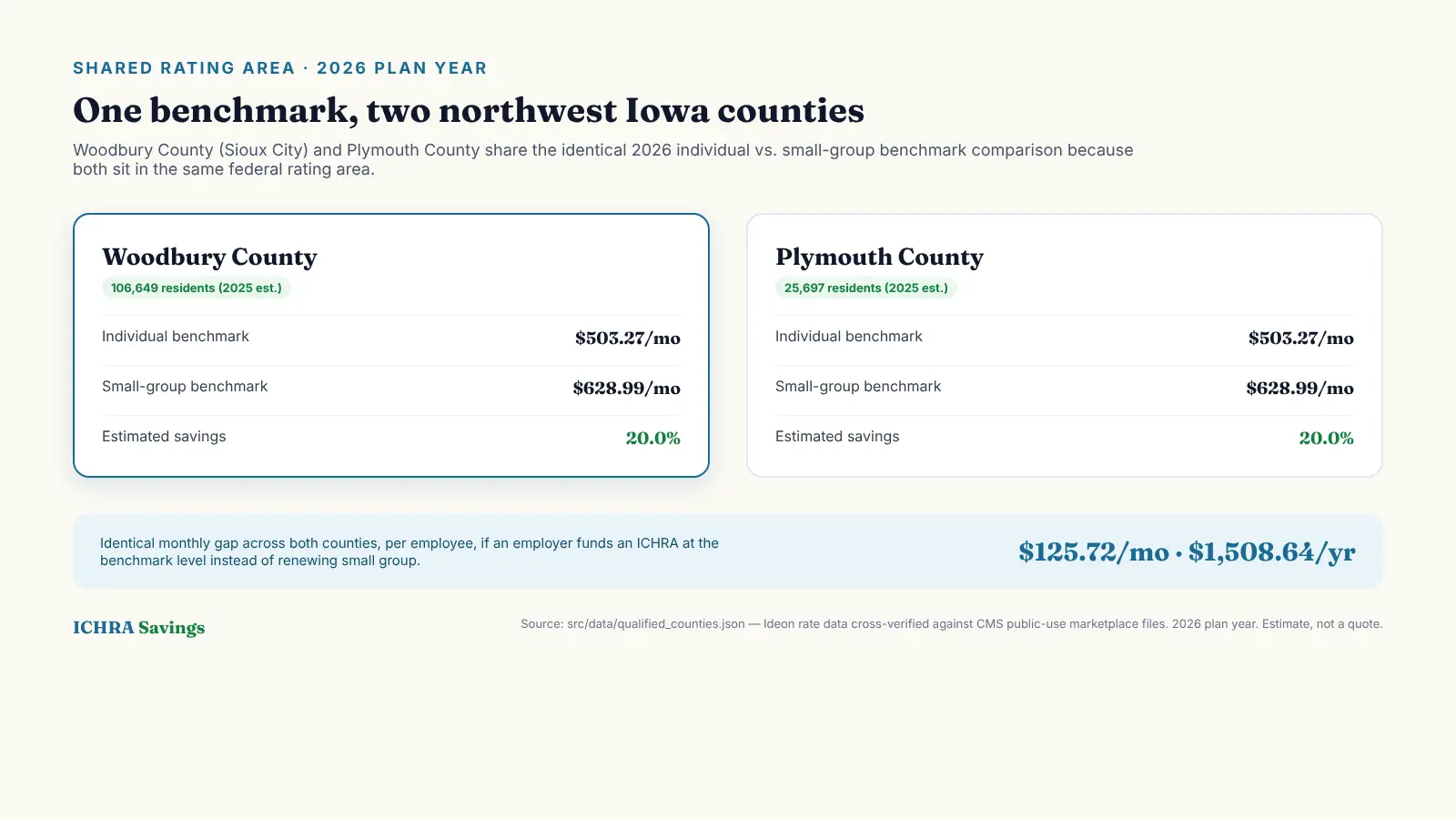
This is the detail that makes Woodbury County worth its own page. Its benchmark comparison doesn't just resemble its smaller rural neighbor to the north — it's identical, to the cent, because both counties sit in the same federal rating area.
| County | Population (dataset) | Individual benchmark | Small-group benchmark | Savings vs. small group |
|---|---|---|---|---|
| Woodbury (Sioux City) | 106K | $503.27 | $628.99 | 20.0% |
| Plymouth | 26K | $503.27 | $628.99 | 20.0% |
Woodbury and Plymouth counties share the identical 2026 benchmark comparison because both sit in the same marketplace rating area.
Woodbury County's population grew an estimated 0.6% between the Census Bureau's 2020 base and its 2025 estimate — from 105,981 residents to 106,649 — while Plymouth County was essentially flat, changing by +0% over the same window, per the Bureau's Vintage 2025 county population estimates. Sioux City itself had 85,797 residents at the 2020 census, growing to an estimated 86,875 by 2024, per Wikipedia's summary of the city citing U.S. Census Bureau figures — meaning the city alone accounts for roughly four-fifths of the county's total population, unlike a rural county where the population is spread across many small towns.
How Woodbury compares to Iowa's biggest counties
Iowa's largest counties by population don't show anywhere near Woodbury's gap, and two of them don't clear our qualifying floor at all. That's not a knock on those counties; it reflects how each rating area's carriers happened to price small-group versus individual coverage for 2026, which has little to do with a county's size or economic weight. It's a clear illustration of why a statewide average can mislead in a state like Iowa: check your own county, not a regional headline number, before you model a rollout.
| County (city) | Population | Savings vs. small group | Est. annual savings / employee |
|---|---|---|---|
| Polk (Des Moines) | 493,378 | 10.5% * | $715 |
| Scott (Davenport) | 174,315 | 6.4% * | $433 |
| Black Hawk (Waterloo) | 131,041 | 6.4% * | $433 |
| Dubuque (Dubuque) | 98,812 | 6.4% * | $433 |
| Woodbury (Sioux City) | 106K | 20.0% | $1,509 |
* Below our $100-a-month qualifying floor — the gap is real but too thin for us to recommend an ICHRA switch on the county math alone.
How Iowa's 11 qualifying counties break down by savings tier
Number of counties in each savings band, 2026 plan year, among the counties clearing our $100-a-month floor. Source: src/data/qualified_counties.json (Ideon rate data, cross-verified against CMS public-use files).
Woodbury sits in the "20%+" band, alongside only one other Iowa county. Illustrative and rounded; not an offer of insurance or a guarantee of savings.
What Sioux City's economy looks like after the stockyards
The scale of the local labor market today, per the Bureau of Labor Statistics' Quarterly Census of Employment and Wages, shows a county that's diversified well beyond its stockyard-era identity. Woodbury County (area code 19193) reported 3,258 establishments and an average employment of 50,924 across 2025, at an average weekly wage of $1,081 and an average annual pay of $56,218. Meatpacking is still a major piece of that economy — Tyson Fresh Meats and Seaboard Triumph Foods alone employ an estimated 6,900 people between them — but thousands of those 3,258 establishments are small operations with no dedicated HR department and no group-plan broker on retainer.
| Employer | Industry | Employees | % of city employment |
|---|---|---|---|
| Tyson Fresh Meats | Meat processing | 4,500 | 10.77% |
| Seaboard Triumph Foods | Meat processing | 2,400 | 5.74% |
| Sioux City Community School District | Education | 2,370 | 5.67% |
| Bomgaars | Retail | 2,100 | 5.02% |
| Mercy Medical Center | Healthcare | 1,562 | 3.74% |
| UnityPoint Health - St. Luke's | Healthcare | 1,500 | 3.59% |
Per the City of Sioux City's 2020 Annual Comprehensive Financial Report, cited in Wikipedia's summary of the city. The top 10 employers account for an estimated 41.36% of city employment.
Stockyards closed in 2002
After peaking in 1924 at an estimated 3.7 million hogs a year — more than Iowa's population that year.
3,258 establishments today
BLS QCEW count for Woodbury County, 2025 annual average — most of them far smaller than Tyson or Seaboard Triumph.
Same price as one rural neighbor
Woodbury County's benchmark comparison is identical to Plymouth County, to the cent.
Why a ten-person shop can't buy insurance the way Tyson does
Small-group health insurance isn't sold to individual employees one at a time; it's underwritten as a pool, and a carrier can require a minimum share of a company's eligible employees to actually enroll before it will issue the policy at all. That mechanic exists precisely because insurers price small-group coverage on the assumption that most of a company's eligible workforce participates, spreading risk across the group. A company the size of Tyson Fresh Meats or the Sioux City school district has enough scale, and enough of its own benefits staff, to manage enrollment and meet whatever a carrier requires. A ten-person machine shop with a part-timer, a new hire still inside a waiting period, or an employee already covered through a spouse's job at one of the county's larger employers can end up short of that bar even though every one of those employees technically has coverage somewhere.
An ICHRA (or CHOICE Arrangement, per HealthCare.gov's current naming) sidesteps that mechanic entirely when it's the only benefit offered. Per HealthCare.gov, employers of any size can generally offer one if they have at least one eligible employee who isn't a self-employed business owner or the owner's spouse — there's no minimum employer size and no participation-percentage test to clear. A minimum class size only applies when an employer offers a CHOICE Arrangement to one employee class while also offering a traditional group plan to a different class: 10 employees for employers with fewer than 100 total employees, 10% of the workforce for 100 to 200 employees, and 20 employees for more than 200. Those class-size rules don't apply at all to an employer offering only a CHOICE Arrangement, which describes most Woodbury County small businesses.
If a group quote already fell through on enrollment
If you've already tried to set up small-group coverage in the Sioux City area and a carrier's enrollment or participation requirement blocked the quote, that's a specific, common signal that an ICHRA is worth pricing out next, since the scale problem that blocked you doesn't apply to it when it's the only benefit you offer.
A worked example for a Woodbury County employer
Here's what the Woodbury County numbers look like applied to a real headcount. Assume a 10-employee Sioux City-area company currently renewing a small-group plan priced at this year's Woodbury County benchmark.
Here's the math
The 2026 small-group benchmark in Woodbury County is $628.99 a month per employee, or $7547.88 a year. The 2026 individual-market benchmark is $503.27 a month, or $6039.24 a year. The difference is $1,509 a year per employee. For a 10-person company, funding ICHRA contributions at the benchmark level instead of renewing small group works out to an estimated $15,086 a year in aggregate savings.
This is illustrative math built from real 2026 county rate data and a hypothetical headcount. It is not a quote, and it assumes the employer sets the ICHRA contribution at the benchmark level, which is a design choice, not a requirement. Your actual number depends on your employees' ages, exact home counties, and the plans they choose once they're shopping with their own budget.
The same arithmetic scales down to a smaller shop: a 5-person dental practice or auto shop near downtown Sioux City that has never offered benefits at all. That company could fund an ICHRA at the $503.27 individual benchmark and offer a real, tax-free benefit for about $2516 a month in total contributions, or roughly $30,196 a year for the whole company — a genuine first benefit offered to every eligible employee, with no enrollment percentage to clear.
At the other end of the size range, a 55-employee Woodbury County company crosses into ALE territory under the employer mandate, which changes the calculus without changing the underlying county math. The same Woodbury County benchmark comparison applies, but an ALE has to run the affordability safe-harbor test — against the 9.96% threshold for 2026 or 10.22% for 2027 — carefully for every employee class, since an ICHRA offer judged "unaffordable" for even a handful of lower-paid employees can trigger an employer-mandate penalty. That's not a reason to avoid ICHRA at 55 employees; it's a reason to model the affordability test before setting a contribution amount, which our eligibility guide walks through in detail.
How ICHRA adoption is actually growing
Woodbury County's numbers sit inside a national adoption trend that keeps compounding. The HRA Council's fifth annual report, Growth Trends for ICHRA & QSEHRA, Vol. 5 (released August 12, 2026, data current through January 31, 2026), found that ICHRA-covered lives surpassed 500,000 nationally at the start of 2026, spread across more than 20,000 U.S. businesses now offering ICHRA or QSEHRA. Adoption among applicable large employers (ALEs) more than doubled year over year, the fastest-growing segment in the report.
The number that matters most for the small Sioux City-area business this article opened on: over two-thirds of small businesses offering ICHRA had previously offered no health coverage options at all. For most small Woodbury County businesses, the realistic comparison usually isn't "ICHRA versus our current group plan." It's "ICHRA versus offering nothing while we compete for workers against Tyson, Seaboard Triumph, and the county's hospital systems," which is a much easier case to make than it sounds.
Setting up an ICHRA in Woodbury County
Iowa does not layer state-specific ICHRA rules on top of the federal framework. The same IRS, Department of Labor, and HHS final rule that governs ICHRA everywhere applies here. What determines whether a Woodbury County rollout goes smoothly:
- Pull your census by county, not by office address. A company headquartered in Sioux City with staff living in Plymouth County shares the same numbers — but a company with staff further out may not, since most Iowa counties don't clear our qualifying floor.
- Check every employee's actual county on the savings map. In a state where only 11 of 99 counties qualify, this step is not optional the way it might be in a state where every county clears the bar.
- Model affordability before you set a contribution. The reimbursement level decides whether an employee keeps or waives premium tax credit eligibility, against the 9.96% (2026) or 10.22% (2027) Required Contribution Percentage.
- Define employee classes carefully, if you use them. Class rules carry minimum-size requirements and cannot offer the same class a choice between ICHRA and group coverage.
- Send the required notice on time. Eligible employees need written notice at least 90 days before the plan year starts, with specific required content.
- Budget for onboarding support. Employees who have never shopped the individual market on their own need guidance, once, at enrollment — especially new hires coming from a bigger employer's group plan.
See our full ICHRA setup timeline for the detailed rollout plan, including the exact notice content requirements, and our eligibility guide for the affordability test itself. Before anything else, it's worth checking whether your county is one where this works at all: the national savings map takes about ten seconds to search.
If your employer just offered you an ICHRA
This guide is written for the employer side of the decision, but if you're a Woodbury County employee who was just told your benefit is changing, the short version is: you'll get a fixed monthly amount and shop for your own plan on the individual market instead of picking from your employer's group menu. Our guide for employees walks through what to expect.
The honest limits of this data
A strong county number is not a guarantee for your business
- Most of Iowa doesn't qualify at all. Only 11 of the state's 99 counties clear our $100-a-month floor. If your employees live outside Woodbury or Plymouth counties, don't assume this article's math applies to them.
- A benchmark comparison is not your actual renewal. The $628.99 Woodbury County figure is a small-group benchmark built from filed rates, not your specific carrier's quote for your specific group.
- A diversified local economy doesn't guarantee every sector feels the same pressure. A county anchored by large meatpackers doesn't mean every new business faces the exact competitive dynamic described above; model your own hiring situation rather than assuming the county trend applies to you.
- An older or higher-risk workforce changes the real-world math. Benchmark premiums are built around a representative 50-year-old enrollee; a company with a younger average age could see a different real-world spread than the headline figure implies.
- Rates move every plan year. Iowa already lost one insurer (Medica) and gained another (Avera) within two plan years; recheck before every renewal, not just once.
- Waiving the premium tax credit is part of the deal. An employee whose ICHRA offer is deemed affordable generally cannot also claim a marketplace subsidy for that month. Model both sides before assuming the reimbursement is pure upside for the employee.
Sioux City rebuilt its economy once already, after the stockyards closed in 2002. The town still runs on a handful of large employers with real benefits budgets, and a small shop competing for the same workers needs a real answer, not just a wish that it had group insurance's economics.
Mike MooreIf your renewal letter is already sitting on your desk and you're working against a deadline, it's worth a conversation before you sign: book time with our team. If you'd rather work through the mechanics on your own first, start with how ICHRA works and come back when you have questions.
How these numbers are calculated
Every county savings figure in this article comes from the same dataset that powers our savings map, not a survey or a sales estimate. For each county, we compare a 2026 individual-market benchmark premium — the second-lowest-cost silver plan available to a representative 50-year-old enrollee — against a small-group benchmark premium built from comparable small-group plan filings for that rating area. Both figures come from Ideon, a licensed insurance rate-data provider, and are cross-verified against CMS public-use marketplace files before publication. A county "qualifies" for our page-generation floor when the individual benchmark sits below the small-group benchmark by at least $100 a month; the percentage and dollar figures in this article are the gap between those two numbers, expressed as an annual per-employee figure at 12 times the monthly difference.
Woodbury County's population figures (105,981 in the Census Bureau's 2020 base, 106,649 estimated for 2025, a 0.6% change) come from the U.S. Census Bureau's Population Estimates Program, Vintage 2025 county totals file (co-est2025-alldata.csv), fetched directly from the Bureau's data server. The same file provides the Plymouth County comparison (0% change) used above. The Bureau of Labor Statistics' Quarterly Census of Employment and Wages reports 3,258 establishments, an average employment of 50,924, an average weekly wage of $1,081, and an average annual pay of $56,218 for Woodbury County (area code 19193) across 2025 — broader labor-market context for the county, not a figure used in the savings calculation itself.
The national small-group renewal figures (11% median for 2026 across 318 insurers; 14% median for 2027 across 295 insurers), the national and Iowa-specific insurer-participation figures (9.6 to 9.0 issuers per state nationally; 93 to 165 single-issuer counties; Iowa gaining one insurer for 2026), Iowa's own marketplace rate figures (six insurers for 2026 at roughly 15.3% average increase; five for 2027 at roughly 6.7% weighted average), the IRS affordability percentages, the HRA Council adoption figures, Sioux City's population and stockyards history, the city's current major employers, and the fact that Iowa has 99 counties (per Wikipedia's "List of counties in Iowa") each come from separately published, independent sources, not from our own county dataset, and describe national, statewide, or local context rather than the Woodbury-specific benchmark comparison above. We've kept these data sources clearly separate throughout this article rather than blending them into one number.
Three limitations are worth stating plainly. First, benchmark premiums are built around a representative enrollee profile, so an unusually young or unusually old workforce will see a different real-world spread than the county figure implies. Second, these are benchmark plans, not every plan on the market; an employee who chooses a richer or leaner plan than the benchmark will see a different premium, though the relative spread tends to hold directionally. Third, rates are filed and refreshed annually, so a county that qualifies for 2026 is not guaranteed to show the same gap for 2027 if a carrier enters or exits that market, as Iowa's own insurer turnover between 2026 and 2027 already illustrates.
Questions Sioux City employers actually ask
Does ICHRA beat small-group insurance in Sioux City, Iowa?
Yes. Sioux City sits in Woodbury County, and the county's 2026 individual-market benchmark premium runs an estimated 20.0% below the small-group benchmark, about $1,509 per employee per year. That ranks 2nd of the 11 Iowa counties that clear our $100-a-month qualifying floor, tied with neighboring Plymouth County, and well above Iowa's qualifying-county average of 17.6%.
Why does Woodbury County price identically to Plymouth County?
Iowa prices health insurance by federal rating area, a geography covering a cluster of neighboring counties that all get filed the identical benchmark price for a given plan year. Woodbury County's rating area also covers Plymouth County — a combined population of roughly 131,147 residents in our dataset. Both counties run on the identical $503.27 individual and $628.99 small-group monthly benchmark for 2026.
How much can a Woodbury County employer expect to save?
Using 2026 benchmark data, the estimated gap in Woodbury County is $125.72 a month, or $1,509 a year, per employee. For a 10-person company, that is roughly $15,086 a year in aggregate estimated savings if the employer funds ICHRA contributions at the benchmark level instead of renewing small group. This is illustrative math from public rate data, not a projection of what any specific employer will actually pay.
What happened to Sioux City's stockyards?
The Sioux City stockyards opened in 1894 and at their 1924 peak handled an estimated 3.7 million hogs in a single year — more livestock than Iowa's entire human population that year, per the Deseret News' March 28, 2002 report on the closure. As recently as 1973, Sioux City sold more livestock than any other stockyards in the world. Rising land values, roughly $4,000 a month in property taxes on the site, and a farm economy that shifted toward refrigerated trucking and packers buying straight from farmers closed the stockyards in 2002, ending thousands of jobs tied to the yards and the surrounding meatpacking and rendering businesses.
What companies employ the most people in Sioux City today?
Tyson Fresh Meats is Sioux City's largest employer at an estimated 4,500 workers, or 10.77% of city employment, followed by Seaboard Triumph Foods at 2,400 (5.74%), the Sioux City Community School District at 2,370 (5.67%), Bomgaars at 2,100 (5.02%), Mercy Medical Center at 1,562 (3.74%), and UnityPoint Health-St. Luke's at 1,500 (3.59%), per the City of Sioux City's 2020 Annual Comprehensive Financial Report, cited in Wikipedia's summary of the city. Together the city's top 10 employers account for an estimated 41.36% of city employment.
Why did my 2026 or 2027 small-group renewal come in higher than expected?
Nationally, small-group insurers filed a median proposed premium increase of 14% for the 2027 plan year, across 295 insurers filing in all 50 states and the District of Columbia, per the Peterson-KFF Health System Tracker's brief published August 6, 2026 — up from an 11% median across 318 insurers for the 2026 plan year, per the same tracker's brief published September 24, 2025. Fifty-nine percent of insurers proposed 2027 increases between 10% and 20%. Iowa's own individual-market picture moved the opposite direction on insurer count: per healthinsurance.org's Iowa marketplace guide (updated July 2, 2026), Iowa was one of only four states nationally that gained a marketplace insurer for 2026, even as the national average fell from 9.6 to 9.0 issuers per state.
What happens to my employees' premium tax credit if I switch to ICHRA?
An employee who is offered an affordable ICHRA generally becomes ineligible for a premium tax credit for any month that offer applies, whether or not they accept it. Affordability is measured against the IRS's Required Contribution Percentage, which is 9.96% of household income for plan years beginning in 2026 (Rev. Proc. 2025-25) and rises to 10.22% for plan years beginning in 2027 (Rev. Proc. 2026-26). Model that test before you set a contribution amount for any Woodbury County employee currently receiving marketplace subsidies.
Sources
- Peterson-KFF Health System Tracker, "How Much and Why Premiums Are Going Up for Small Businesses in 2027" (Aug. 6, 2026)
- Peterson-KFF Health System Tracker, "How Much and Why Premiums Are Going Up for Small Businesses in 2026" (Sep. 24, 2025)
- KFF, "How Has Insurer Participation in the ACA Marketplaces Changed in 2026?"
- healthinsurance.org, "Iowa Health Insurance Marketplace" guide (updated Jul. 2, 2026)
- IRS Revenue Procedure 2025-25 — Required Contribution Percentage, plan years beginning in 2026 (9.96%)
- IRS Revenue Procedure 2026-26 — Required Contribution Percentage, plan years beginning in 2027 (10.22%)
- 84 Fed. Reg. 28888 — ICHRA final rule, Departments of the Treasury/IRS, Labor, and Health and Human Services (June 20, 2019)
- HealthCare.gov, "CHOICE Arrangements" — participation, class-size, and age-variance rules
- HRA Council, "Growth Trends for ICHRA & QSEHRA, Vol. 5" (Aug. 12, 2026)
- U.S. Census Bureau, Population Estimates Program, Vintage 2025 county population totals
- U.S. Bureau of Labor Statistics, Quarterly Census of Employment and Wages — Woodbury County, Iowa (area code 19193), 2025 annual averages
- Deseret News, "Sioux City stockyards are closing" (Mar. 28, 2002)
- Wikipedia, "Sioux City, Iowa" — population, current major employers
- Wikipedia, "Woodbury County, Iowa" — county seat, population, FIPS code
- Wikipedia, "List of counties in Iowa" — 99 counties
- County-level premium comparison:
src/data/qualified_counties.json, 2026 plan year (Ideon rate data, cross-verified against CMS public-use marketplace files)