ICHRA vs Level-Funded 2026: Who Carries the Risk
Level-funded plans promise predictable costs, but claims experience still drives your renewal. See how ICHRA compares for 2026, with real numbers.
The short version
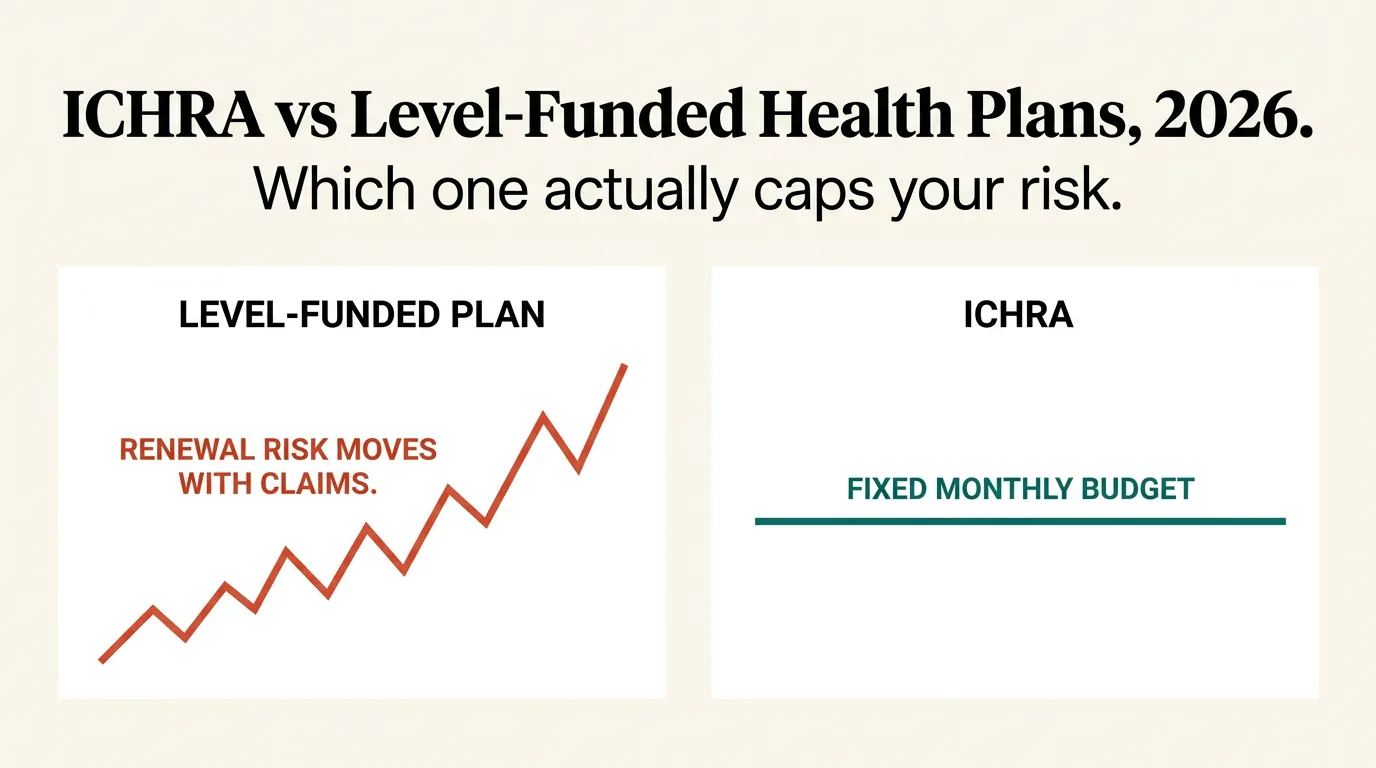
- A level-funded plan is a form of self-funding. Per KFF, it is priced using your group’s own health status and claims, not a flat community rate, so a bad claims year can show up as a steeper renewal the next one.
- An ICHRA has no claims risk for the employer. The employer’s cost is the fixed monthly contribution it chooses, regardless of what any employee’s individual-market plan pays out.
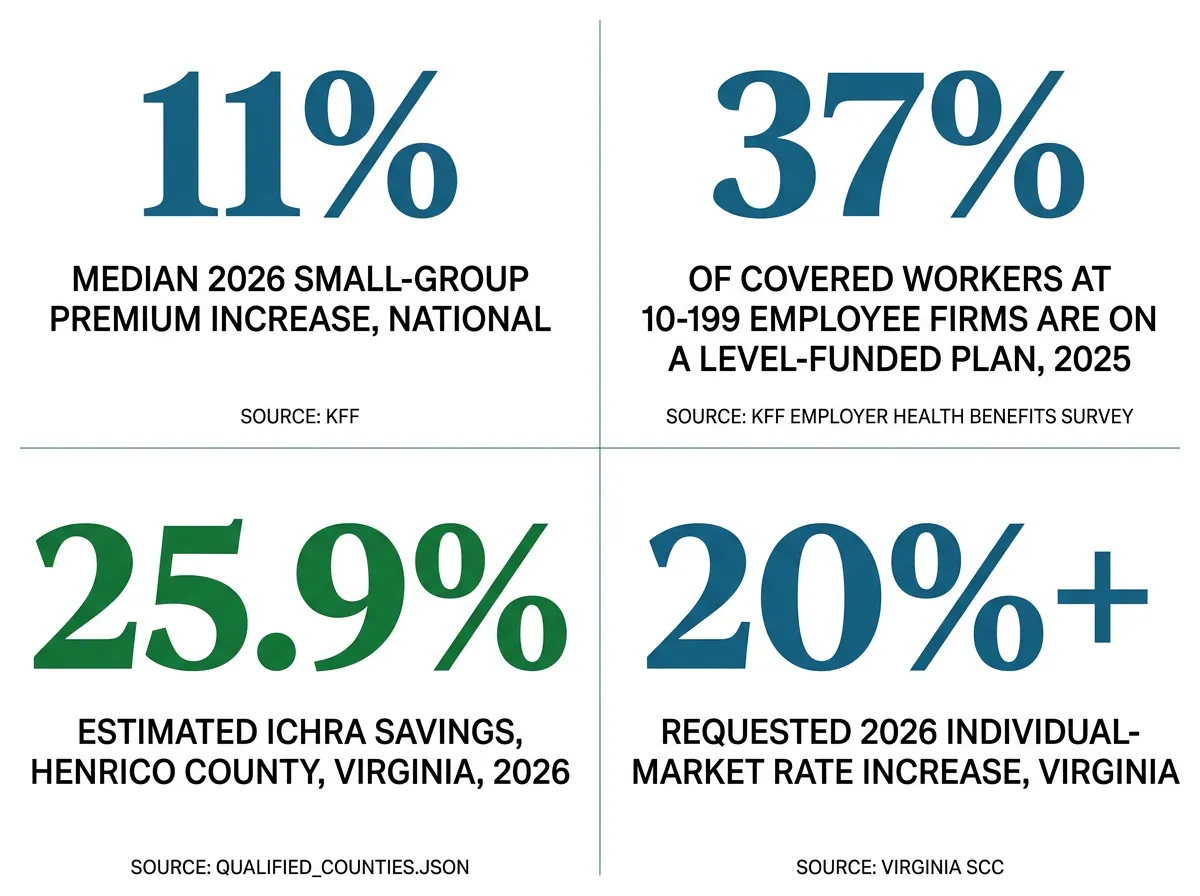
- Small-group premiums were requested up 11.2% for Virginia’s 2026 plan year, and a median 11% nationally, per the Virginia SCC and KFF. Neither figure tells you whether ICHRA saves money for your county; that is a separate, local question.
- 37% of covered workers at 10–199-employee firms nationally are already on a level-funded plan, per KFF’s 2025 Employer Health Benefits Survey. Most employers weighing this decision are choosing between two products they have both heard pitched as "the fix."
- Neither option is universally right. A level-funded plan can still be the better call for a young, low-claims group or a thin individual-market county.
Does a level-funded plan protect you from a bad renewal?
Not the way most employers assume. A level-funded plan smooths your monthly cash flow, so you pay a predictable amount every month instead of a fully-insured premium. But the price you pay is still built from your group’s own claims and health status, and that number can move hard at renewal if your group has a rough year. It is a different mechanism for the same underlying exposure, not an exit from it.
An Individual Coverage HRA (ICHRA) works differently at the root. The employer sets a fixed monthly contribution, employees use it to buy their own individual health plan, and the employer’s cost never changes based on who gets sick or what anyone claims. That distinction, not brand names or marketing language, is what actually decides which one caps your risk.
What a level-funded plan controls
Your monthly cash outlay. It smooths the bill across the year instead of one large invoice.
What it does not control
The underlying price. That is still set by your group’s claims and health status, year over year.
What an ICHRA controls instead
The number itself. The employer picks the contribution; nobody’s claims history changes it.
The renewal that follows you anywhere
Most employers who look into level-funded plans arrive from the same place: a small-group renewal letter with a number they cannot justify to their owner or their board. Someone, a broker or a peer at another company, mentions level-funded as the alternative that finally gets you off the fully-insured renewal treadmill. It sounds like the fix, and for one plan year, it often is.
The part that gets left out of that pitch is what happens in year two if your group has an expensive year. A single employee with a difficult diagnosis, a run of surgeries, a high-cost newborn, anything that pushes your group’s claims meaningfully above what was budgeted, and you are back in the same conversation you thought you had escaped: a renewal number that moved because of something you had no control over and could not have predicted when you signed up. The mechanism changed. The exposure did not.
This matters because of how level-funded plans are actually priced. Per KFF’s 2025 Employer Health Benefits Survey, level-funded arrangements "use health status in rating and underwriting," unlike a fully-insured small-group plan, which is priced under ACA community-rating rules that do not let a carrier reprice your group because of one bad year. A level-funded plan gives that protection back to the carrier, in exchange for the potential upside of a refund in a good year. Whether that trade works in your favor is not something you know at signing; you find out at renewal.
What a level-funded plan actually is
A few terms worth defining before going further, since the marketing language around this product tends to blur them on purpose.
Self-funded means the employer, not an insurance carrier, is financially responsible for paying employee medical claims, typically up to some limit. Stop-loss insurance is a policy the employer buys to cap that exposure: specific stop-loss caps the cost of any single employee’s claims, and aggregate stop-loss caps the total claims cost across the whole group. A level-funded plan is a packaged version of this structure built for small employers: you pay one predictable monthly amount that bundles an estimate of expected claims, the stop-loss premium, and administration, and a carrier or third-party administrator runs the claims and underwriting behind the scenes. It looks and feels like a normal group health plan from the employee’s seat. From the employer’s seat, it is legally a form of self-insurance.
KFF’s 2025 survey describes it this way: level-funded arrangements "combine a relatively small self-funded component with stop-loss insurance, which limits the employer’s liability and transfers a substantial share of risk to insurers." That is a real protection against catastrophic, single-event cost. It is not the same thing as a fixed price, because the amount you pay next year is still built from what your group cost this year.
The same survey flags two structural differences from fully-insured small-group coverage that matter for this comparison specifically: level-funded plans "use health status in rating and underwriting," and they "are not required to provide all of the essential health benefits that are mandatory for insured plans." Both of those are trade-offs, not defects; they are part of why level-funded plans can price lower than a comparable fully-insured plan for a young, healthy group. They are also exactly the two levers that can move your renewal number in a direction you did not choose.
37% of small employers are already here
Per KFF’s 2025 Employer Health Benefits Survey, 37% of covered workers at firms with 10 to 199 employees are enrolled in a level-funded plan, essentially unchanged from 2024. If your business already offers group coverage, there is a real chance you are already carrying this exposure and have not thought of it that way.
How an ICHRA is built differently
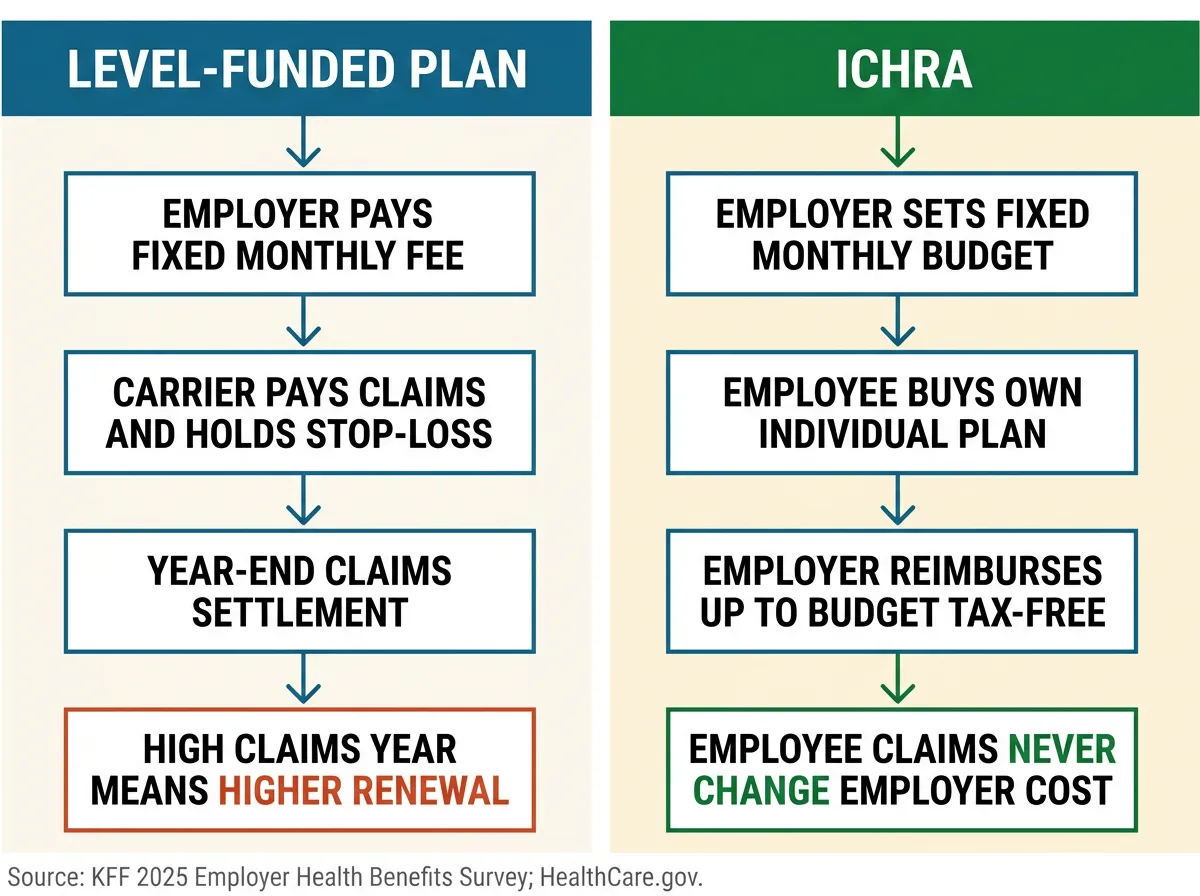
An ICHRA is not a funding mechanism for a group plan at all. There is no group plan. The employer sets a monthly reimbursement amount, by employee class if it chooses to use classes, and employees use that amount to buy their own individual-market health plan and get reimbursed, tax-free, up to the amount they were allotted. Per HealthCare.gov, employers "provide tax-free reimbursements to employees for qualified medical expenses up to a set annual amount," and there are "no annual minimum or maximum contribution requirements" set federally on that number, beyond the class-size rules that apply if an employer splits classes.
The employee’s individual-market plan is priced and regulated the way ACA-compliant individual plans are priced: it has to cover the ACA essential health benefits, and, unlike a small-group plan, its premium for a given plan and rating area is the same regardless of that one employee’s health status, because individual-market pricing does not use medical underwriting either. The plan itself may cost more or less depending on age and location, but not because of a claim any specific employee filed.
That is the structural reason an ICHRA has no claims-risk feedback loop back to the employer. The employer’s number was never built from anyone’s claims in the first place, so there is nothing for a bad year to move.
The 2026 numbers
Table 1 collects the sourced figures behind this comparison. Read the national and Virginia figures as market context, and the Henrico County figures as the one number that is actually specific to a real employer decision.
| Figure | Value | Geography | Source |
|---|---|---|---|
| Median small-group premium increase, 2026 | 11% | National | KFF |
| Small-group rate increase requested, plan year 2026 | 11.2% | Virginia | Virginia SCC |
| Individual-market rate increase requested by most insurers, plan year 2026 | 20%+ | Virginia | Virginia SCC |
| Covered workers at 10–199-employee firms on a level-funded plan, 2025 | 37% | National | KFF Employer Health Benefits Survey |
| Estimated ICHRA savings vs. small group, Henrico County | 25.9% ($1,167/yr per employee) | Henrico County, VA | qualified_counties.json |
National figures: KFF, "How Much and Why Premiums Are Going Up for Small Businesses in 2026,"
Sept. 24, 2025 (analysis of preliminary 2026 rate filings from 318 insurers, all 50 states and
D.C.). Virginia figures: Virginia State Corporation Commission, plan year 2026 premium notice,
Aug. 7, 2025 (requested rates, not final approved rates). Level-funded share: KFF, 2025
Employer Health Benefits Survey. County figures: src/data/qualified_counties.json,
2026 plan year.
Two numbers in that table are worth sitting with together. Virginia insurers requested small- group rates up a median 11.2% for plan year 2026, while most individual-market insurers in the same state requested 20% or higher, according to the Virginia SCC. Read alone, that looks like bad news for the ICHRA math: the individual market is proposed to rise faster than small group this cycle, in this state. It is a fair, honest data point, and it is also not the whole picture, because these are requested rates relative to the prior year, not the underlying benchmark premium level. Chesterfield and Henrico Counties still show a wide dollar gap between the two markets for 2026, which the worked example below walks through directly. Rate of change and level are two different questions, and only the second one tells you whether ICHRA saves money today.
11%
Median 2026 small-group premium increase, national
37%
Covered workers at small firms on a level-funded plan, 2025
25.9%
Estimated ICHRA savings, Henrico County, VA, 2026
$1,167
Estimated per-employee annual savings, same county
Side by side, on the things that matter
Table 2 sets the two structures against each other on the dimensions that actually decide an employer’s outcome, not the ones that make for a clean sales page.
| Dimension | Level-funded plan | ICHRA |
|---|---|---|
| Who holds the claims risk | The carrier and the employer’s stop-loss layer, tied to group claims experience | Neither. The employer’s cost is the contribution it sets, full stop |
| How the price is set | Underwritten using group health status and claims history | Employer chooses the number; not underwritten by employee health |
| What happens after a high-claims year | Can show up as a steeper renewal the following plan year | No effect. The employer’s number does not move |
| What happens after a low-claims year | Some plans return a year-end refund or credit | No refund mechanism; savings are the lower ongoing number itself |
| Essential health benefits | Not required to cover all ACA essential health benefits | Employee buys an ACA-compliant individual plan that must cover them |
| Multi-state or remote teams | One network has to work for every state you employ in | Each employee buys a plan that works where they live |
| Participation minimums | Carrier-set minimum enrollment to keep the group priced | No federal participation minimum |
| Admin footprint | Census, underwriting renewal, stop-loss shopping most years | Substantiation and reimbursement workflow, ongoing |
Source: KFF, 2025 Employer Health Benefits Survey; HealthCare.gov, Individual coverage HRA. Structural comparison, not a recommendation for any specific workforce.
One row is not a tie-breaker for everyone
The refund mechanic in a low-claims year is the strongest real argument for a level-funded plan. If your group is young, healthy, and has run low claims for several years running, it is worth pricing both options rather than assuming ICHRA automatically wins.
A worked example, Henrico County, Virginia
The figures below come directly from this site’s county dataset, not a hand-typed example. Henrico County, Virginia, part of the Richmond metro area with a population of 333,120 in this dataset, shows a 2026 individual-market benchmark premium of $278 a month against a small-group benchmark of $375 a month, an estimated 25.9% spread, or $1,167 a year per employee. See the rest of Virginia’s qualifying counties on our Virginia savings page.
Henrico County, Virginia: 2026 benchmark premiums
Individual-market vs. small-group benchmark, monthly, per employee
Source: src/data/qualified_counties.json, 2026 plan year (Ideon rate data,
cross-verified against CMS public-use marketplace files). Estimates, not quotes.
Example: a 15-person Henrico County employer comparing the two options
Funding each employee at the county’s individual-market benchmark of $278 a month through an ICHRA costs 15 × $278 × 12 months = $50,040 a year, a fixed number the employer chooses and that does not move if an employee has a costly year. The same group’s small-group benchmark runs $375 a month, or $67,547 a year, before any level-funded stop-loss premium or year-end settlement is layered on top. The gap between the two benchmarks is an estimated $17,507 a year across the group. This is an illustrative comparison built from the county dataset, not a projection for any specific business; a level-funded quote for the same group could land above or below the small-group benchmark shown here, depending on that group’s underwriting.
When a level-funded plan is still the better call
It would be easy to write the rest of this article as a straight pitch for ICHRA. It would also be wrong often enough to matter. A level-funded plan is the better fit for a real, identifiable set of employers, and pretending otherwise would undercut the one thing this site is actually built on: county-level data that sometimes says small group, or level funding, wins.
- Your county’s individual market is thin or expensive. Not every county has a wide gap between individual and small-group rates. Where the individual-market benchmark sits close to, or above, the small-group benchmark, an ICHRA is not the cost play, and a level-funded plan’s refund upside becomes more attractive by comparison.
- Your group is young, healthy, and has run low claims for years. That is exactly the profile a level-funded plan is underwritten to reward, through a lower starting price and, in a good year, a refund or credit at settlement.
- You want to keep offering one employer-curated plan and network. Some workforces, especially ones with employees who have never shopped an individual-market plan before, value a single plan the employer picked over the research and decision-making an ICHRA hands to each employee.
None of that erases the risk this article opened with. It means the risk is a trade you can make with your eyes open, for a specific reason, rather than a surprise you discover at your second renewal.
How to decide, in order
- Pull your census by county. Not by headquarters, by where employees actually live, since both the individual-market benchmark and small-group rating vary by county.
- Check your county’s rate spread. Run your counties on the savings map before assuming either direction; a national average will hide the counties where this does not favor ICHRA.
- Get an actual level-funded quote, not just a renewal. A real underwritten quote reflects your group’s claims and health status; a renewal projection alone will not show you what a fresh level-funded bid looks like.
- Ask what happens after a bad year, in writing. Get the carrier or broker to explain, specifically, how a high-claims year affects your renewal terms and whether there is a rate cap.
- Model ICHRA affordability before setting a contribution. The amount you choose affects whether each employee keeps or waives premium-tax-credit eligibility.
- Budget for the admin shift either way. A level-funded plan still means a renewal cycle most years; an ICHRA means an ongoing substantiation and reimbursement workflow. Neither is free of administrative work.
Where this goes wrong
The mistakes that show up most
- Treating "level-funded" as a synonym for "fixed price." The monthly bill is level; the underlying claims-based pricing is not.
- Not asking what happens after a bad claims year, before signing. Get the renewal mechanics in writing, not a verbal assurance.
- Assuming a national average applies to your county. Both the level-funded and ICHRA decisions are local questions with local numbers.
- Moving to an ICHRA without modeling affordability first. The contribution amount decides whether employees keep subsidy eligibility; get it wrong and you create a bigger problem than the one you were solving.
- No onboarding help for employees new to the individual market. This is where ICHRA rollouts succeed or fail, not the underlying math.
A level-funded plan can look like a fixed price right up until the year your claims run hot. An ICHRA’s price was never tied to your employees’ claims in the first place.
Mike MooreChecking whether ICHRA works for your counties
Everything above about how level-funded plans are priced is a structural fact; it applies the same way whether your team sits in Henrico County or anywhere else. Whether an ICHRA actually costs less than either a fully-insured or level-funded small-group option is not structural. It depends on the individual-market and small-group benchmark premiums in each county your employees live in, which is exactly what our savings map and county dataset are built to show, for the 2026 plan year.
Check your counties first
Before comparing a level-funded quote against an ICHRA, check whether your specific counties are ones where an ICHRA costs less than your current renewal: Check your county on the savings map →
What this does not guarantee
Read this before you compare quotes
- This is not tax, legal, or HR advice. Whether a level-funded quote or an ICHRA design is right for your business depends on facts this article cannot see.
- A level-funded quote for your specific group could land above or below the small-group benchmark shown here. The county dataset reflects a market benchmark, not an underwritten quote for your workforce.
- Taking an ICHRA generally means an employee waives premium tax credit eligibility for any month the offer applies, regardless of the county math. See our ACA subsidy cliff guide for the income thresholds involved.
- Virginia’s cited 2026 rate figures are insurer requests, not final approved rates. Approved rates can differ from what was filed.
- None of the figures in this article are an offer of insurance, a quote, or a guarantee of savings or tax outcome for any specific employer or employee.
How these numbers are calculated
The national premium figure comes from KFF’s analysis of preliminary 2026 rate filings from 318 insurers across all 50 states and D.C., published Sept. 24, 2025, which found a median proposed increase of 11% for ACA-compliant small-group plans, and a 12% median across a 16-state-plus-D.C. deep dive within the same analysis. The Virginia figures come directly from the Virginia State Corporation Commission’s Aug. 7, 2025 plan-year-2026 premium notice, which reports a median 11.2% small-group rate request and individual-market requests of 20% or higher from most insurers; these are requested, not final approved, rates. The level-funded enrollment share and its underwriting characteristics come from KFF’s 2025 Employer Health Benefits Survey, a national survey of employer-sponsored group coverage. The Henrico County figures come from the same dataset that powers our savings map: a 2026 individual-market benchmark premium (the second-lowest-cost silver plan available to a representative enrollee, the same benchmark the federal government uses to calculate premium tax credits) compared against a small-group benchmark premium built from comparable small-group filings for that rating area. Both figures come from Ideon, a licensed insurance rate-data provider, cross-verified against CMS public-use marketplace files before publication.
One limitation worth stating plainly: the Henrico County small-group benchmark reflects filed small-group rates, not a level-funded plan’s underwritten price, which can differ meaningfully from a fully-insured benchmark for any specific group. Use this article’s numbers to understand the mechanism and the market-level context, and get an actual quote before deciding between the two products for your own workforce.
Questions employers actually ask
Is a level-funded health plan the same thing as a self-funded plan?
A level-funded plan is a form of self-funding, legally. According to KFF’s 2025 Employer Health Benefits Survey, level-funded arrangements "combine a relatively small self-funded component with stop-loss insurance, which limits the employer’s liability and transfers a substantial share of risk to insurers." The employer is technically the insurer of record and pays a level monthly amount that covers expected claims, stop-loss premium, and administration, but a licensed carrier is doing most of the underwriting and claims work behind the scenes. That is different from a fully self-funded plan, where a larger employer carries more of the risk directly, and different again from a fully-insured small-group plan, where a carrier prices the whole group under ACA community-rating rules.
Can a level-funded plan’s price change based on what your employees claimed the year before?
The plan is priced and re-underwritten using the group’s health information, not just a flat community rate. KFF’s 2025 survey states plainly that level-funded arrangements "use health status in rating and underwriting" and "are not required to provide all of the essential health benefits that are mandatory for insured plans," unlike a traditional insured small-group plan. In practice, that means a plan year with a few high-cost claims can show up in your renewal terms the following year, in a way a community-rated small-group plan’s renewal, by law, cannot reflect the same way.
Is an ICHRA always cheaper than a level-funded plan?
No, and we would be lying if we said otherwise. Whether an ICHRA costs less depends on your county’s individual-market rates relative to small-group rates, which is a geography-specific question, not a universal one. A level-funded plan can also come in cheaper than either option in a good claims year, or for a workforce whose age and health profile underwrites favorably. Check your own counties on the savings map before assuming either direction.
Does an ICHRA carry any claims risk for the employer?
No. Under HealthCare.gov’s description of the individual coverage HRA, employers "provide tax-free reimbursements to employees for qualified medical expenses up to a set annual amount," and there are "no annual minimum or maximum contribution requirements" set by the government beyond that structure. The employer’s cost is the contribution amount it chooses to set, full stop. What an employee’s individual-market plan actually pays out in claims is between that employee and their individual-market carrier; it never flows back to the employer’s bill the way a level-funded settlement can.
Can a small business switch from a level-funded plan to an ICHRA?
Yes, generally at your next plan year renewal, since ICHRA has to be offered on a plan-year basis and there is a required advance notice period for enrolled employees before the new plan year begins. Work the timeline backward from your current level-funded plan’s renewal date with a benefits attorney or a qualified administrator, since getting the notice timing wrong is one of the most common rollout mistakes.
Do level-funded plans ever pay money back to the employer?
Some do, in a plan year where actual claims come in under what was budgeted; that upside is part of why level-funded plans appeal to employers with a young, healthy group. The reverse is also true and is the part this article focuses on: a plan year with higher-than-expected claims typically shows up as a steeper renewal the following year, since the plan is still priced off your group’s own claims and health status rather than a fixed community rate.
Is a level-funded plan ever the better choice over an ICHRA?
Yes. If your county’s individual market is thin or priced above small group, the ICHRA math will not favor you, and a level-funded plan’s potential year-end refund can be a real advantage for a young, low-claims group. A level-funded plan also keeps you offering a single, employer-curated plan and network, which some workforces prefer over shopping the individual market on their own. This is exactly why we built a county map instead of publishing one national answer.
Where can I check whether an ICHRA saves money for my specific county?
Use the savings map. It runs the same 2026 individual-market and small-group benchmark comparison used throughout this article, county by county, so you can see your own numbers instead of a national average that may not apply to where your employees actually live.
Sources
- KFF, "How Much and Why Premiums Are Going Up for Small Businesses in 2026" (Sept. 24, 2025)
- Virginia State Corporation Commission, "Health Insurance Premiums in Virginia for Plan Year 2026" (Aug. 7, 2025)
- KFF, "2025 Employer Health Benefits Survey" (Oct. 22, 2025)
- HealthCare.gov, "Individual coverage Health Reimbursement Arrangements"
- ICHRA final rule: Departments of the Treasury/IRS, Labor, and Health and Human Services (2020)
- County-level premium comparison:
src/data/qualified_counties.json, 2026 plan year (Ideon rate data, cross-verified against CMS public-use marketplace files)