ICHRA vs QSEHRA in 2026: Which HRA Fits Your Business
QSEHRA caps 2026 reimbursements at $6,450 self-only and $13,100 family; ICHRA has no federal cap. See the numbers and which HRA fits your business.

The short version
- A QSEHRA caps 2026 reimbursement at $6,450 self-only or $13,100 family and requires fewer than 50 full-time equivalent employees with no group plan (IRS Rev. Proc. 2025-32; HealthCare.gov).
- An ICHRA has no federal dollar cap and no employer-size floor, but reimbursement above a certain level stops counting as "affordable" under the IRS's 2026 test of 9.96% of household income (IRS Rev. Proc. 2025-25).
- Only 59% of firms with 10 to 199 workers offer any health benefit at all, versus 97% of firms with 200 or more (KFF, 2025 Employer Health Benefits Survey) — for most of the rest, either arrangement is a first benefit, not a replacement.
- ICHRA beats small-group coverage on an estimated cost basis in 719 US counties for the 2026 plan year, but that is a county question, not a national one.
The quick answer
If your business has fewer than 50 full-time equivalent employees, doesn't offer a group health plan, and you're comfortable with a reimbursement cap of $6,450 for self-only or $13,100 for family coverage in 2026, a QSEHRA is simpler to set up. If you're at or near 50 employees, want to vary contributions by role or location, or want to reimburse above those caps, you need an ICHRA instead, because a QSEHRA legally cannot do either of those things.
That's the whole decision in one paragraph. The rest of this page is the arithmetic behind it, because the caps and the affordability rule change every year, and a number you looked up in 2024 is already wrong for 2026.
Why this decision matters more in 2026
Employers aren't Googling QSEHRA and ICHRA out of curiosity. Most arrive here after a renewal letter or a hiring plan that no longer fits the coverage they have, or don't have. The backdrop is not encouraging if you're staying with group coverage. According to KFF's 2025 Employer Health Benefits Survey, the average annual premium for employer-sponsored coverage nationally reached $9,325 for single coverage and $26,993 for family coverage in 2025, with the single premium up 5% and the family premium up 6% over the year before — both increases outrunning the 2.7% inflation rate KFF cites for the same period. Firms with 10 to 199 workers actually pay a slightly lower average family premium than larger firms ($26,054 versus $27,280), which tells you the group-market squeeze isn't a small-employer problem specifically. It's just that small employers have fewer levers to absorb it.
And a lot of small employers aren't absorbing anything, because they never started. The same KFF survey found that 59% of firms with 10 to 199 workers offer any health benefit at all, against 97% of firms with 200 or more workers. For the businesses in that gap, QSEHRA and ICHRA aren't a replacement for group coverage — they're usually the first real benefit on offer, which changes the calculus. You're not comparing an HRA against a renewal number; you're comparing it against nothing, and against whatever a competitor down the street is now offering to the same candidates.
What QSEHRA and ICHRA actually are
Both are types of health reimbursement arrangement, or HRA: an employer sets aside a fixed amount, and employees get reimbursed tax free for premiums and eligible medical expenses they pay on their own individual-market health plan. Neither one is an insurance policy. The employer never picks a carrier or a plan; the employee buys their own coverage on the ACA marketplace or off it, and submits proof of what they paid.
A QSEHRA — qualified small employer health reimbursement arrangement — is the version Congress built specifically for small businesses that don't offer a group plan. Eligibility is narrow by design: fewer than 50 full-time equivalent employees, and the employer cannot offer a group health plan, an FSA, or any other group coverage to any employee, according to HealthCare.gov. In exchange for that narrowness, a QSEHRA is close to a fixed formula: reimbursement can vary by employee age and family size, but not by role, location, or any other class, and the total can't exceed the IRS's annual dollar cap.
An ICHRA — individual coverage health reimbursement arrangement — is the newer, broader version. Under the 2019 federal final rule from the Departments of the Treasury, Labor, and Health and Human Services, an employer of any size can offer one, "if they have at least one employee who isn't a self-employed business owner or the spouse of a self-employed owner," per HealthCare.gov. There is no federal dollar cap on the contribution. The trade is more design work: an employer can vary the reimbursement amount by permitted employee classes (full-time versus part-time, salaried versus hourly, different work locations, and a handful of others defined in the rule), and if it also offers a traditional group plan to a different class, minimum class-size rules kick in, generally in a range of 10 to 20 employees depending on total company headcount.
Neither arrangement is insurance the employer buys and hands to employees. Both work the same way mechanically: the employer sets aside a monthly allowance, the employee pays their own premium and eligible medical bills out of pocket, submits proof (a premium invoice, an explanation of benefits, a receipt), and gets reimbursed from the allowance, tax free, up to whatever the employer set as the contribution amount. Unused allowance in a given month generally doesn't carry an income tax cost to the employee either way, and the employer's contribution is a deductible business expense that isn't subject to payroll (FICA) tax, which is the same underlying tax treatment that makes both arrangements attractive compared to simply raising wages and asking employees to buy their own coverage unassisted.
The two different "50 employees" rules
This is where a lot of confusion comes from, because two unrelated federal rules both use the number 50, and people conflate them. The first is the QSEHRA eligibility rule already covered: fewer than 50 full-time equivalent employees, or you can't use a QSEHRA at all. The second is the ACA's Applicable Large Employer (ALE) threshold, which triggers the employer shared-responsibility mandate. Per the IRS, "if an employer has at least 50 full-time employees, including full-time equivalent employees, on average during the prior year, the employer is an ALE for the current calendar year," calculated by averaging full-time and full-time-equivalent headcount across the 12 months of the prior year.
Those two 50s point at the same headcount math but trigger opposite consequences. Cross 50 FTEs and you simultaneously lose QSEHRA eligibility and pick up ALE status, which brings employer-mandate exposure into play for the first time. An ICHRA is available on either side of that line and can be one part of how an employer satisfies the mandate once ALE status applies, which is one more reason employers near the threshold tend to skip QSEHRA and design directly for an ICHRA.
Terms worth pinning down before you go further
Full-time equivalent (FTE): a headcount measure that combines part-time hours into full-time units; it's what decides QSEHRA eligibility, not raw employee count. Affordability: the IRS test comparing an employee's out-of-pocket premium cost, after any employer contribution, against a percentage of household income. Premium tax credit: the ACA marketplace subsidy an employee may be waiving by accepting an affordable HRA offer. Employee class: an IRS/DOL-defined category of employees an ICHRA can treat differently for contribution purposes.
The 2026 numbers that decide it
Three federal figures do almost all the work in this decision, and all three are indexed for inflation and change every year, so the number you remember from a 2024 article is not this year's number.
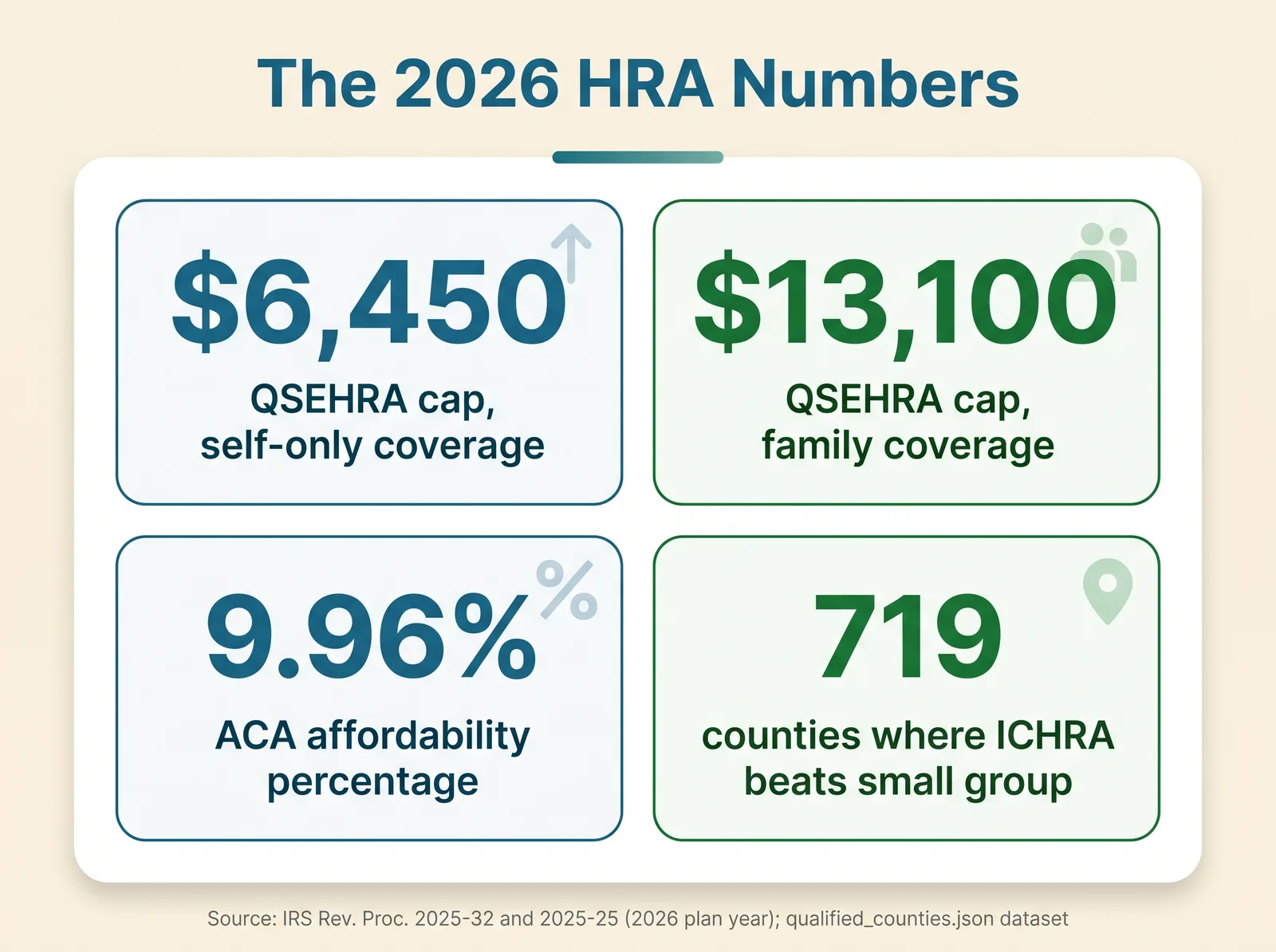
- The 2026 QSEHRA cap: $6,450 self-only, $13,100 family. The IRS set this in Section 4.63 of Revenue Procedure 2025-32: "the total amount of payments and reimbursements for any year cannot exceed $6,450 ($13,100 for family coverage)" for taxable years beginning in 2026. That's a roughly 1.6% increase for self-only and 2.3% for family coverage over the 2025 caps, reflecting the chained CPI adjustment required by statute.
- The 2026 ACA affordability percentage: 9.96%. Per Section 3.02 of Revenue Procedure 2025-25, "for plan years beginning in calendar year 2026, the Required Contribution Percentage… is 9.96%." That's the highest this figure has been since the ACA's affordability test began, up from 9.02% for 2025 — a jump that makes it easier, not harder, for an employer's ICHRA contribution to qualify as affordable, since the employee's allowed out-of-pocket share is now a larger slice of their income.
- 719 qualifying counties for 2026. This is our own figure, generated from
src/data/qualified_counties.json, which compares the 2026 individual-market benchmark premium against the small-group benchmark premium in every US county, cross-verified against CMS public-use marketplace files. In those counties, the individual market is cheaper than small group by an estimated 20% to 62%; the county average across all 719 is 32.9%, and the single highest county in the dataset is Morrow County, Ohio at an estimated 62.3%. This has nothing to do with QSEHRA versus ICHRA directly — a QSEHRA reimburses toward the same individual-market plans an ICHRA does — but it tells you whether either arrangement is likely to beat what you're already paying for group coverage in your specific county.
Where the QSEHRA cap actually bites
The $6,450 self-only cap works out to $537.50 a month. That number is easy to blow past without noticing, especially in a market where small-group renewals have been running in the mid-to-high teens percentage-wise and owners are trying to be generous to keep people. If you want to offer $600 or $700 a month self-only, on paper that looks like a reasonable, competitive number. Structured as a QSEHRA, it isn't legal.
This is the single most common design mistake we see referenced in benefits-administrator guidance on QSEHRA compliance: an employer sets a reimbursement amount that feels competitive, without checking it against the federal cap first. The fix isn't complicated — it's an ICHRA instead, which has no federal dollar ceiling, only the affordability percentage described above, which governs whether the offer counts as affordable, not whether it's legal to make.
Side by side, on the things that matter
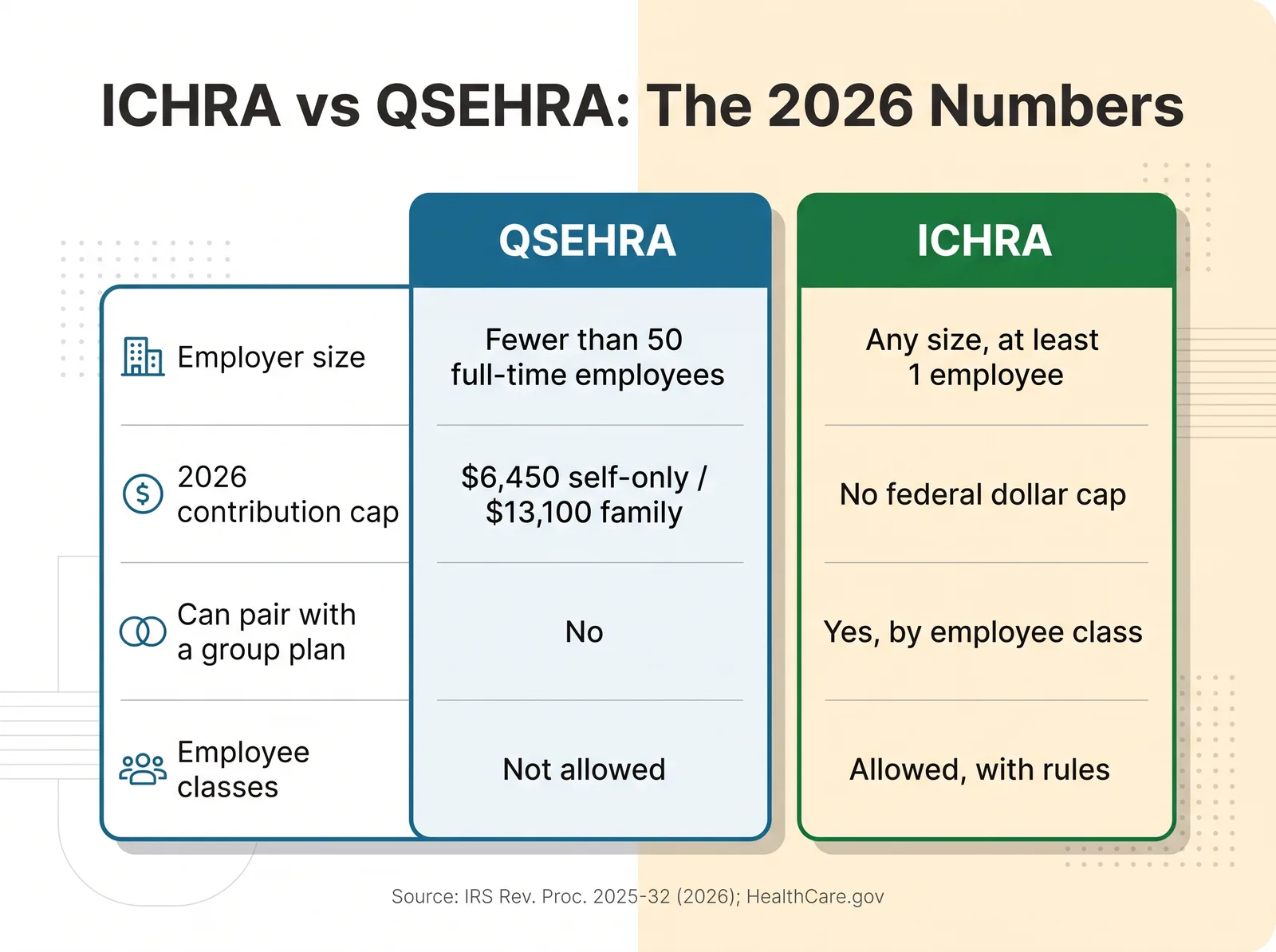
| Dimension | QSEHRA | ICHRA |
|---|---|---|
| Employer size | Fewer than 50 full-time equivalent employees | Any size, at least one non-owner employee |
| Existing group plan | Not allowed to offer one to any employee | Allowed for a different, permitted employee class |
| 2026 contribution cap | $6,450 self-only / $13,100 family, hard IRS limit | No federal dollar cap; limited by affordability math |
| Varying the amount | By employee age and family size only | By permitted employee class (role, hours, location, more) |
| Minimum class size | Not applicable | 10 to 20 employees, only if mixing with a group plan class |
| Design complexity | Lower — one formula for everyone | Higher — classes, affordability modeling, substantiation |
| Growth runway | Ends at 50 FTEs; forces a re-platform | No size ceiling to plan around |
A worked example: a 14-person company in Wisconsin
Say you run a 14-employee logistics company with a warehouse in Jefferson County, Wisconsin. You don't offer group coverage today. Two vendors have pitched you two different acronyms, and you want the actual math, not the sales pitch.
Start with what the county looks like for 2026. Per src/data/qualified_counties.json,
Jefferson County's individual-market benchmark premium runs an estimated $315 a
month against a small-group benchmark of $423, a spread of about 25.6%,
or roughly $1,301 per employee per year — useful context for whether either HRA beats what a small-group quote would run you here,
separate from the QSEHRA-versus-ICHRA question itself. The rest of Wisconsin's qualifying
counties are on the state page: See Wisconsin ICHRA savings by county →.
Now the reimbursement design. You want to offer $650 a month for self-only coverage, because it's competitive in your labor market and roughly matches what your best people say they're paying today. Structured as a QSEHRA, that's a problem: the 2026 self-only cap is $537.50 a month ($6,450 ÷ 12). At $650 a month, you'd be $112.50 over the monthly cap, or $1,350 a year per employee — and across all 14 employees, that's $18,900 a year of reimbursement that would jeopardize the QSEHRA's tax-favored status for the whole group, not just the excess dollars.
Structured as an ICHRA instead, $650 a month has no federal ceiling to clear. The only question is whether it's affordable for employer-mandate and subsidy-coordination purposes: does the employee's remaining out-of-pocket cost for the lowest-cost silver plan available to them, after your $650 contribution, stay at or under 9.96% of that employee's household income for 2026? That's a per-employee calculation, not a county-wide one — it depends on each person's actual income and the actual lowest-cost silver plan where they live, which is why we're not putting a single dollar figure on it here. The arithmetic is simple once you have those two numbers; running it for real is exactly the kind of thing worth doing before you announce a contribution amount, not after.
Illustrative, not a quote
The county figures above are 2026 plan-year estimates from public and industry rate data, not a quote, an offer of insurance, or a guarantee of what any specific employee will pay. Individual results vary by age, plan selection, and carrier participation.
The decision, step by step
Skip the vendor pitch and work it out in this order. Every step here is something you or your accountant can do without a phone call.
- Count full-time equivalents, not heads. If you're at or approaching 50 FTEs, a QSEHRA is off the table regardless of anything else — go straight to evaluating an ICHRA.
- Check whether you already offer any group coverage. Any group health plan, even a limited one like a dental-only or vision-only plan bundled with medical, can disqualify a QSEHRA. It does not disqualify an ICHRA offered to a separate employee class.
- Decide the reimbursement amount you actually want to offer. Divide your target annual number by 12. If the self-only monthly figure is under $537.50 and the family figure is under $1,091.67 (2026), a QSEHRA can legally support it. Above either number, you need an ICHRA.
- Decide if you want to vary the amount by role, location, or hours. A QSEHRA can only vary by age and family size. Any other kind of variation requires an ICHRA's employee-class structure — see ICHRA eligibility: who qualifies to offer and receive it → for the class and affordability rules in full.
- Check your county's rate spread before committing to either one. Both arrangements reimburse toward the same individual-market plans, so the same county math applies to both. Ten minutes on the savings map tells you whether the county-level economics favor this approach at all: Check your county on the savings map →
- Model affordability if you're going the ICHRA route. This is the step that decides whether your specific employees keep or lose premium tax credit eligibility, and it has to happen before you set final contribution amounts, not after you announce them.
- Build a rollout timeline once the design is set. The 90-day employee notice, open enrollment, and first reimbursement all have to land in the right order — see How to set up an ICHRA plan: a step-by-step timeline →.
What changes for the employer
Simple, but boxed in
- One reimbursement formula, varied only by age and family size
- Hard $6,450 / $13,100 cap for 2026, no exceptions
- Cannot coexist with any group health plan
- Stops being available the moment you cross 50 FTEs
Fixed formulaSimple to run, hard ceiling
More design work, more room
- Contribution can vary by permitted employee class
- No federal dollar cap; governed by the affordability test instead
- Can run alongside a group plan for a different class
- No size ceiling to plan around later
Class-basedMore setup, no growth wall
A QSEHRA isn't a smaller ICHRA. It's a different arrangement with a hard ceiling built in on purpose, and the ceiling is the whole reason it's simpler to run.
Mike MooreWhere employers get this wrong
The four mistakes we see most
- Setting a QSEHRA reimbursement above the federal cap because it seemed like a reasonable number without checking it against $537.50 a month self-only for 2026.
- Building a QSEHRA at 45 employees with a hiring plan that hits 55 next year. The re-platform to an ICHRA is avoidable if you start there.
- Assuming an ICHRA contribution is "legal" and "affordable" are the same test. There's no dollar limit on legality; affordability is a separate, per-employee calculation that decides mandate and subsidy exposure.
- Picking a contribution number before checking the county. The right reimbursement level in a county where individual coverage runs well below small group looks different than in a county where it doesn't.
How ICHRA Savings fits in
We don't sell QSEHRA or ICHRA administration software, and we're not the ones running your payroll integration. What we built is the county-level dataset above: a comparison of the 2026 individual-market benchmark against the small-group benchmark in every US county, so you can see, before any design conversation, whether your specific county is one where either arrangement is likely to beat what you're paying now. If your county doesn't qualify, the honest answer is that a QSEHRA or ICHRA may not save you money against group coverage this year, no matter how well it's designed — and we'd rather tell you that up front than after a rollout.
If your county does qualify and you want help thinking through class design, affordability modeling, or the rollout timeline, that's a conversation worth having with a licensed advisor before you set contribution amounts, not after.
Two places to go next
Before anything else, check whether your county is one where this works: Check your county on the savings map →. If you want the mechanics of an ICHRA rollout before talking to anyone, start here: How ICHRA works →.
Questions employers actually ask
Can a small business have both a QSEHRA and an ICHRA?
No, not for the same class of employees at the same time. A QSEHRA and an ICHRA are two separate, mutually exclusive arrangements under the Internal Revenue Code, and offering a QSEHRA to a class of employees rules out also offering that class an ICHRA in the same plan year. An employer can, however, run a QSEHRA one year and switch to an ICHRA the next, or use an ICHRA for one employee class and a traditional group plan for another, subject to the class-size and eligibility rules.
What happens if a business reimburses more than the QSEHRA cap allows?
The arrangement stops qualifying as a QSEHRA under section 9831(d) of the Internal Revenue Code. For 2026, the cap is $6,450 for self-only coverage and $13,100 for family coverage, per IRS Rev. Proc. 2025-32. Reimbursing above that breaks the tax-favored status of the whole arrangement, not just the excess dollars, which is why this is treated as a compliance failure rather than a rounding error.
Does an ICHRA have any dollar limit on how much an employer can contribute?
No federal dollar cap exists for ICHRA contributions. The constraint is the ACA's affordability test: if the employer wants to avoid employer-mandate exposure and wants the ICHRA to count as affordable for a given employee, the employee's out-of-pocket cost for the lowest-cost silver plan, after the ICHRA contribution, generally cannot exceed 9.96% of that employee's household income for the 2026 plan year, per IRS Rev. Proc. 2025-25. An employer can contribute more than that and still offer an ICHRA; it simply will not be an affordable offer for mandate and subsidy purposes at that level.
Can a 60-employee company use a QSEHRA?
No. QSEHRA eligibility requires fewer than 50 full-time equivalent employees and no group health plan offered to any employee, per HealthCare.gov. A 60-employee company is not eligible for a QSEHRA under any structure. An ICHRA has no employer size floor or ceiling, which is the main reason larger small employers end up looking at ICHRA even when a QSEHRA was their first search term.
What happens to an employee's premium tax credit under either arrangement?
The mechanics are the same question under both: if the QSEHRA or ICHRA offer is affordable for that employee under the IRS test, the employee generally must waive the premium tax credit to use the reimbursement for that month. If the offer is unaffordable, the employee may decline the employer's HRA and claim a subsidy instead. This is not a penalty specific to either arrangement; it is how the IRS coordinates employer reimbursement with marketplace subsidies, and it applies employee by employee, not company-wide.
Can an employer switch from QSEHRA to ICHRA if it grows past 50 employees?
Yes, and it usually has to. Once full-time equivalent headcount crosses 50, the QSEHRA is no longer available, and the employer needs to either move to an ICHRA, adopt a traditional group plan, or drop reimbursement altogether. Employers expecting to cross that threshold within a year or two are often better served starting with an ICHRA, since the eligibility rules do not change again as the company grows.
Do employee classes work the same way in both arrangements?
No. A QSEHRA can vary reimbursement amounts only by employee age and family size, and it must be offered on the same terms to all eligible employees otherwise. An ICHRA can be structured around permitted employee classes, such as full-time versus part-time, salaried versus hourly, or different geographic locations, each with its own contribution amount, subject to nondiscrimination and minimum class-size rules when an employer also offers a traditional group plan to another class.
Which one is easier to run from an administrative standpoint?
For a very small, stable team under the QSEHRA cap, a QSEHRA is usually simpler, mainly because there is one reimbursement rule for everyone instead of a class structure to design. Once a company wants to vary contributions by role or location, or expects to grow past 50 employees, the extra setup work an ICHRA requires up front tends to pay for itself by avoiding a second migration later.
Sources
- IRS Revenue Procedure 2025-32, Section 4.63, 2026 QSEHRA reimbursement limits (issued Oct. 9, 2025)
- IRS Revenue Procedure 2025-25, Section 3.02, 2026 Required Contribution (affordability) Percentage (issued July 18, 2025)
- HealthCare.gov, "Health Reimbursement Arrangements (HRAs) for small employers", QSEHRA eligibility rules
- HealthCare.gov, "Individual coverage Health Reimbursement Arrangements", ICHRA eligibility and class rules
- KFF, "2025 Employer Health Benefits Survey: Summary of Findings", firm offer rates by size
- ICHRA final rule: Departments of the Treasury/IRS, Labor, and Health and Human Services (2019, effective for plan years beginning 2020)
- County-level premium comparison:
src/data/qualified_counties.json, 2026 plan year (Ideon rate data, cross-verified against CMS public-use marketplace files)