ICHRA ACA Reporting 2026: 1095-C Codes and Deadlines
The CHOICE Arrangement (formerly ICHRA) requires 1095-C codes 1L to 1U and new 2026 deadlines. See the codes, the math and the March 2027 due dates, sourced.
The short version
- An ICHRA offer (now also called a CHOICE Arrangement) uses its own Form 1095-C codes, 1L through 1U, instead of the codes for a traditional group plan.
- Only applicable large employers (50+ full-time-equivalent employees) file 1094-C/1095-C at all. Most first-time ICHRA adopters are smaller than that and skip this system entirely.
- Line 15 is the silver benchmark premium for the employee's age and location minus the monthly HRA amount — not the HRA amount itself.
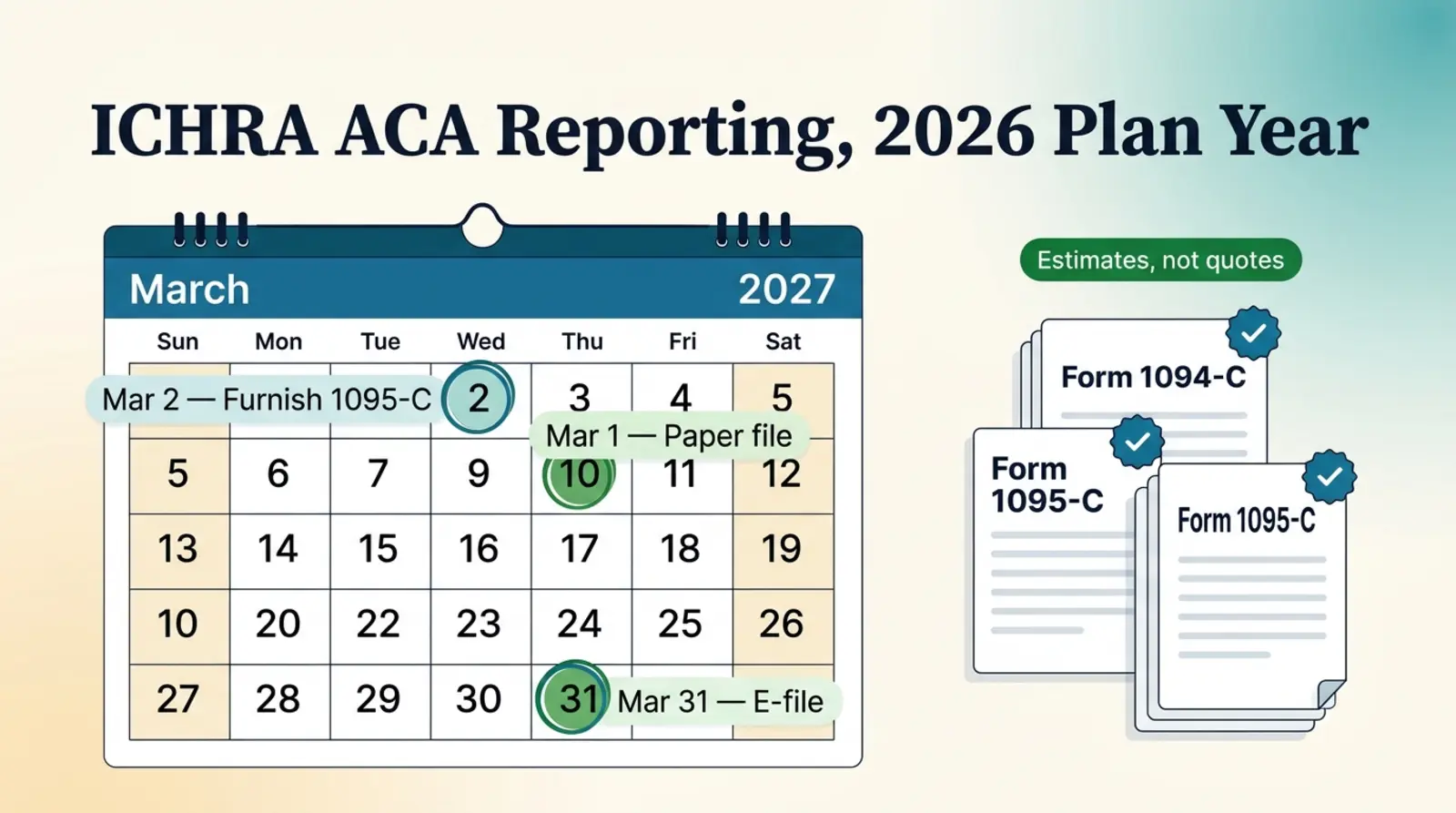
- For calendar year 2026, Forms 1095-C are due to employees by March 2, 2027, with IRS filing due March 1, 2027 on paper or March 31, 2027 electronically.
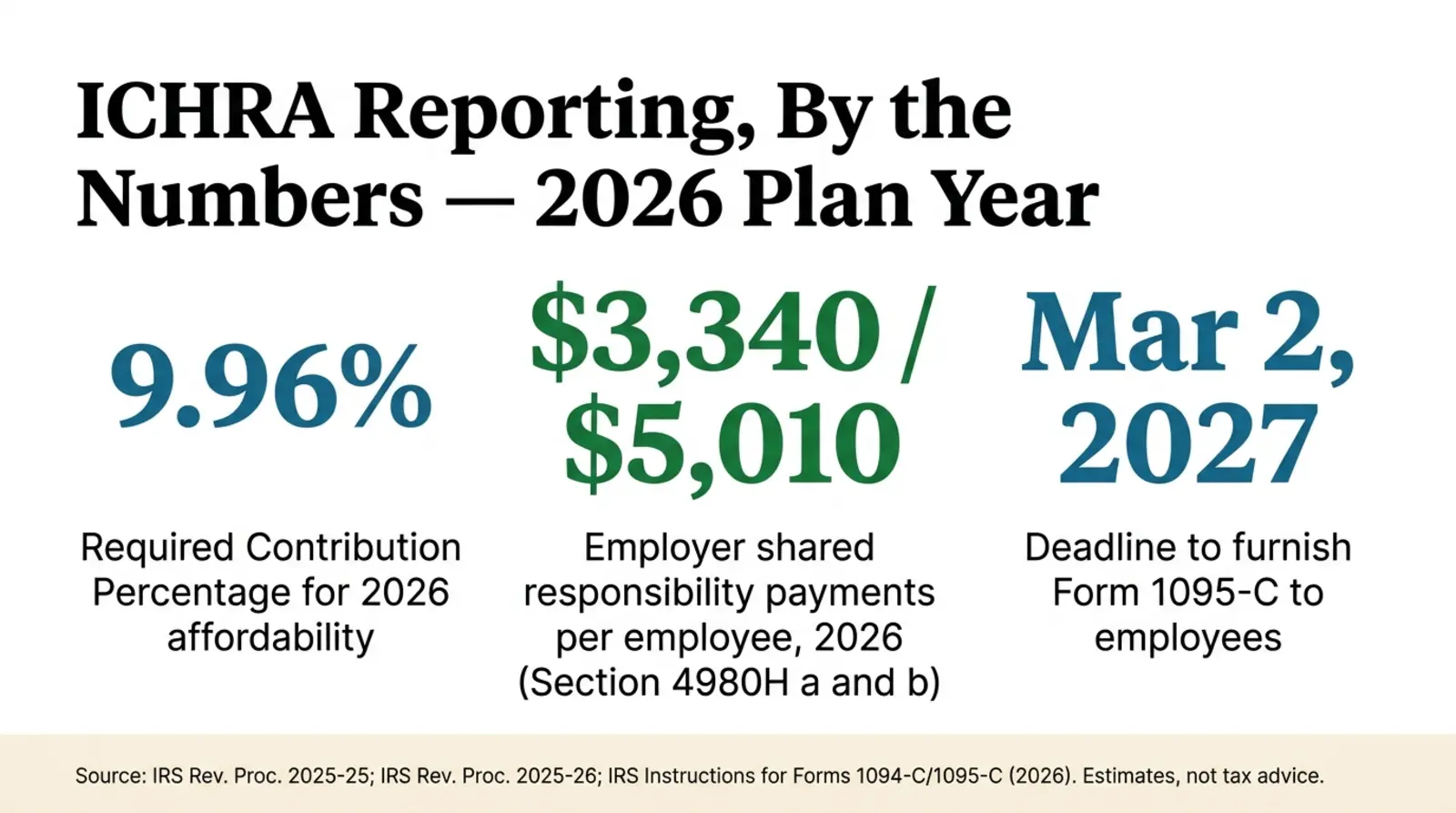
- Two different penalty systems apply to mistakes: information-return penalties up to $340 a form, and employer-mandate payments of $3,340 or $5,010 per employee if an offer is miscoded as affordable.
- The rate-spread math and the reporting math are two separate questions — an estimated 57.4% of US counties in our national rate file actually favor small group at the silver, age-50 benchmark, so check your own county before assuming either answer.
The paperwork surprise nobody mentioned
Most employers hear about ICHRA through the savings pitch: a fixed monthly budget, employees pick their own plan, contributions are tax-free. What rarely comes up until January of the following year is ACA reporting: offering one can put you on the hook for Forms 1094-C and 1095-C, a federal information return you didn't have to file for a plan this simple before.
That's not a reason to avoid an ICHRA. It's a reason to know, before you set your first contribution amount, whether this applies to you at all, and if it does, exactly which boxes get filled in and when. Most of this article is that list, taken directly from the IRS instructions rather than summarized secondhand.
Why an ICHRA offer shows up on a tax form at all
An ICHRA (Individual Coverage Health Reimbursement Arrangement) is an employer-funded account-based group health plan, created by a 2019 final rule from the IRS, the Department of Labor, and HHS, published at 84 Fed. Reg. 28888 on June 20, 2019, effective August 19, 2019, and applicable to plan years beginning on or after January 1, 2020 (govinfo.gov, FR-2019-06-20). Treasury and the IRS now also refer to the same arrangement as a CHOICE Arrangement, a name change covered in full further down this page.
The reporting obligation follows from one specific fact: an ICHRA is still, in the IRS's eyes, an employer-sponsored group health plan, even though the employee ends up buying an individual-market policy with the money. That means it feeds the same information-return system Congress built for the ACA's employer mandate — Forms 1094-C (an employer-level summary transmittal) and 1095-C (one per employee, describing the specific offer made each month), per the IRS Instructions for Forms 1094-C and 1095-C (2026). An employer that already files these forms for a traditional group plan doesn't gain a new system by switching to ICHRA; it gains a new set of codes within the system it already uses.
Three more terms matter before the codes make sense. An applicable large employer (ALE) is generally an employer with 50 or more full-time employees, counting full-time-equivalents, in the prior calendar year — the threshold that decides whether any of this applies to you at all. The affordability safe harbor is the test that decides whether an ICHRA offer counts as "affordable" under the IRS's rules; get the contribution amount wrong relative to that test, and the code you report on Line 14 can misstate whether an employee was entitled to a premium tax credit that month. And Line 15, the Employee Required Contribution, is the specific dollar figure the IRS uses to check that affordability math against.
It's worth being precise about a cousin arrangement here too, because the two get confused constantly. A QSEHRA (qualified small employer HRA, open only to employers with fewer than 50 full-time-equivalent employees that offer no group plan at all) does not run through Forms 1094-C or 1095-C at all. Instead, the employer reports each eligible employee's full annual permitted benefit in Box 12 of Form W-2, using Code FF — listed as "Permitted benefits under a qualified small employer health reimbursement arrangement" in the IRS's own General Instructions for Forms W-2 and W-3 (2026). An ICHRA has no size cap and no code-FF shortcut; once you're an ALE offering one, you're inside the 1094-C/1095-C system described in the rest of this article, not the simpler W-2 box.
Do you even have to file? The 50-employee line
Here's the single most common misunderstanding in this whole topic: the ICHRA rule itself applies to employers of any size, with no minimum headcount. The 1094-C/1095-C reporting system does not. It applies specifically to applicable large employers, generally 50 or more full-time-equivalent employees in the prior year, counting every member of an aggregated ALE group under its own EIN (IRS Instructions for Forms 1094-C and 1095-C, 2026). A nine-person machine shop offering an ICHRA for the first time generally has nothing to file under this system at all, ICHRA or not.
That's worth sitting with, because it's exactly the opposite of what the paperwork fear implies. The employers most likely to be scared off by "new IRS reporting" are often the smallest ones — and the smallest ones are usually the ones this reporting system doesn't reach. It starts to matter once you cross the 50-employee line, which is also, not coincidentally, the point where the ACA's employer mandate itself starts to apply.
Below 50 full-time-equivalent employees
You can generally stop reading the codes section below. It still matters to understand affordability if you want employees to keep any premium tax credit eligibility they're not using, but the 1094-C/1095-C filing requirement itself does not apply to you.
One wrinkle worth knowing before you count heads: the 50-employee threshold looks at every member of an aggregated ALE group together, not each legal entity alone. Two commonly owned companies with 30 full-time employees each are treated as one 60-employee ALE group for this test, even though each files its own Form 1094-C under its own EIN. A business that looks small on its own org chart can still land inside this system if it shares majority ownership with another company, which is exactly the kind of structure a tax advisor should confirm before you assume you're exempt.
The exact codes: Line 14, 1L through 1U
For an ALE, Line 14 of each employee's Form 1095-C reports what kind of offer that employee got each month. A traditional group-plan offer uses one set of codes; an ICHRA offer uses a dedicated set, 1L through 1U, that distinguishes who the offer covers and which ZIP code sets the affordability test (IRS Instructions for Forms 1094-C and 1095-C, 2026).
| Code | Who the offer covers | Affordability ZIP basis |
|---|---|---|
| 1L | Employee only | Employee's residence |
| 1M | Employee + dependent(s), no spouse | Employee's residence |
| 1N | Employee + spouse + dependent(s) | Employee's residence |
| 1O | Employee only | Primary employment site |
| 1P | Employee + dependent(s), no spouse | Primary employment site |
| 1Q | Employee + spouse + dependent(s) | Primary employment site |
| 1T | Employee + spouse, no dependents | Employee's residence |
| 1U | Employee + spouse, no dependents | Primary employment site |
| 1R | Offer not affordable for employee, spouse, or dependents | |
| 1S | Offered to someone who was not a full-time employee | |
Source: IRS Instructions for Forms 1094-C and 1095-C (2026), irs.gov, read directly this session.
Notice what decides 1L/1M/1N versus 1O/1P/1Q: not what the offer covers, but which ZIP code the employer used to run the affordability test. An employer using the employee's home address reports one set; an employer using its own primary work-site address for the safe harbor reports the other. Get that backwards and the form describes a different affordability test than the one you actually ran.
Employee classes complicate the codes
An ICHRA lets an employer define different employee classes — full-time, part-time, seasonal, salaried versus hourly, different work locations, or employees still in a waiting period — and offer a different contribution, or no ICHRA at all, to each one. That design flexibility is one of the arrangement's biggest selling points, and it's also exactly where reporting mistakes cluster, because every class needs its own correct code for every month it applied.
A seasonal harvest crew offered no ICHRA at all generally gets Code 1S for the months they're not full-time, not left blank. A salaried class with a richer contribution and an hourly class with a leaner one are two different Line 15 calculations running in parallel, for the same employer, in the same month, because the IRS instructions (2026) tie Line 14 and Line 15 to the specific offer each individual employee actually received, not to a single company-wide number. Our employee classes guide covers the design rules in detail; this article covers what happens to that design once it reaches a tax form.
Multi-state and remote teams make this harder
The ICHRA rate comparison runs by county because individual-market premiums are filed by rating area, and the same logic reaches the reporting side: the benchmark premium behind Line 15 is tied to each employee's own age and ZIP code (residence or work site, depending on which safe harbor you chose), not to one company-wide figure. A payroll department running this by hand for a dozen employees in a dozen different counties is running a dozen separate Line 15 calculations, each against a different local benchmark.
That's precisely the profile of the remote and multi-state teams this site's savings map is built to handle on the rate side; the reporting side inherits the same complexity, one employee at a time. An employer in that position is the strongest case for letting a payroll provider or benefits administrator automate the Line 15 math against current county benchmarks, rather than tracking each one in a spreadsheet by hand.
Line 15: the number the IRS actually wants
Line 15 is where the most common ICHRA-specific mistake happens, because the instinct is to enter the HRA contribution itself. That's wrong. Line 15 reports the Employee Required Contribution: the monthly premium for the lowest-cost self-only silver plan available to that employee, at their applicable age and location, minus the monthly ICHRA amount (generally the annual HRA amount divided by 12) — the excess the employee would have to pay out of pocket on top of the HRA, per the same IRS instructions. If the HRA fully covers that benchmark plan, Line 15 is entered as 0.00, never left blank. Line 17 reports the ZIP code used to identify that lowest-cost silver plan.
Here's the math
Line 15 = (lowest-cost self-only silver premium for that employee's age and location) − (annual HRA amount ÷ 12). A $450-a-month HRA against a $500-a-month benchmark plan reports $50.00 on Line 15. The same $450 HRA against a $420-a-month benchmark plan reports $0.00 — not a negative number, and not the HRA amount itself.
A worked example, Lima, Ohio
Put real county numbers behind that formula. Allen County, Ohio — home to Lima — carries an estimated 2026 individual-market silver benchmark of $632.65 a month for a 50-year-old enrollee, against a small-group benchmark of $1596.34, a gap of 60.4%, or $11,564 a year per employee (ICHRA Savings county dataset, 2026 plan year, cross-verified against CMS public-use marketplace files).
Say a Lima-area employer with 11 full-time employees — below the ALE threshold, so no 1094-C/1095-C filing applies here, but useful for the Line 15 math regardless of size — sets an ICHRA contribution of $500 a month per employee. A 50-year-old employee whose own benchmark plan, at their specific ZIP code, prices at $632.65 would see Line 15 report $132.65 (the $632.65 benchmark minus the $500 HRA). Funding all 11 employees at the full individual-market benchmark instead, rather than at a flat $500, would run an estimated $127,207 a year in aggregate contributions for the group — the illustrative gap between "ICHRA funded at the benchmark" and "ICHRA funded at a flat, lower number," which is a legitimate design choice, not a requirement.
None of this is a quote or a guarantee for any specific business. It's the same formula applied to one real county's 2026 numbers, which you can run against your own county on the savings map.
A second example, for an ALE in Albany, Georgia
The Lima example above sits under the ALE threshold on purpose, to show the Line 15 formula without the filing requirement attached. Here's the same math once a business actually has to file. Dougherty County, Georgia — home to Albany — carries a 2026 individual-market benchmark of $663.75 a month against a small-group benchmark of $1393.22, a gap of 52.4%, or $8,754 a year per employee (ICHRA Savings county dataset, 2026 plan year).
Say an Albany-area employer with 55 full-time-equivalent employees — comfortably past the 50-employee ALE line — sets an ICHRA contribution of $650 a month per employee. For an employee whose benchmark plan prices at the county figure above, Line 15 reports $13.75 (the $663.75 benchmark minus the $650 HRA). If that contribution turns out to fail the affordability safe harbor for 4 lower-paid employees who go on to claim a premium tax credit, the employer-mandate exposure under § 4980H(b) runs an estimated $20,040 for the year — 4 employees at $5,010 each (IRS Rev. Proc. 2025-26, 2026 figures) — on top of whatever information-return penalty applies to the forms themselves. That's the concrete cost of setting a contribution amount without first running the affordability math, not a hypothetical scare number.
What to actually keep on file
Every figure that lands on Line 14, 15, or 17 has to come from somewhere defensible if the IRS ever asks. In practice that means keeping, for every employee and every month an ICHRA offer applied: the written notice given to the employee (the same notice required at least 90 days before the plan year, covered in our setup timeline), the employee's class assignment, the ZIP code used for the affordability safe harbor, the benchmark premium pulled for that ZIP and age, the monthly HRA amount, and the resulting Line 15 calculation. This is largely the same substantiation trail already required to prove an ICHRA reimbursement is for actual coverage, covered in full in our substantiation guide — the reporting side mostly reuses records you need to keep anyway, rather than demanding an entirely separate file.
The 2027 filing calendar
For calendar year 2026 — the plan year most of this article has been describing — the IRS Instructions for Forms 1094-C and 1095-C (2026) set three separate dates, and missing the wrong one costs differently.
March 2, 2027
Furnish Form 1095-C to each employee
March 1, 2027
File with the IRS on paper
March 31, 2027
File with the IRS electronically
50+
Full-time-equivalent employees to be an ALE at all
The 2026 instructions also note that employers can satisfy the employee-copy requirement by posting a clear, conspicuous notice on the company website or benefits portal instead of mailing every form, though some states still require physical mailing — check your own state's rule before relying on a website notice alone.
What a wrong form actually costs
Two separate, stackable penalty systems apply to a 1095-C mistake, and conflating them is common. The first is a plain information-return penalty, the kind that applies to any wrong or late IRS form, health-related or not. For returns and statements due in 2027 — the Forms 1094-C/1095-C covering 2026 — the base penalty is $340 per form, capped at $1,397,000 a year for smaller filers, dropping to $60 per form (capped at $244,500) if corrected within 30 days, or $130 per form (capped at $698,500) if corrected by August 1. Intentional disregard carries a $690-per-form penalty with no annual cap at all (irs.gov/payments/information-return-penalties).
The second is specific to the ACA employer mandate itself, and it's the one that actually turns on whether your Line 14 code was right. If an ICHRA offer gets coded as affordable when it wasn't, and an employee goes on to receive a premium tax credit for that month, the employer can owe an employer shared responsibility payment under IRC § 4980H. For 2026, that's $3,340 per full-time employee (minus the first 30) under § 4980H(a) if no offer of coverage was made at all to enough full-time employees, or $5,010 per affected employee under § 4980H(b) where an offer was made but judged unaffordable (IRS Rev. Proc. 2025-26, Internal Revenue Bulletin 2025-33).
| What went wrong | Penalty | Annual cap |
|---|---|---|
| Form filed late, corrected within 30 days | $60/form | $244,500 |
| Form filed late, corrected by Aug. 1 | $130/form | $698,500 |
| Form wrong or missing, base rate | $340/form | $1,397,000 |
| Intentional disregard | $690/form | None |
| ICHRA offer wrongly coded "affordable" (§ 4980H(b)) | $5,010/employee | None stated |
| No offer made to enough full-time employees (§ 4980H(a)) | $3,340/employee | None stated |
Sources: irs.gov/payments/information-return-penalties (returns due 2027); IRS Rev. Proc. 2025-26, IRB 2025-33 (2026 plan year). Not legal or tax advice.
The information-return penalty punishes a wrong form. The employer-mandate payment punishes a wrong affordability answer. They are not the same fine, and a clean Line 14 code does not protect you from the second one if the contribution amount behind it was never affordable to begin with.
Mike MooreHow to actually file this, step by step
None of this requires guessing. In order:
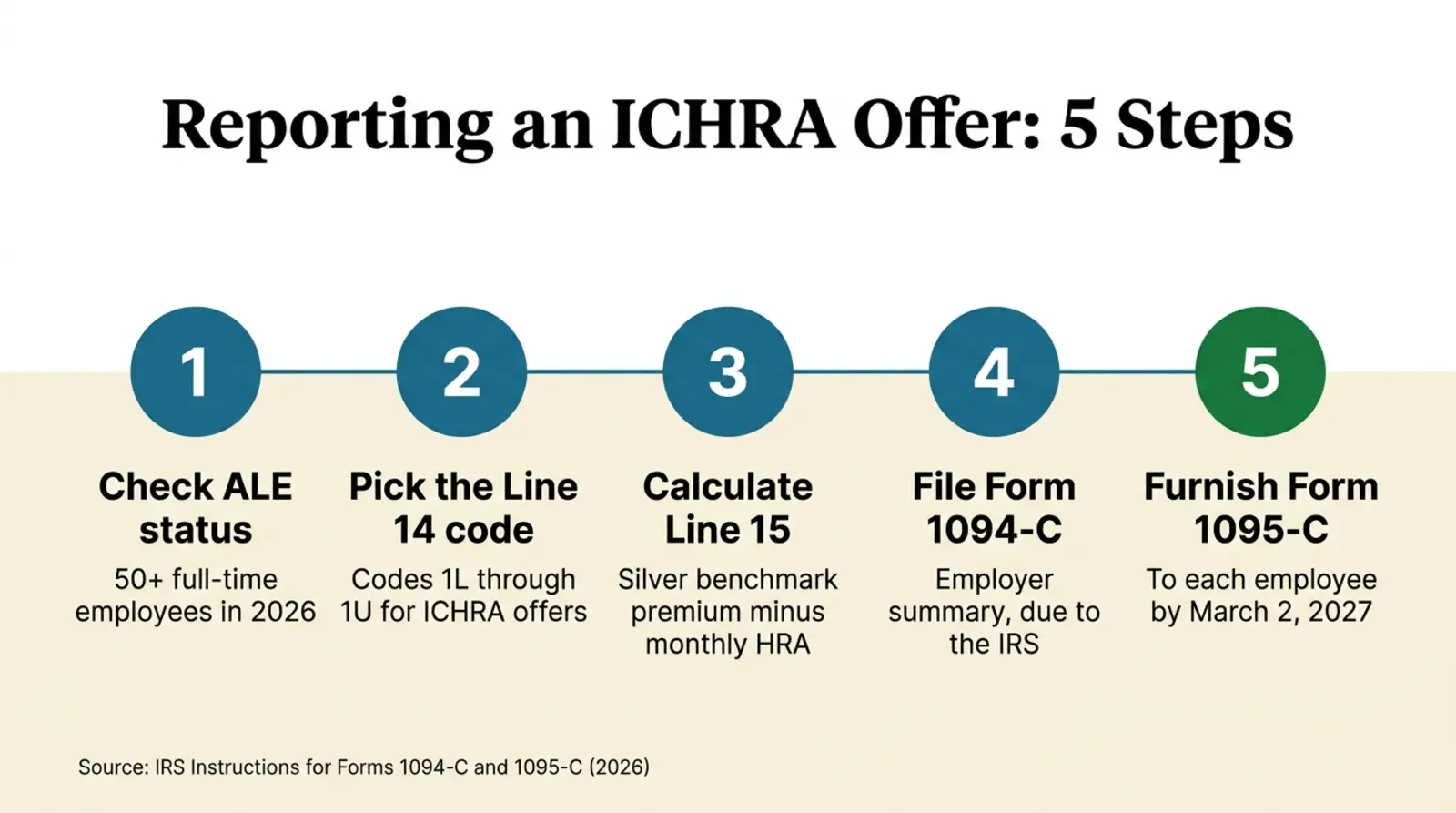
- Confirm ALE status first. Count full-time-equivalent employees for the prior calendar year. Under 50, you can generally stop here.
- Decide which ZIP code sets your affordability safe harbor — employee residence or primary work site — before you pick a code, since that choice determines whether you're in the 1L–1N family or the 1O–1Q family.
- Pull the benchmark premium for each employee's age and location for every month an ICHRA offer applied, to calculate Line 15.
- Code Line 14 by household coverage — employee only, employee and dependents, employee and spouse, or employee-spouse-dependents — using the matching code from the table above.
- File the employer-level Form 1094-C summarizing every employee's monthly offers, by March 1, 2027 on paper or March 31, 2027 electronically.
- Furnish each employee their own Form 1095-C by March 2, 2027, by mail or by a compliant website notice where your state allows it.
Most ALEs offering an ICHRA for the first time use a payroll provider, benefits administrator, or tax preparer already set up to handle 1094-C/1095-C filing for a traditional group plan; the work is adding the correct ICHRA-specific codes to a system you likely already run, not standing up a new one.
Why this is also called a CHOICE Arrangement now
None of the reporting rules above changed because of a rename, but the name itself is real and worth being precise about. On September 14, 2026, the Centers for Medicare & Medicaid Services, the Small Business Administration, and the state of Georgia jointly announced that the arrangement would be publicly branded a CHOICE Arrangement, described in that release as "formerly known as Individual Coverage Health Reimbursement Arrangements (ICHRAs)" (cms.gov press release, Sept. 14, 2026). CMS followed with similar outreach naming Ohio employers specifically on October 16, 2026 (cms.gov press release, Oct. 16, 2026). Neither release changes a single IRS form, code, or deadline described in this article; it's the same 2019 final rule under a new public-facing name.
Where the paperwork is worth it
The reporting burden only matters relative to what an ICHRA actually saves, and that's a county-level question, not a national one. In Allen County, Ohio, the 2026 benchmark comparison runs 60.4% in favor of the individual market, or $11,564 a year per employee. In Dougherty County, Georgia — home to Albany — the gap is 52.4%, or $8,754 a year per employee (ICHRA Savings county dataset, 2026 plan year). Both counties clear a wide margin over the $100-a-month floor we use to decide whether a county qualifies at all, which is exactly the kind of gap that makes a few extra tax-form fields a reasonable trade for an ALE large enough to file them. See the full Ohio county breakdown or the Georgia county breakdown for every qualifying county in either state.
Where the data says small group still wins
It would be easy to stop at the counties where ICHRA wins, since that's the whole premise of this site. It's also not honest. At the same silver, age-50 benchmark, our national county rate file — all 3,108 US counties, not just the 719 that qualify for our savings map — shows the individual-market benchmark running above the small-group benchmark in an estimated 57.4% of counties nationwide — 1,785 counties where small group is still the better deal on pure rate spread.
Georgia's own Carroll County is one of them. At the 2026 age-50 silver benchmark, the individual-market rate there runs about $6.54 a month above the small-group rate, a narrow but real loss for the ICHRA side (ICHRA Savings national county benchmark file, 2026 plan year, same Ideon rate data cross-checked against CMS public-use marketplace files used throughout this site). For an employer headquartered in Carrollton, the honest answer is that small-group coverage likely remains the better deal on pure rate spread, reporting complexity aside.
The point isn't that Georgia is weak ground for ICHRA — Dougherty County above shows the opposite can be true a few counties away. The point is that "does ICHRA win here" and "do I have to file 1094-C/1095-C" are two separate questions with two separate answers, and neither one should be assumed from the other or from a national average.
Check your own county before the reporting question matters at all
If your county is one where small group already wins on price, the reporting rules in this article are moot for that specific decision — you'd be taking on new filing complexity for a plan that doesn't save you money to begin with. The savings map answers that first question in about ten seconds.
Where ICHRA Savings fits in
We don't file your Forms 1094-C or 1095-C — that's a job for your payroll provider, your benefits administrator, or your CPA, and this article is not a substitute for any of them. What we built is the county-level data that answers the question that has to come before any of this paperwork matters: does an ICHRA actually beat small group where your people live, and by how much. That's the same 719-county, 2026 plan-year dataset behind every number in this article, cross-verified against CMS public-use marketplace files.
If you've already run the numbers and you're an ALE weighing whether the reporting lift is worth it, talk to an expert before you lock in a contribution amount or a Line 14 code. If you haven't run the numbers yet, start with the savings map — it takes less time than reading the IRS instructions this article is built from.
Questions employers actually ask
Does offering an ICHRA mean I have new IRS reporting to do?
If you're an applicable large employer (ALE, generally 50 or more full-time-equivalent employees), yes. You already file Forms 1094-C and 1095-C for your group plan offer; an ICHRA (now also called a CHOICE Arrangement) offer uses its own Line 14 codes, 1L through 1U, instead of the codes you'd use for a traditional group plan (IRS Instructions for Forms 1094-C and 1095-C, 2026). If you're not an ALE, the 1094-C/1095-C system generally does not apply to you at all, ICHRA or not.
What are the ICHRA codes on Form 1095-C, Line 14?
Codes 1L through 1U cover an individual coverage HRA offer, split by who it covers (employee only, employee and spouse, employee and dependents, employee-spouse-dependents) and by which ZIP code sets affordability, the employee's residence or the employer's primary work site (IRS Instructions for Forms 1094-C and 1095-C, 2026). Code 1R marks an offer that isn't affordable for anyone in the household, and 1S marks an offer to someone who wasn't full-time.
What goes on Line 15 for an ICHRA offer?
The Employee Required Contribution: the lowest-cost self-only silver plan premium for that employee's age and location, minus the monthly ICHRA amount (the annual HRA amount divided by 12), per the same IRS instructions. If the HRA fully covers the benchmark plan, enter 0.00, never leave it blank.
What happens if I use the wrong code or miss the deadline?
Two separate penalty systems can apply. A late or wrong Form 1095-C risks an information-return penalty under IRC §§ 6721/6722, up to $340 per form for 2026 forms (due in 2027), with faster correction cutting that to $60 or $130 (irs.gov/payments/information-return-penalties). Separately, coding an unaffordable ICHRA offer as affordable can trigger an employer-mandate payment under IRC § 4980H, $3,340 or $5,010 per affected employee for 2026 (IRS Rev. Proc. 2025-26). These are not quotes or legal advice; confirm your own exposure with a tax professional.
Is the CHOICE Arrangement a different rule from ICHRA?
No. CMS and the Small Business Administration began using "CHOICE Arrangement" as the public name for the same arrangement in a September 14, 2026 press release, which describes it as "formerly known as Individual Coverage Health Reimbursement Arrangements (ICHRAs)." The underlying rule is unchanged: the 2019 IRS/DOL/HHS final rule at 84 Fed. Reg. 28888, applicable to plan years beginning on or after January 1, 2020. The 1095-C codes, deadlines, and penalties in this article apply either way.
Is QSEHRA reporting the same as ICHRA reporting?
No. A QSEHRA is capped at fewer than 50 full-time-equivalent employees and a business offering no group plan at all; its reporting runs through Box 12, Code FF of each employee's Form W-2 — the full annual permitted benefit, per the IRS's General Instructions for Forms W-2 and W-3 (2026) — not through Forms 1094-C or 1095-C. An ICHRA has no size cap, and once an ICHRA-offering employer is an ALE, it's inside the 1094-C/1095-C system this article describes, with its own Line 14 codes and deadlines.
Can my payroll provider just handle this for me?
Usually, yes, if you tell them you're offering an ICHRA rather than a traditional group plan. Most payroll and benefits-administration platforms that already generate Forms 1094-C/1095-C for a group plan can apply the 1L-1U code set and the Line 15 benchmark-minus-HRA calculation once they know the arrangement type, the employee classes involved, and the ZIP code basis you're using for affordability. The work for you is making sure they have that information correct for every employee, not building a new filing process from scratch.
Does every county actually come out ahead with an ICHRA?
No, and it's worth saying plainly: at the silver, age-50 benchmark we use, individual-market rates run above small-group rates in an estimated 57.4% of the 3,108 US counties in our national rate file, including Carroll County, Georgia, where the individual benchmark runs about $6.54 a month above small group. Reporting rules apply the same way regardless of which side of that line your county sits on; the rate spread is a separate question from the paperwork, and you should check both before deciding.