ICHRA Employee Classes 2026: The 11 Types, Explained
ICHRA lets you split your team into 11 permitted classes, each with its own budget. See the minimum-size rule, the 3:1 age cap, and a real county example.

The short version
- An ICHRA can split your workforce into up to 11 permitted classes, each with its own contribution amount, defined at 26 CFR 54.9802-4(d)(2).
- Most small employers never need more than one class. Classes exist for the workforces that genuinely differ by employment type, location, or bargaining unit.
- A numeric minimum class size — 10, 10 percent, or 20 employees depending on your headcount — only applies if you offer group coverage to one class and an ICHRA to another in the same plan year.
- Family status is not a class. It is a permitted way to vary the dollar amount inside a class you already defined, alongside age, capped at a 3:1 ratio between your oldest and youngest participants.
- Getting the class structure wrong is a real tax exposure under 26 U.S.C. 4980D, not just an administrative slip.
You have four kinds of employees and one health benefits budget. A dozen people in the office, a warehouse crew paid hourly, three remote account managers spread across three states, and a handful of seasonal hires who show up every fall. Group insurance forces all of them into the same one or two plans, priced off a census that treats them like a single risk pool. An Individual Coverage Health Reimbursement Arrangement (ICHRA), the IRS-defined arrangement that lets you set a fixed monthly reimbursement and let each employee buy their own individual health plan, does not have to work that way. It lets you split your workforce into up to 11 permitted employee classes and set a different contribution for each one, as long as you draw the lines using the criteria the rule actually allows and clear a minimum headcount where one applies. This article walks through all 11 classes, the minimum-size rule, how contributions can vary by age and family size inside a class, and where employers actually get this wrong, using the real federal regulation text and the site's own 2026 county dataset for the worked numbers.
The instinct we hear most from employers standing this up for the first time is worry, not curiosity: "Can I even legally give my warehouse crew a different amount than my office staff without a lawsuit?" The honest answer is yes, but only along the lines the federal rule actually draws — not along whatever lines feel intuitive to an employer who has never had to think about it before. The rest of this article is that list, in full, with the parts employers most often get backwards flagged as they come up.
Why ICHRA classes exist
Nothing about ICHRA requires you to use more than one class. A five-person consulting firm with an owner, two salaried staff, and two part-timers can put everyone in a single class and offer one contribution amount to the whole company. That is the simplest, most common setup, and it is the right one for most small employers with a workforce that does not really differ in employment type or location.
Classes solve a narrower problem: a workforce that is genuinely not uniform. A restaurant group with full-time kitchen staff and a rotating cast of part-time servers. A logistics company with a warehouse crew in one county and dispatchers working from home in three others. A firm that just acquired a unionized shop and now has a collective bargaining agreement to honor alongside its existing non-union staff. Without classes, an employer in any of those situations has two bad options: offer the same dollar amount to everyone regardless of how different their situations are, or offer nothing at all to the group that does not fit. Classes are the mechanism that lets a budget follow the actual shape of a workforce instead of forcing the workforce to fit the budget.
The rule that defines all of this sits in the same federal regulation that created ICHRA itself: 26 CFR 54.9802-4, issued jointly by the Treasury Department (IRS), the Department of Labor, and the Department of Health and Human Services in 2019. Paragraph (d)(2) lists the classes. Paragraph (d)(3) sets the minimum-size rule. Paragraph (c)(3)(iii) governs how the dollar amount can vary within a class. Everything in this article traces back to those three paragraphs.
You are not required to use classes
One employer-wide class, one contribution amount, is a complete and compliant ICHRA on its own.
Classes follow objective facts
Employment type, hours, location, and bargaining status — never a health condition or claims history.
A minimum size guards against gerrymandering
It only bites when you offer group coverage to one class and an ICHRA to another.
The 11 permitted classes
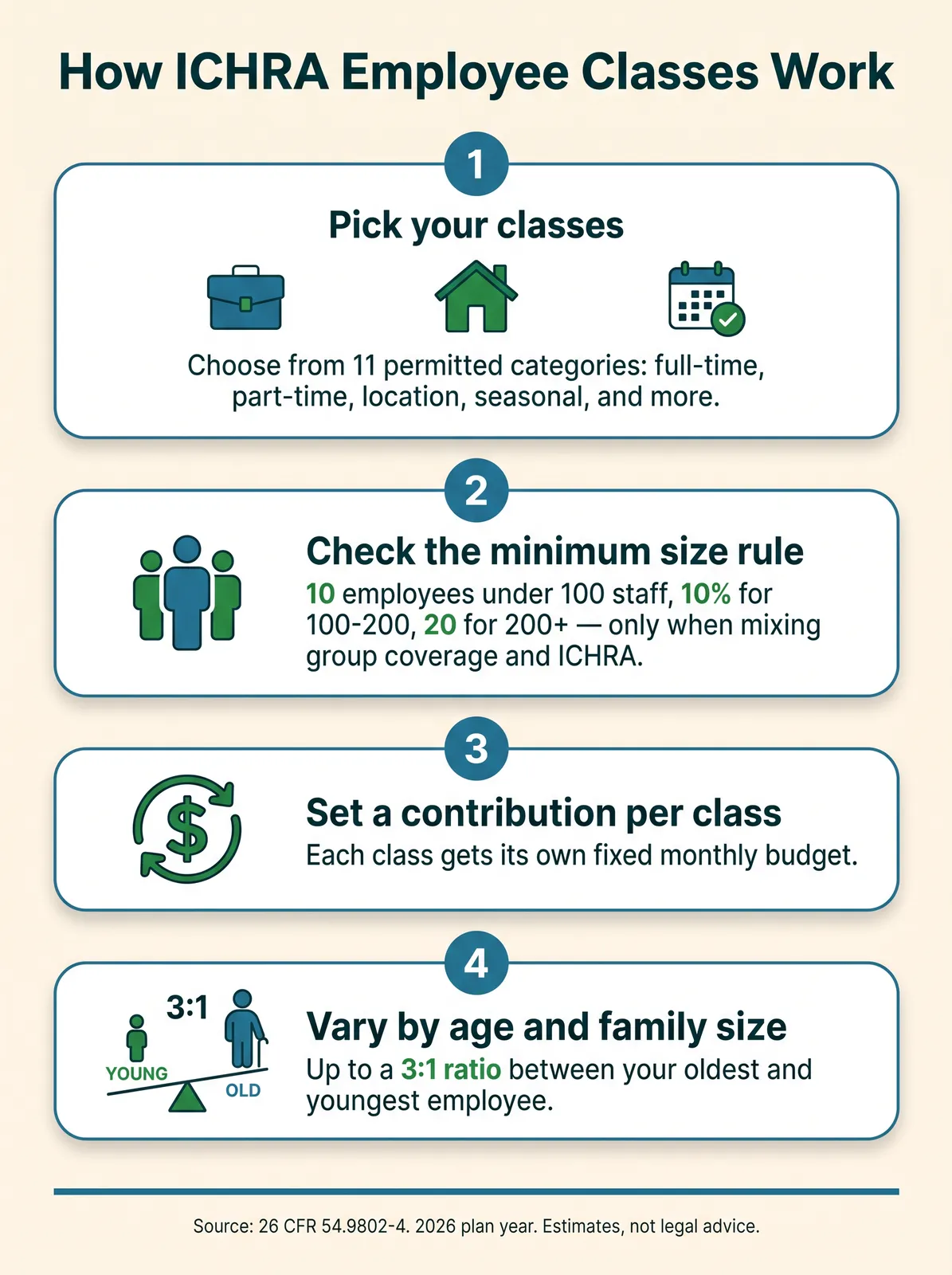
The ICHRA final rule allows exactly 11 ways to define a class of employees. Ten are distinct categories; the eleventh is any combination of the other ten, which is how most real-world classes actually get built — "full-time employees whose primary site of employment is in the Chicago rating area" is a combination of class (i) and class (v), for example, not a class of its own on the list.
| # | Class | What it means in practice |
|---|---|---|
| 1 | Full-time employees | Defined either by the employer's own policy or by the ACA section 4980H full-time standard — pick one definition and use it consistently. |
| 2 | Part-time employees | Everyone who is not full-time under whichever definition you chose above. |
| 3 | Salaried employees | Paid a fixed salary rather than by the hour, regardless of full- or part-time status. |
| 4 | Non-salaried employees | Hourly and other non-salaried pay structures. |
| 5 | Employees in the same insurance rating area | Grouped by their primary work site's ACA rating area — the geographic zone insurers use to price individual and small-group plans. A class can also be defined by a whole state or combination of states. |
| 6 | Seasonal employees | Defined at the employer's election — a harvest crew, holiday retail staff, or a ski-season team. |
| 7 | Employees covered by a collective bargaining agreement | One class per bargaining unit, tracking the union contract rather than the employer's own org chart. |
| 8 | Employees who have not satisfied a waiting period | New hires still inside the plan's eligibility waiting period, held in their own class until it ends. |
| 9 | Non-resident aliens with no US-based income | A narrow category for employees working entirely outside the US with no US-source income. |
| 10 | Employees of temporary staffing firms placed with a client | Staffing-agency workers placed at a work site, classed separately from the client's own direct employees. |
| 11 | Any combination of classes 1 through 10 | The class most employers actually build — e.g., "part-time, non-salaried employees in the Denver rating area." |
Two of these are worth a second look because they are the ones that solve the pain points employers most often bring to us. Class 5, the rating-area class, is the direct answer to a remote or multi-state workforce: instead of forcing a single national contribution amount, you can set a different reimbursement for employees based on where they actually live and work, which matters because individual-market benchmark premiums vary enormously by county. Class 8, the waiting-period class, solves a timing problem every growing employer runs into — it lets new hires sit in their own class with their own (often lower, or zero) contribution until they clear your standard eligibility waiting period, without that arrangement counting against you elsewhere.
What is not on this list
Job title, department, tenure beyond a waiting period, performance tier, and health status are not permitted class criteria. Neither is "family status" on its own — covered next, it is a variation you apply inside a class, not a class you can create by itself. If a criterion is not one of the 11 above, or a combination of them, it cannot define an ICHRA class.
The minimum class size rule
The minimum class size rule exists for one reason: to stop an employer from carving out a small, cherry-picked group of costly employees, shoving them onto the ICHRA, and keeping everyone healthier and cheaper on the traditional group plan. It is a real numeric threshold, but it is far narrower in scope than most employers assume.
It applies only when both of these are true at once, under 26 CFR 54.9802-4(d)(3)(ii): the employer offers a traditional group health plan to one or more classes of employees, and offers an ICHRA to one or more other classes, in the same plan year. An employer who offers only an ICHRA — to one class or to everyone — never triggers this rule at all, regardless of how small any individual class is. This single fact eliminates the concern for the large majority of small employers reading this, who are standing up an ICHRA precisely because they are not currently offering group coverage.
Where it does apply, the rule further narrows to five "applicable classes" that are the easiest ones to gerrymander around health risk: full-time, part-time, salaried, non-salaried, and same-rating-area employees (26 CFR 54.9802-4(d)(3)(ii)(C)). The remaining six classes — seasonal, collectively bargained, waiting-period, non-resident alien, staffing-firm, and any combination — are not subject to a numeric minimum at all.
| Employer size | Minimum class size |
|---|---|
| Fewer than 100 employees | 10 employees |
| 100 to 200 employees | 10% of the total workforce, rounded down to a whole number |
| More than 200 employees | 20 employees |
There is one more carve-out worth knowing, because it directly serves multi-state employers: the minimum-size rule does not apply to a same-rating-area class at all if the geographic area defining that class is an entire state, or a combination of two or more entire states (26 CFR 54.9802-4(d)(3)(ii)(C)(1)). Draw your remote-employee class around a specific rating area smaller than a state — a metro area, say — and the headcount minimum applies. Draw it around a whole state instead, and it does not, even if only three employees live there.
Worked example: a 45-employee company
A 45-employee company (fewer than 100, so the 10-employee minimum applies where the rule is triggered) wants to keep its 30 full-time office staff on the existing group plan and move its 15 part-time employees to an ICHRA. Fifteen is above the 10-employee minimum for the part-time class, so this split is allowed. If the part-time group were only 7 people, the same split would fail the minimum-size test — the employer would need to either grow that class, redefine it using a class that is not subject to the size rule (seasonal or waiting-period, for instance, if either genuinely fit), or offer the ICHRA to everyone instead of splitting by group plan versus ICHRA.
Varying the dollar amount by age and family size
Inside a single class, an ICHRA does not have to give every participant the exact same dollar amount. The rule at 26 CFR 54.9802-4(c)(3)(iii) allows two specific kinds of variation, and understanding the difference between them is where we see the most confusion, because outside sources routinely describe the second one incorrectly.
Family size. The maximum reimbursement available to a participant is allowed to increase as the number of their dependents covered under the HRA increases (26 CFR 54.9802-4(c)(3)(iii)(A)). A single employee and an employee covering a spouse and two kids can receive different contribution ceilings inside the identical class, without that difference counting as a violation of the "same terms" requirement that otherwise applies within a class.
Age, with a hard ratio cap. The maximum reimbursement is also allowed to increase with a participant's age, but only if the amount given to the oldest participant or participants is no more than three times the amount given to the youngest (26 CFR 54.9802-4(c)(3)(iii)(B)(2)). That 3:1 ceiling is written directly into the ICHRA rule itself. It is not, contrary to how a lot of secondary sources describe it, a cross-reference to the Affordable Care Act's separate 3:1 age-rating curve that insurers use to price individual and small-group premiums under 45 CFR 147.102. The two rules happen to land on the same ratio, three times, but they are legally independent requirements — an employer sets its own age brackets and dollar amounts for ICHRA contributions, it does not have to import an insurer's rating curve to do it.
| Age band | Monthly contribution | Ratio to youngest band |
|---|---|---|
| Under 30 | $300 | 1.0x |
| 30–44 | $450 | 1.5x |
| 45–59 | $650 | 2.2x |
| 60 and over | $900 | 3.0x (the maximum allowed) |
These figures are illustrative, chosen only to show a schedule that respects the 3:1 cap ($900 is exactly three times $300) — they are not a recommendation for what your own contribution amounts should be. What is real is the design logic: age-rated contributions exist because older employees typically face higher individual-market premiums for the same plan, and a flat dollar amount across every age would leave your oldest employees paying a much larger share of their own coverage than your youngest. A properly age-banded contribution keeps the employee's out-of-pocket share more consistent across the workforce, without breaching the ratio cap.
What a class cannot do
Two constraints sit on top of everything above, and both are easy to violate by accident rather than by intent.
First, a class has to be defined using only the permitted, objective criteria on the list of 11 — never a criterion tied to a health factor, and never simply an ad hoc grouping that does not map to one of those categories. "Employees who filed high claims last year" is not a class. Neither, on its own, is "employees over 55," even though age can vary the dollar amount inside a class — age is not itself one of the 11 class-defining categories.
Second, within a single class, you cannot offer some employees the ICHRA and others in that same class a traditional group plan, and let them choose. A class gets one benefit type. If you want part of your workforce on group coverage and part on an ICHRA, that split has to happen at the class-definition level — separate classes, each offered one benefit type consistently — not as an individual election inside one class.
Where employers actually get this wrong
- Treating "family status" as a class. It is a contribution variation inside a class, not a class-defining criterion on its own.
- Assuming the minimum-size rule always applies. It only triggers when you offer group coverage to one class and an ICHRA to another in the same plan year.
- Drawing a rating-area class narrower than a state without checking the headcount. The state-wide exception to the minimum-size rule does not extend to a metro-area class.
- Exceeding the 3:1 age ratio. It is measured oldest participant against youngest participant, not oldest bracket against an arbitrary baseline.
- Letting employees inside one class choose between the ICHRA and group coverage. The choice has to be made at the class level, not the individual level.
Classes for new hires, seasonal staff, and the ALE question
Two of the ten named classes deserve their own explanation, because they solve problems that have nothing to do with geography or pay structure and everything to do with the calendar.
The waiting-period class. Most employer health plans, ICHRA included, use an eligibility waiting period — commonly the first of the month after 60 or 90 days of employment — before a new hire can enroll. Class 8 lets you formally hold new hires who have not yet cleared that period in a class of their own, distinct from the continuing employees in whatever class they will eventually join. In practice this is less about giving new hires a different dollar amount and more about administrative clarity: it lets your ICHRA administrator track exactly who is and is not yet eligible without that distinction accidentally reading as a violation of the "same terms within a class" requirement that governs everyone who has cleared the waiting period.
The seasonal class. An employer defines "seasonal" for its own workforce — a landscaping company's spring-through-fall crew, a retailer's November-through-January hires, an accounting firm's tax-season temps. Because this class is not one of the five "applicable classes" subject to the numeric minimum-size rule, a seasonal class of any size is permitted even if the employer also splits full-time staff between group coverage and an ICHRA elsewhere in the same plan year. That combination — a protected, no-minimum seasonal class sitting alongside a regulated full-time split — is one of the more useful, underused structures in the whole rule.
One more thing classes do not change: your Applicable Large Employer (ALE) status. Whether you cross the 50-full-time-equivalent threshold that triggers the ACA employer mandate is a function of your total headcount across the entire company, counted the way the IRS counts full-time-equivalents — it has nothing to do with how many ICHRA classes you have or how you have drawn them. An employer with six classes and an employer with one both cross the ALE line at the identical FTE count. What classes do change, once you are an ALE, is which class each employee's ICHRA offer gets reported under on Form 1095-C. See our guide to the 50-employee rule for the full FTE counting method and what changes once you cross it.
A worked example: three classes, three counties
Put this together with one company. A 40-employee logistics firm has 22 full-time warehouse and office staff working out of a single site in Cook County, Illinois (metro Chicago), plus 18 remote account managers spread across North Carolina and Colorado. The employer wants three classes: a full-time Cook County class, a same-rating-area class for the North Carolina remote staff, and a same-rating-area class for the Colorado remote staff — each drawn state-wide, so none of them has to clear the minimum-size threshold under the state exception described above.
Because contribution amounts do not have to be identical across classes, the employer can also let each class's dollar amount track that county's own individual-market cost, using the site's 2026 qualifying-county dataset rather than a single national guess.
| Class / county | 2026 individual benchmark | 2026 small-group benchmark | Estimated monthly savings | Estimated % savings |
|---|---|---|---|---|
| Class 1: Cook County, IL (full-time, on-site) | $301.79 | $429.45 | $127.66 | 29.7% |
| Class 2: North Carolina remote (Forsyth County shown) | $344.50 | $449.61 | $105.11 | 23.4% |
| Class 3: Colorado remote (Mesa County shown) | $320.79 | $438.91 | $118.12 | 26.9% |
Estimated 2026 monthly savings by class/county, individual vs. small-group benchmark
Source: ICHRA Savings 2026 qualifying-county dataset. Estimates, not quotes.
Bar length shows the individual-market benchmark as a share of the small-group benchmark for that county; the shorter the bar, the larger the estimated savings.
None of these three counties is Minnehaha County, South Dakota, where ICHRA Savings is based — worth saying plainly, because the site's own 2026 dataset does not currently list a qualifying county in South Dakota at all. That is exactly the honest, county-by- county reality this dataset exists to show: the class structure above is legally available anywhere in the country, but whether it produces real savings depends entirely on where your specific classes' employees actually live, not on the state your company calls home.
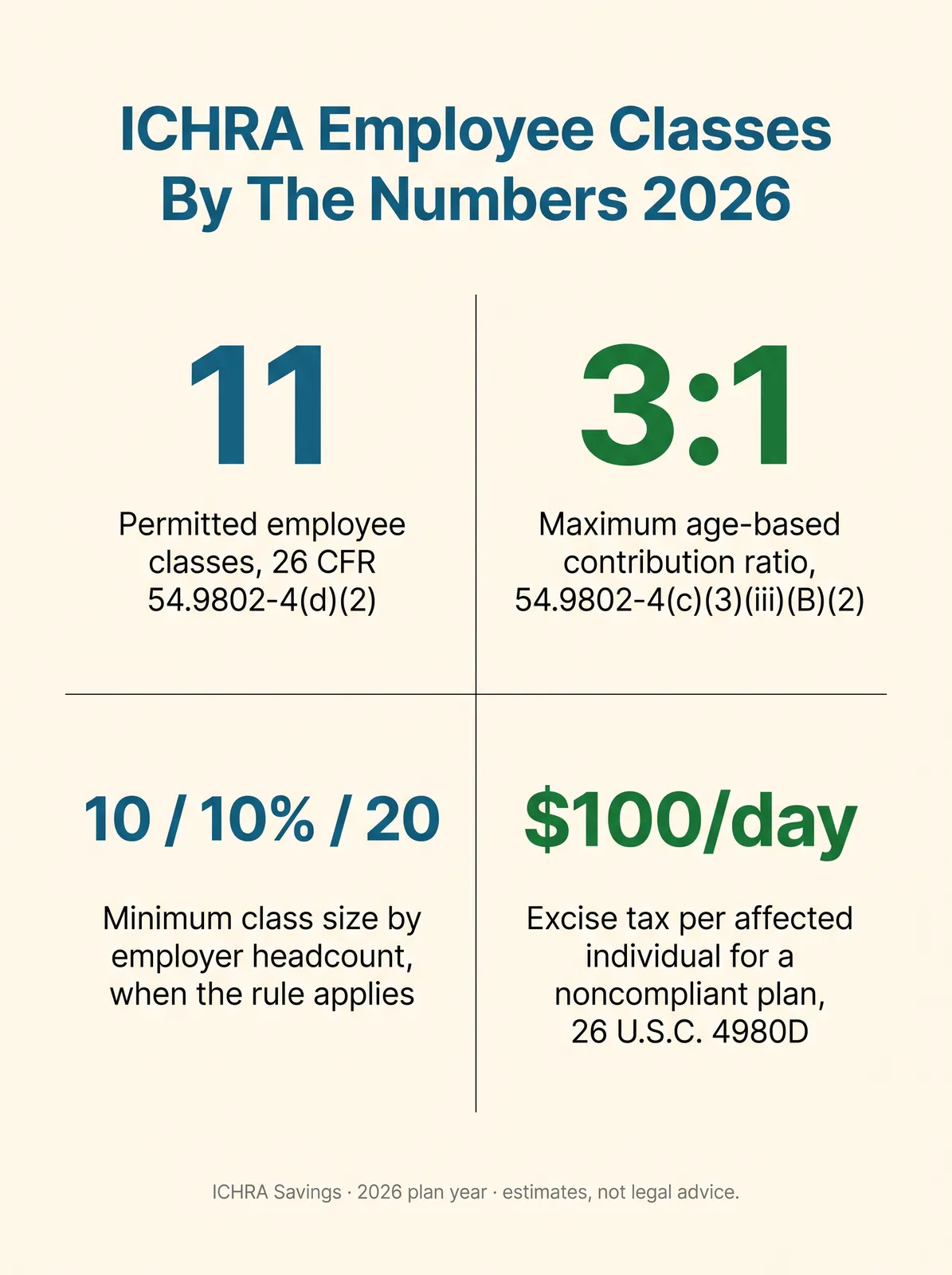
11
Permitted ICHRA employee classes
3:1
Maximum age-based contribution ratio
10
Minimum class size, employers under 100 people, when the rule applies
719
2026 counties where ICHRA estimates beat small group
Before spending time designing a multi-class structure, it is worth checking whether the underlying county math even supports it. Check your own counties on the savings map: https://ichrasavings.com/ichra-savings-map/.
Classes are a tool for matching a budget to a real workforce. They are not a way to make a single national number apply everywhere — that still comes down to the county.
Mike MooreWhat getting it wrong actually costs
An improperly structured ICHRA is not simply a paperwork problem to fix later. An HRA that fails to meet the requirements for an account-based group health plan — including the class and minimum-size rules above — can be treated as failing to meet the ACA's market reform requirements for group health plans generally. That failure carries a real federal excise tax under 26 U.S.C. 4980D: $100 per day, per affected individual, for each day the plan remains out of compliance, measured from the date the failure began to the date it is corrected. For a single-employer plan, a failure due to reasonable cause and not willful neglect can have its annual exposure capped at the lesser of 10 percent of the employer's prior-year group health plan expenditures or $500,000 — a real ceiling, but one that still starts from a number most small employers would rather avoid triggering in the first place.
The practical takeaway is not that class structures are dangerous to use. It is that the rules are specific enough, and different enough from ordinary intuition — family status is not a class, the minimum-size rule has a narrow trigger, the age ratio is a stand-alone cap — that a class structure belongs in front of a benefits attorney or a qualified advisor before your first plan year starts, not after an IRS notice arrives.
Where ICHRA Savings fits
ICHRA Savings is not a law firm or a third-party administrator, and nothing here substitutes for a benefits attorney reviewing your specific class structure. What we built is the piece that comes before that conversation: the county-level dataset that tells you whether an ICHRA estimate beats small-group coverage for each of your classes' actual locations, so you are designing classes around real numbers rather than a national average. Mike Moore, a licensed independent insurance agent, is available to walk through how a class structure like the one above would apply to your own workforce.
If you are still deciding between an ICHRA and renewing group coverage at all, our decision guide walks through that comparison end to end. For the notice and rollout sequence once your classes are set, see how to set up an ICHRA plan, and for the affordability math that interacts with whatever contribution you land on per class, see our guides to the 2026 FPL safe harbor and the 2027 affordability percentage.
More than 20,000 US businesses now offer an ICHRA or QSEHRA to at least 500,000 employees combined, and more than two-thirds of the small businesses among them previously offered no health coverage at all (HRA Council, Growth Trends for ICHRA & QSEHRA, Volume 5, August 12, 2026). Classes are part of why that adoption has scaled past uniform, single-plan employers: a structure that once only worked for a workforce that looked the same on paper now works for one that does not.
What this leaves you with
A complete, sourced list of the 11 permitted classes, the exact minimum-size numbers and when they actually apply, the difference between a class and a within-class variation (the mistake that trips up the most employers), and a real worked example using this year's county data instead of invented figures. None of this changes whether an ICHRA beats your current group renewal in the first place — that is still a county-by-county question, answered on the savings map, not by this article. What this article settles is the design question that comes right after: once you know ICHRA works for your numbers, here is exactly how far you can and cannot go in shaping the budget around how your workforce is actually built.
Questions employers actually ask
How many ICHRA classes can an employer use?
Up to 11 permitted classes, defined in the ICHRA final rule at 26 CFR 54.9802-4(d)(2): full-time, part-time, salaried, non-salaried, employees in the same insurance rating area, seasonal, collectively bargained, employees who have not satisfied a waiting period, non-resident aliens with no US-based income, temporary staffing-firm employees, and any combination of those ten. You do not have to use more than one class — a single employer-wide class is the most common setup for a small business with a uniform workforce.
Is "family status" one of the 11 ICHRA classes?
No, and this is the mix-up we see most often. Family status is not a class category at all. It is a permitted way to vary the dollar amount within a class you have already defined, alongside age, under 26 CFR 54.9802-4(c)(3)(iii)(A). You cannot create a stand-alone class of "employees with dependents." You can let the reimbursement amount inside your one class grow as an employee covers more dependents.
Does the minimum class size rule apply if we only offer an ICHRA and nothing else?
No. The rule in 26 CFR 54.9802-4(d)(3)(ii) only turns on when an employer offers a traditional group health plan to one or more classes and an ICHRA to one or more other classes, in the same plan year. An employer who offers only an ICHRA, to some classes or to everyone, never has to clear a minimum headcount for any class.
What is the actual minimum class size number?
When the rule applies, the threshold is 10 employees for an employer with fewer than 100 employees, 10 percent of the total workforce (rounded down) for an employer with 100 to 200 employees, and 20 employees for an employer with more than 200 employees (26 CFR 54.9802-4(d)(3)(iii)(A)). It applies only to the five "applicable classes" that are easiest to gerrymander around health status: full-time, part-time, salaried, non-salaried, and same-rating-area employees.
Can we give older employees a bigger ICHRA contribution than younger ones?
Yes, within a class, as long as the amount given to your oldest participant or participants is no more than three times the amount given to your youngest, per 26 CFR 54.9802-4(c)(3)(iii)(B)(2). That 3:1 ceiling is a stand-alone cap written directly into the ICHRA rule. It is not a cross-reference to the ACA's own 3:1 age-rating curve for insurance premiums, even though the ratio happens to match — the two are separate legal requirements that arrive at the same number.
Can an employer design classes just to push its sicker or older employees onto the ICHRA?
No. Beyond the numeric minimum-size rule, the ICHRA regulations require that a class be defined using only the permitted, objective criteria listed in the rule, not any criteria related to a health factor. An employer cannot draw a class boundary around "employees who filed high claims last year" or otherwise design its classes to steer costlier individuals toward the ICHRA and healthier ones toward the group plan.
Do different classes have different affordability tests?
Each employee's affordability determination is individual, based on their own required contribution and the lowest-cost silver plan available in their own rating area, but where you have drawn your class lines has a real effect: two classes in two different counties can see very different affordability outcomes from the identical dollar contribution, simply because local benchmark premiums differ. See our guides to the 2026 FPL safe harbor and the 2027 affordability percentage for the underlying math.
What happens if we improperly structure our ICHRA classes?
An ICHRA that fails the class and minimum-size rules can be treated as failing to meet the requirements for an account-based group health plan, which exposes the employer to the same excise tax that applies to other group health plan failures under 26 U.S.C. 4980D: $100 per day per affected individual, with relief available for a failure due to reasonable cause. This is a legal and tax exposure, not a hypothetical — get your class structure reviewed by a benefits attorney or a qualified advisor before your first plan year begins.