ICHRA Compliance: The 2026 Deadlines Employers Miss
An ICHRA means five federal deadlines across the IRS, DOL, and CMS. See the 2026 dates, penalties, and exemptions, every figure sourced this year.

The short version
- An ICHRA touches at least four separate compliance regimes at once: IRS tax reporting, ERISA plan reporting, an IRS excise tax, and a CMS Medicare disclosure.
- Most ICHRAs under 100 participants that are unfunded or fully insured are exempt from Form 5500 entirely — a fact many employers never check.
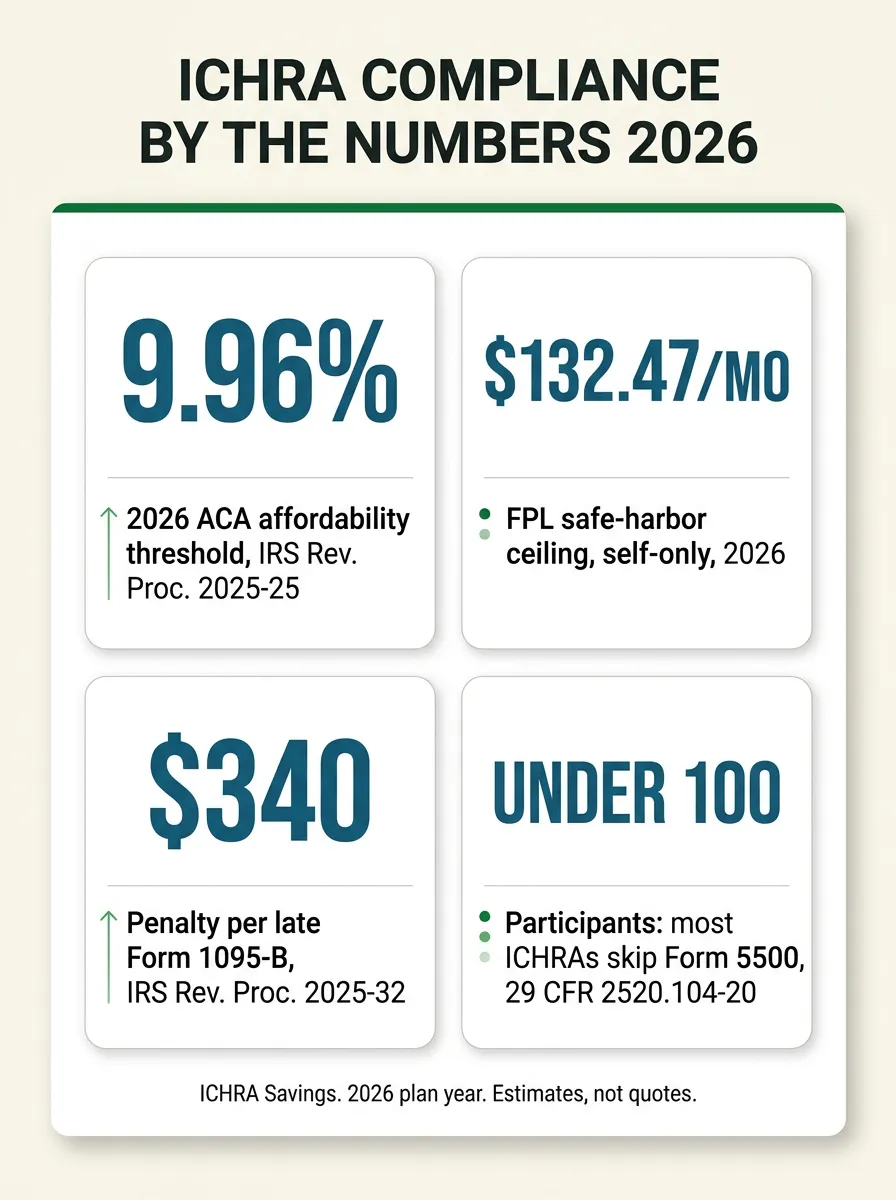
- The 2026 FPL safe-harbor ceiling for self-only affordability works out to $132.47 a month, calculated from two federal numbers published this year.
- The per-form penalty for a late or wrong 1095-B is $340, dropping to $60 if you catch it within 30 days.
- None of this is a reason to skip an ICHRA. It is a reason to put five real dates on a calendar before your first plan year starts.
You set up the ICHRA. The notice went out, employees enrolled in their own individual plans, and the first reimbursements cleared without drama. Then, months later, someone on your team — a bookkeeper, a broker, or the IRS itself — asks about a form you have never heard of. Was a 1095-B filed? Did anyone pay the PCORI fee? Does this thing need a Form 5500?
Here is the direct answer: an Individual Coverage Health Reimbursement Arrangement (ICHRA), the IRS-defined arrangement that lets you set a fixed monthly budget and let employees buy their own individual health plan, is not a single compliance event. Standing one up is only the beginning. Running one correctly means five separate deadlines spread across the IRS, the Department of Labor, and the Centers for Medicare & Medicaid Services (CMS), and missing the wrong one carries a real, sourced dollar cost. This piece lays out every one of those deadlines for the 2026 plan year, where each number comes from, and which of them you can skip because your plan is small enough to be exempt.
Why one plan touches four agencies
None of this was designed as a single ICHRA compliance package. Each requirement existed before ICHRA did, aimed at employer health plans generally, and an ICHRA simply counts as one. Once you understand which bucket each obligation falls into, the list stops feeling random.
Tax reporting (IRS, under Internal Revenue Code section 6055). Because an ICHRA is minimum essential coverage, the employer sponsoring it has to report who was covered and for which months, the same way a self-insured group plan would. For an employer that is not an Applicable Large Employer (ALE) — broadly, fewer than 50 full-time-equivalent employees — that reporting happens on Form 1094-B (the transmittal) and Form 1095-B (one per covered individual). ALEs generally use Form 1095-C instead, as part of their existing employer-mandate reporting; see our guide to the 50-employee rule for how that separate obligation works.
Plan reporting (Department of Labor, under ERISA). Most employer-sponsored health plans, ICHRA included, are technically ERISA welfare benefit plans, and ERISA plans generally file an annual Form 5500. There is a widely applicable exemption for small plans, which we cover in detail below, and it is the single most common thing small employers get wrong — in both directions. Some file a return they never needed to file; more often, employers assume they are exempt without actually checking the two conditions the exemption requires.
An excise tax (IRS, under the Patient-Centered Outcomes Research Institute program). The PCORI fee is a small annual tax on self-insured health plans that predates the ICHRA rule by nearly a decade. An ICHRA counts as a self-insured plan for this purpose, so it owes the fee every year, regardless of headcount. It is paid using Form 720, the same excise-tax return used for dozens of unrelated federal taxes, which is part of why employers miss it — nothing about the form name says "health plan."
A Medicare disclosure (CMS). If your ICHRA could reimburse prescription drug costs for anyone who is Medicare-eligible — an older employee, a retiree, a Medicare-eligible dependent — federal law requires you to tell CMS whether your plan's drug coverage counts as "creditable" against Medicare Part D, and to tell those individuals directly. This has nothing to do with ICHRA specifically; it applies to essentially any employer plan that touches drug costs for a Medicare-eligible person.
Add the notice the ICHRA final rule itself requires — a written explanation to every eligible employee, generally at least 90 days before the plan year begins — and you have five distinct clocks running at once, set by three different regulators, none of whom coordinate their calendars with each other or with you.
It helps to compare this against the arrangement people most often confuse an ICHRA with: a QSEHRA, or qualified small employer HRA, which is a narrower option limited to employers with fewer than 50 employees who offer no group plan at all, and which carries its own annual reimbursement cap set by the IRS. The two share some DNA — both reimburse individual coverage tax-free — but QSEHRA's compliance list is shorter because it was built, from the start, as a small-business product with a single set of rules. ICHRA was built as a general-purpose tool available to employers of any size, which is exactly why it inherited the full set of obligations that already applied to larger, more complex health plans. You get more flexibility — no cap on the contribution, no upper employee-count limit — in exchange for the same reporting stack a group plan would carry.
The ALE determination matters here too, because it decides which tax-reporting track you are on. An employer counts as an Applicable Large Employer for a given year if it averaged 50 or more full-time-equivalent employees during the prior calendar year, counting full-time employees plus the combined hours of part-time employees converted to full-time-equivalents. ALEs report ICHRA offers on Form 1095-C as part of their existing employer-mandate filing; everyone else uses the simpler Form 1094-B/1095-B pair described below. Getting this classification wrong means filing the wrong form entirely, not just filing late — see our guide to the 50-employee rule for the full FTE counting method and the separate mandate penalties that attach to it.
Terms used in this piece
Plan year is the 12-month period your ICHRA runs on, usually but not always the calendar year. Participant means an enrolled employee, not a dependent. Creditable coverage means drug coverage that is, on average, at least as good as Medicare Part D's standard benefit. Required contribution percentage is the IRS's annual measure of what counts as "affordable" employer coverage relative to income.
What a missed deadline actually costs
Take a plain 12-employee ICHRA as an example. The PCORI fee itself is close to nothing: 12 covered lives at the current $3.84-per-life rate (IRS Notice 2025-61) comes to about $46 a year. The risk was never the size of the fee. It is that Form 720 is easy to forget exists, and the penalties attached to the paperwork around an ICHRA are not sized like $46.
If that same employer skips Form 1095-B for all 12 employees, the per-return penalty under IRC 6721 and 6722, for returns required to be filed in 2027, is $340 — a maximum of $4,080 for a stack of forms that takes an afternoon to prepare correctly the first time (IRS Rev. Proc. 2025-32). Catch the error and correct it within 30 days and the same 12 forms cost $720 instead. Correct them by August 1 of that filing year and it is $1,560. The gap between "we caught this fast" and "we never filed it" is the whole point of the tiered penalty structure.
What 12 missed Forms 1095-B cost, by how fast you fix it
Per-return penalty under IRC 6721/6722, for returns required to be filed in 2027, times 12 forms. Source: IRS Rev. Proc. 2025-32.
Illustrative arithmetic for a 12-employee plan using sourced IRS penalty tiers. Not a prediction of any actual assessment.
Form 5500, when it applies, is a different order of magnitude. The IRS penalty for failing to file it under IRC 6058 is $250 per day, capped at $150,000 (IRS Form 5500 Corner). A plan that is 30 days late is already looking at a potential $7,500 exposure before anyone has done anything except be late. That is precisely why the small-plan exemption, covered next, matters more than any other single fact in this article for a business under 100 employees.
There is one more cost worth naming, and it is not a penalty at all: the affordability miscalculation. If you set a reimbursement amount using last year's federal poverty line or last year's required contribution percentage instead of the 2026 figures, you can accidentally make your ICHRA "unaffordable" under the test you meant to pass, or "affordable" when you meant to leave room for employees to keep a premium tax credit. Neither mistake carries a fixed dollar penalty on its own, but both change what your employees are legally entitled to do, which is harder to unwind after the fact than a late form. The worked math further down this page uses the actual 2026 numbers so you are not extrapolating from a prior year by habit.
Your 2026 ICHRA compliance calendar
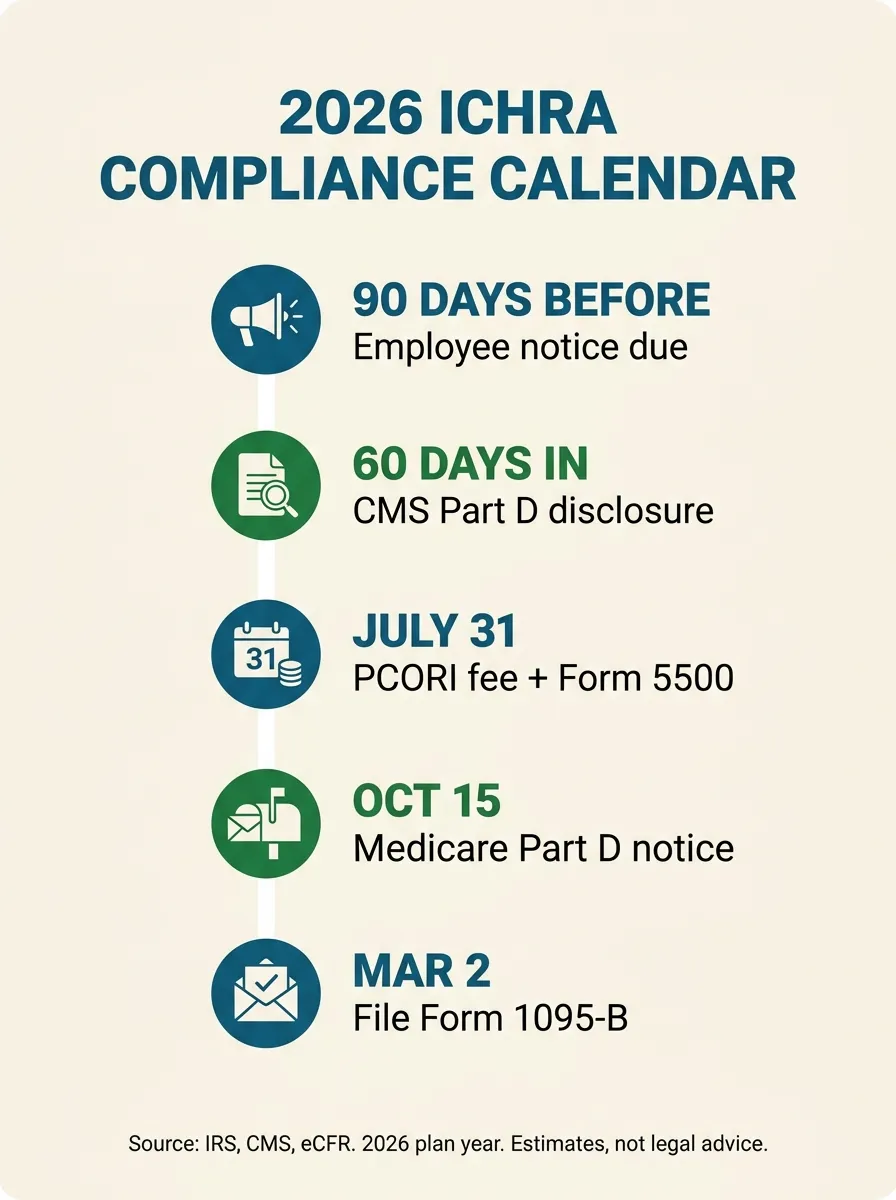
Here is the full calendar for a calendar-year ICHRA plan (January 1 to December 31), with every date sourced to the agency that set it. If your plan year runs on a different 12-month cycle, most of these dates shift with it — the notice, PCORI, and Form 5500 dates are all defined relative to your plan year, not the calendar year.
| When | What is due | Who it applies to | Source |
|---|---|---|---|
| 90 days before the plan year starts | Written employee notice explaining the ICHRA and the premium tax credit trade-off | Every employer offering an ICHRA | CMS Individual Coverage HRA Model Notice; 26 CFR 54.9802-4(c)(6)(i) |
| Within 60 days of the plan year start | Online creditable-coverage disclosure to CMS | Plans that could reimburse Medicare-eligible individuals' drug costs | CMS.gov, Creditable Coverage guidance |
| July 31 | PCORI fee, via second-quarter Form 720 | Every ICHRA, any size | IRS, PCORI fee Q&A; IRS Notice 2025-61 |
| July 31 (calendar-year plan) | Form 5500, unless the small-plan exemption applies | ERISA welfare plans not covered by 29 CFR 2520.104-20 | IRS Form 5500 Corner |
| October 15 | Medicare Part D creditable-coverage notice to individuals | Plans that could reimburse Medicare-eligible individuals' drug costs | CMS.gov, Creditable Coverage guidance |
| March 2, 2026 | Furnish Form 1095-B to covered individuals; file paper Forms 1094-B/1095-B with the IRS | Non-ALE employers, for 2025 coverage | IRS Instructions for Forms 1094-B and 1095-B (2025) |
| March 31, 2026 | File Forms 1094-B/1095-B electronically with the IRS | Non-ALE employers, for 2025 coverage | IRS Instructions for Forms 1094-B and 1095-B (2025) |
Put five dates on a real calendar, once
Every one of these dates is knowable months in advance. The employers who get tripped up are not the ones facing a genuinely ambiguous rule — they are the ones who never wrote the dates down anywhere. This table is meant to be copied into whatever calendar your business already uses.
Do you even have to file Form 5500?
For most small employers running an ICHRA, the honest answer is no. Under 29 CFR 2520.104-20, a welfare benefit plan is exempt from the Form 5500 annual report requirement if it meets two conditions at once, measured at the start of the plan year:
- Fewer than 100 participants. Count enrolled employees, not dependents, and count as of the first day of the plan year — the exemption still applies even if enrollment grows past 100 later in the same year.
- Unfunded, fully insured, or a combination of the two. An ICHRA that simply reimburses employees from the company's general assets, with no separate trust holding plan funds, is unfunded in the sense this rule means. Running reimbursements through a trust changes the analysis.
Meet both conditions and the administrator is not required to file an annual report with the Department of Labor, and is not required to furnish participants with the kind of asset-and-liability statement a Form 5500 would otherwise require (29 CFR 2520.104-20). Cross either line — 100 or more participants, or a funded arrangement — and the ordinary Form 5500 deadline applies: the last day of the seventh month after the plan year ends, July 31 for a calendar-year plan, with an extension available on Form 5558 (IRS Form 5500 Corner).
This is worth checking in writing, not assuming from memory. A workforce that sits at 94 employees in January and hires eight more contractors-turned-employees by June has not lost the exemption for that plan year — the test is a snapshot at the start, not a running count. Get that wrong in either direction and you either file a return nobody required, or skip one that was actually due.
Who actually has to worry about the Medicare Part D disclosure
This is the deadline small employers dismiss fastest, usually because "Medicare" sounds like someone else's problem. It is not automatically someone else's problem. The trigger is not your company's size or industry — it is whether your ICHRA could reimburse prescription drug costs for anyone who is Medicare-eligible, and that group is broader than most owners assume. It includes any employee 65 or older who has not enrolled in Medicare, any Medicare-eligible spouse or dependent covered by the plan, and any Medicare-eligible retiree or COBRA participant your ICHRA still reaches.
If that group is not empty, two disclosures apply, both sourced to CMS's own creditable coverage guidance. First, a written notice to those individuals, generally due before October 15 each year, telling them whether your plan's drug coverage counts as "creditable" — roughly as good as, or better than, Medicare Part D's standard benefit. Second, a separate online disclosure to CMS itself, due within 60 days of the start of each plan year, or within 30 days of a plan termination or a change in creditable-coverage status. Neither disclosure asks you to guess; CMS provides the online form and the criteria for creditability directly.
If your entire workforce is genuinely under 65 with no Medicare-eligible dependents on the plan, this section does not apply to you this year — but it is worth rechecking annually, not assuming permanently, since workforces age and eligibility changes one birthday at a time.
Update, published April 6, 2026: CMS finalized a rule (Federal Register document 2026-06600) exempting HRAs and ICHRAs from both of these creditable-coverage disclosures — but only for plan years beginning on or after January 1, 2027. If your plan year started in 2026, the October 15 notice and the 60-day CMS disclosure above still apply to you through the end of that plan year. We cover the mechanics of this change, and how an ICHRA integrates with Medicare more broadly, in a dedicated article: ICHRA and Medicare: what changes for 2027.
What changes once the calendar is written down
The difference between an employer who handles this smoothly and one who gets a penalty notice is rarely knowledge of the underlying law. It is almost always whether the dates exist anywhere outside one person's memory.
Compliance lives in someone's head
- Deadlines get remembered when a form shows up, not before
- Nobody has checked whether the Form 5500 exemption actually applies
- Affordability was set once, at launch, and never rechecked against the current year's numbers
- The PCORI fee gets discovered by accident, usually late
- One person leaving the company means the whole calendar leaves with them
Compliance lives on a shared calendar
- Five dates, sourced once, sit on the same calendar as payroll and renewals
- The 100-participant, unfunded-or-insured test gets checked every plan year, in writing
- Affordability gets recalculated against the current year's FPL and required contribution percentage
- Form 720 is a ten-minute task because someone already knows it is coming
- The process survives staff turnover, because it was never only in one person's head
The FPL safe harbor, worked out for 2026
Affordability is a separate question from whether you have to file anything, but it decides something that matters just as much: whether your employees keep the right to claim a premium tax credit if they decline your ICHRA. Taking an ICHRA that is considered affordable generally means an employee waives that credit for the months they are covered — so getting the affordability math right protects them, not just you.
One of three IRS safe harbors employers can use is the federal poverty line (FPL) safe harbor, which swaps a household-income calculation you cannot verify for a flat national number you can. Here is the full 2026 calculation, both inputs sourced this year:
| Input | 2026 value | Source |
|---|---|---|
| Federal poverty guideline, 1-person household (48 states + DC) | $15,960 / year | HHS, Federal Register notice 2026-00755 |
| Required contribution percentage | 9.96% | IRS Rev. Proc. 2025-25 |
| Maximum "affordable" employee cost, self-only, per month | $132.47 | Calculated: $15,960 × 9.96% ÷ 12 |
To use this safe harbor, compare $132.47 against what an employee would actually pay out of pocket for the lowest-cost silver plan available to them, after your ICHRA contribution. Two illustrative examples, using a made-up $500-a-month benchmark premium so the arithmetic is easy to follow — your own county's real benchmark will differ, and belongs on the savings map, not guessed here:
- Employer sets a $400/month contribution against a $500/month benchmark. Employee share: $100/month. That is under $132.47, so the ICHRA is affordable under this safe harbor.
- Employer sets a $250/month contribution against the same $500/month benchmark. Employee share: $250/month. That is over $132.47, so the ICHRA is not affordable under this safe harbor for that employee.
Neither example is a guarantee of your own outcome. Age, family size, and your actual county's benchmark premium all move the real number, and this is general education, not individualized tax advice — confirm your specific calculation with a qualified tax advisor before you finalize contribution amounts.
The FPL safe harbor is one of three the IRS allows; it is simply the easiest to calculate without seeing anyone's pay stub. The other two — the W-2 wages safe harbor, based on a percentage of an employee's actual prior-year W-2 Box 1 wages, and the rate-of-pay safe harbor, based on hourly rate or monthly salary at the start of the year — can produce a higher affordable-contribution ceiling for lower-earning employees than the flat FPL number does, because they scale to the individual instead of a single national figure. Which safe harbor fits best depends on your actual payroll, which is exactly the kind of calculation to run with a tax advisor rather than estimate from a blog post.
Where employers actually trip on this calendar
- Assuming the Form 5500 exemption without checking it. "We're small" is not the test; unfunded-or-insured and under 100 participants, measured at the start of the plan year, is.
- Using last year's FPL or required contribution percentage. Both are republished annually, and both changed for 2026.
- Treating the PCORI fee as optional because the dollar amount is small. The fee is trivial; the missed Form 720 filing is the actual issue.
- Skipping the Part D disclosure because "we're not a Medicare company." The trigger is a single Medicare-eligible person on the plan, not your industry.
- Sending the employee notice late. The 90-day window is measured backward from the plan year start, not forward from when you remembered.
5
Separate deadlines across the plan year
$132.47
2026 FPL safe-harbor ceiling, self-only, per month
$340
Per-return penalty for a late 1095-B, 2027 filings
100
Participant threshold for the Form 5500 exemption
Before anything else, it is worth checking whether your county is even one where an ICHRA beats small-group coverage in the first place — the compliance calendar above applies either way, but it is only worth carrying if the underlying math works for your workforce. Check your county on the savings map: https://ichrasavings.com/ichra-savings-map/.
A full plan year, worked through: an 18-employee company
Put the whole calendar together with one running example. A company with 18 employees launches a calendar-year ICHRA for January 1, 2026, unfunded, reimbursing straight from general assets, with no plans to bring on more than a handful of additional hires this year.
By October 3, 2025 (90 days before January 1), the written employee notice goes out to all 18 eligible employees, using the CMS model notice as the base and filling in the plan's actual contribution amounts and start date. Sometime before March 1, 2026 (within 60 days of the plan year start), someone checks whether any of the 18 employees or their covered dependents are Medicare-eligible; suppose one employee, a 67-year-old part-time controller, is. The plan sends CMS the online creditable-coverage disclosure for that reason alone — the other 17 employees do not change the answer.
Through the spring, whoever runs payroll checks the participant count at the start of the plan year: 18, well under 100, and the plan is unfunded, so the Form 5500 exemption under 29 CFR 2520.104-20 applies. No Form 5500 gets filed, and that decision gets written down, with the date it was checked, in case anyone asks later. By July 31, 2026, the PCORI fee is paid on a second-quarter Form 720: 18 covered lives at $3.84 each, a little over $69 for the year, filed alongside a note for next year's rate, since the per-life amount is republished annually. Before October 15, 2026, the Medicare Part D notice goes out to the one Medicare-eligible employee identified back in March.
Then, by March 2, 2027, the company furnishes each of the 18 employees a Form 1095-B for their 2026 coverage and files Forms 1094-B and 1095-B with the IRS — on paper by that date, or electronically by March 31, 2027, since 18 forms is well within the range most small employers file on paper without issue. Total forms filed across the year: one notice, one CMS disclosure, one excise-tax return, one Part D notice, and 18 information returns. Total Form 5500s filed: zero, correctly. That is the entire compliance footprint of a small, well-run ICHRA — five categories of task, most of them small, none of them mysterious once the dates are known in advance.
None of these five deadlines is hard on its own. What sinks employers is not knowing there are five.
Mike MooreWhere ICHRA Savings fits
ICHRA Savings is not a third-party administrator, and this article is not a substitute for one — the actual filing of Form 5500, Form 720, or your 1095-Bs should sit with your payroll provider, benefits administrator, or accountant, whoever already handles your federal filings. What we built is the piece that comes before any of that: the county-level dataset showing where an ICHRA estimate genuinely beats small-group coverage, so you know whether taking on this compliance calendar is worth it before you commit to it. We also help with the design side — class structure, contribution levels, and the affordability approach — and Mike Moore, a licensed independent insurance agent, is available to talk through a specific rollout.
If you want to see the mechanics before you talk to anyone, start here: https://ichrasavings.com/how-ichra-works/. And if you are still deciding between an ICHRA and renewing your current group plan, our decision guide walks through that comparison end to end. For the setup sequence itself — plan design, the 90-day notice, and open enrollment — see how to set up an ICHRA plan.
Worth saying plainly: a fixed monthly ICHRA budget does not eliminate the tradeoffs, it relocates them. You give up curating a single group plan and take on this reporting calendar instead. For a workforce spread across counties where the underlying rate spread favors an ICHRA, most employers still find that trade worthwhile once the calendar is written down and handled once a year rather than relearned from scratch. For a workforce in a county where small group is still the cheaper option, the honest answer is that taking on this compliance load is not worth it, and the county map will tell you that in about ten seconds rather than after you have already built the calendar.
What this leaves you with
A source-linked compliance calendar you can hand to whoever runs your payroll or benefits administration, the FPL math worked out so you are not guessing at affordability, and clarity on the single fact that changes the picture most for a small employer: if you are under 100 participants and your ICHRA is unfunded or insured, Form 5500 is not on your list at all. The three that remain for almost everyone — the 90-day notice, the PCORI fee, and Form 1095-B — are each a modest, well-defined task once you know they exist.
None of this changes whether an ICHRA is the right call for your business. That question still comes down to a county-level rate comparison and how your workforce is spread across counties, which is a separate calculation from the one this article covers. What this article settles is the operational side: once you decide an ICHRA works for your numbers, here is exactly what running it correctly requires, with every date and dollar figure checked against a primary source this year rather than carried over from memory.
Questions employers actually ask
Does every employer with an ICHRA have to file Form 5500?
No. A welfare benefit plan, including an ICHRA, that covers fewer than 100 participants at the start of the plan year and is unfunded, fully insured, or a combination of the two is exempt from the Form 5500 annual report requirement under 29 CFR 2520.104-20. Most small-employer ICHRAs qualify. If you cross 100 participants, or the plan is funded through a trust, the exemption does not apply.
What is the PCORI fee, and does an ICHRA owe it?
The Patient-Centered Outcomes Research Institute fee is an annual excise tax on self-insured health plans, including HRAs. For plan years ending between October 1, 2025 and September 30, 2026, the rate is $3.84 per covered life (IRS Notice 2025-61). It is reported and paid with a second-quarter Form 720, due July 31 each year, regardless of your plan’s size.
When is the 2026 Form 1095-B deadline for an ICHRA?
For coverage provided in 2025, employers must furnish Form 1095-B to covered individuals by March 2, 2026, and file Forms 1094-B and 1095-B with the IRS by March 2, 2026 on paper or March 31, 2026 electronically (IRS Instructions for Forms 1094-B and 1095-B). An automatic 30-day filing extension is available on Form 8809.
What happens if we file a 1095-B late or with an error?
For returns required to be filed in 2027, the general per-return penalty under IRC 6721/6722 is $340, dropping to $60 if corrected within 30 days or $130 if corrected by August 1 of that year (IRS Rev. Proc. 2025-32). Form 5500, when required, carries a separate $250-per-day penalty capped at $150,000 under IRC 6058.
How do we calculate the 2026 FPL safe harbor for ICHRA affordability?
Multiply the 2026 federal poverty guideline for a one-person household, $15,960 (HHS, Federal Register notice 2026-00755), by the 2026 required contribution percentage, 9.96% (IRS Rev. Proc. 2025-25), then divide by 12. That comes to $132.47 a month — the most an employee can be asked to pay for the lowest-cost silver plan in their county before the ICHRA is considered unaffordable under this safe harbor.
Do we need to tell CMS about Medicare Part D coverage?
If your ICHRA could reimburse prescription drug costs for anyone Medicare-eligible, two separate disclosures apply: a written notice to those individuals before October 15 each year, and an online disclosure to CMS within 60 days of the start of each plan year, or within 30 days of a plan termination or status change (CMS.gov, Creditable Coverage guidance).
Does an Applicable Large Employer file the same forms as a small employer?
No. Employers with 50 or more full-time-equivalent employees generally report ICHRA offers on Form 1095-C instead of 1095-B, as part of their employer-mandate reporting. See our guide to the 50-employee rule for how that mandate and its own deadlines work.