ICHRA and the ACA Mandate: The 50-Employee Rule
Cross 50 full-time employees and the ACA employer mandate applies. See the 2026 IRS penalty math, the FTE count rule, and how ICHRA meets it at any headcount.
The short version
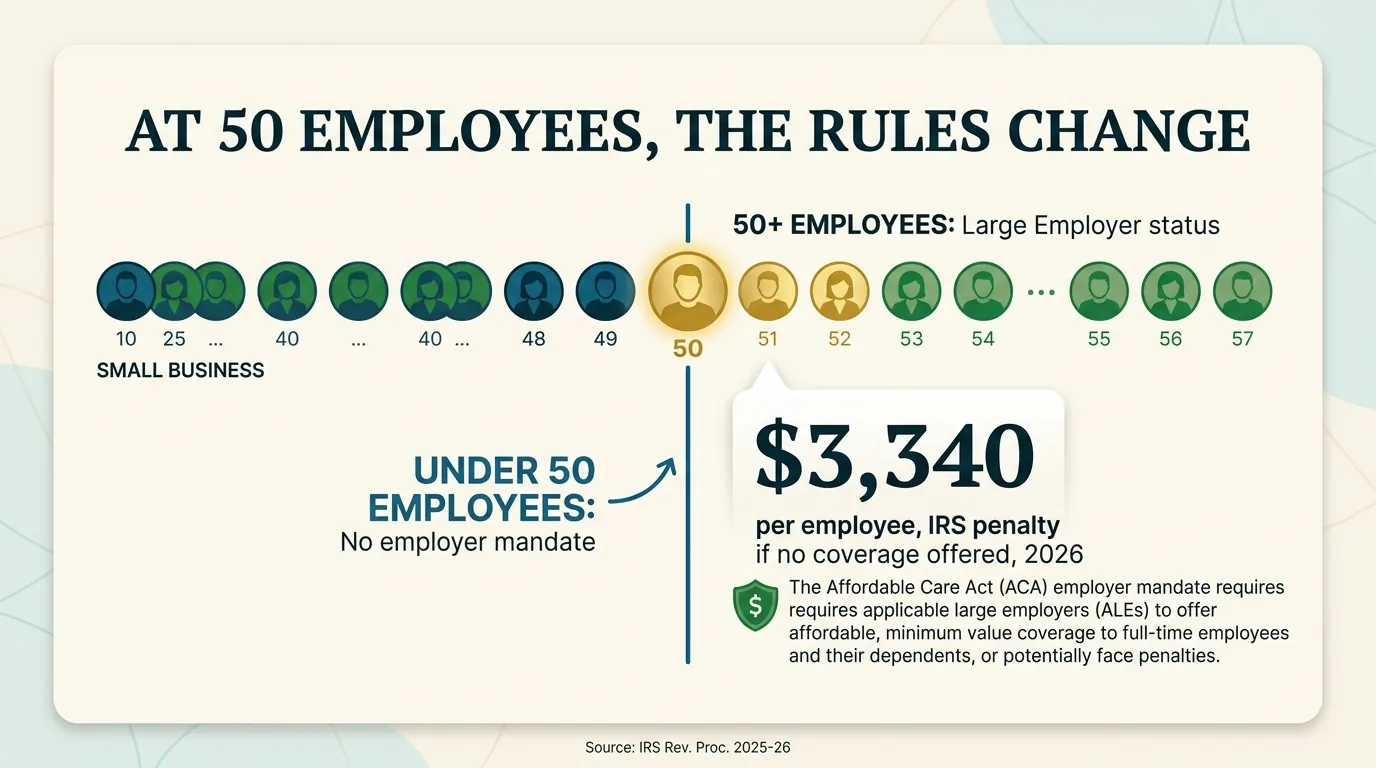
- Once a business averages 50 or more full-time and full-time-equivalent employees over a calendar year, it becomes an Applicable Large Employer (ALE) under IRS rules, and the ACA employer mandate applies the next year, whether or not the owner has thought about it.
- Offer no coverage as an ALE and one full-time employee gets a marketplace subsidy, and the IRS charges $3,340 per full-time employee (minus the first 30) for the 2026 plan year, per Revenue Procedure 2025-26. A 53-employee company: $76,820 a year.
- Offer coverage that is not affordable under the 9.96% test, and the penalty is smaller per person, $5,010 for 2026, but still applies employee by employee.
- Crossing 50 also ends QSEHRA eligibility outright; that HRA type is capped at businesses under 50 full-time employees by statute.
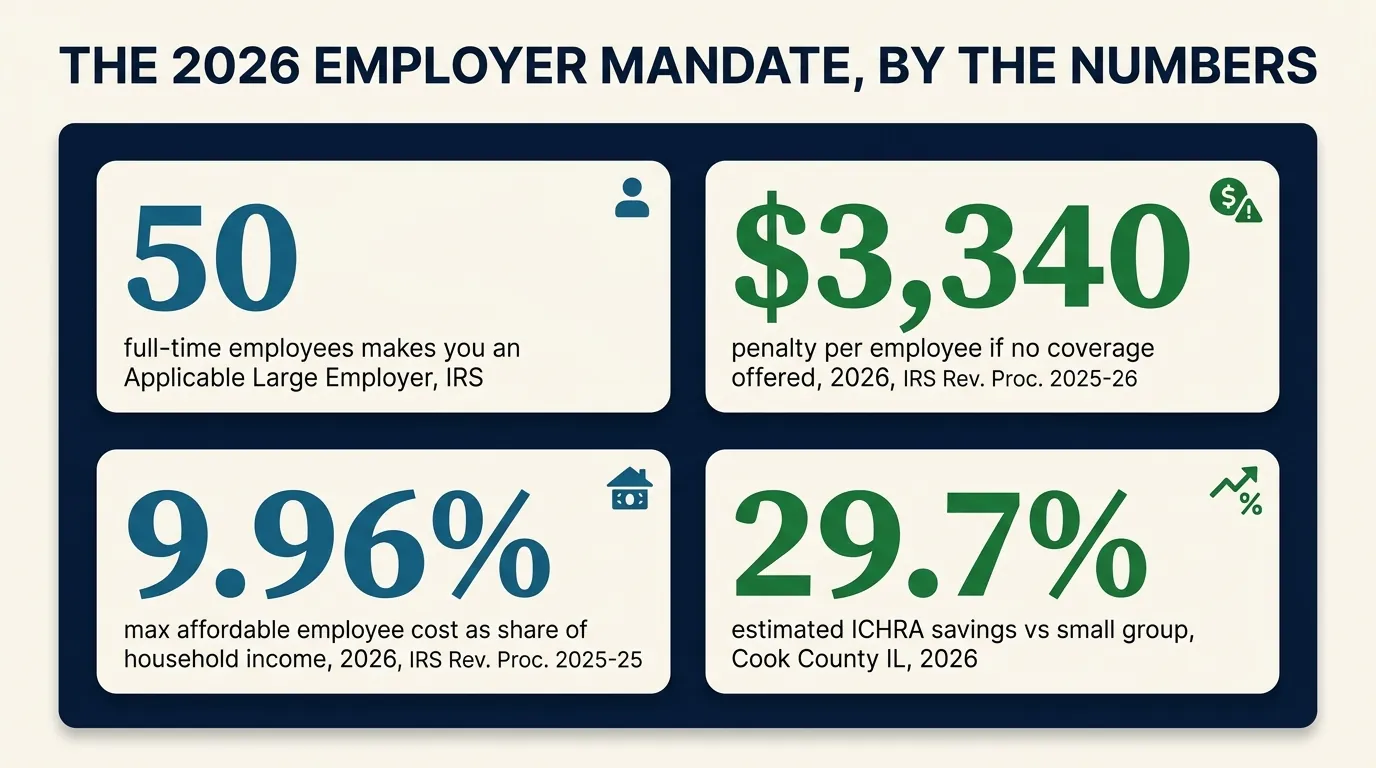
- An ICHRA satisfies the mandate at any headcount, with no federal dollar cap, and in Illinois's 11 qualifying counties, home to about 9.2 million people, it is estimated to cost less than small group too.
What actually changes at 50 employees
Fifty is not a round number that HR software picked. It is the line in the Internal Revenue Code, at section 4980H, where a business stops being just a business and becomes, in IRS language, an Applicable Large Employer (ALE). Cross it, and a federal requirement to offer health coverage attaches to the company that was not there the day before, along with a penalty structure if that offer does not happen or does not clear an affordability bar. Stay under it, and none of this applies. There is no phase-in, no warning letter before the fact, and no grace period tied to how fast you grew.
Most owners who cross this line do not do it on purpose. They hire a few more people to handle a busy season, add a shift, open a second location, or simply keep growing the way a healthy small business grows, and somewhere in that process their average headcount for the year passes 50. The mandate does not care why the headcount grew. It cares what the average was, measured a specific way, over a specific period, which this article works through in full, including the two separate penalties, the number that actually decides whether a given coverage offer counts as good enough, and where an Individual Coverage HRA (ICHRA), the IRS-defined arrangement where an employer sets a fixed monthly reimbursement and each employee buys their own individual health plan with it, tax-free, fits into the answer.
What triggers it
Averaging 50 or more full-time and full-time-equivalent employees across the prior calendar year, per the IRS. Not your headcount today; your average for the whole year.
What it requires
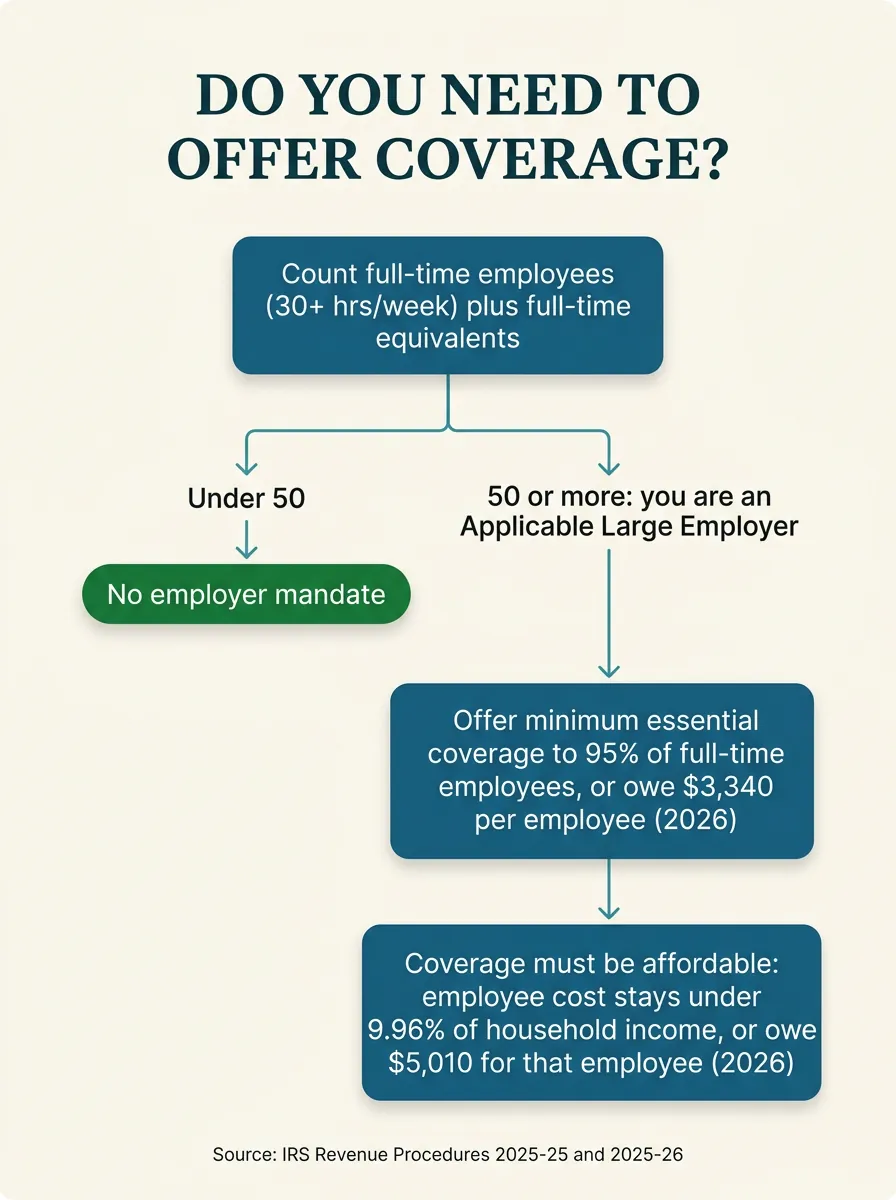
An offer of affordable, minimum-value coverage to at least 95% of full-time employees and their dependents, or exposure to a per-employee federal penalty.
What still works at any size
An ICHRA. No employee-count ceiling, no federal dollar cap, and it counts as a qualifying offer of coverage under the 2019 final rule.
The employer that's never offered anything
Picture a company that has never offered health coverage. Maybe it is a five-person shop that grew to 40, then 48, then, this year, 53. Nobody sat down and decided to become the kind of business that offers benefits; the headcount just grew, the way it does when the work is there. Health insurance was always something to figure out "once we're bigger," and now the business is bigger, and the IRS has an opinion about that whether anyone asked for one or not.
This is the single most common way employers meet the employer mandate for the first time: not by deciding to offer coverage, but by finding out, usually from an accountant or a benefits broker rather than a government notice, that they were required to. There is no dedicated letter that arrives the week you cross 50. The obligation exists whether or not anyone told you, and the penalty calculation, worked through below, does not adjust for a business that genuinely did not know.
What makes you an Applicable Large Employer
An employer is an ALE for a given calendar year if it had an average of at least 50 full-time employees, including full-time-equivalent employees, during the preceding calendar year, per the IRS. Two terms need defining before that sentence means anything useful.
A full-time employee, for this purpose, is someone employed on average at least 30 hours of service a week, or 130 hours of service a month, per the IRS. That threshold is lower than the 40-hour week most people picture as "full time," which surprises a lot of owners the first time they see it; someone working four 8-hour shifts a week already clears it.
A full-time equivalent (FTE) employee is how the IRS folds part-time hours into the same headcount. You add up the monthly hours of everyone who is not full-time, capping each individual person's hours at 120 for the month, and divide the total by 120. The IRS gives its own example: a company with 40 full-time employees and 20 part-time employees, each logging 60 hours a month, has 10 FTEs (20 × 60 = 1,200 hours; 1,200 ÷ 120 = 10), for a combined headcount of 50, which is ALE status. Two dozen part-time employees at half-time hours can push a company over the line just as surely as two dozen full-time hires can.
It's an average, not a snapshot
ALE status for a given year is based on the average headcount across the entire prior calendar year, not a single month. A business that ran a heavy summer season and a lean winter can still average 50 or more for the year even if its current headcount, checked today, looks smaller than that.
How the IRS counts your headcount
Getting the count right matters, because the penalty math that follows is unforgiving of a miscount in either direction. Overcounting means treating yourself as exempt from a rule that actually applies to you, which is how penalties show up years later with interest. Undercounting means budgeting for a compliance burden you do not actually have, which wastes money a growing company usually needs somewhere else.
Run the calculation for every month of the prior calendar year, average the twelve monthly totals, and compare that average to 50. Seasonal employers get a narrow exception: if a business would only be an ALE because of workers employed 120 days or fewer in a year, seasonal fluctuation can be excluded from the calculation, per the IRS's guidance on the topic. That exception is specific and worth confirming with a professional rather than assuming it applies just because your business has a busy season; most businesses with a busy season do not actually qualify for it.
The penalty for offering nothing
Once ALE status attaches, the mandate has two separate ways to cost money, and employers who have never dealt with either one tend to conflate them. The first, under section 4980H(a), is the penalty for not offering minimum essential coverage broadly enough: specifically, offering it to fewer than 95% of full-time employees and their dependents. It applies only if, in addition, at least one full-time employee goes to the ACA marketplace and receives a premium tax credit, the subsidy that lowers what an eligible person pays for an individual-market plan.
For the 2026 plan year, the IRS set that penalty at $3,340 per full-time employee, with the first 30 full-time employees excluded from the count, under Revenue Procedure 2025-26. For 2027, the same figures are already indexed to $3,780 per employee, under Revenue Procedure 2026-22, published this January. This penalty is not deductible as a business expense, and it recurs every year the company stays an ALE without an adequate offer.
Illustrative math: a 53-employee company offering no coverage
(53 full-time employees − 30 excluded) × $3,340 per employee (2026) = $76,820 a year, assessed for as long as the company stays an ALE without an adequate offer of coverage and at least one full-time employee claims a premium tax credit. This is an illustrative calculation using the 2026 penalty figure and a round headcount, not a projection for any specific business.
The quieter penalty: unaffordable coverage
The second penalty, under section 4980H(b), is easy to miss because it applies to companies that did the right thing on paper: they offered coverage to enough people to clear the 95% bar. The penalty applies instead when that coverage is not affordable, an IRS test, for specific employees, and those employees claim a premium tax credit anyway because the employer's offer cost them too much relative to their income.
For plan years beginning in 2026, the IRS set the required contribution percentage, the affordability threshold, at 9.96% of household income, under Revenue Procedure 2025-25. In practice, an employee's monthly cost for the employer's lowest-cost, minimum-value plan option cannot exceed 9.96% of that employee's household income for the offer to count as affordable for that person. The IRS permits simplified stand-ins for actual household income, called safe harbors, based on W-2 wages, rate of pay, or the federal poverty line, so an employer does not have to see anyone's tax return to run the test.
The 4980H(b) penalty for 2026 is $5,010 per affected employee, again under Revenue Procedure 2025-26, rising to $5,670 for 2027 under Revenue Procedure 2026-22. It is charged only for the specific employees whose coverage was unaffordable and who claimed a credit, not across the whole workforce, which is why it is usually, though not always, the smaller of the two exposures in total dollars.
Illustrative math: unaffordable coverage for 7 employees
7 affected full-time employees × $5,010 per employee (2026) = $35,070 a year. Smaller than the (a) penalty in this example, but still a recurring cost for offering coverage that technically exists on paper and does not actually clear the affordability bar for the people it was supposed to help.
Why a fast group rollout usually fails growing companies
The instinct, once an owner realizes they have crossed 50, is to call a broker and get a small-group plan in place immediately. That instinct runs into timing problems that have nothing to do with the ACA and everything to do with how group insurance is built. Small-group carriers typically require a minimum share of eligible employees to actually enroll before they will issue a plan at all, a rule we've covered in detail in our guide to small-group participation requirements, and hitting that share takes real enrollment time, open communication, and often a second attempt after the first one falls short. None of that compresses well into the weeks between "we just found out we're an ALE" and a plan year deadline.
There is also a network problem specific to companies that grew by adding locations or hiring remote staff along the way, which is common in exactly the kind of growth that pushes a company past 50 employees. A single small-group plan is priced and networked around a single geography. A team that grew across a metro area, let alone across state lines, often cannot find one group plan with adequate provider access for everyone, a problem we've written about at length for teams that grew remote first in our piece on ICHRA for multi-state teams. None of this is a reason to panic. It is a reason to know, before the deadline pressure sets in, that "just get a group plan fast" is often not actually fast.
The QSEHRA ceiling you are about to hit
Some growing companies already have a small HRA in place and assume it will keep working as they scale. It will not. A Qualified Small Employer HRA (QSEHRA) is only available to an employer with fewer than 50 full-time employees that does not offer a group health plan to any employee, per HealthCare.gov. It also carries a hard federal reimbursement ceiling: for 2026, $6,450 for self-only coverage and $13,100 for family coverage, under IRS guidance. We've compared the two structures directly in ICHRA vs QSEHRA, but the relevant fact here is narrower: the moment a business becomes an ALE, QSEHRA eligibility ends by statute, not by choice, regardless of how well it was working the year before.
An ICHRA has neither limitation. There is no employee-count ceiling on who can offer one, and no federal dollar cap on the reimbursement amount, which is exactly why it is the tax-advantaged reimbursement structure that survives the transition a QSEHRA cannot make.
How an ICHRA clears both bars, at any headcount
Under the 2019 final rule issued jointly by the Treasury Department (IRS), the Department of Labor, and the Department of Health and Human Services, an Individual Coverage HRA that meets the coverage and affordability requirements counts as an offer of minimum essential coverage for section 4980H purposes. That single fact does most of the work in this article. Offer an ICHRA to substantially all full-time employees, and the 95%-offer requirement behind the (a) penalty is addressed. Size the contribution using one of the IRS affordability safe harbors against the 9.96% threshold, and the (b) penalty exposure for that employee is addressed too.
It also sidesteps the two practical problems from the section above. There is no group participation minimum to hit, because each employee buys their own individual-market plan rather than enrolling in a single underwritten group contract. There is no single-geography network constraint, because the plan each employee buys is priced and networked around where that specific person lives, which is the same reason an ICHRA works cleanly for a team spread across several counties or several states. None of this is unique to a business that just crossed 50; it is the same mechanism smaller employers use to offer a first benefit without underwriting risk at all. It happens to also be the mechanism available at the exact moment a QSEHRA stops being an option.
Worked example: a 53-person Chicago-area employer
Numbers land differently attached to a real county. Cook County, Illinois, home to Chicago and the state's most populous county at 5,225,367 people in our dataset, shows a 2026 individual-market benchmark of $302 a month against a small-group benchmark of $429 a month, an estimated 29.7% spread, or $1,532 a year per employee. It is one of 11 Illinois counties that currently qualify in our dataset, covering an estimated 9.2 million people across the Chicago metro area and a few downstate counties.
Cook County, Illinois: 2026 benchmark premiums
Individual-market vs. small-group benchmark, monthly, per employee
Source: src/data/qualified_counties.json, 2026 plan year (Ideon rate data,
cross-verified against CMS public-use marketplace files). Estimates, not quotes.
Say this same 53-person employer, sitting in Cook County, spent last year growing past 50 full-time employees and has offered no coverage at all. Doing nothing this year exposes the business to the (a) penalty worked out above, $76,820. Funding every employee's individual-market plan through an ICHRA at the county's benchmark instead costs an estimated $191,938 a year ($302 × 12 months × 53 employees).
This is not "the penalty costs more, so pay it"
Actual coverage will almost always cost more out of pocket than a per-employee fine, because a fine buys the business nothing and coverage buys employees something real. The penalty is not deductible and does not help you keep or hire anyone. ICHRA contributions are tax-deductible business expenses with no FICA tax on the amount, employees actually get covered, and the 4980H exposure goes away for that employee. Compare what each dollar does, not just its size.
| County | Population | Individual benchmark | Small-group benchmark | Est. savings |
|---|---|---|---|---|
| Cook County | 5,225,367 | $302/mo | $429/mo | 29.7% |
| DuPage County | 930,559 | $308/mo | $411/mo | 25.0% |
| Lake County | 713,159 | $320/mo | $422/mo | 24.1% |
| Will County | 696,774 | $270/mo | $392/mo | 31.1% |
| Kane County | 517,254 | $308/mo | $411/mo | 25.0% |
| McHenry County | 311,133 | $329/mo | $422/mo | 22.0% |
Source: src/data/qualified_counties.json, 2026 plan year (Ideon rate data,
cross-verified against CMS public-use marketplace files). Estimates, not quotes. Individual
results vary by age, plan selection, and carrier participation.
Setting a contribution that actually works
Clearing the employer mandate with an ICHRA is not just a matter of offering one; the contribution amount has to actually satisfy the affordability test for it to address the (b) exposure. Underfund it, and an employee whose after-contribution cost exceeds 9.96% of their measured income can still decline the ICHRA and claim a premium tax credit instead, which puts the (b) penalty for that person right back on the table even though a benefit was technically offered.
This is a modeling exercise, not a guess. It starts with picking a safe harbor that fits the workforce, usually the W-2 wages safe harbor for most employers, then checking the lowest-cost silver plan available in each employee's county against that employee's measured income, and setting the contribution high enough to clear 9.96% for the group as a whole. County-level individual-market rates, like Cook County's $302 benchmark used above, are the starting input for that math, which is exactly why this is a local calculation and not a single number that works the same way in every part of the country.
The IRS did not send you a letter the week you crossed 50. It just started the clock. Finding out from a penalty notice instead of from your own headcount math is the expensive way to learn where that clock started.
Mike MooreWhere ICHRA is not the fix
It would be convenient to end here with "just offer an ICHRA and the mandate problem disappears." It is not that simple everywhere, and saying so plainly is the most useful thing this article can do. Avoiding a 4980H penalty requires an affordable offer of coverage; it does not require that offer to be an ICHRA specifically. In counties where the individual market is thin or priced above small group, a properly underwritten small-group plan or a level-funded arrangement can satisfy the same rule for less money, and our own dataset is the thing that tells you which case you are in.
Nationally, entire states show zero qualifying counties in our data because individual-market rates run above small-group rates statewide, a pattern we documented in detail for one such state in why zero counties qualify in Florida. If most of your workforce sits in a market like that, the employer mandate still applies once you cross 50, but the coverage that satisfies it most cheaply is probably not an ICHRA. Run your own counties rather than assuming either answer.
The order to work this in
- Run the full-time-equivalent count for the entire prior calendar year, not today's headcount, to know your actual ALE status.
- If you are an ALE, confirm it in writing with a benefits attorney or tax advisor before assuming either way.
- Pull your employee census by county, since both the affordability math and the ICHRA-vs-small-group comparison are local questions.
- Check your specific counties on the savings map before assuming an ICHRA is, or is not, the cheaper path to compliance.
- Model affordability using the 9.96% threshold and a safe harbor that fits your workforce before setting a contribution number.
- Compare what each option actually buys, not just its price: a penalty buys nothing, coverage buys a real, deductible benefit.
- Budget for the notice and enrollment timeline either way; neither a group plan nor an ICHRA rollout compresses well into a few weeks.
Check your county before you call anyone
Ten minutes on the savings map tells you whether an ICHRA is likely to be the cheaper way to clear the mandate for your specific counties, before you are negotiating against a plan-year deadline. Check your county on the savings map →
Checking your own counties
Everything above about the mandate mechanism, the FTE count, and the two penalties applies the same way no matter where your team is. Whether an ICHRA is the cheapest way to clear it is not the same everywhere; it depends on the individual-market and small-group benchmark premiums in the specific counties your employees live in, which is exactly what our county dataset and savings map are built to show, for the 2026 plan year.
If you have already confirmed you are an ALE and are working against a plan-year deadline, it is worth a conversation: talk to an advisor about your timeline → If you would rather see the mechanics first, start with how ICHRA works, or if you are the employee side of this conversation rather than the employer, this page is written for you.
What this does not guarantee
Read this before you act on any of the above
- This is not tax, legal, or HR advice. Whether your business is an ALE, and what satisfies the mandate for it, depends on facts this article cannot see.
- ALE determination is fact-specific. Seasonal exceptions, controlled-group aggregation rules, and edge cases in the FTE calculation can change the answer; confirm your status with a qualified professional.
- Taking an ICHRA generally means an employee waives premium tax credit eligibility for any month the offer is deemed affordable for them. See our ACA subsidy cliff guide for the income thresholds involved.
- None of the figures in this article are an offer of insurance, a quote, or a guarantee of savings, coverage, or tax outcome for any specific employer or employee.
- ICHRA Savings is a private, independent advisory service and is not connected with or endorsed by the U.S. government, HealthCare.gov, the IRS, the Department of Labor, or CMS.
How these numbers are calculated
The ALE threshold, the full-time and full-time-equivalent definitions, and the FTE worked example come directly from the IRS's own pages, "Employer Shared Responsibility Provisions" and "Determining if an employer is an applicable large employer." The 2026 section 4980H(a) and 4980H(b) penalty amounts, $3,340 and $5,010, come from IRS Revenue Procedure 2025-26; the 2027 amounts, $3,780 and $5,670, come from IRS Revenue Procedure 2026-22, published this January. The 2026 affordability required contribution percentage, 9.96%, comes from IRS Revenue Procedure 2025-25. The 2026 QSEHRA reimbursement caps come from IRS Revenue Procedure 2025-32, and the QSEHRA under-50-employee eligibility rule comes directly from HealthCare.gov. National survey figures on employer offer rates and ICHRA adoption come from KFF's 2025 Employer Health Benefits Survey, the organization's 27th annual survey of employers with ten or more workers, fielded January through July 2025.
The Illinois county figures come from the same dataset that powers our savings map: a 2026 individual-market benchmark premium, the second-lowest-cost silver plan available to a representative enrollee, compared against a small-group benchmark premium built from comparable small-group filings for that rating area. Both figures come from Ideon, a licensed insurance rate-data provider, cross-verified against CMS public-use marketplace files before publication.
One limitation worth stating plainly: the worked examples in this article use a round, illustrative headcount and a single county's rates to show the mechanism. Every real business has its own headcount history, its own employee locations, and its own affordability math. Use this article to understand how the mandate works and where the levers are, then run your own numbers before deciding anything.
Questions employers actually ask
What is the ACA employer mandate and when does it apply to my business?
How do I count full-time equivalent employees for ALE status?
What happens if I am an ALE and I do not offer coverage at all?
What's the difference between the (a) penalty and the (b) penalty?
Does an ICHRA satisfy the employer mandate?
Can I still use a QSEHRA once I cross 50 employees?
Does ICHRA save money everywhere, or just in certain counties?
What if I am right at the 50-employee line and not sure which side I am on?
| Figure | Value | Geography | Source |
|---|---|---|---|
| Applicable Large Employer (ALE) threshold | 50 full-time employees (avg., prior year) | National | IRS, "Determining if an employer is an applicable large employer" |
| Full-time employee definition | 30 hrs/week or 130 hrs/month | National | IRS, Employer Shared Responsibility Provisions |
| Full-time-equivalent formula | Non-FT monthly hours (capped at 120/person) ÷ 120 | National | IRS, ALE determination page |
| 4980H(a) penalty per FT employee (minus first 30), plan year 2026 | $3,340 | National | IRS Rev. Proc. 2025-26 |
| 4980H(b) penalty per affected employee, plan year 2026 | $5,010 | National | IRS Rev. Proc. 2025-26 |
| 4980H(a) penalty per FT employee, plan year 2027 | $3,780 | National | IRS Rev. Proc. 2026-22 |
| 4980H(b) penalty per affected employee, plan year 2027 | $5,670 | National | IRS Rev. Proc. 2026-22 |
| ACA/ICHRA affordability required contribution percentage, plan year 2026 | 9.96% of household income | National | IRS Rev. Proc. 2025-25 |
| QSEHRA annual reimbursement cap, 2026 (self-only / family) | $6,450 / $13,100 | National | IRS Rev. Proc. 2025-32 |
| QSEHRA eligibility ceiling | Fewer than 50 full-time employees | National | HealthCare.gov, QSEHRA |
| Firms with 10+ workers offering health benefits, 2025 | 61% | National | KFF 2025 Employer Health Benefits Survey |
| Offer rate, firms 200+ workers vs. firms 10-199 workers, 2025 | 97% vs. 59% | National | KFF 2025 Employer Health Benefits Survey |
| Average annual family premium, 2025 | $26,993, up 6% YoY | National | KFF 2025 Employer Health Benefits Survey |
| Share of firms funding an ICHRA (offer / non-offer firms), 2025 | 4% / 9% | National | KFF 2025 Employer Health Benefits Survey |
| Estimated ICHRA savings vs. small group, Cook County, IL | 29.7% ($1,532/yr per employee) | Cook County, IL | qualified_counties.json, 2026 plan year |
| Estimated ICHRA savings vs. small group, Will County, IL | 31.1% ($1,460/yr per employee) | Will County, IL | qualified_counties.json, 2026 plan year |
| Illinois qualifying counties and covered population | 11 counties, ~9.2M people | Illinois | qualified_counties.json, 2026 plan year |
Sources
- IRS, "Employer Shared Responsibility Provisions" (ALE definition, full-time employee definition)
- IRS, "Determining if an employer is an applicable large employer" (FTE calculation and worked example)
- IRS, Revenue Procedure 2025-26 (2026 section 4980H(a)/(b) penalty amounts)
- IRS, Revenue Procedure 2026-22 (2027 section 4980H(a)/(b) penalty amounts)
- IRS, Revenue Procedure 2025-25 (2026 ACA/ICHRA affordability required contribution percentage)
- IRS, Revenue Procedure 2025-32 (2026 QSEHRA reimbursement caps)
- HealthCare.gov, "Qualified Small Employer HRA (QSEHRA)" (under-50-employee eligibility rule)
- KFF, "Employer Health Benefits 2025 Annual Survey, Summary of Findings"
- ICHRA final rule: Departments of the Treasury/IRS, Labor, and Health and Human Services (2019)
- County-level premium comparison:
src/data/qualified_counties.json, 2026 plan year (Ideon rate data, cross-verified against CMS public-use marketplace files)