ICHRA and Medicare: What Changes for 2027
A Medicare-eligible employee can use ICHRA funds, but the rules are specific. See how it works for 2026 and what a new CMS rule ends starting in 2027.
The short version
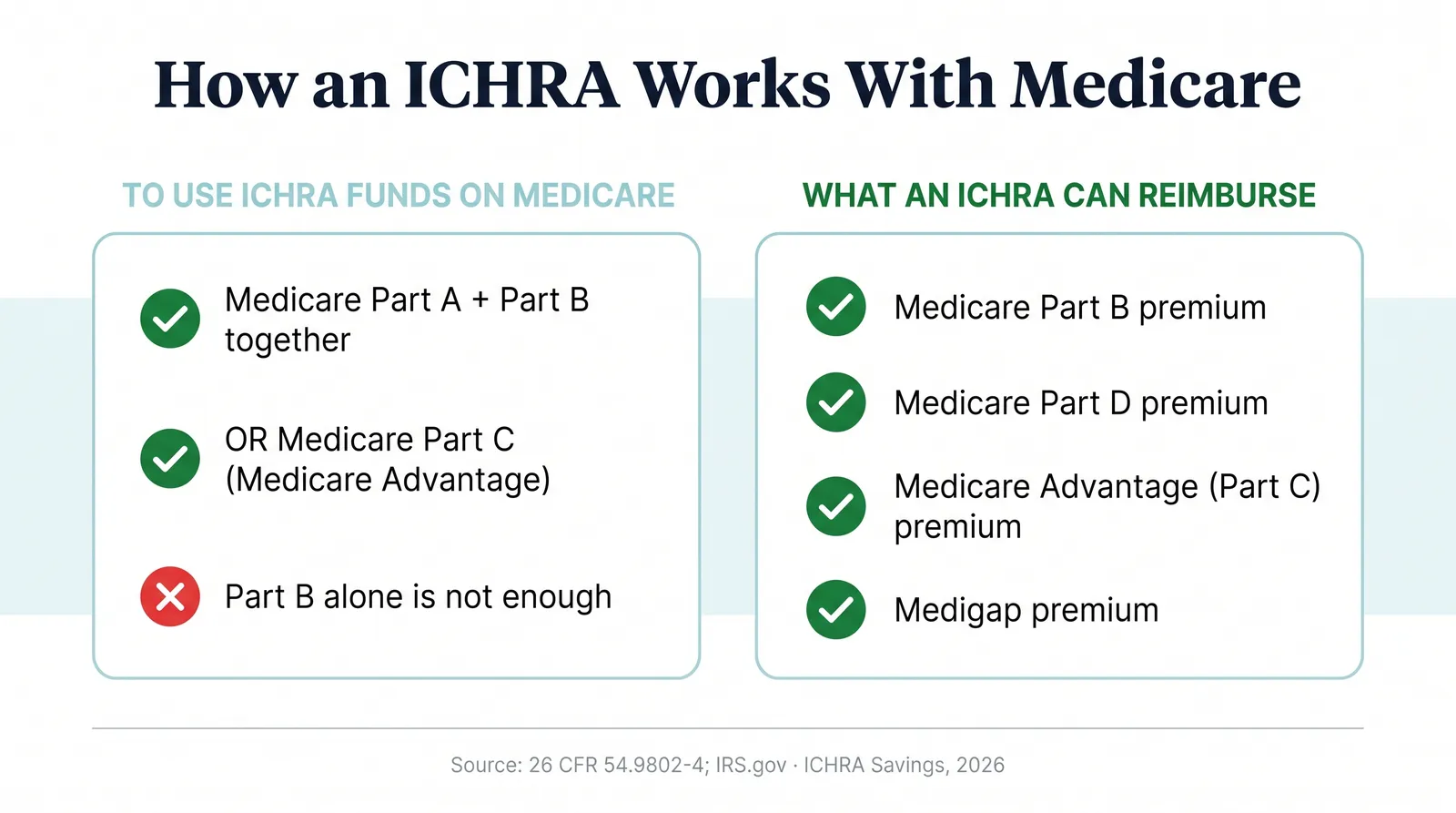
- Yes, an ICHRA can pay for a Medicare-eligible employee's coverage, but only once they are enrolled in Medicare Part A and Part B together, or in Part C (Medicare Advantage). Part B alone does not qualify.
- Medicare status cannot be its own ICHRA employee class under 26 CFR § 54.9802-4. Medicare-eligible employees stay inside whichever class they already belong to.
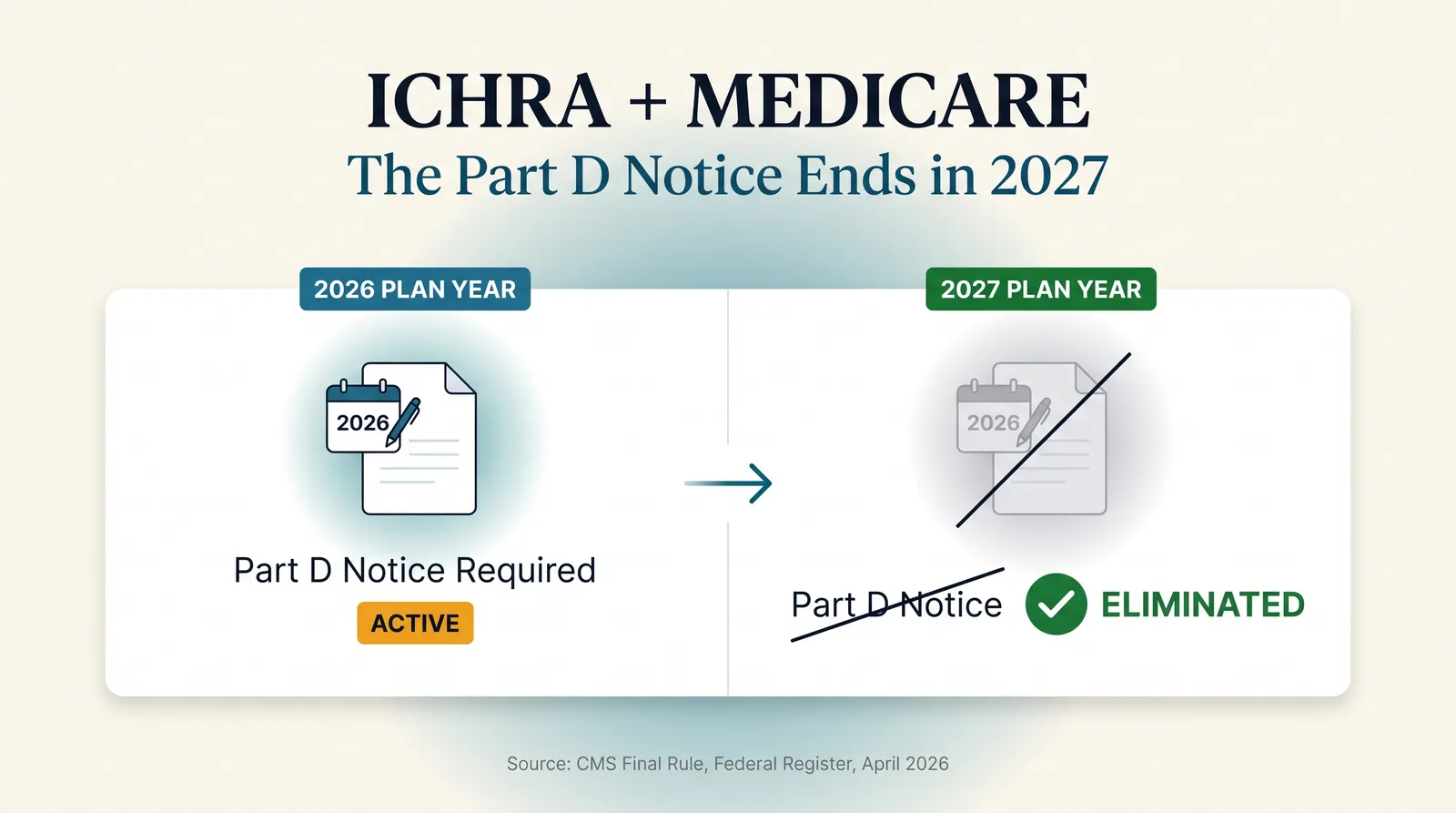
- A CMS final rule published April 6, 2026 (Federal Register document 2026-06600) removes the Medicare Part D creditable-coverage disclosure for HRAs and ICHRAs, but only for plan years beginning on or after January 1, 2027. For a 2026 plan year, you still owe the October 15 individual notice and the CMS online disclosure.
- Once someone is entitled to Medicare, they generally cannot claim an ACA premium tax credit, so the usual subsidy-waiver trade-off that applies to other ICHRA participants does not apply to them the same way.
Can a Medicare-eligible employee use an ICHRA?
Yes. An Individual Coverage HRA (ICHRA), the employer-funded arrangement that reimburses employees tax-free for their own individual health coverage, can reimburse a Medicare-enrolled employee too, as long as that employee is enrolled in Medicare Part A and Part B together, or in Medicare Part C (Medicare Advantage). Enrollment in Part B alone does not clear the bar, because Part B by itself does not meet the ACA's definition of minimum essential coverage, and an ICHRA can only reimburse premiums for coverage that does.
Once an employee clears that bar, the ICHRA can reimburse their Medicare Part B premium, their Part D premium, their Medicare Advantage premium, and their Medigap premium, tax-free and without a cap set by the federal government. What it cannot do is treat them differently from their coworkers just because they are on Medicare. That single fact — that Medicare status is not, on its own, a permitted way to split your workforce — trips up more employers than almost anything else in this arrangement.
There is also a second, newer thread running through this question in 2026: a federal rule finalized this year changes one of the compliance obligations that comes with having any Medicare-eligible employee on your books at all, starting with plan years that begin in 2027. If you offer an ICHRA and any employee, spouse, or dependent on your plan is eligible for Medicare, both threads matter to you. This article walks through both.
Your bookkeeper just turned 65
Here is the version of this question that actually shows up in an inbox. You run a nine-person company. Your bookkeeper, who has been with you for eleven years, just turned 65. She mentions, almost in passing, that she signed up for Medicare last month. You have no idea what that means for the ICHRA contribution she has been getting reimbursed through for the past two plan years. Does her class change? Does her contribution change? Do you owe her some kind of notice you have never heard of? And somewhere in the back of your mind, a vaguely remembered warning: something about Medicare and a penalty, and you are not sure if that is her problem or yours.
It is a fair set of questions, and the honest answer is that most of it changes less than you would expect. Her class does not change. Her contribution does not have to change. What does change is which premiums she is now eligible to have reimbursed, and — separately — what you, as the plan sponsor, owe to CMS and to her about the prescription-drug coverage question. That second piece is the one this article spends the most time on, because it is the one with an actual federal rule change attached to it this year.
If you are the employee reading this instead of the employer, the mechanics below apply to you directly, and there is a page written from your side of the desk if you want it: what an ICHRA means for you.
How ICHRA and Medicare actually fit together
Start with the definition. An ICHRA is a type of health reimbursement arrangement created under a 2019 federal final rule from the Treasury/IRS, the Department of Labor, and HHS. An employer sets a monthly reimbursement budget, the employee buys their own individual health coverage, submits proof of what they paid, and the employer reimburses them tax-free, with no FICA tax on either side. There is no employer size minimum and no federal dollar cap on the contribution.
Medicare is not "individual coverage" in the marketplace sense, but the ICHRA rules specifically integrate it. 26 CFR § 54.9802-4, the Treasury regulation that governs ICHRA class and integration rules, addresses Medicare directly: an employee who is enrolled in both Medicare Part A and Part B, or in Medicare Part C, is treated as having the kind of coverage an ICHRA is allowed to support. An employee enrolled in Part B only, without Part A, is not, because Part B alone is a supplemental medical-insurance benefit, not a complete minimum-essential-coverage plan on its own.
In practice, this covers almost every Medicare-eligible employee you will actually run into. Most people qualify for premium-free Part A automatically once they have 40 quarters of Medicare-taxed work history (their own or a spouse's), so the moment they add Part B, or enroll in a Part C Medicare Advantage plan that bundles A and B together, they clear the ICHRA integration bar without doing anything unusual.
It is worth being precise about one more term here, because employers mix it up constantly: ICHRA is not the same thing as a QSEHRA, the smaller HRA variant capped at a fixed annual dollar limit and restricted to businesses with fewer than 50 full-time-equivalent employees. ICHRA has no employer size ceiling and no federal dollar cap, which is exactly why it works for a nine-person company with one Medicare-eligible employee and a 150-person company with twenty. The Medicare integration rules described in this article apply the same way regardless of which size band you sit in.
This question also comes up more often than it used to, for an ordinary demographic reason: a meaningful share of small-business owners and long-tenured employees are themselves at or past 65 and still working, whether full time, part time, or in a semi-retired capacity. If your own company has been offering an ICHRA for a year or two, the odds that someone on it ages into Medicare eligibility during that time are real, not theoretical, which is why this is worth reading before it happens to a specific person on your payroll rather than after.
What an ICHRA can pay for on Medicare
Four categories of premium are eligible for tax-free ICHRA reimbursement once an employee is Medicare-integrated: the Part B premium, a standalone Part D prescription-drug premium (or the drug-coverage portion of a Medicare Advantage plan), a Medicare Advantage (Part C) premium, and a Medigap (Medicare Supplement) premium. Part A itself is usually already premium-free for anyone with sufficient work history, so there is frequently nothing to reimburse there — the money goes toward the pieces Medicare does not fully cover.
| Coverage | Eligible for ICHRA reimbursement? |
|---|---|
| Medicare Part A premium | Yes, if the employee pays one (most do not) |
| Medicare Part B premium | Yes |
| Medicare Part D premium (standalone plan) | Yes |
| Medicare Advantage (Part C) premium | Yes |
| Medigap (Medicare Supplement) premium | Yes |
| Reimbursement based on Part B enrollment alone, without Part A | No — does not meet minimum essential coverage on its own |
A design choice, not a Medicare rule
Nothing in federal law forces you to let ICHRA dollars flow toward Medicare premiums — that is set by your own plan document. Most employers who have Medicare-eligible staff write the plan broadly enough to cover all four categories above, because narrowing it usually just pushes the employee toward a workaround that is harder to substantiate, not toward a cheaper outcome for you.
Employee classes: what you can and cannot do
ICHRA lets you split your workforce into permitted classes and offer a different contribution to each one. There are eleven of them under 26 CFR § 54.9802-4: full-time, part-time, salaried, non-salaried (hourly), seasonal, geographic location (generally by insurance rating area), a waiting-period class, collectively bargained employees, non-resident aliens with no U.S. income, temporary staffing-firm employees, and any combination of two or more of the above. We cover the full list in more depth in a dedicated article on the 11 classes.
Medicare enrollment is not on that list, and it cannot be combined into one either. You cannot write a plan that says, in effect, "employees on Medicare get X and everyone else gets Y," because Medicare status by itself is not a permitted classification basis. A Medicare-eligible employee who is full-time and salaried is simply a full-time, salaried employee who happens to also qualify for Medicare — same class, same contribution rules, same 3:1 maximum age-based variation the rest of that class is subject to.
This matters because the instinct to carve out a "Medicare class" is common, and it is the kind of mistake that does not show up until an audit or a departing employee's benefits claim forces someone to read the plan document closely. If you want to vary the contribution for older workers, the permitted lever is the age-based variation inside a class (capped at a 3:1 ratio between your oldest and youngest participants in that class), not a class built around Medicare status itself.
How your headcount changes the picture
There is one more federal rule worth knowing, even though it applies to traditional group health plans more directly than it applies to ICHRA. Under Medicare Secondary Payer rules, an employer with 20 or more employees generally has to offer employees and spouses age 65 or older the same group health coverage, on the same terms, that it offers everyone else — the employer's plan pays first, and Medicare pays second. Cross below 20 employees, and it flips: Medicare pays first, the employer's coverage pays second, and it becomes much more common, and more sensible, for the employer to simply help the employee pay their Medicare premiums directly instead of trying to coordinate two payers.
An ICHRA sits a little outside this coordination question, because the employee is not enrolled in your group health plan at all — they are reimbursed for coverage they bought on their own, whether that is an individual-market plan or Medicare. That said, the same-class, same-terms principle still shows up in the ICHRA rules in a different form: if you offer a class of employees an ICHRA, you cannot offer that same class a choice between the ICHRA and a traditional group plan, and you cannot use Medicare status to build the class in the first place, whether you have 9 employees or 90. The headcount threshold changes which strategy makes financial sense for a Medicare-eligible employee. It does not change the class rule itself.
The Part D notice you have been sending
Separately from all of the above, group health plans that offer prescription-drug coverage to anyone eligible for Medicare have long had to run a Medicare Part D creditable-coverage disclosure process, and CMS has historically applied that requirement to HRAs and ICHRAs as "group health plans" too. It has two parts, and if you have any Medicare-eligible person on your plan, you have likely been doing both without necessarily knowing the name for them.
The first is a written notice to every Medicare-eligible individual on the plan — the employee, and any Medicare-eligible spouse or dependent covered through them — telling them whether the coverage they have is "creditable," meaning its value is at least as good as standard Medicare Part D coverage. That notice is due before October 15 each year, timed to land before Medicare's annual Part D enrollment window opens.
The second is a separate online disclosure filed directly with CMS, due within 60 days of the start of each plan year. For an employer running a standard calendar-year plan, that works out to roughly March 1.
For the 2026 plan year, both of these are still required if your ICHRA covers anyone Medicare-eligible. Nothing about the rule change described in the next section removes either obligation yet.
What changes: the rule that ends it
On April 6, 2026, CMS published a final rule in the Federal Register — "Medicare Program; Contract Year 2027 and Certain Contract Year 2026 Policy and Technical Changes to the Medicare Advantage Program, Medicare Prescription Drug Benefit Program, and Medicare Cost Plan Program," document number 2026-06600 — that formally exempts account-based group health plans, including HRAs, ICHRAs, health FSAs, and HSAs, from the Medicare Part D creditable-coverage disclosure requirement described above. That exemption covers both halves of the obligation: the individual notice and the CMS online disclosure.
CMS's own stated reasoning is worth repeating, because it is unusually candid for a federal rule preamble: an HRA does not have a fixed "actuarial value" the way an insured drug plan does, so asking a plan sponsor to certify whether an account-based reimbursement arrangement is "at least as good as" standard Part D coverage was never really an apples-to-apples comparison. Worse, an employee could receive one message from their ICHRA saying it is not creditable, while the individual-market plan they actually bought with that money says it is, which is confusing and does not tell the employee anything useful about their real coverage.
The catch is the effective date. The exemption applies to plan years beginning on or after January 1, 2027, not retroactively to plan years already underway. If your ICHRA runs on a calendar-year basis and your current plan year started January 1, 2026, you are still inside the old requirement through the end of that plan year. The first plan year that gets to skip both notices is the one that starts January 1, 2027, for a calendar-year plan, or whenever your next plan year begins if it runs on a different cycle.
| Requirement | Plan year beginning 2026 | Plan year beginning 2027 or later |
|---|---|---|
| Written notice to Medicare-eligible participants | Required, due before October 15 | Eliminated for HRAs and ICHRAs |
| Online disclosure to CMS | Required, due within 60 days of plan year start | Eliminated for HRAs and ICHRAs |
| Applies to | Account-based plans: HRAs, ICHRAs, health FSAs, HSAs | |
| Source | Federal Register, document 2026-06600, published April 6, 2026 | |
What to actually do about it
Keep sending the October 15 notice and filing the CMS disclosure for any plan year that starts before January 1, 2027. Once your plan year rolls over into 2027, you can drop both from your compliance calendar for the ICHRA specifically — but confirm with your administrator or benefits counsel that your plan year start date actually qualifies before you stop, since a non-calendar plan year could still straddle the line.
What it costs to miss the notice
There is no standalone federal dollar fine written into the Part D notice requirement itself, and that leads some employers to treat it as optional. The real cost lands on the employee, and it is permanent, which is why it is worth taking seriously through the last plan year the requirement still applies to you.
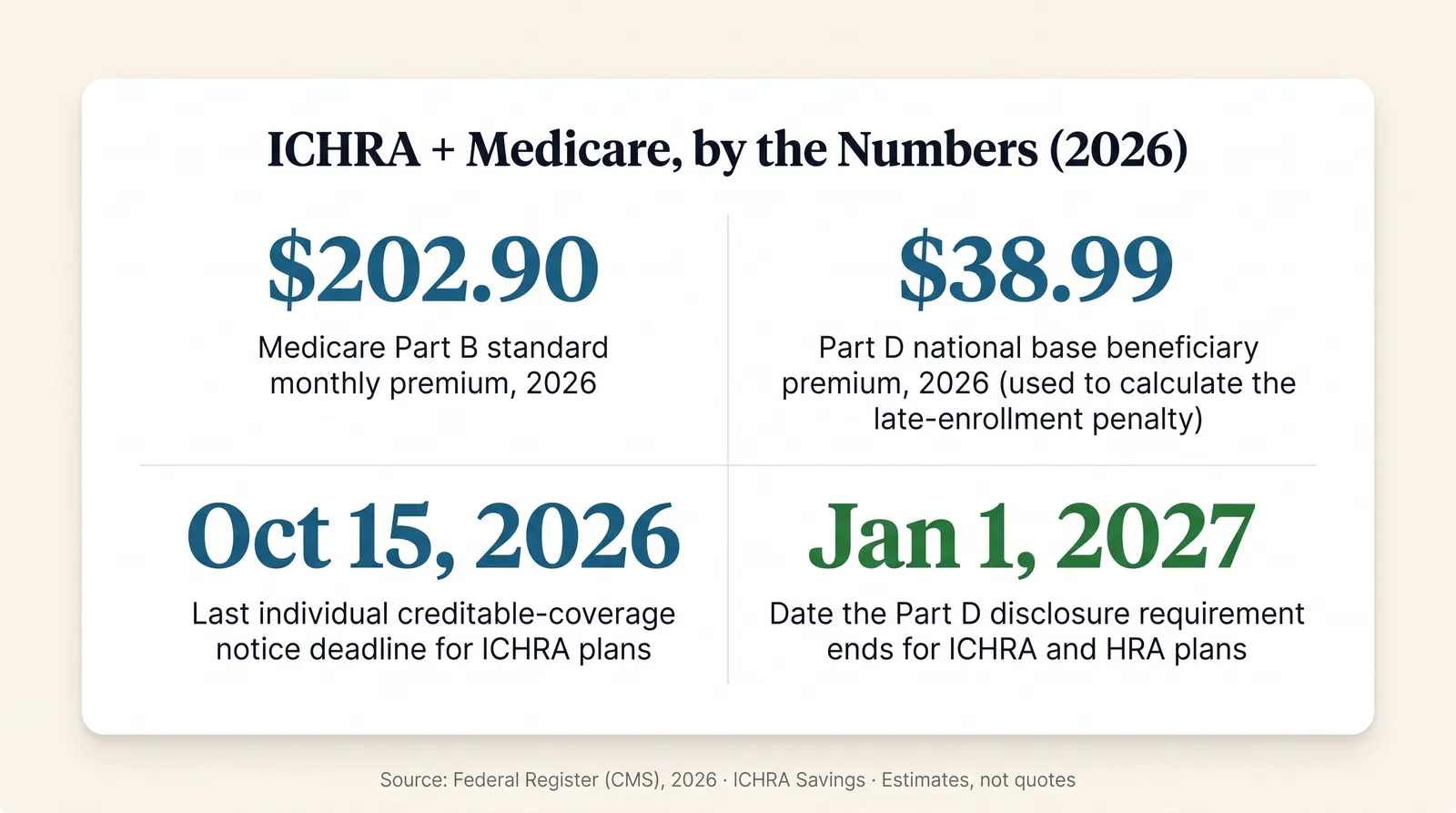
Medicare charges a late-enrollment penalty to anyone who goes 63 or more consecutive days without Part D coverage or other creditable prescription-drug coverage after their initial enrollment window closes. The penalty is calculated as 1% of the national base beneficiary premium, multiplied by the number of full months the person went without coverage, rounded to the nearest ten cents, and added to their Part D premium for as long as they have Part D coverage — not for a year, for the rest of their enrollment. The national base beneficiary premium for 2026 is $38.99, so every uncovered month currently adds roughly $0.39 to that person's monthly premium, permanently, and it compounds every year the beneficiary goes without a Part D plan.
Illustrative permanent monthly Part D penalty by months without creditable coverage
1% of the 2026 national base beneficiary premium ($38.99) per full uncovered month, added to the Part D premium for life.
Illustrative arithmetic using CMS's published 2026 formula. The penalty is per beneficiary, not per employer, and it is added for as long as the person carries Part D coverage.
That is why the notice exists in the first place: it is how a Medicare-eligible employee finds out, before the penalty clock starts running, whether the drug coverage they have through your plan counts as creditable. An employee who never sees the notice and assumes their employer coverage is "good enough" can end up self-inflicting a permanent premium surcharge simply because nobody told them their options in time. That is the actual stake behind a deadline that looks, on paper, like paperwork.
The subsidy trade-off is different here
For a non-Medicare employee, taking an ICHRA usually means weighing it against an ACA marketplace premium tax credit: if the ICHRA is considered "affordable" under the IRS test, the employee has to waive the credit to use the ICHRA instead. That trade-off does not apply to a Medicare-eligible employee in the same way, because the IRS is explicit that individuals eligible for government coverage — Medicare included — generally are not eligible for a marketplace premium tax credit at all, regardless of what their employer offers. There is nothing to waive, because there was nothing to claim.
Practically, that simplifies the conversation with a Medicare-eligible employee. You are not modeling an affordability percentage against their household income to figure out whether they keep a subsidy. You are simply deciding how much of their real Medicare-era costs — Part B, Part D, Medicare Advantage, or Medigap — your contribution should offset, the same way you would think about any other fixed benefit line.
A worked example: Charlotte, North Carolina
Put a number on it. Say your bookkeeper lives in Mecklenburg County, North Carolina — Charlotte and its suburbs — and enrolls in Medicare Part B plus a standalone Part D plan. Using the 2026 standard Part B premium of $203 a month and CMS's projected 2026 national average standalone Part D premium of $35 a month, her core Medicare premiums run about $237 a month, or roughly $2,849 a year, before accounting for any Medigap policy she might add on top. If your ICHRA contribution for her class covers that amount, she is fully reimbursed, tax-free, for the two premiums that matter most. Her actual figure will differ if she is subject to an income-related monthly adjustment on Part B, or if she picks a Part D plan priced above or below the national average — Part D pricing in particular varies a lot by plan and region, so treat $35 as a planning estimate, not what she will actually pay.
Mecklenburg County is also a useful stand-in for the ordinary ICHRA math that still applies to the rest of your team, the employees who are not on Medicare and are shopping the individual market instead. For the 2026 plan year, our qualified-counties dataset puts Mecklenburg County's individual-market benchmark premium at $688 a month against a small-group benchmark of $860, an estimated 20% gap worth about $2,062 per employee per year. Nationally, 894 of the 1309 counties in our dataset clear the same $100-a-month bar for the 2026 plan year — a reminder that the Medicare question and the small-group-versus-individual-market question are two separate arithmetic problems, and you may need to run both for the same workforce.
20%
Mecklenburg County, NC estimated ICHRA savings, 2026
$2,062
Estimated annual savings per non-Medicare employee
$237
Illustrative Part B + Part D premium, 2026, per month
894
Of 1309 tracked counties clearing the $100/mo bar, 2026
See North Carolina's full county breakdown →. If your team sits somewhere else, the same dataset covers every state we track — check your own county before assuming Mecklenburg's numbers apply to you.
How to get this right this year
- Identify who on your ICHRA is Medicare-eligible. That includes employees, and any Medicare-eligible spouse or dependent covered through them.
- Confirm your plan year start date. It decides whether October 15, 2026 and the 60-day CMS disclosure still apply to you, or whether you are already inside a plan year that starts in 2027 and is exempt.
- Send the individual notice on time if you are not yet exempt. CMS publishes a model notice; most ICHRA administrators generate and send it automatically, but the employer is still the plan sponsor of record.
- File the CMS online disclosure if you are not yet exempt. It is a short form on CMS's disclosure portal, done once per plan year, not per employee.
- Do not build a Medicare-only class. Confirm with whoever wrote your plan document that Medicare-eligible employees sit inside an ordinary permitted class, not a carve-out.
- Set the contribution based on real premiums, not guesswork. Ask a Medicare-eligible employee what they actually pay for Part B, Part D or Part C, and Medigap if they carry it, before finalizing what your class contribution should cover.
Where this goes wrong
- Assuming the 2027 exemption already applies. If your plan year started in 2026, it does not yet.
- Writing a Medicare-only employee class. Not a permitted classification basis under 26 CFR § 54.9802-4.
- Modeling a subsidy waiver for a Medicare-eligible employee. There is usually no marketplace subsidy for them to waive in the first place.
- Letting the notice lapse because "nothing happened last year." The cost shows up on the employee's Part D bill, permanently, often years later.
Medicare status is not a reason to write your Medicare-eligible employees a separate rulebook. It is a reason to read the one rulebook a little more carefully.
Mike MooreHow ICHRA Savings helps
Our county-level dataset answers the question your non-Medicare employees actually face: whether individual-market rates in their county sit below what small-group coverage would cost you. It does not answer the Medicare question above — that is a federal rule question, not a rate-spread question — but the two usually show up in the same rollout, so it is worth checking both before you finalize a plan design that has to work for a mixed-age workforce. Before anything else, check whether your county is one where the individual-market math works: explore the savings map.
Questions employers actually ask
Can an employee on Medicare participate in an ICHRA?
Yes, if they are enrolled in Medicare Part A and Part B together, or in Medicare Part C (Medicare Advantage). Part B alone does not qualify as the individual coverage an ICHRA requires, because Part B by itself does not meet the ACA definition of minimum essential coverage. Once that bar is cleared, the employee is treated like any other participant in their employee class.
What can an ICHRA reimburse for someone on Medicare?
The Medicare Part B premium, a standalone Medicare Part D premium, a Medicare Advantage (Part C) premium, and a Medigap (Medicare Supplement) premium are all eligible for tax-free ICHRA reimbursement, along with other substantiated medical expenses the plan document allows. Part A is usually premium-free for people with enough work history, so there is often nothing to reimburse there.
Do we still have to send a Medicare Part D notice in 2026?
Yes. The exemption for HRAs and ICHRAs does not take effect until plan years beginning on or after January 1, 2027. For a 2026 plan year, the individual notice to Medicare-eligible participants is still due before October 15, 2026, and the online disclosure to CMS is still due within 60 days of the start of your plan year.
Can we set up a separate ICHRA class just for employees on Medicare?
No. Medicare enrollment or eligibility is not one of the permitted classes under 26 CFR 54.9802-4. You can use classes such as full-time, part-time, salaried, hourly, geographic location, or a combination of those, and Medicare-eligible employees who fall inside a class you do offer are included the same as anyone else in it. You cannot carve them into their own class based on Medicare status alone.
Does an employee on Medicare lose anything by taking the ICHRA instead of a marketplace plan?
They are not choosing between the two the way a younger employee would. Once someone is entitled to Medicare, they generally are not eligible for an ACA marketplace premium tax credit regardless of what their employer offers, so the usual affordability-and-subsidy-waiver calculation that applies to other employees does not apply to them in the same way.
What happens if we miss the October 15 notice deadline?
The bigger risk lands on the employee, not you directly. A Medicare-eligible person who goes 63 or more days without creditable drug coverage, and without knowing it, can trigger a Part D late-enrollment penalty that gets added to their premium for as long as they have Part D coverage. There is no federal dollar fine written into the notice requirement itself, but a late or missing notice is still a compliance failure worth fixing before your next plan year.
Can we let Medicare-eligible employees choose between the ICHRA and our group plan?
No, not within the same employee class. If a class of employees is offered the ICHRA, that same class cannot also be offered a traditional group health plan as an alternative, regardless of Medicare status. Employers with 20 or more employees also have Medicare Secondary Payer obligations that shape how a traditional group plan interacts with Medicare, but an ICHRA sidesteps most of that coordination question because the employee is not enrolled in your group plan at all.
Is this the same as the ICHRA affordability rule?
No, they are unrelated. The affordability rule (10.22% of income for plan years beginning in 2027, per IRS guidance) decides whether a non-Medicare employee must waive their premium tax credit to take the ICHRA. The creditable-coverage rule discussed here is a separate Medicare Part D disclosure requirement that has nothing to do with affordability.
Where can I check whether an ICHRA works for the rest of my team?
The Medicare question only affects the employees on Medicare. For everyone else, the answer is still a county-by-county question about individual-market rates versus small-group rates. Look up your county on the savings map before you assume the arithmetic works the same way it did for your Medicare-eligible employee.
Sources
- Federal Register, "Medicare Program; Contract Year 2027 and Certain Contract Year 2026 Policy and Technical Changes to the Medicare Advantage Program, Medicare Prescription Drug Benefit Program, and Medicare Cost Plan Program" (document 2026-06600, published April 6, 2026 — the final rule exempting account-based plans from Part D creditable-coverage disclosure)
- National Law Review, "Final Rule Exempts ICHRAs and Other Account-Based Plans From Medicare Part D-Creditable Coverage Notice" (2026 applicability date confirmation)
- Groom Law Group, "CMS Exempts HRAs from Part D Creditable Coverage Reporting" (2026)
- Morgan Lewis, ML BeneBits, "Medicare Part D Creditable Coverage Online Disclosure Due March 1" (60-day/CMS disclosure deadline mechanics)
- Marshall & Sterling, "Medicare Part D Creditable Coverage Notice Deadline" (October 15 individual notice deadline)
- Federal Register, "Medicare Program; Medicare Part B Monthly Actuarial Rates, Premium Rates, and Annual Deductible Beginning January 1, 2026" (document 2025-20251, published November 19, 2025 — 2026 Part B premium of $202.90 and deductible of $283.00)
- National Council on Aging, "Medicare Part D Late Enrollment Penalty: What You Need to Know" (2026 national base beneficiary premium of $38.99 and the penalty formula)
- American Hospital Association, "CMS says premiums, enrollment for MA and Part D to slightly decline for 2026", reporting CMS's 2026 Medicare Advantage and Part D Rate Announcement (projected 2026 average standalone Part D premium of $34.50)
- Fierce Healthcare, "CMS: Average MA premiums are set to decline for 2026 plan year" (corroborating the 2026 Part D premium projection)
- 26 CFR § 54.9802-4, Cornell Law School Legal Information Institute (the 11 permitted ICHRA employee classes, the 3:1 age-variation cap, and Medicare integration under paragraph (e))
- IRS, "Eligibility for the Premium Tax Credit" (Medicare eligibility and marketplace premium tax credit ineligibility)
- HUB International, "ICHRA and Medicare: Rules, Coverage & Compliance Guide" (Medicare A+B or Part C requirement; reimbursable premium categories)
- Pennsylvania Office of Rural Health, Penn State, "Employers Now Have Employee Health Insurance Coverage Options" (ICHRA and Medicare integration)
- GBS Benefits, "Can Employers Pay Employees' Medicare Premiums?" (Medicare Secondary Payer 20-employee threshold; same-class ICHRA restriction)
- Flexible Benefit Service LLC, "MSP Requirements: Offering Incentives" (corroborating the 20-employee Medicare Secondary Payer threshold)
- ICHRA Savings qualified-counties dataset, 2026 plan year (Mecklenburg County, NC and national county-qualification figures)