ICHRA Administration Cost in 2026: What Employers Pay
ICHRA administration runs $29 to $199 in 2026. See real vendor prices, the federal deadlines, and who does what to run it, sourced this session.

The short version
- ICHRA administration is not free, but it is not required to be expensive either: real 2026 vendor pricing runs from a $199 one-time self-administer package to $29-plus per employee per month for a full-service administrator.
- The employer never picks the health plan, self-administered or not. The employee always chooses their own plan; an administrator only verifies coverage and processes reimbursements.
- Federal law sets two hard deadlines: written notice at least 90 calendar days before the plan year, and proof of coverage before every reimbursement, under 26 CFR § 54.9802-4.
- Whether the fee is worth it depends on your county's savings margin. Run the numbers before assuming either answer.
What "ICHRA administration" actually means
ICHRA administration is the ongoing work of running the reimbursement arrangement after you set it up: sending the required employee notice on time, checking that each reimbursement request is backed by real proof of coverage, processing the reimbursement itself, and keeping the paperwork an auditor would ask for. It is separate from your ICHRA contribution, the monthly budget you fund per employee. Administration is the plumbing; the contribution is the water.
The fear behind this question is usually not really about money. It is about becoming the person employees call with health-insurance problems, the person chasing down missing paperwork, the person who has to understand a federal regulation to avoid a compliance mistake. That is a real cost, distinct from the dollar figure on a vendor's pricing page, and it is the reason most employers with more than a few people pay someone else to run this instead of doing it themselves.
A few terms come up constantly in this conversation, so define them once. A TPA (third-party administrator) is the vendor you pay to run the notice, substantiation and reimbursement workflow on your behalf. PEPM means "per employee per month," the standard way administration pricing is quoted. The plan document and summary plan description (SPD) are the two required written documents, under ERISA, that describe how your specific ICHRA works: the contribution amount, the classes you use, the claims and appeals process, and privacy obligations under HIPAA. Every ICHRA needs both, self-administered or not; a TPA usually drafts and maintains them for you, while a self-administer package like Core Documents' hands you a template to fill in yourself.
The federal jobs the law puts on you
The federal ICHRA final rule puts two specific, dated jobs on whoever runs the plan, whether that is you or a paid administrator. Both come from the same regulation, and neither is optional. Get familiar with the terms once here and the rest of this article, and every vendor's sales page, will make more sense.
The 90-day notice. Under 26 CFR § 54.9802-4(c)(6)(i)(A), the ICHRA has to give each eligible employee written notice at least 90 calendar days before the plan year starts. The notice has to cover specific content: the dollar amount offered, whether it covers dependents, and how the offer affects the employee's eligibility for a premium tax credit. The Department of Labor, Treasury and HHS jointly publish a model notice employers can adapt, and using it in good faith is treated as compliance with the content requirement.
Substantiation. Under 26 CFR § 54.9802-4(c)(5), the ICHRA cannot reimburse a medical expense unless the employee first proves they (and any dependent being reimbursed for) are enrolled in individual health insurance coverage or Medicare. That proof is required once, generally by the first day of the plan year, and then again with every single reimbursement request for the rest of the year. It is a per-claim requirement, not an annual one, which is exactly the part that turns into ongoing administrative work rather than a one-time setup task.
Same rule, every state
These two requirements come from a single federal regulation and apply identically nationwide. There is no state-by-state variation in the notice timing or the substantiation standard, though standard state insurance-producer licensing still applies to anyone advising an employee on which individual plan to buy.
What administration actually costs in 2026
Real 2026 pricing, fetched directly from each vendor's own site this session, spans a wide range depending on how much of the work you want done for you. Three approaches, three very different price tags.
Core Documents sells a self-administer plan document package, the paperwork you legally need (plan document, summary plan description, notices and forms) to run the plan yourself, for a one-time $199 in PDF form or $249 including a mailed binder. There is no published recurring fee; you do the substantiation checks and reimbursement runs yourself, every month, by hand.
SimplyHRA publishes a flat $29 per employee per month, with the site stating explicitly: "no setup fees, no onboarding fees, no platform fees, no switching fees." For a 10-person company that is $3,480 a year, and the number does not change based on how many claims you file.
Take Command Health's own current pricing page lists ICHRA administration starting at $40-plus a month in platform fees for employers with 1 to 49 employees, rising to $100-plus or custom pricing at 50 or more employees, on top of a separate published per-employee rate. The platform fee alone works out to at least $480 a year before adding the per-head cost, which buys payroll integration and a heavier support layer than a flat-fee vendor typically offers.
Annual ICHRA administration cost for a 10-employee company, by approach
2026 vendor pricing, fetched and verified this session. National; not state-specific.
Take Command's figure is the published platform fee alone and excludes its separate per-employee rate, which is not published without a quote. Illustrative for a 10-employee team; scales roughly with headcount for the per-employee models. Not an offer, a quote, or a guarantee of pricing.
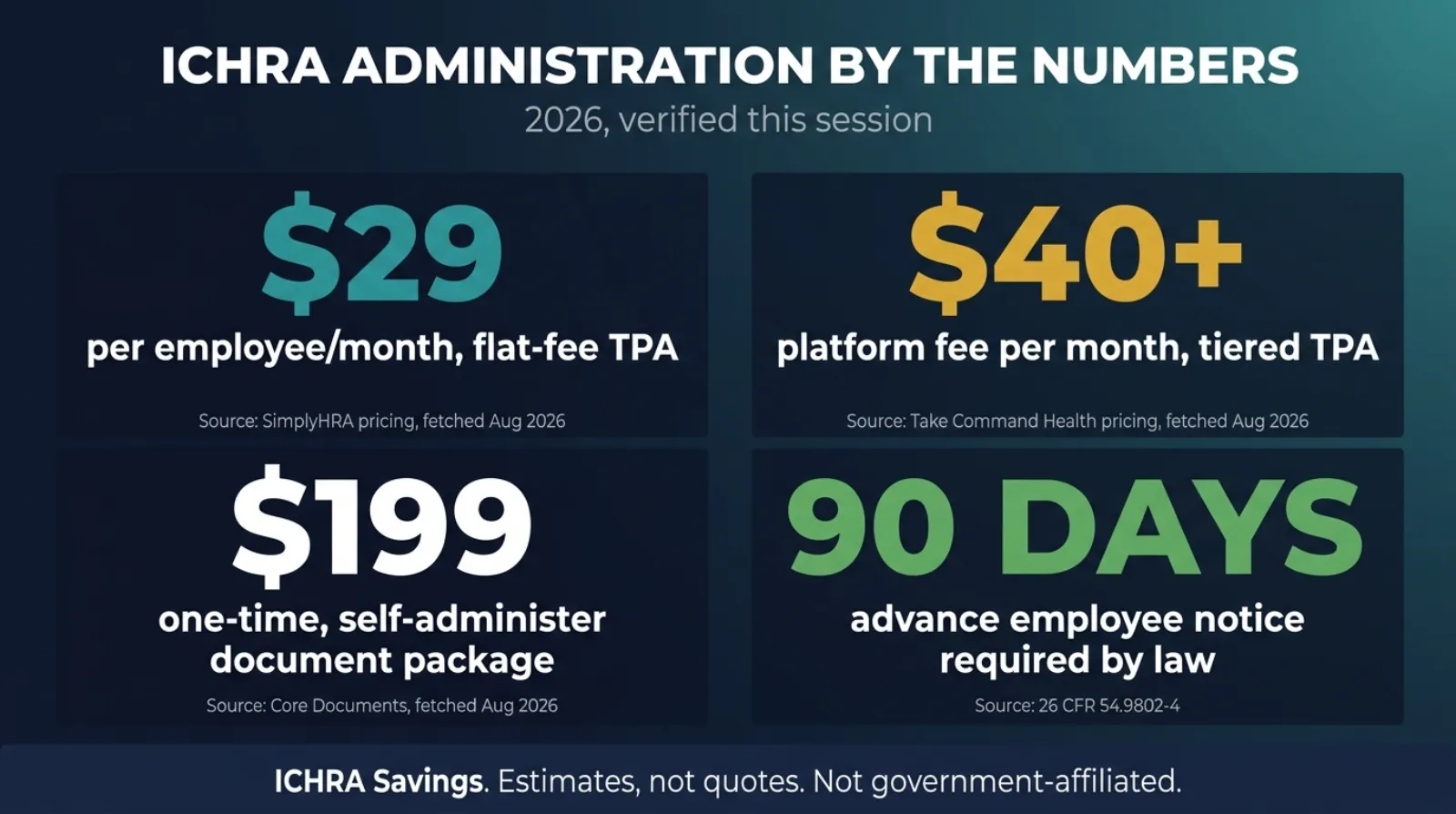
$199
One-time cost to self-administer, Core Documents
Fetched Aug 2026
$29
Flat monthly fee per employee, SimplyHRA
Fetched Aug 2026
$40+
Monthly platform-fee floor, Take Command Health
Fetched Aug 2026
90
Days' advance notice required by federal law
26 CFR § 54.9802-4
For scale, the average annual premium for family coverage across all employer-sponsored health insurance reached $26,993 in 2025, up 6% (about $1,408) from 2024, according to KFF's 2025 Employer Health Benefits Survey, a national figure. Next to that, even the priciest administration fee here is a small line item. The real question is not whether the fee is affordable in isolation. It is whether it is worth paying relative to what your specific counties actually save, which is a math problem, not a guess.
Self-administer or hire an administrator
The right answer depends on headcount, appetite for paperwork, and how much the "in the middle" feeling actually bothers you. There is no legal requirement to hire anyone; the decision is entirely about your own time and risk tolerance.
| Dimension | Self-administer | Flat-fee TPA | Platform TPA |
|---|---|---|---|
| Setup cost | $199-$249 one-time (Core Documents) | No setup fee (SimplyHRA) | No setup fee (Take Command) |
| Ongoing cost | $0 published recurring fee | $29/employee/month flat | $40+/month platform fee, plus a published per-employee rate |
| Who verifies substantiation | You, by hand, every reimbursement | The administrator | The administrator |
| Who sends the 90-day notice | You, using the DOL model notice | Usually generated by the platform | Usually generated by the platform |
| Best fit | Very small teams, hands-on owner | Small teams wanting one flat number | Larger or fast-growing teams wanting payroll integration |
A one- or two-person owner-operated business with a hands-on founder can genuinely self-administer: buy the document package, calendar the 90-day notice, and check substantiation by hand each month. Once a company gets past roughly 5 to 10 employees, the per-claim substantiation requirement alone tends to turn into a real recurring task, which is usually the point where paying a flat monthly fee starts looking cheap relative to the time it buys back.
A simple rule of thumb: if you already personally handle payroll, benefits questions and HR paperwork for your team without outside help, self-administering an ICHRA adds a manageable amount of work on top of what you are already doing. If HR runs through a payroll provider or a fractional HR person, a TPA that plugs into that same system usually saves more in avoided mistakes than it costs in fees, because a missed substantiation check does not show up as an error until an employee's reimbursement gets questioned or a plan year is audited. Neither path is legally required, and switching later is normal as a company grows past the size where the founder can realistically keep up with it by hand.
Who does what, in plain terms
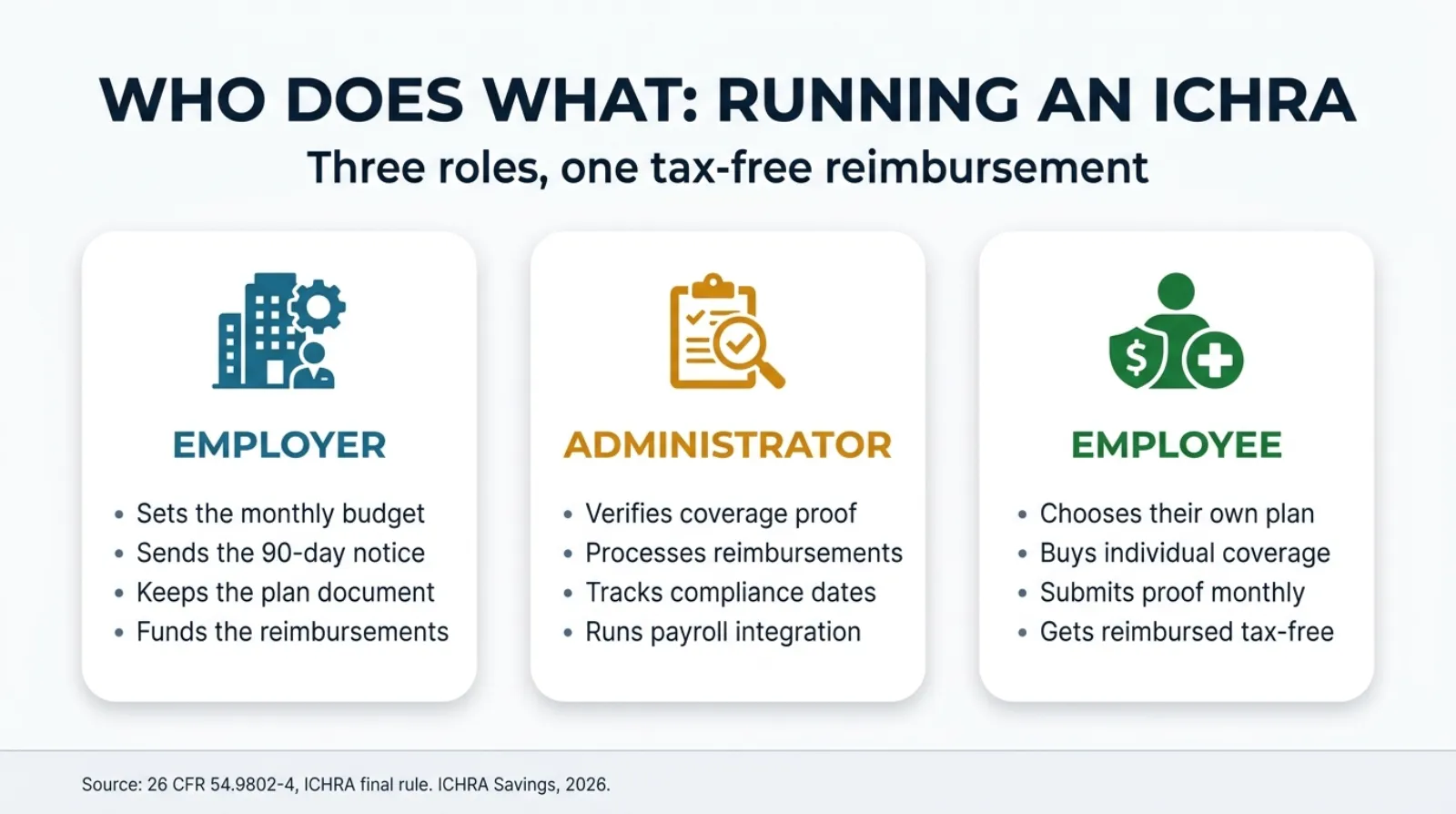
Every version of an ICHRA splits the same three jobs across the same three parties. Nothing about hiring an administrator changes who chooses the health plan; that decision stays with the employee in every single case.
| Role | What they actually do |
|---|---|
| Employer | Sets the monthly contribution, funds reimbursements, keeps the plan document and summary plan description, signs off on employee classes |
| Administrator (or you, if self-administering) | Sends the 90-day notice, collects and checks substantiation, processes reimbursement claims, tracks every compliance date |
| Employee | Shops the individual market, buys their own plan and network, submits proof of coverage, receives the reimbursement tax-free |
Notice what is not in that table: nobody but the employee ever chooses a specific health plan or network. If the "in the middle of my employees' health choices" fear is what has been holding you back, the fix is not avoiding an ICHRA. It is paying an administrator to run the parts you do not want to run, while the plan-choice decision that was never yours to make in the first place stays exactly where it already was.
A worked example: admin cost against real savings
Here is what a flat-fee administrator actually costs against real county-level savings, using the same benchmark dataset behind our savings map. Assume a 10-employee company and a $3,480-a-year flat-fee administrator at $29 per employee per month.
Here's the math: a strong-savings county
In Erie County, Ohio, the 2026 individual-market benchmark premium runs $545 a month against a small-group benchmark of $1,474 a month, an estimated 63.0% savings, or $11,145 per employee per year. For 10 employees, that is an estimated $111,451 a year in aggregate savings. A $3,480-a-year administrator fee is about 3.1% of that, a small slice of a large number.
Here's the math: a thinner-margin county
In Kings County, New York (Brooklyn), the 2026 individual-market benchmark runs $807 a month against a small-group benchmark of $1,043 a month, an estimated 22.7% savings, or $2,836 per employee per year. For the same 10-employee company, that is an estimated $28,357 a year in aggregate savings, and the same $3,480-a-year fee is now about 12.3% of the savings, still worth paying, but a noticeably thinner margin than Erie County's.
These are both real, currently qualifying counties from the 1309-county 2026 dataset behind the savings map, and they make the same point two different ways: the administration fee is a fixed, knowable number, but what it is worth paying depends entirely on your specific county's rate spread, not a national assumption. The average savings across every currently qualifying county in the dataset is 21.5%, or about $2,651 per employee per year, but averages hide exactly the kind of spread Erie and Kings Counties show here. Check your own counties before you decide an administrator's fee is or is not worth it.
Run your counties before you shop vendors
An administrator's fee is the same whether your county saves 5% or 60%. Check the savings map first so you know which situation you are actually in before you spend time comparing administration pricing.
Setting it up without the stress
Administration gets easier when the sequence is right. Six steps cover it, in order, whether you end up self-administering or hiring someone.
- Decide self-administer or TPA before you design the plan. This choice shapes your budget and your timeline, so make it early, not after the notice is already due.
- Check your counties on the savings map. Know what you are working with before you spend money on administration; a thin-margin county changes the math.
- Get the plan document and summary plan description in place. Whether from a self-administer package or your chosen TPA, this is the legal foundation everything else sits on.
- Calendar the 90-day notice now, not later. Count backward from your plan year start and put a hard deadline on the calendar, with the DOL model notice as your starting draft.
- Build the substantiation workflow before the first reimbursement. Decide, in writing, what proof of coverage you will accept and how you will check it every single claim.
- Budget for employee questions at enrollment. People who have never shopped the individual market need guidance once, and that support cost is real whether or not you count it on a vendor invoice.
See our full ICHRA setup timeline for the complete rollout plan, and our 2026 compliance deadlines guide for every federal date beyond the notice requirement.
Where administration actually breaks down
The recurring failure points
- Treating substantiation as a one-time task. It is required with every reimbursement request, not once a year, and skipping it on later claims is the most common compliance gap.
- Sending the notice late. Ninety calendar days is a hard floor, not a target, and counting from the wrong start date is an easy, avoidable mistake.
- Underestimating employee support at rollout. The administration fee covers claims processing, not necessarily the hand-holding a first-time individual-market shopper needs.
- Picking a vendor before checking the county math. A $40-plus-a-month platform fee is a bigger relative bite in a thin-margin county than a strong one; check the savings first.
Administration does not disappear when you skip an ICHRA. It just moves back to shopping small-group renewals every year instead.
Mike MooreEdge cases that change the administration picture
A handful of situations come up often enough to plan for before they surprise you, and none of them change the base pricing above; they change how much work that price is actually buying.
A new hire joins mid-year. The 90-day rule applies to the plan year, not to each individual employee. Under 26 CFR § 54.9802-4, someone who becomes eligible fewer than 90 days before the plan year starts, or after it has already started, gets their notice by the date their ICHRA coverage can begin instead of 90 days out. A good administrator, paid or self-run, has this exception built into the onboarding checklist rather than re-deriving it every time someone is hired.
An employee misses a substantiation deadline. The regulation is clear that a reimbursement cannot go out without proof of coverage for that claim period; the practical result is that the claim sits unpaid, not forfeited, until the employee provides it. This is exactly the kind of routine follow-up that eats an owner's time under self-administration and is precisely what a TPA's PEPM fee is paying for.
A remote or multi-state workforce. Administration pricing does not change by state; a $29-a-month flat fee is the same whether the employee lives in Ohio or California. What does change is the plan design underneath it, since employees in different rating areas see different individual-market prices, and a class structure built around location needs to be set up correctly from day one. See our guide to ICHRA for remote teams for how that plays out across state lines.
An employee declines the ICHRA. They still count for notice purposes, since the notice has to go to every eligible employee, but they generate no reimbursement claims and therefore no ongoing substantiation work. A workforce with a meaningful opt-out rate costs less to administer per enrolled employee than the per-head sticker price implies, though every published PEPM rate in this article is quoted per eligible employee, not per enrollee, so confirm which basis a vendor is actually pricing against before comparing quotes.
Where this isn't worth the trouble
Administration cost is rarely the reason an ICHRA fails to make sense; the county-level rate spread is. If your workforce sits mostly in counties where the individual market does not run meaningfully below small-group rates, no amount of cheap administration changes that answer, and paying even $29 a month per employee for a plan that is not saving you anything is not a good trade. A very small, single-owner business with no real appetite for compliance paperwork, and no interest in paying someone else to carry it, may also be better served by a simpler benefit or no formal HRA at all for now. Administration is a solvable logistics problem. It is not a substitute for checking whether your counties qualify in the first place.
How ICHRA Savings helps
None of the county math above requires talking to anyone. The savings map lets you look up any county in the country and see the same individual-market and small-group benchmark premiums used in this article, so you know your real savings margin before you spend a dollar on administration. Beyond the map, we help employers design an ICHRA correctly: setting employee classes, modeling affordability against a real census, and getting the compliance scaffolding, including the notice and substantiation workflow, right the first time. We do not run your payroll or process your reimbursements, and we never pick a plan for your employees; that part was always theirs.
Before anything else, check whether your county is one where this works: https://ichrasavings.com/ichra-savings-map/. Ten minutes there tells you whether the administration-cost conversation is even worth having for your business.
How these numbers are calculated
The county figures in this article come from the same dataset that powers our savings map, not a survey or a sales estimate. For each of the 1309 currently qualifying US counties, we compare a 2026 individual-market benchmark premium against a small-group benchmark premium built from comparable plan filings for that county's rating area; a county "qualifies" when the individual benchmark sits below the small-group benchmark. Both figures are cross-verified against CMS public-use marketplace files. Erie County, Ohio and Kings County, New York were selected because they show a strong-savings and a thin-margin example from the same live dataset, not because they are the highest or lowest figures on file.
The administration pricing in this article was fetched directly from each vendor's own current pricing page in August 2026 and is not tied to a specific insurance plan year; it reflects software and service pricing, which vendors can change at any time, so confirm current pricing directly with any vendor before budgeting against it. The 90-day notice and substantiation figures come from the codified federal regulation, 26 CFR § 54.9802-4, issued under the 2019 ICHRA final rule, and apply nationally regardless of plan year.
Questions employers actually ask
Do I have to hire a third-party administrator to offer an ICHRA?
No. Nothing in the federal ICHRA rule requires a paid administrator. An employer can self-administer, using a plan document and summary plan description package like the one Core Documents sells for a one-time $199 to $249 (fetched August 2026), and then handle notice, substantiation and reimbursements in-house. Most employers with more than a handful of people still hire an administrator, not because the law demands it, but because someone has to check proof of coverage and cut reimbursements every month without missing a deadline.
How much does ICHRA administration cost per employee in 2026?
It depends on the vendor and the model. SimplyHRA publishes a flat $29 per employee per month with no setup, platform or switching fees (fetched August 2026). Take Command Health's own pricing page lists ICHRA administration starting at $40-plus a month in platform fees for employers with 1 to 49 employees, and $100-plus or custom pricing at 50-plus employees (fetched August 2026), on top of a published per-employee rate. Self-administering skips the recurring fee entirely and costs a one-time $199 to $249 for the required plan documents, per Core Documents (fetched August 2026).
What is the 90-day notice requirement, exactly?
Federal regulation 26 CFR § 54.9802-4(c)(6)(i)(A) requires the ICHRA to give each eligible participant written notice at least 90 calendar days before the start of the plan year, unless the person becomes eligible less than 90 days before the plan year starts or later, in which case the notice is due by the date coverage can begin. This is a hard compliance deadline, not a suggestion, and it applies the same way in every state.
What does 'substantiation' mean, and how often do I have to do it?
Substantiation is proof that an employee (and any dependents on the reimbursement) is actually enrolled in qualifying individual health coverage or Medicare. Under 26 CFR § 54.9802-4(c)(5), the ICHRA has to get that proof once up front, generally by the first day of the plan year, and then again with every single reimbursement request for the rest of the plan year before it can pay a claim. It is not an annual checkbox; it is a per-claim requirement.
Does an ICHRA administrator pick health plans for my employees?
No, and this is the part employers most often get wrong in their heads. Whether you self-administer or hire the priciest platform on the market, the employee still shops the individual market and chooses their own plan and network. An administrator's job is verifying coverage, processing reimbursements and tracking deadlines, not selecting or recommending a specific health plan.
Is the administration cost worth it compared to what an ICHRA saves?
Usually, but it depends on your county. In a strong-savings county, a full-service administrator's fee can be a small single-digit share of the aggregate savings; in a thin-margin county the same fee can eat a meaningfully larger slice. Run your own counties before you assume either answer. The savings map shows the individual-market and small-group benchmark side by side for any county in the country.
Can I switch from self-administering to a TPA later, or the other way around?
Generally yes, and most employers time the switch to a plan-year renewal rather than mid-year, since your plan document and the notice you send employees need to reflect whoever is actually running the plan. Moving mid-year is possible but adds compliance details worth reviewing with a benefits attorney or qualified advisor first.
What happens if I send the required notice late?
A late or missing notice is a real compliance failure under 26 CFR § 54.9802-4, not a paperwork technicality, and it can affect whether the ICHRA is treated as properly offered for that plan year. If you think a notice went out late or incomplete, get in front of it with a benefits attorney rather than waiting to see if it becomes a problem at audit or renewal.
Sources
- SimplyHRA, "Pricing" ($29/employee/month flat-fee ICHRA administration, fetched August 2026)
- Take Command Health, "Pricing" ($40+/month platform fee, 1-49 employees; $100+/custom at 50+, fetched August 2026)
- Core Documents, "How To Set Up and Self-Administer a 2026 ICHRA for just $199" (fetched August 2026)
- 26 CFR § 54.9802-4, Cornell Law School Legal Information Institute (codified text of the notice and substantiation requirements, fetched August 2026)
- Federal Register, "Health Reimbursement Arrangements and Other Account-Based Group Health Plans" (ICHRA final rule, 84 Fed. Reg. 28888, June 20, 2019)
- U.S. Department of Labor, EBSA, "Individual Coverage HRA Model Notice"
- HRA Council, "Strong ICHRA Growth Among Large Employers..." (Growth Trends for ICHRA & QSEHRA, Vol. 5) (August 12, 2026)
- KFF, "Annual Family Premiums for Employer Coverage Rise 6% in 2025..." (2025 Employer Health Benefits Survey)
- ICHRA qualifying-county dataset,
src/data/qualified_counties.json, cross-verified against CMS public-use marketplace files, 2026 plan year