ICHRA Affordability Safe Harbors: The 2026 Guide
Three IRS safe harbors decide if your ICHRA is affordable in 2026: FPL, rate of pay, and W-2. See the exact math for each, worked out with real numbers.

The short version
- An ICHRA offer counts as "affordable" if it clears one of three IRS safe harbors: the federal poverty line (FPL), the rate of pay, or the Form W-2 wages test — all defined at 26 CFR 54.4980H-5(e)(2).
- For the 2026 plan year, every safe harbor formula uses the same required contribution percentage: 9.96%, set by IRS Revenue Procedure 2025-25.
- The FPL safe harbor produces one flat ceiling, about $129.90 a month, for every employee — easiest to run, but usually the most expensive for the employer to satisfy.
- The rate of pay and W-2 safe harbors scale to what each employee actually earns, and can lower the required ICHRA contribution by hundreds of dollars a month for a lower-earning employee, using the same benchmark premium.
- Applicable Large Employers face a real, sourced penalty for getting this wrong — $5,010 per affected employee for 2026. Smaller employers face a different cost: an ICHRA that quietly stops doing its job.
An ICHRA — Individual Coverage Health Reimbursement Arrangement, the IRS-defined arrangement that lets an employer set a fixed monthly budget and let each employee buy their own individual health plan with it, tax-free — is only "affordable" if it clears one of three federal tests the IRS calls affordability safe harbors: the federal poverty line test, the rate of pay test, and the Form W-2 wages test. Each one multiplies a different number by the same annual percentage, 9.96% for the 2026 plan year, to produce a ceiling on what an employee can be asked to pay before your offer counts as unaffordable. This piece walks through all three, works the actual 2026 math for a real county, and shows how the same benchmark premium can require three different minimum contribution amounts depending on which safe harbor you pick. None of the three is automatically correct for every business; the right one depends on how your payroll is structured, and picking without running the numbers is the single most avoidable mistake in an otherwise straightforward ICHRA rollout.
Why guessing at a contribution number is risky
You have a headcount, a renewal deadline, and a target monthly budget in your head. Maybe it's $400 a person, because that felt round and defensible when you said it out loud. What you don't have, at the moment you pick that number, is any idea whether it clears the federal bar for "affordable" — and that single word decides whether your ICHRA does what you set it up to do.
Get it wrong in one direction and an employee who should have been able to use your ICHRA tax-free instead has to weigh giving up a premium tax credit they were entitled to keep. Get it wrong in the other direction, as an Applicable Large Employer, and you can end up owing a real federal penalty for an employee who declines your offer and gets subsidized marketplace coverage instead. Neither mistake announces itself immediately. Both surface later, usually when someone else — an employee's tax preparer, an IRS letter, a benefits attorney doing a year-two audit — asks a question you cannot answer with a number you can source.
The fix is not complicated, but it is precise: pick one of three federal formulas, run the real 2026 numbers, and set your contribution against the answer instead of a round figure that felt right.
This is also not a one-time task you finish at launch and forget. The required contribution percentage changes every year — it moved from 9.02% for 2025 to 9.96% for 2026, and it moves again to 10.22% for 2027 — and the federal poverty guideline behind one of the three safe harbors resets every January. A contribution that cleared the bar cleanly at launch can drift out of compliance a year later even if you never touched the dollar amount, simply because the bar itself moved and your county's benchmark premium moved with it. Treat this as an annual reset, on the same calendar as your renewal, not a decision you make once.
What "affordable" actually means here
"Affordable" is a defined term, not a feeling. Under Internal Revenue Code section 36B and the employer shared responsibility rules of section 4980H, an offer of coverage is affordable if the employee's required contribution for self-only coverage does not exceed a set percentage of their income — the required contribution percentage, 9.96% for plan years beginning in calendar year 2026, per IRS Revenue Procedure 2025-25. The same percentage decides two separate things at once: whether an Applicable Large Employer (ALE) — broadly, one that averaged 50 or more full-time-equivalent employees the prior year — risks a penalty for that employee, and whether that employee is allowed to keep a premium tax credit if they buy marketplace coverage instead of using your ICHRA.
Because an employer usually has no legal way to see an employee's actual household income, the IRS built three shortcuts, called affordability safe harbors, that substitute a number the employer can see — a national poverty figure, an hourly wage, or a W-2 — for household income. Pass one of them and the employer is protected from a penalty for that employee, full stop, regardless of what the employee's real household income turns out to be.
One more term matters specifically for an ICHRA, and it is where employers most often get confused: the lowest-cost silver plan (LCSP), also called the applicable benchmark plan. For a traditional group plan, affordability is tested against the group premium itself. For an ICHRA, it is tested against something narrower: the age-rated LCSP premium available in the employee's rating area (the geographic pricing zone insurers use, which does not always match county lines), minus the monthly ICHRA amount the employer actually makes available. The IRS and Treasury call that difference the required HRA contribution, and it is what every safe harbor formula below actually gets applied to — not the raw insurance premium (ICHRA final rule, Federal Register document 2019-12571).
Terms used in this piece
ALE (Applicable Large Employer): averaged 50+ full-time-equivalent employees the prior calendar year; subject to the section 4980H penalties. LCSP: lowest-cost silver plan, the ACA benchmark plan used to price affordability. Rating area: the geographic zone insurers use to set premiums, set by each state, not always identical to county lines. Employee class: a permitted grouping (full-time, part-time, salaried, hourly, and others) an employer can use to offer different ICHRA amounts to different groups, as long as the rules inside each class stay uniform.
The three IRS safe harbors, at a glance
All three safe harbors answer the identical question — "does this employee's required HRA contribution stay under 9.96% of something?" — but each one swaps in a different stand-in for household income. Here is the full 2026 comparison, every figure sourced independently.
| Safe harbor | Formula | 2026 result | Citation |
|---|---|---|---|
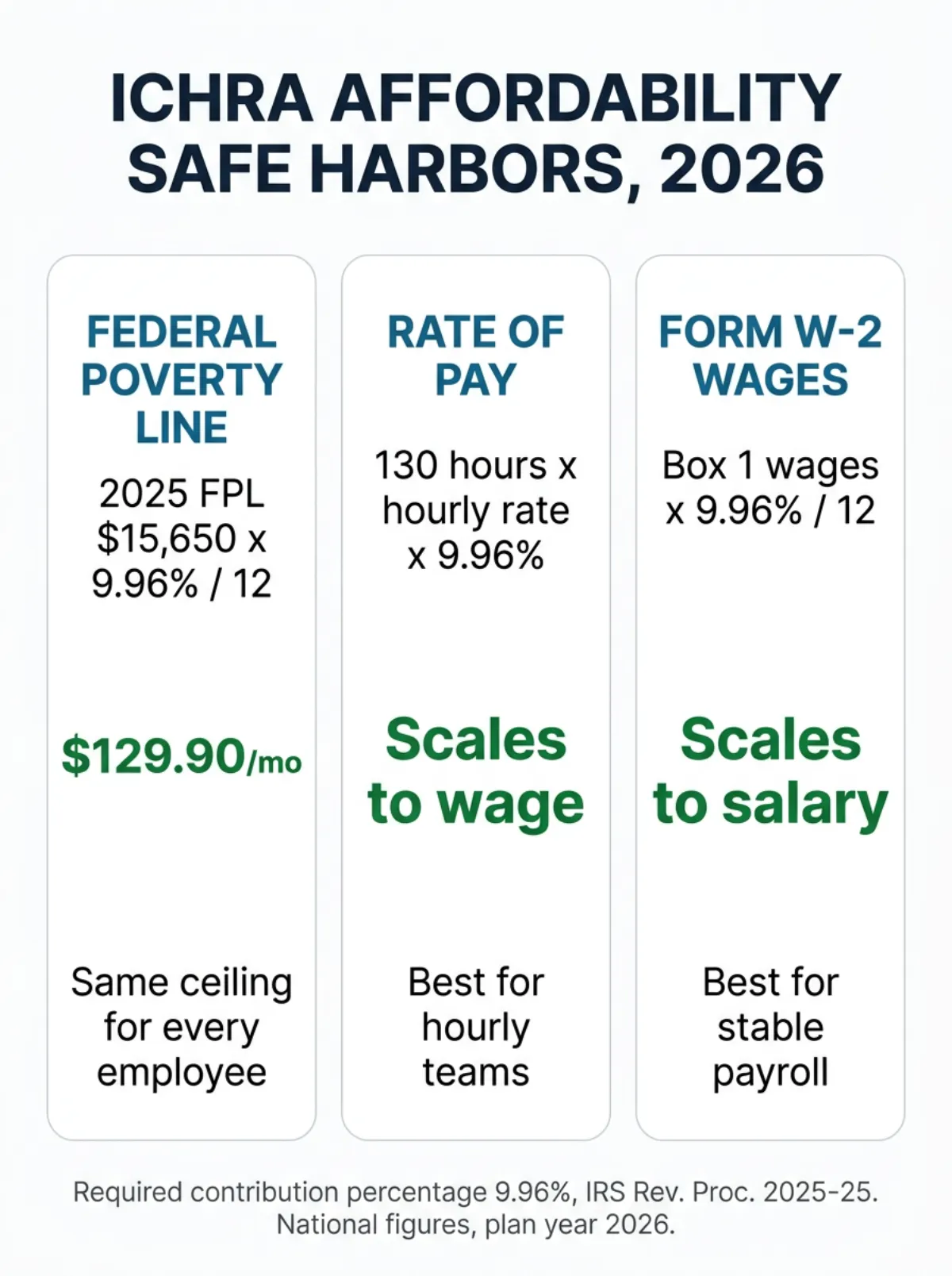
| Federal poverty line (FPL) | 2025 FPL, household of 1 × 9.96% ÷ 12 | $129.90/mo, flat | 26 CFR 54.4980H-5(e)(2)(iv) |
| Rate of pay | 130 hrs × hourly rate × 9.96% | Scales to hourly wage | 26 CFR 54.4980H-5(e)(2)(iii) |
| Form W-2 wages | Box 1 wages × 9.96% ÷ 12 | Scales to annual salary | 26 CFR 54.4980H-5(e)(2)(ii) |
The federal poverty line safe harbor
The FPL safe harbor swaps a household-income calculation no employer can verify for a single published number: the federal poverty guideline for a household of one. For a calendar-year plan beginning January 1, 2026, the rule lets an employer use the guideline "in effect within six months before the first day of the plan year" (26 CFR 54.4980H-5(e)(2)(iv)) — which means the 2025 guideline, published by HHS in the Federal Register on January 17, 2025, because the 2026 guideline would not exist yet at that six-month mark. That figure is $15,650 for one person in the 48 contiguous states and DC (90 Fed. Reg. 5917).
Multiply $15,650 by the 2026 required contribution percentage, 9.96%, and divide by twelve: $129.90 a month. That is the most any employee can be asked to pay, out of pocket, for the LCSP premium after your ICHRA contribution, for your offer to clear this specific safe harbor. It is the same number for every employee at every income level, which is exactly why it is the easiest of the three to administer — and, for most payrolls, the strictest, because it does not get more generous for a lower-earning employee the way the other two do.
The rate of pay safe harbor
The rate of pay safe harbor scales to what an employee is actually paid at the start of coverage. For an hourly employee, the rule multiplies 130 hours — a standardized full-time month, not the employee's actual hours worked — by the lower of their hourly rate at the start of the coverage period or their lowest hourly rate during the month, then applies the 9.96% ceiling (26 CFR 54.4980H-5(e)(2)(iii)). For a salaried employee, the same safe harbor applies 9.96% to their monthly salary as of the first day of the plan year instead.
Take an hourly employee earning $22 an hour. 130 hours × $22 = $2,860 in standardized monthly pay. 9.96% of that is $284.86 — more than double the flat FPL ceiling, because this employee's actual pay supports a higher affordable cost-share than the flat poverty-line number assumes. The tradeoff is administrative: this safe harbor has to be recalculated whenever a rate of pay changes, and hourly employers with wide pay bands end up running the formula separately for groups of employees rather than once for the whole class.
The Form W-2 wages safe harbor
The W-2 safe harbor uses the number your payroll system already produces every year: Box 1 wages on the employee's Form W-2. The rule applies the same 9.96% to those wages, divided by twelve (26 CFR 54.4980H-5(e)(2)(ii)). Unlike the other two, this safe harbor is tested after the year ends, against actual wages paid that year — which makes it the most precise of the three but also the hardest to use for setting a contribution amount in advance, since you are testing against a number you cannot know for certain until December.
Take a salaried employee earning $52,000 a year. $52,000 × 9.96% ÷ 12 = $431.60 a month — close to the rate of pay result for a comparably-paid hourly worker, because both methods scale to real earnings rather than a flat national figure. Most employers who use the W-2 safe harbor do so retroactively, as a confirmation check at year end, while using the FPL or rate of pay method to set the actual contribution going into the year.
Two things ICHRA adds on top
The three safe harbors above are general ACA employer-mandate rules; they existed before ICHRA did and apply to any employer coverage offer. The ICHRA final rule (Federal Register document 2019-12571) layers two more mechanisms on top, specific to how an ICHRA prices affordability against the individual market rather than a single group plan.
The location safe harbor. Because an ICHRA reimburses employees who may live in different rating areas, the rule lets an employer use either the employee's residence or their primary site of employment to identify the applicable LCSP premium — administratively useful for a company with a home office and a distributed workforce, since it means one consistent location can be used per employee rather than tracking moves in real time for affordability purposes specifically.
The look-back month safe harbor. Instead of pricing the LCSP fresh every month, a calendar-year ICHRA can use the January LCSP premium of the prior calendar year to set affordability for the whole upcoming plan year, applying the current year's age and location to that premium. This is what lets an employer set a single contribution amount before a plan year starts and know it will hold, rather than re-testing affordability every month as rates and ages shift.
One county, three safe harbors, three answers
Here is the whole mechanism worked through on one real county: Jackson County, Missouri, home to Kansas City. The 2026 individual-market benchmark premium there (age-50, silver tier) runs an estimated 27.6% below the small-group benchmark, a gap of about $2,800 a year per employee — which is exactly the kind of county this site's savings map exists to surface, alongside the rest of the state on our Missouri savings page. Set that county-level question aside for a moment and look only at affordability: the same $613-a-month LCSP benchmark premium produces three different minimum ICHRA contributions depending on which safe harbor you pick.
| Safe harbor | Employee's affordable ceiling | Minimum ICHRA needed |
|---|---|---|
| FPL (flat, any employee) | $129.90/mo | $483.30/mo |
| Rate of pay ($22/hr employee) | $284.86/mo | $328.34/mo |
| W-2 ($52,000/yr employee) | $431.60/mo | $181.60/mo |
Minimum ICHRA contribution to clear each safe harbor
Same $613/mo benchmark premium, Jackson County, MO, 2026 plan year. Source: qualified_counties.json plus IRS Rev. Proc. 2025-25 and 26 CFR 54.4980H-5(e)(2).
Illustrative employees chosen to show the mechanism; your own payroll will produce different figures. Not an offer of insurance, a quote, or a guarantee of savings.
The spread is not a rounding error. Between the flat FPL method and the W-2 method for this $52,000-a-year employee, the minimum compliant contribution moves by $301.70 a month — $3,620 a year, on the identical benchmark premium, in the identical county. An employer using the FPL safe harbor across the board is not wrong; they are simply choosing the most conservative, least payroll-dependent method, and paying for that simplicity in a larger required contribution. An employer with a lower-earning workforce and the payroll infrastructure to run the other two formulas correctly can often set a smaller, equally compliant contribution instead.
This is a payroll question before it is a benefits question
The right safe harbor for your business is mostly a function of how your payroll already runs, not a philosophical preference. Hourly, wage-band workforce: rate of pay usually fits. Mixed salaried office staff: W-2 is precise but retrospective. Want one number and one calculation, full stop: FPL is the only one that does not depend on anyone's pay.
Which safe harbor actually fits your payroll
Choose FPL if...
You want one contribution amount for an entire class, do not want to track individual pay for compliance, and can afford the most conservative (highest) ceiling.
Choose rate of pay if...
Your workforce is mostly hourly, pay rates are stable through the year, and your payroll system can flag rate changes so the calculation gets rerun.
Choose W-2 if...
Your team is mostly salaried with predictable annual pay, and you are comfortable confirming affordability after the fact rather than only in advance.
Nothing stops an employer from running all three formulas for a representative sample of employees before choosing — in fact, that is the only reliable way to know which one actually produces the lowest required contribution for your specific workforce. The FPL safe harbor is not automatically the "safe" choice in a cost sense; it is only the simplest to compute.
How this interacts with employee classes
An ICHRA lets an employer split its workforce into permitted employee classes — full-time, part-time, salaried, hourly, seasonal, and several others defined in the final rule — and offer a different contribution amount to each class. Affordability is tested separately, class by class, which is exactly why the safe-harbor choice above matters more for a mixed workforce than a uniform one. A company with a salaried office staff and an hourly warehouse crew is not required to use the same safe harbor for both groups; it can run the W-2 method against the office class and the rate of pay method against the warehouse class, and set two different contribution floors that each reflect how that group is actually paid.
What it cannot do is cherry-pick the friendliest safe harbor for each individual employee inside the same class to minimize the contribution owed to any one person. The rule requires uniform treatment inside a class: whichever safe harbor an employer picks for a class has to apply to everyone in it, tested consistently. Decide the method at the class level, before you run anyone's individual numbers, and the rest of this article's arithmetic applies cleanly. Decide it employee by employee and you are no longer inside the safe harbor at all.
What getting it wrong actually costs
Two separate costs are in play, and they land on different employers.
For an Applicable Large Employer (50+ full-time-equivalent employees), an unaffordable offer that leads an employee to claim a marketplace premium tax credit can trigger a section 4980H(b) penalty: $5,010 per affected employee for the 2026 plan year, per IRS Revenue Procedure 2025-26. A related but separate penalty, 4980H(a), applies if an ALE fails to offer coverage broadly enough in the first place — $3,340 per full-time employee, minus the first 30, for 2026. These are indexed every year, and both went up from 2025 levels; do not assume last year's dollar figure still applies. See our guide to the 50-employee ALE rule for the full FTE counting method.
Put a number on it. A 60-person ALE sets a flat contribution using a safe harbor it never actually calculated, the offer turns out unaffordable for a subset of the lower-paid class, and five of those employees decline it and buy a subsidized marketplace plan instead. Five affected employees at $5,010 each is $25,050 in 4980H(b) exposure for the 2026 plan year — real money, for a mistake a single spreadsheet formula would have caught before the plan year even started.
For a smaller employer under the ALE threshold, there is no 4980H penalty exposure at all — but there is a quieter cost. An ICHRA that fails the affordability test for an employee does not stop being legal; it just stops accomplishing what most small employers actually want, because that employee has to choose between using the ICHRA and keeping a premium tax credit they may be relying on. An employer who set a contribution without running any of the three safe harbors has no way to know, in either direction, whether their offer is protecting employees' subsidy eligibility the way they assumed it was.
Either way, the tradeoff is the same and worth stating plainly: taking an ICHRA that is considered affordable generally means an employee waives their premium tax credit for the months that offer applies. Our ACA subsidy cliff guide covers the income side of that same interaction in more detail.
Setting your 2026 contribution, step by step
None of the arithmetic above is complicated once you have the right inputs in front of you. What trips employers up is skipping a step, not misunderstanding the math. Work through these in order and each one feeds the next.
- Pull your actual county's LCSP benchmark premium, age-rated, for the rating area where each class of employees lives or works — not a national average.
- Pick one safe harbor per employee class — FPL for simplicity, rate of pay for an hourly team, W-2 for a salaried team — and apply it uniformly inside that class.
- Run the 2026 numbers, not last year's: 9.96% is this year's percentage, and the FPL figure resets every January.
- Subtract the safe-harbor ceiling from the benchmark premium to get your minimum compliant contribution, the same arithmetic worked through above.
- Document which safe harbor you used and why, in writing, before the plan year starts — this is the single easiest thing to produce later if anyone asks.
- Send the required employee notice on time, generally at least 90 days before the plan year begins, explaining the ICHRA and the premium-tax-credit tradeoff.
Where employers actually trip on this
- Reusing last year's dollar ceiling. The required contribution percentage and the federal poverty line both reset annually; 2025's numbers do not carry over to 2026.
- Testing against the group-style premium instead of the LCSP-minus-contribution formula. ICHRA affordability is the required HRA contribution, not the raw premium.
- Switching safe harbors employee by employee inside the same class to chase the smallest number, instead of applying one method uniformly.
- Assuming "we're too small for a penalty" means the math does not matter. Non-ALEs face no 4980H(b) penalty, but an unaffordable offer still costs an employee their subsidy eligibility.
- Picking a round contribution number first and working backward to justify it, rather than starting from the safe-harbor ceiling.
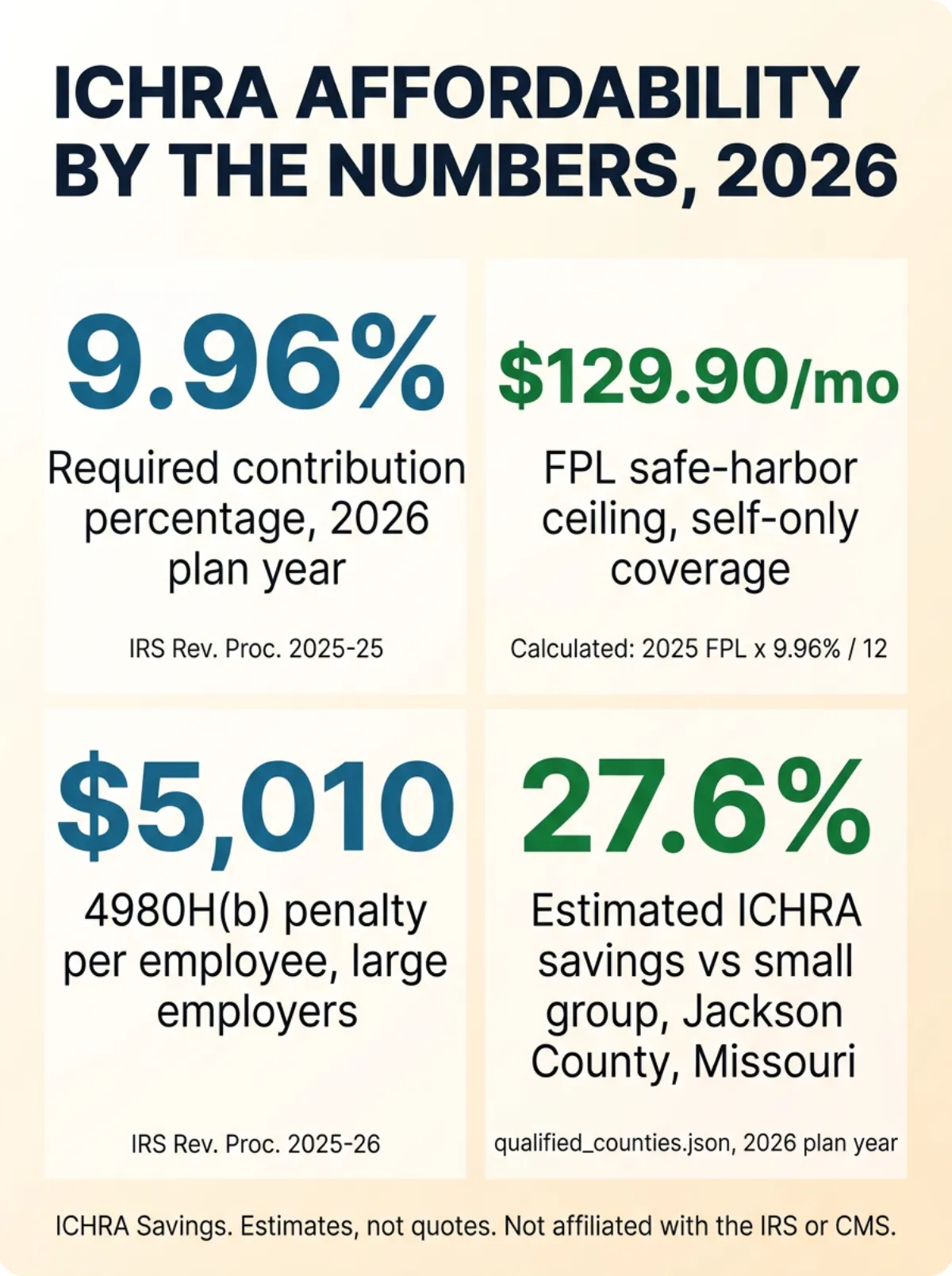
9.96%
2026 required contribution percentage, all three safe harbors
$129.90
Flat FPL safe-harbor ceiling, self-only, per month
$5,010
4980H(b) penalty per affected employee, ALEs, 2026
3
Federal safe harbors an employer can choose from
The FPL safe harbor is not the "correct" one. It is the one that asks the least of your payroll system and the most of your budget.
Mike MooreWhere ICHRA Savings fits
Affordability math tells you the floor your contribution has to clear. It does not tell you whether an ICHRA is the cheaper way to cover your team in the first place — that is a separate, county-specific question, and it is the one our county savings map is built to answer, using the same 2026 plan-year dataset behind the Jackson County numbers above. Before anything else, check whether your county is one where the individual market actually beats small group: https://ichrasavings.com/ichra-savings-map/. If the county math works and you want to see the full mechanics before talking to anyone, start here. If your renewal is already in hand and you are working against a real deadline, that is worth a conversation: https://ichrasavings.com/book.
What you get from getting this right
Get the safe harbor right and you get something concrete: an ICHRA contribution you can defend with a specific federal formula, employees who know exactly whether they are keeping or trading their subsidy eligibility, and — if you are an ALE — a documented reason a 4980H(b) penalty letter does not apply to a given employee. None of that requires guessing.
Questions employers actually ask
What is an ICHRA affordability safe harbor?
It is one of three IRS-approved shortcuts an employer can use to prove that an Individual Coverage HRA offer counts as "affordable" without calculating each employee's actual household income, which an employer generally cannot see. The three are the federal poverty line (FPL) safe harbor, the rate of pay safe harbor, and the Form W-2 wages safe harbor, all defined at 26 CFR 54.4980H-5(e)(2). Passing any one of them protects the employer from a section 4980H(b) penalty for that employee, and generally means that employee has waived eligibility for a premium tax credit for the months the offer applies.
What is the 2026 ICHRA affordability percentage?
For plan years beginning in calendar year 2026, the IRS set the required contribution percentage at 9.96% of income, per Revenue Procedure 2025-25. That is the figure every safe harbor formula below multiplies against, whether the "income" stand-in is the federal poverty line, an hourly rate of pay, or Form W-2 wages. It rises to 10.22% for plan years beginning in 2027, per Revenue Procedure 2026-26.
Which ICHRA safe harbor should a small employer use?
There is no single right answer; it depends on your payroll. The FPL safe harbor is the easiest to administer because it produces one flat dollar ceiling for every employee, but it is also the strictest, meaning it requires the largest ICHRA contribution to satisfy for a given benchmark premium. The rate of pay and W-2 safe harbors scale to what each employee actually earns, which usually lets a lower-earning employee's offer qualify as affordable with a smaller contribution than the FPL method would require. Many employers use the FPL safe harbor for simplicity and accept that it is the most conservative choice, then revisit it once a payroll system can automate the other two.
Can an employer use different safe harbors for different employees?
Yes, but not employee by employee at will. The safe harbors must be applied uniformly and consistently for all employees in a given class of employees receiving an ICHRA offer, per the ICHRA final rule's affordability provisions (Federal Register document 2019-12571). An employer can choose one safe harbor for its full-time class and a different one for a part-time class, for example, but cannot switch methods employee by employee inside the same class to chase the lowest number.
Does passing a safe harbor guarantee my ICHRA is affordable for every employee?
No. A safe harbor is a shortcut an employer can rely on for its own penalty protection under section 4980H; it is not a guarantee about any individual employee's actual circumstances, and it does not override that employee's own eligibility determination when they apply for marketplace coverage. It also does not guarantee savings, a specific premium, or a specific tax outcome for any employer or employee. Confirm your specific numbers with a qualified tax advisor or benefits attorney before finalizing a contribution amount.
What happens if my ICHRA is not affordable for an employee?
That employee may decline the ICHRA and shop the ACA marketplace instead, potentially claiming a premium tax credit if their income qualifies. If your business is an Applicable Large Employer (50 or more full-time-equivalent employees) and that employee receives a subsidized marketplace plan, you may owe a section 4980H(b) penalty for that employee: $5,010 for the 2026 plan year, per IRS Revenue Procedure 2025-26. Employers under the ALE threshold do not face that specific penalty, but an unaffordable offer still means the employee cannot use the ICHRA tax-free without giving up their subsidy, which usually defeats the point of offering it.
Does the ICHRA affordability test work the same way as the regular ACA employer mandate test?
Almost, with one ICHRA-specific twist. A traditional group plan is tested against the group premium itself. An ICHRA is tested against the "required HRA contribution": the age-rated premium for the lowest-cost silver plan (LCSP) in the employee's rating area, minus the monthly ICHRA amount the employer makes available. The three safe harbor formulas — FPL, rate of pay, and W-2 — are applied to that required HRA contribution, not to the raw premium. This mechanism comes from the ICHRA final rule itself (Federal Register document 2019-12571), not from the general section 4980H regulations, which only set the safe harbor percentages and formulas.
Where do the federal poverty line and required contribution percentage figures actually come from?
The required contribution percentage is published annually by the IRS in a Revenue Procedure under Internal Revenue Code section 36B: 9.96% for 2026 (Rev. Proc. 2025-25) and 10.22% for 2027 (Rev. Proc. 2026-26). The federal poverty guideline is published annually by HHS in the Federal Register: $15,650 for a household of one in the 48 contiguous states and DC, published January 17, 2025, which is the figure calendar-year 2026 plans use under the safe harbor's look-back rule. Neither figure is estimated by ICHRA Savings; both are read directly from the federal source and cited below.
| Figure | Value | Geography | Source |
|---|---|---|---|
| Required contribution percentage, plan years beginning 2026 | 9.96% | National | IRS Rev. Proc. 2025-25 |
| Required contribution percentage, plan years beginning 2027 | 10.22% | National | IRS Rev. Proc. 2026-26 |
| HHS federal poverty guideline, household of one (used for calendar-year 2026 plans) | $15,650/yr | 48 contiguous states + DC | HHS/Federal Register, 90 FR 5917 (Jan. 17, 2025) |
| FPL safe-harbor monthly ceiling, self-only coverage, 2026 | $129.90/mo | 48 contiguous states + DC | Calculated: $15,650 × 9.96% ÷ 12 |
| Rate of pay safe-harbor formula | 130 hrs × hourly rate × 9.96% | National | 26 CFR 54.4980H-5(e)(2)(iii) |
| Form W-2 wages safe-harbor formula | Box 1 wages × 9.96% ÷ 12 | National | 26 CFR 54.4980H-5(e)(2)(ii) |
| Federal poverty line safe-harbor formula | FPL × 9.96% ÷ 12 | National | 26 CFR 54.4980H-5(e)(2)(iv) |
| ICHRA "required HRA contribution" formula (LCSP minus ICHRA amount) plus location and look-back month safe harbors | LCSP − ICHRA contribution | National | ICHRA final rule, Federal Register doc. 2019-12571 (June 20, 2019) |
| 4980H(a) penalty per full-time employee (minus first 30), plan year 2026 | $3,340 | National | IRS Rev. Proc. 2025-26 |
| 4980H(b) penalty per affected employee, plan year 2026 | $5,010 | National | IRS Rev. Proc. 2025-26 |
| 2026 individual-market benchmark premium (age-50 silver) | $613/mo | Jackson County, MO | qualified_counties.json, 2026 plan year |
| 2026 small-group benchmark premium (age-50 silver) | $847/mo | Jackson County, MO | qualified_counties.json, 2026 plan year |
| Estimated ICHRA savings vs. small group | 27.6% ($2,800/yr per employee) | Jackson County, MO | qualified_counties.json, 2026 plan year |
| Minimum ICHRA contribution to satisfy the FPL safe harbor | $483.30/mo | Jackson County, MO | Calculated: $613.20 − $129.90 |
| Minimum ICHRA contribution to satisfy the rate of pay safe harbor ($22/hr employee) | $328.34/mo | Jackson County, MO | Calculated: $613.20 − (130×$22×9.96%) |
| Minimum ICHRA contribution to satisfy the W-2 safe harbor ($52,000/yr employee) | $181.60/mo | Jackson County, MO | Calculated: $613.20 − ($52,000×9.96%÷12) |
| Spread between the FPL and W-2 minimum contributions, same premium | $301.70/mo ($3,620/yr) per employee | Jackson County, MO | Calculated from the three rows above |
Sources
- IRS, Revenue Procedure 2025-25 (2026 ACA/ICHRA required contribution percentage, 9.96%)
- IRS, Revenue Procedure 2026-26 (2027 required contribution percentage, 10.22%)
- IRS, Revenue Procedure 2025-26 (2026 section 4980H(a)/(b) penalty amounts, $3,340 / $5,010)
- HHS, "Annual Update of the HHS Poverty Guidelines" (Federal Register Vol. 90, No. 11, Jan. 17, 2025; 2025 FPL, household of one: $15,650)
- 26 CFR 54.4980H-5(e)(2) (Cornell Legal Information Institute; the three affordability safe harbor formulas)
- IRS, "Questions and Answers on Employer Shared Responsibility Provisions" (general safe harbor descriptions)
- ICHRA final rule — Departments of the Treasury/IRS, Labor, and Health and Human Services, Federal Register document 2019-12571 (June 20, 2019): the required HRA contribution formula, location safe harbor, and look-back month safe harbor
- County-level premium comparison:
src/data/qualified_counties.json, 2026 plan year (Ideon rate data, cross-verified against CMS public-use marketplace files)