ICHRA and HSA in 2026: The New IRS Bronze Rule
IRS Notice 2026-5 made ACA bronze and catastrophic plans HSA-eligible for 2026. See how a premium-only ICHRA can pair with an HSA, and where it cannot.
The short version
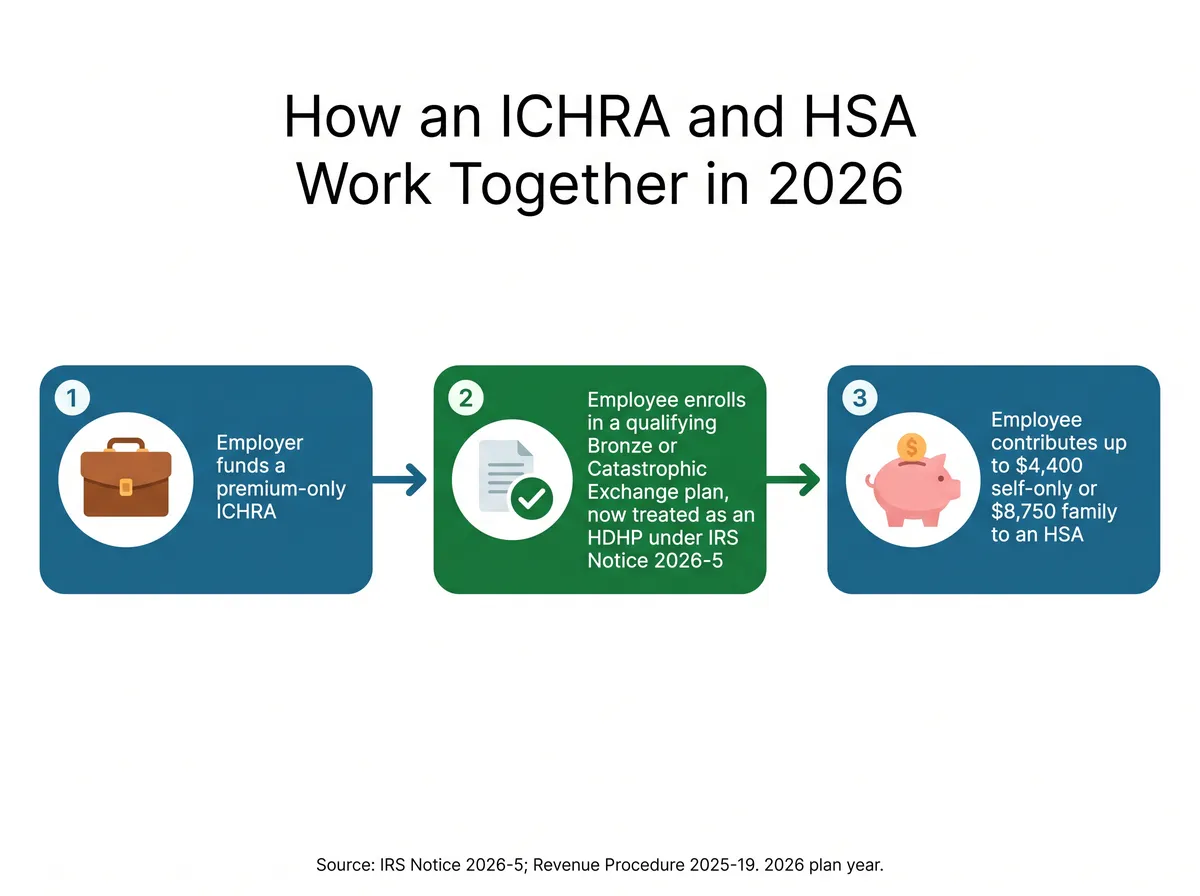
- Yes, an ICHRA and an HSA can work together in 2026, if the ICHRA reimburses premiums only and the employee is on a plan that counts as an HDHP.
- IRS Notice 2026-5 made every ACA bronze and catastrophic Exchange plan count as an HDHP for months beginning after December 31, 2025, whether or not it meets the standard deductible and out-of-pocket test.
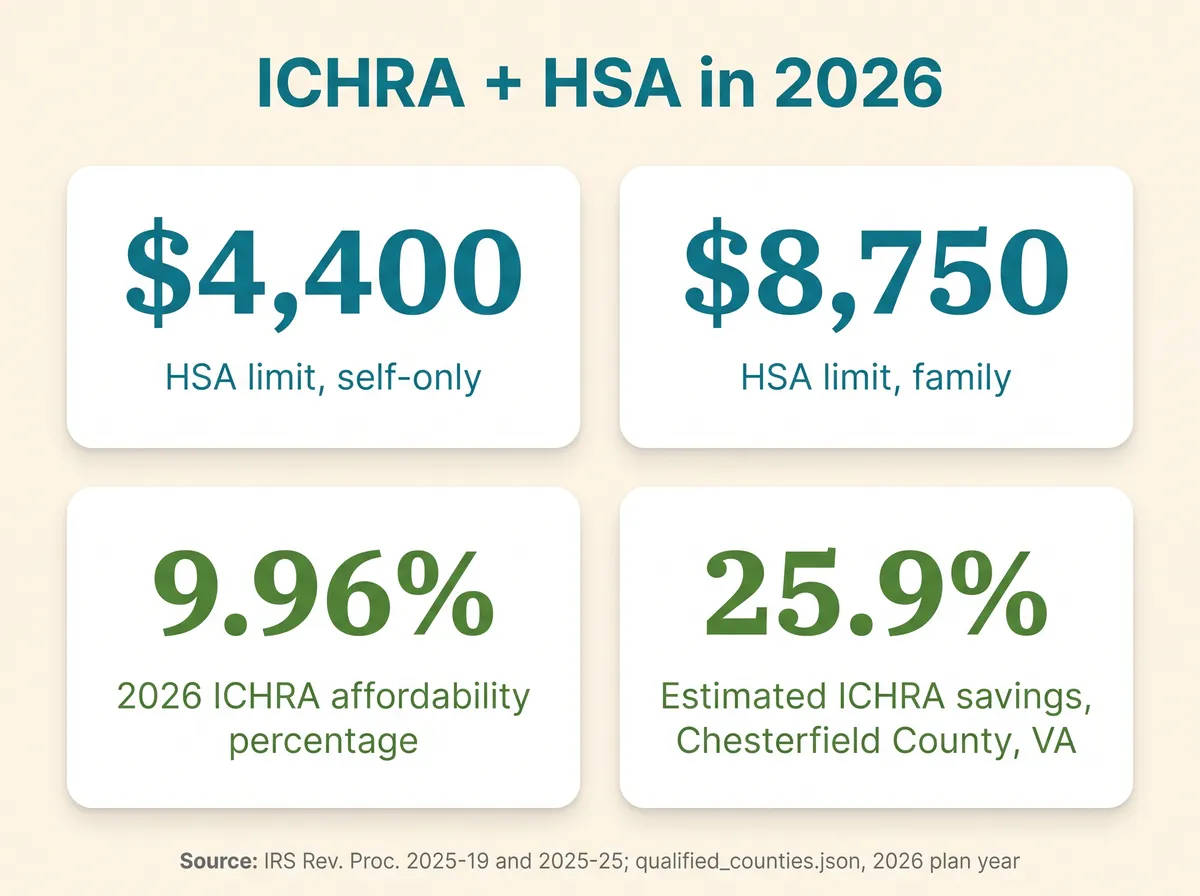
- The 2026 HSA contribution limits are $4,400 self-only and $8,750 family, per Revenue Procedure 2025-19; the 2026 ICHRA affordability percentage is 9.96%, per Revenue Procedure 2025-25, a separate calculation.
- The one rule that has not changed: an ICHRA that reimburses anything beyond premiums generally disqualifies the employee from HSA eligibility, regardless of the plan.
- All figures here are national and regulatory; whether an ICHRA saves money against your small-group renewal still depends on your specific county.
Can you combine an ICHRA and an HSA?
Yes, and as of the 2026 plan year, it is easier to qualify for than it used to be. An Individual Coverage HRA (ICHRA) can sit alongside a Health Savings Account (HSA) for the same employee, as long as two things are both true: the ICHRA reimburses insurance premiums only, with no other medical expenses, and the employee is enrolled in a plan that counts as a high-deductible health plan (HDHP) under Internal Revenue Code Section 223.
That second condition used to be the sticking point. Most of the individual-market bronze and catastrophic plans that pair naturally with a modest ICHRA contribution did not reliably meet the federal deductible and cost-sharing structure that defines an HDHP. IRS Notice 2026-5, issued by the Treasury Department and the IRS to implement part of the One Big Beautiful Bill Act (OBBBA), changed that. For months beginning after December 31, 2025, every bronze plan and every catastrophic plan sold as individual coverage through an Exchange counts as an HDHP, regardless of whether its actual deductible and out-of-pocket design would otherwise qualify. That is a real, dated regulatory change, not a workaround, and it is the reason this question is worth a fresh answer for 2026.
What changed
A new IRS notice makes far more individual-market plans HSA-eligible, starting with the 2026 plan year.
What did not change
The ICHRA still has to be premium-only. Reimburse anything else, and HSA eligibility is gone.
What still depends on your county
Whether the ICHRA costs less than your small-group renewal is a separate, geography-specific question.
Why this question keeps coming up
You want to give employees a fixed monthly budget so your benefit line item stops moving around every renewal. You also do not want to take away something an employee already values: a Health Savings Account they have been quietly building for a few years, using it to pay for orthodontia, a new pair of glasses, or just a cushion against a bad year. Most of the plain-English explainers an employer finds when researching ICHRA say some version of "pick one," as if the two benefits were mutually exclusive by design. They are not, and they never fully were, but the practical odds of an individual-market plan actually qualifying as an HDHP used to be lower than most people realized.
The confusion is understandable. An ICHRA and an HSA solve different problems and are governed by different sections of the tax code: the ICHRA is an employer-funded arrangement created by the 2020 ICHRA final rule from the IRS, the Department of Labor and HHS, while HSA eligibility is a personal tax status governed by Internal Revenue Code Section 223 and tied to whether the employee's health plan meets the HDHP definition. Whether those two things can coexist for a given employee comes down to plan design, not employer intent, and the plan-design math changed materially on January 1, 2026. If you are still deciding between an ICHRA and a QSEHRA before you even get to the HSA question, our ICHRA vs QSEHRA comparison covers that first choice.
The people who ask this question are usually not asking out of idle curiosity. An HR lead who already runs payroll for a small team has typically heard two competing pieces of advice from two different sources: a broker who says ICHRA and HSA "don't mix," and an employee, often one who has had an HSA at a previous job, who assumes their new benefit should work the same way. Both are half right. The broker is describing the older, general rule correctly for a plan that does not meet the standard HDHP test. The employee is describing what they want, which the 2026 rule change now makes achievable for a specific, identifiable slice of individual-market plans.
There is also a version of this question that comes from the employer side of a rollout that has already started. A company sets up an ICHRA, employees start shopping the individual market, and partway through open enrollment someone asks whether the bronze plan they are eyeing, the one with the lowest premium on the list, will let them keep contributing to the HSA they have used for years. Getting that answer wrong, in either direction, either telling an employee no when the answer is now yes, or telling them yes without confirming the ICHRA itself is premium-only, creates a cleanup problem after the fact that is considerably more expensive than getting the plan design right before the notice goes out.
What actually changed on January 1, 2026
A quick round of definitions, since the rest of this article leans on them. A high-deductible health plan (HDHP) is a health plan that meets specific minimum-deductible and maximum-out-of-pocket thresholds set annually by the IRS; enrollment in an HDHP, with no other disqualifying coverage, is the gateway requirement for HSA eligibility. A bronze plan is one of the four ACA metal tiers, defined in ACA Section 1302(d)(1)(A), designed to cover roughly 60% of an average enrollee's costs, which typically means a high deductible and lower monthly premium. A catastrophic plan, under ACA Section 1302(e), is a stripped-down, typically lower-premium plan generally limited to enrollees under 30 or those who qualify for a hardship or affordability exemption.
IRS Notice 2026-5 states that, for months beginning after December 31, 2025, bronze and catastrophic plans available as individual coverage through an Exchange "are treated as HDHPs," regardless of whether they independently satisfy the general Section 223 deductible and cost-sharing requirements. In plain terms: an employee enrolled in a qualifying bronze or catastrophic plan through the marketplace is now HSA-eligible on the plan-design side of the test, even if that specific plan's deductible or first-dollar coverage would not have cleared the bar under the older, general HDHP rule. The notice also directly addresses ICHRA: using an ICHRA to purchase a qualifying bronze or catastrophic plan does not, on its own, disqualify that plan from HDHP status.
This did not happen in isolation. It is one piece of a broader set of HSA expansions under the One Big Beautiful Bill Act that Notice 2026-5 implements, including a separate, previously finalized rule permanently allowing telehealth and other remote-care services to be covered before the deductible is met without breaking HSA eligibility, effective for plan years beginning on or after January 1, 2025.
Why bronze and catastrophic plans matter for ICHRA specifically
Bronze and catastrophic plans tend to have the lowest monthly premiums on the individual market, which makes them the most common plans an employee actually chooses when an employer's ICHRA contribution is modest. Before this notice, those same low-premium plans were the ones least likely to independently satisfy the HDHP deductible test, which meant the plans an ICHRA most naturally funded were often the ones that blocked HSA eligibility. Notice 2026-5 closes that specific gap.
The one rule that has not changed
None of this changes the older, separate rule that actually protects HSA eligibility on the employer's side of the arrangement: the HRA itself has to reimburse insurance premiums only. Notice 2026-5 is explicit that an ICHRA still has to comply with existing guidance, specifically IRS Notice 2008-59, to avoid constituting disqualifying coverage. An HRA that reimburses copays, coinsurance, prescriptions, or any other first-dollar medical expense generally counts as its own form of health coverage, and having that coverage disqualifies the employee from contributing to an HSA for that period, regardless of what plan they are enrolled in or how the plan itself is treated for HDHP purposes.
That means an employer choosing to preserve employee HSA eligibility has to make an explicit, affirmative plan-design decision: build the ICHRA as a premium-reimbursement-only arrangement for that employee class. It is not the default configuration many payroll or benefits administration platforms ship with, and it is worth confirming in writing with whichever third-party administrator sets up the plan documents, since the plan document language is what actually controls the outcome, not the employer's intent.
The 2026 numbers you need
Three separate sets of figures govern this design, and it is easy to conflate them. The first is the HSA contribution limit and the HDHP thresholds, set annually by the IRS under Section 223. The second is the ICHRA affordability percentage, set annually under Section 36B, which is a completely different calculation that decides whether your contribution amount counts as "affordable" for premium-tax-credit purposes. The third is your own county's benchmark premium spread, which decides whether the whole exercise saves you money in the first place.
| Figure | 2025 | 2026 |
|---|---|---|
| HSA annual contribution limit, self-only | $4,300 | $4,400 |
| HSA annual contribution limit, family | $8,550 | $8,750 |
| HDHP minimum annual deductible, self-only | $1,650 | $1,700 |
| HDHP minimum annual deductible, family | $3,300 | $3,400 |
| HDHP maximum out-of-pocket, self-only | $8,300 | $8,500 |
| HDHP maximum out-of-pocket, family | $16,600 | $17,000 |
| HSA catch-up contribution, age 55+ | $1,000 | $1,000 |
Source: IRS Revenue Procedure 2025-19, Internal Revenue Bulletin 2025-21 (May 19, 2025). National figures, calendar/plan year 2026. Bronze and catastrophic Exchange plans qualifying under Notice 2026-5 are not required to independently meet the deductible and out-of-pocket figures in this table.
Separately, the ICHRA affordability test uses the required contribution percentage under Section 36B, which the IRS set at 9.96% for plan years beginning in calendar year 2026, up from 9.02% in 2025, per Revenue Procedure 2025-25. An ICHRA offer is considered affordable for a given employee when the monthly premium for the lowest-cost silver plan in that employee's rating area, minus the monthly ICHRA contribution, does not exceed 9.96% of that employee's household income for the year. This percentage has nothing to do with HSA eligibility; it only determines whether the employee keeps or loses premium-tax-credit eligibility. We cover the tax-credit trade-off itself, including the FPL thresholds by household size, in our separate ACA subsidy cliff guide, rather than repeating that table here.
$4,400
2026 HSA limit, self-only coverage
$8,750
2026 HSA limit, family coverage
9.96%
2026 ICHRA affordability percentage, a separate test
33%
Covered workers already on an HDHP with a savings option, 2025
Sources: IRS Revenue Procedure 2025-19 (HSA limits); IRS Revenue Procedure 2025-25 (affordability percentage); KFF, "2025 Employer Health Benefits Survey" (HDHP/SO enrollment share, national, group coverage, 2025 survey year).
That last figure is worth sitting with. According to KFF's 2025 Employer Health Benefits Survey, 33% of covered workers nationally are already enrolled in a high-deductible plan with a savings option, ahead of HMOs and POS plans combined. A meaningful share of the workforce an employer is trying to serve with an ICHRA is already comfortable with, or actively wants, an HSA-linked plan. Before Notice 2026-5, an employer funding a low-premium bronze plan through an ICHRA could easily be putting that same employee into a plan that did not actually support the HSA contributions they were counting on.
Two more 2026 changes: telehealth and direct primary care
Notice 2026-5 does more than the bronze and catastrophic plan change, and the other two pieces are worth knowing if your workforce uses either benefit. First, the OBBBA made permanent a rule that had previously existed only as a temporary, expired provision: an HDHP can cover telehealth and other remote-care services before the deductible is met, with no cost-sharing requirement, without disqualifying the enrollee from HSA eligibility. That treatment applies for plan years beginning on or after January 1, 2025, so it was already in effect before the bronze-plan change and remains in effect for 2026.
Second, starting January 1, 2026, an otherwise HSA-eligible individual enrolled in certain direct primary care service arrangements (DPCSAs) may still contribute to an HSA, reversing the older rule that treated most DPC memberships as disqualifying coverage on their own. There is a wrinkle worth flagging for employers: if the employer pays the DPCSA fee directly, including through salary reduction in a cafeteria plan, that payment is excludable compensation under Internal Revenue Code Section 106, and it cannot also be treated as a qualified medical expense reimbursed through the HSA. In practice, that means an employer deciding to fund a DPC membership alongside a premium-only ICHRA needs to keep the two funding streams separate and documented, rather than letting one arrangement quietly reimburse what the other already paid for.
Neither of these two changes is the headline of this article, but both matter for the same reason the bronze-plan rule does: OBBBA is actively widening what an employee can pair with an HSA, in ways that were not true even twelve months ago, and an employer designing a 2026 benefit around last year's assumptions is designing around a rulebook that has since moved.
Premium-only ICHRA vs. a richer ICHRA, side by side
The decision to make an ICHRA class HSA-compatible is a trade-off, not a strictly better option. Table 2 lays out what an employer is actually choosing between.
| Design element | Premium-only ICHRA | Broader-reimbursement ICHRA |
|---|---|---|
| What the ICHRA reimburses | Insurance premiums only | Premiums plus copays, coinsurance, prescriptions, or other medical costs |
| Employee HSA eligibility | Preserved, if enrolled in a qualifying HDHP | Generally disqualified, regardless of the plan |
| Best fit for a bronze/catastrophic plan | Yes, under Notice 2026-5 | Not applicable to the HSA question |
| Out-of-pocket costs beyond premium | Paid by the employee, potentially from their own HSA | Partly offset directly by the ICHRA |
| Administrative complexity | Lower; premium substantiation only | Higher; claims-level substantiation for additional expense types |
Source: IRS Notice 2026-5 and IRS Notice 2008-59, as summarized in this article. Design comparison, not a recommendation for any specific workforce.
A workforce that skews younger and healthier, with employees who already value building an HSA balance, tends to benefit more from the premium-only design. A workforce with predictable, recurring medical costs, an aging team, or several employees managing chronic conditions may get more real value from an ICHRA that also offsets some out-of-pocket cost, even at the price of HSA eligibility. Nothing prevents an employer from offering the premium-only design to one employee class and the broader design to another, provided each class follows the permitted class-definition rules under the federal ICHRA regulation.
Designing a premium-only, HSA-compatible ICHRA
The mechanics are not complicated, but the order of operations matters, and skipping a step is where most first-time rollouts run into trouble.
- Decide whether HSA compatibility matters for a given employee class. Not every workforce needs it; a younger, healthier group that rarely uses medical care beyond preventive visits may prefer a richer, non-HSA ICHRA that also covers some out-of-pocket costs.
- Write the ICHRA to reimburse premiums only, for that class. This is the single non-negotiable design choice. Confirm the plan document language explicitly, in writing, with whoever administers the arrangement.
- Confirm the employee's chosen plan qualifies. A bronze or catastrophic Exchange plan qualifies automatically under Notice 2026-5. A silver, gold, or platinum plan, or an off-Exchange plan, still has to independently meet the standard Section 223 HDHP deductible and out-of-pocket thresholds to count.
- Set the ICHRA contribution amount and separately test it for affordability. Use the 9.96% required contribution percentage against each employee's household income and county-level benchmark premium.
- Send the required advance notice. Current participants must receive written notice at least 90 days before the plan year begins; newly eligible employees must receive it no later than the ICHRA's effective date for them, per the Department of Labor's individual coverage HRA model notice guidance.
- Tell employees, in writing, that they are now eligible to contribute to an HSA. Most employees will not know this changed. If your enrollment materials do not say so plainly, the benefit this design was meant to provide goes unused.
Check the plan document, not just the plan
A bronze plan qualifying under Notice 2026-5 does not automatically make your ICHRA HSA-compatible. The HRA's own reimbursement rules are what matter. If your ICHRA plan document allows reimbursement of anything beyond premiums for that class, HSA eligibility is off the table regardless of which plan the employee picks.
A worked example, Chesterfield County, Virginia
The figures below come directly from this site's county dataset, not a hand-typed example. Chesterfield County, Virginia, part of the Richmond metro area with a population of 366,019 in this dataset, currently shows a 2026 individual-market benchmark premium of $278 a month against a small-group benchmark of $375 a month, an estimated 25.9% spread, or $1,167 a year per employee. See the rest of Virginia's qualifying counties on our Virginia savings page.
Example: a 12-person Chesterfield County employer choosing a premium-only, HSA-compatible design
Funding each employee at the county's individual-market benchmark of $278 a month costs 12 × $278 × 12 months = $40,032 a year, versus small-group coverage at the same county's benchmark of $375 a month, or $54,037 a year. The gap is an estimated $14,005 a year across the group. If the ICHRA is written as premium-only and each employee enrolls in a qualifying bronze or catastrophic plan through the Exchange, every employee in that class is also free to contribute up to the 2026 HSA limit, $4,400 for self-only coverage, on top of the employer's premium reimbursement. This is an illustrative comparison, not a projection for any specific business; actual results depend on each employee's age, plan choice, and household income.
Chesterfield County, Virginia: 2026 benchmark premiums
Individual-market vs. small-group benchmark, monthly, per employee
Source: src/data/qualified_counties.json, 2026 plan year (Ideon rate data,
cross-verified against CMS public-use marketplace files). Estimates, not quotes.
Where this still goes wrong
A handful of mistakes account for most of the rollouts that end with an employee losing HSA eligibility they thought they had. Knowing them ahead of time is cheaper than fixing them after the fact.
Reasons HSA eligibility quietly disappears
- The ICHRA plan document allows reimbursement of any medical expense, not just premiums, for a class the employer intended to keep HSA-compatible
- An employee enrolls in a silver or gold plan, assuming any ICHRA-funded plan qualifies, when only bronze and catastrophic Exchange plans get the automatic treatment under Notice 2026-5
- An employee buys a plan off-Exchange, where the bronze/catastrophic exception described in secondary guidance summaries has been reported but is not the plain focus of the notice's Exchange-plan language
- An employee is also enrolled in a general-purpose FSA or a spouse's non-HDHP coverage, which independently disqualifies HSA contributions regardless of the ICHRA design
What a clean rollout looks like
- Plan document states premium-only reimbursement in writing, reviewed by whoever administers the arrangement
- Enrollment materials name the specific plan types (bronze, catastrophic, Exchange) that qualify under the 2026 rule
- Employees confirm no other disqualifying coverage before electing HSA contributions
- A benefits attorney or tax advisor signs off on the specific plan design before the notice goes out
What this does not guarantee
Read this before you finalize a plan design
- This is not tax, legal, or HR advice. Whether a specific plan design achieves HSA eligibility for a specific employee depends on facts this article cannot see, including that employee's full coverage picture.
- The county savings figure is a separate question from HSA eligibility. A premium-only ICHRA can be HSA-compatible in a county where it does not save money, and it can save money in a county where HSA compatibility does not matter to the workforce.
- Taking an ICHRA generally means the employee waives premium tax credit eligibility for any month the offer applies, whether or not the plan is HSA-compatible. See our ACA subsidy cliff guide for the income thresholds involved.
- Notice 2026-5 is new guidance, not a permanent statute provision restated word-for-word. Confirm with a qualified advisor that no subsequent IRS or Treasury guidance has altered this analysis before finalizing plan documents for a new plan year.
- None of the figures in this article are an offer of insurance, a quote, or a guarantee of savings or tax outcome for any specific employer or employee.
The plans an ICHRA most naturally funds used to be the plans least likely to protect HSA eligibility. As of the 2026 plan year, that is no longer automatically true, but the ICHRA still has to be built as premium-only to matter.
Mike MooreChecking whether it is worth it for your county
Everything in this article about HSA eligibility is a national rule; it applies the same way whether your team sits in Richmond, Virginia or anywhere else. Whether an ICHRA actually costs less than renewing small-group coverage is not national. It depends on the individual-market and small-group benchmark premiums in each county your employees live in, which is exactly what our savings map and county dataset are built to show, county by county, for the 2026 plan year.
Before writing a premium-only ICHRA into a plan document, it is worth ten minutes checking whether the underlying economics make sense for your specific workforce. If your team is concentrated in a handful of counties, the map will tell you quickly whether you are looking at a genuine cost reduction, a wash, or a county where small-group coverage currently prices lower.
Check your counties first
Before finalizing an HSA-compatible ICHRA design, check whether your specific counties are ones where an ICHRA costs less than your current renewal: Check your county on the savings map →
How these numbers are calculated
The regulatory figures in this article, the bronze/catastrophic HDHP treatment, the 2026 HSA contribution and HDHP limits, and the 2026 ICHRA affordability percentage, come directly from IRS Notice 2026-5, Revenue Procedure 2025-19, and Revenue Procedure 2025-25, all fetched directly from irs.gov. The HDHP/SO enrollment share comes from KFF's 2025 Employer Health Benefits Survey, a national survey of employer-sponsored group coverage, not the individual market. The Chesterfield County figures come from the same dataset that powers our savings map: a 2026 individual-market benchmark premium (the second-lowest-cost silver plan available to a representative enrollee, the same benchmark the federal government uses to calculate premium tax credits) compared against a small-group benchmark premium built from comparable small-group filings for that rating area. Both figures come from Ideon, a licensed insurance rate-data provider, cross-verified against CMS public-use marketplace files before publication.
Two limitations are worth stating plainly. First, Notice 2026-5's plain text focuses on bronze and catastrophic plans available through an Exchange; secondary summaries from benefits consultancies describe an extension of that treatment to equivalent off-Exchange plans, but this article treats the Exchange-plan case as the confirmed baseline and recommends confirming off-Exchange treatment with a tax advisor before relying on it. Second, this is new guidance as of the 2026 plan year; it has not yet been tested through a full plan year of employer administration, and further sub-regulatory guidance is possible.
Questions employers actually ask
Can you combine an ICHRA and an HSA in 2026?
Yes, if the ICHRA is designed to reimburse premiums only and the employee is enrolled in a plan that qualifies as a high-deductible health plan (HDHP). Since January 1, 2026, IRS Notice 2026-5 treats every ACA bronze and catastrophic plan sold on an Exchange as an HDHP for this purpose, even if the plan’s cost-sharing design would not otherwise meet the standard HDHP deductible and out-of-pocket rules under Internal Revenue Code Section 223. That single change opens HSA eligibility to a much larger share of the plans an ICHRA typically funds.
What exactly did IRS Notice 2026-5 change?
Notice 2026-5, issued by the Treasury Department and the IRS to implement provisions of the One Big Beautiful Bill Act, provides that for months beginning after December 31, 2025, bronze plans (as described in ACA Section 1302(d)(1)(A)) and catastrophic plans (Section 1302(e)) available as individual coverage through an Exchange are treated as HDHPs, regardless of whether they meet the general Section 223 deductible and cost-sharing requirements. The notice also confirms that using an ICHRA to purchase one of these plans does not, by itself, disqualify the plan from HDHP status.
Does the ICHRA itself have to change to make this work?
Yes, in one specific way: the ICHRA has to be structured to reimburse insurance premiums only, not other medical expenses like copays, coinsurance, or prescriptions. Notice 2026-5 is explicit that the HRA still has to satisfy the pre-existing rule from Notice 2008-59, which is what actually protects HSA eligibility. An ICHRA that reimburses any first-dollar medical expense, even a modest one, generally disqualifies the employee from contributing to an HSA for that coverage period, no matter what plan they are enrolled in.
What are the 2026 HSA contribution limits?
For calendar year 2026, the HSA annual contribution limit is $4,400 for self-only coverage and $8,750 for family coverage, both up from $4,300 and $8,550 in 2025, per IRS Revenue Procedure 2025-19. The same revenue procedure sets the 2026 HDHP minimum annual deductible at $1,700 self-only and $3,400 family, and the HDHP maximum out-of-pocket at $8,500 self-only and $17,000 family. Bronze and catastrophic plans that qualify under Notice 2026-5 do not have to independently meet that deductible and out-of-pocket test.
Does this change the ICHRA affordability calculation?
No. The required contribution percentage used to test ICHRA affordability under Internal Revenue Code Section 36B is a separate number, set at 9.96% for plan years beginning in calendar year 2026 by Revenue Procedure 2025-25, up from 9.02% in 2025. That test is unaffected by whether the underlying plan is HSA-compatible. An employer still has to price the ICHRA contribution against each employee’s county-level benchmark premium to know whether the offer is affordable, separately from the HSA-eligibility question covered in this article.
Can one employer offer an HSA-compatible ICHRA to some employees and a richer, non-HSA-compatible ICHRA to others?
Yes, within the class structure the federal ICHRA rule already allows. An employer can define separate employee classes and offer a premium-only, HSA-compatible design to one class and a design that also reimburses out-of-pocket costs to another, as long as the class definitions follow the permitted categories (full-time versus part-time, salaried versus hourly, geographic rating area, and the others in the final rule) and every employee inside a given class gets the same terms.
Is this rule permanent, or could it change again?
Notice 2026-5 states the bronze and catastrophic HDHP treatment applies for months beginning after December 31, 2025, without a stated expiration, but it is guidance implementing a 2025 statute (the One Big Beautiful Bill Act), and Treasury and the IRS can issue further guidance that narrows or clarifies it. Employers designing a plan around this rule for 2026 should confirm with a benefits attorney or tax advisor that no subsequent guidance has changed the analysis before finalizing plan documents.
Where can I check whether an ICHRA saves money for my specific county, separately from the HSA question?
The HSA-compatibility rule in this article applies nationwide and does not depend on your county. Whether an ICHRA contribution actually costs less than your current small-group renewal does depend on your county, since individual-market and small-group premiums are priced by rating area. Use the savings map to check your specific counties before finalizing any plan design.
Sources
- IRS Newsroom, "Treasury, IRS Provide Guidance on New Tax Benefits for Health Savings Account Participants Under the One, Big, Beautiful Bill" (Notice 2026-5, Dec. 2025)
- IRS Notice 2026-5, full text
- Internal Revenue Bulletin 2025-21, Revenue Procedure 2025-19 (2026 HSA and HDHP inflation adjustments, May 19, 2025)
- Internal Revenue Bulletin 2025-32, Revenue Procedure 2025-25 (2026 ACA required contribution percentage, Aug. 4, 2025)
- KFF, "2025 Employer Health Benefits Survey" (Oct. 2025)
- U.S. Department of Labor, EBSA, Individual Coverage HRA Model Notice
- ICHRA final rule: Departments of the Treasury/IRS, Labor, and Health and Human Services (2020)
- County-level premium comparison:
src/data/qualified_counties.json, 2026 plan year (Ideon rate data, cross-verified against CMS public-use marketplace files)