ICHRA in California 2026: 8 Counties, No Savings
California's individual market has closed the cost gap in the 8 counties we checked. See the 2026 data, the 2027 rate filings, and what employers should do.
The short version
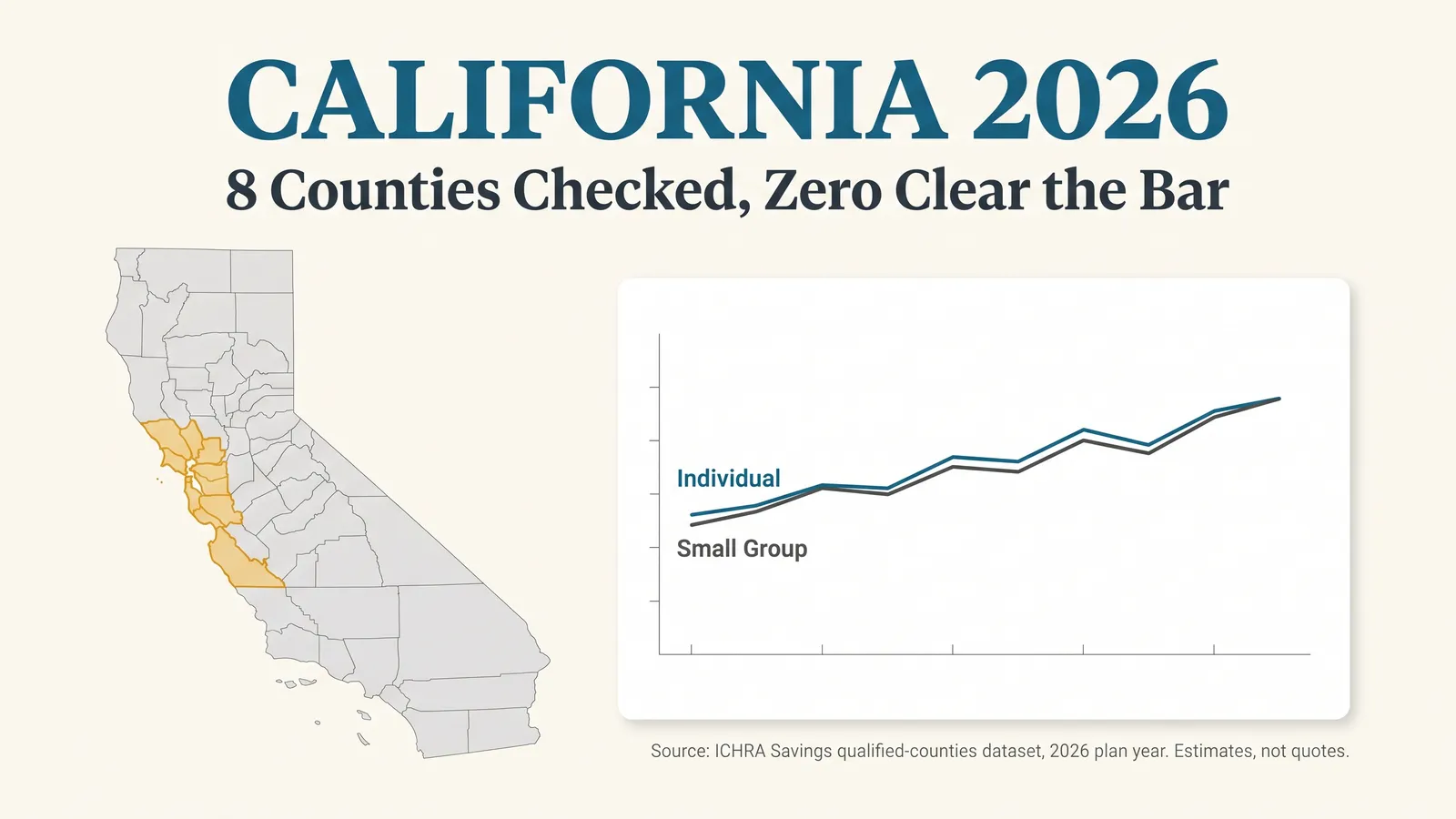
- Our dataset compares individual-market and small-group benchmark premiums for 8 of California's 58 counties for the 2026 plan year. None clear our $100-a-month qualifying bar.
- The widest gap we found, in Santa Clara County, is about $52 a month (6.7%). The narrowest, shared by four counties, is $0 (0.1%).
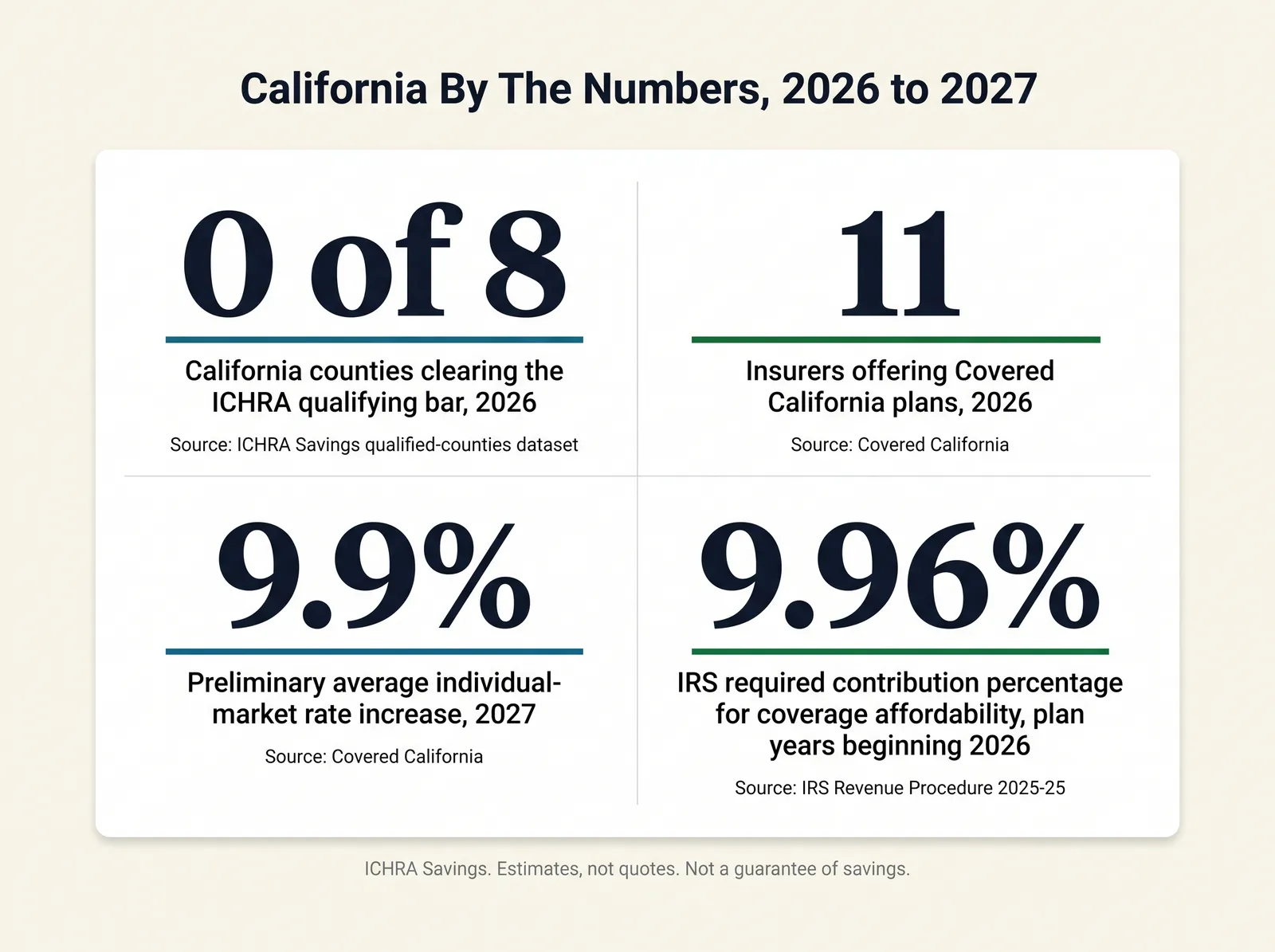
- Covered California's preliminary weighted average rate increase is 9.9% for 2027, after 10.3% for 2026 — both below the national median filing pace, per Covered California's own releases.
- California layers its own individual mandate on top of the federal rules: a 2025 tax-year penalty of at least $950 per uninsured adult or 2.5% of income over the filing threshold, whichever is greater.
- ICHRA still solves problems that have nothing to do with the rate spread: no participation minimum, a fixed budget, and coverage that travels with a remote or hybrid workforce.
Does ICHRA beat small group in California?
Not in the counties we've checked, and we're going to say that plainly before anything else. An ICHRA (Individual Coverage Health Reimbursement Arrangement) is a way for an employer to give each employee a fixed monthly amount, tax-free, to buy their own individual health plan instead of enrolling everyone in one employer-chosen group plan. Whether that beats a traditional small-group plan on pure cost comes down to one question: does the individual-market premium in an employee's county run meaningfully below the small-group premium there? For the eight California counties currently in our dataset, Santa Clara, Solano, Sonoma, Napa, Marin, Monterey, Santa Cruz, and Kings, the answer for the 2026 plan year is none of them. The gap our method looks for simply hasn't opened up in the market data we have.
If you already know what ICHRA is and want the general decision framework, our ICHRA vs. small group decision guide covers that ground. This article applies it specifically to California, using the same county-level dataset behind every state page on this site.
We also need to be upfront about something a flat "California doesn't qualify" headline would hide: we haven't checked all 58 counties. Building this dataset county by county, cross-verifying individual and small-group rate filings against CMS public-use files, is slow work, and California's build currently covers 8 counties, home to about 4,112,826 people, concentrated in the Bay Area and the Central Coast. Los Angeles County alone has roughly 9.6 million residents and isn't in this dataset yet. That matters for how you read everything that follows: this article is an honest report on what we've measured, not a claim that we've measured all of California.
What we can say with confidence is what the 8 counties show, and it's a genuinely different pattern than most of the states we've profiled on this site. In Ohio, where all 88 counties are in our dataset, the statewide average spread between individual and small-group benchmark premiums is roughly 55%. In the 8 California counties we've built, the average spread is about 1%. That's not a small gap that missed our threshold; it's two markets that have converged to within a few dollars of each other.
0 of 8
Checked California counties clearing our 2026 qualifying bar
$52
Widest monthly gap found, Santa Clara County, 2026
9.9%
Covered California's preliminary average rate increase, 2027
8 of 58
California counties in our dataset so far
What an ICHRA actually is
An ICHRA lets an employer of any size set a monthly reimbursement budget, and each employee uses it to buy their own plan on the individual market (a Covered California plan or an off-exchange plan) and gets reimbursed tax-free for the premium and, if the employer allows it, other qualified medical expenses. It's a self-insured group health plan under IRS rules, created by a 2019 final rule from the Treasury/IRS, Department of Labor, and HHS, and it has no employer-size minimum: a five-person shop can offer one on the same legal terms as a five-hundred-person company. It's distinct from a QSEHRA (Qualified Small Employer HRA), a smaller HRA structure capped at a federal dollar limit that only employers with fewer than 50 employees and no group plan can use; ICHRA has no federal reimbursement cap and no employer-size ceiling. An employer can't offer the same class of employees a choice between traditional group coverage and an ICHRA, though it can offer group coverage to one class (say, full-time staff) and an ICHRA to a different class (say, part-time or remote staff). ICHRA eligibility doesn't depend on whether a company is an ALE (Applicable Large Employer, generally an employer averaging 50 or more full-time-equivalent employees in the prior year, per IRS rules); that status matters separately, because it decides whether the ACA's employer mandate, the requirement to offer affordable coverage to at least 95% of full-time employees or face a potential shared-responsibility payment, applies to a company at all. An ICHRA that clears the affordability test satisfies that mandate the same way traditional group coverage would.
Two more terms matter before the numbers do. An employee class is a group defined by an IRS-permitted factor, such as full-time versus part-time status, salaried versus hourly work, or geographic location, each of which can get its own ICHRA design and budget, subject to minimum-size rules. And substantiation is the paperwork side: before the first reimbursement and again with every claim, an employee has to show proof of individual coverage, either a document from the insurer or exchange or a signed attestation, which is what keeps the arrangement compliant as a tax-free benefit rather than taxable income.
A few more terms, briefly
A metal level (bronze, silver, gold, platinum) sets how a plan splits costs between premium and out-of-pocket spending; this article uses the silver benchmark, the standard ACA reference point. A rate area is a geographic pricing zone insurers use to set premiums. The FPL (Federal Poverty Level) is an income threshold HHS publishes each year, used in one accepted method for testing ICHRA affordability. And MOOP (maximum out-of-pocket) is the ACA-mandated annual cap on what an enrollee pays in cost-sharing before their plan covers 100% of covered costs.
Why California's gap has closed
For the 2026 plan year, exactly 11 health insurance companies offer plans through Covered California statewide, and 92% of the state's marketplace enrollees can choose from three or more carriers, with 75% able to choose from four or more, according to Covered California's own August 2025 rate announcement. That's a well-supplied individual market by national standards, more competitive on carrier count than several states where this site's method finds wide savings. A crowded individual market doesn't automatically translate into individual premiums running far below group premiums, though; it depends on how the two markets price relative to each other, and in California's case, both sides currently sit close together.
We want to be careful here about what we can and can't tell you. Industry commentary points to several plausible contributors to California's narrow spread, active-purchaser rate negotiation through Covered California, the state's own individual mandate keeping more healthy people in the individual-market risk pool, and a small-group market that hasn't detached from individual pricing the way it has in some other states. We haven't independently verified which of those factors, if any, is doing the work, and we're not going to present a guess as a finding. What we can verify, because it's the actual arithmetic behind our dataset, is the result: across the 8 counties we've built, individual and small-group benchmark premiums differ by an average of about $8 a month, roughly a 1.0% spread. Compare that to Ohio, Georgia, or South Carolina, states where every county is in our dataset and the statewide average spread runs from the high 20s to the mid-50s in percentage terms. California isn't missing a few points off the qualifying bar; it's a fundamentally different market shape.
None of this means California's individual market is expensive in absolute terms, or that its small-group plans are unusually cheap. It means that, for the 2026 plan year in the counties we've measured, the gap this site's method looks for, individual-market benchmark pricing running meaningfully below small-group benchmark pricing, hasn't opened up here the way it has in a majority of the counties we've built nationally.
For a broker or an HR lead who has watched ICHRA pitches built entirely around a big savings number, this is the part worth sitting with. A lot of the national conversation about ICHRA treats the individual-versus-group rate spread as a fixed, generalizable advantage: individual coverage is medically underwritten in a leaner risk pool, so it should always run cheaper. California's own market data doesn't back that up. Both markets here operate under the same guaranteed-issue, community-rated ACA framework as everywhere else, and they've still landed in roughly the same place. That's a useful corrective for any pitch, ours included, that leans on the rate spread as if it were universal. It isn't. It's a county-by-county fact, and California's counties, at least the eight we can currently prove it in, happen to sit on the flat side of that fact.
What the eight counties we checked show
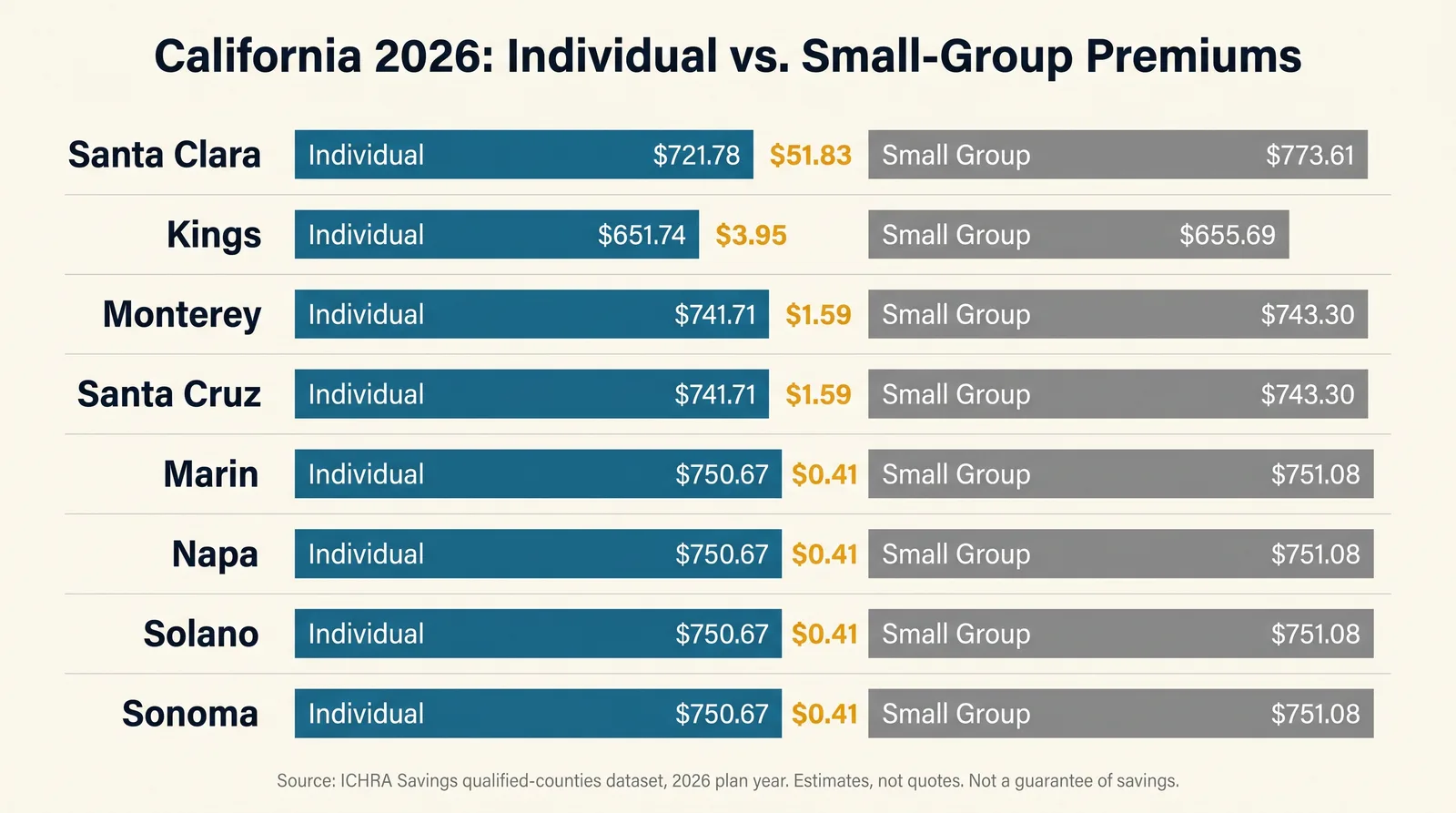
Here's every county currently in our California dataset, 2026 plan year, individual and small-group benchmark premiums side by side.
| County | Individual benchmark | Small-group benchmark | Monthly gap | Est. spread |
|---|---|---|---|---|
| Santa Clara County | $722 | $774 | $52 | 6.7% |
| Kings County | $652 | $656 | $4 | 0.6% |
| Monterey County | $742 | $743 | $2 | 0.2% |
| Santa Cruz County | $742 | $743 | $2 | 0.2% |
| Marin County | $751 | $751 | $0 | 0.1% |
| Napa County | $751 | $751 | $0 | 0.1% |
| Solano County | $751 | $751 | $0 | 0.1% |
| Sonoma County | $751 | $751 | $0 | 0.1% |
Two things jump out. First, four counties, Marin, Napa, Solano, and Sonoma, share an identical individual benchmark of $751 and an identical small-group benchmark of $751, which points to a shared insurer rate area rather than four coincidentally similar county markets; our sister article on how rating areas create identical premiums across different counties walks through the same mechanism in Ohio. Second, Santa Clara County, Silicon Valley's home county and by far the most populous in this dataset at 1,916,831 residents, has both the widest dollar gap ($52) and the highest spread ( 6.7%) of the eight, and it still falls well short of our $100-a-month qualifying threshold.
California isn't a state where ICHRA loses on the arithmetic. It's a state where the individual and small-group markets have stopped disagreeing with each other, at least in the eight counties we can currently prove that in.
Mike MooreHere's what that looks like for a real employer. Say a 15-employee company is headquartered in San Jose (Santa Clara County) and facing a renewal that, in line with Covered California's statewide 2026 filing pace, comes in around 10%. If last year's small-group premium averaged $900 per employee per month, a 10% renewal pushes that to about $990, an increase of roughly $1,080 per employee per year, or $16,200 across 15 employees.
Here's the math
Against that renewal, Santa Clara County's individual benchmark runs $722 a month versus a small-group benchmark of $774, a gap of just $52 a month, or $622 a year, per employee, on the rate-spread math alone. Across 15 employees, that's roughly $9,329 a year in estimated rate-arbitrage savings, a real number, but a small fraction of what the same calculation returns in a county like Ohio's Erie County, where the equivalent employer could see closer to $11,000 per employee per year. The rate-spread case in Santa Clara County is thin. It is not, on this data, the reason to choose ICHRA there.
Run the same exercise in Sonoma County and the numbers move slightly, not directionally. A 15-employee company there would see an estimated $0 a month, or $5 a year, per employee, against the same size of renewal increase, for a combined estimated $74 a year across the team. Kings County, the narrowest-population county in this dataset at 152,515 residents, shows a similarly modest $47 a year per employee. None of these numbers are nothing. They just aren't the kind of number that, on its own, justifies redesigning a company's benefits program. In every one of these counties, the rate-spread savings would need to be paired with at least one of the non-arbitrage reasons covered next before an ICHRA rollout makes sense on the numbers alone.
California's own individual mandate
One thing that changes the ICHRA conversation specifically in California: this is one of a handful of states with its own individual mandate, layered on top of whatever federal rules apply. Since 2020, California residents have generally been required to maintain minimum essential coverage for each month of the year or pay a penalty on their state income tax return, enforced by the California Franchise Tax Board (FTB). For tax year 2025, the flat-rate penalty ran at least $950 per uninsured adult and $475 per uninsured child, capped at three times the adult rate per household, or 2.5% of household income above the filing threshold, whichever is greater, per Covered California's own Individual Mandate and Penalty Quick Guide. A household with two adults and two children with no coverage for the full year faced at least $2,850 under the flat method for 2025. The FTB updates these amounts each fall for the coming tax year.
Minimum essential coverage under the state mandate includes employer-sponsored insurance, individual-market coverage bought through Covered California or directly from an insurer, Medicare Parts A and C, and most Medi-Cal coverage. An employee who substantiates their ICHRA-funded individual plan is covered under that definition the same as if they'd bought the plan with their own money and no employer involvement at all; the mandate doesn't care where the premium dollars came from, only that qualifying coverage exists for the month.
The tradeoff, stated plainly
Taking an ICHRA generally means an employee waives eligibility for a premium tax credit (the federal ACA subsidy) for that month, if the ICHRA offer is considered affordable under the IRS test. This isn't free money stacked on top of a marketplace subsidy; it's a trade, and California employers should explain it to employees in exactly those terms, not as an unambiguous upgrade.
What the 2027 filings show
Rates are refreshed every plan year, and California's next cycle is already filed. Covered California announced a preliminary weighted average rate increase of 9.9% for the 2027 coverage year on July 21, 2026, down from the prior cycle, and said that figure sits below "the preliminary national median rate increase of 14 percent." One new carrier is entering the marketplace for 2027. For context, the 2026 plan year's preliminary weighted average increase was 10.3%, announced August 14, 2025, alongside the carrier and choice figures cited above.
Filed is not final
These are preliminary, weighted-average figures for the individual market, subject to final review by California's Department of Managed Health Care, with final 2027 rates taking effect January 1, 2027. Covered California's release does not break out a parallel small-group average, which is why this article doesn't quote one; our own qualifying calculation, built from Ideon and CMS-cross-verified data, is what backs the county figures above instead.
If your county isn't in our data yet
The fix isn't a trick, and we're not going to pretend the rate-spread math says something it doesn't, or that we've checked more of California than we have. Here's the real method, in order.
- Check the savings map before you assume anything. If your county is one of the 8 we've built, you'll see the actual numbers. If it isn't, treat it as unverified rather than assuming it looks like Santa Clara or Sonoma.
- Separate the cost-arbitrage question from the other reasons employers choose ICHRA. A fixed, employer-chosen monthly budget instead of a carrier-set annual renewal; no carrier participation minimum, which matters for a small team where a few employees are on a spouse's plan; coverage that travels with anyone who works remotely or across county lines; and, for a company offering no benefit today, a real benefit at any size, starting at one employee. None of those depend on the individual market being cheaper than group.
- If you're a company under 50 employees with no group plan today, look at QSEHRA too. Its federal reimbursement caps are lower than an uncapped ICHRA, but it's simpler to administer for a very small team weighing "something" against "nothing."
- Recheck after 2027 rates are approved, not just once. Covered California's preliminary 2027 average (9.9%) is already lower than 2026's (10.3%); we don't yet have a small-group figure to compare it against, which is exactly why we'll rebuild this dataset once final rates are in.
- If you still want to run the ICHRA math yourself, model your real census. County benchmarks describe the market; your workforce's actual ages, family sizes, and plan choices decide your real number.
The arithmetic above is generic
Your county, and each of your employees' counties, has its own answer where we have the data, and you can look it up in about ten seconds: https://ichrasavings.com/ichra-savings-map/.
How ICHRA Savings helps
None of the county math above requires talking to anyone. The savings map lets you look up any California county we've built, or any other U.S. county, and see the same individual-market and small-group benchmark premiums used in this article, so you can check where you actually have employees before spending time on anything else. Where we help past that: designing employee classes that hold up, geography-based classes are the relevant tool for a California employer with staff spread across counties we haven't benchmarked yet, modeling affordability against a real census rather than a rule of thumb, and getting the required employee notice right and on time if the math and the workforce shape make ICHRA a fit. We don't pick anyone's individual plan for them; that choice, and the choice of network, stays with each employee. For a California employer specifically, the most common shape we see is a company weighing "offer something for the first time" or "convert a fixed-cost problem into a fixed-budget one" rather than "chase a rate-arbitrage windfall," since the data in this article doesn't currently support the windfall case for the counties we've checked. If your renewal is already in hand and you have a deadline, it's worth a conversation: https://ichrasavings.com/book.
Setting one up anyway, if it fits
California doesn't add state-specific ICHRA rules on top of the federal framework beyond its own individual mandate, covered above; the same 2019 Treasury/IRS, Department of Labor, and HHS final rule governs it here as everywhere else, and the setup sequence is the same one we walk employers through in any state where the case is real, whether that's cost arbitrage, participation flexibility, or a remote workforce:
- Pull your census by county, not by office address. Include every remote hire, even one living outside the counties we've currently benchmarked.
- Check each employee's county on the savings map. A San Jose headquarters and a Los Angeles remote hire may be two different stories once that county is added to our data.
- Model affordability against real household incomes. The IRS's required contribution percentage, 9.96% for plan years beginning in 2026 per Rev. Proc. 2025-25, decides whether a given employee's offer counts as affordable, which decides their premium tax credit eligibility. There are two accepted ways to run this test: measuring against the employee's actual household income, or using an affordability safe harbor, a simpler, IRS-approved substitute measure (an employee's Form W-2 wages, their rate of pay, or the FPL) an employer can use instead of asking for real household income. Our affordability percentage guide covers the current federal threshold and each safe harbor in depth.
- Define employee classes carefully, if you use them. Class rules carry minimum-size requirements and can't offer the same class a choice between ICHRA and group coverage.
- Send the required notice on time. Eligible employees generally need written notice at least 90 calendar days before the plan year begins, with specific required content about the offer and its effect on subsidy eligibility.
- Remember the state mandate is separate from the federal affordability test. An employee can satisfy California's individual mandate with an ICHRA-funded plan regardless of whether that same offer is "affordable" under IRS rules; the two tests answer different questions.
- Budget for onboarding support. Employees who have never shopped Covered California or the off-exchange individual market on their own need guidance, once, at enrollment.
See our full ICHRA setup timeline for the detailed rollout plan, and our guide to ICHRA employee classes if your California workforce spans counties or states we haven't built into this dataset yet.
This last point matters more in California than in most states we cover, because so much of its workforce, especially around Santa Clara County's tech employers, is remote or hybrid by default. A company headquartered in San Jose with engineers living in Austin, Denver, or a rural county three states away isn't really asking "does ICHRA work in California." It's asking a dozen separate county-level questions, one per employee's actual address, and California's own answer, thin as it currently is, only covers the people who happen to live in the eight counties in this dataset. Everyone else's answer lives in whatever state and county they actually work from, which is the entire reason this site checks counties instead of publishing one number per state.
Read this before you commit
The honest limits of this data
- We've only checked 8 of California's 58 counties. The finding in this article applies to Santa Clara, Solano, Sonoma, Napa, Marin, Monterey, Santa Cruz, and Kings Counties. It is not a statement about Los Angeles, San Diego, Orange, Sacramento, or any other California county we haven't built yet.
- Zero of those 8 clear our qualifying bar for 2026. That's the finding of this specific method (a $100-a-month-per-employee individual-versus-small-group gap), not a statement that ICHRA cannot work in California for other reasons.
- These are benchmark comparisons, not a guarantee for your specific workforce. A non-qualifying county does not mean every individual plan costs more than every group plan for every person; model your real census before ruling anything out.
- Rates move every plan year. Covered California's preliminary 2027 average (9.9%) is already lower than 2026's (10.3%); recheck before every renewal, not just once.
- Filed 2027 rates are not approved. California's Department of Managed Health Care can adjust the final figure before it takes effect.
- Taking an ICHRA generally means waiving the premium tax credit for that month if the offer is considered affordable under the IRS test. It does not exempt an employee from California's separate state individual mandate, and it is not free money layered on top of a marketplace subsidy.
How these numbers are calculated
Every county figure in this article comes from the same dataset that powers our savings map, not from a survey or a sales estimate. For each U.S. county we've built, we compare a 2026 individual-market benchmark premium (the second-lowest-cost silver plan available to a representative enrollee) against a small-group benchmark premium built from comparable small-group plan filings for that county's rate area, using Ideon data cross-verified against CMS public-use marketplace files. A county enters the qualifying dataset when the gap between those two benchmarks reaches at least $100 a month per employee. None of the 8 California counties we've built clear that bar for 2026. California's total county count, 58, comes from the U.S. Census Bureau's 2020 county reference file. The Covered California rate figures (9.9% for 2027, 10.3% for 2026, the carrier and choice statistics) come directly from Covered California's own newsroom releases, dated July 21, 2026 and August 14, 2025 respectively. The 9.96% affordability figure comes from IRS Rev. Proc. 2025-25. The individual mandate penalty figures come from Covered California's Individual Mandate and Penalty Quick Guide, dated March 2, 2026, describing tax year 2025 amounts.
Two limitations are worth stating plainly. First, benchmark premiums are built around a representative enrollee profile, so an unusually young or unusually old California workforce will see a different real-world spread than a county average implies. Second, this dataset's California coverage is a work in progress; 8 counties is not 58, and we will publish an update as more of the state is built out. We rebuild the underlying dataset every plan year rather than reusing prior numbers, and we recommend employers do the same before every renewal.
Questions California employers actually ask
Does an ICHRA save California employers money compared to small-group insurance?
Not on the rate-spread math, based on the counties we have checked for the 2026 plan year. Our qualified-counties dataset currently carries individual-versus-small-group benchmark comparisons for 8 of California's 58 counties, and none of the 8 show individual pricing at least $100 a month below small group. The widest gap we found, in Santa Clara County, is about $52 a month (6.7%), well under our qualifying bar. That is a statement about today's rate filings in the counties we have data for, not a permanent verdict, and it is an estimate from public and industry data, not a quote.
Why hasn't ICHRA Savings checked all 58 California counties yet?
Our dataset is built county by county from Ideon rate data cross-verified against CMS public-use marketplace files, and California's build currently covers 8 counties concentrated in the Bay Area and Central Coast: Santa Clara, Solano, Sonoma, Napa, Marin, Monterey, Santa Cruz, and Kings. It does not yet include Los Angeles, San Diego, Orange, Sacramento, or the state's other 50 counties. We are publishing what we have rather than waiting, because the pattern in the 8 counties we do have, individual and small-group premiums sitting within a few dollars of each other, is worth an employer knowing about now.
Why is California's individual-versus-small-group gap so much smaller than states like Ohio?
We don't have a verified answer to the "why," and we'd rather say that than guess. What we can say from the data itself: across the 8 California counties in our dataset, individual and small-group benchmark premiums differ by an average of just $8 a month, a 1.0% average spread. In Ohio, where every one of the state's 88 counties is in our dataset, the average spread is roughly 55%. Both markets operate under the same federal ACA rules; whatever is compressing California's gap is a state-market dynamic this article does not independently investigate.
What's happening with California's 2027 health insurance rates?
Covered California announced a preliminary weighted average rate increase of 9.9% for the 2027 coverage year on July 21, 2026, down from the prior year's preliminary increase, and said that figure sits below "the preliminary national median rate increase of 14 percent." One new carrier is entering the marketplace for 2027. These are preliminary figures, subject to final review by California's Department of Managed Health Care, with final 2027 rates taking effect January 1, 2027.
Does California add anything on top of the federal ICHRA rules?
Not to ICHRA itself; the same 2019 federal final rule governs it in California as everywhere else. What California does add is its own individual mandate: state residents generally must carry minimum essential coverage or pay a penalty on their state tax return, separate from any federal requirement. For tax year 2025, the Franchise Tax Board's flat-rate penalty was at least $950 per uninsured adult and $475 per uninsured child, or 2.5% of household income over the filing threshold, whichever is greater. An employee substantiating ICHRA-funded individual coverage satisfies this mandate the same way employer-sponsored coverage would.
Is ICHRA still worth considering for a California employer if it does not save money on the rate spread?
It can be, for reasons that have nothing to do with the individual-versus-group rate spread. An ICHRA has no carrier participation minimum, so it does not collapse when part of a team is on a spouse's plan. It travels with employees who work from a different county than the company's office, which matters in a state where remote and hybrid work is common. And it converts an unpredictable annual renewal, the kind that just rose a preliminary 9.9% to 10.3% two years running, into a fixed number the employer chooses.
What if my California company has employees in Los Angeles, San Diego, or another county not in your dataset yet?
We don't have a benchmark comparison to show you for those counties yet, and we would rather tell you that directly than imply an answer we haven't verified. The honest next step is the same one we'd give for any uncovered county: use the savings map to check what data we do have, and treat a county with no listing as unverified rather than assuming it behaves like the 8 Bay Area and Central Coast counties in this article.
Where can I check my own county, or my employees' counties?
Use the savings map to look up any U.S. county by name. It shows the same 2026 individual-market and small-group benchmark premiums used in this article for the counties we have built, so you can check where you actually have employees before spending time modeling a rollout.
Sources
- ICHRA Savings qualified-counties dataset (
src/data/qualified_counties.json), built from Ideon rate data cross-verified against CMS public-use marketplace files, 2026 plan year - Covered California, "Covered California Rates and Plans for 2027" (July 21, 2026; 9.9% preliminary weighted average increase; one new carrier; national median comparison)
- Covered California, "Covered California Rates and Plans for 2026" (August 14, 2025; 10.3% preliminary weighted average increase; 11 carriers; 92%/75% carrier-choice figures)
- IRS, Rev. Proc. 2025-25 (Required Contribution Percentage, 9.96%, for plan years beginning in calendar year 2026)
- Covered California, "California Individual Mandate and Penalty Quick Guide" (March 2, 2026; tax year 2025 penalty amounts; minimum essential coverage definition)
- U.S. Census Bureau, 2020 county reference file for California (58 counties)
- HealthCare.gov, "Individual coverage HRA" (definition, employer-size rule, premium tax credit interaction)
- IRS, "Employer Shared Responsibility Provisions" (Applicable Large Employer / employer mandate, 50 full-time-equivalent threshold)
- ICHRA final rule: Departments of the Treasury/IRS, Labor, and Health and Human Services (2019)