ICHRA in Fremont, Ohio 2026: Sandusky County 63%
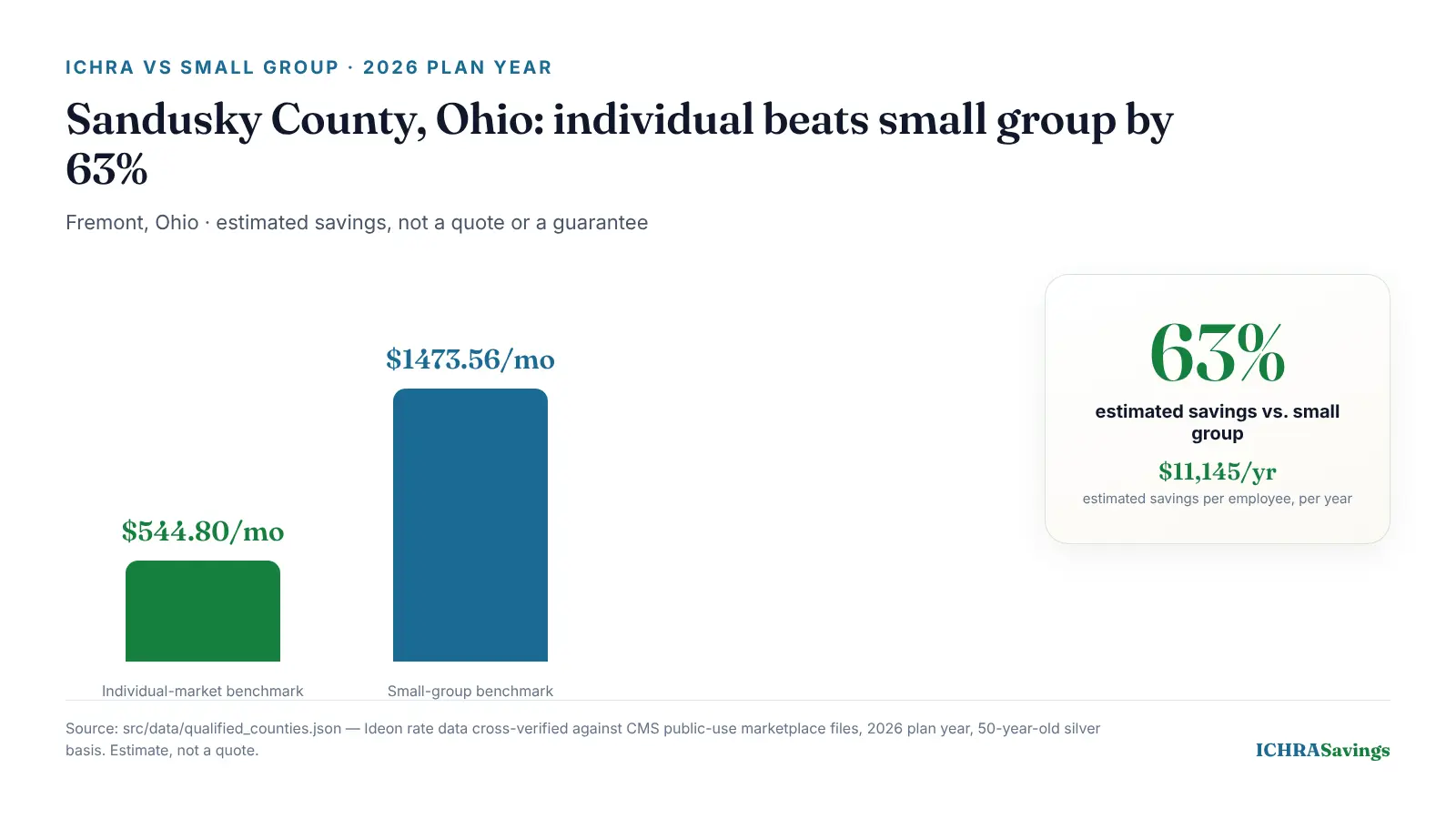
Sandusky County's 2026 benchmark runs an estimated 63% below small group, about $11,145 a year per employee. See the Fremont, Ohio data, sourced.
The short version
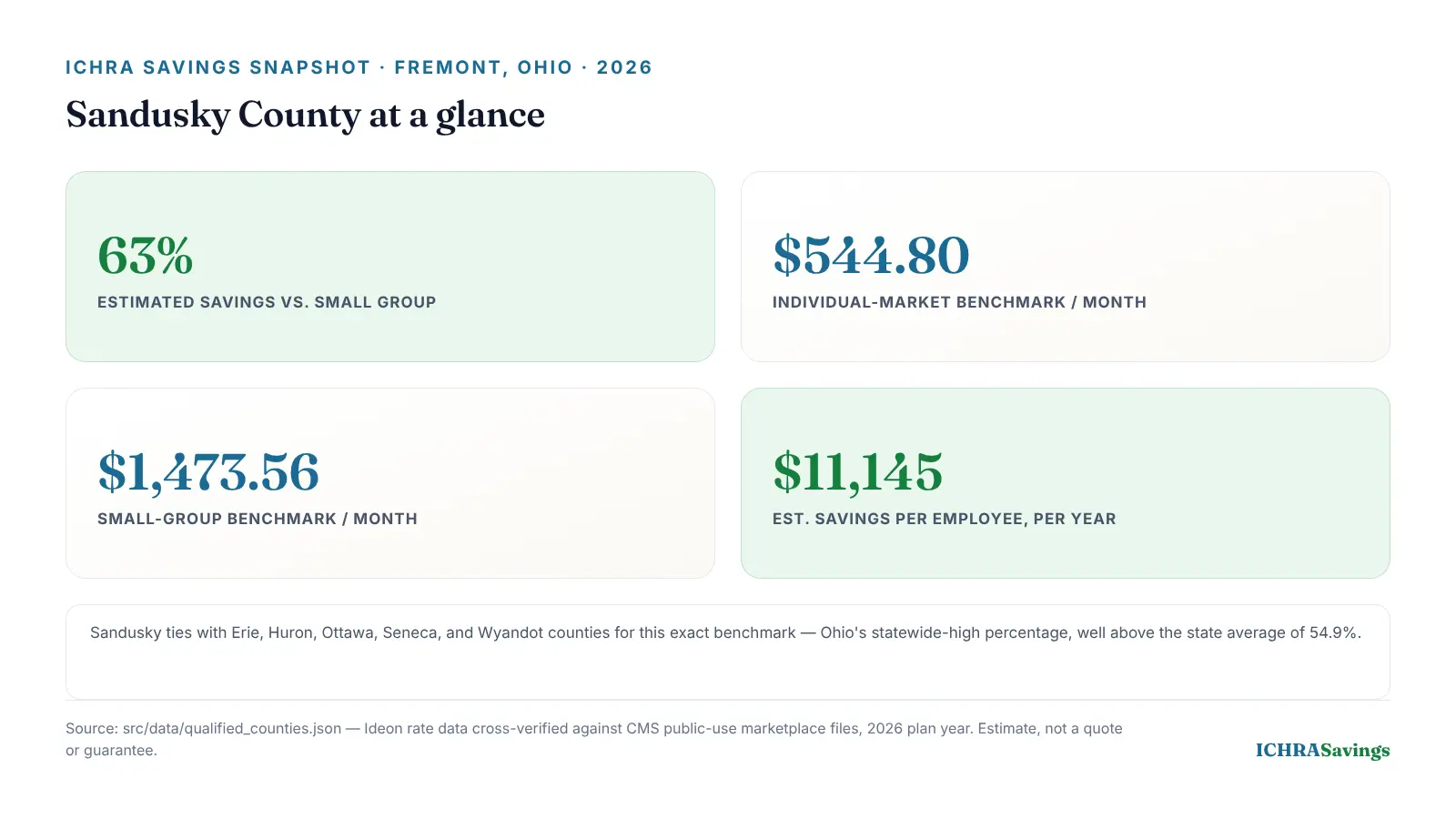
- Sandusky County's 2026 individual-market benchmark runs an estimated 63.0% below the small-group benchmark, about $11,145 per employee per year — tied for Ohio's statewide-high percentage with five neighboring counties, well above the statewide average of 54.9%.
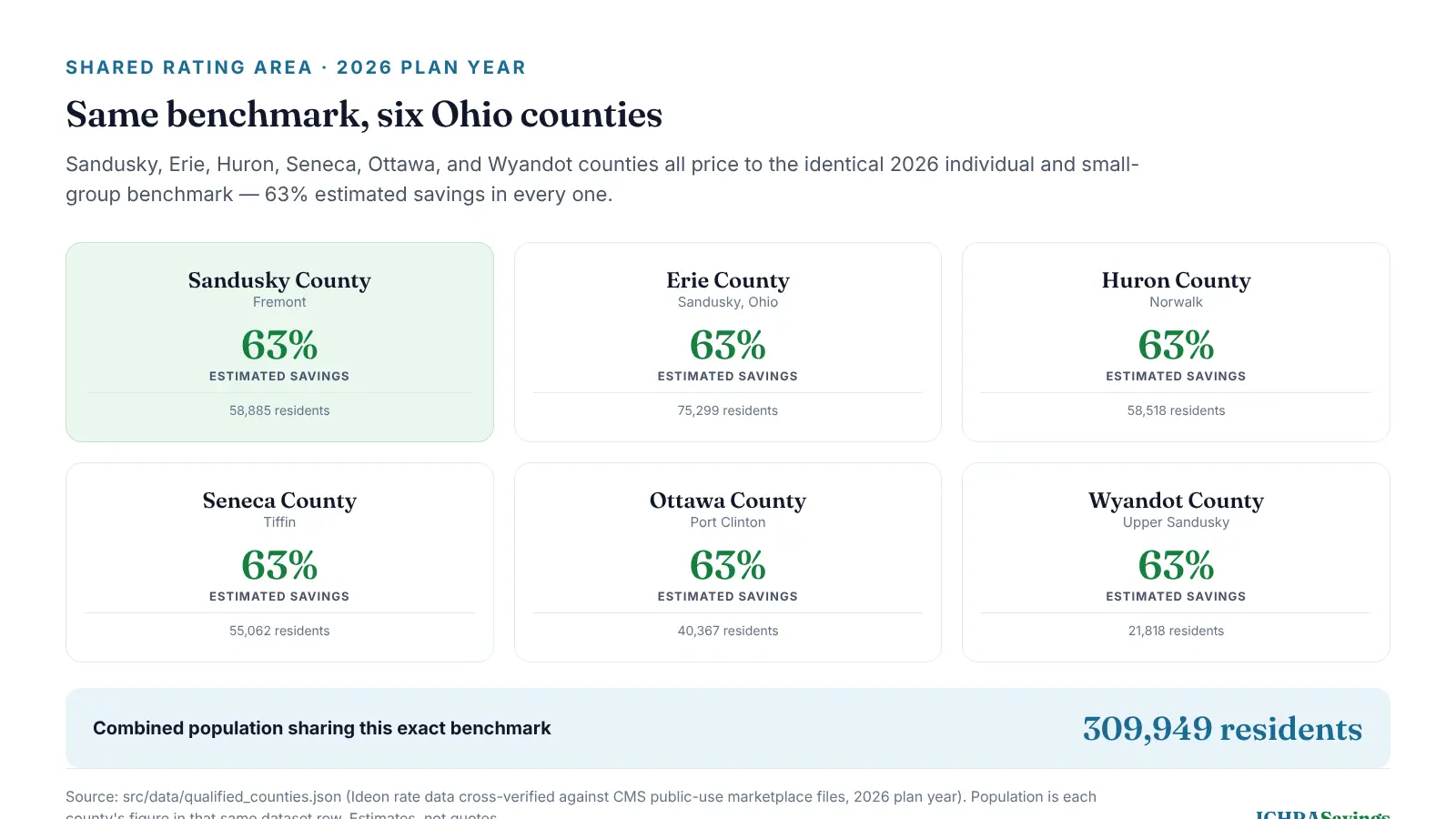
- Sandusky's benchmark is shared, to the cent, with Erie (Sandusky, Ohio), Huron (Norwalk), Ottawa (Port Clinton), Seneca (Tiffin), and Wyandot (Upper Sandusky) counties — a six-county rating area of roughly 309,949 residents in our dataset. Two of those counties already have their own articles on this site.
- Fremont, the county seat, sits between two outsized local employers: the H.J. Heinz Company's ketchup plant, described on its own tour page as the world's largest, and Whirlpool's Clyde facility, the world's largest washing-machine factory, with about 2,600 employees as of an August 2026 company release.
- That combination raises the local benefits bar rather than lowering it: a smaller Fremont-area employer isn't just competing against a renewal letter, it's competing for workers against two companies large enough to run full benefits departments.
- On raw dollars, Sandusky isn't Ohio's single widest gap — that belongs to Morrow County. Tying for the top percentage is not the same as a guaranteed outcome for your business; the honest limits are covered later.
Does ICHRA beat small group in Fremont, Ohio?
Yes. An ICHRA (Individual Coverage Health Reimbursement Arrangement, now also referred to by HealthCare.gov as a CHOICE Arrangement) is an IRS-defined arrangement that lets an employer set a fixed monthly reimbursement amount and let each employee buy their own individual-market plan with it, tax-free. In Sandusky County, the Ohio county that contains the city of Fremont, the 2026 individual-market benchmark premium runs an estimated 63.0% below the small-group benchmark premium, according to a county-by-county comparison built from Ideon rate data and cross-verified against CMS public-use marketplace files.
That 63.0% ties Sandusky with 5 other Ohio counties — Erie, Huron, Ottawa, Seneca, and Wyandot — for the statewide-high percentage, well above the 54.9% average across all 88 counties. In dollars it's $11,145 a year per employee, ranking 13th of 88 counties statewide on that measure. Of the 1,309 counties nationwide in our dataset, every one of Ohio's 88 counties clears the $100-a-month gap we use as the floor for including a county at all, and Sandusky sits at the very top of the state's own range.
63.0%
Estimated Sandusky County savings vs. small group
6-county tie
Ohio's statewide-high rating area
59K
Sandusky County residents in our dataset
$11,145
Est. Sandusky County savings per employee, per year
The employer problem this is actually solving
A ten-person machine shop or medical practice near downtown Fremont isn't just competing with the renewal letter sitting on the owner's desk. It's competing for the same workers as two of the largest manufacturing operations in their industries anywhere in the world, both headquartered a few miles from the county courthouse. When a candidate can walk into Whirlpool's Clyde plant or Heinz's Fremont facility and get a full corporate benefits package on day one, a five-person business down the road has to offer something real, or stop competing for that candidate at all.
That's a different flavor of the same pain most small Ohio employers describe. It isn't only "our renewal went up again," though it did. It's "we don't have a benefits department, and the companies we're recruiting against do." An ICHRA doesn't require one. A fixed monthly budget set by the employer, funded tax-free, with no participation percentage to clear and no group underwriting pool to qualify for — a genuinely different mechanic than trying to assemble a corporate-style benefits package from a five-person payroll.
Why 2026 and 2027 renewals keep landing high
For Sandusky County employers who already carry a small-group plan, the renewal letter has been getting heavier for two straight years, and that isn't a local quirk. Nationally, small-group insurers filed a median proposed premium increase of 14% for the 2027 plan year, across 295 insurers filing in all 50 states and the District of Columbia, according to the Peterson-KFF Health System Tracker's brief published August 6, 2026 — up from an 11% median across 318 insurers for the 2026 plan year, per the same tracker's brief published September 24, 2025. Fifty-nine percent of insurers proposed 2027 increases between 10% and 20%.
Ohio's individual market tells a similarly pointed story. healthinsurance.org's Ohio marketplace guide reports an average unsubsidized rate increase of 19.8% for 2026, calculated before any premium tax credit. Separately, KFF's own tracking of national ACA marketplace competition found that the average number of insurers participating per state fell from 9.6 in 2025 to 9.0 in 2026, and that the number of counties served by only a single ACA issuer nationwide jumped from 93 to 165 — a shift KFF ties largely to Aetna CVS's exit from 17 states and other insurer departures following the expiration of enhanced premium tax credits at the end of 2025.
None of that changes the underlying mechanic that makes ICHRA work in a county like Sandusky: what matters isn't whether either market's prices went up in isolation, it's whether individual rates rose relative to small-group rates in the same county and rating area. Sandusky's gap has held for the entire 2026 plan year regardless of which direction each market moved on its own.
How an ICHRA (now also called CHOICE) actually works
Before the Sandusky County numbers mean anything, it helps to be precise about what's being compared, since most of the confusion around ICHRA comes from skipping this step.
An ICHRA is an employer-funded health reimbursement arrangement created by a 2019 final rule from the IRS and Treasury, the Department of Labor, and HHS, published at 84 Fed. Reg. 28888 on June 20, 2019, effective August 19, 2019, and applicable to plan years beginning on or after January 1, 2020. HealthCare.gov now also refers to the same structure as a CHOICE Arrangement; the mechanics and the federal rules haven't changed, only the public-facing name. Instead of choosing one group health plan for everyone, the employer sets a fixed monthly reimbursement amount, and each employee uses that money to buy an individual-market plan of their own choosing, then submits proof of coverage (substantiation) to get reimbursed tax-free. The employer isn't picking a plan for a dozen different households; the employer is funding a budget, and the employee is doing the shopping.
The comparison behind every number in this article rests on two specific prices for a given county and rating area — the geographic zone insurance regulators use to set premiums, usually a cluster of neighboring counties. The individual-market benchmark premium is the second-lowest-cost silver-level plan available in that rating area to a representative 50-year-old enrollee. "Silver" refers to one of four ACA metal levels (bronze, silver, gold, platinum) describing how costs split between premium and out-of-pocket spending, not the quality of care. This is the same type of benchmark the federal government uses to calculate premium tax credits, which is why it's a defensible number to build a comparison on rather than one insurer's list price. The small-group benchmark premium is the equivalent figure built from comparable small-group plan filings for that same rating area. When the individual benchmark is lower, the county "qualifies," and the gap between the two is the estimated per-employee savings if the employer funds ICHRA at that benchmark level.
Two more terms matter once an employer is actually deciding whether to switch. The affordability safe harbor is the test that decides whether the ICHRA offer counts as "affordable" under IRS rules — for plan years beginning in 2026 that test runs against a Required Contribution Percentage of 9.96% of household income (IRS Rev. Proc. 2025-25), rising to 10.22% for plan years beginning in 2027 (IRS Rev. Proc. 2026-26). Get the contribution amount wrong relative to that threshold and an employer can trigger a penalty tied to the employer mandate, the ACA requirement that applies to ALEs (applicable large employers, generally 50 or more full-time-equivalent employees). Smaller, non-ALE employers aren't subject to that mandate at all, which covers most of the small Fremont-area shops and practices described above — Whirlpool and Heinz are the exception in this county, not the rule.
One structural piece is often misunderstood: an employer can define different employee classes — for example, full-time versus part-time, or by geographic rating area — and offer different benefits to each class, subject to federal minimum-size rules for some class types. What an employer cannot do is offer the same class of employees a choice between ICHRA and a traditional group plan; it's one or the other, per class, not both at once for the same people. Within a class, reimbursements can still vary by age, up to a 3-to-1 ratio, and by number of dependents, per HealthCare.gov's current CHOICE Arrangement guidance.
Sandusky County's rate spread, in dollars
Here is the actual 2026 benchmark comparison for Sandusky County, home to the city of Fremont. The individual-market benchmark premium is $544.80 a month. The small-group benchmark premium, built from comparable small-group plan filings for the same rating area, is $1473.56 a month. That's a gap of $928.76 a month, or $11,145 a year, per employee, an estimated 63.0% in favor of the individual market.
Ohio's statewide-high rating area
Sandusky County's 63.0% is identical, to the cent, to five other Ohio counties: Erie (Sandusky, Ohio), Huron (Norwalk), Ottawa (Port Clinton), Seneca (Tiffin), and Wyandot (Upper Sandusky). It's the highest percentage anywhere in our Ohio dataset. Two of these six counties, Sandusky (Erie County) and Norwalk (Huron County), already have their own articles; this one covers Sandusky County itself, with the full six-county table below.
See the full Ohio savings breakdown for every county, or the national savings map to look up a specific county by name.
Why Sandusky shares its benchmark with five other counties
This is the detail that makes Sandusky County worth its own page. Its benchmark comparison doesn't just resemble its neighbors in north-central Ohio — it's identical, to the cent, across six counties at once.
| County | Population (dataset) | Individual benchmark | Small-group benchmark | Savings vs. small group |
|---|---|---|---|---|
| Sandusky (Fremont) | 59K | $544.80 | $1473.56 | 63.0% |
| Erie (Sandusky, Ohio) | 75K | $544.80 | $1473.56 | 63.0% |
| Huron (Norwalk) | 59K | $544.80 | $1473.56 | 63.0% |
| Ottawa (Port Clinton) | 40K | $544.80 | $1473.56 | 63.0% |
| Seneca (Tiffin) | 55K | $544.80 | $1473.56 | 63.0% |
| Wyandot (Upper Sandusky) | 22K | $544.80 | $1473.56 | 63.0% |
All six counties share the identical 2026 benchmark comparison because they sit in the same marketplace rating area. See our Sandusky, Ohio (Erie County) and Norwalk (Huron County) articles for the same numbers from a different county's vantage point.
That's a combined 309,949 residents in our dataset sharing one number. An employer headquartered in Fremont with staff living across the Sandusky, Ohio area (Erie), Norwalk (Huron), Port Clinton (Ottawa), Tiffin (Seneca), or Upper Sandusky (Wyandot) doesn't need six different calculations; everyone runs on the same $544.80 individual and $1473.56 small-group monthly benchmark for 2026.
How Sandusky compares to Ohio's biggest counties
Every one of Ohio's eight largest counties by population — Franklin (Columbus), Cuyahoga (Cleveland), Hamilton (Cincinnati), Summit (Akron), Montgomery (Dayton), Lucas (Toledo), Butler, and Stark (Canton) — shows a smaller percentage spread than Sandusky County's 63.0%. That's not a knock on those counties; it reflects how each rating area's carriers happened to price small-group versus individual coverage for 2026, which has little to do with a county's size or economic weight. It's a clear illustration of why a statewide or metro-level average can mislead: check your own county, not a regional headline number, before you model a rollout.
| County (city) | Population | Savings vs. small group | Est. annual savings / employee |
|---|---|---|---|
| Franklin (Columbus) | 1,318,149 | 59.6% | $10,624 |
| Cuyahoga (Cleveland) | 1,256,620 | 48.6% | $7,414 |
| Hamilton (Cincinnati) | 827,671 | 62.3% | $10,675 |
| Summit (Akron) | 539,361 | 38.8% | $4,433 |
| Montgomery (Dayton) | 536,121 | 58.3% | $10,014 |
| Lucas (Toledo) | 430,014 | 57.0% | $9,514 |
| Butler (Hamilton, Ohio) | 388,327 | 62.3% | $10,675 |
| Stark (Canton) | 374,199 | 41.1% | $4,692 |
| Sandusky (Fremont) | 59K | 63.0% | $11,145 |
How Ohio's 88 counties break down by savings tier
How Ohio's 88 counties break down by savings tier
Number of counties in each savings band, 2026 plan year. Source: ICHRA Savings county dataset (Ideon rate data, cross-verified against CMS public-use files).
Sandusky sits in the "60%+" band, tied for the top spot statewide with 5 other counties. Illustrative and rounded; not an offer of insurance or a guarantee of savings.
Twenty-two of Ohio's 88 counties clear the 60% mark, and Sandusky sits at the very top of that group alongside its five rating-area neighbors. Forty-six more counties fall in the 50-to-60% band, which is where most of Ohio's larger metro counties — Columbus, Cincinnati — actually land. Only 6 counties statewide post a spread under 40%, including two of Ohio's biggest, Akron's Summit County and Canton's Stark County, both shown in the table above.
Fremont's economy: a presidential library next to two world's-largest factories
Fremont had 15,930 residents at the 2020 census, per Wikipedia's summary of the city citing U.S. Census Bureau figures, and it carries one of the more unusual economic profiles of any county seat this site has covered: a 19th-century presidential estate sitting inside a county anchored by two present-day manufacturing giants.
Rutherford B. Hayes, the 19th president of the United States, moved into Spiegel Grove, his late uncle's family estate in Fremont, in 1873, four years before taking office. Spiegel Grove is now part of the Rutherford B. Hayes Presidential Center, which its own history page describes as the first presidential library in the United States. It's the kind of civic landmark that gives a small county seat national name recognition, but it isn't what employs Sandusky County.
That falls to two companies. The H.J. Heinz Company operates a ketchup plant inside Fremont itself, described on Wikipedia's summary of the city as the world's largest ketchup factory, producing roughly 80% of the ketchup sold in the United States. A few miles away in Clyde, also inside Sandusky County, Whirlpool Corporation runs what the company's own August 18, 2026 press release calls "the largest washing machine factory in the world," employing approximately 2,600 people and running a formal apprenticeship program dating to 1958. Whirlpool has also disclosed a planned $300 million investment in machinery and equipment at the Clyde plant, a project state tax-credit filings tie to roughly 448 additional full-time-equivalent jobs by 2029.
Per the Bureau of Labor Statistics' Quarterly Census of Employment and Wages, Sandusky County (area code 39143) reported 1,474 establishments and an average employment of 24,435 across 2025, at an average weekly wage of $1,051 and an average annual pay of $54,648. Whirlpool's roughly 2,600 Clyde employees alone account for more than a tenth of the county's entire average 2025 employment base — a genuinely outsized share for one employer, even before counting Heinz's Fremont workforce.
The county also made regional news for an unrelated piece of infrastructure: the 1913-built Ballville Dam on the Sandusky River, just upstream from downtown Fremont, was removed in 2018 after an estimated $6.3 million, three-phase project, per the U.S. Fish and Wildlife Service's recommendation reported by Renewable Energy World. Engineering firm Stantec, which worked on the project, calls it the largest ecosystem-restoration project ever undertaken in Ohio — a state-level claim from a project contractor, included here for local color, not as part of the ICHRA savings analysis.
Two world's-largest factories, one county
Heinz's Fremont ketchup plant and Whirlpool's Clyde washing-machine plant each carry a "world's largest" claim for their category, inside the same county.
~2,600 jobs at one plant
Whirlpool's own August 2026 release puts Clyde plant employment at about 2,600 — more than a tenth of the county's total 2025 average employment.
Same price as five neighbors
Sandusky County's benchmark comparison is identical to Erie, Huron, Ottawa, Seneca, and Wyandot counties, to the cent.
Ohio's group participation rule, and why there's no state-set ceiling
Small-group health insurance isn't sold to individual employees one at a time; it's underwritten as a pool, and a carrier can require a minimum share of a company's eligible employees to actually enroll before it will issue the policy at all. Ohio law defines this mechanic in Ohio Revised Code § 3924.03(E)(1), which defines a "group participation rule" as "a requirement relating to the minimum number of employees or dependents" that must be enrolled relative to a specified percentage or number of eligible individuals or employees of an employer. The same subsection permits a small-group carrier to establish such a rule "as allowed under the law of this state," but the statute itself does not cap the percentage a carrier is allowed to require statewide.
In practice, that means a Fremont-area employer shopping small-group coverage may see a different minimum-participation requirement from one carrier to the next, confirmed plan by plan rather than published in one place. A ten-person shop with a part-timer, a new hire still inside a waiting period, or an employee already covered through a spouse's job at Whirlpool or Heinz can end up short of whatever bar a given carrier sets, even though every one of those employees technically has coverage somewhere.
An ICHRA (or CHOICE Arrangement, per HealthCare.gov's current naming) sidesteps the mechanic entirely when it's the only benefit offered. Per HealthCare.gov, there is no participation-percentage requirement at all in that case — generally, employers of any size can offer one if they have at least one eligible employee who isn't a self-employed business owner or the owner's spouse. There are also no annual minimum or maximum contribution requirements. A minimum class size only applies when an employer offers a CHOICE Arrangement to one employee class while also offering a traditional group plan to a different class: 10 employees for employers with fewer than 100 total employees, 10% of the workforce for 100 to 200 employees, and 20 employees for more than 200. Those class-size rules don't apply at all to an employer offering only a CHOICE Arrangement, which describes most Sandusky County small businesses outside Whirlpool and Heinz.
If a group quote already fell through on participation
If you've already tried to set up small-group coverage in the Fremont area and a carrier's participation requirement blocked the quote, that's a specific, common signal that an ICHRA is worth pricing out next, since the mechanic that blocked you doesn't apply to it when it's the only benefit you offer.
A worked example for a Sandusky County employer
Here's what the Sandusky County numbers look like applied to a real headcount. Assume a 10-employee Fremont-area company currently renewing a small-group plan priced at this year's Sandusky County benchmark.
Here's the math
The 2026 small-group benchmark in Sandusky County is $1473.56 a month per employee, or $17682.72 a year. The 2026 individual-market benchmark is $544.80 a month, or $6537.60 a year. The difference is $11,145 a year per employee. For a 10-person company, funding ICHRA contributions at the benchmark level instead of renewing small group works out to an estimated $111,451 a year in aggregate savings.
This is illustrative math built from real 2026 county rate data and a hypothetical headcount. It is not a quote, and it assumes the employer sets the ICHRA contribution at the benchmark level, which is a design choice, not a requirement. Your actual number depends on your employees' ages, exact home counties, and the plans they choose once they're shopping with their own budget.
The same arithmetic scales down to a smaller shop: a 5-person print shop or dental practice near downtown Fremont that has never offered benefits at all, and knows it's competing for hires against Whirlpool's hiring events. That company could fund an ICHRA at the $544.80 individual benchmark and offer a real, tax-free benefit for about $2724 a month in total contributions, or roughly $32,688 a year for the whole company — a genuine first benefit offered to every eligible employee, with no enrollment percentage to clear.
At the other end of the size range, a 55-employee Sandusky County company crosses into ALE territory under the employer mandate, which changes the calculus without changing the underlying county math. The same Sandusky County benchmark comparison applies, but an ALE has to run the affordability safe-harbor test — against the 9.96% threshold for 2026 or 10.22% for 2027 — carefully for every employee class, since an ICHRA offer judged "unaffordable" for even a handful of lower-paid employees can trigger an employer-mandate penalty. That's not a reason to avoid ICHRA at 55 employees; it's a reason to model the affordability test before setting a contribution amount, which our eligibility guide walks through in detail.
How ICHRA adoption is actually growing
Sandusky County's numbers sit inside a national adoption trend that keeps compounding. The HRA Council's fifth annual report, Growth Trends for ICHRA & QSEHRA, Vol. 5 (data current through January 2026), found that ICHRA-covered lives surpassed 500,000 nationally at the start of 2026, spread across more than 20,000 U.S. businesses now offering ICHRA or QSEHRA, drawing on reporting from 17 HRA Council member organizations covering an estimated 75% to 80% of the market.
The number that matters most for the small Fremont-area business this article opened on: more than two-thirds of small businesses offering ICHRA had previously offered no health coverage options at all. For most small Sandusky County businesses, the realistic comparison usually isn't "ICHRA versus our current group plan." It's "ICHRA versus offering nothing while we compete for workers against two of the biggest factories in their industries," which is a much easier case to make than it sounds.
Setting up an ICHRA in Sandusky County
Ohio does not layer state-specific ICHRA rules on top of the federal framework. The same IRS, Department of Labor, and HHS final rule that governs ICHRA everywhere applies here. What determines whether a Fremont-area rollout goes smoothly:
- Pull your census by county, not by office address. A company headquartered in Fremont with staff living in Erie, Huron, Ottawa, Seneca, or Wyandot counties shares the same numbers — but a company with staff further out, in Wood or Lucas counties, needs to check that county's own figure separately.
- Check every employee's actual county on the savings map. Even inside a shared rating area, it's worth confirming each employee's home county before you model a rollout.
- Model affordability before you set a contribution. The reimbursement level decides whether an employee keeps or waives premium tax credit eligibility, against the 9.96% (2026) or 10.22% (2027) Required Contribution Percentage.
- Define employee classes carefully, if you use them. Class rules carry minimum-size requirements and cannot offer the same class a choice between ICHRA and group coverage.
- Send the required notice on time. Eligible employees need written notice at least 90 days before the plan year starts, with specific required content.
- Budget for onboarding support. Employees who have never shopped the individual market on their own need guidance, once, at enrollment — especially new hires coming from a larger local employer's group plan.
See our full ICHRA setup timeline for the detailed rollout plan, including the exact notice content requirements, and our eligibility guide for the affordability test itself. Before anything else, it's worth checking whether your county is one where this works at all: the national savings map takes about ten seconds to search.
If your employer just offered you an ICHRA
This guide is written for the employer side of the decision, but if you're a Sandusky County employee who was just told your benefit is changing, the short version is: you'll get a fixed monthly amount and shop for your own plan on the individual market instead of picking from your employer's group menu. Our guide for employees walks through what to expect.
The honest limits of this data
A strong county number is not a guarantee for your business
- This isn't Ohio's single widest dollar gap. Morrow County posts a wider per-employee dollar figure, $12,121 a year, even though its percentage spread is lower than Sandusky's. Check the full Ohio breakdown before assuming Sandusky is the strongest case nearby.
- A benchmark comparison is not your actual renewal. The $1473.56 Sandusky County figure is a small-group benchmark built from filed rates, not your specific carrier's quote for your specific group.
- Two large employers don't set the small-group market price here. Whirlpool and Heinz almost certainly self-insure or negotiate their own group rates directly with carriers; the small-group benchmark this article uses reflects plans filed for smaller employers, not what either large employer actually pays.
- An older or higher-risk workforce changes the real-world math. Benchmark premiums are built around a representative 50-year-old enrollee; a company with a younger average age could see a different real-world spread than the headline figure implies.
- Rates move every plan year. A carrier entering or leaving the rating area can shift the comparison for 2027; recheck before every renewal, not just once.
- Waiving the premium tax credit is part of the deal. An employee whose ICHRA offer is deemed affordable generally cannot also claim a marketplace subsidy for that month. Model both sides before assuming the reimbursement is pure upside for the employee.
Fremont holds the first presidential library in the country and two factories that each call themselves the biggest in the world at what they make. None of that helps the five-person shop two blocks from the courthouse square compete for a hire against a company running shift differentials and a full HR department. A fixed, employer-funded ICHRA budget is built for exactly that gap — a real, tax-free benefit a small Fremont business can actually afford to offer, without needing to look like Whirlpool to do it.
Mike MooreIf your renewal letter is already sitting on your desk and you're working against a deadline, it's worth a conversation before you sign: book time with our team. If you'd rather work through the mechanics on your own first, start with how ICHRA works and come back when you have questions.
How these numbers are calculated
Every county savings figure in this article comes from the same dataset that powers our savings map, not a survey or a sales estimate. For each county, we compare a 2026 individual-market benchmark premium — the second-lowest-cost silver plan available to a representative 50-year-old enrollee — against a small-group benchmark premium built from comparable small-group plan filings for that rating area. Both figures come from Ideon, a licensed insurance rate-data provider, and are cross-verified against CMS public-use marketplace files before publication. A county "qualifies" for our dataset when the individual benchmark sits below the small-group benchmark by at least $100 a month; the percentage and dollar figures in this article are the gap between those two numbers, expressed as an annual per-employee figure at 12 times the monthly difference.
The population figures for Sandusky, Erie, Huron, Ottawa, Seneca, and Wyandot counties come from the same county dataset. The Bureau of Labor Statistics' Quarterly Census of Employment and Wages reports 1,474 establishments, an average employment of 24,435, an average weekly wage of $1,051, and an average annual pay of $54,648 for Sandusky County (area code 39143) across 2025 — broader labor-market context for the county, not a figure used in the savings calculation itself.
The national small-group figures (11% median for 2026 across 318 insurers; 14% median for 2027 across 295 insurers), the national insurer-participation figures (9.6 to 9.0 issuers per state; 93 to 165 single-issuer counties), Ohio's own marketplace figures (19.8% average 2026 increase), the IRS affordability percentages, the HRA Council adoption figures, Fremont's population and the Hayes Presidential Center's history, the Heinz and Whirlpool plant facts, the Ballville Dam removal figures, and the fact that Ohio has 88 counties each come from separately published, independent sources, not from our own county dataset, and describe national, statewide, or local context rather than the Sandusky-specific benchmark comparison above. We've kept these data sources clearly separate throughout this article rather than blending them into one number.
Three limitations are worth stating plainly. First, benchmark premiums are built around a representative enrollee profile, so an unusually young or unusually old workforce will see a different real-world spread than the county figure implies. Second, these are benchmark plans, not every plan on the market; an employee who chooses a richer or leaner plan than the benchmark will see a different premium, though the relative spread tends to hold directionally. Third, rates are filed and refreshed annually, so a county that qualifies for 2026 is not guaranteed to show the same gap for 2027 if a carrier enters or exits that market.
Questions Sandusky County employers actually ask
Does ICHRA beat small-group insurance in Fremont, Ohio?
Yes. Fremont is the county seat of Sandusky County, and the county's 2026 individual-market benchmark premium runs an estimated 63.0% below the small-group benchmark, about $11,145 per employee per year. Sandusky ties with five other Ohio counties — Erie, Huron, Ottawa, Seneca, and Wyandot — for this exact benchmark, well above the statewide average of 54.9%, because all six share one federal rating area.
Why does Sandusky County price identically to five other counties?
Ohio prices health insurance by federal rating area, a geography covering a cluster of neighboring counties that all get filed the identical benchmark price for a given plan year. Sandusky County's rating area also covers Erie (Sandusky, Ohio), Huron (Norwalk), Ottawa (Port Clinton), Seneca (Tiffin), and Wyandot (Upper Sandusky) counties — a combined population of roughly 309,949 residents in our dataset. An employer with a Fremont office and staff living across any of those six counties doesn't need six different calculations; all of them run on the identical $544.80 individual and $1473.56 small-group monthly benchmark for 2026.
How much can a Sandusky County employer expect to save?
Using 2026 benchmark data, the estimated gap in Sandusky County is $928.76 a month, or $11,145 a year, per employee. For a 10-person company, that is roughly $111,451 a year in aggregate estimated savings if the employer funds ICHRA contributions at the benchmark level instead of renewing small group. This is illustrative math from public rate data, not a projection of what any specific employer will actually pay.
Is Sandusky County the single best savings number in Ohio?
On percentage, it ties for the statewide high with five other counties at 63.0% — Erie, Huron, Ottawa, Seneca, and Wyandot. On raw dollars, Sandusky ranks 13th of 88 Ohio counties at $11,145 a year, behind Morrow County's statewide-widest $12,121. It's a strong, tied-for-the-top number, not Ohio's single widest dollar figure, and this article says so plainly later on.
What is Fremont, Ohio known for, besides Whirlpool and Heinz?
Fremont is the hometown and longtime residence of Rutherford B. Hayes, the 19th president of the United States, who moved into the family estate at Spiegel Grove in 1873. Spiegel Grove is now part of the Rutherford B. Hayes Presidential Center, described on its own site as the first presidential library in the United States. Fremont had 15,930 residents at the 2020 census, per Wikipedia's summary of the city citing U.S. Census Bureau figures.
Why did my 2026 or 2027 small-group renewal come in higher than expected?
Nationally, small-group insurers filed a median proposed premium increase of 14% for the 2027 plan year, across 295 insurers filing in all 50 states and the District of Columbia, per the Peterson-KFF Health System Tracker's brief published August 6, 2026 — up from an 11% median across 318 insurers for the 2026 plan year, per the same tracker's brief published September 24, 2025. Fifty-nine percent of insurers proposed 2027 increases between 10% and 20%. On Ohio's individual-market side specifically, healthinsurance.org's Ohio marketplace guide reports an average unsubsidized rate increase of 19.8% for 2026.
What happens to my employees' premium tax credit if I switch to ICHRA?
An employee who is offered an affordable ICHRA generally becomes ineligible for a premium tax credit for any month that offer applies, whether or not they accept it. Affordability is measured against the IRS's Required Contribution Percentage, which is 9.96% of household income for plan years beginning in 2026 (Rev. Proc. 2025-25) and rises to 10.22% for plan years beginning in 2027 (Rev. Proc. 2026-26). Model that test before you set a contribution amount for any Sandusky County employee currently receiving marketplace subsidies.
Sources
- Peterson-KFF Health System Tracker, "How Much and Why Premiums Are Going Up for Small Businesses in 2027" (Aug. 6, 2026)
- Peterson-KFF Health System Tracker, "How Much and Why Premiums Are Going Up for Small Businesses in 2026" (Sep. 24, 2025)
- KFF, "How Has Insurer Participation in the ACA Marketplaces Changed in 2026?"
- healthinsurance.org, "Ohio Health Insurance Marketplace" guide
- IRS Revenue Procedure 2025-25 — Required Contribution Percentage, plan years beginning in 2026 (9.96%)
- IRS Revenue Procedure 2026-26 — Required Contribution Percentage, plan years beginning in 2027 (10.22%)
- 84 Fed. Reg. 28888 — ICHRA final rule, Departments of the Treasury/IRS, Labor, and Health and Human Services (June 20, 2019)
- HealthCare.gov, "CHOICE Arrangements" — participation, class-size, and age-variance rules
- Ohio Legislative Service Commission, Ohio Revised Code § 3924.03(E)(1) — definition of "group participation rule" for small-employer health benefit plans
- HRA Council, "Growth Trends for ICHRA & QSEHRA, Vol. 5" (2026 report, data as of January 2026)
- U.S. Bureau of Labor Statistics, Quarterly Census of Employment and Wages — Sandusky County, Ohio (area code 39143), 2025 annual averages
- Whirlpool Corporation, press release on Clyde, Ohio plant apprenticeship programs (Aug. 18, 2026)
- Renewable Energy World, reporting on U.S. Fish & Wildlife Service's Ballville Dam recommendation
- Rutherford B. Hayes Presidential Center — Spiegel Grove history
- Wikipedia, "Fremont, Ohio" — population, Hayes connection, Heinz plant, cutlery history
- Wikipedia, "Sandusky County, Ohio" — county seat, population, neighboring counties
- Wikipedia, "List of counties in Ohio" — 88 counties
- County-level premium comparison: ICHRA Savings county dataset, 2026 plan year (Ideon rate data, cross-verified against CMS public-use marketplace files)