ICHRA in Missouri 2026: Every County Qualifies
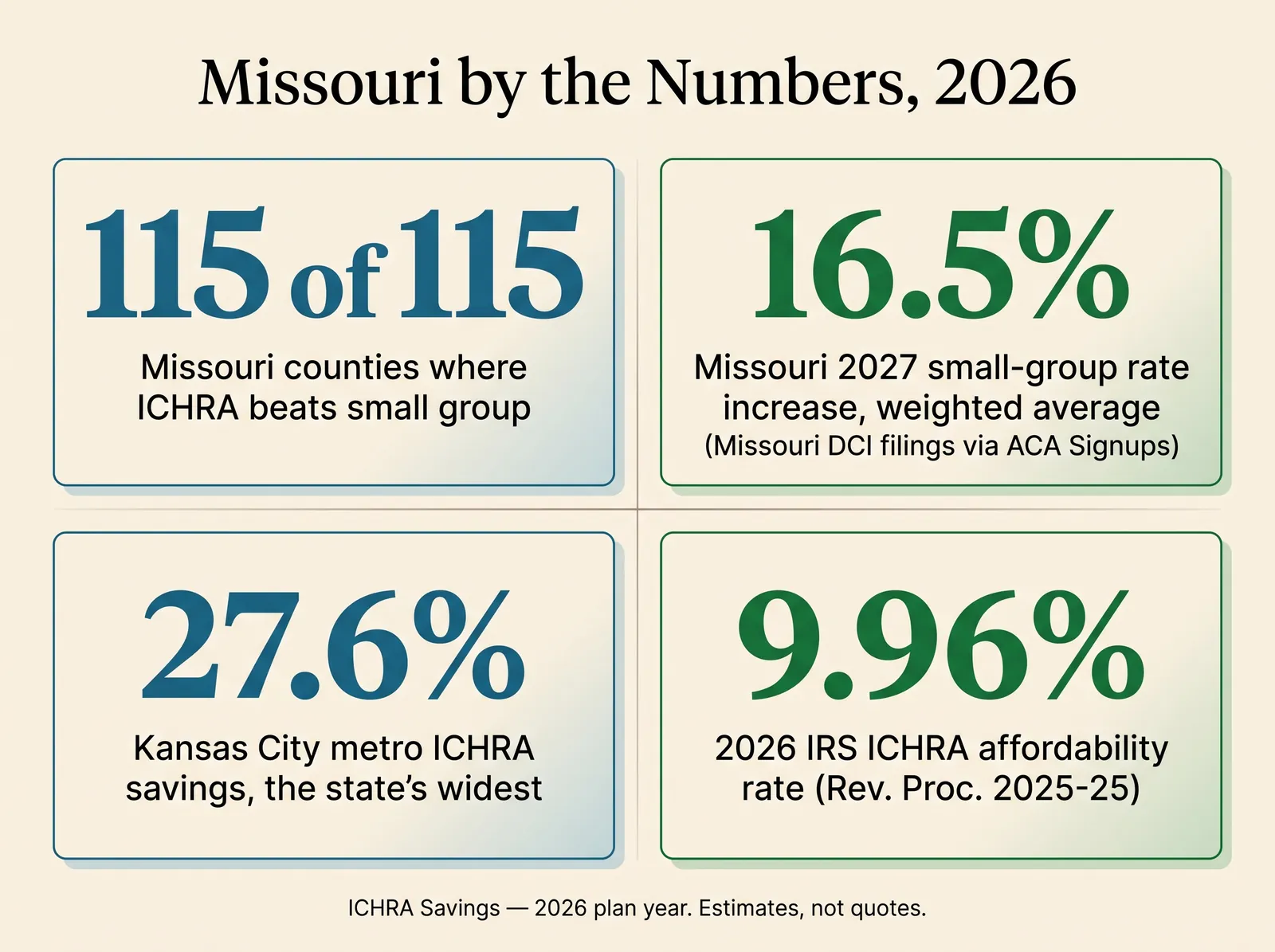
Missouri's 2027 small-group rates are filed up a weighted 16.5%. All 115 Missouri counties beat small group with an ICHRA in 2026, led by Kansas City's 27.6%.

The short version
- ICHRA beats small-group coverage in an estimated 115 of Missouri's 115 counties and the independent City of St. Louis for 2026, effectively every jurisdiction in the state, covering roughly 6.2M residents.
- The margin varies enormously. Kansas City's core counties (Jackson, Clay, Cass, Platte) qualify at 27.6%, the widest spread in the state. St. Louis City and County qualify at 16.6%. DeKalb and Caldwell Counties barely clear the bar at 3.7%.
- Missouri's individual-market carriers filed preliminary 2027 rates averaging a weighted 12.4% increase; small-group carriers filed averaging 16.5%. Both are requested, not approved, rates, open for public comment through August 31, 2026.
- The 2026 IRS affordability threshold is 9.96% of household income, the number that decides whether an employee's ICHRA is considered affordable.
Does ICHRA beat small group in Missouri?
Yes, nearly everywhere, though not by the same amount everywhere. An ICHRA (Individual Coverage Health Reimbursement Arrangement) currently beats traditional small-group coverage in an estimated 115 of Missouri's 115 counties, including the independent City of St. Louis, for the 2026 plan year, based on a county-by-county comparison of individual-market and small-group benchmark premiums. Those 115 counties make up about 9% of the 1309 counties nationwide where the math currently favors ICHRA, and cover essentially the entire state's population.
If you haven't worked through the general decision yet, our ICHRA vs. small group decision guide walks through the framework this article applies specifically to Missouri. Here's the part a simple "Missouri qualifies" headline hides: qualifying isn't binary in this state, it's a spectrum. The Kansas City metro's core counties clear a 27.6% spread. St. Louis clears 16.6%. Springfield's Greene County clears 19.7%. And a handful of small counties along the Iowa border, DeKalb and Caldwell among them, clear the bar by less than 4 percentage points, worth under $400 a year per employee. All of them "qualify." Only some of them make the exercise worth running.
115
Missouri counties and cities where ICHRA beats small group in 2026
115/115
Share of Missouri's counties and independent city that qualify
6.2M
Missourians living in a qualifying county
$1,774
Average estimated savings per employee, per year
Why Missouri's 2027 rate filings matter now
Missouri's small-group employers are looking at another round of increases before this year's renewal even settles. The state's insurers have filed preliminary 2027 small-group rate requests averaging a weighted 16.5% increase, and individual-market carriers filed averaging 12.4%, according to rate data compiled by ACA Signups from Missouri Department of Commerce and Insurance (DCI) and SERFF filings. The Missouri DCI opened these preliminary filings for public comment through August 31, 2026, and expects to post final, approved rates no later than October 31, 2026. Eight carriers plan to continue selling individual-market coverage in Missouri for 2027, with at least two carriers offering plans on and off the exchange in every county; four carriers will offer small-group plans off the exchange, and National Health Insurance Co. appears to be dropping out of that market.
Neither the 12.4% nor the 16.5% figure is final. Missouri's Department of Commerce and Insurance reviews every filing before approving anything, and rates can move in either direction once that review closes. Still, a filed 16.5% small-group increase, on the heels of already-rising premiums, is the specific, dated reason an ICHRA conversation is worth having in Missouri right now, not a generic "costs are rising" claim.
This matters for an ICHRA specifically because ICHRA reimbursements ride on individual-market prices, not small-group prices. When small-group rates move up sharply, as filed for Missouri's 2027 plan year, the spread this entire strategy depends on can widen, even if individual-market rates rise too, so long as they don't rise as fast. That's exactly why every figure in this article is tied to a specific plan year and why we rebuild the underlying dataset every year rather than reusing prior numbers.
| Metric | Missouri | Detail |
|---|---|---|
| 2027 individual-market change (preliminary) | +12.4% weighted average | Filed, not yet approved |
| 2027 small-group change (preliminary) | +16.5% weighted average | Four carriers filed off-exchange |
| Public comment period | Through Aug. 31, 2026 | Missouri Dept. of Commerce and Insurance |
| Final rates posted | No later than Oct. 31, 2026 | Missouri Dept. of Commerce and Insurance |
| IRS affordability threshold | 9.96% of household income | 2026 plan year, national |
Filed is not final
The 2027 figures above are requested rates, not approved ones. Missouri's Department of Commerce and Insurance has authority to review and adjust filings before they take effect. Treat 12.4% and 16.5% as the numbers insurers proposed, not locked-in figures for next year's renewal.
The individual-market filings, carrier by carrier
The 12.4% figure for 2027 is a weighted statewide average across a field of eight continuing carriers. Celtic Insurance Co., which sells as Ambetter, is by far Missouri's largest individual-market carrier by enrollment, covering an estimated 151,880 members, and filed one of the smaller requested increases at 10.3%. Blue Cross Blue Shield of Kansas City filed 10.6% on about 5,416 members, and Bankers Reserve Life Insurance Co. filed 11.3% on about 2,442 members. Healthy Alliance Life Insurance Co., covering an estimated 40,000 members, filed 12.67%. Oscar Insurance Co. filed 15.9% on about 18,672 members, and UnitedHealthcare filed 16.5%, though its Missouri enrollee count wasn't broken out in the filing. Medica Insurance Co. filed the steepest increase among continuing carriers at 25.6%, on a comparatively small block of about 12,843 members. Separately, Cox Health Systems Insurance Co. cited underlying health care cost trend running about 9.9% a year as part of its filing rationale, a different figure from a requested rate change.
| Carrier | Requested change | Detail |
|---|---|---|
| Medica Insurance Co. | +25.6% | ~12,843 members |
| UnitedHealthcare Insurance Co. | +16.5% | Member count not disclosed in filing |
| Oscar Insurance Co. | +15.9% | ~18,672 members |
| Healthy Alliance Life Insurance Co. | +12.67% | ~40,000 members |
| Bankers Reserve Life Insurance Co. | +11.3% | ~2,442 members |
| Blue Cross Blue Shield of Kansas City | +10.6% | ~5,416 members |
| Celtic Insurance Co. (Ambetter) | +10.3% | ~151,880 members, the largest single block |
Because Celtic/Ambetter's enormous enrollment base filed near the bottom of the range, it pulls the statewide weighted average down toward 12.4% even though five of the seven listed carriers filed above that number. An employer whose current individual-market plan sits with Medica or Oscar is looking at a materially steeper filed increase than the statewide average implies, a reminder that "the state average" and "your employees' actual plan" are not the same number.
All 115 counties and cities, ranked
Missouri's qualifying list isn't confined to its two big metros. It runs from the Kansas City and St. Louis metro cores, through Springfield and Joplin in the southwest, up to St. Joseph in the northwest, and across most of the state's small rural counties. Savings for 2026 run from about 3.7% to 27.6% below the small-group benchmark, averaging 16.6% across all 115 qualifying counties and the City of St. Louis.
| County | Population | Savings vs. small group | Est. annual savings / employee |
|---|---|---|---|
| St. Louis County | 999,703 | 16.6% | $1,343 |
| Jackson County | 715,526 | 27.6% | $2,800 |
| St. Charles County | 406,262 | 16.6% | $1,343 |
| Greene County | 299,188 | 19.7% | $1,979 |
| St. Louis city | 298,018 | 16.6% | $1,343 |
| Clay County | 253,085 | 27.6% | $2,800 |
| Jefferson County | 226,984 | 16.6% | $1,343 |
| Boone County | 184,043 | 9.2% | $933 |
| Jasper County | 122,788 | 12.1% | $1,176 |
| Cass County | 108,205 | 27.6% | $2,800 |
St. Louis County, Missouri's largest county by population at nearly a million residents, qualifies at 16.6%. Jackson County, anchoring the Kansas City side of the state line, qualifies at a wider 27.6%, and shares that exact spread with its immediate suburban ring: Clay, Cass and Platte Counties. St. Charles County, a fast-growing St. Louis suburb, sits in the St. Louis-area benchmark group at 16.6% rather than the Kansas City one, a reminder that county-level rating areas, not simple geography, drive this math.
How Missouri's 115 qualifying counties break down by savings tier
Number of counties and cities in each savings band, 2026 plan year. Source: repo county dataset.
Most of Missouri's qualifying counties (53 of 115) cluster in the 15-to-21% savings band, a solid middle tier rather than the extreme highs or lows. Illustrative and rounded; not an offer of insurance or a guarantee of savings.
See the full Missouri savings breakdown for every qualifying county, or the national savings map to check a specific county by name.
Why Kansas City saves more than St. Louis
Both of Missouri's major metros qualify, but Kansas City's spread runs meaningfully wider than St. Louis's, and the individual-market side of the equation isn't why. Jackson, Clay, Cass and Platte Counties, the Kansas City metro's core, share a 2026 individual-market benchmark of $613 a month, actually higher than St. Louis City and County's $561. What separates the two metros is the small-group side: Kansas City's small-group benchmark runs $847 a month against St. Louis's $673, a gap of more than $170 a month between the two metros' small-group pricing alone. That's why Kansas City clears 27.6% while St. Louis clears 16.6%: a pricier small-group market in the Kansas City rating area, not a cheaper individual market.
Springfield's Greene County lands in between at 19.7%, with an individual benchmark of $673 against a small-group benchmark of $838. Boone County, home to Columbia and the University of Missouri, qualifies at a much thinner 9.2%, a reminder that a college town with a large, comparatively young workforce can produce a narrower spread than either big metro.
Outside the two big metros, the picture is more mixed than either extreme. Jasper County, home to Joplin, qualifies at a middling 12.1%, an estimated $1,176 a year per employee. Buchanan County, anchoring St. Joseph in the state's northwest corner, qualifies closer to the St. Louis range at 16.6%, worth an estimated $1,944 a year. Neither city is a household name in ICHRA coverage the way Kansas City or St. Louis is, but both have real, qualifying spreads worth checking if you have staff based there.
Missouri doesn't have one ICHRA story. It has a Kansas City story at 27.6%, a St. Louis story at 16.6%, and a DeKalb County story at 3.7%. All three are true at once.
Mike Moore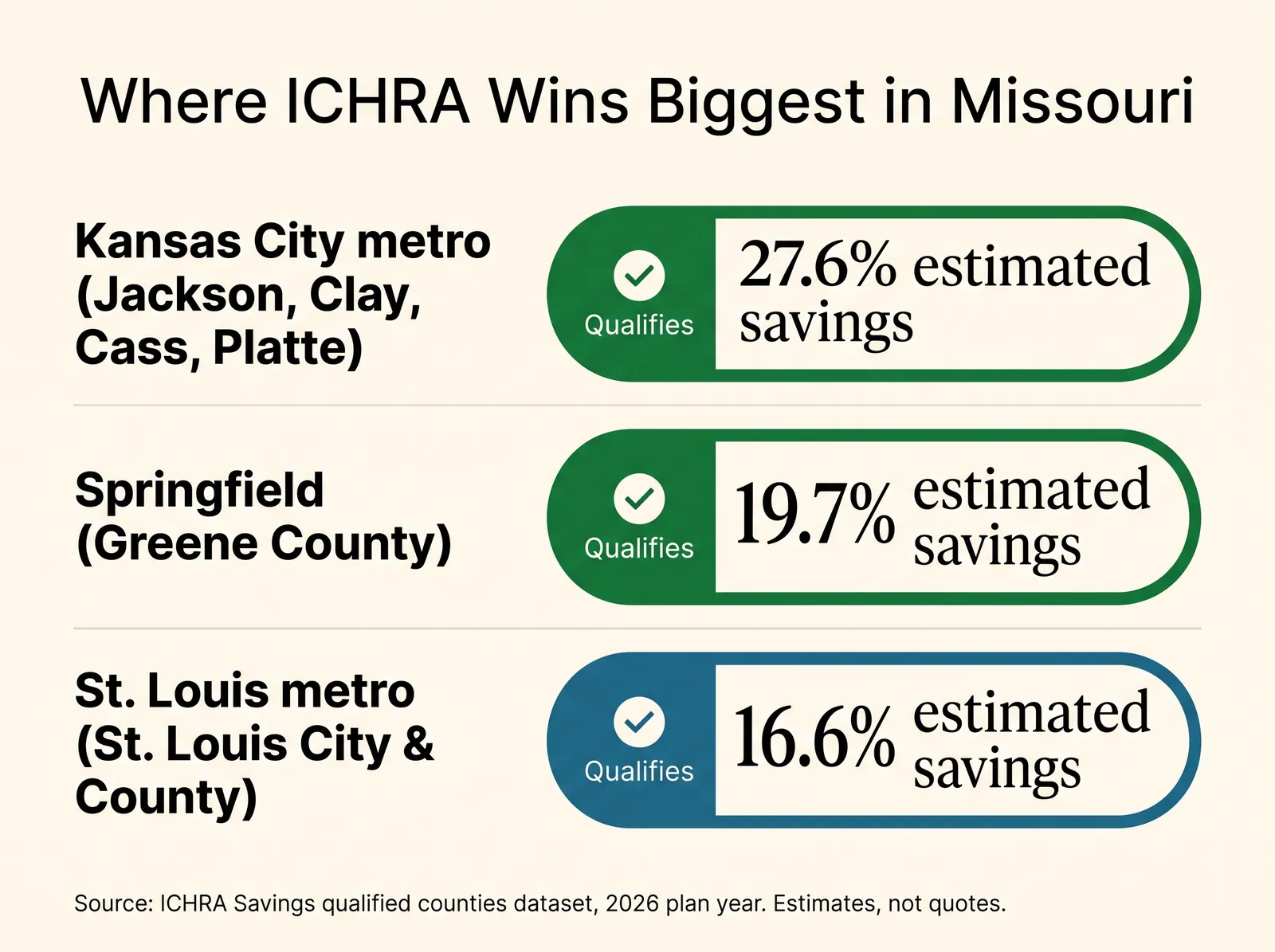
A worked example: Kansas City versus St. Louis
Here's what the county-level math actually looks like for a small employer with a split Missouri workforce, using real 2026 rate data for two qualifying counties. Assume a 20-employee company with 12 employees in Jackson County (Kansas City metro) and 8 employees in St. Louis County (St. Louis metro).
Here's the math
In Jackson County, the 2026 individual-market benchmark premium runs $613 a month against a small-group benchmark of $847 a month, a savings of $233 a month, or $2,800 a year per employee. In St. Louis County, the individual benchmark runs $561 against a small-group benchmark of $673, a savings of $112 a month, or $1,343 a year.
For this hypothetical 20-person company: 12 employees x $2,800 (Jackson) + 8 employees x $1,343 (St. Louis) = an estimated $44,338 a year in aggregate savings using benchmark-level ICHRA contributions across the whole workforce. This is an illustrative estimate using real county rate data and a hypothetical headcount split; your actual result depends on your employees' ages, exact counties and the plan levels they choose.
Notice what this example does not do: claim a single statewide "Missouri saves X%" figure. A headline like that would blur the fact that the Kansas City side of this workforce is worth nearly $1,500 a year more per employee than the St. Louis side. Checking counties individually, not trusting a state average, is the entire argument for county-level data.
Scale the same math to a bigger, more realistic Missouri employer. A 50-person firm centered entirely on the Kansas City metro's qualifying counties could see an estimated $139,986 a year in aggregate savings if it funded ICHRA contributions at the benchmark level across the board (50 x $2,800). That isn't a guarantee. It assumes every employee enrolls in a plan priced near the benchmark, and real households will land above or below it depending on age, plan choice and household size. It is, however, a real number built from real 2026 rate data, not a sales estimate.
The affordability test, in plain numbers
Every ICHRA has to clear the IRS's affordability test to avoid pushing an eligible employee's premium tax credit decision the wrong way. Under IRS Revenue Procedure 2025-25, the required contribution percentage for plan years beginning in 2026 is 9.96% of household income, up from 9.02% for 2025. In plain terms: an employer's ICHRA is considered affordable for an employee if that employee's own required monthly contribution toward the lowest-cost silver plan in their rating area doesn't exceed 9.96% of their household income, divided by 12.
Here's the math on affordability
Take a Jackson County employee earning $38,000 a year. Under the 2026 required contribution percentage of 9.96%, their household's monthly contribution toward the lowest-cost silver plan is considered affordable if it doesn't exceed $315.20 a month (9.96% of $38,000, divided by 12). Jackson County's 2026 individual-market benchmark premium runs near $613 a month; if the employer's ICHRA contribution covers, say, $130 of it, the employee's remaining share is well under $315.20, so the ICHRA is affordable for this employee, meaning they must waive the premium tax credit to use it. A smaller contribution can still clear the line for a mid-income employee; a much smaller one, or a lower-income employee, can flip the answer. Modeling this test against your actual census, not a rule of thumb, has to happen before you set a contribution amount.
That waiver decision matters more this year than in the recent past. Enhanced federal premium tax credits expired at the end of 2025, and the 400% federal poverty line cliff is back for the 2026 plan year: under the Federal Register's January 2026 update to the HHS poverty guidelines, 400% of the poverty line for the 2026 guideline year is $63,840 for a single person and $132,000 for a family of four in the 48 contiguous states. A household over that line gets no premium tax credit at all, on or off an employer's ICHRA, which is part of why an employer-funded contribution has become a more meaningful offer for higher earners than it was when generous subsidies were available up and down the income scale.
Say this plainly to employees
Taking an employer's ICHRA contribution generally means an employee waives the federal premium tax credit for that month, unless the ICHRA is unaffordable under the IRS test, in which case they can decline it and keep shopping the marketplace with a subsidy instead. Anyone modeling their own numbers needs to understand which side of that line they're on before they decide.
Why more Missouri employers are looking at this now
Missouri's rate filings aren't happening in a vacuum. The HRA Council, an industry association that aggregates anonymized enrollment data from its member organizations, released its newest annual report on August 12, 2026: Growth Trends for ICHRA & QSEHRA, Vol. 5. It found that more than 20,000 US businesses now offer ICHRA or QSEHRA, covering at least 500,000 employees nationally, with ICHRA-covered lives alone surpassing 500,000 for the first time at the start of 2026. Among small employers, more than two-thirds of those offering ICHRA, and 93% of those newly offering QSEHRA in 2026, had previously offered no health coverage at all. Applicable Large Employers were the fastest-growing segment, more than doubling their average ICHRA adoption since the prior year.
That distinction matters for a Missouri employer weighing this for the first time. On the current individual marketplace, Missouri's 2026 open enrollment saw 365,734 plan selections statewide, down from 417,000 during the 2025 open enrollment period, a roughly 12.3% year-over-year decline, according to KFF's Marketplace Enrollment Snapshot for the 2026 open enrollment period. For most small businesses in the state's qualifying counties, the realistic comparison isn't "ICHRA versus our current group plan." It's "ICHRA versus offering nothing," which is a much easier case to make when you're competing for talent against employers who already offer some kind of benefit, and a more urgent one with small-group rates already filed up 16.5% for 2027. The IRS, DOL and HHS final rule that created ICHRA in 2020 sets no employer size minimum at all; a single-employee company can offer one on the same terms as a 500-person company, part of why adoption keeps climbing fastest among the smallest employers in the HRA Council's data.
New coverage, not always a switch
Two-thirds-plus of 2026 small-business ICHRA adopters had never offered coverage before.
Large-employer adoption is accelerating
ALE ICHRA adoption more than doubled on average year over year, per the HRA Council.
Marketplace enrollment is falling in Missouri
Plan selections dropped about 12.3% for 2026, per KFF, as the subsidy cliff returned.
How ICHRA Savings helps
None of the county math above requires talking to anyone. The savings map lets you look up every Missouri county by name and see the same individual-market and small-group benchmark premiums used in this article, so you can check whether your specific workforce sits inside a strong-margin county, a thin-margin one, or somewhere in between before you spend time on anything else. Beyond the map, we help employers design and set up an ICHRA: building employee classes correctly, modeling affordability against your real census instead of a rule of thumb, and getting the required employee notice right and on time. We don't pick your employees' plans for them; that decision, and the choice of network, stays with each person buying their own coverage. Our part is the budget, the design and the compliance scaffolding around it.
Before anything else, check whether your county is one where this works well: https://ichrasavings.com/ichra-savings-map/. Ten minutes there tells you whether the rest of this process is worth starting, and whether your county lands closer to Kansas City's 27.6% or DeKalb's 3.7%.
One more wrinkle worth flagging for Missouri specifically: both major metros straddle a state line. The Kansas City metro spans Jackson, Clay, Cass and Platte Counties on the Missouri side, and Johnson and Wyandotte Counties on the Kansas side. St. Louis touches Illinois across the Mississippi River. An employer with staff living on either side of either line needs each employee's actual county checked individually, since Kansas and Illinois run their own separate rate filings and their own separate qualifying counties on our savings map, not a mirror of Missouri's numbers.
Setting up an ICHRA in Missouri
Missouri doesn't add state-specific ICHRA rules on top of the federal framework. The same IRS, DOL and HHS final rule that governs ICHRA everywhere applies here, and the setup sequence is identical to any other state:
- Pull your census by county, not by office address. A company headquartered in St. Louis with field or remote staff in the Kansas City metro or Springfield has a materially different savings story per location.
- Check each employee's county on the savings map. Don't assume a statewide average applies; a 27.6% metro and a 3.7% rural county both technically "qualify," but they aren't the same decision.
- Model affordability using the 2026 threshold. At 9.96% of household income, the required contribution percentage sets how much an ICHRA contribution needs to cover to count as affordable.
- Define employee classes carefully, if you use them. An employee class is a group defined by an objective factor the IRS permits, such as full-time versus part-time status, geographic location, or salaried versus hourly work. Class rules carry minimum-size requirements and cannot offer the same class a choice between ICHRA and group coverage.
- Send the required notice on time. Under the federal ICHRA final rule, eligible employees generally need written notice at least 90 days before the plan year starts, with specific required content about the offer and its effect on subsidy eligibility.
- Budget for onboarding support. Employees who have never shopped Missouri's individual marketplace on their own need guidance, once, at enrollment, especially with eight carriers competing statewide and coverage options varying meaningfully by county.
See our full ICHRA setup timeline for the detailed rollout plan, including the exact notice content requirements, and our guide to ICHRA employee classes if your Missouri workforce spans more than one rating area.
Run your counties first
Before scheduling a single meeting, look up every county where you have employees on the savings map. If your Missouri workforce sits mostly inside DeKalb, Caldwell or another thin-margin county, you have a different, more marginal conversation ahead than an employer centered on Kansas City, Springfield or the St. Louis metro.
The honest limits of this data
Read this before you commit
- "Qualifies" isn't a single tier. DeKalb and Caldwell Counties clear the bar by about $31 a month per employee, roughly $377 a year, thin enough that a small employer should weigh it against the administrative cost of running the program correctly.
- Rates move every plan year. With 2027 small-group filings already up an average of 16.5% and individual-market filings up 12.4%, next year's spread could widen or narrow from this year's; recheck before every renewal, not just once.
- These are benchmark comparisons, not a guarantee for your specific workforce. A qualifying county means the benchmark math favors ICHRA; model your actual census, ages and plan choices before committing.
- Filed 2027 rates are not approved. Missouri's Department of Commerce and Insurance can adjust either figure before finalizing rates by October 31, 2026.
How these numbers are calculated
Every county figure in this article comes from the same dataset that powers our savings map, not from a survey or a sales estimate. For each of Missouri's 115 counties and its one independent city, we compare a 2026 individual-market benchmark premium, the second-lowest-cost silver plan available to a representative 50-year-old enrollee, against a small-group benchmark premium built from comparable small-group plan filings for that county's rating area. A county "qualifies" when the individual benchmark sits below the small-group benchmark; the percentage and dollar savings figures in this article are the gap between those two numbers, expressed as an annual per-employee figure at 12 times the monthly difference. The separate 2026 and 2027 rate-filing figures in this article come from Missouri Department of Commerce and Insurance and SERFF filings as compiled by ACA Signups, and are not reflected in the county-level qualifying dataset above, which uses the 2026 benchmark comparison described here.
Three limitations are worth stating plainly. First, benchmark premiums are built around a representative enrollee profile, so an unusually young or unusually old workforce will see a different real-world spread than the county average implies. Second, these are benchmark plans, not every plan on the market; an employee who chooses a richer or leaner plan than the benchmark will see a different premium, though the relative spread tends to hold directionally. Third, rates are filed and refreshed annually, so a county that qualifies for 2026 is not guaranteed to qualify for 2027 once the current filings are approved. We rebuild this dataset each plan year rather than reusing prior-year figures, and we recommend employers do the same before every renewal.
Questions Missouri employers actually ask
Does ICHRA beat small-group insurance everywhere in Missouri?
Yes, on paper, in an estimated 115 of Missouri's 115 counties and the independent City of St. Louis for the 2026 plan year, covering roughly 6.2M residents. But "qualifies" covers a wide range: the Kansas City metro clears 27.6%, worth an estimated $2,800 a year per employee, while DeKalb and Caldwell Counties clear just 3.7%, worth about $377. Both technically qualify. Only one is worth the administrative lift for most small employers.
Why does Kansas City save more than St. Louis?
Jackson, Clay, Cass and Platte Counties, the core of the Kansas City metro, share a 2026 individual-market benchmark of $613 a month against a small-group benchmark of $847, a 27.6% spread. St. Louis City and County, plus St. Charles and Jefferson Counties, run $561 against $673, a 16.6% spread. The individual-market side is priced almost identically in both metros; the difference comes almost entirely from a small-group benchmark that runs meaningfully higher in the Kansas City rating area than in the St. Louis one.
How much can a Kansas City-area employer expect to save with an ICHRA?
Jackson County qualifies at an estimated 27.6% savings for 2026, about $2,800 per employee per year using benchmark premiums. That's an estimate built from public rate data, not a quote, and your real number depends on your employees' ages, exact counties and the plans they choose.
What's happening with Missouri's 2027 health insurance rates?
Missouri individual-market carriers filed preliminary 2027 rate requests averaging a weighted 12.4% increase, and small-group carriers filed averaging 16.5%, according to rate data compiled by ACA Signups from Missouri Department of Commerce and Insurance filings. The department opened these preliminary filings for public comment through August 31, 2026, and expects to post final, approved rates no later than October 31, 2026. These are requested figures, not approved final rates.
What is the 2026 ICHRA affordability percentage, and why does it matter in Missouri?
The IRS set the required contribution percentage for plan years beginning in 2026 at 9.96% of household income, under Revenue Procedure 2025-25. It decides whether an employee's ICHRA is considered 'affordable,' which in turn decides whether they must waive their ACA premium tax credit to use it. This is a federal number, the same in Missouri as anywhere else, but the exact contribution needed to clear it still depends on each employee's household income.
Does Missouri impose any state-specific ICHRA rules?
No. ICHRA is a federal HRA structure created by an IRS, DOL and HHS final rule, and it works the same way in Missouri as in any other state. Missouri does not layer additional ICHRA-specific requirements on top of the federal rule, though standard state insurance-producer licensing still applies to anyone advising employees on plan selection, and Missouri uses HealthCare.gov as its marketplace rather than running a state-based exchange.
Is a county that only qualifies at 3.7% even worth pursuing?
Usually not on its own. DeKalb and Caldwell Counties clear the bar by roughly $31 a month per employee, about $377 a year, which can be smaller than the administrative cost of running an ICHRA correctly for a very small group. If your workforce sits mostly in a thin-margin county like that, the more useful question isn't "does it qualify" but "is small group, a taxable stipend, or offering nothing at all the better comparison for us," and that answer depends on your specific carrier options and headcount.
Where can I check whether my specific Missouri county qualifies?
Use the savings map to look up any Missouri county by name. It shows the 2026 individual-market and small-group benchmark premiums side by side, so you can see the estimated spread for your workforce's counties before you model a rollout.
Sources
- ACA Signups, "2027 Rate Changes - Missouri: +12.4% indy mkt; +16.5% sm. group" (compiled from Missouri DCI/SERFF filings)
- Missouri Department of Commerce and Insurance, "Missouri Releases Preliminary 2027 Health Insurance Rates"
- IRS, Revenue Procedure 2025-25 (2026 ACA/ICHRA required contribution percentage, 9.96%)
- Federal Register, "Annual Update of the HHS Poverty Guidelines" (Jan. 15, 2026; 2026 FPL figures)
- KFF, "Marketplace Enrollment Snapshot for Open Enrollment 2026" (Missouri plan selections)
- HRA Council, "Strong ICHRA Growth Among Large Employers..." (Growth Trends for ICHRA & QSEHRA, Vol. 5) (Aug. 12, 2026)
- Federal Register, "Health Reimbursement Arrangements and Other Account-Based Group Health Plans" (84 Fed. Reg. 28888, June 20, 2019; the ICHRA final rule)
- HealthCare.gov, "Individual coverage HRAs"
- "List of counties in Missouri" (114-county count, plus the independent City of St. Louis)
- ICHRA final rule: Departments of the Treasury/IRS, Labor, and Health and Human Services (2020)