ICHRA in Mount Gilead, Ohio 2026: Morrow County 62.7%
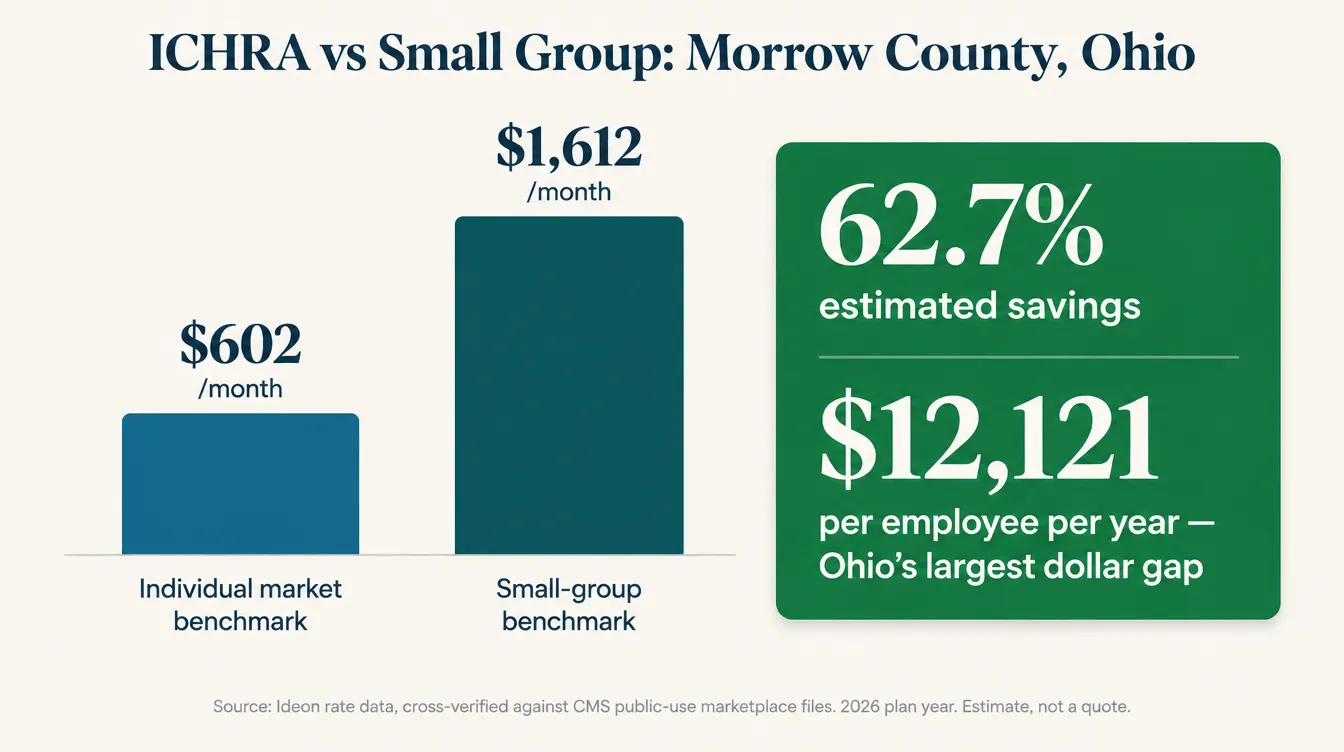
Morrow County's 2026 benchmark runs an estimated 62.7% below small group, $12,121 a year per employee, Ohio's widest dollar gap. See the sourced data.
The short version
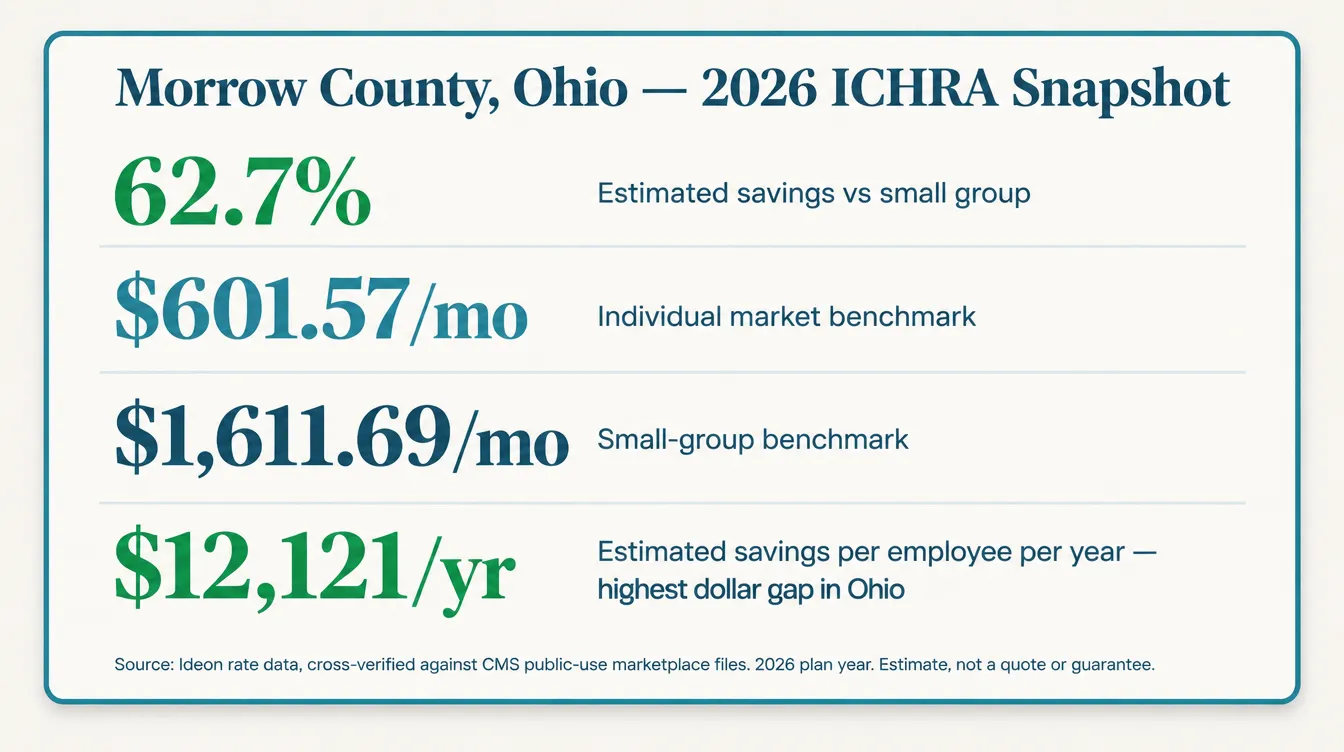
- Morrow County's 2026 individual-market benchmark runs an estimated 62.7% below the small-group benchmark, about $12,121 per employee per year — the largest per-employee dollar gap of any Ohio county in our dataset, ahead of every other Ohio county including the well-known percentage leaders.
- Morrow's benchmark numbers don't match any of its five bordering counties (Knox, Marion, Richland, Crawford, Delaware) or any other Ohio county in the dataset — unlike much of the state, Morrow isn't part of a shared multi-county rating-area price.
- Per the U.S. Bureau of Labor Statistics' Quarterly Census of Employment and Wages for Morrow County (area code 39117), 2025 annual averages, the county's 499 private establishments employ 3,894 people; manufacturing alone pays an average annual wage of $63,556, well above the county's $46,691 all-private average.
- Ohio does not cap small-group carrier participation requirements by statute the way some states do; Ohio Revised Code § 3924.01 defines the mechanic but leaves the specific enrollment bar to each carrier, which varies plan to plan.
- Qualifying is not the same as guaranteed savings for your business. The honest limits are covered later, including where this comparison breaks down for a specific workforce.
Does ICHRA beat small group in Mount Gilead, Ohio?
Yes, and by more real dollars per employee than any other county in Ohio. An ICHRA (Individual Coverage Health Reimbursement Arrangement) is an IRS-defined arrangement that lets an employer set a fixed monthly reimbursement amount and let each employee buy their own individual-market plan with it, tax-free. In Morrow County, the county whose seat is Mount Gilead, the 2026 individual-market benchmark premium runs an estimated 62.7% below the small-group benchmark premium, according to a county-by-county comparison built from Ideon rate data and cross-verified against CMS public-use marketplace files.
That 62.7% ranks 7 out of Ohio's 88 counties by percentage, sitting above the statewide average of 54.9%. But the number that actually matters to a Morrow County employer's budget is the dollar gap, and there Morrow leads the entire state: $12,121 per employee per year, more than any of Ohio's other 87 counties in our dataset, including counties that post a higher percentage. That happens because Morrow's individual-market benchmark is unusually low in absolute terms, not just relative to its own small-group benchmark, which widens the dollar gap even where the percentage is a shade behind the state's percentage leaders.
Of the 1,309 counties nationwide in our dataset, 88 are in Ohio, and 88 of them clear the $100-a-month gap we use as the floor for calling a county "qualifying" at all. Morrow clears it by a wide margin, at $1010.12 a month. The question that matters for a Mount Gilead employer isn't whether the county "qualifies" in the abstract, it's what this specific gap is worth to a specific headcount, and whether it solves the actual problem a small Morrow County business runs into with group coverage. That's what the rest of this guide works through.
62.7%
Estimated Morrow County savings vs. small group
$12,121
Highest per-employee dollar gap of any Ohio county
35K
Morrow County residents
7/88
Morrow's rank by percentage among Ohio counties
Why Morrow County's number matches no neighboring county
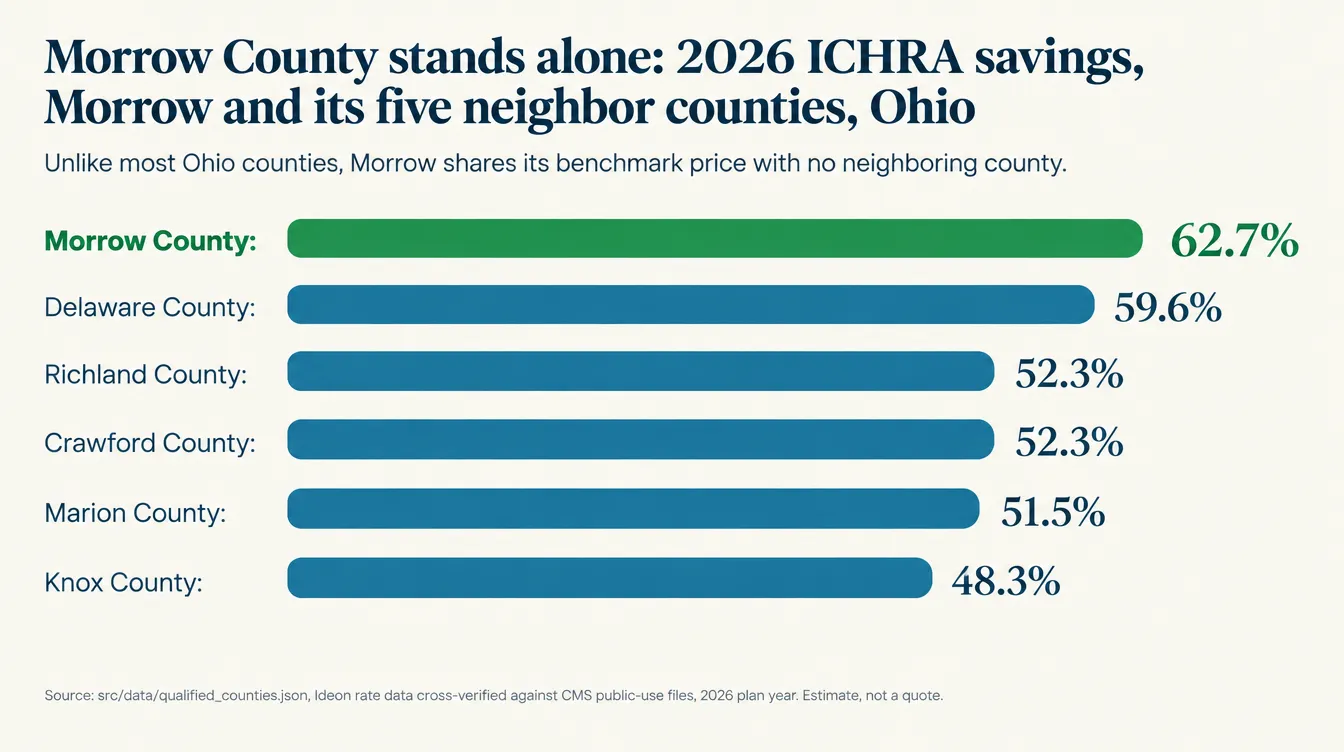
Our earlier guide to Ohio's rating areas explains a pattern that holds across much of the state: carriers file one benchmark price for a whole cluster of counties at once, a federally defined geography called a rating area, so several counties end up showing the identical number to the cent. Morrow County breaks that pattern. Checked against every other Ohio county in our dataset, Morrow's individual benchmark ($601.57) and small-group benchmark ($1611.69) don't match any other county's figures, including its five bordering counties: Knox to the east, Marion to the west, Richland to the northeast, Crawford to the north, and Delaware to the south.
That's worth stating plainly because it cuts against the usual advice for this site's county guides, which is often "check your neighbor's number, it's probably the same as yours." For Morrow County employers, it isn't. A Mount Gilead business with staff who commute in from Delaware County (part of the fast-growing Columbus exurbs) or Knox County can't assume the Morrow benchmark applies to those employees' home-county pricing; the comparison in this article is Morrow-specific, and each neighboring county has its own, different answer, shown below.
| County | Population | Individual benchmark | Small-group benchmark | Savings vs. small group |
|---|---|---|---|---|
| Morrow County (this article) | 35K | $601.57 | $1611.69 | 62.7% |
| Delaware County | 216K | $600.46 | $1485.83 | 59.6% |
| Crawford County | 42K | $768.09 | $1611.69 | 52.3% |
| Richland County | 125K | $768.09 | $1611.69 | 52.3% |
| Marion County | 65K | $781.54 | $1611.69 | 51.5% |
| Knox County | 63K | $768.89 | $1485.83 | 48.3% |
Source: src/data/qualified_counties.json, 2026 plan year (Ideon rate data,
cross-verified against CMS public-use marketplace files). Estimates, not quotes.
Columbus is close, but its number is different too
Franklin County (Columbus), covered in our statewide "All 88 Counties Qualify" guide, shows an estimated 59.6%, a real and sourced figure, but still a different number from Morrow's 62.7%. And Erie County, on Lake Erie, shows the state's highest percentage at 63.0%, covered in our Sandusky ICHRA guide, yet its dollar gap trails Morrow's because Erie's underlying benchmark prices run higher in absolute terms. Percentage and dollar gap don't always move together; check both before assuming one county's headline applies to yours.
How Ohio's 88 counties break down by savings tier
Number of counties in each savings band, 2026 plan year. Source: Ideon rate data, cross-verified against CMS public-use files.
Morrow sits in the top tier, well above the statewide average. Illustrative and rounded; not an offer of insurance or a guarantee of savings.
Mount Gilead's manufacturing-and-farmland economy, in the numbers
Morrow County doesn't run on tourism or a single dominant hospital system the way some qualifying counties do. Per the Morrow County Economic Development office, agriculture — corn, soybeans, dairy and livestock — remains the foundation of the county's economy, supplemented by small manufacturing operations and service businesses along the Interstate 71 corridor that runs through the county's eastern edge and connects it toward both Columbus and Cleveland. Mount Gilead itself, the county seat, carries the county's highest concentration of retail, commercial and food-service activity, while the village of Cardington is home to Cardington Yutaka Technologies, an automotive-parts manufacturer and one of the county's largest private employers.
Per the U.S. Bureau of Labor Statistics' Quarterly Census of Employment and Wages (QCEW) for Morrow County (area code 39117), 2025 annual averages, the county's 499 private-sector establishments employed 3,894 people at an average annual pay of $46,691. Manufacturing, though a small slice by establishment count at 19 firms, employed 709 people at an average annual pay of $63,556 — the best-paying major private sector in the county and well above the countywide private average. Construction employed 425 people across 89 firms at $59,194 average pay, while accommodation and food services, the lowest-paid major sector, employed 410 people across 36 firms at just $17,808 average pay. Local government, which per the same source includes county offices, schools and the county hospital, employed 1,303 people across 50 establishments at $46,974 average pay.
| Sector | Establishments | Employment | Avg. annual pay |
|---|---|---|---|
| All private industry | 499 | 3,894 | $46,691 |
| Manufacturing (NAICS 31-33) | 19 | 709 | $63,556 |
| Construction (NAICS 23) | 89 | 425 | $59,194 |
| Retail trade (NAICS 44-45) | 58 | 607 | $30,129 |
| Accommodation and food services (NAICS 72) | 36 | 410 | $17,808 |
| Local government | 50 | 1,303 | $46,974 |
Source: U.S. Bureau of Labor Statistics, Quarterly Census of Employment and Wages, Morrow County, Ohio (area code 39117), 2025 annual averages.
A total covered workforce smaller than the county's own population
Across all ownership types, BLS counts 5,310 total covered jobs in Morrow County against a dataset population of 35K. That gap is a real signal, not a data error: a meaningful share of Morrow County residents commute out of the county for work, largely down the I-71 corridor toward Delaware County and Columbus. An employer here is competing for labor against Columbus-metro wages and benefits packages, even while running a smaller, more rural operation.
Why a small manufacturer or farm operation feels group-insurance pricing the hardest
A 19-person machine shop in Cardington, a farm-supply retailer outside Mount Gilead, or a family-run construction firm along the I-71 corridor all share a version of the same problem. None of them is a large enough employer to negotiate group-insurance pricing the way a big Columbus employer can, and none of them has the kind of stable, uniformly full-time payroll that small-group underwriting assumes. A farm-supply business might carry two full-time counter staff, three seasonal warehouse hands, and an owner's family member who's covered through a spouse's plan. A machine shop might run lean on office staff while its skilled trades crew is exactly the kind of higher-wage, harder-to-replace worker an owner most wants to compete for with a real benefit.
Group health insurance is priced and underwritten around a knowable, largely stable enrolled population. A carrier protects that pricing with a minimum enrollment share among eligible employees before it will issue a policy, and the exact bar is set by the carrier, not capped by Ohio statute (more on that below). For a small Morrow County employer with a mix of full-time, part-time and family labor, or with employees already covered elsewhere, clearing whatever bar a given carrier happens to set is a real obstacle, one that has nothing to do with whether the employer wants to offer a benefit and everything to do with a workforce shape group underwriting wasn't built for.
This is the pain point this guide is written for: an owner who priced group coverage, ran into either the participation math or a renewal number that jumped without warning, and assumed there was nothing realistic to offer, when in fact Morrow County's individual market is priced low enough, relative to small group, that a modest fixed monthly contribution goes further here than in almost any other Ohio county.
See the full Ohio savings breakdown for every qualifying county, the national savings map to look up a specific county by name, or the Ohio vs. Georgia comparison for how Morrow's number fits into the bigger multi-state picture.
Morrow County isn't a household name the way Columbus or Cincinnati is, but the arithmetic here is the widest dollar gap of any county in the state. A small manufacturer or farm operation that never seriously priced a benefit should look at this number before assuming it can't afford one.
Mike MooreHow an ICHRA (now also called CHOICE) actually works
Before the Morrow County numbers mean anything, it helps to be precise about what's being compared.
An ICHRA is an employer-funded health reimbursement arrangement created by a 2019 final rule from the IRS and Treasury, the Department of Labor, and HHS, published in the Federal Register on June 20, 2019, applicable to plan years beginning on or after January 1, 2020. Instead of choosing one group health plan for everyone, the employer sets a fixed monthly reimbursement amount, and each employee uses that money to buy an individual-market plan of their own choosing, then submits proof of coverage (called substantiation) to get reimbursed tax-free. The employer isn't picking a plan for a dozen households with different doctors and different needs; the employer is funding a budget, and the employee is doing the shopping.
Worth naming directly: as of this article's publish date, HealthCare.gov's own page on this arrangement is titled "CHOICE Arrangements," and states plainly that CHOICE Arrangements are "formerly known as the Individual Coverage Health Reimbursement Arrangements, or ICHRAs." That's an administrative renaming on federal consumer-facing pages, not a change to the 2019 final rule or to any compliance requirement described in this article. We use "ICHRA" throughout this site, since that's still the term used in the regulations themselves.
The comparison behind every number in this article rests on two specific prices for a given rating geography. The individual-market benchmark premium is the second-lowest- cost silver-level plan available to a representative 40-year-old enrollee. "Silver" is one of four ACA metal levels (bronze, silver, gold, platinum) describing how costs split between premium and out-of-pocket spending, not the quality of care. This is the same benchmark the federal government uses to calculate premium tax credits, which is why it's a defensible number to build a comparison on rather than one insurer's list price. The small-group benchmark premium is the equivalent figure built from comparable small-group plan filings for the same geography. When the individual benchmark is lower, the county "qualifies," and the gap between the two is the estimated per-employee savings if the employer funds ICHRA at that benchmark level.
Two more terms matter once an employer is actually deciding whether to switch. The affordability safe harbor is the test that decides whether the ICHRA offer counts as "affordable" under IRS rules — for plan years beginning in 2026 that test runs against a Required Contribution Percentage of 9.96% of household income (IRS Rev. Proc. 2025-25), rising to 10.22% for plan years beginning in 2027 (IRS Rev. Proc. 2026-26). Get the contribution amount wrong relative to that threshold and an ALE (applicable large employer, generally 50 or more full-time-equivalent employees) can trigger an employer-mandate penalty. Most Morrow County manufacturers, farm operations and shops, running well under 50 employees, sit comfortably under that threshold.
Morrow County's rate spread, in dollars
Here is the actual 2026 benchmark comparison for Morrow County, the county whose seat is Mount Gilead. The individual-market benchmark premium is $601.57 a month. The small-group benchmark premium, built from comparable small-group plan filings for the same geography, is $1611.69 a month. That's a gap of $1010.12 a month, or $12,121 a year, per employee, an estimated 62.7% in favor of the individual market.
Put next to the rest of central Ohio, Morrow's percentage sits a few points behind Delaware County's 59.6% and well ahead of Knox County's 48.3%, Marion County's 51.5%, and Richland and Crawford counties, both at 52.3%. But because Morrow's individual-market benchmark is lower in absolute dollar terms than any of those counties', Morrow's actual per-employee dollar savings, $12,121 a year, outruns all five of its neighbors and every other county in Ohio's 88-county dataset.
Ohio's group participation rule, and why there's no state-set ceiling
Small-group health insurance isn't sold to individual employees one at a time; it's underwritten as a pool, and a carrier can require a minimum share of a company's eligible employees to actually enroll before it will issue the policy at all. Ohio law defines this mechanic in Ohio Revised Code § 3924.01, which describes a "group participation rule" as "a requirement relating to the minimum number of employees or dependents that must be enrolled in relation to a specified percentage or number of eligible individuals or employees of an employer." What that statute does not do is cap the percentage a carrier is allowed to require. Some states set an explicit statewide ceiling on group participation rules; Ohio, per the plain text of § 3924.01, leaves the specific bar to each carrier's own underwriting.
In practice, that means a Morrow County employer shopping small-group coverage may see a different minimum-participation requirement from one carrier to the next, and that requirement isn't published anywhere in one place the way a statutory cap would be; it has to be confirmed plan by plan. A 15-person machine shop or family farm operation with a couple of part-timers, a new hire still inside a waiting period, or a spouse covered elsewhere can end up short of whatever bar a given carrier happens to set, even though every one of those employees technically has coverage somewhere.
An ICHRA (or CHOICE Arrangement, per HealthCare.gov's current naming) sidesteps the mechanic entirely when it's the only benefit offered. Per HealthCare.gov, there is no participation-percentage requirement at all in that case. A minimum class size only applies when an employer offers a CHOICE Arrangement to one employee class while also offering a traditional group plan to a different class: 10 employees for employers with fewer than 100 total employees, 10% of the total workforce for employers with 100 to 200 employees, and 20 employees for employers with more than 200. Those class-size rules exist to keep the two benefit types properly separated when both are in use; they don't apply at all to an employer offering only a CHOICE Arrangement, which describes most Morrow County small businesses.
If a group quote already fell through on participation
If you've already tried to set up small-group coverage in Morrow County and a carrier's participation requirement blocked the quote, that's a specific, common signal that an ICHRA is worth pricing out next, since the mechanic that blocked you doesn't apply to it when it's the only benefit you offer.
A worked example for a Morrow County employer
Here's what the Morrow County numbers look like applied to a real headcount. Assume an 11-employee Morrow County company — a machine shop in Cardington, a farm-supply retailer, or a small construction firm along the I-71 corridor — currently renewing a small-group plan priced at this year's Morrow County benchmark.
Here's the math
The 2026 small-group benchmark in Morrow County is $1611.69 a month per employee, or $19340.28 a year. The 2026 individual-market benchmark is $601.57 a month, or $7218.84 a year. The difference is $12,121 a year per employee. For an 11-person company, funding ICHRA contributions at the benchmark level instead of renewing small group works out to an estimated $133,336 a year in aggregate estimated savings.
This is illustrative math built from real 2026 county rate data and a hypothetical headcount. It is not a quote, and it assumes the employer sets the ICHRA contribution at the benchmark level, which is a design choice, not a requirement. Your actual number depends on your employees' ages, exact home counties, and the plans they choose once they're shopping with their own budget.
The same arithmetic scales down cleanly to a smaller case: a 4-person farm-supply counter operation outside Mount Gilead that never seriously priced group coverage because the owner assumed a business that small couldn't offer anything worth having. At the $ 601.57 individual benchmark, funding an ICHRA for all four employees costs about $2406 a month in total contributions — a real, tax-free benefit offered to every eligible employee, since there's no enrollment percentage to clear and no group underwriting to qualify for.
At the other end of the size range, a 55-employee manufacturer along the I-71 corridor crosses into ALE territory under the employer mandate, which changes the calculus without changing the underlying county math. The same benchmark comparison applies, but an ALE has to run the affordability safe-harbor test — against the 9.96% threshold for 2026 or 10.22% for 2027 — carefully for every employee class, since an ICHRA offer judged "unaffordable" for even a handful of lower-paid employees can trigger a penalty. That's not a reason to avoid ICHRA at that size; it's a reason to model the affordability test before setting a contribution amount, which our eligibility guide walks through in detail.
Setting up an ICHRA in Morrow County
Ohio doesn't layer a statewide participation cap on top of the federal framework the way some states do, but the underlying setup sequence is the same one that applies everywhere. What determines whether a Morrow County rollout goes smoothly:
- Pull your census by county, not by office address. A business headquartered in Mount Gilead with staff commuting in from Delaware, Knox, Marion, Richland or Crawford counties needs each employee's actual home-county comparison, since none of those counties share Morrow's number.
- Decide how you'll define your eligible class. An hours-based eligible class (for example, employees regularly scheduled 30+ hours a week) is a legitimate way to extend a benefit to full-time shop or field staff without promising it to every seasonal or family-labor hire.
- Check whether you're offering ICHRA alone or alongside a group plan. That decision determines whether any class-size minimum applies at all.
- Model affordability before you set a contribution. The reimbursement level decides whether an employee keeps or waives premium tax credit eligibility, against the 9.96% (2026) or 10.22% (2027) Required Contribution Percentage.
- Send the required notice on time. Eligible employees need written notice at least 90 days before the plan year starts, with specific required content.
- Budget for onboarding support. Employees who've never shopped Ohio's individual marketplace, especially skilled-trades and farm-operation staff used to a single group-plan option, need guidance once, at enrollment, not a lengthy annual open-enrollment process.
See our full ICHRA setup timeline for the detailed rollout plan, including the exact notice content requirements, and our eligibility guide for the affordability test itself.
If your employer just offered you an ICHRA
This guide is written for the employer side of the decision, but if you're a Morrow County employee who was just told your benefit is changing, the short version is: you'll get a fixed monthly amount and shop for your own plan on the individual marketplace instead of picking from your employer's group menu. Our guide for employees walks through what to expect.
The honest limits of this data
A strong county average is not a guarantee for your specific workforce
- A benchmark comparison is not your actual renewal. The $1611.69 Morrow County figure is a small-group benchmark built from filed rates, not your specific carrier's quote for your specific group.
- The dollar gap is driven by a low individual-market baseline, not just a wide spread. Morrow's individual benchmark is genuinely low in absolute terms; if your employees' actual plan choices land above that benchmark, your real-world dollar savings will run below the $12,121 figure used here.
- Older or higher-risk workforces change the math. Individual-market premiums are age-rated more steeply in some geographies than small-group premiums, which can narrow real-world savings for an older ownership or management team below the benchmark figure.
- Carrier participation rules still apply if you keep a group plan alongside ICHRA. Ohio's lack of a statutory cap means a carrier's own bar could be higher than you expect; confirm it directly with any carrier you're still comparing against.
- Rates move every plan year. A carrier entering or leaving this geography can shift the comparison for 2027; recheck before every renewal, not just once. Ohio's individual market already moved 19.8% for 2026 per healthinsurance.org, so don't assume this year's spread holds next year.
- Waiving the premium tax credit is part of the deal. An employee whose ICHRA offer is deemed affordable generally cannot also claim a marketplace subsidy for that month. Model both sides before assuming the reimbursement is pure upside.
How these numbers are calculated
Every county figure in this article comes from the same dataset that powers our savings map, not a survey or a sales estimate. For each county, we compare a 2026 individual-market benchmark premium — the second-lowest-cost silver plan available to a representative enrollee, the same benchmark the federal government uses to calculate premium tax credits — against a small-group benchmark premium built from comparable small-group plan filings for that geography. Both figures come from Ideon, a licensed insurance rate-data provider, and are cross-verified against CMS public-use marketplace files before publication. A county appears in our location-page dataset when the individual benchmark sits below the small-group benchmark by at least $100 a month; the percentage and dollar figures in this article are the gap between those two numbers, expressed as an annual per-employee figure at 12 times the monthly difference.
Morrow County's population figure (35K) comes from the same underlying county dataset used across the site. The employment figures in the economy section — 3,894 total private jobs across 499 establishments at $46,691 average pay, 709 manufacturing jobs across 19 establishments at $63,556 average pay, 425 construction jobs across 89 establishments at $59,194 average pay, 607 retail-trade jobs across 58 establishments at $30,129 average pay, 410 accommodation-and-food-services jobs across 36 establishments at $17,808 average pay, and 1,303 local-government jobs across 50 establishments at $46,974 average pay — come from the U.S. Bureau of Labor Statistics' Quarterly Census of Employment and Wages, Morrow County, Ohio (area code 39117), 2025 annual averages, a separate federal dataset from our own county premium comparison, fetched directly from BLS's public CEW API. The total covered (all ownerships) figure of 5,310 jobs across 565 establishments comes from the same BLS source. The description of Morrow County's economy, its position on the I-71 corridor, and its top private employers (including Cardington Yutaka Technologies) comes from the Morrow County Economic Development office's own published materials. The Ohio participation-rule citation comes directly from the text of Ohio Revised Code § 3924.01, as published by the Ohio Legislative Service Commission at codes.ohio.gov. The national small-group premium figure (Peterson-KFF), the Ohio individual-market figures (healthinsurance.org), the national family premium figure (KFF), the IRS affordability percentages (Rev. Proc. 2025-25 and 2026-26), and the HealthCare.gov participation and naming details each come from separately published, independent sources, described and cited where they appear. We've kept these data sources clearly separate throughout this article rather than blending them into one number.
Three limitations are worth stating plainly. First, benchmark premiums are built around a representative enrollee profile, so an unusually young or unusually old workforce will see a different real-world spread than the county figure implies. Second, these are benchmark plans, not every plan on the market; an employee who chooses a richer or leaner plan than the benchmark will see a different premium, though the relative spread tends to hold directionally. Third, rates are filed and refreshed annually, so a geography that qualifies for 2026 is not guaranteed to qualify, or to keep its current percentage, for 2027 if a carrier enters or exits that market.
Questions Morrow County employers actually ask
Does ICHRA beat small-group insurance in Mount Gilead, Ohio?
Yes, by more dollars per employee than any other Ohio county in our dataset. In Morrow County, the county seat of which is Mount Gilead, the 2026 individual-market benchmark premium runs an estimated 62.7% below the small-group benchmark, about $12,121 per employee per year. That's an estimate built from public and industry rate data, not a quote. The percentage ranks 7 of Ohio's 88 counties, but the dollar gap ranks first, the widest in the state.
Why doesn't Morrow County share its number with Knox, Marion, Richland, Crawford or Delaware counties?
Most Ohio counties are grouped into shared rating areas, where a cluster of counties gets the exact same filed benchmark price, the way our earlier guide on Ohio's rating areas explains for a nine-county cluster elsewhere in the state. Morrow County doesn't follow that pattern: its 2026 individual benchmark ($601.57) and small-group benchmark ($1611.69) don't match any other Ohio county in our dataset, including its five bordering counties. That means Morrow's rate is priced on its own, not shared, and a Mount Gilead employer can't assume a neighboring county's marketing material applies locally.
How much can a Morrow County employer expect to save?
Using 2026 benchmark data, the estimated gap in Morrow County is $1010.12 a month, or $12,121 a year, per employee. For an 11-employee company, that's roughly $133,336 a year in aggregate estimated savings if the employer funds ICHRA contributions at the benchmark level instead of renewing small group. This is illustrative math from public rate data, not a projection of what any specific employer will actually pay.
Why did my 2026 small-group renewal come in higher than expected?
Nationally, small-group insurers filed a median proposed premium increase of 11% for the 2026 plan year across 318 insurers in all 50 states and the District of Columbia, according to the Peterson-KFF Health System Tracker brief published September 24, 2025. On the individual-market side, healthinsurance.org's Ohio marketplace guide (updated August 23, 2026) puts the average unsubsidized rate increase at 19.8% across the 11 insurers offering marketplace plans in Ohio for 2026, with the average post-subsidy premium enrollees actually pay running about $233 a month.
Does a small Morrow County employer have to hit a participation minimum to offer ICHRA?
No, not if ICHRA is the only benefit offered. Ohio law (Ohio Revised Code § 3924.01) defines what a 'group participation rule' is but does not set a statewide percentage cap the way some other states do; Ohio leaves the specific minimum-enrollment bar to each small-group carrier's own underwriting rules, and those rules vary by carrier and plan. Per HealthCare.gov's current CHOICE Arrangement guidance, there is no participation-percentage requirement at all when an employer offers the arrangement on its own, which sidesteps that carrier-by-carrier variation entirely.
What happens to my employees' premium tax credit if I switch to ICHRA?
An employee who is offered an affordable ICHRA generally becomes ineligible for a premium tax credit for any month that offer applies, whether or not they accept it. Affordability is measured against the IRS's Required Contribution Percentage, which is 9.96% of household income for plan years beginning in 2026 (Rev. Proc. 2025-25) and rises to 10.22% for plan years beginning in 2027 (Rev. Proc. 2026-26). Model that test before you set a contribution amount for any Morrow County employee currently receiving marketplace subsidies.
How does ICHRA work for a small manufacturer or family farm operation?
ICHRA doesn't require a company to hit a workforce-wide enrollment percentage the way small-group underwriting often does. A machine shop or farm-supply business can define an eligible class (for example, all employees regularly scheduled 30 or more hours a week) and fund a fixed monthly reimbursement for everyone in that class, without needing a threshold share of the whole payroll to actually enroll. For a family-run operation with a mix of full-time shop staff, seasonal farm labor and family members who may already be covered elsewhere, that removes the specific mechanic that most often blocks a small group quote from getting written in the first place.
Is ICHRA now called something else? I keep seeing "CHOICE Arrangement."
HealthCare.gov now labels the same arrangement a "CHOICE Arrangement," and its own page states it is "formerly known as the Individual Coverage Health Reimbursement Arrangements, or ICHRAs." That is an administrative naming update on federal consumer-education pages, not a change to the underlying 2019 federal rule or the compliance requirements it sets. We use "ICHRA" throughout this site because it is still the term used in the regulations themselves; the two names describe the identical arrangement.
Sources
- Ohio Legislative Service Commission, Ohio Revised Code § 3924.01 — definition of "group participation rule" for small-employer health benefit plans
- Peterson-KFF Health System Tracker, "How Much and Why Premiums Are Going Up for Small Businesses in 2026" (Sept. 24, 2025)
- healthinsurance.org, "Ohio Health Insurance Marketplace" guide (updated Aug. 23, 2026)
- KFF, 2025 Employer Health Benefits Survey — national average premiums (Oct. 22, 2025)
- IRS Revenue Procedure 2025-25 — Required Contribution Percentage, plan years beginning in 2026 (9.96%)
- IRS Revenue Procedure 2026-26 — Required Contribution Percentage, plan years beginning in 2027 (10.22%)
- 84 Fed. Reg. 28888 — ICHRA final rule, Departments of the Treasury/IRS, Labor, and Health and Human Services (June 20, 2019)
- HealthCare.gov, "CHOICE Arrangements" — participation and class-size rules; naming update from "Individual Coverage HRA"
- U.S. Bureau of Labor Statistics, Quarterly Census of Employment and Wages — Morrow County, Ohio (area code 39117), 2025 annual averages
- Morrow County Ohio Economic Development, "Top Private Sector Employers" — county economy and top-employer description
- County-level premium comparison:
src/data/qualified_counties.json, 2026 plan year (Ideon rate data, cross-verified against CMS public-use marketplace files)