ICHRA Nondiscrimination: The 2026 105(h) Test
Give owners a bigger ICHRA than staff and you may trigger IRS Section 105(h) testing. See the two tests, the safe harbors, and what actually fails.
The short version
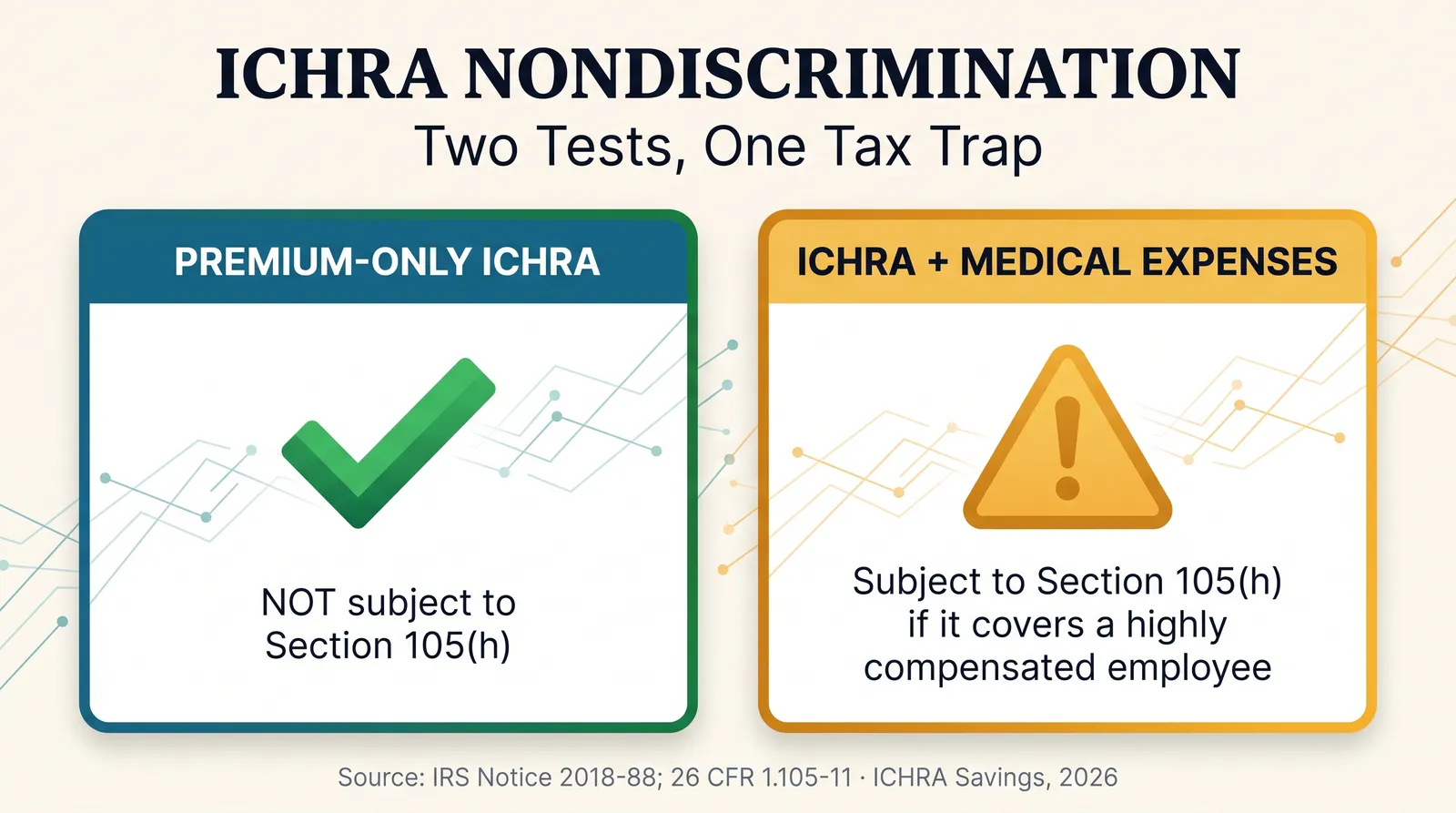
- An ICHRA that reimburses insurance premiums only is not subject to Section 105(h) nondiscrimination testing at all (IRS Notice 2018-88). Add reimbursement for other medical expenses, and it usually is.
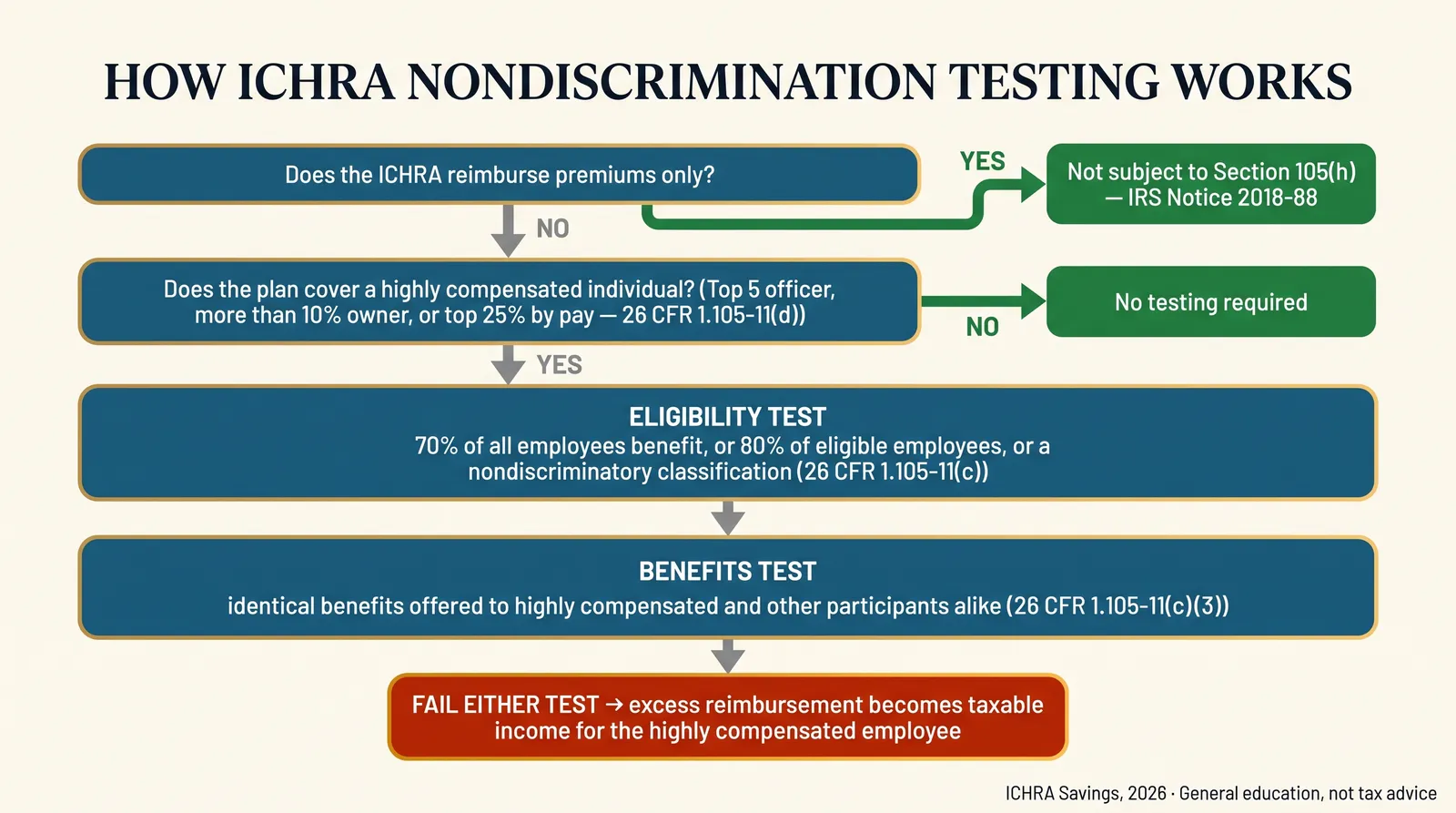
- Once 105(h) applies, a plan that covers a highly compensated individual has to pass two separate tests: an eligibility test (who is covered) and a benefits test (whether everyone gets the same deal).
- Passing the ICHRA's own class rules under 26 CFR § 54.9802-4 does not automatically mean you pass Section 105(h) — they are two different rulebooks, and only one of them was written with ICHRA in mind.
- Fail either test, and the disqualified reimbursement stops being tax-free for the highly compensated employees it was supposed to help — it becomes ordinary taxable income instead.
Can you give the owners a bigger ICHRA than everyone else?
Sometimes, but not by simply deciding to. An Individual Coverage HRA, the arrangement where an employer sets a fixed monthly amount employees use to buy their own individual health insurance tax-free, is flexible about how much you contribute and to whom. What it is not flexible about is Internal Revenue Code Section 105(h), a decades-old nondiscrimination rule written for self-insured medical plans in general, long before ICHRA existed, that still applies to an ICHRA the moment it reimburses more than just premiums and covers at least one highly compensated employee.
Most employers designing their first ICHRA have never heard of Section 105(h). They know the ICHRA-specific class rules, because those get covered in every plan-design conversation. They do not know that a second, older rulebook can sit on top of those classes and tax the exact people the richer benefit was meant to help. This article walks through both rulebooks, the two tests that make up 105(h), a worked example with real numbers, what actually happens when a plan fails, and the single easiest way to avoid the whole question.
Why this catches employers who never ran a self-insured plan
If your company has always bought fully insured small-group coverage, Section 105(h) has never applied to you. A fully insured plan is the carrier's problem, not yours; the carrier prices the risk and nondiscrimination is baked into how group insurance is medically underwritten and rated. An ICHRA is different. Even though the money moves to an individual insurance policy the employee buys on their own, the reimbursement arrangement itself is a self-insured plan you fund directly, and self-insured plans have always been held to a stricter nondiscrimination standard than insured ones.
That gap between what employers expect and what the law actually requires is where the mistake happens. A common design instinct — give the two founders a richer monthly allowance because they are paying the most for their own family's coverage, and give everyone else a flatter, smaller number — feels like ordinary business judgment. Whether it is legal depends entirely on how the ICHRA reimburses money and how the classes are drawn, and neither of those questions gets asked in most first-time ICHRA conversations, because the older 105(h) rule rarely comes up until something goes wrong.
Here is the version of this that actually shows up in a real planning conversation. A founder and a co-owner have been paying for their own family coverage out of pocket for years, quietly, without expensing it. They finally set up an ICHRA for the whole company, and the first instinct is to correct that old imbalance: give themselves a bigger monthly number than the rest of the team, since they have been absorbing more of the cost personally for longer. Nobody in that conversation is trying to game the system. They are trying to fix something that already felt unfair. The problem is that federal tax law does not ask about fairness in the way the founders mean it; it asks a narrower, mechanical question about who benefits and by how much, and it does not care why the gap exists.
Two different rulebooks, and most employers only know one
Two separate sets of federal rules govern how an ICHRA can vary by employee, and they were written decades apart for different reasons.
The ICHRA-specific rules, at 26 CFR § 54.9802-4, were finalized in 2019 and govern whether a contribution structure counts as a valid ICHRA at all. They define which classes of employees you are allowed to treat differently — full-time, part-time, salaried, non-salaried, employees whose primary worksite is in the same insurance rating area, seasonal employees, and employees covered by a particular collective bargaining agreement, among the eleven permitted classes covered in more depth in our guide to ICHRA employee classes. They also set a minimum class size, generally 10 employees for a company with fewer than 100 workers, and a same-terms requirement within each class, with a narrow exception letting the dollar amount rise by age up to 3 times the youngest participant's amount.
Section 105(h), by contrast, is a much older nondiscrimination rule written for self-insured medical reimbursement plans in general — the kind of plan a large, self-funded employer has always run. Congress added it to the tax code in the Revenue Act of 1978 (Pub. L. 95-600, § 366(a)), effective for amounts reimbursed after December 31, 1979, four decades before ICHRA existed. It has nothing to do with ICHRA specifically, and it was never rewritten for ICHRA; instead, the IRS's 2018 and 2021 guidance clarified how a decades-old rule applies to a brand-new arrangement, which is exactly why so many employers miss it. You can satisfy every ICHRA-specific class requirement and still run headfirst into a 105(h) problem that the ICHRA rules never warned you about, because they were never designed to.
The two rulebooks also answer to different people. The ICHRA class rules exist to define what counts as a valid ICHRA at all — get them wrong, and the arrangement may not qualify as an ICHRA for affordability and premium-tax-credit purposes in the first place. Section 105(h) exists to protect the tax-free status of the reimbursement itself for your highest earners. A plan can be a perfectly valid ICHRA under the first rulebook and still cost its own owners a tax-free benefit under the second. Neither failure cancels the other out.
The easiest way out: reimburse premiums only
There is one design choice that removes Section 105(h) from the conversation entirely. Under IRS Notice 2018-88, an ICHRA that reimburses insurance premiums only, and nothing else, is treated the same way an insured plan is treated for nondiscrimination purposes: it is not subject to Section 105(h) at all. The moment an ICHRA also reimburses other medical care expenses — a copay, a deductible, an out-of-pocket prescription cost — it loses that exception and becomes a self-insured medical reimbursement plan subject to the full 105(h) analysis, if it covers even one highly compensated individual.
That single fact does more to protect a small employer than any class design choice. A premium-only ICHRA can still vary by class and by age within the limits 26 CFR § 54.9802-4 already allows, and none of that variation has to clear the separate, harder 105(h) tests described below. The tradeoff is real: employees cannot use a premium-only ICHRA for anything but the premium itself, so a deductible or a copay comes out of their own pocket. For many first-time ICHRA employers, especially smaller ones without in-house benefits counsel, that tradeoff is worth making on purpose, not discovering by accident.
"Highly compensated individual" is a pay-and-ownership test, not a job title
Under 26 CFR § 1.105-11(d), a highly compensated individual is one of the five highest-paid officers of the company, a shareholder who owns more than 10% of its value (family attribution rules apply), or anyone among the highest-paid 25% of all employees by compensation. A well-paid employee with no ownership stake can be an HCI. A co-owner who takes a modest salary might not be. Check actual pay and ownership, not org-chart titles, before assuming who this affects.
If you own the company, you are already highly compensated
A detail that surprises a lot of founders: you cannot design your way out of being a highly compensated individual by paying yourself modestly. Under 26 CFR § 1.105-11(d), anyone who owns more than 10% of the value of the company's stock, with family-attribution rules folded in, is an HCI on ownership alone, regardless of salary. A founder who takes a token draw while reinvesting everything in the business is still an HCI. So is a spouse or child who owns a stake but draws no pay at all, once family attribution is applied.
That means almost every closely held small business setting up its first ICHRA has at least one highly compensated individual in the plan by default: the owner. It does not mean the plan is automatically discriminatory — a solo owner with no other employees has nobody to discriminate against, and a small company where the owner's contribution matches everyone else's dollar for dollar has nothing to test. It does mean that the moment you give the owner's class a materially richer benefit than the rest of the team, and the plan reimburses more than premiums, you are testing a plan that includes an HCI by definition, not by accident.
Passing the ICHRA class rules does not mean you pass 105(h)
This is the single most common misunderstanding in ICHRA plan design. Employers, and sometimes the vendors helping them set up a plan, treat the ICHRA-specific class rules as the entire compliance picture. They are not. 26 CFR § 54.9802-4 answers a narrower question: is this a valid ICHRA class structure at all? Section 105(h) answers a completely separate question: does this plan, once it reimburses more than premiums, discriminate in favor of your highest earners?
A plan can pass the first question and fail the second. Say a ten-person company splits its team into "salaried" and "hourly" classes, a distinction permitted under 26 CFR § 54.9802-4(d)(2)(iii)-(iv), and every employee within each class gets the same dollar amount on the same terms, satisfying the same-terms requirement. That plan is a valid ICHRA. If the salaried class happens to consist entirely of the company's owners and its highest earners, and the plan reimburses non-premium medical expenses as well, the ICHRA class rules have nothing further to say about it — but Section 105(h) does, because it looks at who actually benefits and by how much, independent of whether the class itself was permitted.
A class design that actually clears both rulebooks
It helps to see a design that works, not just the ones that fail. Take a company with employees split across two offices in different insurance rating areas — say a Columbus headquarters and a remote sales team spread across several other states. Under 26 CFR § 54.9802-4(d)(2)(v), "employees whose primary site of employment is in the same rating area" is a permitted ICHRA class on its own. If the Columbus office and the remote-sales class get different contribution amounts because individual-market premiums genuinely differ by rating area, and the amount is uniform within each class, that variation is doing exactly what the ICHRA class rules were built to allow: pricing the benefit to where people actually live, not to who they are.
Now run that same design past Section 105(h). As long as the highly compensated owners are spread across both classes in roughly the same proportion as everyone else, and the dollar gap between the two classes tracks the actual cost-of-coverage difference between the regions rather than exceeding it, there is no pattern of HCIs disproportionately drawing the richer benefit. That is the difference between a class boundary that happens to produce a dollar gap for a defensible, cost-based reason, and one that produces a dollar gap because it was drawn around who the owners are. Both can be permitted ICHRA classes. Only one of them reliably survives a 105(h) benefits-test review.
Test one: does enough of your team actually benefit?
Once Section 105(h) applies, the first hurdle is the eligibility test, defined at 26 CFR § 1.105-11(c)(2). A self-insured plan satisfies it if it benefits 70% or more of all employees, or 80% or more of the employees who are eligible to benefit if 70% or more of all employees are eligible in the first place. There is a third path: benefiting a classification of employees that the IRS finds, on the facts, is not set up to favor highly compensated individuals — a more subjective standard than the two bright-line percentage tests, and a harder one to rely on without a professional's sign-off.
In practice, this test bites hardest at companies that offer the ICHRA, or the version of it that covers non-premium expenses, to only a subset of the workforce — commonly, only salaried staff or only management, while frontline hourly employees get a bare-bones or premium-only version, or nothing at all. If that excluded group is large enough that fewer than 70% of everyone, or 80% of everyone eligible, actually benefits, the plan fails the eligibility test outright, regardless of how the dollar amounts compare.
Test two: is everyone offered the same deal?
Passing the eligibility test does not finish the job. The benefits test, at 26 CFR § 1.105-11(c)(3), requires that all the benefits available to highly compensated participants be available to every other participant too, on the same terms, including for dependents. This is the test that actually reaches a plan design where everyone is covered, but the highly compensated class gets a materially richer dollar amount than everyone else.
A benefit that only highly compensated participants can actually use — a bigger monthly allowance, a lower deductible built into the reimbursement structure, coverage for an expense category only their class can submit — fails this test even if every single employee is nominally "eligible" for the plan. Eligibility and benefits are graded separately on purpose: a plan can look perfectly inclusive on the cover page and still hand its richest benefit almost exclusively to the people who need it least.
A worked example: a 10-person Columbus, Ohio employer
Numbers make this concrete. Franklin County, home to Columbus, is one of 88 Ohio counties where an ICHRA estimate currently beats small-group coverage, with an estimated 59.6% spread for the 2026 plan year: an individual-market benchmark premium of $600 a month against a small-group benchmark of $1,486, a gap of $885 a month, or an estimated $10,624 a year per employee (ICHRA Savings qualified-counties dataset, 2026 plan year).
Picture a 10-person Columbus-area company setting up its first ICHRA: 3 salaried highly compensated employees (two owners and a general manager) and 7 hourly staff. The plan reimburses premiums plus other substantiated medical expenses, so it is subject to Section 105(h). Two versions of this company illustrate the two tests.
Version one, an eligibility-test failure. The company offers the ICHRA only to its 3 salaried employees; the 7 hourly workers get nothing. Only 30% of all employees benefit, well under the 70% threshold, and every one of the participants is highly compensated. Under the formula at 26 CFR § 1.105-11(d), when a plan fails the eligibility test, the excess reimbursement for each highly compensated individual equals their total reimbursement multiplied by the ratio of total HCI reimbursements to total reimbursements paid to all participants. Because only HCIs participate here, that ratio is 100% — meaning the entire $12,000 reimbursed to each of the 3 owners and managers over the year becomes an excess reimbursement, taxable to them, not a tax-free health benefit at all.
Version two, a benefits-test failure. The company covers everyone — all 10 employees participate, clearing the eligibility test with room to spare. But the salaried class gets $1,000 a month and the hourly class gets $400, a gap of $600 a month that the hourly class never sees. Under the benefits-test rule at 26 CFR § 1.105-11(d), the excess reimbursement equals the amount reimbursed to the highly compensated individual "with respect to" the benefit not available to everyone else — here, the $600-a-month differential. That comes to $7,200 a year in taxable excess reimbursement for each of the 3 highly compensated employees, or $21,600 across all three, even though every employee was technically covered by the plan.
| Detail | Version one: eligibility-test failure | Version two: benefits-test failure |
|---|---|---|
| Who is covered | Only the 3 salaried HCIs | All 10 employees |
| Share of all employees benefiting | 30% (below the 70% threshold) | 100% (clears the 70% threshold) |
| What fails | Eligibility test, 26 CFR § 1.105-11(c)(2) | Benefits test, 26 CFR § 1.105-11(c)(3) |
| Taxable excess reimbursement, per HCI | $12,000 a year (100% of their reimbursement) | $7,200 a year (the unequal portion only) |
Taxable excess reimbursement per highly compensated employee, hypothetical example
10-person Columbus, Ohio employer, $1,000/mo salaried class vs $400/mo hourly class, ICHRA reimburses premiums plus other medical expenses
Hypothetical worked example for illustration only, not a specific employer's data. Formula source: 26 CFR § 1.105-11(d). County premium source: ICHRA Savings qualified-counties dataset, 2026 plan year. Not tax advice.
What it costs when a test fails
There is no separate IRS fine written into Section 105(h) the way there is for the ACA employer mandate under 26 U.S.C. § 4980H. The cost lands somewhere more direct: the excess reimbursement stops being tax-free. Under 26 CFR § 1.105-11(d), an excess reimbursement paid to a highly compensated individual "is not excludable from such individual's gross income," and it is treated as received in the tax year in which the plan year ends. In plain terms, the exact dollars that were supposed to be a tax-free health benefit for your owners and top earners become ordinary taxable income for them instead, the year the plan year closes out.
That consequence lands on the individual, not a corporate penalty on the business, but it is rarely a clean, contained problem. It usually surfaces during a plan-document review, an accountant's year-end reconciliation, or an audit, well after the plan year the excess reimbursement belongs to has already closed — which means correcting it means going back and amending, not simply adjusting course going forward. The employees most affected are exactly the ones the richer benefit was designed to help, and they are the ones now facing an unplanned tax bill on money they believed was already tax-free.
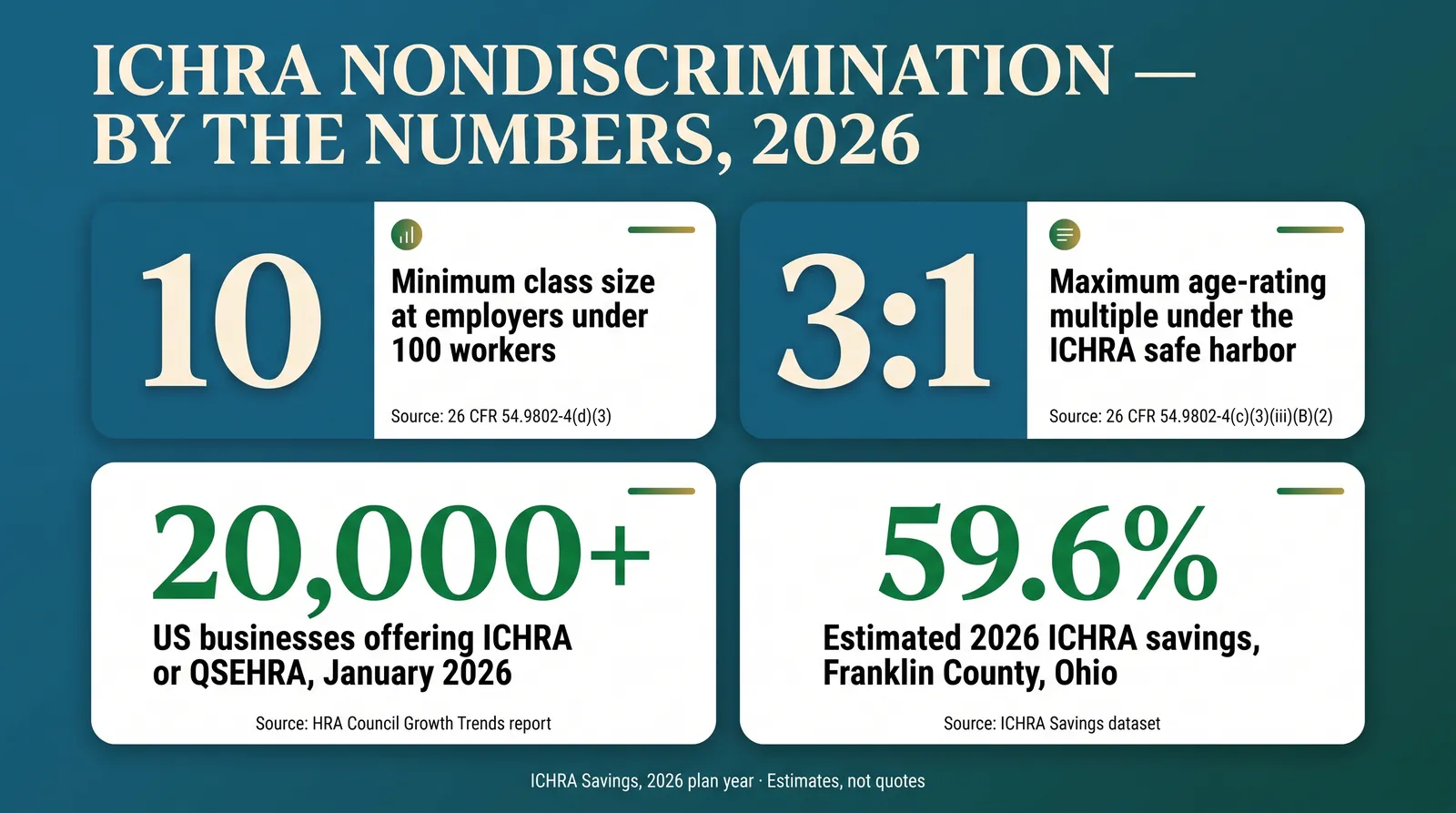
10
Minimum class size at employers under 100 workers (26 CFR § 54.9802-4(d)(3))
3:1
Maximum age-rating multiple under the ICHRA safe harbor
10.22%
ACA affordability percentage, 2027 plan years — a separate test from 105(h) (IRS Rev. Proc. 2026-26)
25%
Top share of employees by pay that counts as "highly compensated" (26 CFR § 1.105-11(d))
How to design around it
None of this means an ICHRA cannot vary by class, or that owners can never get more than staff. It means the design has to be deliberate about which rulebook it is following.
- Reimburse premiums only, if you can. This removes Section 105(h) from the picture entirely, under IRS Notice 2018-88. For a first-time ICHRA at a small company, this is usually the simplest, lowest-risk starting point, even if it means adding a broader reimbursement design later once the plan has run a full year.
- If you reimburse more than premiums, build classes off the permitted list, not off compensation or ownership. Full-time versus part-time, salaried versus hourly, or worksite-based classes under 26 CFR § 54.9802-4(d)(2) are valid starting points. "The owners" and "management" are not permitted classes on their own.
- Run the eligibility math before launch, not after. Count how many employees will actually be covered under each class against your total headcount. If a class you are excluding pushes coverage below 70% of everyone, or 80% of everyone eligible, you have an eligibility-test problem before a single dollar is reimbursed.
- Keep the dollar gap between classes proportionate, not dramatic. The benefits test does not require identical dollar amounts across every class, but a gap that tracks almost perfectly with who is highly compensated is the pattern that draws scrutiny, whether the review happens internally, from a TPA, or on audit.
- Get a benefits professional to review the class design before the plan year starts, not after a highly compensated employee files taxes. The classification test's facts-and-circumstances standard, and the "discriminatory in operation" question covered next, are judgment calls that a plan document alone cannot answer.
The cheapest fix is usually the first one
Most small employers who run into a 105(h) problem never needed to reimburse non-premium medical expenses in the first place — they added it because it sounded more generous, not because an employee asked for it. Before you build a richer, class-based reimbursement structure, ask whether a simpler premium-only design would have done the job.
Passing on paper is not the same as passing in operation
A plan document that satisfies every percentage test on the day it is written can still fail in practice. The IRS's own guidance on ICHRA nondiscrimination makes clear that a plan "must also be nondiscriminatory in operation," and can fail that separate standard even with a clean-looking eligibility and benefits test, if, for example, a disproportionate share of highly compensated individuals end up qualifying for and drawing the plan's maximum amount once age-based or other permitted variation is applied.
There is no formula for this part. It is a facts-and-circumstances judgment, similar to how the IRS evaluates the classification test's alternative path at 26 CFR § 1.105-11(c)(2). The practical takeaway is not to treat a passing test result on day one as the end of the question. Revisit the actual claims and reimbursement pattern at least once a plan year, especially if your workforce mix shifts, and especially if the class that happens to skew highly compensated is also the class drawing the richest benefit in practice, not just on paper.
How ICHRA Savings helps
The county-level data behind this site answers a different question than the one this article covers: whether an ICHRA beats small-group coverage where your employees actually live in the first place. It does not replace a benefits attorney's or a TPA's review of a class design this specific to your ownership structure and pay levels. What it does give you is the starting number, the real benchmark premium your county supports, so any class and contribution structure you design is built on real numbers rather than a guess. Before anything else, check whether your county is one where the underlying arithmetic works: explore the savings map, or see the full Ohio county-by-county breakdown if you are weighing this for a Columbus-area team like the one in the example above.
Questions employers actually ask
Does every ICHRA have to pass nondiscrimination testing?
No. An ICHRA that reimburses insurance premiums only, and nothing else, is treated as an insured plan and is not subject to Internal Revenue Code Section 105(h) at all, under the treatment the IRS laid out in Notice 2018-88. The testing described in this article only applies once an ICHRA also reimburses other medical expenses, like a copay or a deductible, and at least one participant is a highly compensated individual.
What makes someone a "highly compensated individual" for this test?
Under 26 CFR § 1.105-11(d), a highly compensated individual is one of the five highest-paid officers, a shareholder who owns more than 10% of the company's value (with family attribution rules applied), or someone among the highest-paid 25% of all employees by compensation. It is a compensation-and-ownership test, not a job-title test — a well-paid non-owner employee can be an HCI, and a lower-paid co-owner might not be.
Can I give the owners a bigger ICHRA contribution than the rest of the team?
Sometimes, but not by drawing a class around "the owners" directly — ownership and job title are not permitted ICHRA classes under 26 CFR § 54.9802-4(d)(2). A difference in contribution has to track one of the regulation's specific permitted classes, such as salaried versus hourly, or full-time versus part-time, and even then, if the plan reimburses more than premiums and a permitted class happens to line up closely with who is highly compensated, it can still fail the Section 105(h) benefits test described in this article.
What actually happens to us if the plan fails the test?
There is no separate IRS penalty line item for this the way there is for the ACA employer mandate. Instead, the reimbursement itself stops being tax-free for the affected highly compensated individuals. Under 26 CFR § 1.105-11(d), the disqualified portion — the "excess reimbursement" — is not excludable from that person's gross income and is treated as received in the tax year the plan year ends, which generally means it becomes ordinary taxable income for them, not a tax-free health benefit.
Is this the same thing as the ACA affordability test?
No, and confusing the two is common. The affordability test, 10.22% of income for plan years beginning in 2027 under IRS Revenue Procedure 2026-26, decides whether a non-highly-compensated employee's ICHRA offer is generous enough to require them to waive a premium tax credit. Section 105(h) nondiscrimination testing is a completely separate question about whether your plan design favors your highest earners over everyone else. A plan can be affordable for every employee and still fail 105(h), or vice versa.
If we already follow the ICHRA class rules, are we automatically protected from Section 105(h)?
No. The ICHRA-specific rules at 26 CFR § 54.9802-4 — permitted classes, minimum class size, the same-terms requirement, the age-rating safe harbor — govern whether your contribution structure counts as a valid ICHRA in the first place. Section 105(h) is a separate, older nondiscrimination rule that applies to self-insured medical reimbursement plans generally. An ICHRA can satisfy every ICHRA-specific class rule and still fail the independent 105(h) eligibility or benefits test if it reimburses non-premium medical expenses and covers a highly compensated individual.
What does "discriminatory in operation" mean if our plan passes on paper?
It means the IRS looks past the plan document to what actually happens. A plan whose written terms look neutral can still fail if, in practice, a disproportionate share of highly compensated individuals end up drawing the richer benefit — for example, because an age-based safe harbor happens to track who the owners are, or because only certain classes ever submit claims for the non-premium expenses the plan covers. There is no bright-line formula for this part; it is a facts-and-circumstances judgment call, which is exactly why a benefits professional should review any class design that puts most of your highly compensated people in one favored group.
What is the easiest way to avoid all of this?
Reimburse premiums only. Under Notice 2018-88, that single design choice takes the entire ICHRA outside Section 105(h), regardless of how you structure your classes or how much more the owners' contribution is than everyone else's. You still have to follow the ICHRA-specific class and minimum-size rules at 26 CFR § 54.9802-4, but you skip the older, harder self-insured nondiscrimination test described in this article entirely.
Sources
- 26 CFR § 1.105-11, Code of Federal Regulations (via Cornell Legal Information Institute) — the eligibility test, the benefits test, the definition of highly compensated individual, and the excess-reimbursement formulas for both eligibility-test and benefits-test failures
- 26 CFR § 54.9802-4, Code of Federal Regulations (via Cornell Legal Information Institute) — the ICHRA-specific permitted classes, minimum class size rule, same-terms requirement, and the 3-to-1 age-rating safe harbor
- IRS Notice 2018-88 — the premium-only exception treating a premium-only ICHRA as an insured plan not subject to Section 105(h), corroborated in Thomson Reuters' summary of the final ICHRA nondiscrimination regulations
- IRS Newsroom, "Health Reimbursement Arrangements (HRAs)", last updated January 15, 2026 — confirms the current nondiscrimination safe-harbor guidance for ICHRAs
- IRS Revenue Procedure 2026-26 (the 10.22% ACA affordability percentage for plan years beginning in 2027, up from 9.96% for 2026), corroborated by Sequoia's July 29, 2026 summary
- HRA Council, "Growth Trends for ICHRA & QSEHRA" (data as of January 31, 2026 — more than 20,000 US businesses offering ICHRA or QSEHRA, at least 500,000 covered lives, applicable-large-employer adoption more than doubling year over year)
- ICHRA Savings qualified-counties dataset, 2026 plan year (Franklin County, OH and statewide Ohio qualifying-county figures)