ICHRA for Business Owners: Who Qualifies in 2026
S-corp owners over 2%, partners, and sole proprietors generally can't use their own ICHRA tax-free under IRS rules. See who can, and the 2026 fix.
The short version
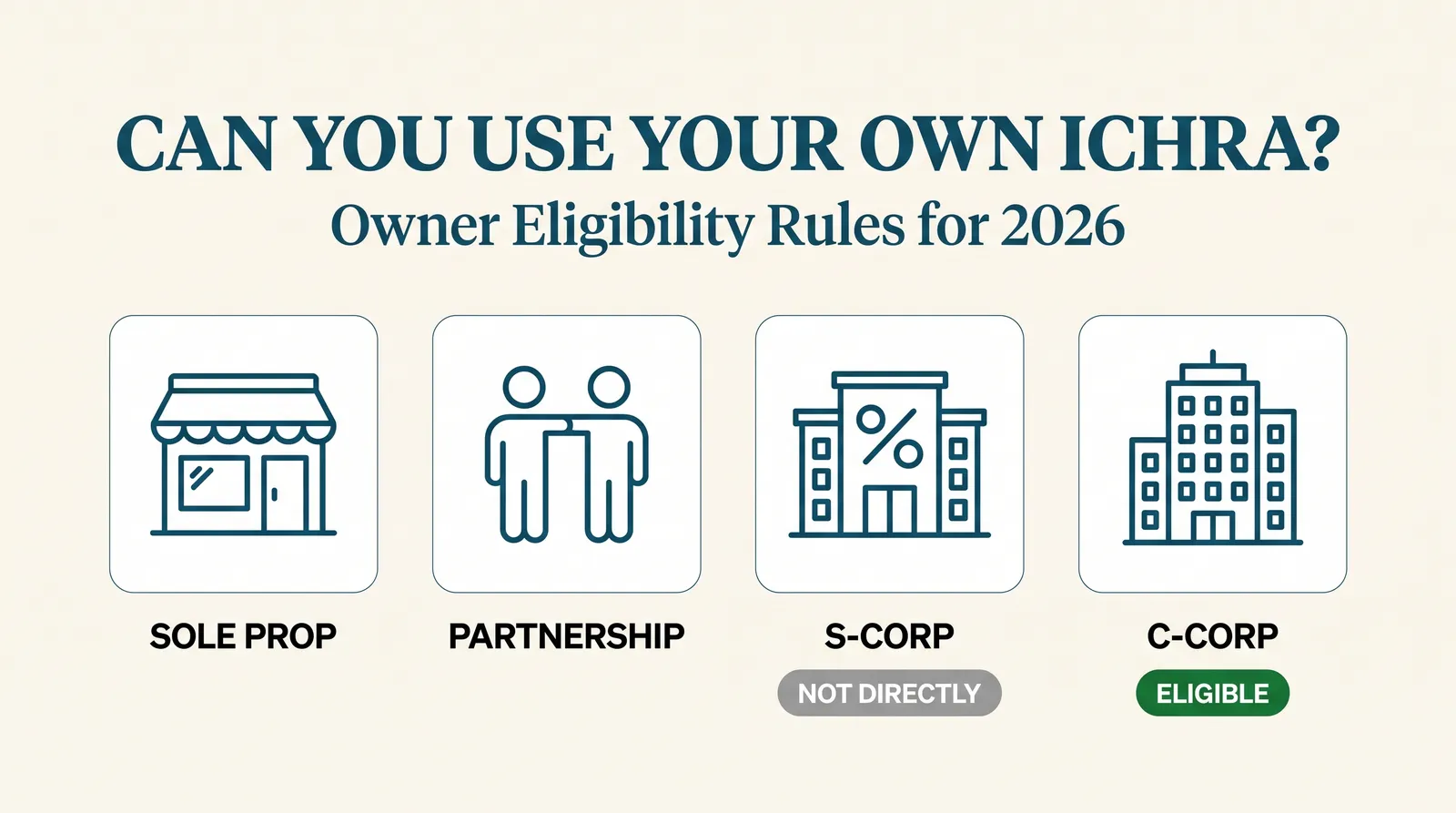
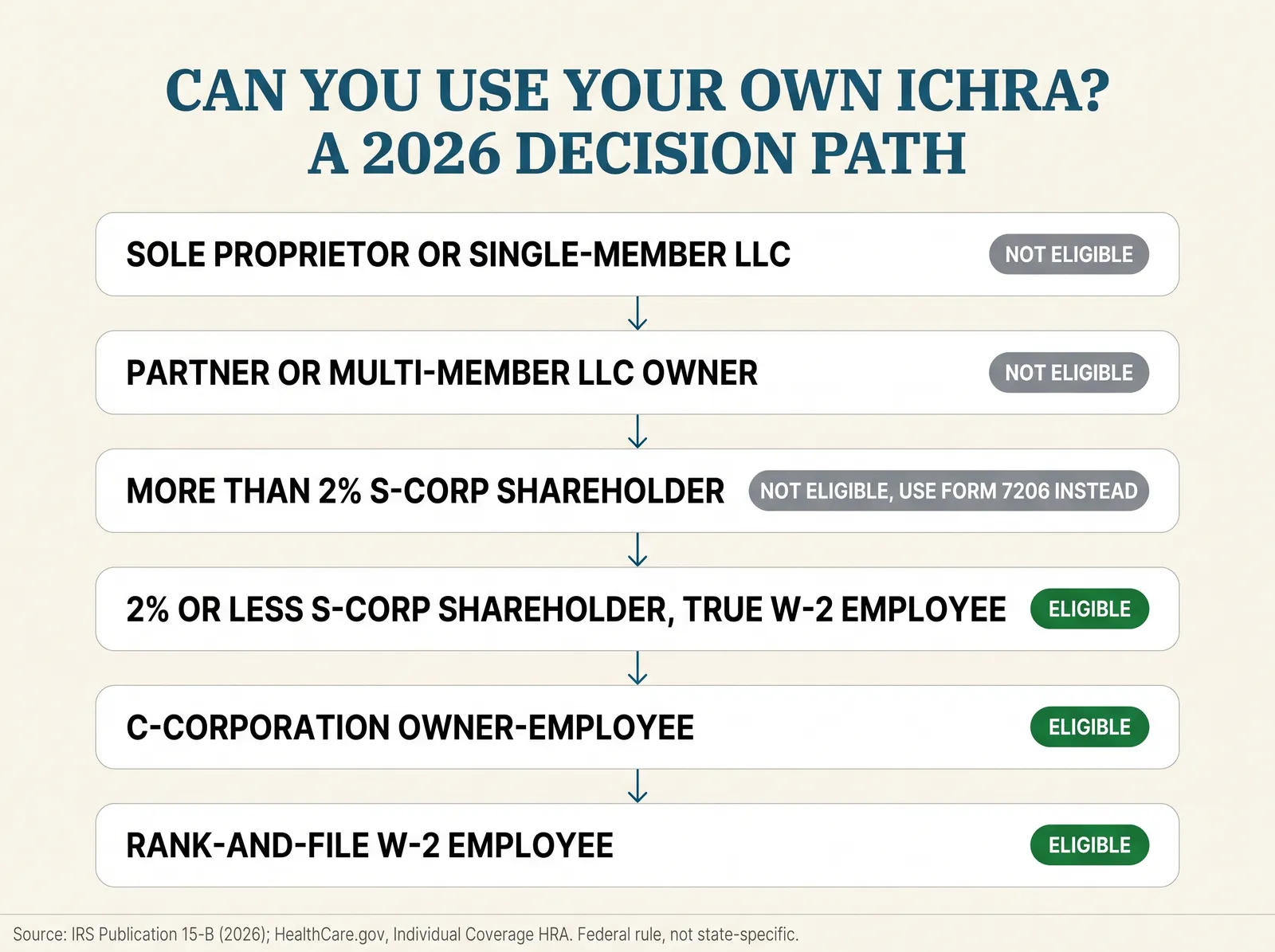
- Sole proprietors, single-member LLC owners, general partners, and LLC members taxed as a partnership generally cannot use their own company's ICHRA tax-free.
- A more-than-2% S corporation shareholder faces the same block: IRS Publication 15-B (2026) says not to treat that shareholder as an employee for the accident-and-health-benefit exclusion an ICHRA relies on.
- A C corporation owner-employee, a 2%-or-less S-corp shareholder who is a genuine W-2 employee, and every rank-and-file W-2 employee are eligible.
- An owner who can't personally use the ICHRA can still offer a fully compliant, fully tax-free ICHRA to the rest of the W-2 team — the two questions are separate.
- 1099 independent contractors are never eligible for an ICHRA, regardless of entity type, under the IRS common-law employee test.
The question that stalls a rollout
Say you run a 14-person marketing agency in Kenosha County, Wisconsin, structured as an S corporation, and you own 80% of the stock. Your team has never had health coverage, your renewal-shopping friends keep telling you group plans are a headache at your size, and an ICHRA (Individual Coverage Health Reimbursement Arrangement) looks like the answer: set a monthly amount, let each employee buy their own individual-market plan, reimburse it tax-free. You run the county numbers, you like what you see, and you start drafting the plan document.
Then your bookkeeper asks a question you weren't ready for: "Wait — are you on this too?" You don't actually know. You've been the one designing the benefit for everyone else, and it never occurred to you to check whether the rules that make this tax-free for your employees also make it tax-free for you. That gap — designing a benefit for your team without knowing your own status under it — is where a lot of owners get stuck, and it's an easy thing to get wrong quietly, because nothing stops you from reimbursing yourself. The IRS just won't agree it was tax-free later.
This article is for exactly that owner — someone who has already decided an ICHRA makes sense for the team, or is close to deciding, and needs a straight answer about their own status before signing a plan document. It isn't a reason to abandon the idea. In almost every case, your team's eligibility and your own eligibility turn out to be two separate questions with two separate answers, and getting your own answer wrong costs you money without touching theirs at all.
What an ICHRA actually is
An Individual Coverage HRA lets an employer of any size set a fixed monthly reimbursement amount and let each employee buy their own plan on the individual health insurance market, then reimburse the premium (and sometimes other medical expenses) tax-free. The arrangement came out of a final rule issued jointly by the IRS, the Treasury Department, the Department of Labor, and the Department of Health and Human Services on June 20, 2019, effective August 19, 2019, and applicable to plan years beginning on or after January 1, 2020, according to the IRS's own HRA newsroom page. There's no participation minimum and no employer-size floor, which is a large part of why it fits a small business that has never offered a benefit before.
Everything about that description assumes the person receiving the reimbursement is an employee. That word is doing more legal work than it looks like, and it's the entire reason this article exists. HealthCare.gov puts it as bluntly as a federal agency puts anything: "Health Reimbursement Arrangements are only for employees, not self-employed individuals." The same page defines an eligible employer as one with "at least one employee who isn't a self-employed business owner or the spouse of a self-employed owner." Whether you personally clear that bar depends entirely on how your business is structured, not on how hard you work in it.
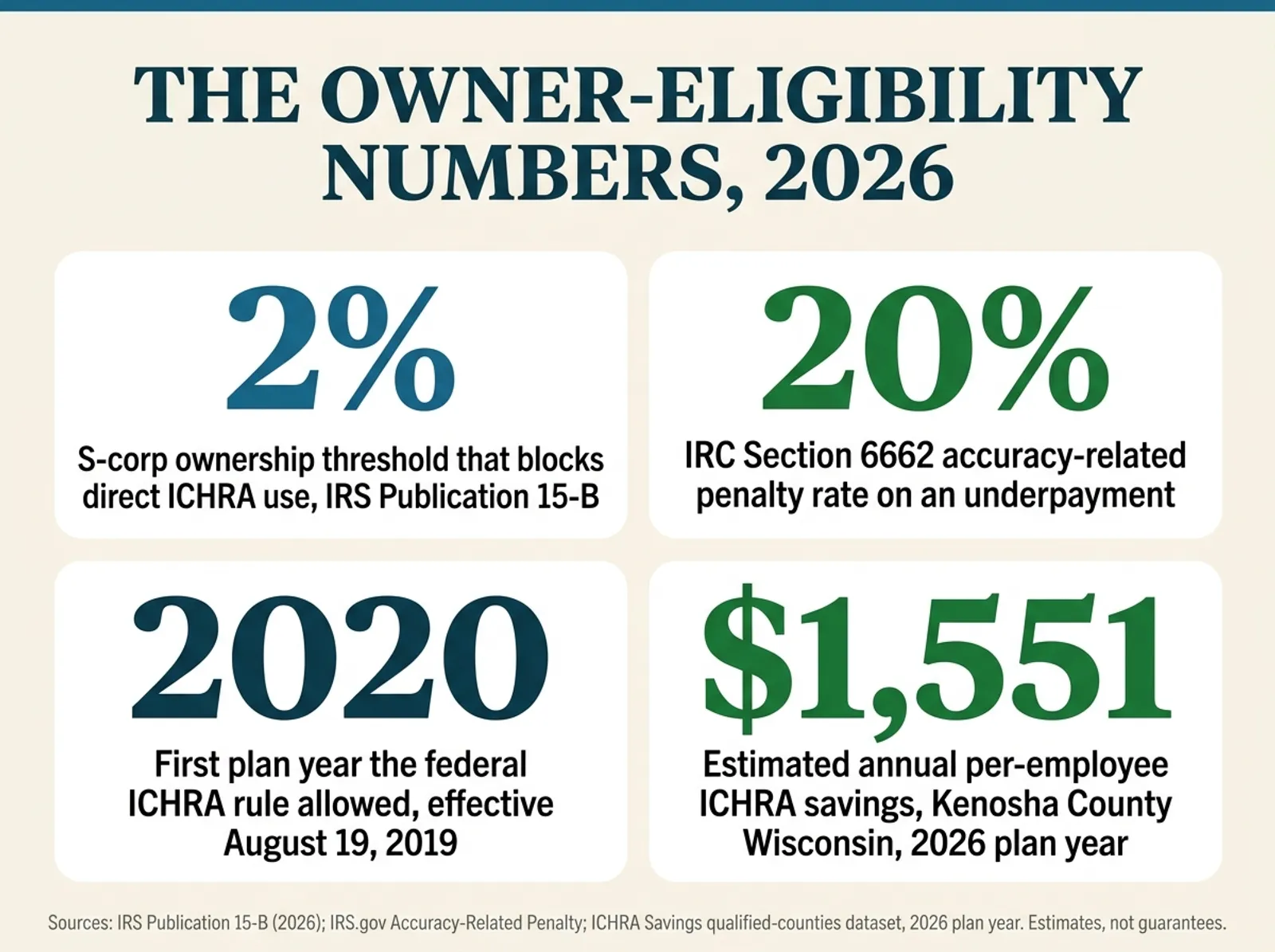
2%
S-corp ownership that triggers the exclusion, IRS Publication 15-B
2020
First ICHRA plan year, per IRS.gov
4
Entity types where the owner is generally excluded
0
Effect on your W-2 employees' own eligibility
Why ownership changes the answer
The mechanism is narrower than most owners expect, and it hinges on one specific tax provision. An ICHRA reimbursement is tax-free because it falls under the "accident and health benefits" exclusion in the federal tax code, the same exclusion that has always let employers pay for employee health coverage without that value showing up as taxable wages. IRS Publication 15-B (2026), the Employer's Tax Guide to Fringe Benefits, states the limit on that exclusion in plain language: "Don't treat a 2% shareholder of an S corporation as an employee of the corporation for this purpose." A 2% shareholder is defined, per the same publication, as someone who "directly or indirectly owns (for any day during the tax year) more than 2% of the corporation's stock or stock with more than 2% of the voting power." Publication 15-B goes a step further and tells employers to "treat a 2% shareholder as you would a partner in a partnership for fringe benefit purposes" — which is the sentence that pulls partners and multi-member LLC owners into the same exclusion, not as an afterthought but by explicit instruction.
Sole proprietors and single-member LLC owners face a simpler, more basic problem: there's no separate employer entity to issue them a W-2 in the first place. The IRS's common-law employee standard defines an employee as someone whose work you control — "if you can control what will be done and how it will be done" — evaluated across behavioral control, financial control, and the type of relationship. A sole proprietor cannot be their own common-law employee any more than they can be their own employer; it's the same person on both sides of a relationship the tax code requires to exist between two.
A C corporation breaks this pattern, and the break is deliberate, not an oversight. Publication 15-B's shareholder carve-out names "a 2% shareholder of an S corporation" specifically — it says nothing about a C corporation. Because a C corp is a separate taxable entity from the people who own it, an owner who draws a genuine W-2 salary and meets the common-law employee test is an ordinary employee of that corporation for fringe-benefit purposes, the same as anyone else on payroll. If your business is a C corp and you're a real W-2 employee of it, none of the exclusions above apply to you.
One structure trips people up specifically because it looks like a workaround and isn't: an LLC that has filed an election to be taxed as an S corporation. A growing number of small businesses do this deliberately, usually on a CPA's advice, to reduce self-employment tax on part of the owner's income. Once that election is in place, the IRS treats the business as an S corporation for federal tax purposes generally, which means the more-than-2%-shareholder exclusion in Publication 15-B applies to its owner exactly as it would to any other S corp. The LLC label on the entity doesn't matter once the S-corp tax election is filed; what matters is which subchapter of the tax code the business is taxed under. If your LLC has made this election and you're not sure, your Form 2553 filing (or your CPA) will confirm it.
The exclusion exists because of how these entities are taxed, not as an arbitrary line-drawing exercise. An S corporation and a partnership are both pass-through entities, meaning the business's income, and by extension the value of any benefit it funds, ultimately lands on the owner's own personal return either way. The tax code has long treated a more-than-2% S-corp shareholder, and a partner, as functionally closer to a self-employed person than to a rank-and-file employee for this narrow purpose — exactly the framing Publication 15-B uses when it says to treat a 2% shareholder "as you would a partner in a partnership." A C corporation doesn't share that pass-through structure; its income is taxed at the entity level, separately from the owner's personal return, which is the practical reason its owner-employees aren't pulled into the same carve-out.
What still works if you're excluded
A more-than-2% S-corp shareholder or a partner isn't left with nothing. If the S corporation or partnership pays or reimburses the premiums and the shareholder or partner meets the other requirements, that person can generally claim the self-employed health insurance deduction using Form 7206, reported on Schedule 1 (Form 1040), line 17, for the 2025 tax year. It's a different mechanism from an ICHRA reimbursement, with its own conditions, but it exists specifically to cover this gap.
Every entity type, side by side
Line them up and the pattern is consistent: it isn't about how much you own in a folk sense of "owning the business," it's about whether federal tax law treats you as an employee of a separate entity or as the same taxpayer as the business itself.
| Entity / role | Owner eligible? | Why |
|---|---|---|
| Sole proprietor / single-member LLC | No | No separate employer entity — owner and business are the same taxpayer |
| General partner / multi-member LLC owner | No | Pub 15-B: treat like a 2% S-corp shareholder for fringe benefits |
| More-than-2% S-corp shareholder | No | Excluded from the accident-and-health-benefit exclusion by Pub 15-B |
| 2%-or-less S-corp shareholder, genuine W-2 employee | Yes | Below the threshold that triggers the exclusion |
| C-corporation owner-employee (real W-2 wages) | Yes | C corp is a separate taxable entity; the S-corp carve-out doesn't apply |
| Rank-and-file W-2 employee | Yes | A common-law employee with no ownership complication |
| Owner's spouse, genuine W-2 employee | Depends | Family-attribution rules can treat spousal stock as the owner's own — confirm with a CPA |
| 1099 independent contractor | No | Not a common-law employee under any entity structure |
Source: IRS Publication 15-B (2026), Employer's Tax Guide to Fringe Benefits; HealthCare.gov, Individual Coverage HRA. Federal rules; entity classification for your specific business should be confirmed with a CPA.
What about 1099 contractors?
This one is simpler than the ownership question, and it applies no matter what kind of entity you run. An ICHRA is only for employees, full stop — HealthCare.gov's language on this doesn't hedge. Whether a specific worker counts as an employee for this purpose comes down to the same IRS common-law test used everywhere else in tax law: behavioral control (do you direct how the work gets done), financial control (who bears the investment and profit-or-loss risk), and the type of relationship (is there a written contract, are benefits offered, is the work part of the regular business). The label on the contract doesn't decide it. If someone is a genuine 1099 contractor under that test, putting them on your ICHRA doesn't create a compliant benefit — it creates a reimbursement with no valid tax exclusion behind it, sitting on top of whatever worker-classification exposure misclassifying them in the first place already creates.
The practical upshot for a small business that uses a mix of W-2 staff and 1099 contractors: your ICHRA class structure can only ever cover the W-2 side. A contractor who wants coverage has their own path — the same Section 162(l) self-employed health insurance deduction that applies to a sole proprietor or partner covers a genuine independent contractor's premiums too, just claimed on their own return, not funded through your plan.
What it costs to get this wrong
Go back to the Kenosha County agency. Say the owner, at 80% ownership, has been quietly reimbursing their own individual-market premium through the company's ICHRA alongside the 13 W-2 employees, treating all 14 reimbursements the same way on the books: excluded from wages, no income tax withheld, nothing on the W-2. For the 13 actual employees, that treatment is correct. For the owner, it isn't — under Publication 15-B, that reimbursement should have been added to their W-2 wages (deductible by the S corp, taxable to the shareholder), with the shareholder then claiming the Section 162(l) deduction separately on their personal return, the same three-step process the IRS describes for S-corp health premiums generally.
Here's the math
If the IRS catches the error on exam and reclassifies, say, $6,000 in a single tax year's worth of owner reimbursements as unreported wages, the company generally owes the unpaid income tax on that amount plus interest from the original due date. If the understatement is substantial, the IRS can also add the accuracy-related penalty under IRC §6662, which the IRS states is 20% of the underpayment in cases of a substantial understatement. On that same $6,000, a 20% penalty adds $1,200 on top of the tax and interest already owed — and none of the 13 correctly-run employee reimbursements are touched by any of it, because their treatment was never wrong.
None of this is a reason to avoid an ICHRA. It's a reason to get your own status right before you set the plan up, rather than assuming the same rules that cover your team automatically cover you. The fix, in almost every case, is not complicated: report the owner's share correctly through wages and Form 7206 from the start, and the team-wide plan runs exactly as clean as it would have anyway.
How to work out your own answer
Do this before you finalize a plan document, not after your first reimbursement runs.
- Identify your entity type. Sole proprietorship, single-member LLC, partnership, multi-member LLC, S corporation, or C corporation — this is the single fact that decides everything downstream, and it's worth pulling your actual formation documents rather than going from memory. An LLC that elected S-corp taxation on Form 2553 is an S corp for this purpose, not an LLC, no matter what your bank account or invoices say.
- If S corp, check your ownership percentage — including family attribution. More than 2%, directly or through a spouse, parent, child, or grandchild under IRC §1372(b), and you're treated as excluded. This is the step owners skip most often: they check their own K-1 percentage, see something under 2%, and stop, without adding in a spouse's or adult child's shares who also work in the business.
- If partnership or multi-member LLC, assume you're excluded as a general rule. Publication 15-B directs employers to treat partners the same as more-than-2% S-corp shareholders for fringe-benefit purposes. This applies whether you're a managing partner actively running day-to-day operations or a more passive member — the tax treatment doesn't turn on how involved you are, only on your legal status as a partner or member.
- If C corp, confirm you're a genuine common-law employee. Real W-2 wages, real behavioral and financial control exercised by the corporation over how and when you work — and you're eligible the same as any other employee. A C corp owner who takes no salary and lives on distributions instead isn't a W-2 employee in the first place, which is a separate problem from the ownership question this article covers.
- Design the ICHRA for your W-2 team regardless of your own answer. Their eligibility doesn't depend on yours. Build the class structure and reimbursement amount around them, run your county's numbers, and send the required notice on the normal timeline — none of that changes because the owner personally sits outside the plan.
- If you're excluded, talk to your CPA about Form 7206 for your own premiums, and correct any prior reimbursements that were treated as tax-free in error before an exam finds them for you. Amending a prior return voluntarily is a very different conversation with the IRS than getting caught first.
80% S-corp owner, self-reimbursed
- Owner's premium excluded from wages like a regular employee's
- No W-2 adjustment, no Form 7206 filed
- Looks identical to the 13 correct employee reimbursements on the books
- Exposure sits quietly until an exam finds it
UnreportedOwner's wages understated
Same owner, same company
- Owner's premium added to Box 1 wages, excluded from Box 3/5
- Owner claims Form 7206 on their personal return
- 13 employee ICHRA reimbursements run untouched, fully tax-free
- No exposure left sitting on the books
CompliantBoth sides correctly reported
Four situations that trip owners up
Where this actually goes wrong
- Forgetting family attribution. An owner who personally holds 2% or less of an S corp can still be swept into the exclusion if a spouse, parent, child, or grandchild's shares push the attributed total above 2% under IRC §1372(b). Run the math including family shares, not just your own.
- Treating "I pay myself a W-2" as the whole test. An S-corp shareholder-employee already gets a W-2 for their salary; that alone doesn't change their status for the health-benefit exclusion. The 2% ownership test, not the payroll mechanics, is what controls here.
- Assuming owner ineligibility means the whole plan fails. It doesn't. A company can run a fully compliant ICHRA for its W-2 employees while its majority owner uses a completely separate deduction for their own coverage. Don't let this question talk you out of a benefit that still works for your team.
- Skipping the county math because of the ownership question. Whether the individual market beats small-group pricing in your county is a separate fact from who's eligible to participate. Check both — the savings map answers the first one in about ten seconds.
| County | Individual benchmark | Small-group benchmark | Est. monthly gap | Est. savings |
|---|---|---|---|---|
| Kenosha County | $705 | $834 | $129 | 15.5% |
| Racine County | $705 | $834 | $129 | 15.5% |
| Brown County | $639 | $731 | $92 | 12.6% |
| Door County | $639 | $731 | $92 | 12.6% |
| Kewaunee County | $639 | $731 | $92 | 12.6% |
Source: ICHRA Savings qualified-counties dataset (src/data/qualified_counties.json),
built from Ideon rate data cross-verified against CMS public-use marketplace files, 2026
plan year. Kenosha and Racine counties share an identical benchmark because Wisconsin's
individual and small-group markets price by rating area, not strictly by county. Estimates,
not quotes or guarantees.
Back to the 14-person Kenosha County agency: even with the owner excluded from the ICHRA itself, the 13 eligible W-2 employees carry an estimated combined annual savings of roughly $20,166 (13 employees × an estimated $1,551 a year each, per our county dataset) if the individual-market benchmark in their county holds for their actual plan choices. The owner's own path runs through Form 7206 instead, separately, and neither number depends on the other.
What doesn't change either way
Whether or not you personally qualify, every federal requirement that applies to an ICHRA for your W-2 team still applies once you launch one. You still owe eligible employees the required written notice, generally at least 90 days before the plan year begins — our guide to the ICHRA notice deadline covers that calendar in full. You still have to run substantiation on every reimbursement, confirming each employee actually has individual coverage before the arrangement pays a claim; our substantiation guide covers the two federal rules behind that and what it costs to skip them. You still have to set contribution amounts so the arrangement is affordable under the IRS's federal safe harbor test, a separate calculation from anything in this article; our guide to the 2027 ICHRA affordability percentage covers that number. And if you're weighing an ICHRA against renewing a small-group plan in the first place, our ICHRA vs. small-group decision guide walks through that separate question end to end. None of those federal obligations get easier, harder, or different because the owner personally sits inside or outside the plan.
How ICHRA Savings helps
We don't file your Form 7206 or your S-corp payroll adjustments — that's your CPA's job, and it should stay that way. Where we help: showing you whether your county's individual market actually beats small-group pricing before you spend time on plan design, and building an employee class structure that's correct for your actual W-2 team regardless of how your own ownership question shakes out. None of the county math requires talking to anyone first. Check your county on the savings map: https://ichrasavings.com/ichra-savings-map/. If you're in Wisconsin specifically, run the numbers for your own county the same way we did for Kenosha above. If your renewal is already in hand and you have a deadline, it's worth a conversation: https://ichrasavings.com/book.
Your eligibility and your team's eligibility are two separate questions under two different rules. Answer both before you sign anything — not just the one that's easier to check.
Mike MooreQuestions owners actually ask
Can a more-than-2% S corporation shareholder participate in the company’s own ICHRA?
Not tax-free, directly. IRS Publication 15-B (2026) instructs employers not to treat a more-than-2% S corporation shareholder as an employee for the accident-and-health-benefit exclusion, which is the provision that makes an ICHRA reimbursement tax-free in the first place. The shareholder can still have the S-corp pay premiums, report them as W-2 wages, and claim the self-employed health insurance deduction on Form 7206 instead — a different tax mechanism with a similar end result, not the ICHRA itself.
Can a sole proprietor or a single-member LLC owner use an ICHRA for themselves?
No. HealthCare.gov states plainly that Health Reimbursement Arrangements are only for employees, not self-employed individuals, and defines an eligible employer as one with at least one employee who isn’t a self-employed business owner or the spouse of one. A sole proprietor has no separate employer entity to issue them a W-2, so there is no ICHRA to enroll in for that person specifically. The Section 162(l) self-employed health insurance deduction is the correct tool here instead.
Can a partner in a partnership, or a member of a multi-member LLC, use an ICHRA?
No, for the same underlying reason as an S-corp shareholder above 2%. IRS Publication 15-B directs employers to treat a 2% S-corp shareholder the same way they treat a partner in a partnership for fringe-benefit purposes, which means the accident-and-health-benefit exclusion that makes ICHRA reimbursements tax-free does not reach a general partner or an LLC member taxed as a partnership either. The same Form 7206 deduction path applies to a partner’s own premiums.
Does a C corporation owner-employee qualify for a tax-free ICHRA?
Generally, yes. Publication 15-B’s shareholder carve-out names “a 2% shareholder of an S corporation” specifically; it does not extend to a C corporation. Because a C corp is a separate taxable entity from its owners, an owner who draws a W-2 salary and is a genuine common-law employee of the corporation is treated as an ordinary employee for fringe-benefit purposes, ICHRA included — the same common-law test the IRS uses for any other worker.
Can I put my spouse on the ICHRA if they work in the business?
It depends on whether your spouse is a genuine common-law employee of an entity that is not a disregarded sole proprietorship, and on your own ownership status. In a sole proprietorship, a spouse’s attributed ownership under family-attribution rules can create the same exclusion a direct owner faces. In an S corporation, family-attribution rules under IRC §1372(b), which incorporates §318(a)(1), can treat stock owned by a spouse, parent, child, or grandchild as owned by the shareholder for this same test. Confirm your specific ownership structure with a CPA before assuming either way.
Can I offer ICHRA reimbursements to a 1099 independent contractor?
No. HealthCare.gov and the IRS common-law employee standard both draw the same line: an ICHRA is only for employees. Independent contractors are not employees under the IRS three-factor common-law test — behavioral control, financial control, and the type of relationship — regardless of what a contract calls them. Reimbursing a 1099 worker through an ICHRA does not create a compliant benefit; it creates a worker-classification problem layered on top of an ineligible reimbursement.
What happens if I’ve been treating my own ICHRA reimbursements as tax-free and I’m not actually eligible?
The reimbursed amount should have been included in your wages and, for a partner or self-employed individual, run through the Section 162(l) deduction rather than excluded from income outright. If the IRS later reclassifies it, you would generally owe the unpaid tax plus interest, and a substantial understatement can trigger the accuracy-related penalty under IRC §6662, set at 20% of the underpayment. Talk to your CPA about correcting prior returns before this surfaces in an exam rather than after.
Does the owner’s ineligibility affect whether my employees can still use the ICHRA?
No. Your W-2 employees’ eligibility for a tax-free ICHRA does not depend on whether you, the owner, can also participate. A 13-employee team can have a fully compliant, fully tax-free ICHRA even in a company where the majority owner has to use a separate deduction for their own coverage. The two questions — does my team qualify, and do I personally qualify — are legally distinct and should be evaluated separately.
Sources and methodology
The 2% S-corp shareholder threshold, the accident-and-health-benefit exclusion language,
and the instruction to treat 2% shareholders like partners come from IRS Publication 15-B
(2026), Employer's Tax Guide to Fringe Benefits, fetched directly from IRS.gov for this
article. The W-2 Box 1/Box 3-5 reporting mechanics for 2% shareholders come from the IRS's
own "S Corporation Compensation and Medical Insurance Issues" page. The employee-only
eligibility rule and the definition of an eligible employer come from HealthCare.gov's
Individual Coverage HRA page. The common-law employee three-factor test comes from the
IRS's "Employee (Common-Law Employee)" page. Form 7206's purpose and tax-year coverage come
from the IRS's "About Form 7206" page. The ICHRA final rule's issuance and effective dates
come from the IRS's HRA newsroom page. The IRC §6662 accuracy-related penalty rate comes
from the IRS's "Accuracy-Related Penalty" page. Wisconsin county figures come from the same
qualified-counties dataset behind every state page on this site
(src/data/qualified_counties.json), built from Ideon rate data cross-verified
against CMS public-use marketplace files for the 2026 plan year; a county enters the
qualifying set when its individual-market benchmark premium runs below its small-group
benchmark premium for the same age and metal tier.
Sources
- IRS Publication 15-B (2026), Employer's Tax Guide to Fringe Benefits — 2% shareholder exclusion
- IRS, S Corporation Compensation and Medical Insurance Issues — W-2 reporting mechanics
- HealthCare.gov, Individual Coverage HRA — employee-only eligibility rule
- IRS, Employee (Common-Law Employee) — three-factor test
- IRS, About Form 7206 — self-employed health insurance deduction
- IRS Newsroom, Health Reimbursement Arrangements (HRAs) — final rule dates
- IRS, Accuracy-Related Penalty — IRC §6662, 20% rate
- ICHRA Savings qualified-counties dataset (
src/data/qualified_counties.json), built from Ideon rate data cross-verified against CMS public-use marketplace files, 2026 plan year