How the ICHRA Special Enrollment Period Works
Offering an ICHRA opens a federal 60-day enrollment window under 45 CFR 155.420. See how it works, with a worked 2026 example and sourced county data.

The short version
- Offering an ICHRA is a qualifying life event. It opens a special enrollment period, so your employees do not have to wait for the next annual open enrollment window.
- The window is 60 days, but its shape depends on your notice timing: 60 days before the ICHRA's start date if you gave the required 90-day notice, or 60 days before or after that date if you did not, under 45 CFR 155.420.
- A new hire added mid-year gets the extended before-or-after window automatically, because the 90-day notice rule never applied to them in the first place.
- None of this tells you whether an ICHRA is the right move for your county. Check that first; it takes minutes, not weeks.
Does offering an ICHRA actually let employees enroll?
Yes. If you offer an Individual Coverage HRA, or ICHRA, to your employees at any point in the year, federal regulation treats that offer as a qualifying life event. It opens a special enrollment period, or SEP, that lets each newly eligible employee shop for and select an individual health plan on the ACA marketplace right then, without waiting for the next annual open enrollment window. This is codified at 45 CFR 155.420(d)(14), part of the federal rules governing every ACA exchange (Cornell Law School Legal Information Institute, current CFR text, fetched this week; federal, applies nationwide).
That answers the headline worry, the one that stops a lot of employers before they get past the first conversation: if I switch my team off small group in, say, October, are they stuck with nothing until January? No. The mechanism exists specifically so that is not true. What trips people up is not whether the SEP exists, but exactly how long it lasts and when the clock starts, which changes depending on your situation. That is what the rest of this guide works through, with the exact regulatory language and a worked example using today's date.
What a special enrollment period is, and why ICHRA triggers one
A quick definition, because the terms get used loosely. Open enrollment is the one annual window, set by HHS, when anyone can buy or change an ACA marketplace plan without a special reason. A special enrollment period is a separate, narrower window available only to people who have a specific qualifying life event: losing other coverage, having a baby, getting married, moving, or, relevant here, gaining or losing access to an employer-sponsored HRA. Outside one of these two windows, an insurer generally cannot sell you an individual marketplace plan at all.
The reason an ICHRA offer counts as a qualifying event is straightforward once you see the alternative. An ICHRA is only useful to an employee if they can actually go buy the individual coverage it is meant to reimburse. If the only way to do that were the November open enrollment window, an employer could not roll out an ICHRA on any other date without leaving employees without a way to get individual coverage in the meantime. The regulation closes that gap by making the HRA offer itself the trigger, so the timing of your rollout does not have to be hostage to the marketplace calendar.
The same rule covers QSEHRA, the smaller reimbursement arrangement available only to an employer that is not an "applicable large employer," meaning one that averaged fewer than 50 full-time employees in the preceding calendar year (26 USC 9831(d) defining the eligible employer by reference to 26 USC 4980H(c)(2)(A), which sets the 50-employee threshold; federal). This guide focuses on ICHRA, which has no such size limit. Both are named together in the same subsection of the special enrollment regulation, because both create the identical practical problem for employees: a new source of reimbursement money that is useless without a matching way to buy a plan.
It helps to see where this sits next to the other, more familiar qualifying life events. Losing a job, having a baby, getting married, and moving to a new coverage area all trigger their own SEPs, and most employees have at least heard of those. An employer HRA offer is a newer, less-known entry on that same list, added to the regulation when the ICHRA itself was created. It behaves the same way procedurally, meaning the same 60-day mechanics and the same requirement to act inside the window, but it is the one qualifying event that depends entirely on something the employer does, not something that happens to the employee. That is exactly why the employer's own communication about it carries more weight here than it would for, say, a marriage, which the employee already knows happened without being told.
One adjacent situation worth naming so it does not get confused with this one: COBRA continuation coverage, the temporary right to stay on a former employer's group plan after a qualifying event like termination, is a completely separate system from the ACA marketplace SEP discussed here. An employee leaving group coverage for an ICHRA is not electing COBRA; they are choosing individual marketplace coverage instead, using the SEP this guide covers. The two are sometimes presented to departing employees in the same packet of paperwork, which is one more reason to be precise about which rule applies to which choice.
How many days your employees actually get
Here is the part that is genuinely easy to get wrong, because the window is not a flat 60 days in every case. The controlling text is 45 CFR 155.420(c)(3): a qualified individual "has 60 days before the triggering event to select a QHP, unless the [ICHRA or QSEHRA] was not required to provide the notice setting forth its terms... at least 90 days before the beginning of the plan year," in which case the individual instead "has 60 days before or after the triggering event to select a QHP" (Cornell Law School Legal Information Institute, 45 CFR 155.420 current text, fetched this week; federal, applies nationwide). The triggering event itself is defined as the first day ICHRA coverage can take effect for that specific person, not the day they received the notice and not the day they filled out any paperwork.
Read plainly, that creates three practical scenarios, and the difference between them matters for how much runway an employee actually has.
| Who | Notice timing | Enrollment window |
|---|---|---|
| Existing employee, eligible on day one of the plan year | 90-day notice given on time | 60 days before the triggering event only |
| Existing employee, eligible on day one of the plan year | 90-day notice not given, or given late | 60 days before OR after the triggering event |
| New hire added mid-year (not eligible on day one) | The 90-day rule does not apply to this person at all | 60 days before OR after their own effective date |
Source: 45 CFR 155.420(c)(3) and (d)(14) (Legal Information Institute, current CFR text, fetched this week). Federal rule, applies nationwide.
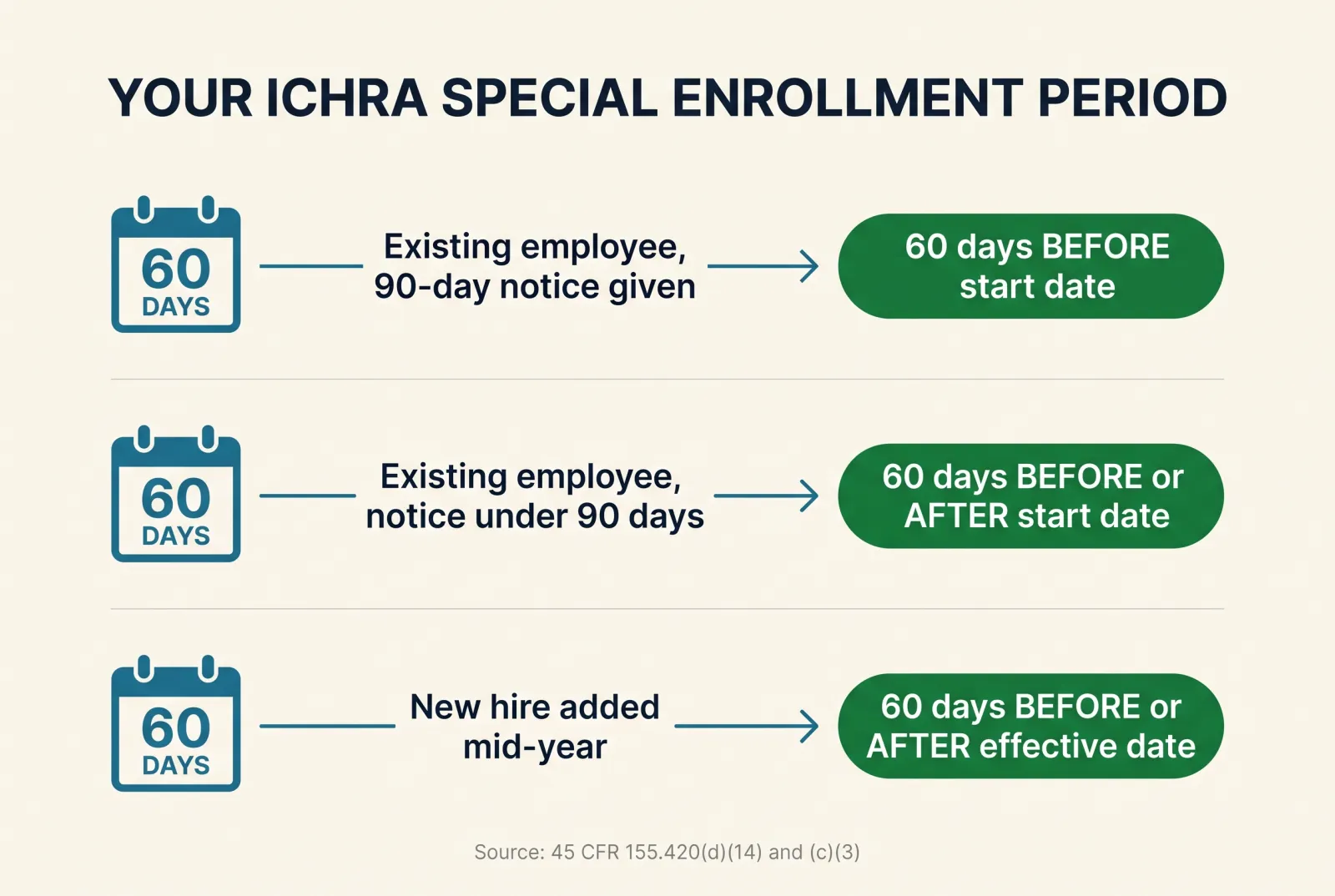
Notice the asymmetry: an employee who got proper advance notice actually has a narrower window than one whose employer was late or informal about it. That is not a typo in the regulation; it is deliberate. Someone with 90 days' advance notice has had real time to plan before the triggering event even arrives, so the rule only needs to give them a lead-in window. Someone who did not get that advance notice, including almost every new hire, needs a window that also runs after the event, because that is realistically the only time they will have known about it.
This is not the same clock as your notice deadline
Your obligation to send employees a 90-day advance notice under 26 CFR 54.9802-4(c)(6) is a separate rule from the SEP discussed here. We cover that deadline in detail, including the exact October 3, 2026 cutoff for a January 1, 2027 plan year, in our notice deadline guide. Sending the notice on time changes which SEP window your existing employees fall into; it does not change whether an SEP exists at all.
A worked example: today is August 24
Numbers land better with a real date attached, so use today: August 24, 2026. Say a 25-person company decides today that it wants to move off small group and start an ICHRA effective November 1, 2026, for its nine currently eligible full-time employees.
Counting back 90 calendar days from November 1, 2026 lands on August 3, 2026, which has already passed. That means this company cannot give its nine existing eligible employees the full 90-day advance notice the separate notice-deadline rule calls for for a clean day-one start. Two honest options follow from that, and it is worth being direct about both instead of picking whichever sounds better in a sales pitch: push the plan year start to a later date where 90 days is still achievable (working back from the calendar in our notice deadline guide), or proceed with a shorter notice window for this year and treat the extended, more forgiving 60-days-before-or-after SEP as the safety net for the employees affected, not as a substitute for trying to hit 90 days next time.
Now add a tenth employee, hired on September 22, 2026, with a 30-day waiting period that makes their ICHRA eligibility effective October 22, 2026. The 90-day notice rule for existing employees never applied to this person in the first place; under 26 CFR 54.9802-4(c)(6)(i)(B), they only need notice by their own effective date. Their SEP under 45 CFR 155.420(c)(3) is therefore the extended window: 60 days before or after October 22, 2026, meaning roughly August 23 through December 21, 2026. That is real, usable time to shop the marketplace, even though this employee joined the company only a month before their coverage could start.
What happens to spouses and dependents
An ICHRA offer usually covers not just the employee but any dependents named as eligible under the plan design, and the same qualifying-event logic in 45 CFR 155.420(d)(14) extends to them. A spouse or child who is newly eligible for reimbursement under the employee's ICHRA gets their own access to the same special enrollment period, on the same 60-day terms described above, measured from the same triggering event date as the employee.
Two practical wrinkles show up here often enough to plan for. First, a spouse who is currently covered by their own employer's group plan does not have to drop that coverage just because your employee gained ICHRA eligibility; whether it makes sense for them to switch is a household decision, not a requirement. Second, if only some family members are eligible under your class structure, for example a plan that covers the employee and children but excludes a spouse who has other coverage available, each eligible person's SEP still runs independently, and your notice needs to be specific enough that a family does not assume everyone is covered when only part of the household actually is. Vague dependent language is one of the more common sources of a rollout complaint after the fact, and it is entirely avoidable with a notice that names exactly who the ICHRA reaches.
What missing the window actually costs
The dollar cost of missing an SEP is not a fine or a penalty from a regulator; it is a coverage gap. An employee who does not act inside their window is generally locked out of the individual marketplace until the next annual open enrollment period, unless a separate qualifying event (a birth, a marriage, losing other coverage) opens a new SEP for them in the meantime. If that employee's SEP closes in, say, early September and open enrollment does not start until November 1, they could go roughly two months with no individual plan in place and, depending on your plan design, no ICHRA reimbursement flowing either, because there is usually nothing to reimburse against.
That wait is getting less forgiving, and it is worth knowing the exact rule rather than the version most people remember. For benefit years beginning on or after January 1, 2027, 45 CFR 155.410(e)(5) requires the annual open enrollment period on every Exchange to begin no later than November 1, to end no later than December 31 of the preceding calendar year, and to run no more than 9 weeks (Cornell Law School Legal Information Institute, current CFR text, fetched this week; federal, applies nationwide). Employers and employees who are working from memory of the older January 15 deadline that applied to benefit years 2022 through 2026 are working from a date that no longer applies. A missed SEP now lands someone in a shorter, earlier window than the one they think they are waiting for.
This is squarely a communication problem, not a legal one, which is exactly why it is worth solving with a checklist instead of hoping employees read the fine print in a notice letter. Employers who treat the SEP purely as a compliance box, satisfied the moment the notice goes out, are the ones most likely to have employees miss it. Employers who treat it as an active, time-boxed task, with a specific end date on a calendar an actual person is tracking, are the ones whose rollouts go smoothly.
How to walk your employees through it, step by step
None of this requires a vendor or a broker to execute. Here is the full method, in order.
- Identify each employee's individual triggering event date. For employees eligible on day one of the plan year, that is your plan year start date. For anyone added mid-year, it is their own effective date after any waiting period, which will differ person by person. Build this as a simple spreadsheet, one row per person, not a single date for the whole company; a plan with even a short new-hire waiting period will have staggered triggering dates within the first few months.
- Work out which SEP shape applies to each person, using the table above. If you gave that specific employee the full 90-day advance notice, their window is the 60-days-before version. If you did not, or they are a new hire the 90-day rule never applied to, their window is the 60-before-or-after version. Write the exact start and end date for each employee; do not leave it as a general policy statement. This is the single step most rollouts skip, because it takes real per-person arithmetic instead of one company-wide sentence, and it is the step that prevents the coverage gaps described above.
- Put the deadline in writing, separately from the plan design notice. The required ICHRA notice explains the dollar terms; it is easy for an employee to read it, note the reimbursement amount, and never register that a clock is also running. A short, plain follow-up that states the specific enrollment deadline in calendar form, not just "60 days from your start date," closes that gap. Put the actual month and day on the page.
- Point employees to where they actually shop, not just "the marketplace." That means HealthCare.gov for most states, or their state's own exchange if they run one (more on that below), plus the reminder that they can also work with a licensed agent or broker of their choosing if they want help comparing plans. Tell them plainly that you, as the employer, are not permitted to pick a plan for them or steer them toward one.
- Confirm enrollment before the window closes, not after. A short check-in near the midpoint of each employee's window, not just at the very end, gives you time to catch someone who has not acted while there is still time left to fix it. A single message two weeks out asking "did you get your marketplace plan selected yet" catches most stragglers without feeling like a compliance audit.
- Collect what you need for the reimbursement side once enrollment is done. The SEP gets someone onto a plan; it does not automatically start reimbursements. Your substantiation process, covered next, is the last mile that actually gets money to the employee.
What employees actually need on the application
When an employee applies through HealthCare.gov or a state exchange during this SEP, they will be asked whether they have access to employer-sponsored coverage and, specifically, whether that coverage is an individual coverage HRA. The application walks them through entering the employer's name, the ICHRA's monthly reimbursement amount, and the start date of their eligibility, information that comes straight from the notice you already gave them. Give employees a short reference sheet with these exact figures spelled out, employer legal name, monthly reimbursement dollar amount, and eligibility start date, rather than expecting them to dig through the full notice document while filling out an online form.
Two details matter enough to call out directly. The application may ask for a way to verify the HRA offer, and the marketplace can request supporting documentation before finalizing eligibility for premium tax credit purposes, since accepting an affordable ICHRA generally waives that credit; a copy of your written notice satisfies this if asked. Second, the affordability determination for that specific employee, whether their required contribution toward the cheapest silver plan stays under the IRS percentage discussed below, is a number the employee needs from you, not one the marketplace calculates independently from your intent alone. If your notice already states the reimbursement amount clearly, this step is quick; if it does not, this is where a vague notice turns into a stalled application and a support call to your office.
Once the plan is selected and coverage begins, your side of the paperwork shifts to substantiation: confirming, typically through a proof of payment or an insurer-issued statement, that the employee is actually maintaining the individual coverage before you reimburse them. Most ICHRA administration platforms handle this collection automatically, but the underlying requirement, that reimbursements only flow against verified coverage, applies whether you use a platform or run it by hand. Build this step into your onboarding checklist now, not after the first reimbursement cycle is already due.
Common mistakes that blow up an otherwise compliant rollout
Every one of these is legally avoidable, and every one of them shows up repeatedly in ICHRA rollouts that got the regulatory notice right but the human execution wrong.
- Treating the SEP as automatic and self-explanatory. The right to enroll does not enroll anyone. An employee who has never shopped the individual market before, often the majority of a group moving off small-group coverage for the first time, needs to be told the SEP exists at all, not just handed a notice that assumes they already know what a special enrollment period is.
- Using one company-wide deadline instead of individual dates. If your notice says "enroll within 60 days" without stating an actual calendar date per person, employees with staggered hire dates will calculate it wrong, and some will calculate it in the direction that costs them coverage.
- Confusing the SEP with the employer's own 90-day notice deadline. These are two different clocks governed by two different regulations, discussed above; conflating them in employee communication produces exactly the kind of confusion this guide exists to prevent.
- Promising a specific savings outcome to get buy-in. An HR team eager to sell the change internally sometimes tells employees they will "save money" on the switch. Nobody can promise that for an individual household; the honest, defensible version states the contribution amount and lets each employee's own marketplace shopping determine their result.
- Skipping the mid-window check-in. Waiting until the deadline has passed to find out who has not enrolled turns a fixable problem into an unfixable one, since there is no retroactive SEP once the window closes.
- Not telling employees their SEP right also covers their eligible dependents. A worker who assumes only they personally can act during the window may not realize a spouse or child needs to complete their own selection too, particularly when family members are covered under separate marketplace applications.
Does it work the same on a state-run exchange?
Mostly yes, with one distinction worth knowing. The regulation creating this SEP, 45 CFR Part 155, governs "Exchanges" as a defined federal term that includes both HealthCare.gov and the state-based exchanges that a number of states run instead, such as Covered California, MNsure in Minnesota, or Pennie in Pennsylvania. A state-based exchange has to honor the same HRA-offer qualifying event; it cannot simply decline to recognize it.
What differs from state to state is the enrollment mechanics, not the legal right to an SEP: which website or call center handles the application, how documentation of the employer's HRA offer gets submitted, and how quickly an application gets processed. If your workforce spans more than one state, which is common for remote teams, budget slightly more support time for employees in a state-based exchange state than for those using the federal HealthCare.gov platform, simply because the interface and required documents are not identical.
Check your county before you build any of this
Everything above assumes you have already decided an ICHRA makes sense for your business. That is a separate question from the enrollment mechanics, and it depends entirely on where your employees actually live, not on a national average. Two real counties from our own dataset make the point.
| County | Individual benchmark | Small-group benchmark | Estimated savings |
|---|---|---|---|
| Mecklenburg County, NC (Charlotte) | $688.02/mo | $859.85/mo | 20.0% · $2,062/yr per employee |
| Dakota County, MN (Twin Cities) | $536.21/mo | $627.56/mo | 14.6% · $1,096/yr per employee |
Source: ICHRA Savings county dataset, src/data/qualified_counties.json, cross-verified against CMS public-use marketplace files. Plan year 2026. Figures are estimates, not quotes, and are not a guarantee of savings for any specific employer.
Both counties show a real, estimated gap in favor of individual coverage, but the size of that gap is not close: Mecklenburg County's estimated 20 percent spread is meaningfully wider than Dakota County's 14.6 percent. Neither number tells you what a third county looks like. Building a compliant SEP rollout process is wasted effort if the underlying economics do not work for where your specific team lives, which is why this check belongs before the enrollment logistics, not after.
Individual vs. small-group monthly benchmark, two counties
Estimated 2026 benchmark premiums, single adult. Not a projection for any specific employer.
Source: ICHRA Savings county dataset, src/data/qualified_counties.json, plan year 2026, cross-verified against CMS public-use marketplace files. Estimates, not quotes.
The bars make the same point the table does, visually: in both counties small group sits above individual, but the distance between the two bars, not just the percentage figure, is what should drive your decision about how much effort a compliant SEP rollout is worth this year.
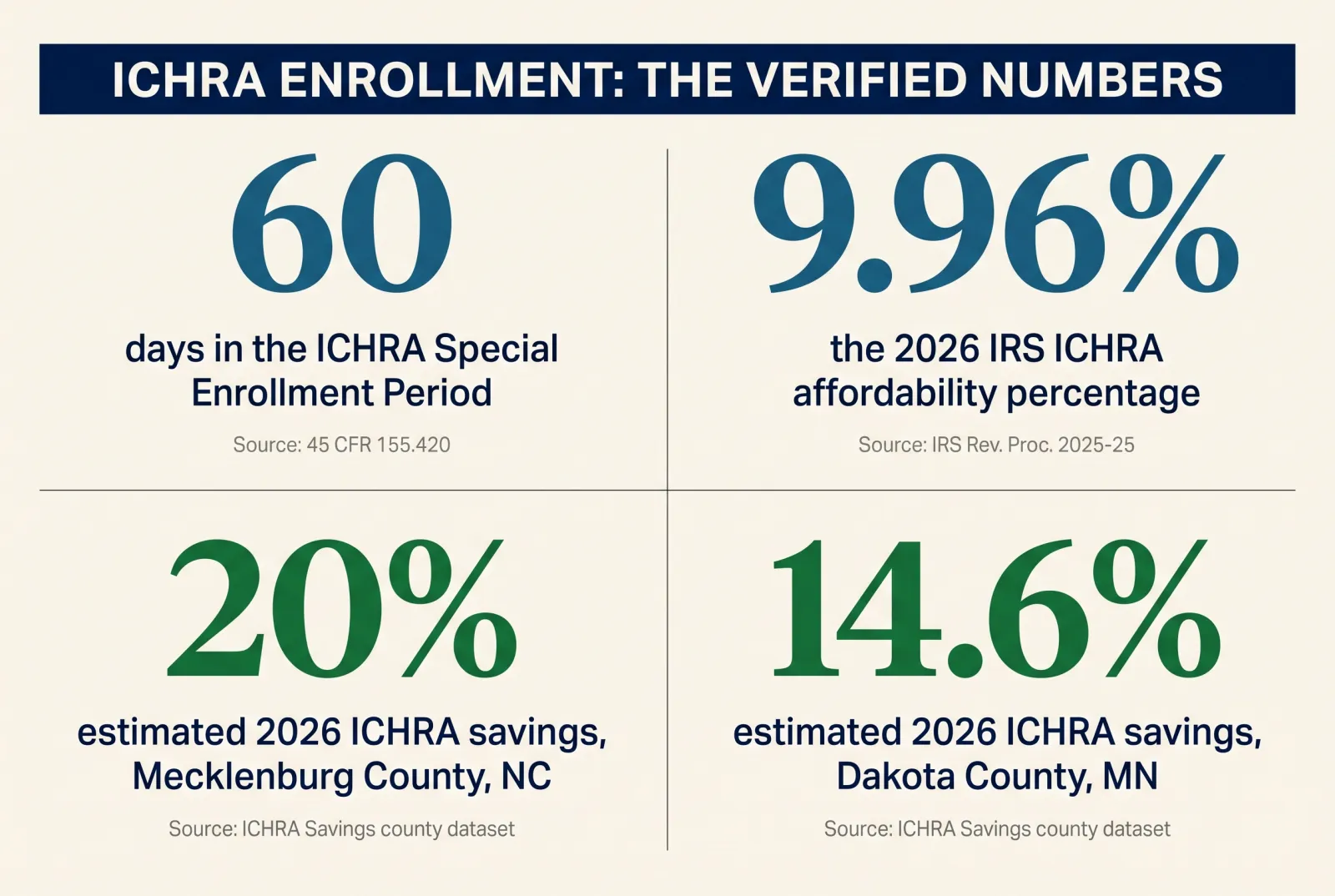
One more number worth having on hand while you are checking counties: the contribution you set also has to clear the IRS affordability test. For plan years beginning in 2026, the required contribution percentage under section 36B(c)(2)(C)(i)(II) is 9.96 percent of household income (IRS, Revenue Procedure 2025-25, Section 3.02, published in Internal Revenue Bulletin 2025-32; national, plan year 2026). That number bounds how much of the lowest-cost silver plan's premium an employee can be required to pay themselves after your reimbursement, and it is a separate calculation from the SEP timing covered in this guide, but the two decisions get made together in practice.
Say this plainly to every employee
Accepting an ICHRA that is deemed affordable generally means an employee has to waive eligibility for a premium tax credit on the marketplace for that coverage period. This is not a footnote; it is the single most common point of confusion in an ICHRA rollout, and it belongs in your plain-language communication, not just the legal notice.
Where ICHRA Savings fits
Before anything else, check whether your county is one where an ICHRA estimate actually beats small group: ichrasavings.com/ichra-savings-map. That answer takes minutes, and everything in this guide, the enrollment windows, the affordability math, the rollout checklist, only matters once the county math already works in your favor. If it does, we help with the design and setup work: choosing a contribution that clears the affordability test for your actual county, structuring employee classes if your workforce needs them, and building the notice and enrollment-tracking workflow around the exact dates that apply to your specific plan year and hire dates.
If you want to see the mechanics before talking to anyone, start with how ICHRA works. If your renewal is already in hand and you are working against a real calendar, a short conversation is worth more than another week of research: ichrasavings.com/book. And if your employer already offered you one of these and you are the one trying to understand your own enrollment window, this page is written for you.
What you get out of any of this is not a guaranteed saving, and we will say so plainly if your counties do not support one. What you get is an enrollment rollout where nobody on your team finds out about a 60-day clock only after it has already closed.
The special enrollment period is not the hard part of an ICHRA rollout. The hard part is making sure every employee actually knows their own personal deadline, because it is rarely the same date twice.
Mike MooreQuestions employers actually ask
Does offering an ICHRA really let my employees buy a plan outside of November open enrollment?
Yes. Federal regulation 45 CFR 155.420(d)(14) makes "newly gains access to an individual coverage HRA" a qualifying event for a special enrollment period on the ACA marketplace, so your employees are not stuck waiting for the next annual open enrollment window just because your ICHRA starts mid-year.
How many days do employees actually have to enroll?
Sixty days, but which 60 days depends on your notice timing. Under 45 CFR 155.420(c)(3), an employee who received the required 90-day advance notice gets 60 days before the ICHRA's effective date to select a plan. An employee who did not get that 90-day notice, including any new hire added mid-year, gets an extended window of 60 days before or after the effective date.
What counts as the "triggering event" that starts the clock?
The regulation defines it as the first day on which ICHRA coverage can take effect for that specific person, not the date they were told about it and not the date they signed paperwork. For an existing employee on a calendar-year plan, that is usually the plan year start date. For a new hire, it is the date their own eligibility (and any waiting period) ends.
What happens if an employee misses their special enrollment period entirely?
They generally have to wait for the next ACA open enrollment period to buy an individual plan, unless a separate qualifying life event (marriage, birth, loss of other coverage) opens a new SEP for them. Note that the open enrollment window itself has been shortened: for benefit years beginning on or after January 1, 2027, 45 CFR 155.410(e)(5) requires it to begin no later than November 1, end no later than December 31 of the preceding year, and run no more than 9 weeks. A missed SEP is therefore a longer wait than it used to be, which is why walking employees through their window in real time matters more than the legal notice itself.
Is the special enrollment period the same thing as the 90-day employer notice deadline?
No, and mixing them up causes real confusion. The 90-day notice deadline (26 CFR 54.9802-4(c)(6)) is your obligation as the employer to tell eligible employees about the ICHRA before the plan year starts. The special enrollment period (45 CFR 155.420) is the separate window employees then get to actually go shop and select a marketplace plan. You can satisfy one and still confuse employees about the other if you do not explain both.
Does this work the same way if my state runs its own exchange instead of HealthCare.gov?
The special enrollment trigger itself is set at 45 CFR Part 155, which governs all ACA exchanges, state-based marketplaces included, so a state-run exchange like MNsure in Minnesota or Pennie in Pennsylvania has to honor the same HRA-offer qualifying event. What differs by state is the enrollment process and interface, not whether the SEP exists.
Can an employee use this special enrollment period if they already have a marketplace plan?
Yes. The regulation qualifies anyone newly gaining access to an ICHRA, regardless of whether they were previously enrolled in individual coverage, as long as they were not already covered under that same ICHRA the day before the triggering event. An employee already on a marketplace plan can use the SEP to switch to a different plan that pairs better with the ICHRA reimbursement.
Do I need to tell employees which plan to pick?
No, and you should not. Steering an employee toward a specific plan or carrier creates its own compliance and liability questions. Your job is to communicate the dollar amount, the deadline, and where to shop; the plan selection is the employee's decision to make on the marketplace or with a licensed agent of their choosing.
Sources
- 45 CFR § 155.420(c)(3) and (d)(14), special enrollment periods, individual coverage HRA/QSEHRA qualifying event and the 60-day windows — law.cornell.edu/cfr/text/45/155.420
- 45 CFR § 155.410(e)(5), annual open enrollment period for benefit years beginning on or after January 1, 2027 — law.cornell.edu/cfr/text/45/155.410
- 26 CFR § 54.9802-4(c)(6), Individual Coverage HRA notice requirement, including (c)(6)(i)(B) for mid-year eligible employees — law.cornell.edu/cfr/text/26/54.9802-4
- 26 USC § 4980H(c)(2)(A), applicable large employer definition (50 full-time employees), referenced by the QSEHRA eligible-employer definition — law.cornell.edu/uscode/text/26/4980H
- IRS Revenue Procedure 2025-25, Section 3.02, 2026 required contribution percentage (9.96%) — irs.gov/irb/2025-32_IRB and irs.gov/pub/irs-drop/rp-25-25.pdf
- ICHRA Savings county dataset, src/data/qualified_counties.json, plan year 2026, cross-verified against CMS public-use marketplace files
- ICHRA Savings, "ICHRA for 2027: Your Notice Deadline Is October 3," internal reference for the separate 90-day employer notice deadline — ichrasavings.com/blog/ichra-2027-notice-deadline