ICHRA State Tax Credits 2026: Indiana and Mississippi Pay
Indiana and Mississippi pay small employers up to $400 per employee to offer an ICHRA in 2026. See the rules, the caps, and where our county data agrees.
The short version
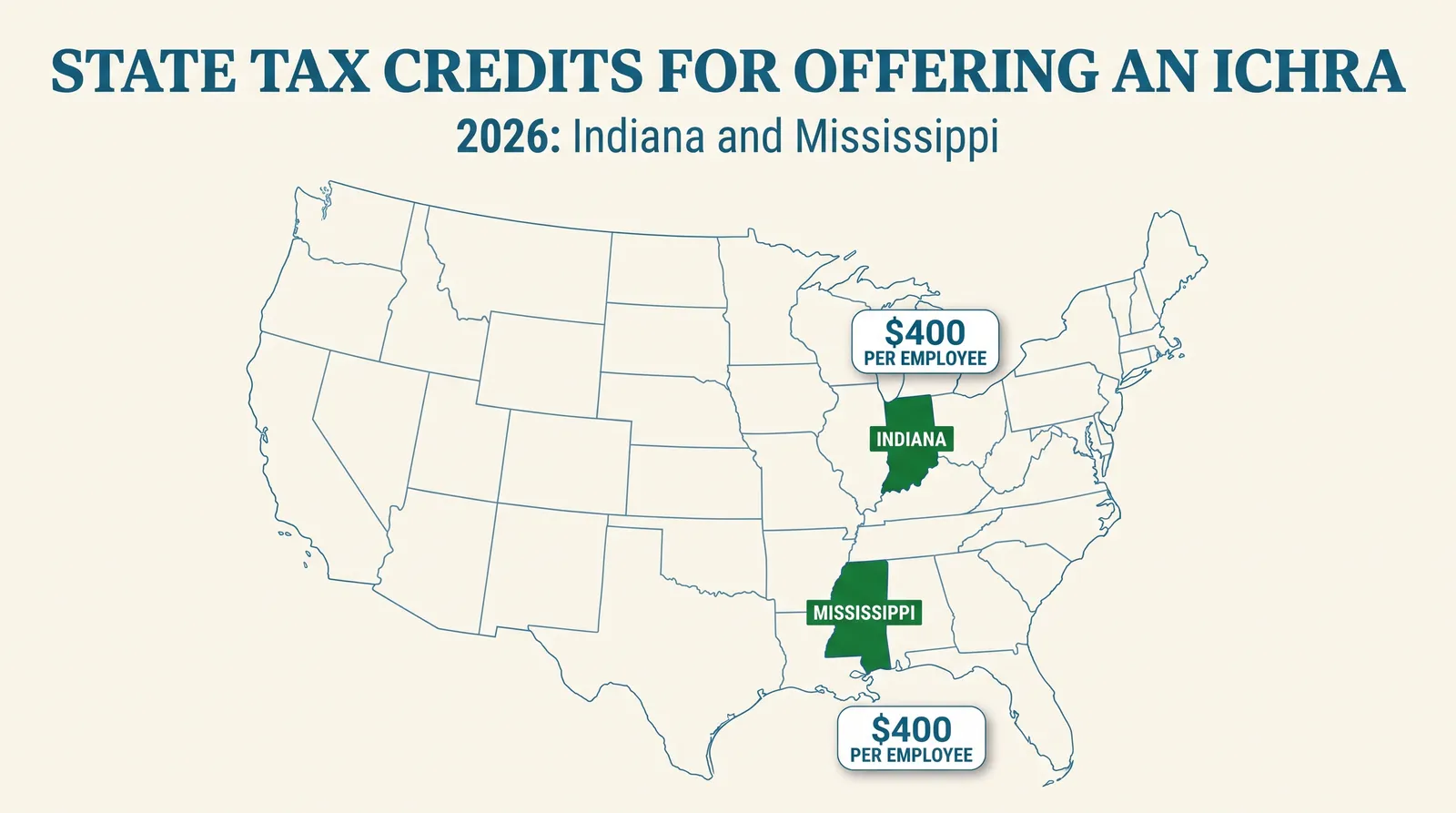
- Indiana has paid small employers up to $400 per covered employee for offering an ICHRA since the 2024 tax year, dropping to $200 in year two, under Indiana Code 6-3.1-38.
- Mississippi became the second state to do this: Governor Tate Reeves signed House Bill 343 on April 6, 2026, the same $400/$200 structure, retroactive to January 1, 2026.
- Both credits are nonrefundable, capped for eligible employers under 50 employees, and capped statewide: $10 million a year in Indiana, $1 million a year in Mississippi.
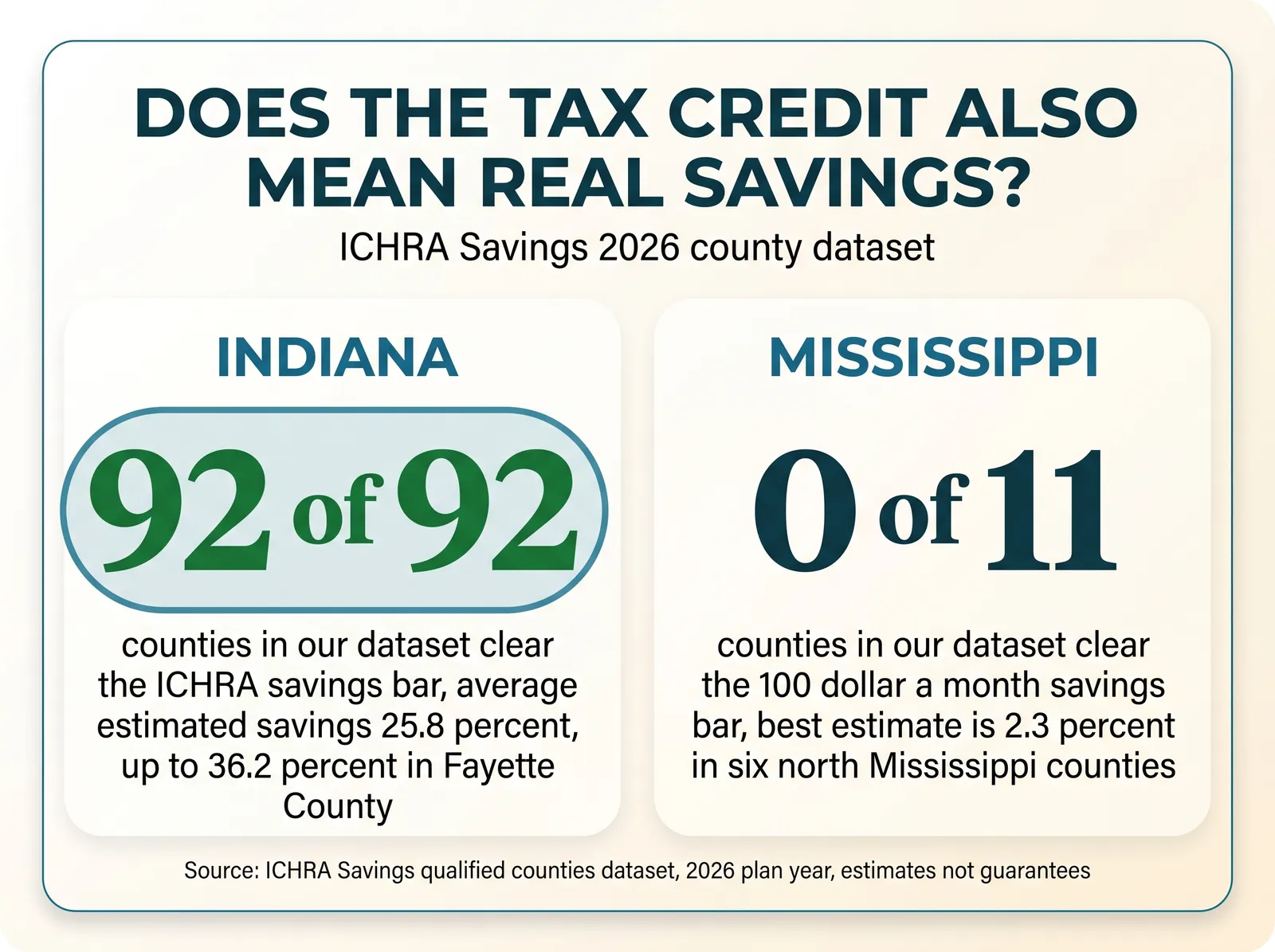
- The credit and the underlying cost case are two different questions. In our dataset, all 92 Indiana counties clear our ICHRA savings bar; zero of Mississippi's counties do.
- The National Council of Insurance Legislators adopted a model act on May 20, 2026 giving other states a template; Ohio's version passed its House and is pending in the Senate.
What's actually new here
You already knew an ICHRA (Individual Coverage Health Reimbursement Arrangement) lets you set a fixed monthly reimbursement and let each employee buy their own plan on the individual market, tax-free. What's new is that two state governments now also pay you, directly, in cash off your state tax bill, for doing exactly that. Indiana has run a credit since 2024. Mississippi signed one into law on April 6, 2026. Neither program is a federal benefit, a marketplace subsidy, or anything connected to CMS or the IRS: they are state income tax credits, administered by each state's own Department of Revenue, layered entirely on top of whatever the federal ICHRA rules already require.
If you run a business with fewer than 50 employees in Indiana or Mississippi and you are weighing an ICHRA for the first time, this changes the arithmetic in your favor by a fixed, real dollar amount. If you run one anywhere else, the credit itself does not apply to you yet, but it is worth understanding both because more states are actively copying the structure and because it forces a question every employer should be asking anyway: does the ICHRA save you money on its own, before any tax credit gets involved? We answer that with our own county data further down, and the answer is not the same in both of the states that currently pay for it.
2
States with an enacted ICHRA tax credit as of this article (IN, MS)
$400
Year-one credit per covered employee, both states
<50
Employees: the eligibility ceiling in both states
92 of 92
Indiana counties that also clear our 2026 ICHRA savings bar
Why states are doing this at all
Start with the pain this is actually responding to. Fewer small employers offer health coverage than you might assume: in the 2025 KFF Employer Health Benefits Survey, only 61% of firms with 10 or more workers offered health benefits to at least some of their employees nationally. KFF changed its 2025 sampling to exclude firms under 10 employees entirely, explaining that in the prior year's survey only 151 such firms responded and just 29 of them offered benefits, too small a sample to report reliably. Read plainly: a large share of the smallest US employers, the ones this article is about, offer no health benefit at all, and the national survey instrument used to track this has gotten worse at even measuring them, not better.
State legislators building these credits are responding to that gap with the "we offer nothing at all" problem in mind, not the "we're choosing between two good options" problem. An ICHRA has no minimum participation requirement, unlike a traditional small-group plan, which typically needs a set percentage of eligible employees enrolled before a carrier will even issue the policy. That makes it the more realistic option for a company that has never offered coverage before, and a state credit is a direct nudge toward making that first offer, not toward switching an employer who already has a working group plan.
The industry's own adoption data backs up which employers these credits are actually reaching. The HRA Council, an industry trade group, reported in its "Growth Trends for ICHRA & QSEHRA," Volume 5 (published August 12, 2026) that more than two-thirds of small businesses currently offering an ICHRA previously offered no health coverage at all, with roughly another third transitioning from a small-group plan. That first figure is the one that matters for this article: state tax credits are mostly subsidizing employers making a first offer, not employers switching away from a group plan they were already happy with.
The clearest sign this is a trend rather than a coincidence is what happened at the state-legislator level in May 2026. The National Council of Insurance Legislators (NCOIL), an association of state lawmakers who write model insurance legislation that individual states then adapt, adopted its own Individual Coverage Health Reimbursement Arrangement Model Act at its Spring National Meeting in Louisville, Kentucky on May 20, 2026. The model gives any state a ready-made framework for "a nonrefundable tax credit to small businesses that are not required to provide health insurance but choose to offer an ICHRA," explicitly leaving the exact per-employee dollar amount up to each state, restricting the credit to employers with 2 to 50 employees, and including a drafting note letting states add an expiration date if they want one. Indiana and Mississippi did not wait for NCOIL's model; both had already enacted their own versions before or around the same time NCOIL formalized the template. What NCOIL's action means is that more states now have a finished blueprint to work from instead of starting from a blank page.
Indiana's credit, in full
Indiana's Health Reimbursement Arrangement Tax Credit has been in place since the 2023 legislative session, codified at Indiana Code 6-3.1-38, and the Indiana Department of Revenue documented exactly how it works in Income Tax Information Bulletin #122, published December 2024. The credit applies to an "eligible employer," defined as one with fewer than 50 employees at any point during the taxable year, that adopts a health reimbursement arrangement after December 31, 2023, in place of, or instead of never having offered, traditional employer-provided insurance.
The dollar structure is a straight step-down. For each covered employee, the credit is the lesser of the employer's actual HRA contribution or a fixed ceiling: $400 for the arrangement's first year established in 2024 or later, $200 for its second year, and $0 for the third year and every year after that. The bulletin gives a worked example directly: an employer that contributes $300 toward one employee's HRA and $600 toward a second employee's HRA in year one claims $700 in credit, not $800, because the $600 contribution is capped at the $400 ceiling per employee. The credit is computed strictly per employee, and it tracks each employee's individual year of coverage, not the calendar year, so a new hire added to an existing 2024 HRA in 2025 only generates the $200 second-year amount for that employee, even though the company's plan itself is older.
Two limits matter as much as the headline number. First, the credit is nonrefundable and limited to the employer's actual state tax liability for the year; unused amounts carry forward for up to 10 years. Second, and this is the one most articles about this credit skip, Indiana caps the total credit awarded to all employers statewide at $10 million per state fiscal year (July 1 through June 30), allocated in the order returns are received. If that statewide cap is reached before your return is processed, your claim for that year is permanently disallowed, though the bulletin notes any carryover portion is still preserved for future years. Indiana also excludes a professional employer organization, a common paymaster, or an affiliated entity from the definition of "employer" for this credit unless the employee actually performs services for that specific company, which matters if your business runs payroll through a PEO.
How to actually claim it
Indiana reports the credit under Code 878 on Schedule IN-OCC, Part A. For tax years starting in 2024, the Department sends eligible employers a separate letter requesting Form HRA-1 to verify the claim; that form is submitted on its own, not attached to the return, and failing to complete it can result in the credit being denied in full. This is a state tax filing question specific to your business structure; confirm the current-year process with your CPA or the Indiana Department of Revenue directly.
Mississippi's credit, in full
Mississippi is the second state to enact a dedicated ICHRA tax credit. Governor Tate Reeves signed House Bill 343 into law on April 6, 2026, according to the Mississippi Department of Revenue's own list of enacted 2026 legislation, and the law is retroactive to January 1, 2026. Reporting from Bloomberg Tax's Daily Tax Report State, which cites the enacted bill directly, describes the same $400-per-employee, first-year structure Indiana uses, stepping down to $200 in year two, for employers with fewer than 50 employees. Mississippi's statewide annual cap is set at $1 million, a tenth the size of Indiana's cap, with excess credit carried forward for up to 10 years.
The bill's path through the Mississippi Legislature is itself worth noting: it passed with overwhelming, bipartisan support in both chambers, a pattern that mirrors Indiana's original bill and suggests this specific policy design, unlike broader health-coverage fights, is not drawing the usual partisan resistance at the state level. That matters for predicting whether more states follow, covered further down.
What Mississippi's law does not do, and this is the honest part of this article, is guarantee that the individual market in Mississippi actually beats small-group pricing for a given employer. A state tax credit for offering an ICHRA and a county where an ICHRA is the cheaper choice are two entirely separate facts, and conflating them is exactly the kind of thing that makes an employer feel misled six months into a decision. We cover what our own county data shows for Mississippi, plainly, below.
Indiana vs Mississippi, side by side
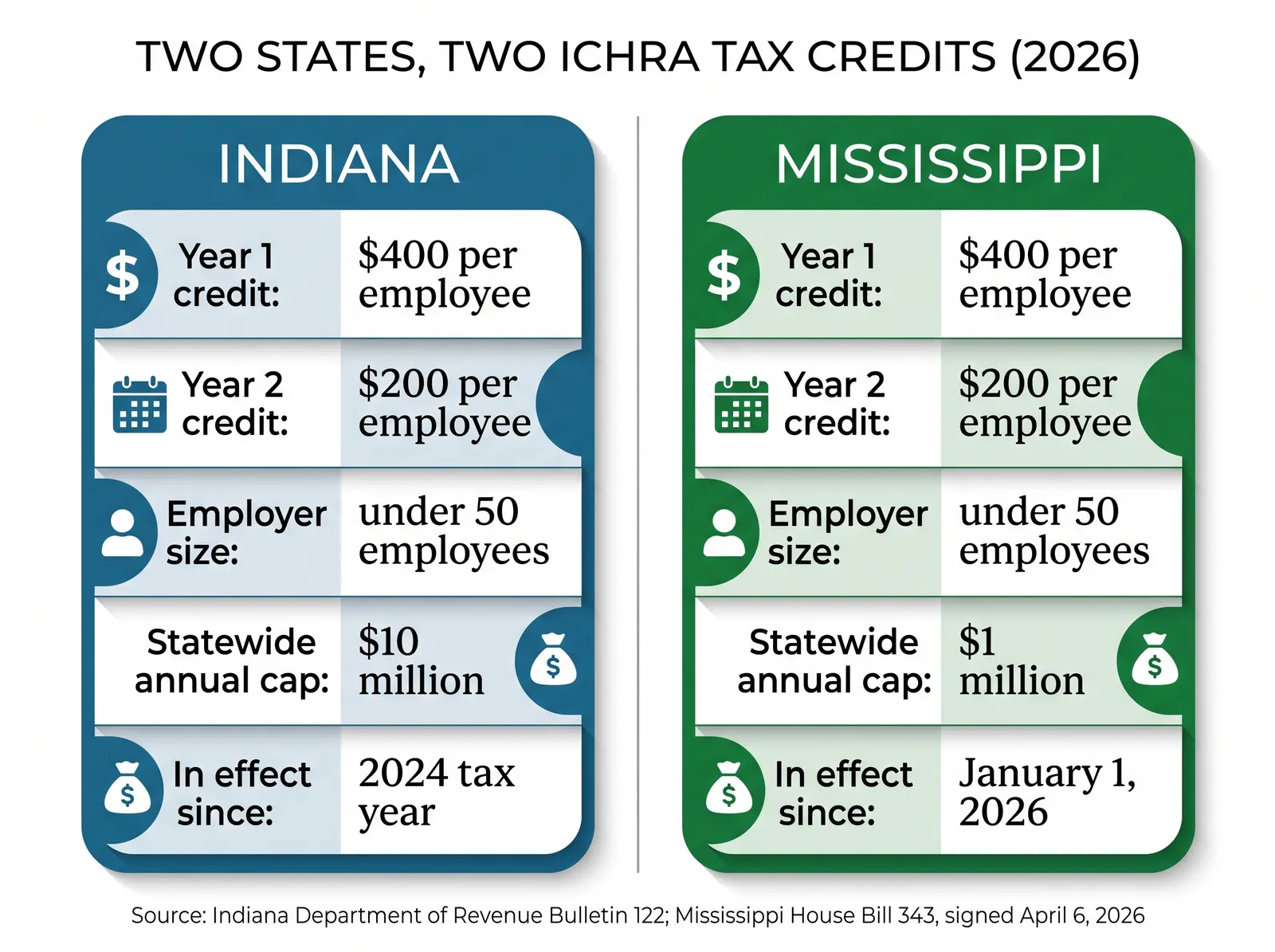
Lined up, the two programs are nearly identical in shape and different mainly in scale and how long each has existed.
| Feature | Indiana | Mississippi |
|---|---|---|
| Legal basis | Indiana Code 6-3.1-38 | House Bill 343 (2026) |
| In effect since | Tax year 2024 | January 1, 2026 (retroactive) |
| Year-one credit | Up to $400 per covered employee | Up to $400 per covered employee |
| Year-two credit | Up to $200 per covered employee | Up to $200 per covered employee |
| Year three and beyond | $0 | $0 |
| Eligible employer size | Fewer than 50 employees | Fewer than 50 employees |
| Refundable? | No; limited to state tax liability | No; limited to state tax liability |
| Carryforward | Up to 10 years | Up to 10 years |
| Statewide annual cap | $10,000,000 per fiscal year | $1,000,000 per fiscal year |
Sources: Indiana Department of Revenue, Income Tax Information Bulletin #122 (Dec. 2024); Mississippi Department of Revenue, 2026 Legislation summary; Bloomberg Tax Daily Tax Report State, "Mississippi Authorizes Income Tax Credit for Certain Employers."
Does the credit also mean real savings?
This is the question a state tax credit cannot answer for you, because a state Department of Revenue is not in the business of comparing individual-market premiums against small-group premiums county by county. We are, and that dataset is the whole reason this site exists. So we ran both states through it.
In Indiana, the answer is about as clean as this data ever gets: every single one of the 92 Indiana counties in our qualifying dataset clears our savings threshold, meaning the individual-market benchmark premium runs at least $100 a month below the small-group benchmark, per employee, for the 2026 plan year. The average estimated savings across those counties is 25.8%. The strongest case in the state is Fayette County, where our data puts the individual benchmark at $580 a month against a small-group benchmark of $909, an estimated 36.2% savings. The weakest qualifying county, LaPorte County, still clears the bar at 14.0%. In Indiana, the state tax credit and the underlying cost case point the same direction almost everywhere in the state.
In Mississippi, our dataset tells a different, and frankly more interesting, story. Only 11 of Mississippi's 82 counties appear in our qualifying-counties file at all for the 2026 plan year, and none of them clear our $100-a-month qualifying threshold. The closest any Mississippi county comes is an estimated 2.3% savings, roughly $17 a month per employee, in Benton County, Itawamba County, Lee County, Pontotoc County, Tippah County, Union County. Our own Mississippi savings page is upfront about this: it lists the same 11 counties and states plainly that Mississippi averages closer to 1% savings statewide, nowhere near the strength of a state like Indiana. None of Mississippi's counties clear the stronger $100-a-month bar we use before we consider a county a genuine cost-driven case for switching.
None of this makes Mississippi's tax credit worthless. An employer there offering nothing today can still use the $400-per-employee credit to help fund a first-time benefit with no participation minimum, which is a real advantage over group coverage regardless of the individual-market rate spread. What it means is that a Mississippi employer should go into this clear-eyed: you would be adopting an ICHRA there mainly for flexibility, no-minimum-participation access, and the state credit itself, not because our county data says the individual market is dramatically cheaper than group coverage in your area right now. That is exactly the kind of admission the county data exists to make possible, and it is the honest answer even though it complicates the story.
| County | Individual benchmark | Small-group benchmark | Est. monthly gap | Est. savings |
|---|---|---|---|---|
| Benton County | $730 | $747 | $17 | 2.3% |
| Itawamba County | $730 | $747 | $17 | 2.3% |
| Lee County | $730 | $747 | $17 | 2.3% |
| Pontotoc County | $730 | $747 | $17 | 2.3% |
| Tippah County | $730 | $747 | $17 | 2.3% |
| Union County | $730 | $747 | $17 | 2.3% |
| George County | $756 | $760 | $4 | 0.5% |
| Hancock County | $756 | $760 | $4 | 0.5% |
| Harrison County | $756 | $760 | $4 | 0.5% |
| Jackson County | $756 | $760 | $4 | 0.5% |
| Stone County | $756 | $760 | $4 | 0.5% |
Source: ICHRA Savings qualified-counties dataset (src/data/qualified_counties.json),
built from Ideon rate data cross-verified against CMS public-use marketplace files,
2026 plan year. These are estimates, not quotes or guarantees, and this table lists
every Mississippi county currently in the dataset, not a curated subset.
A worked example: 10 employees in Fayette County
Put a real number on what "stacking" the credit with real savings looks like in the state where both line up. Say a 10-employee company in Fayette County, Indiana, has never offered health coverage and adopts an ICHRA for the first time in 2026, funding it at or above $400 per employee so each employee's contribution clears the credit ceiling.
Here's the math
The Indiana tax credit alone is worth $4,000 in year one (10 employees × $400), assuming the company's state tax liability is at least that large, dropping to $2,000 in year two. Separately, our county data puts Fayette County's estimated individual-vs-small-group gap at $3,956 per employee per year, which is $39,556 across 10 employees. Add the two together and year one's combined estimated benefit, tax credit plus the county-level cost difference, comes to roughly $43,556. That figure is illustrative, not a quote: it assumes full credit eligibility, a specific plan selection, and that this specific county's 2026 benchmark premiums hold for your actual employees, none of which is guaranteed for any individual business.
The point of the example is not the exact dollar figure, which will differ for every real company. It is that in a county like this one, the state credit and the underlying county math are additive, not competing explanations for the same saving. Run the same exercise for a Mississippi employer in one of the counties in the table above and the county-level piece of that sum shrinks to a few hundred dollars a year across the same 10 employees, even though the $400-per-employee state credit itself is identical.
Four edge cases that trip employers up
The headline $400/$200 structure is simple. The eligibility mechanics underneath it are where employers actually lose the credit, usually without realizing it until a return gets adjusted.
Where the credit actually gets lost
- Crossing 50 employees mid-year. Indiana's bulletin defines an eligible employer using the maximum number of employees at any point during the taxable year, not an average or a year-end count. A 47-employee company that hires five seasonal workers in November and ends the year at 52 is not an eligible employer for that year under a literal reading, even though it spent most of the year under the cap. The bulletin allows "minimal, short-term variances… on a case-by-case basis," which is not a bright-line rule; a company near the boundary should get this reviewed before assuming eligibility, not after filing.
- Running payroll through a PEO. Indiana's guidance treats the business the employee actually performs services for as the "employer," and explicitly excludes a professional employer organization from that definition unless the employee works for the PEO itself. A company that outsources HR and payroll to a PEO but directs its own employees' day-to-day work is very likely still the "employer" for credit purposes, but the PEO relationship is exactly the kind of detail a generalist tax preparer can miss. Confirm this specifically rather than assuming either way.
- Owners of pass-through entities. If your business is an S corporation or partnership, Indiana's rule is explicit that the credit does not flow through to the entity's owners in their personal capacity, and owners cannot claim a proportionate share on their individual returns. A two-owner, eight-employee S corp gets the credit calculated on its eight covered employees, not ten covered individuals.
- Filing after the statewide cap is already spent. Both states allocate their statewide cap by order of filing, not by when the ICHRA itself started. An employer that adopts an ICHRA in January but files its return in the following spring, after other employers' returns already exhausted the fiscal year's cap, can lose the current year's credit outright, with only the carryforward portion preserved. Filing earlier in the season, once your CPA has the numbers, is not just administrative tidiness here; it is the entire difference between getting paid and getting a carryforward.
Who a state credit doesn't make the decision for
Say this plainly, because a $400-per-employee number is easy to let do more work than it should. If your business already has 50 or more employees, neither Indiana's nor Mississippi's credit applies to you at all, no matter how strong your county's ICHRA savings case is; a larger employer's ICHRA decision has to stand on the cost math alone. If you already run a group plan your employees like and your renewal came in flat or only modestly higher this year, a one-time or two-year state credit is rarely enough by itself to justify disrupting a benefit that is working, especially in a county like the ones in our Mississippi table above, where the underlying individual-market case is thin. The credit is best understood as an accelerant for a decision your county data already supports, not a reason to make a decision your county data does not support.
States still deciding: Ohio, and the model bill behind it
Indiana and Mississippi are the only two states with an enacted ICHRA tax credit as of this article. Ohio is the closest to becoming a third. House Bill 133, sponsored by Representative Meredith Craig, passed the Ohio House unanimously and, per the official Ohio House of Representatives bill page, remains pending in Senate committee as of this writing, meaning it has not yet passed the Senate or reached the Governor's desk. The bill would authorize a nonrefundable income tax credit for small employers that cover employees with an ICHRA and would also restrict practices designed to discourage employees from accepting an employer's ICHRA offer; the exact per-employee dollar figure in the current Senate version was not confirmed by a primary source at the time of this article and should be checked against the bill's current text before an Ohio employer plans around it.
Beyond Ohio, NCOIL's May 2026 model act gives any state legislature a ready template: a nonrefundable credit for employers with 2 to 50 employees who choose an ICHRA, with the specific dollar amount and any expiration date left to each state to decide, plus a requirement that participating employers report back to the state's insurance department every three years on whether they are still offering the arrangement. Whether your own state adopts a version of this is a legislative question we cannot predict, and this article will not speculate about bills that have not been introduced. What is worth doing regardless of your state: build your ICHRA decision on your own county's numbers first, since that math does not depend on any legislature acting at all, and treat a future state credit as a bonus if and when it arrives.
How to find out if your state has one
Do this before assuming either way:
- Check your state Department of Revenue's website directly for "health reimbursement arrangement tax credit" or "ICHRA tax credit," not a vendor blog summarizing it, since state programs change and a vendor's summary can lag the current statute.
- If you use a payroll provider, benefits broker, or third-party ICHRA administrator, ask them directly whether they track state-level credits for your state; several ICHRA administration platforms flag this automatically during setup.
- Confirm the eligibility test with your own CPA, specifically the employer-size cap, whether a PEO relationship disqualifies you, and whether your specific entity structure (S corp, partnership, sole proprietor) can actually use a nonrefundable credit given your expected state tax liability.
- Separately, and regardless of any credit, check your own county's cost case on our savings map: https://ichrasavings.com/ichra-savings-map/. A state credit is worth pursuing whether or not your county clears our savings bar; it is not, by itself, a reason to assume your county does.
What a state credit doesn't change
A state income tax credit is a financial incentive, not a compliance shortcut. Every federal requirement that applies to an ICHRA without a state credit attached still applies with one. You still owe eligible employees the required written notice, generally at least 90 days before the plan year begins; our guide to the ICHRA notice deadline covers that calendar. You still have to run substantiation on every reimbursement, confirming each employee actually has individual coverage or Medicare before the HRA pays a claim; our substantiation guide covers the two federal rules and what it costs to get them wrong. You still have to structure employee classes and set contribution amounts so the arrangement is affordable under the IRS's federal safe harbor test, which is a separate calculation from any state's tax credit eligibility test; our guide to the 2027 ICHRA affordability percentage covers that number. None of these federal obligations get easier or harder because a state also hands you a tax credit for doing what you were already going to do.
A state tax credit is real money. It is not proof that an ICHRA is the right call in your county. Check both, separately, before you sign anything.
Mike MooreHow ICHRA Savings helps
We do not administer your ICHRA or file your state tax credit claim; a licensed third-party administrator and your own CPA handle those pieces, respectively. Where we help: showing you whether your actual county, not a national average and not just the fact that your state offers a credit, makes the underlying cost case for an ICHRA in the first place, designing employee classes that hold up under the federal rules, and modeling affordability so your reimbursement amount is set correctly before enrollment opens. None of the county math requires talking to anyone first. Check your county on the savings map: https://ichrasavings.com/ichra-savings-map/. If you're in Indiana specifically, our Indiana savings page breaks the county data down further. If your renewal is already in hand and you have a deadline, it is worth a conversation: https://ichrasavings.com/book.
Questions employers actually ask
Which states currently offer a tax credit for offering an ICHRA?
Two, as of this article's publication: Indiana, whose credit has run since the 2024 tax year under Indiana Code 6-3.1-38, and Mississippi, whose House Bill 343 was signed by Governor Tate Reeves on April 6, 2026, retroactive to January 1, 2026. Both give an eligible small employer up to $400 per covered employee in the arrangement's first year and up to $200 in the second year, then nothing in year three and beyond. Several other states, including Ohio, have bills in progress but had not enacted a credit as of this writing.
Do I have to be a new ICHRA employer to claim either credit?
No, but the credit amount depends on which year of the arrangement you're in, not the calendar year. Indiana's rule is explicit: the credit is $400 for the HRA's first year established in 2024 or later, $200 for its second year, and $0 after that, tracked per employer, not reset annually. An employer that started its ICHRA in 2024 was already in year three by the 2026 tax year and would not qualify for either credit tier again, even though the ICHRA itself continues.
Does a Professional Employer Organization (PEO) arrangement qualify for the Indiana credit?
Generally no. Indiana Department of Revenue guidance defines "employer" for this credit as the entity for whom the covered employee actually performs services, and specifically excludes a professional employer organization, a common paymaster for a group of businesses, or an affiliated entity from that definition unless the employee actually performs services for that specific company. A business using a PEO for payroll and HR should confirm with its own tax advisor whether it, rather than the PEO, is the "employer" for this credit before assuming it qualifies.
Is the credit refundable if my business owes little or no state income tax?
No, in either state. Both credits are nonrefundable, meaning they can reduce your state tax liability to zero but will not generate a refund beyond that. Indiana allows unused credit to carry forward for up to 10 years; Mississippi's law includes a similar 10-year carryforward. A very small or newly formed business with minimal state tax liability in year one may not capture the full $400-per-employee value immediately, but does not lose it outright as long as it keeps filing.
Is there a statewide limit that could mean my claim gets denied even if I qualify?
Yes, in both states, and this is easy to miss. Indiana caps total approved credits at $10 million per state fiscal year (July 1 to June 30) and allocates by the order returns are received; once the cap is hit for the year, later claims for that year are permanently disallowed, though any carryforward amount is preserved. Mississippi's cap is $1 million annually. Neither state has published, as of this article, a running public total of how much of that cap is already claimed for the current fiscal year, so there is no way to know in advance exactly how close either program is to its ceiling.
My state is not Indiana or Mississippi. Should I wait for my state to pass something similar?
That depends entirely on whether an ICHRA already makes financial sense for your county without any credit attached, which is a completely separate question from state tax policy. A state credit, where one exists, is a bonus on top of an ICHRA that already clears the cost bar in your county; it is not, on its own, a reason to adopt one in a county where the individual market does not beat small-group pricing. Check your own county before deciding either way: https://ichrasavings.com/ichra-savings-map/.
Does taking a state ICHRA tax credit affect my employees' premium tax credit eligibility?
Not directly; those are separate systems. An employee's federal premium tax credit eligibility depends on whether your ICHRA offer is affordable under the IRS's federal safe harbor test, not on whether your state also gives you an income tax credit for offering the arrangement. Our guide to the 2027 ICHRA affordability percentage covers how that federal test works and what changes for the coming plan year.
Can an owner or owner-employee count toward the per-employee credit?
This depends on how the owner is classified and paid, and it varies by state statute and entity type (S corporation, partnership, sole proprietorship). Indiana's rule that the credit does not flow through to a pass-through entity's owners is a related but separate limitation worth checking with a CPA who has reviewed your specific entity structure, rather than assuming either state treats every owner the same way a rank-and-file W-2 employee is treated.
How these figures are calculated
Indiana's credit structure, definitions, and caps come directly from the Indiana
Department of Revenue's Income Tax Information Bulletin #122 (December 2024), which
cites Indiana Code 6-3.1-38 as its statutory basis. Mississippi's figures come from two
independent sources fetched for this article: the Mississippi Department of Revenue's
own 2026 enacted-legislation summary, which confirms House Bill 343 as an ICHRA-related
income tax credit signed April 6, 2026, and Bloomberg Tax's Daily Tax Report State
coverage of the same bill, which supplies the specific dollar figures, the statewide cap,
and the carryforward term; Mississippi's own bill-tracking site returned a server error
throughout this article's research session and could not be fetched directly. Ohio's
bill status comes from the official Ohio House of Representatives legislation page for
House Bill 133. The NCOIL model act description comes from NCOIL's own news release
dated May 20, 2026. The national employer offer-rate figure comes from KFF's 2025
Employer Health Benefits Survey, published October 22, 2025. County-level savings
figures for Indiana and Mississippi come from the same qualified-counties dataset behind
every state page on this site (src/data/qualified_counties.json), built
from Ideon rate data cross-verified against CMS public-use marketplace files for the
2026 plan year; a county enters the qualifying set when its individual-market benchmark
premium runs at least $100 a month below its small-group benchmark premium, per
employee.
Sources
- Indiana Department of Revenue, Income Tax Information Bulletin #122 (Dec. 2024) — credit structure, caps, IC 6-3.1-38
- Mississippi Department of Revenue, 2026 Legislation — confirms House Bill 343 as an enacted ICHRA tax credit
- Bloomberg Tax, Daily Tax Report State — Mississippi HB 343 dollar figures, cap, effective date
- Ohio House of Representatives, House Bill 133 status — pending Senate legislation
- NCOIL, "NCOIL Adopts Individual Coverage Health Reimbursement Arrangement Model Act" (May 20, 2026)
- KFF, 2025 Employer Health Benefits Survey (Oct. 22, 2025) — national employer offer rate
- ICHRA Savings qualified-counties dataset (
src/data/qualified_counties.json), built from Ideon rate data cross-verified against CMS public-use marketplace files, 2026 plan year