ICHRA vs Health Stipend: The 2026 Tax Math
A taxable health stipend loses money to payroll tax before it buys coverage. See the 2026 IRS math against a compliant, tax-free ICHRA, sourced this year.

The short version
- A taxable health stipend and an ICHRA are not the same thing. One is ordinary wages; the other is a formal, tax-free federal benefit.
- On a $500 monthly stipend, 2026 IRS withholding rates take $110.00 in federal tax and $38.25 in FICA, leaving $351.75 in the employee's pocket. The same $500 through an ICHRA arrives intact.
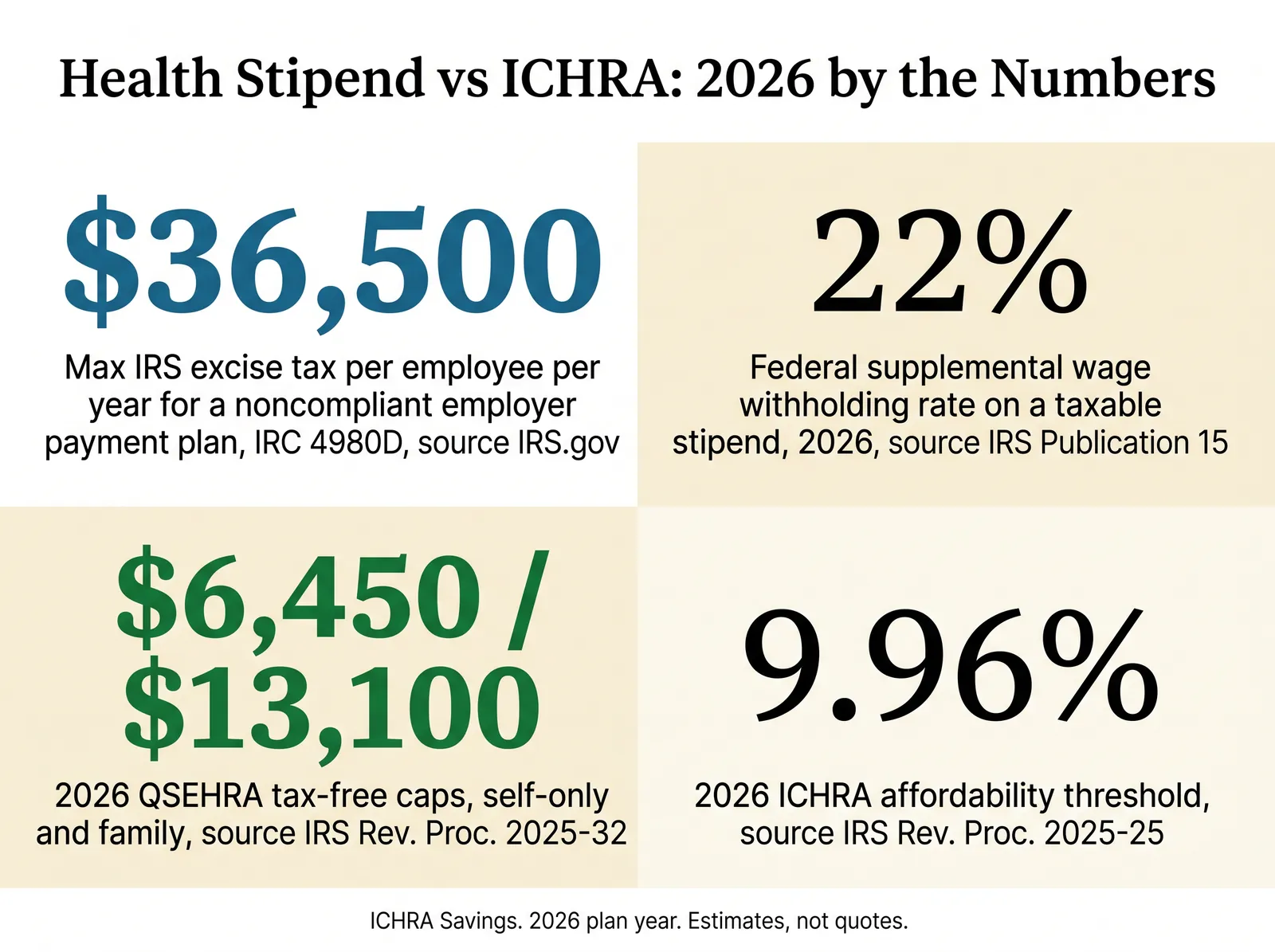
- Reimbursing premiums directly, tax-free, outside a formal HRA risks an IRS excise tax of $100 a day, $36,500 a year, per employee under IRC 4980D.
- Converting the same dollars from a stipend to an ICHRA is worth an estimated $$2,238 a year per employee in combined tax friction, before county-level rate spread is even considered.
Is a health stipend the same as an ICHRA?
No, and the difference is not cosmetic. A health insurance stipend is extra money added to an employee's paycheck as ordinary taxable wages, with income tax and payroll tax withheld exactly like the rest of their pay. An ICHRA (Individual Coverage Health Reimbursement Arrangement, an HRA structure created by a 2019 federal final rule) reimburses an employee's substantiated individual health insurance premiums tax-free, with no income tax and no FICA withheld on either side. Both can hand an employee money toward a health plan. Only one of them is a benefit in the IRS's eyes, and that distinction changes how much of the money survives contact with payroll, and how much legal exposure the employer is carrying.
This matters right now because a stipend is the arrangement small employers reach for first, often without realizing there's a formal, tax-advantaged alternative that costs the business the same amount but delivers more to the employee. It also matters because the informal version of "just reimburse the premium" is not the same as a taxable stipend, and that specific version carries real IRS penalty exposure most employers have never heard of. This article walks through both, with the actual 2026 numbers.
Taxable stipend
Ordinary wages. Fully taxed, no strings attached, no proof of coverage required.
Employer payment plan
Reimbursing premiums directly, tax-free, with no formal HRA. This is the one with real IRS exposure.
ICHRA or QSEHRA
Formal, IRS-defined HRAs. Tax-free to the employee, payroll-tax-free to both sides, when run correctly.
Why employers reach for a stipend first
Most small employers who land on a stipend didn't set out to avoid an ICHRA. They set out to avoid the perceived complexity of any formal benefit. A group plan means shopping renewals, meeting carrier participation minimums, and picking one plan that has to work for everyone. A stipend feels like the opposite: pick a number, add it to payroll, done. According to the 2025 KFF Employer Health Benefits Survey, 61% of firms with 10 or more workers offered health benefits to at least some employees in 2025, and firms with 200 or more workers were far more likely to offer than smaller ones (97% versus 59% for firms in the 10-to-199-employee range). That gap is exactly where a stipend tends to live: a business too small to feel like it can run a group plan, but that still wants to compete for people who expect some kind of health benefit.
The instinct is reasonable. The execution usually isn't optimized. An employer who is already willing to spend $500 a month per employee on health coverage, and structures it as a stipend instead of an ICHRA, is not saving anything by skipping the paperwork. They are giving away real money to payroll tax that a compliant structure would have kept out of the transaction entirely, for no additional employer cost.
Why the two are taxed completely differently
The tax code treats "cash toward health insurance" and "reimbursement of a substantiated health insurance premium under a formal plan" as two different things, and every dollar of this article's argument comes from that one distinction. A few terms, defined once:
- ICHRA: Individual Coverage Health Reimbursement Arrangement. An employer-funded account that reimburses individual-market premiums and, optionally, other qualified medical expenses, tax-free, under the federal final rule issued jointly by the IRS, the Department of Labor, and HHS in June 2019 (84 Fed. Reg. 28888), effective for plan years beginning on or after January 1, 2020.
- QSEHRA: Qualified Small Employer HRA. A smaller, capped cousin of the ICHRA, available only to employers under 50 full-time-equivalent employees that offer no group health plan at all.
- Employer payment plan: The IRS's term for an arrangement where an employer reimburses, or directly pays, an employee's individual health insurance premium outside a formal HRA. Despite sounding harmless, this is the arrangement that fails ACA market reforms.
- Substantiation: The paperwork requirement, proof that a reimbursed expense was an eligible premium or medical cost, that both ICHRA and QSEHRA require and a stipend does not.
- FICA: The combined Social Security and Medicare payroll tax: 6.2% Social Security plus 1.45% Medicare, 7.65% total, matched by the employer.
- Supplemental wages: IRS shorthand for pay outside regular salary, bonuses, stipends, and similar; employers may withhold federal income tax on it at a flat optional rate.
- Employee class: A group of employees defined by an IRS-permitted factor (full-time vs. part-time, salaried vs. hourly, geographic location, and others) that can be offered a different ICHRA design or a different benefit entirely.
- ALE / employer mandate: An Applicable Large Employer is one that averaged 50 or more full-time-equivalent employees in the prior year; the ACA's employer mandate requires an ALE to offer minimum essential coverage or risk a penalty.
A stipend is just wages. It shows up on the employee's W-2 like their salary, and is subject to federal income tax withholding, FICA, and, in most states, state income tax. An ICHRA reimbursement, when substantiated correctly, is excluded from the employee's gross income under Internal Revenue Code Section 106 and is not wages for FICA purposes either. Same employer intent, same dollar amount possible, opposite tax result.
The compliance trap hiding inside "just reimburse them"
Here is where a lot of well-meaning employers get into real trouble, and it isn't the stipend itself. A genuinely unconditional cash stipend, added to wages with no requirement to show proof of insurance, is generally just taxable compensation and sits outside ERISA's definition of a group health plan. The risk shows up the moment an employer instead tells an employee, informally, "send me your health insurance bill and I'll pay you back," whether or not tax is withheld on it. IRS guidance built on Notice 2013-54 and Notice 2015-17 treats that kind of arrangement, reimbursing or directly paying an individual health insurance premium outside a compliant HRA, as an employer payment plan. Because it fails the ACA's market reforms, it can trigger an excise tax under Internal Revenue Code section 4980D of $100 per day per affected employee, which works out to $36,500 per employee per year, self-reported by the employer on IRS Form 8928.
The line that actually matters
It is not "taxed versus untaxed" that decides whether an arrangement is a group health plan. It's whether the payment is conditioned on the purchase of health insurance. A no-strings-attached raise, even one an employee happens to spend on insurance, is compensation. A payment tied to proof of a premium, run outside a formal HRA, is the arrangement the IRS is describing when it discusses employer payment plans, and it is the one with real exposure. Limited transition relief existed for small, non-Applicable-Large-Employer businesses for 2014 and the first half of 2015 only; it does not apply going forward. If your business is currently reimbursing anyone's individual premium informally, that is worth a conversation with a benefits attorney before your next renewal, not after.
This is also the strongest argument for formalizing the arrangement rather than trying to word a stipend carefully enough to dodge the definition. A QSEHRA or an ICHRA is built specifically to let an employer condition its money on proof of real health coverage, tax-free, without tripping the excise tax, because the entire point of the 2019 final rule and its QSEHRA predecessor was to create a lawful path to exactly that.
What it costs: the same $500, two different outcomes
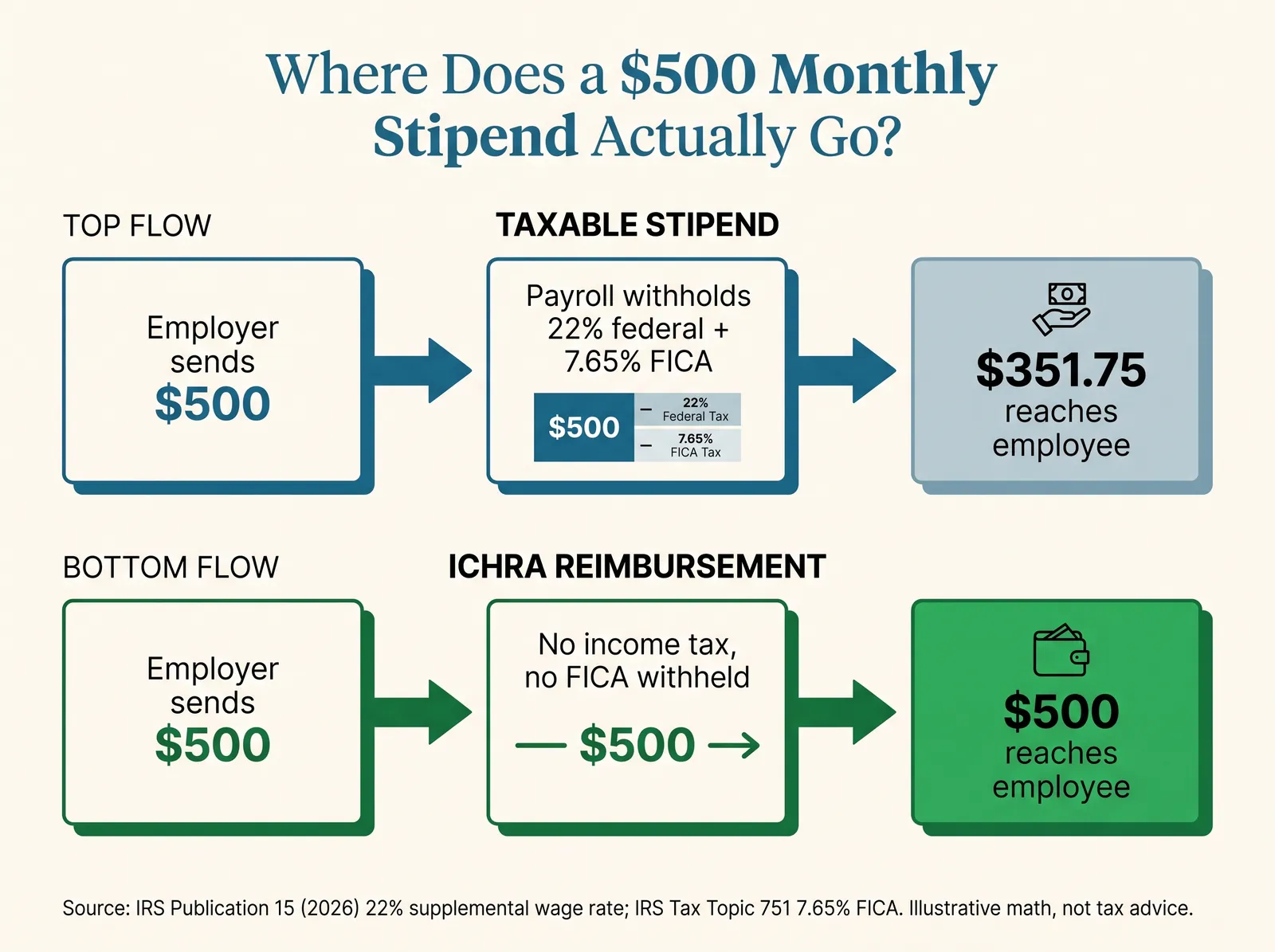
Run the actual 2026 numbers on a modest, common contribution amount, $500 a month, and the gap is not subtle. Under the 2026 flat federal supplemental-wage withholding rate of 22% (IRS Publication 15) and the 7.65% employee-side FICA rate (IRS Tax Topic 751), a $500 taxable stipend loses $110.00 to federal withholding and $38.25 to FICA before the employee ever sees it, and that's before any state income tax. The same $500, reimbursed through an ICHRA against a substantiated premium, arrives whole.
Here's the math
Employer sends $500 a month either way. As a taxable stipend: federal withholding at the 22% flat supplemental rate takes $110.00; employee-side FICA at 7.65% takes $38.25; the employee keeps $351.75. The employer also owes a matching 7.65% FICA contribution of $38.25, pushing the employer's true cost to $538.25 to deliver $351.75 of employee purchasing power.
As an ICHRA reimbursement against a substantiated premium: $0 withheld, $0 employer match, and the full $500 reaches the employee. Annualized per employee, that's an estimated $$1,779 a year more in the employee's pocket, plus $$459 a year the employer no longer owes in matching FICA, a combined swing of about $$2,238 per employee per year, from tax treatment alone, before any county-level rate spread is factored in.
22%
2026 flat federal withholding rate on supplemental wages, IRS Pub. 15
7.65%
Employee-side FICA, matched by the employer, IRS Tax Topic 751
$0
Income tax or FICA on a substantiated ICHRA reimbursement
$36,500
Max IRC 4980D excise tax per employee, per year, if mishandled
Where a $500 monthly contribution ends up, by structure
Illustrative, 2026 federal rates. Source: IRS Publication 15; IRS Tax Topic 751.
Employee take-home per $500 employer contribution, before state income tax. Not a guarantee; actual withholding varies by employee filing status and state.
The gap scales linearly with the contribution amount, so a business offering more than $500 a month loses proportionally more to withholding as a stipend, and a business offering less still loses the same percentage. Four common contribution levels, using the same 2026 federal rates:
| Monthly employer contribution | Employee take-home as a taxable stipend | Employee take-home as an ICHRA reimbursement | Annual gap per employee |
|---|---|---|---|
| $300/mo | $211.05/mo | $300/mo | $1,067/yr |
| $500/mo | $351.75/mo | $500/mo | $1,779/yr |
| $750/mo | $527.63/mo | $750/mo | $2,669/yr |
| $1,000/mo | $703.50/mo | $1,000/mo | $3,558/yr |
Stipend vs. QSEHRA vs. ICHRA, side by side
Once the tax treatment is clear, the rest of the comparison is mostly about who qualifies for what and how much paperwork each option carries.
| Dimension | Taxable stipend | QSEHRA | ICHRA |
|---|---|---|---|
| Tax treatment to the employee | Fully taxable wages | Tax-free (substantiated) | Tax-free (substantiated) |
| Payroll tax (FICA) either side | 7.65% + 7.65% | None | None |
| Federal dollar cap, 2026 | None | $6,450 self-only / $13,100 family | None |
| Employer size limit | None | Under 50 FTEs, no group plan offered | None |
| Counts as an ACA-mandate coverage offer | No | N/A (below mandate threshold) | Yes, if affordability test is met |
| Requires proof of coverage (substantiation) | No | Yes | Yes |
| 4980D excise-tax exposure if mishandled | Low, if truly unconditional wages | Low, if run correctly | Low, if run correctly |
Why most growing small employers land on ICHRA, not QSEHRA
QSEHRA disappears the moment a business crosses 50 full-time-equivalent employees or decides to offer any group plan alongside it. ICHRA has no size ceiling and no dollar cap, and it can sit next to a traditional group plan for a different employee class. For a business that expects to grow, or that already has some employees on a group plan and wants a different offer for a remote or part-time class, ICHRA is usually the more durable structure even though QSEHRA is simpler to set up on day one.
A real county: Richland County, South Carolina
The tax math above holds everywhere; the county-level rate spread on top of it does not. Take Richland County, South Carolina, home to Columbia and a population of roughly 416,161. For the 2026 plan year, our dataset puts the individual-market benchmark premium at $673 a month against a small-group benchmark of $954, a spread of 29.5%, worth an estimated $3,379 a year per employee if an employer funds an ICHRA at the benchmark level.
Put the two effects together for a Richland County employer choosing between a $500 monthly stipend and a $500 monthly ICHRA contribution. The stipend costs the employer $538 a month per employee after the FICA match and delivers $352 of employee purchasing power. The ICHRA costs the employer $500 and delivers the full $500, which, against Richland County's $673 individual-market benchmark, comfortably covers a meaningful share of a real premium. Tie that same $500 ICHRA contribution to Richland County's 29.5% spread over small-group coverage, and the same employer dollar is doing two jobs at once: reaching the employee intact, and buying into a market that is estimated to run $3,379 cheaper per employee per year than the small-group alternative. A stipend does neither.
A stipend and an ICHRA can move the exact same dollar. Only one of them lets that dollar arrive whole.
Mike MooreRichland County is one example, and it happens to be a strong one. See the full South Carolina savings breakdown for every qualifying county in the state. Not every county qualifies, and the honest version of this article says so: check your own counties on the savings map before assuming the rate-spread half of this argument applies to your workforce. The tax-treatment half applies everywhere, regardless of county.
How to convert a stipend into a compliant ICHRA
The mechanics of moving from an informal stipend to a formal ICHRA are not complicated, and none of it requires guessing:
- Decide the dollar amount first, separate from the structure. Most employers converting a stipend already know the number; $500 in the example above is arbitrary and yours may be higher or lower.
- Check your counties on the savings map. The rate-spread half of the value only applies where the individual market prices below small-group coverage; some counties will not show a spread worth chasing.
- Model the 2026 affordability test. IRS Revenue Procedure 2025-25 sets the required contribution percentage at 9.96% of household income for plan years beginning in 2026; this decides whether an employee's ICHRA is "affordable" and must waive the premium tax credit to use it.
- Define employee classes if you need more than one contribution level. Class rules have specific, IRS-permitted factors and minimum-size requirements; they are the most common place a rollout goes wrong.
- Write and send the required notice on time. Eligible employees generally need written notice at least 90 days before the plan year starts, describing the offer and its effect on subsidy eligibility.
- Set up substantiation. An ICHRA requires proof that reimbursed amounts went to an eligible premium or expense; this is the paperwork step a stipend never had, and it is what makes the tax-free treatment legitimate.
Start with the county check, not the plan design
Ten minutes on the savings map tells you whether your workforce sits in a county where the rate spread adds real value on top of the tax savings, or whether you're converting mainly for the tax and compliance benefit alone. Both are legitimate reasons to convert; knowing which one applies to you changes how you talk about it internally.
See our full ICHRA setup timeline for the detailed rollout sequence, and our guide to ICHRA employee classes if you need more than one contribution tier across a mixed workforce. If you're still deciding between an ICHRA and keeping a small-group plan at all, our ICHRA vs. small group decision guide covers that broader question.
How ICHRA Savings helps
None of the tax math above requires talking to anyone, and neither does checking your counties: the savings map shows the same individual- market and small-group benchmark premiums used in this article, by county, so you can see whether your workforce sits somewhere like Richland County or somewhere the spread is thin before you spend time on anything else. Beyond the map, we help employers design and set up an ICHRA correctly the first time: building employee classes that hold up, modeling the 2026 affordability test against your real census instead of a rule of thumb, and getting the required notice content and timing right. We don't pick anyone's individual plan for them; that choice, and the network that comes with it, stays with each employee buying their own coverage. Our part is the budget, the design, and the compliance scaffolding that keeps a well-intentioned stipend from becoming an IRS problem.
Before anything else, check whether your county is one where the individual-market spread adds real value on top of the tax savings: https://ichrasavings.com/ichra-savings-map/. If your renewal or your current stipend arrangement is already on your desk and you have a decision to make, it's worth a conversation: https://ichrasavings.com/book.
When a taxable stipend is still the right call
Read this before you convert anything
- A very small headcount testing the idea. If you're not sure you'll keep offering anything in twelve months, the setup cost of a formal HRA program may not be worth it yet for one or two employees.
- A thin-margin county. If your workforce's counties show a small individual-versus-small-group spread on the savings map, the rate-spread argument for converting weakens, and the case rests on tax savings alone, which is still real but smaller in absolute dollars for a low contribution amount.
- Genuine flexibility matters more than tax efficiency. A true no-strings stipend can go toward dental work, a gym membership, or anything else an employee needs, not just a health insurance premium. An HRA cannot.
- You are not tying the payment to proof of coverage. The moment it's conditioned on buying insurance, you're back in employer-payment-plan territory without the benefit of a formal, compliant HRA. If you want that condition, use the HRA structure that's built to carry it.
The honest takeaway is not "never use a stipend." It's that a stipend and an ICHRA solve different problems, and conflating them, thinking a stipend is a cheaper, informal version of an ICHRA, is where employers lose money to payroll tax they didn't have to lose, or take on excise-tax exposure they didn't know they had.
Two edge cases worth naming
"We've been doing this for years and nothing has ever happened." That's common, and it isn't evidence the arrangement is compliant, only that it hasn't been audited yet. The excise tax under IRC 4980D is self-reported on Form 8928, which means most exposure surfaces during a DOL or IRS audit, a due-diligence review ahead of a sale or financing round, or an employee complaint, not on a predictable schedule. A business that has informally reimbursed premiums for years has more retroactive exposure sitting on the books each year it continues, not less.
State income tax makes the gap wider, not narrower. Every number in this article is federal: the 22% supplemental withholding rate and the 7.65% FICA rate apply regardless of where an employee lives. In the nine states with no earned-income tax, those two federal figures are the whole story. In every other state, a stipend also loses money to state withholding on top of the federal amount shown here, while an ICHRA reimbursement stays exempt from state income tax the same way it's exempt federally in nearly all cases. The comparison in this article is already the floor, not the ceiling, of what a stipend gives up.
Questions employers actually ask
Is a health insurance stipend the same as an ICHRA?
No. A health insurance stipend is extra taxable pay added to an employee’s paycheck, with federal income tax and FICA withheld the same as any other wages. An ICHRA (Individual Coverage Health Reimbursement Arrangement) is a formal, IRS-defined benefit that reimburses substantiated individual health insurance premiums tax-free to the employee and free of payroll tax to both sides, under the 2019 federal final rule. Same intent, cash toward health coverage, completely different tax treatment and completely different compliance obligations.
Is it legal to just give employees extra money for health insurance?
It depends entirely on how the money is structured. Adding a flat amount to payroll as ordinary taxable wages, with no requirement to prove it was spent on insurance, is legal and common; it is simply taxed like any other pay. What is not legal without a formal HRA is an employer reimbursing or paying individual health insurance premiums specifically, tax-free, outside a compliant plan structure. The IRS treats that as an "employer payment plan" that fails the ACA market reforms, exposing the employer to an excise tax under Internal Revenue Code section 4980D. The line between the two is thin, which is exactly why most employers who want the money tied to insurance should use a QSEHRA or an ICHRA instead of improvising.
How much of a $500 monthly stipend does an employee actually keep?
Using the 2026 flat federal supplemental-wage withholding rate of 22% (IRS Publication 15) and the 7.65% employee share of FICA (IRS Tax Topic 751), a $500 taxable stipend has $110.00 withheld for federal income tax and $38.25 withheld for Social Security and Medicare, leaving $351.75 in the employee's paycheck before any state income tax. The same $500 paid as a substantiated ICHRA reimbursement has $0 withheld on either side and reaches the employee in full.
What's the difference between a stipend and a QSEHRA?
A QSEHRA (Qualified Small Employer HRA) is a formal, tax-free reimbursement arrangement available only to employers with fewer than 50 full-time-equivalent employees that do not offer any group health plan. For 2026, IRS Revenue Procedure 2025-32 caps QSEHRA reimbursements at $6,450 for self-only coverage and $13,100 for family coverage. An ICHRA has no federal dollar cap and is open to employers of any size. A taxable stipend has no cap either, but unlike both HRA types it is fully taxed as wages, not excluded from income under IRC Section 106.
Can a business offer a stipend and an ICHRA at the same time?
Not to the same employee for the same coverage. An employer can offer an ICHRA to one permitted employee class and a different benefit, including a taxable stipend, to a separate class defined by an IRS-permitted factor such as full-time versus part-time status or geographic location. What an employer cannot do is offer the same class of employees a choice between an ICHRA and a taxable stipend or traditional group plan; the class rules require one consistent offer per class.
Does a taxable health stipend satisfy the ACA employer mandate?
No. The ACA employer shared-responsibility rules for an Applicable Large Employer (an employer that averaged at least 50 full-time-equivalent employees the prior year) require an offer of minimum essential coverage that meets minimum value and affordability standards. A cash stipend added to wages is not an offer of coverage at all, so it does nothing to satisfy the mandate. An ICHRA can satisfy it, because it is a formal offer of coverage subject to its own affordability test.
What is the actual IRS penalty risk for reimbursing insurance premiums directly?
Under IRS guidance built on Notice 2013-54 and Notice 2015-17, an arrangement where an employer reimburses an employee for individual health insurance premiums, or pays the premium directly, without running it through a compliant HRA, is treated as a "group health plan" that fails the ACA’s market reforms. That failure can trigger an excise tax under Internal Revenue Code section 4980D of $100 per day per affected employee, which works out to $36,500 per employee per year, self-reported on IRS Form 8928. Limited transition relief existed for small, non-ALE employers for 2014 and the first half of 2015; outside that narrow window, the exposure is real and current.
When does a taxable stipend still make sense instead of an ICHRA?
When an employer wants maximum simplicity and flexibility, is not trying to tie the money specifically to health coverage, and is comfortable with employees losing roughly a third of it to payroll tax. It also fits an employer testing the waters with a very small headcount before building out a formal benefit, or one whose workforce is concentrated in a county where the individual market does not price meaningfully below group coverage, making the administrative step up to an ICHRA less clearly worth it. Checking your own counties on the savings map is the fastest way to see which situation you are actually in.
Sources
- IRS, "Employer health care arrangements" ($100/day, $36,500/year excise tax under IRC 4980D)
- IRS Notice 2015-17, "Guidance on the Application of Code § 4980D to Certain Types of Health Coverage Reimbursement Arrangements"
- IRS Revenue Procedure 2025-32, Section 3.63 (2026 QSEHRA caps: $6,450 self-only / $13,100 family)
- IRS Revenue Procedure 2025-25 (2026 ACA/ICHRA required contribution percentage, 9.96%)
- IRS Publication 15 (Circular E), 2026 (22% flat federal withholding rate on supplemental wages)
- IRS Tax Topic 751, "Social Security and Medicare Withholding Rates" (7.65% employee-side FICA)
- Federal Register, "Health Reimbursement Arrangements and Other Account-Based Group Health Plans" (84 Fed. Reg. 28888, June 20, 2019; the ICHRA final rule)
- HealthCare.gov, "Individual coverage HRAs"
- KFF, "2025 Employer Health Benefits Survey, Summary of Findings" (small-firm offer rates)
- ICHRA Savings qualified-counties dataset, 2026 plan year (Richland County, SC benchmark premiums)