ICHRA in Nebraska 2026: Panhandle Wins, Omaha Doesn't
Nebraska's Panhandle clears an estimated 16.4% ICHRA savings for 2026; Omaha and Lincoln show no edge at all. See the sourced county data.
The short version
- ICHRA clears the qualifying bar in an estimated 27 of Nebraska's 93 counties for 2026, covering roughly 9% of the state's population.
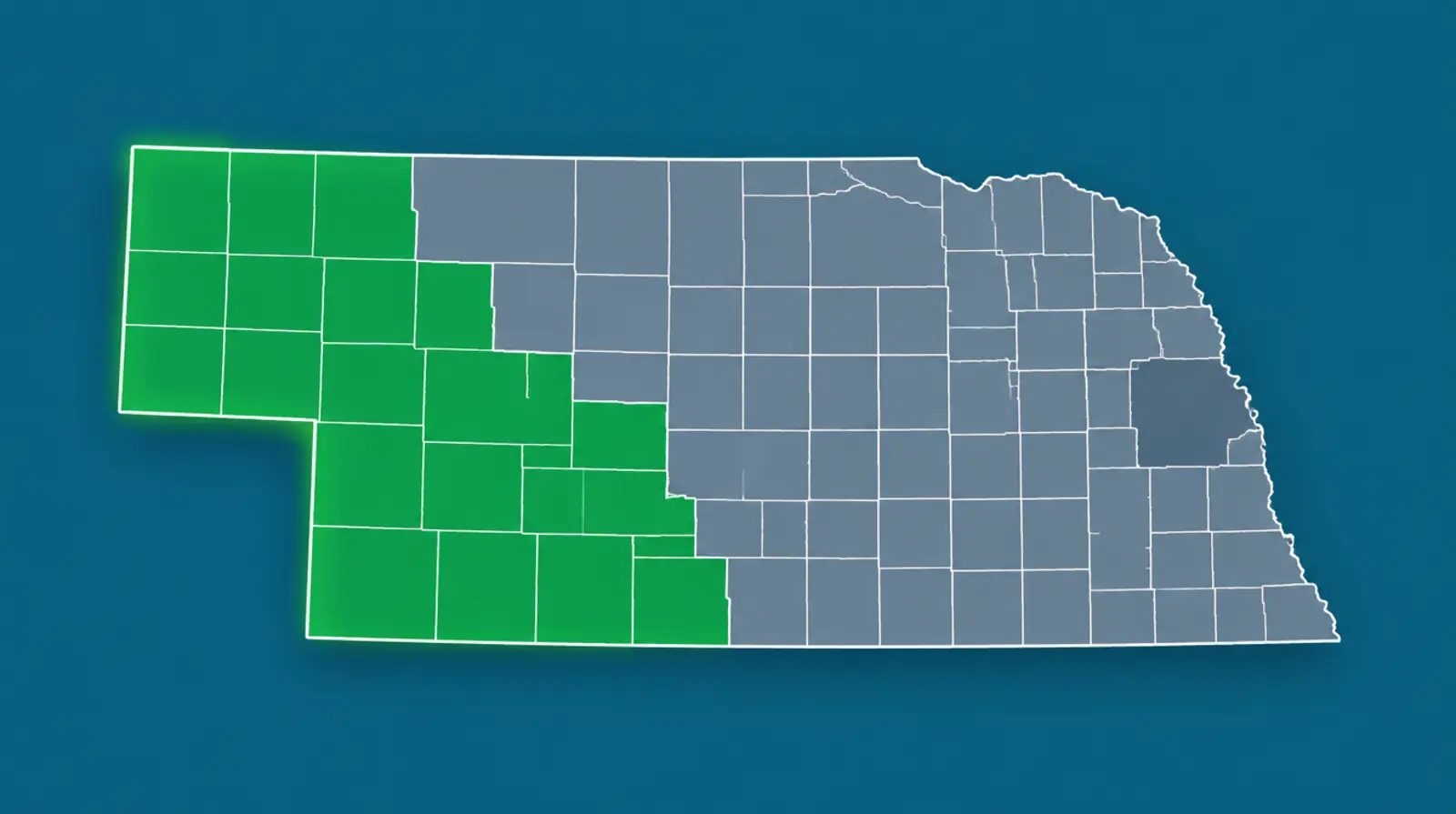
- The margin tops out at 16.4% across 24 Panhandle and southwest counties, including Lincoln County (North Platte) and Scotts Bluff County (Scottsbluff). Douglas County (Omaha), Lancaster County (Lincoln) and Sarpy County don't clear the bar at all.
- Nebraska's individual-market rates rose an estimated final weighted 29.1% for 2026; preliminary 2027 filings run 13.6% for individual coverage and 14.1% for small group, per ACA Signups' compilation of federal Rate Review and SERFF filings.
- The 2026 IRS affordability threshold is 9.96% of household income, the number that decides whether an employee's ICHRA is considered affordable.
Does ICHRA beat small group in Nebraska?
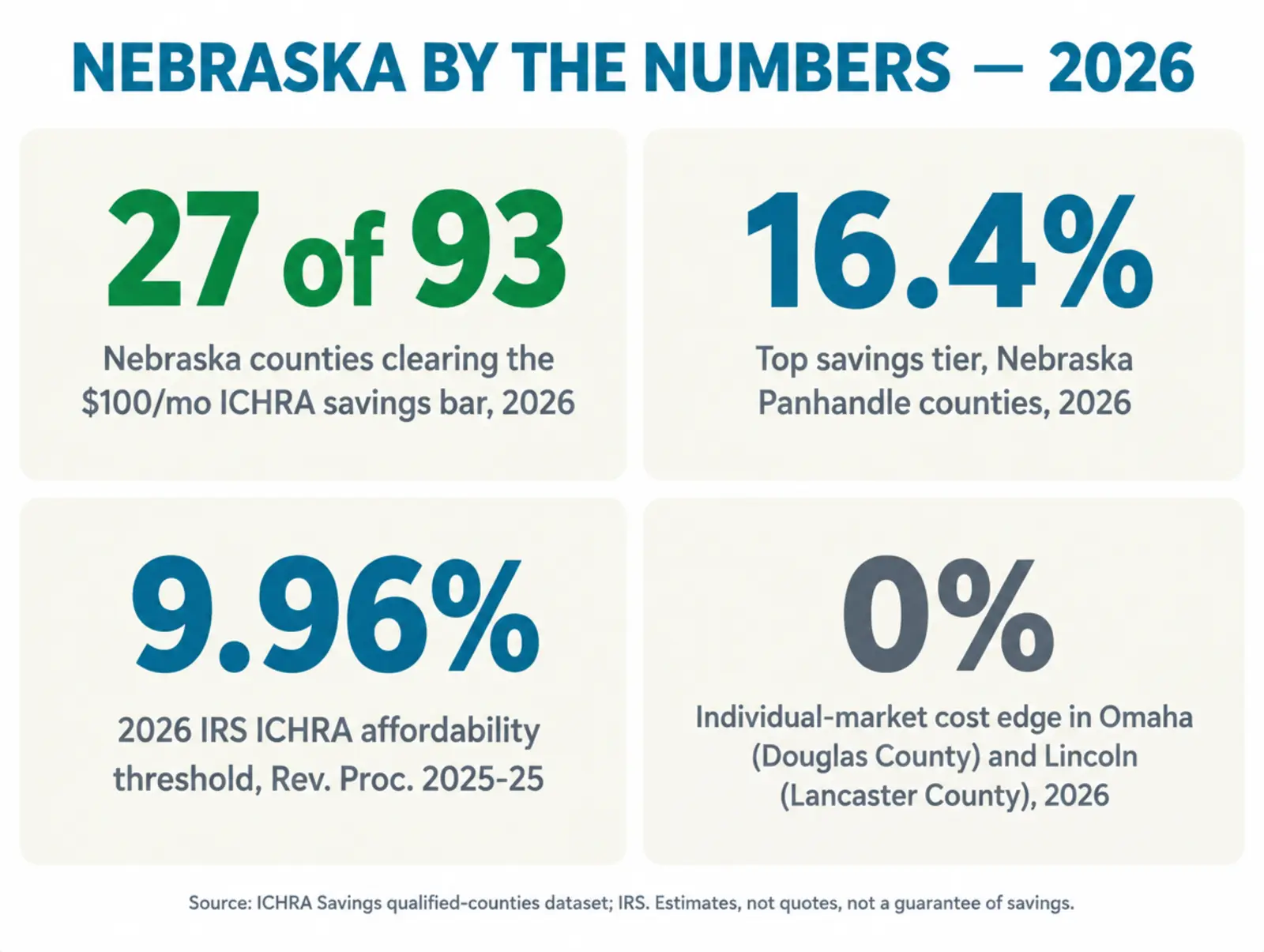
In a specific, identifiable band of mostly rural counties, yes, by a wide margin. In the state's population centers, not this year. An ICHRA (Individual Coverage Health Reimbursement Arrangement) clears our $100-a-month-per-employee qualifying bar in an estimated 27 of Nebraska's 93 counties for the 2026 plan year, based on a county-by-county comparison of individual-market and small-group benchmark premiums. Those 27 counties make up about 2% of the 1309 counties nationwide where the math currently favors ICHRA, and cover an estimated 9% of Nebraska's population.
If you haven't worked through the general decision yet, our ICHRA vs. small group decision guide walks through the framework this article applies specifically to Nebraska. Here's the part a simple "Nebraska qualifies" headline hides: none of the state's five largest counties clear the bar. Douglas County, home to Omaha and nearly a third of Nebraska's population, shows no individual-market cost edge over small group at all for 2026. Neither does Lancaster County (Lincoln, the state capital), Sarpy County (Omaha's largest suburb), Hall County (Grand Island) or Buffalo County (Kearney). Meanwhile Lincoln County, home to North Platte, and Scotts Bluff County, home to Scottsbluff, both clear 16.4%, the widest margin in the state. That split, not a single statewide percentage, is the actual finding here.
27 of 93
Nebraska counties clearing the qualifying bar for 2026
9%
Share of Nebraska's population in a qualifying county
16.0%
Average estimated savings across qualifying counties
$2,031
Average estimated savings per employee, per year
Why Nebraska's rates keep climbing
Nebraska employers are looking at one of the steepest individual-market increases filed anywhere for 2026, on a small-group market climbing in its own right. Nebraska's individual-market carriers posted an estimated final weighted average rate increase of 29.1% for the 2026 plan year, according to rate data compiled by ACA Signups from the federal Rate Review database and SERFF filings, current as of November 1, 2025. Blue Cross Blue Shield of Nebraska requested an average 20.5% increase (ranging from a 1.1% decrease to a 33.3% increase across its plans), Medica requested a 36.1% average increase, and UnitedHealthcare requested 25.03% (ranging from 18.71% to 29.08%). Nebraska Total Care's rebrand to Ambetter Health left no comparable rate change to report for that carrier.
On the small-group side, ACA Signups' preliminary compilation puts Nebraska's 2026 increase at an unweighted average of roughly 16.7%, though enrollment data for two of the state's small-group carriers wasn't available, so that figure is incomplete rather than final. Preliminary 2027 filings run a weighted 13.6% increase for the individual market and an unweighted 14.1% increase for the small-group market, per the same compilation. Blue Cross Blue Shield of Nebraska, the state's largest individual-market carrier by enrollment, filed a 13.0% average increase for 2027 (ranging from 0.1% to 22.8%), while Oscar Health filed the smallest average request among named carriers at 8.6%.
Filed is not final
The 2027 figures above are requested rates, not approved ones, and the 2026 small-group figure is an incomplete preliminary estimate. Nebraska's insurance regulators and CMS review every filing before approving anything, and these figures can move in either direction once that review closes.
None of this happens in a vacuum. When small-group rates move up, as filed for Nebraska's 2027 plan year, the spread this entire strategy depends on can widen, because ICHRA reimbursements ride on individual-market prices, not small-group prices, even if individual-market rates keep rising too, so long as they don't rise as fast. That's exactly why every figure in this article is tied to a specific plan year, and why we rebuild the underlying county dataset every year rather than reusing prior numbers.
All 93 counties, three tiers
Nebraska has 93 counties, and this dataset sorts them into three distinct groups for 2026: 27 that clear the $100-a-month qualifying bar, 19 that show a smaller, real discount but fall short of it, and 47 that show no individual-market cost edge over small group at all. Savings across the 27 qualifying counties run from 13.1% up to 16.4%, averaging 16.0%.
| County | Population | Savings vs. small group | Est. annual savings / employee |
|---|---|---|---|
| Scotts Bluff County | 36,048 | 16.4% | $2,115 |
| Lincoln County | 34,532 | 16.4% | $2,115 |
| Gage County | 21,654 | 13.1% | $1,359 |
| Box Butte County | 10,778 | 16.4% | $2,115 |
| Red Willow County | 10,690 | 16.4% | $2,115 |
| Cheyenne County | 9,489 | 16.4% | $2,115 |
| Keith County | 8,303 | 16.4% | $2,115 |
| Dawes County | 8,279 | 16.4% | $2,115 |
| Richardson County | 7,850 | 13.1% | $1,359 |
| Jefferson County | 7,185 | 13.1% | $1,359 |
Notice what's missing from that list: Douglas, Lancaster, Sarpy, Hall and Buffalo Counties, the five largest in the state by population, appear nowhere in it. Scotts Bluff County, with just over 36,000 residents, is the single biggest county anywhere in Nebraska's qualifying dataset. That's an unusual pattern among the states we've covered; in Kansas and Missouri, the capital and a major metro both clear the bar. In Nebraska, the qualifying counties are almost entirely rural, concentrated in the Panhandle, the southwest, and a small southeast cluster near the Kansas border.
How Nebraska's 93 counties break down by savings tier
Number of counties in each band, 2026 plan year. Source: repo county dataset.
The remaining 47 counties (not shown) have no individual-market cost edge over small group at all for 2026. Illustrative and rounded; not an offer of insurance or a guarantee of savings.
See the full Nebraska savings breakdown for every qualifying county, or the national savings map to check a specific county by name.
Why Nebraska's two biggest counties don't qualify at all
Douglas County and Lancaster County aren't in our qualifying dataset for 2026 at all, which means their 2026 individual-market benchmark premium doesn't run below their small-group benchmark. That's a different, more final result than Kansas's Sedgwick County (Wichita) or Colorado's Denver County, which both show a thin but real discount that simply falls short of our $100-a-month bar. In Omaha and Lincoln, this specific cost-arbitrage lever isn't available this year, full stop. Omaha anchors a diversified metro economy (insurance, logistics, agribusiness headquarters, a growing tech sector), and its individual market prices competitively enough that small-group coverage there isn't carrying the premium it carries in rural western Nebraska.
Sarpy County, Omaha's largest and fastest-growing suburb, Hall County (home to Grand Island), Buffalo County (home to Kearney), Dodge County (home to Fremont) and Madison County (home to Norfolk) are in the same position: all five of Nebraska's next-largest population centers after the Omaha-Lincoln corridor also show no individual-market cost edge for 2026. Our sister article on how rating areas create identical premiums across different counties walks through the general mechanism behind why a cluster of counties in one region can price identically while another region prices very differently, using Ohio as the example; Nebraska's Panhandle counties show the same shared-rating-area pattern among themselves.
Nebraska doesn't have one ICHRA story. It has a North Platte story at 16.4% and an Omaha story that doesn't clear the bar at all. Both are true for the same state, the same year.
Mike Moore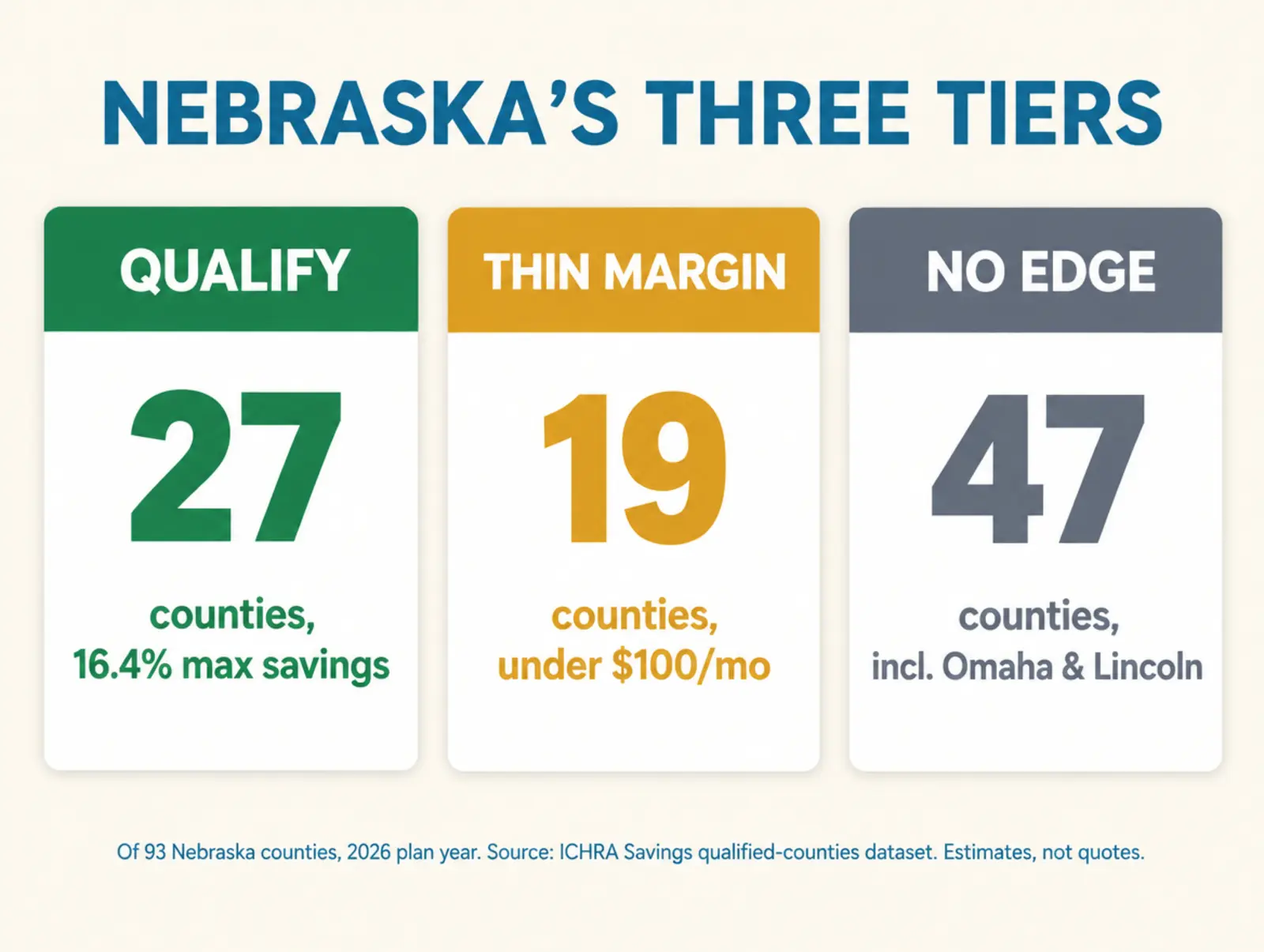
A worked example: North Platte versus Omaha
Here's what the county-level math actually looks like for a small employer with a split Nebraska workforce, using real 2026 rate data for the two counties named in this article's headline. Assume a 20-employee company with 12 employees in Lincoln County (North Platte) and 8 employees in Douglas County (Omaha).
Here's the math
In Lincoln County, the 2026 individual-market benchmark premium runs $896 a month against a small-group benchmark of $1,072, a savings of $176 a month, or $2,115 a year per employee. In Douglas County, there's no individual-market cost edge to model at all for 2026; this dataset shows $0 in estimated county-level savings there.
For this hypothetical 20-person company: 12 employees x $2,115 (Lincoln County) + 8 employees x $0 (Douglas County) = an estimated $25,374 a year in aggregate savings using benchmark-level ICHRA contributions across the whole workforce, and every dollar of it comes from the North Platte side despite that side being only 60% of the headcount. This is an illustrative estimate using real county rate data and a hypothetical headcount split; your actual result depends on your employees' ages, exact counties and the plan levels they choose.
Notice what this example does not do: claim a single statewide "Nebraska saves X%" figure, or pretend the Omaha employees get nothing out of an ICHRA. They might still get a predictable monthly budget, a plan they chose themselves, and coverage that travels if they move counties; that's a real benefit even at $0 of cost arbitrage. What they don't get, this year, in this county, is the specific individual-versus-group price gap that makes the numbers above work so cleanly for the North Platte side. Checking counties individually, not trusting a state average, is the entire argument for county-level data, and Nebraska is one of the starkest examples of why that matters.
The affordability test, in plain numbers
Every ICHRA has to clear the IRS's affordability test to avoid pushing an eligible employee's premium tax credit decision the wrong way. Under IRS Revenue Procedure 2025-25, the required contribution percentage for plan years beginning in 2026 is 9.96% of household income, the highest figure on record, up from 9.02% in 2025. In plain terms: an employer's ICHRA is considered affordable for an employee if that employee's own required monthly contribution toward the lowest-cost silver plan in their rating area doesn't exceed 9.96% of their household income, divided by 12.
Here's the math on affordability
Take a Lincoln County employee earning $32,000 a year. Under the 2026 required contribution percentage of 9.96%, their household's monthly contribution toward the lowest-cost silver plan is considered affordable if it doesn't exceed $265.60 a month (9.96% of $32,000, divided by 12). Lincoln County's 2026 individual-market benchmark premium runs near $896 a month; if the employer's ICHRA contribution covers, say, $400 of it, the employee's remaining share is well under $265.60, so the ICHRA is affordable for this employee, meaning they must waive the premium tax credit to use it. A smaller contribution can still clear the line for a mid-income employee; a lower-income employee needs a bigger contribution to reach the same result. Modeling this test against your actual census, not a rule of thumb, has to happen before you set a contribution amount.
The subsidy trade-off, stated plainly
Taking an ICHRA is not free money layered on top of a marketplace subsidy. Per HealthCare.gov's own guidance on individual coverage HRAs (now also referred to as the CHOICE Arrangement, following a September 2026 federal rename covered in our CHOICE Arrangement guide): if an employer's offer is considered affordable, the employee and their household members "won't be eligible for the premium tax credit on Marketplace coverage, even if they don't use the Health Reimbursement Arrangement." If the offer isn't considered affordable, the employee can choose between the ICHRA and the premium tax credit, "but not both": to get the premium tax credit, they have to decline the ICHRA offer entirely.
Say this plainly to employees
Taking an employer's ICHRA contribution generally means an employee waives the federal premium tax credit for that month, unless the ICHRA is unaffordable under the IRS test, in which case they can decline it and keep shopping the marketplace with a subsidy instead. Enhanced federal premium tax credits expired at the end of 2025 and the underlying 400% federal poverty line subsidy cliff is back for 2026, a separate topic we cover in full in our ACA subsidy cliff guide, which makes an employer-funded ICHRA contribution a more meaningful offer for higher-earning Nebraska employees than it was when broader subsidies were on the table.
Why more Nebraska employers are looking at this now
Nebraska's rate filings aren't happening in a vacuum. The HRA Council, an industry association that aggregates anonymized enrollment data from its member organizations, released its newest annual report on August 12, 2026: Growth Trends for ICHRA & QSEHRA, Vol. 5. It found that more than 20,000 US businesses now offer ICHRA or QSEHRA, with ICHRA-covered lives alone surpassing 500,000 people as of January 31, 2026. More than two-thirds of small employers offering ICHRA had previously offered no health coverage at all, and 93% of small employers newly offering QSEHRA in 2026 had the same history; close to a third of small-employer ICHRA adopters moved from the small-group market specifically. Applicable Large Employers were the fastest-growing segment, more than doubling their average ICHRA adoption since the prior year.
That distinction matters for a Nebraska employer weighing this for the first time. On the current individual marketplace, Nebraska's 2026 open enrollment period saw 128,492 plan selections, down from 136,684 during the 2025 open enrollment period, a 6.0% year-over-year decline, according to KFF's Marketplace Enrollment Snapshot for the 2026 open enrollment period. Nebraska uses HealthCare.gov as its marketplace platform in both years, so that drop reflects real people leaving the individual market, not a technical platform change. For most small businesses in the state's qualifying counties, the realistic comparison isn't "ICHRA versus our current group plan." It's "ICHRA versus offering nothing," which is a much easier case to make when you're competing for talent against employers who already offer some kind of benefit, and a more urgent one with individual-market rates already up an estimated 29.1% for 2026 and small-group filings up 14.1% for 2027. The IRS, DOL and HHS final rule that created ICHRA in 2020 sets no employer size minimum at all; a single-employee company can offer one on the same terms as a 500-person company, part of why adoption keeps climbing fastest among the smallest employers in the HRA Council's data.
New coverage, not always a switch
Two-thirds-plus of 2026 small-business ICHRA adopters had never offered coverage before.
Large-employer adoption is accelerating
ALE ICHRA adoption more than doubled on average year over year, per the HRA Council.
Nebraska marketplace enrollment is falling
Plan selections dropped 6.0% for 2026, per KFF, as the subsidy cliff and rate hikes both bit at once.
How ICHRA Savings helps
None of the county math above requires talking to anyone. The savings map lets you look up every Nebraska county by name and see the same individual-market and small-group benchmark premiums used in this article, so you can check whether your specific workforce sits inside a strong-margin county like Lincoln or Scotts Bluff, a thin-margin one like Thurston, or one of the 47 that don't clear the bar at all, before you spend time on anything else. Beyond the map, we help employers design and set up an ICHRA: building employee classes correctly, modeling affordability against your real census instead of a rule of thumb, and getting the required employee notice right and on time. We don't pick your employees' plans for them; that decision, and the choice of network, stays with each person buying their own coverage. Our part is the budget, the design and the compliance scaffolding around it.
Before anything else, check whether your county is one where this works well: https://ichrasavings.com/ichra-savings-map/. Ten minutes there tells you whether the rest of this process is worth starting, and whether your county lands closer to Lincoln County's 16.4% or Douglas County's 0%.
If your Nebraska workforce is concentrated in the Omaha-Lincoln corridor, that's a different conversation than a county-savings pitch, and we'll say so plainly rather than stretch the data. An ICHRA can still make sense there for budget predictability, multi-state hiring, or simply offering something where you currently offer nothing; it just won't be sold on a cost-arbitrage argument this year.
Setting up an ICHRA in Nebraska
Nebraska doesn't add state-specific ICHRA rules on top of the federal framework. The same IRS, DOL and HHS final rule that governs ICHRA everywhere applies here, and the setup sequence is identical to any other state:
- Pull your census by county, not by office address. A company headquartered in Omaha with field or remote staff in North Platte, Scottsbluff or Beatrice has a materially different savings story per location.
- Check each employee's county on the savings map. Don't assume a statewide average applies; a 16.4% county and a 0% county both technically sit in "Nebraska," but they aren't the same decision.
- Model affordability using the 2026 threshold. At 9.96% of household income, the required contribution percentage sets how much an ICHRA contribution needs to cover to count as affordable.
- Define employee classes carefully, if you use them. An employee class is a group defined by an objective factor the IRS permits, such as full-time versus part-time status, geographic location, or salaried versus hourly work. Class rules carry minimum-size requirements and cannot offer the same class a choice between ICHRA and group coverage.
- Send the required notice on time. Under 26 CFR § 54.9802-4(c)(6), eligible employees generally need written notice at least 90 calendar days before the plan year begins, with specific required content about the offer and its effect on subsidy eligibility.
- Budget for onboarding support. Employees who have never shopped Nebraska's individual marketplace on their own need guidance, once, at enrollment, especially with coverage options varying meaningfully by county and rating area.
See our full ICHRA setup timeline for the detailed rollout plan, including the exact notice content requirements, and our guide to ICHRA employee classes if your Nebraska workforce spans more than one rating area.
Run your counties first
Before scheduling a single meeting, look up every county where you have employees on the savings map. If your Nebraska workforce sits mostly inside Douglas, Lancaster or Sarpy County, you have a different, more marginal conversation ahead than an employer centered on the Panhandle, the southwest, or Gage County around Beatrice.
The honest limits of this data
Read this before you commit
- Forty-seven counties, including Omaha, Lincoln and every other major population center, show no edge at all. Douglas, Lancaster, Sarpy, Hall, Buffalo, Dodge, Madison and Dakota Counties cover a large majority of Nebraska's population and sit entirely outside this dataset for 2026.
- Nineteen more counties show a real but thin discount. Blaine, Boone, Brown, Cherry, Franklin, Furnas, Garfield, Gosper, Harlan, Logan, Loup, Merrick, Morrill, Phelps, Platte, Polk, Thurston, Webster, Wheeler all clear a positive margin that falls below the $100-a-month-per-employee bar we use to build a county page, ranging from 0.5% (Polk and similar) up to 7.0% (Thurston County).
- "Qualifies" isn't a single tier even among the 27 that do. Gage County clears the bar at 13.1%, worth about $1,359 a year; Lincoln County clears it at 16.4%, worth $2,115. Both "qualify." One is a much stronger case.
- Rates move every plan year. With 2027 small-group filings already up a preliminary 14.1% and individual-market filings up 13.6%, next year's spread could widen or narrow from this year's; recheck before every renewal, not just once.
- These are benchmark comparisons, not a guarantee for your specific workforce. A qualifying county means the benchmark math favors ICHRA; model your actual census, ages and plan choices before committing.
- Filed 2027 rates are not approved, and the 2026 small-group figure is incomplete. Nebraska's insurance regulators and CMS can adjust any of these figures before finalizing rates.
How these numbers are calculated
Every county figure in this article comes from the same dataset that powers our savings map, not from a survey or a sales estimate. For each of Nebraska's 93 counties, we compare a 2026 individual-market benchmark premium, the second-lowest-cost silver plan available to a representative enrollee, against a small-group benchmark premium built from comparable small-group plan filings for that county's rating area. A county "qualifies" for its own page when the gap between those two benchmarks reaches at least $100 a month per employee; 27 of Nebraska's 93 counties clear that bar for 2026. Another 19 show a smaller, positive gap that falls short of it. The remaining 47 aren't in the underlying dataset at all, meaning the individual-market benchmark in those counties doesn't run below the small-group benchmark for 2026. Nebraska's total county count comes from the U.S. Census Bureau's 2020 county reference file; the state's 2024 population estimate, used to calculate the population share of qualifying counties, comes from the Census Bureau's Population Estimates Program (Vintage 2024). The 2026-final and 2027-preliminary statewide rate-filing figures come from the federal Rate Review database and SERFF filings as compiled by ACA Signups; neither is reflected in the county-level qualifying dataset above, which uses the 2026 benchmark comparison described here.
Three limitations are worth stating plainly. First, benchmark premiums are built around a representative enrollee profile, so an unusually young or unusually old workforce will see a different real-world spread than the county average implies. Second, these are benchmark plans, not every plan on the market; an employee who chooses a richer or leaner plan than the benchmark will see a different premium, though the relative spread tends to hold directionally. Third, rates are filed and refreshed annually, so a county that qualifies for 2026 is not guaranteed to qualify for 2027 once the current filings are approved, and a county showing no edge for 2026, including Omaha and Lincoln, could show one next year if the 13.6% individual-market and 14.1% small-group preliminary 2027 filings diverge further. We rebuild this dataset each plan year rather than reusing prior-year figures, and we recommend employers do the same before every renewal.
Questions Nebraska employers actually ask
Does ICHRA beat small-group insurance everywhere in Nebraska?
No, and the gap between where it works and where it doesn't is unusually wide. An ICHRA estimate clears our $100-a-month-per-employee qualifying bar in 27 of Nebraska's 93 counties for the 2026 plan year, covering roughly 9% of the state's population. Another 19 counties show a smaller, real individual-market discount that doesn't clear that bar. The remaining 47, including every one of the state's largest population centers, show no individual-market cost edge over small group at all for 2026.
Why don't Omaha and Lincoln qualify, if they're Nebraska's two biggest counties?
Douglas County (Omaha) and Lancaster County (Lincoln) aren't in our qualifying dataset at all for 2026, meaning their 2026 individual-market benchmark premium doesn't run below their small-group benchmark. Neither does Sarpy County, the Omaha suburb and the state's third-largest county, or Hall County (Grand Island) and Buffalo County (Kearney), the next two largest population centers after the Omaha-Lincoln corridor. Nebraska's most competitively priced individual markets sit in its least populated counties, not its biggest ones, which is the opposite of what a simple statewide average would suggest.
How much can a Lincoln County (North Platte) employer expect to save?
Lincoln County qualifies at an estimated 16.4% for 2026, tied for the widest spread in the state, worth about $2,115 per employee per year using benchmark premiums. Scotts Bluff County (Scottsbluff), Box Butte County (Alliance), Cheyenne County (Sidney), and 20 other Panhandle and southwest counties share that exact figure, which points to a shared individual-market rating area across western Nebraska rather than something unique to North Platte. That's an estimate built from public rate data, not a quote, and your real number depends on your employees' ages, exact counties, and the plans they choose.
What's happening with Nebraska's 2026 and 2027 health insurance rates?
Nebraska's individual-market carriers posted a final weighted average rate increase of an estimated 29.1% for the 2026 plan year, according to rate data compiled by ACA Signups from the federal Rate Review database and SERFF filings, with Medica's filing alone averaging a 36.1% requested increase. The same compilation put Nebraska's preliminary small-group increase at roughly 16.7% for 2026, though with two carriers' enrollment data unavailable, that figure is incomplete. Preliminary 2027 filings run a weighted 13.6% for the individual market and an unweighted 14.1% for the small-group market, per ACA Signups' compilation of the same federal data. The 2027 figures are requested, not yet approved, rates.
What is the 2026 ICHRA affordability percentage, and why does it matter in Nebraska?
The IRS set the required contribution percentage for plan years beginning in 2026 at 9.96% of household income, under Revenue Procedure 2025-25, the highest figure on record. It decides whether an employee's ICHRA is considered 'affordable,' which in turn decides whether that employee must waive their ACA premium tax credit to use it. This is a federal number, the same in Nebraska as anywhere else, but the exact dollar contribution needed to clear it still depends on each employee's household income and county.
Does Nebraska impose any state-specific ICHRA rules?
No. ICHRA is a federal HRA structure created by an IRS, DOL and HHS final rule, and it works the same way in Nebraska as in any other state. Nebraska does not layer additional ICHRA-specific requirements on top of the federal rule, though standard state insurance-producer licensing still applies to anyone advising employees on plan selection, and Nebraska uses HealthCare.gov as its marketplace rather than running a state-based exchange.
Is a county that only qualifies at 13.1% still worth pursuing?
Usually, yes. Gage, Jefferson and Richardson Counties, Nebraska's second tier, still clear about $1,359 a year per employee, a real number for a small employer. The more useful question is what happens in the 19 counties below the qualifying bar, where the gap runs from about $4.68 to $57.88 a month per employee, thin enough that it can be swallowed by the administrative cost of running an ICHRA correctly for a very small group. If your workforce sits mostly in Douglas, Lancaster or one of the other 46 no-edge counties, the better comparison isn't "ICHRA versus small group," it's "ICHRA versus a taxable stipend versus offering nothing at all."
Where can I check whether my specific Nebraska county qualifies?
Use the savings map to look up any Nebraska county by name. It shows the 2026 individual-market and small-group benchmark premiums side by side, so you can see the estimated spread for your workforce's counties before you model a rollout.
Sources
- ACA Signups, "2026 Final Gross Rate Changes - Nebraska: +29.1%" (compiled from the federal Rate Review database and SERFF filings, current Nov. 1, 2025)
- ACA Signups, "2027 Rate Changes - Nebraska: +13.6% indy market, +14.1% sm. group market" (preliminary, compiled from the federal Rate Review database, Aug. 10, 2026)
- IRS, Revenue Procedure 2025-25 (2026 ACA/ICHRA required contribution percentage, 9.96%)
- HUB International, "ACA Affordability Percentage Sees Big Increase for 2026" (corroborating the 9.96% figure from Rev. Proc. 2025-25)
- HealthCare.gov, "Individual coverage HRA" (premium tax credit interaction; also referenced as the CHOICE Arrangement)
- 26 CFR § 54.9802-4(c)(6), Individual Coverage HRA notice requirement
- KFF, "Marketplace Enrollment Snapshot for Open Enrollment 2026" (Nebraska plan selections, 128,492 vs. 136,684)
- HRA Council, "Strong ICHRA Growth Among Large Employers..." (Growth Trends for ICHRA & QSEHRA, Vol. 5) (Aug. 12, 2026)
- Federal Register, "Health Reimbursement Arrangements and Other Account-Based Group Health Plans" (84 Fed. Reg. 28888, June 20, 2019; the ICHRA final rule)
- U.S. Census Bureau, 2020 county reference file for Nebraska (93 counties)
- U.S. Census Bureau, Population Estimates Program, "Annual Estimates of the Resident Population" (vintage 2024) (Nebraska population, 2,005,465)
- ICHRA final rule: Departments of the Treasury/IRS, Labor, and Health and Human Services (2020)