ICHRA in New Castle, Indiana 2026: Henry County 36.2%
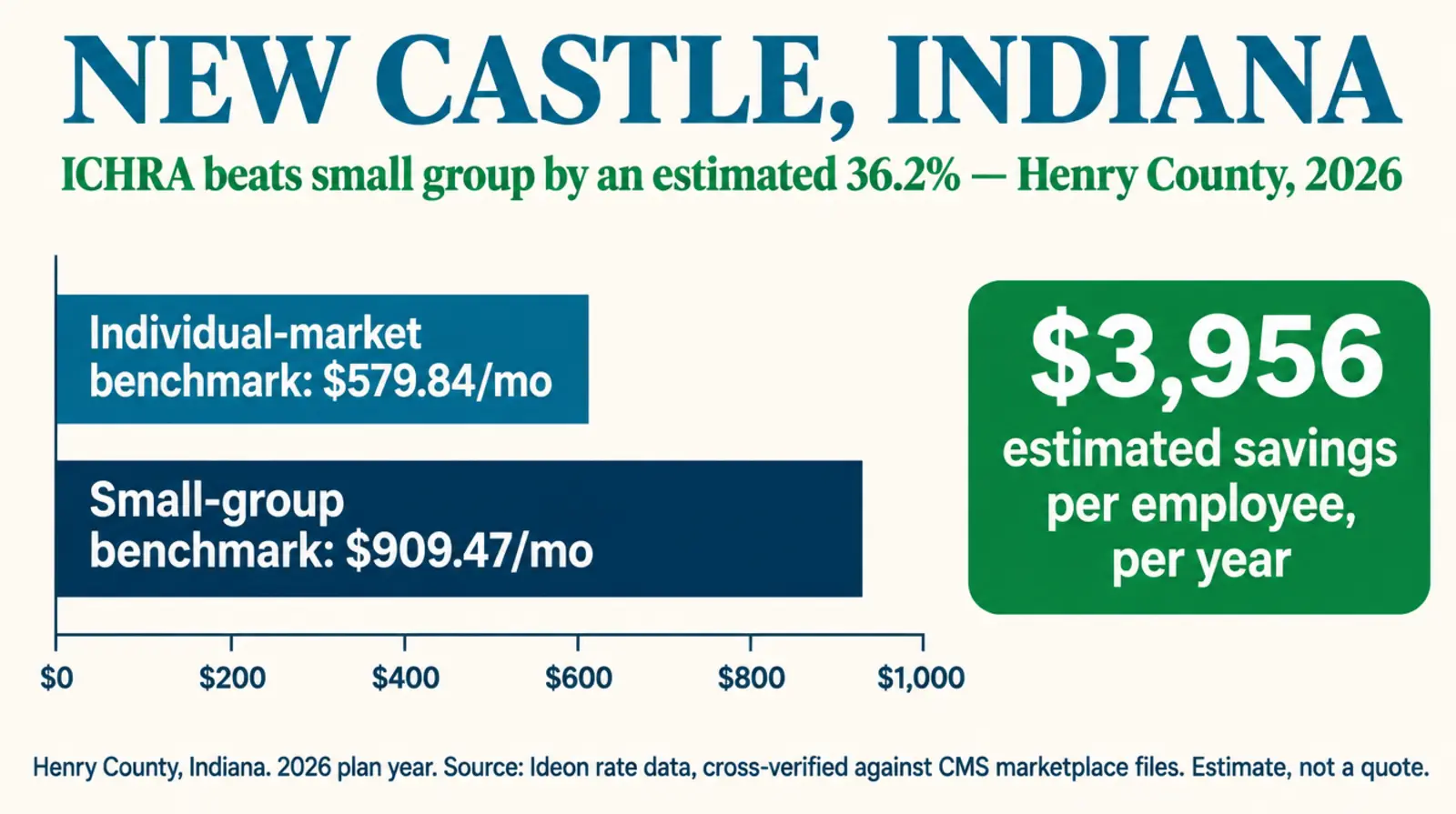
Henry County's 2026 benchmark runs an estimated 36.2% below small group, about $3,956 a year per employee, tied for Indiana's widest gap. Sourced data.
The short version
- Henry County's 2026 individual-market benchmark runs an estimated 36.2% below the small-group benchmark, about $3,956 per employee per year — tied with five other Indiana counties for both the highest percentage spread and the single highest dollar figure in our dataset, above the Indiana qualifying average of 25.8%.
- That number beats every one of Indiana's largest metro counties on this measure, including Marion County (Indianapolis) at 33.2%.
- Henry's population fell sharply in the 1980s, from a 1980 peak of 53,336 to 48,139 by 1990, then leveled off and has sat within a few thousand of that trough for 35 years — a flat, aging labor pool rather than a growing one.
- New Castle still carries a real manufacturing base: Henry County manufacturing jobs pay 22.7% above the county's average wage, a legacy of the Maxwell/Chrysler automotive plant built there in 1907.
- Henry's benchmark is shared, to the cent, with Fayette (Connersville), Hancock (Greenfield), Madison (Anderson), Union, and Wayne (Richmond) counties — a six-county rating area of roughly 356,582 residents in our dataset.
- Qualifying is not the same as a guaranteed saving for your business; the honest limits are covered later in this article.
Does ICHRA beat small group in New Castle, Indiana?
Yes. An ICHRA (Individual Coverage Health Reimbursement Arrangement, now also referred to by HealthCare.gov as a CHOICE Arrangement) is an IRS-defined arrangement that lets an employer set a fixed monthly reimbursement amount and let each employee buy their own individual-market plan with it, tax-free. In Henry County, the Indiana county that contains the city of New Castle, the 2026 individual-market benchmark premium runs an estimated 36.2% below the small-group benchmark premium, according to a county-by-county comparison built from Ideon rate data and cross-verified against CMS public-use marketplace files.
That 36.2% ties Henry with five other Indiana counties — Fayette (Connersville), Hancock (Greenfield), Madison (Anderson), Union, and Wayne (Richmond) — for the single highest percentage spread and the single highest dollar figure of any county in Indiana's 92-county qualifying list, well above the 25.8% statewide average. In dollars it's $3,956 a year per employee — ahead of Marion County (Indianapolis), Indiana's largest county, on both measures.
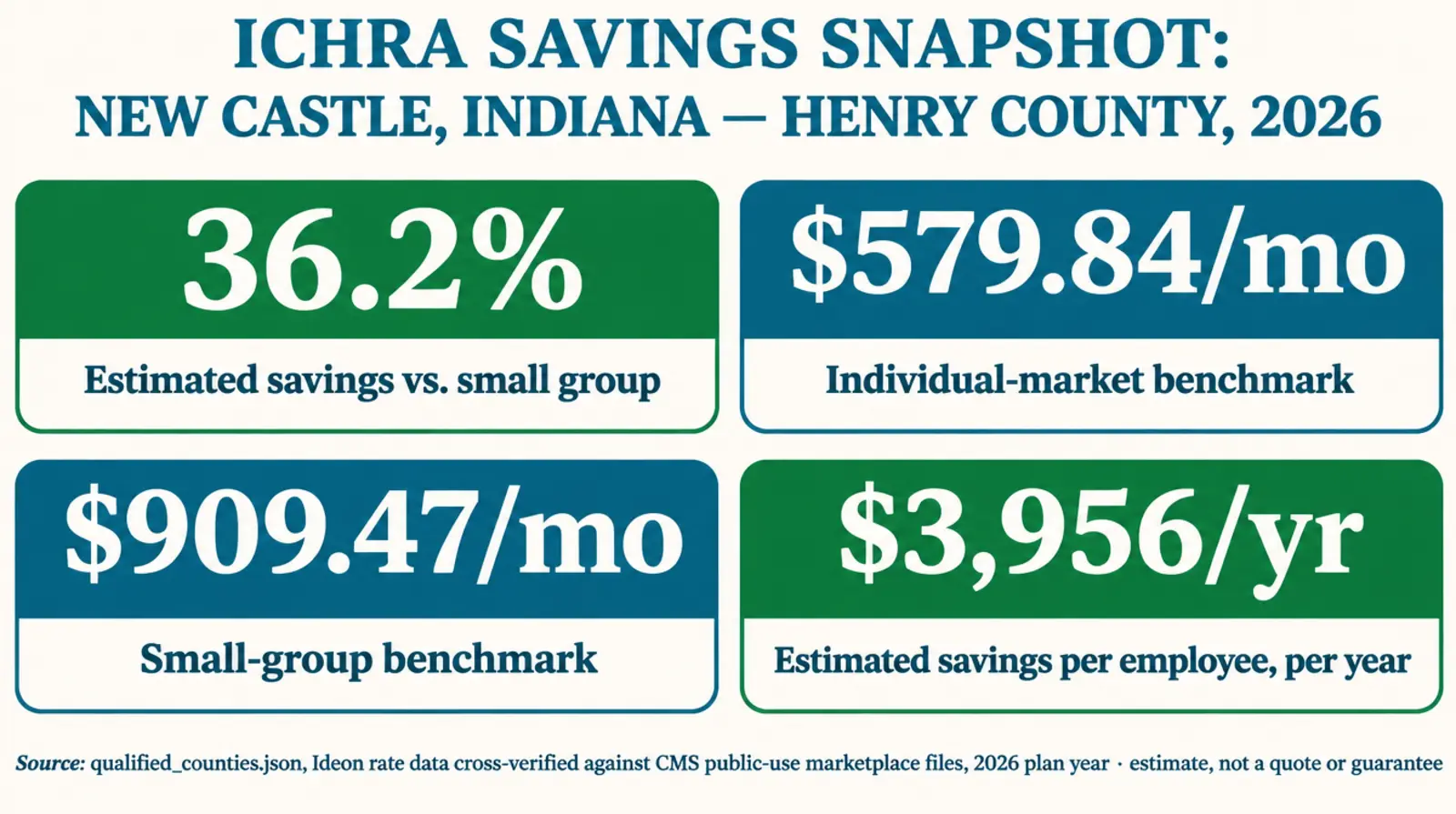
36.2%
Estimated Henry County savings vs. small group
6-county tie
Shared Indiana rating-area benchmark
49K
Henry County residents in our dataset
$3,956
Est. Henry County savings per employee, per year
The employer problem this is actually solving
A machine shop, a small manufacturer, or a professional practice in New Castle usually isn't weighing ICHRA against its current group plan. It's weighing ICHRA against offering nothing at all, because it never found a way to make small-group coverage pencil out for a crew of eight or fifteen people. Meanwhile it's trying to hire from a county whose working-age population hasn't meaningfully grown since the 1980s, against a correctional facility and a handful of larger regional employers that already offer benefits.
That's the specific gap an ICHRA is built to close here — not a seasonal swing, not a carrier participation fight, but the plain math of a benefits budget a small employer couldn't previously afford becoming one it can. The federal rule sets no minimum or maximum contribution and no participation percentage to clear when ICHRA is the only benefit offered, which matters most to exactly the kind of small, first-time-benefits employer this county has a lot of.
Why Indiana's 2026 renewal landed so hard
For Henry County employers who already carry a small-group plan, the renewal letter has been getting heavier. Indiana's 2026 individual-market rates rose an estimated 26.3% final weighted average increase, per ACA Signups' tracking of Indiana Department of Insurance filings (updated Aug. 28, 2025) and independently corroborated by healthinsurance.org's Indiana marketplace guide (updated Oct. 29, 2026), which cites the same 26.3% figure from the state regulator. Five insurers offered Indiana marketplace plans for 2026, and 300,049 people enrolled in private plans through Indiana's Marketplace, with roughly 8 in 10 receiving a premium subsidy, per the same healthinsurance.org guide. On the small-group side, ACA Signups' preliminary filings calculation put Indiana's 2026 small-group weighted average increase at an estimated 6.9%; we found this figure in one place only and it reflects requested, not final, rates, so treat it as directionally indicative rather than confirmed twice over.
For 2027, the Indiana Department of Insurance's final approved individual-market increase came in at 17.5%, down from a requested 19.7%, per healthinsurance.org's Oct. 29, 2026 update citing the state regulator directly; ACA Signups' earlier preliminary tracking (posted 2026) had the proposed figure at a close 18.9%, a reasonable independent cross-check on direction even though the final number landed lower. Two insurers — CareSource and Cigna — are exiting Indiana's individual market for 2027, and AmeriHealth Caritas is entering, for a net of four continuing carriers. On the small-group side, ACA Signups' preliminary tracking puts Indiana's 2027 small-group weighted average proposed increase at 14.1% — again single-sourced and preliminary. Nationally, insurers filed a median proposed premium increase of 14% for small-group plans for the 2027 plan year, across 295 insurers filing in all 50 states and the District of Columbia, per the Peterson-KFF Health System Tracker's brief published Aug. 6, 2026.
None of that changes the underlying mechanic that makes ICHRA work in a county like Henry: what matters isn't whether either market's prices went up in isolation, it's whether individual rates sit below small-group rates in the same county and rating area. Henry's gap has held for the entire 2026 plan year regardless of which direction each market moved on its own.
How an ICHRA (now also called CHOICE) actually works
Before the Henry County numbers mean anything, it helps to be precise about what's being compared, since most of the confusion around ICHRA comes from skipping this step.
An ICHRA is an employer-funded health reimbursement arrangement created by a 2019 final rule from the IRS and Treasury, the Department of Labor, and HHS, published at 84 Fed. Reg. 28888 on June 20, 2019, effective August 19, 2019, and applicable to plan years beginning on or after January 1, 2020. HealthCare.gov now also refers to the same structure as a CHOICE Arrangement; the mechanics and the federal rules haven't changed, only the public-facing name. Instead of choosing one group health plan for everyone, the employer sets a fixed monthly reimbursement amount, and each employee uses that money to buy an individual-market plan of their own choosing, then submits proof of coverage (substantiation) to get reimbursed tax-free.
The comparison behind every number in this article rests on two specific prices for a given county and rating area — the geographic zone insurance regulators use to set premiums, usually a cluster of neighboring counties. The individual-market benchmark premium is the second-lowest-cost silver-level plan available in that rating area to a representative 50-year-old enrollee. "Silver" refers to one of four ACA metal levels (bronze, silver, gold, platinum) describing how costs split between premium and out-of-pocket spending, not the quality of care. This is the same type of benchmark the federal government uses to calculate premium tax credits, which is why it's a defensible number to build a comparison on rather than one insurer's list price. The small-group benchmark premium is the equivalent figure built from comparable small-group plan filings for that same rating area. When the individual benchmark is lower, the county "qualifies," and the gap between the two is the estimated per-employee savings if the employer funds ICHRA at that benchmark level.
Two more terms matter once an employer is actually deciding whether to switch. The affordability safe harbor is the test that decides whether the ICHRA offer counts as "affordable" under IRS rules — for plan years beginning in 2026 that test runs against a Required Contribution Percentage of 9.96% of household income (IRS Rev. Proc. 2025-25, Section 3.02), rising to 10.22% for plan years beginning in 2027 (IRS Rev. Proc. 2026-26, Section 3.02). Get the contribution amount wrong relative to that threshold and an employer can trigger a penalty tied to the employer mandate, the ACA requirement that applies to ALEs (applicable large employers, generally 50 or more full-time-equivalent employees). Smaller, non-ALE employers aren't subject to that mandate at all, which covers the overwhelming majority of Henry County's small manufacturers, shops, and practices.
One structural piece matters here as much as the rate spread itself: an employer can define different employee classes — HealthCare.gov's current list includes full-time, part-time, or seasonal status, employees under a collective bargaining agreement, salaried versus hourly staff, employees still in a waiting period, non-resident immigrants with no U.S.-based income, work location, and combinations of those — and offer a different contribution, or no ICHRA at all, to each class. What an employer cannot do is offer the same class of employees a choice between ICHRA and a traditional group plan; it's one or the other, per class, not both at once for the same people. Within a class, reimbursements can still vary by age, up to a 3-to-1 ratio, and by number of dependents.
Henry County's rate spread, in dollars
Here is the actual 2026 benchmark comparison for Henry County, home to the city of New Castle. The individual-market benchmark premium is $579.84 a month. The small-group benchmark premium, built from comparable small-group plan filings for the same rating area, is $909.47 a month. That's a gap of $329.63 a month, or $3,956 a year, per employee, an estimated 36.2% in favor of the individual market.
See the full Indiana savings breakdown for every qualifying county, or the national savings map to look up a specific county by name.
Why Henry shares its benchmark with five other counties
Henry County's 36.2% isn't a coincidence of similar nearby pricing — it's identical, to the cent, across six counties at once, because they sit in the same federal rating area: Fayette (Connersville), Hancock (Greenfield), Madison (Anderson), Union, and Wayne (Richmond). Fayette County doesn't have its own dedicated article on this site, but it already appears as the worked-example county in two of our other pieces — on stacking state tax credits with ICHRA savings and on offering benefits for the first time — so this article is the first to cover the full six-county rating area as a group.
| County | Population (dataset) | Individual benchmark | Small-group benchmark | Savings vs. small group |
|---|---|---|---|---|
| Henry (New Castle) | 49K | $579.84 | $909.47 | 36.2% |
| Madison (Anderson) | 131K | $579.84 | $909.47 | 36.2% |
| Wayne (Richmond) | 67K | $579.84 | $909.47 | 36.2% |
| Hancock (Greenfield) | 80K | $579.84 | $909.47 | 36.2% |
| Fayette (Connersville) | 23K | $579.84 | $909.47 | 36.2% |
| Union | 7K | $579.84 | $909.47 | 36.2% |
Fayette County is discussed, though not as its own article, in two other posts linked above.
That's a combined 356,582 residents in our dataset sharing one number. An employer headquartered in New Castle with staff living across the Anderson, Richmond, Greenfield, or Connersville areas, or in neighboring Union County, doesn't need six different calculations; everyone runs on the same $579.84 individual and $909.47 small-group monthly benchmark for 2026.
How Henry compares to Indiana's biggest counties
Every one of Indiana's largest and best-known counties by population — Marion (Indianapolis), Hamilton (Carmel/Fishers), Tippecanoe (Lafayette), Lake (Gary), St. Joseph (South Bend), and Allen (Fort Wayne) — shows a smaller percentage spread than Henry County's 36.2%. That's not a knock on those counties; it reflects how each rating area's carriers happened to price small-group versus individual coverage for 2026, which has little to do with a county's size or economic weight. It's a clear illustration of why a statewide or metro-level average can mislead: check your own county, not a regional headline number, before you model a rollout.
| County (city) | Population | Savings vs. small group | Est. annual savings / employee |
|---|---|---|---|
| Marion (Indianapolis) | 971,737 | 33.2% | $3,618 |
| Hamilton (Carmel/Fishers) | 349,527 | 32.2% | $3,469 |
| Tippecanoe (Lafayette) | 186,955 | 28.3% | $3,000 |
| Lake (Gary) | 497,682 | 23.1% | $2,483 |
| St. Joseph (South Bend) | 272,388 | 17.7% | $1,631 |
| Allen (Fort Wayne) | 385,456 | 15.9% | $1,512 |
| Henry (New Castle) | 49K | 36.2% | $3,956 |
Henry County ties for both the highest percentage and the highest dollar figure of any county in Indiana's 92-county qualifying list.
A county that peaked in 1980, then leveled off
This is the part of the Henry County story that a benchmark-premium comparison alone doesn't show, and it's the real reason a first-time-benefits employer here should think about ICHRA as a hiring tool, not only a cost comparison.
Per the U.S. Census Bureau's decennial counts and Population Estimates Program, Henry County's population dropped sharply in the 1980s, then held roughly flat for the next 35 years:
| Year | Population |
|---|---|
| 1980 (peak) | 53,336 |
| 1990 | 48,139 |
| 2000 | 48,508 |
| 2010 | 49,462 |
| 2020 | 48,914 |
| 2025 (est.) | 49,137 |
U.S. Census Bureau decennial counts and Population Estimates Program, Vintage 2025, via Wikipedia's summary of Henry County, Indiana.
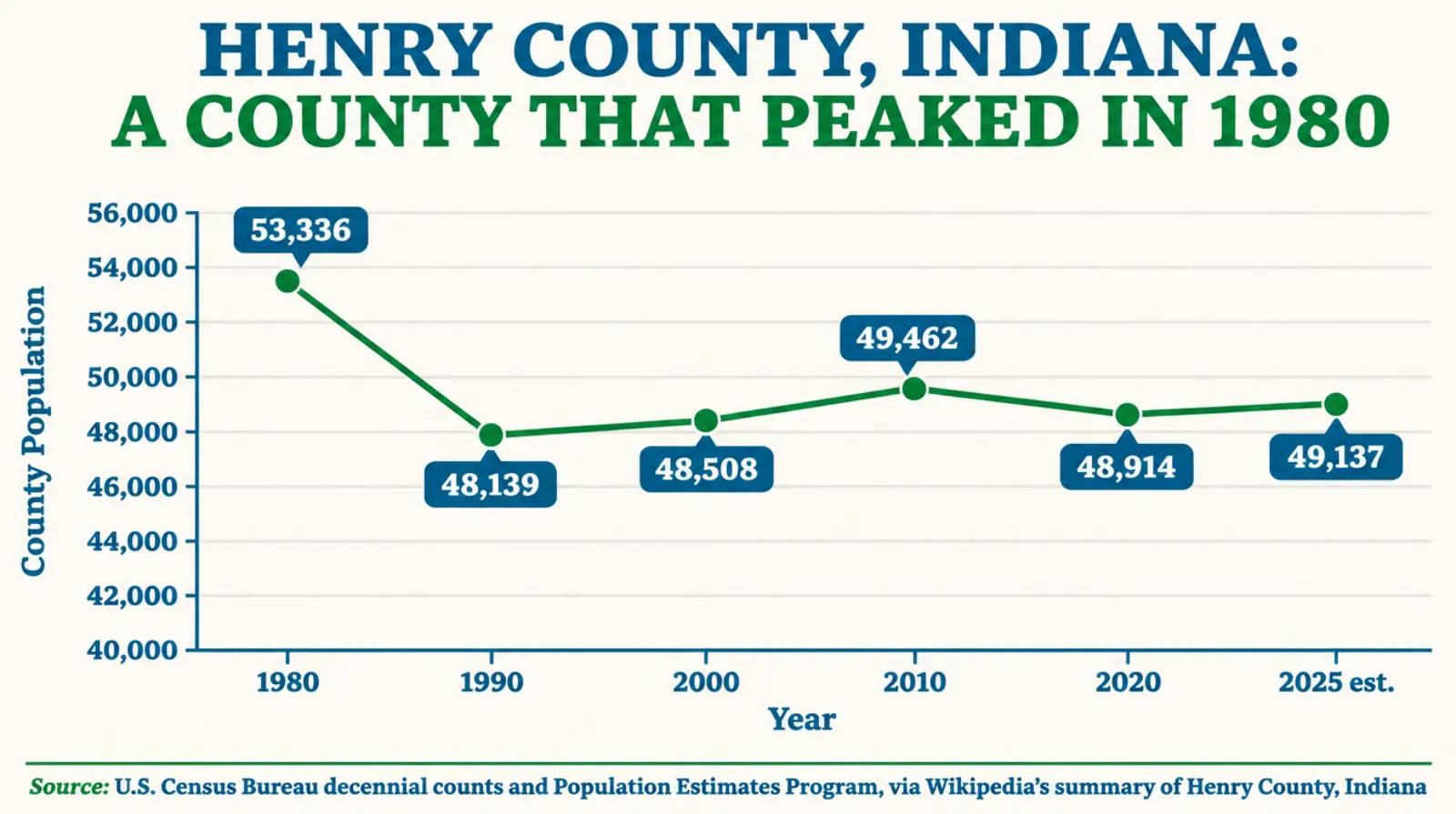
That's a 7.9% decline from the 1980 peak to the 2025 estimate, almost all of it happening in a single decade: the county lost roughly 5,200 residents between 1980 and 1990 alone. Since that 1990 trough, the county has actually grown back 2.1%, essentially moving sideways for a generation rather than continuing to shrink or meaningfully grow. Wikipedia's summary of the county notes Henry was formed in 1822 from land obtained through the 1818 Treaty of St. Mary's and named for Patrick Henry, with Interstate 70 and U.S. Routes 35, 36, and 40 running through it — decent highway access that hasn't, on its own, been enough to reverse four decades of a flat population base.
None of this changes the 2026 benchmark comparison itself, which is set by filed insurance rates, not population trends. But a labor pool that hasn't grown since the Reagan administration is exactly the kind of fact a national average would hide, and exactly why the hiring argument for ICHRA matters as much here as the savings argument.
The world's largest high school gym, and a century of manufacturing
New Castle became the seat of Henry County when the county organized in 1822, platted in 1823 and named after New Castle, Kentucky, per Wikipedia's summary of the city. It had 17,396 residents at the 2020 census, with the Bureau estimating 17,373 in 2025 — essentially flat, consistent with the county's broader pattern.
The city is nicknamed "Rose City," a name that stuck from the early 1900s when it reportedly had around 100 florists in operation. Its manufacturing history runs deep: New Castle was once a production center for sheet iron and steel, automobiles, caskets, clothing, scales, bridges, pianos, furniture, and bricks, and the Maxwell Motor Car factory built there in 1907 was, at the time, the largest automotive plant in the United States. Chrysler Motor Corp. later owned the site, and the Chrysler Enclosure is now one of four local listings on the National Register of Historic Places.
Per the Bureau of Labor Statistics' Quarterly Census of Employment and Wages, Henry County (area code 18065) reported 924 establishments and an average employment of 13,967 across 2025, at an average weekly wage of $976 and an average annual pay of $50,740. Within that, manufacturing alone accounted for 57 establishments and an average of 3,267 jobs — about 23.4% of the county's total employment — at a considerably higher average weekly wage of $1,197 and average annual pay of $62,263, 22.7% above the county-wide average.
Today, two other facts define New Castle's profile. The New Castle Fieldhouse, at New Castle Chrysler High School, is the largest high school gymnasium in the world, seating 9,325 — nine of the eleven largest U.S. high school gyms are in Indiana — and the Indiana Basketball Hall of Fame sits near the same high school. The New Castle Correctional Facility, a large state institution with capacity for more than 3,500 inmates, lies just north of the city, per Wikipedia's summary of New Castle.
A flat labor pool since 1990
Henry County lost roughly 5,200 residents in the 1980s, then held steady for 35 years — a workforce that isn't growing to meet new hiring demand.
A century of manufacturing wages
From the 1907 Maxwell/Chrysler plant to today's QCEW data, manufacturing jobs here still pay 22.7% above the county average.
Same price as five neighbors
Henry County's benchmark comparison is identical to Fayette, Hancock, Madison, Union, and Wayne counties, to the cent.
The hiring problem a benefits budget can actually fix
Put the population trend and the wage data together and the hiring problem comes into focus. Manufacturing jobs in Henry County pay an average of $62,263 a year — 22.7% above the county-wide average of $50,740 — which means manufacturers here are already competing on wages against each other and against the county's larger institutional employers. A shop that pays competitively but has never offered health coverage is giving up one of the few remaining levers it has to win a candidate choosing between two similar-paying jobs, in a county whose working-age population hasn't grown in a generation.
That's a different problem than the renewal-shock story that drives most ICHRA adoption elsewhere. A Henry County employer that's never offered benefits isn't trying to escape a bad small-group renewal; it's trying to close a specific, recurring gap against a flat labor supply. An ICHRA with no minimum contribution requirement and no carrier participation percentage to clear is a realistic way to close part of that gap without first building a benefits department.
Indiana's small-group participation rule, close up
Small-group health insurance isn't sold to individual employees one at a time; it's underwritten as a pool, and a carrier can require a minimum share of a company's eligible employees to actually enroll before it will issue the policy at all. Like Ohio, Indiana leaves the specific participation threshold to each carrier's own filed underwriting rules rather than setting one statewide percentage by statute. Indiana Code § 27-8-15-33(d), read directly, states plainly that "nothing in this chapter prohibits a small employer insurer from including minimum participation and contribution requirements in its offer of coverage" — the law permits the practice without fixing the number.
Indiana insurance brokers describe typical carrier-filed small-group participation requirements running from roughly 50% to 75% of eligible employees, per guides published by Indiana-licensed brokers; we could not confirm a specific figure from a named carrier's own underwriting documentation for Henry County, so treat that range as directionally indicative of local market practice, not a confirmed number for any particular plan.
If a group quote already fell through on participation
If you've already tried to set up small-group coverage for a Henry County business and a carrier's enrollment-percentage rule blocked the quote, that's a specific, common signal that an ICHRA is worth pricing out next, since the participation requirement doesn't apply to it when it's the only benefit you offer.
A worked example for a New Castle employer offering coverage for the first time
Here's what the Henry County numbers look like applied to a real headcount. Assume a precision-machining or light-manufacturing shop — the kind of operation with roots in New Castle's century-long automotive-parts history — with 12 employees and no history of offering health benefits.
Here's the math
The 2026 small-group benchmark in Henry County is $909.47 a month per employee. Buying small-group coverage for all 12 employees at that benchmark rate would run an estimated $130,964 a year — a number that explains why a shop this size often never gets a group plan off the ground in the first place.
The 2026 individual-market benchmark is $579.84 a month. Funding an ICHRA for the same 12 employees at that benchmark level runs an estimated $83,497 a year — a bigger number than offering nothing, but a gap of $47,467 below what small-group coverage would have cost the same shop for the same people.
This is illustrative math built from real 2026 county rate data and a hypothetical headcount. It is not a quote, and it assumes the employer sets the ICHRA contribution at the benchmark level, which is a design choice, not a requirement. A lower contribution is allowed; the federal rule sets no minimum. Your actual number depends on your employees' ages, exact home counties, and the plans they choose once they're shopping with their own budget.
At a larger size, a New Castle employer that crosses 50 full-time-equivalent employees enters ALE territory under the employer mandate, which changes the calculus without changing the underlying county math. The same Henry County benchmark comparison applies, but an ALE has to run the affordability safe-harbor test — against the 9.96% threshold for 2026 or 10.22% for 2027 — carefully for every employee class, since an ICHRA offer judged "unaffordable" for even a handful of lower-paid employees can trigger an employer-mandate penalty. That's not a reason to avoid ICHRA at that size; it's a reason to model the affordability test before setting a contribution amount, which our eligibility guide walks through in detail.
How ICHRA adoption is actually growing
Henry County's numbers sit inside a national adoption trend that keeps compounding. The HRA Council's fifth annual report, Growth Trends for ICHRA & QSEHRA, Vol. 5 (released August 12, 2026), found that ICHRA-covered lives surpassed 500,000 nationally at the start of 2026, spread across more than 20,000 U.S. businesses now offering ICHRA or QSEHRA. Adoption among applicable large employers (ALEs) more than doubled on average year over year, the fastest-growing segment in the report.
The number that matters most for the small New Castle business this article opened on: most small businesses that adopt ICHRA had previously offered no health coverage options at all. For a first-time-benefits employer, the realistic comparison usually isn't "ICHRA versus our current group plan." It's "ICHRA versus nothing, while the county's larger institutional employers keep hiring from the same flat labor pool," which is a much easier case to make than it sounds once the two benchmark numbers are sitting side by side.
Setting up an ICHRA in Henry County
Indiana does not layer state-specific ICHRA rules on top of the federal framework. The same IRS, Department of Labor, and HHS final rule that governs ICHRA everywhere applies here. What determines whether a New Castle-area rollout goes smoothly:
- Pull your census by county, not by office address. A company headquartered in New Castle with staff living in Fayette, Hancock, Madison, Union, or Wayne counties shares the same numbers — but a company with staff further out, in Randolph, Rush, or Delaware counties, does not.
- Decide your contribution level deliberately, not by default. Nothing requires funding at the individual-market benchmark; a lower, still-meaningful contribution is often the realistic starting point for a first-time-benefits employer.
- Model affordability before you set a contribution. The reimbursement level decides whether an employee keeps or waives premium tax credit eligibility, against the 9.96% (2026) or 10.22% (2027) Required Contribution Percentage.
- Check every employee's actual county on the savings map. Even inside a shared rating area, it's worth confirming each employee's home county before you model a rollout.
- Send the required notice on time. Eligible employees need written notice at least 90 days before the plan year starts, with specific required content.
- Budget for onboarding support. Employees who have never shopped the individual market, especially in a county without a large existing ICHRA employer base, need real guidance the first time through.
See our full ICHRA setup timeline for the detailed rollout plan, including the exact notice content requirements, and our eligibility guide for the affordability test itself. Before anything else, it's worth checking whether your county is one where this works at all: the national savings map takes about ten seconds to search.
If your employer just offered you an ICHRA
This guide is written for the employer side of the decision, but if you're a Henry County employee who was just told your benefit is changing, or offered one for the first time, the short version is: you'll get a fixed monthly amount and shop for your own plan on the individual market instead of picking from an employer group menu. Our guide for employees walks through what to expect.
The honest limits of this data
A strong county number is not a guarantee for your business
- A benchmark comparison is not your actual quote. The $909.47 Henry County figure is a small-group benchmark built from filed rates, not your specific carrier's quote for your specific group.
- Several 2026 and 2027 Indiana small-group figures are single-sourced. The 6.9% (2026) and 14.1% (2027) small-group estimates both come from ACA Signups' own calculations against preliminary filings; we could not independently corroborate either elsewhere, and neither is a final, regulator-approved number.
- The 50%–75% participation range is broker-reported, not carrier-confirmed. We could not verify a specific participation percentage from a named Henry County carrier's own underwriting guidelines; Indiana Code § 27-8-15-33(d) confirms carriers may set such requirements, but not what any particular carrier's number is.
- An older or higher-risk workforce changes the real-world math. Benchmark premiums are built around a representative 50-year-old enrollee; a company with a younger average age could see a different real-world spread than the headline figure implies.
- Rates move every plan year. A carrier entering or leaving the rating area can shift either side of this comparison. Recheck before every renewal, not just once.
- Waiving the premium tax credit is part of the deal. An employee whose ICHRA offer is deemed affordable generally cannot also claim a marketplace subsidy for that month. With roughly 8 in 10 of Indiana's 2026 marketplace enrollees receiving a subsidy, model both sides before assuming the reimbursement is pure upside for the employee.
- A flat population is a slow-moving fact, not a lever ICHRA pulls. Funding better benefits can help a Henry County employer compete for the workers who are there; it does not change how many working-age people the county has.
A twelve-person machine shop that has never offered benefits was never going to absorb a six-figure group premium on its first try. Henry County's rate spread is real and it's the strongest number in our Indiana dataset, but the bigger reason to look at ICHRA here isn't the percentage. It's that the plan makes a first health benefit affordable for an employer that was never going to get one through the group market at all.
Mike MooreIf your renewal letter is already sitting on your desk, or you're weighing a first benefit for your team and want to work through the numbers with someone, it's worth a conversation: book time with our team. If you'd rather work through the mechanics on your own first, start with how ICHRA works and come back when you have questions.
How these numbers are calculated
Every county savings figure in this article comes from the same dataset that powers our savings map, not a survey or a sales estimate. For each county, we compare a 2026 individual-market benchmark premium — the second-lowest-cost silver plan available to a representative 50-year-old enrollee — against a small-group benchmark premium built from comparable small-group plan filings for that rating area. Both figures come from Ideon, a licensed insurance rate-data provider, and are cross-verified against CMS public-use marketplace files before publication. A county "qualifies" for our dataset when the individual benchmark sits below the small-group benchmark by at least $100 a month; the percentage and dollar figures in this article are the gap between those two numbers, expressed as an annual per-employee figure at 12 times the monthly difference.
The population figures for Henry County (1980 through 2025) come from the U.S. Census Bureau's decennial counts and Population Estimates Program, Vintage 2025, via Wikipedia's summary of Henry County, Indiana, which cites the same Bureau series, fetched directly. The Bureau of Labor Statistics' Quarterly Census of Employment and Wages reports 924 establishments, an average employment of 13,967, an average weekly wage of $976, and an average annual pay of $50,740 for all of Henry County (area code 18065) across 2025, with the manufacturing-sector figures drawn from the same source's NAICS 31-33 private-sector rows, fetched directly from data.bls.gov.
The national and Indiana-specific small-group and individual-market rate figures (26.3% and 17.5% for Indiana's individual market, 6.9% and 14.1% preliminary for Indiana's small-group market, the 14% national small-group median), the IRS affordability percentages, and the HRA Council adoption figures each come from separately published, independent sources, not from our own county dataset, and describe national, statewide, or local context rather than the Henry-specific benchmark comparison above. Indiana Code § 27-8-15-33 was read directly from the state's own code. We've kept these data sources clearly separate throughout this article rather than blending them into one number.
Three limitations are worth stating plainly. First, benchmark premiums are built around a representative enrollee profile, so an unusually young or unusually old workforce will see a different real-world spread than the county figure implies. Second, these are benchmark plans, not every plan on the market; an employee who chooses a richer or leaner plan than the benchmark will see a different premium, though the relative spread tends to hold directionally. Third, rates are filed and refreshed annually, so a county that qualifies for 2026 is not guaranteed to show the same gap for 2027 if a carrier enters or exits that market.
Questions New Castle employers actually ask
Does ICHRA beat small-group insurance in New Castle, Indiana?
Yes. New Castle is the county seat and only city of Henry County, and the county's 2026 individual-market benchmark premium runs an estimated 36.2% below the small-group benchmark, about $3,956 per employee per year. That ties Henry with five other published Indiana counties — Fayette (Connersville), Hancock (Greenfield), Madison (Anderson), Union, and Wayne (Richmond) — for both the highest percentage spread and the single highest dollar figure of any county in our Indiana dataset, well above the statewide qualifying average of 25.8%.
Why does Henry County price identically to five other counties?
Indiana prices health insurance by federal rating area, not by county. A rating area is a geography covering a cluster of neighboring counties that all get filed the identical benchmark price for a given plan year. Henry County's rating area also covers Fayette, Hancock, Madison, Union, and Wayne counties — a combined population of roughly 356,582 residents in our dataset. An employer headquartered in New Castle with staff living anywhere across that six-county area runs on the identical $579.84 individual and $909.47 small-group monthly benchmark for 2026.
Is Henry County really ahead of Indianapolis on this measure?
Yes, on both the percentage and the dollar figure. Marion County (Indianapolis), Indiana's largest and best-known county, qualifies at an estimated 33.2% for 2026 — a strong number, but below Henry's 36.2%. The same holds for Hamilton, Tippecanoe, Lake, St. Joseph, and Allen counties, each covered later in this article. It's a useful reminder that a state's biggest city doesn't automatically carry its best county-level number.
How much can a New Castle employer expect to save?
Using 2026 benchmark data, the estimated gap in Henry County is $329.63 a month, or $3,956 a year, per employee. For a 12-person shop, funding ICHRA contributions at the individual-market benchmark level instead of trying to buy small-group coverage at the benchmark level works out to roughly $47,467 a year in aggregate estimated savings. This is illustrative math from public rate data, not a projection of what any specific employer will actually pay.
What happens to my employees' premium tax credit if I offer an ICHRA?
An employee who is offered an affordable ICHRA generally becomes ineligible for a premium tax credit for any month that offer applies, whether or not they accept it. Affordability is measured against the IRS's Required Contribution Percentage, which is 9.96% of household income for plan years beginning in 2026 (Rev. Proc. 2025-25, Section 3.02) and rises to 10.22% for plan years beginning in 2027 (Rev. Proc. 2026-26, Section 3.02). Model that test before you set a contribution amount for any Henry County employee currently receiving marketplace subsidies — roughly 8 in 10 of Indiana's 2026 marketplace enrollees receive one, per healthinsurance.org's Indiana guide.
Can a 12-person business realistically afford to offer health benefits for the first time?
That depends entirely on which benchmark it is pricing against. Funding an ICHRA for 12 employees at Henry County's 2026 individual-market benchmark runs an estimated $83,497 a year in total contributions. Buying small-group coverage for the same 12 people at the small-group benchmark runs an estimated $130,964 a year — a gap of $47,467. A shop that could never clear the second number is often within reach of the first one, which is the specific calculation worth running before assuming benefits are out of budget.
Does Fayette County have its own article too?
Not a dedicated one, but Fayette County (Connersville) — which shares Henry's exact benchmark — appears as the worked-example county in two of our other articles, on state tax credits and on offering benefits for the first time. This article is the first to cover the six-county rating area, including Henry, Hancock, Madison, Union, and Wayne, as a group.
What is New Castle known for, besides being a county seat?
New Castle is nicknamed the "Rose City," a name that dates to the early 1900s when the city reportedly had around 100 florists. It was once a diversified manufacturing center for sheet iron, automobiles, caskets, scales, and furniture, and the Maxwell Motor Car plant built there in 1907 was, at the time, the largest automotive factory in the country; Chrysler later owned the site. Today the city is home to the New Castle Fieldhouse, the largest high school gymnasium in the world at 9,325 seats, and the Indiana Basketball Hall of Fame sits nearby, per Wikipedia's summaries of New Castle and Henry County.
Sources
- ACA Signups, "2026 Rate Changes" (Indiana) (updated Aug. 28, 2025) — 26.3% final individual-market increase; 6.9% preliminary small-group increase
- ACA Signups, "2027 Rate Changes" (Indiana) (preliminary, posted 2026) — 18.9% preliminary individual-market and 14.1% preliminary small-group increases for 2027
- healthinsurance.org, "Indiana Health Insurance Marketplace" guide (updated Oct. 29, 2026) — insurer counts, enrollment, subsidy share, 26.3% (2026) and 17.5% (2027) final rate figures
- Peterson-KFF Health System Tracker, "How Much and Why Premiums Are Going Up for Small Businesses in 2027" (Aug. 6, 2026) — national small-group median increase
- IRS Revenue Procedure 2025-25 — Required Contribution Percentage, plan years beginning in 2026 (9.96%)
- IRS Revenue Procedure 2026-26 — Required Contribution Percentage, plan years beginning in 2027 (10.22%)
- 84 Fed. Reg. 28888 — ICHRA final rule, Departments of the Treasury/IRS, Labor, and Health and Human Services (June 20, 2019)
- HealthCare.gov, "CHOICE Arrangements" — participation, employee-class, and age-variance rules
- Indiana Code § 27-8-15-33(d) — small employer insurer participation and contribution requirements
- HRA Council, "Growth Trends for ICHRA & QSEHRA, Vol. 5" (Aug. 12, 2026)
- Wikipedia, "Henry County, Indiana" — founding, land area, population history, neighboring counties
- Wikipedia, "New Castle, Indiana" — population, founding history, manufacturing history, Fieldhouse, Basketball Hall of Fame
- U.S. Bureau of Labor Statistics, Quarterly Census of Employment and Wages — Henry County, Indiana (area code 18065), 2025 annual data
- County-level premium comparison: ICHRA Savings county dataset, 2026 plan year (Ideon rate data, cross-verified against CMS public-use marketplace files)