Open Enrollment 2027 Is Shorter: An ICHRA Employer Guide
Plan year 2027 open enrollment runs Nov 1 to Dec 15 on HealthCare.gov, 31 days shorter. What ICHRA employers must fix in their notice timeline before then.

The short version
- Open enrollment for 2027 coverage on HealthCare.gov runs November 1 to December 15, 2026, a full 31 days shorter than the Nov 1 to Jan 15 window that applied through plan year 2026.
- Every Exchange, federal or state-run, now has a hard federal floor: start no later than Nov 1, end no later than Dec 31, run no more than 9 weeks (45 CFR 155.410(e)(5)).
- State-run Exchanges pick their own dates inside that floor. Georgia Access has not yet published its 2027 dates as of September 1, 2026, even though its 2026 window would no longer be legal under the new rule.
- This does not change your ICHRA's 90-day notice deadline, but it shrinks the room for error if that notice goes out late.
When does open enrollment for 2027 actually start and end?
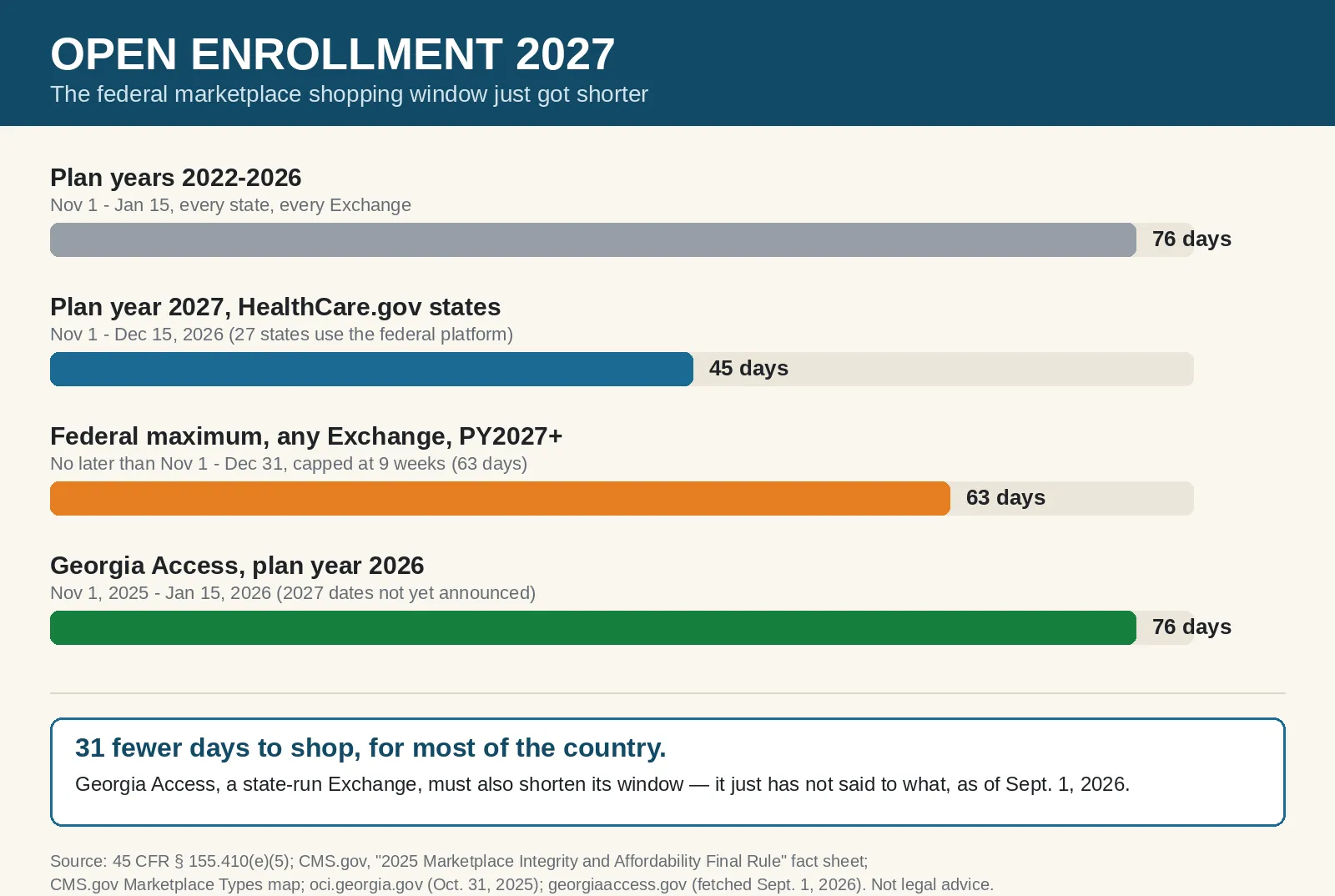
On HealthCare.gov, the federal marketplace platform used by 27 states, open enrollment for coverage starting January 1, 2027 runs from November 1 through December 15, 2026 (CMS.gov, "2025 Marketplace Integrity and Affordability Final Rule" fact sheet, fetched this week; federal, applies to the 27 states on the federal platform). That is a 45-day window. For the five plan years before it, 2022 through 2026, the same window ran from November 1 through January 15, a full 76 days (45 CFR 155.410(e)(4)(i), Cornell Law School Legal Information Institute, current CFR text, fetched this week; federal).
If your mental calendar still says "open enrollment runs into mid-January," that calendar is out of date for most of the country starting this cycle. The rule that changed it, 45 CFR 155.410(e)(5), applies to every state, not just the ones using HealthCare.gov, though the exact end date differs depending on which kind of Exchange your employees' state runs. The rest of this guide works through exactly what changed, which states it hits hardest, and what it means for the calendar you use to run your own ICHRA rollout.
Why the government shortened the window
The change comes from the 2025 Marketplace Integrity and Affordability Final Rule, published by the Centers for Medicare & Medicaid Services (CMS) in the Federal Register on June 25, 2025 (90 FR 27074). Among other provisions, it rewrites 45 CFR 155.410, the regulation that sets the annual open enrollment period, or OEP: the one yearly window when anyone can buy or change an individual marketplace plan without a qualifying life event, as opposed to a narrower special enrollment period available only to people with a specific triggering event.
CMS's own stated reasons, from its fact sheet on the rule: shortening the window is meant to "reduce consumer confusion," "align more closely with open enrollment dates for many employer-based health plans," "encourage continuous coverage," and "reduce the risk of adverse selection from consumers who may otherwise wait to enroll until they need health care services" (CMS.gov, 2025 Marketplace Integrity and Affordability Final Rule fact sheet, fetched this week). Whether or not you buy every piece of that reasoning, the practical effect is the same either way: employees now have roughly a month less runway to shop, decide, and enroll before coverage has to start.
One nuance worth naming directly, because trade coverage has muddied it: separate litigation, City of Columbus v. Kennedy (D. Md.), challenged several provisions of the same final rule in 2025, and some of those provisions were stayed or narrowed. The open enrollment length change was not one of them. It is fully in effect, beginning with the open enrollment period for plan year 2027, which is the window opening this coming November.
The old calendar next to the new one
Laid out side by side, the arithmetic is simple, and it is worth doing once so the number sticks. The old window: November 1 to January 15, 76 calendar days. The new federal-platform window: November 1 to December 15, 45 calendar days. That is 31 fewer days, about four and a half weeks, to research plans, compare a reimbursement amount against real premiums, and finish an application.
76
Days in the old Nov 1 to Jan 15 window, plan years 2022-2026
45
Days in the new HealthCare.gov window, plan year 2027
31
Fewer days to shop, on the federal platform
63
Days, the hard federal maximum for any Exchange, PY2027+
Source: 45 CFR § 155.410(e)(4)-(5) (Legal Information Institute, current CFR text, fetched this week); CMS.gov, 2025 Marketplace Integrity and Affordability Final Rule fact sheet, fetched this week. Federal.
A 9-week cap applies everywhere, even where the exact dates differ
No matter which Exchange your employees use, their plan-year-2027 open enrollment cannot start later than November 1, cannot end later than December 31, and cannot run longer than 9 weeks. That is the floor set by 45 CFR 155.410(e)(5). Where a state lands its actual dates inside that floor is the state's own call, which is exactly why the next section matters if you employ people in more than one state.
Not every state has the same 2027 dates
"Open enrollment" is not one national date; it depends on what kind of Exchange your employees' state runs. There are three arrangements, per CMS's own current marketplace-type map (CMS.gov, Marketplace Types map, page last modified September 1, 2026, fetched this week):
| Exchange type | How many | Example states | Who sets the exact dates |
|---|---|---|---|
| Federally-Facilitated Marketplace (FFM) | 27 states | Ohio, South Dakota, Texas, Florida | Nov 1 – Dec 15, 2026 (CMS-set) |
| State-Based Marketplace on the federal platform (SBM-FP) | 2 states | Arkansas, Oklahoma | Not yet published as of Sept. 1, 2026 |
| State-Based Marketplace (SBM) | 21 states + DC | Georgia, California, New York, Pennsylvania | Each sets its own, within the federal limits |
Source: CMS.gov Marketplace Types map, page last modified 09/01/2026, fetched this week. Federal, current for plan year 2027.
A Federally-Facilitated Marketplace (FFM) state uses HealthCare.gov directly, and CMS itself sets the dates: November 1 to December 15, 2026 for plan year 2027. A State-Based Marketplace on the Federal Platform (SBM-FP), currently Arkansas and Oklahoma, still runs on HealthCare.gov's technology but retains some state-level authority over the exchange. A full State-Based Marketplace (SBM) runs its own separate website and sets its own open enrollment dates entirely, subject only to the federal floor. Twenty-one states plus DC run a full SBM, and that number has been growing: Virginia moved to a state exchange in fall 2023, Georgia in fall 2024, and Illinois in fall 2025 (CMS.gov Marketplace Types map, fetched this week).
If your workforce is entirely in one FFM state, this is close to a solved problem: the date is Dec 15, 2026, and CMS has already said so. If any part of your team lives in an SBM state, you do not get to assume the federal date applies to them, and, as the next section shows, you may not even be able to look the date up yet.
Ohio and Georgia: two states, two calendars, two economics
ICHRA Savings focuses heavily on Ohio and Georgia employers, and the two states happen to sit on opposite sides of this exact split. Ohio is an FFM state; its 2027 open enrollment date is already fixed at November 1 to December 15, 2026, set by CMS. Georgia is an SBM state, running its own exchange, Georgia Access, and its 2027 dates are not yet public.
Georgia Access ran its plan-year-2026 open enrollment from November 1, 2025 through January 15, 2026, a 76-day window (Office of the Commissioner of Insurance and Safety Fire, Georgia, press release dated October 31, 2025, fetched this week; state, Georgia). That is the same length as the old federal window, and it is now 13 days longer than the 63-day maximum that takes effect for plan year 2027. Georgia Access has to shorten its window to comply. As of September 1, 2026, the front page of georgiaaccess.gov still displays plan-year-2026 dates, with no 2027 announcement yet (georgiaaccess.gov, fetched this week; state, Georgia). Georgia announced its 2026 dates on October 31, 2025, roughly six weeks before the January cutoff that year, so a similar-timed announcement for 2027 is plausible but not guaranteed, and it is not something you should plan an employee communication calendar around before it exists.
| County | Individual benchmark | Small-group benchmark | Estimated savings |
|---|---|---|---|
| Montgomery County, OH (Dayton), FFM state | $597.71/mo | $1432.18/mo | 58.3% · $10,014/yr per employee |
| Cobb County, GA (Atlanta metro), SBM state | $749.82/mo | $847.35/mo | 11.5% · $1,170/yr per employee |
Source: ICHRA Savings county dataset, src/data/qualified_counties.json, cross-verified against CMS public-use marketplace files. Plan year 2026. Figures are estimates, not quotes, and are not a guarantee of savings for any specific employer.
Notice these two examples cut in different directions, and it is worth being honest about that instead of only picking the flattering county. Montgomery County's estimated 58.3 percent savings is one of the stronger numbers in our entire dataset. Cobb County's estimated 11.5 percent is real, but modest, and a modest saving is a weaker reason to rush a rollout into a compressed, not-yet-published enrollment window. The exchange-type distinction in this article is about your calendar risk, not your savings potential; those are two separate questions, and Georgia's county-level economics vary widely enough that you should not assume one number for the whole state either way.
Where this collides with your ICHRA notice deadline
Your ICHRA has its own timing rule, separate from the marketplace calendar: under 26 CFR 54.9802-4, an employer generally has to give eligible employees written notice of the ICHRA's terms at least 90 days before the plan year begins, so that an employee who is eligible on day one of the plan year gets the tighter, 60-days-before version of their own enrollment window rather than the more forgiving 60-days-before-or-after version. We cover that deadline's exact math, including this year's October 3, 2026 cutoff for a January 1, 2027 plan year, in our notice deadline guide.
The two rules have always coexisted, but a shorter marketplace window changes how much slack a late notice leaves behind. Picture an employer who sends the ICHRA notice on, say, November 20, 2026, comfortably past this year's October 3 deadline. Under the old Nov 1 to Jan 15 calendar, a late notice still left employees roughly eight weeks to shop before the window closed. Under the new Nov 1 to Dec 15 calendar on the federal platform, that same late notice leaves them barely three and a half weeks, and if the notice slips further into December, some employees could run out the enrollment window entirely before they act. The compliance deadline for the notice itself has not moved. What has moved is how much a missed deadline actually costs you in practice.
The 90-day notice and the enrollment window are two different clocks
Sending the notice on time changes which special enrollment window an existing employee falls into; it does not, by itself, get anyone enrolled in a plan. Separately, this article is about the annual open enrollment period itself getting shorter for everyone, regardless of notice timing. Both clocks now matter more than they used to, and they are easy to conflate in a single employee memo if you are not deliberate about naming each one.
Build your 2027 calendar backward from December 15
The clearest way to plan around a shorter window is to stop thinking forward from today and instead work backward from the deadline. Here is that calendar for an FFM-state employer targeting a clean January 1, 2027 ICHRA start, with Georgia Access dates to be substituted in once the state publishes them.
| Date | What has to happen by then |
|---|---|
| Dec 15, 2026 | New FFM open enrollment deadline for plans effective Jan 1, 2027 |
| Dec 1, 2026 | Mid-window check-in deadline: confirm every eligible employee has acted |
| Nov 1, 2026 | Open enrollment opens; employees can shop and enroll starting today |
| Oct 3, 2026 | Latest date to send the 90-day ICHRA notice for a Jan 1, 2027 plan year |
| Sept 2026 | Finalize contribution amounts, run the affordability test, draft the notice |
Illustrative rollout calendar built from 26 CFR 54.9802-4 (90-day notice) and 45 CFR 155.410(e)(5) and the CMS.gov final rule fact sheet (open enrollment dates), fetched this week. Not a guarantee of any specific employer's timeline.
Read backward like this, the sequence is not complicated, but it does compress. Under the old calendar, an employer had until roughly mid-January to still catch late enrollees. Under the new one, December 15 is a hard wall for HealthCare.gov states, and every task above it has to fit inside a genuinely tighter September-through-December stretch. If your workforce spans an SBM state like Georgia, hold this same structure but treat the enrollment-close date as a placeholder until the state actually publishes it, and build in a buffer rather than assuming it will land later than 63 days after November 1.
What missing the new window actually costs
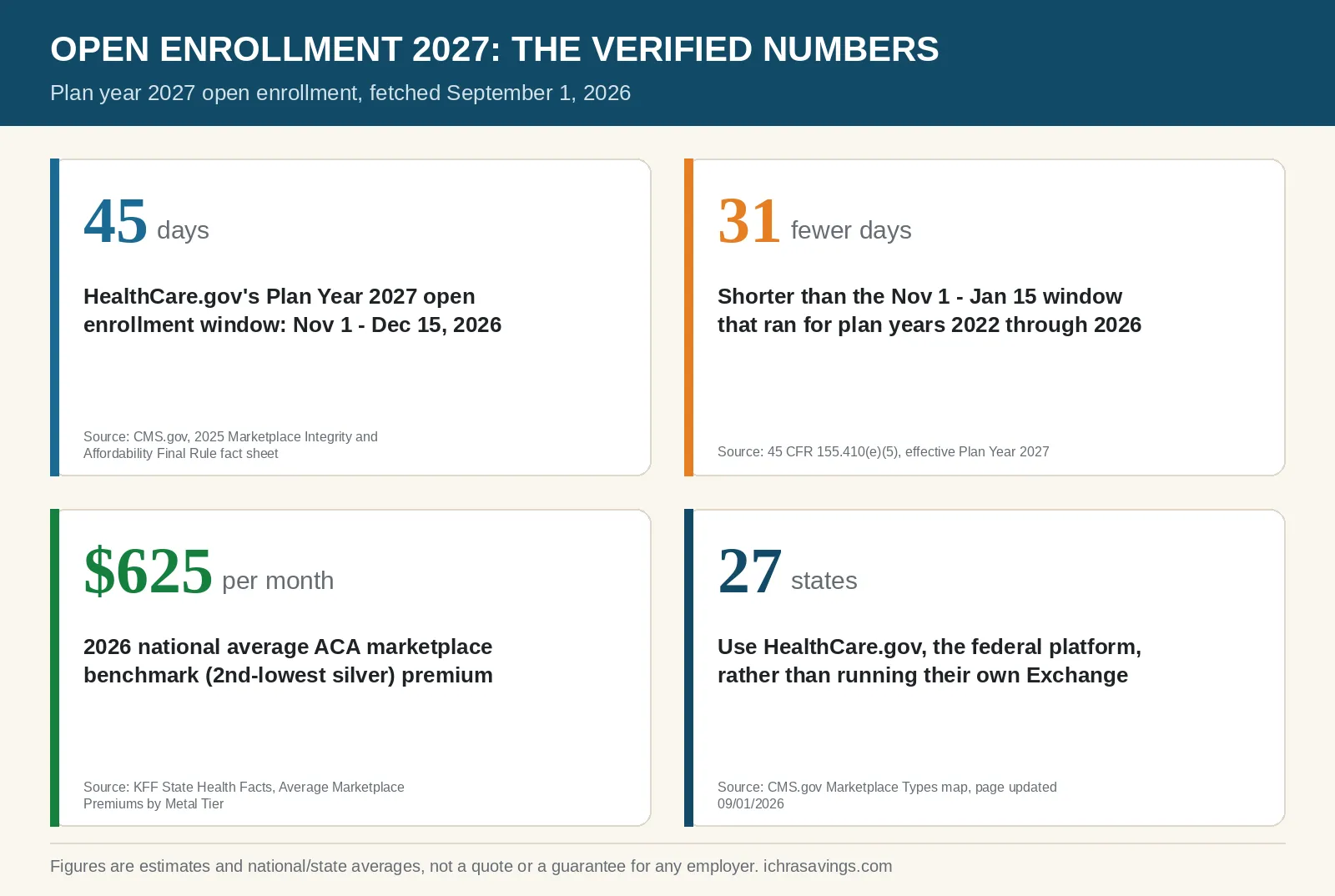
Missing open enrollment is not a fine; it is a coverage gap, and it is worth putting a real number next to that gap instead of leaving it abstract. The 2026 national average marketplace benchmark premium, the second-lowest-cost silver plan used to calculate premium tax credits, is $625 per month before any subsidy (KFF State Health Facts, Average Monthly Marketplace Premiums by Metal Tier, published October 2025 reflecting 2026 plan-year data, fetched this week; national average). Georgia's own state average sits at $615 per month and Ohio's at $513 per month on the same measure (same source).
An employee who is locked out of the individual market until the next annual window, because they missed the shorter one and do not have a qualifying event to open a special enrollment period, is not just facing an abstract inconvenience. They are facing months without a plan to apply an ICHRA reimbursement against, at a point where the benchmark cost of the coverage they are missing runs several hundred dollars a month nationally, more in some counties. Meanwhile, the ICHRA contribution you budgeted for that employee sits unused, because there is usually nothing to reimburse against without an active individual policy. Nobody collects that money; it simply does not do the job you set it aside to do.
The size of the gap also depends on which calendar applies to that employee. Under the old Nov 1 to Jan 15 window, a missed deadline in early December still left roughly six weeks of runway before the window closed. Under the new Nov 1 to Dec 15 window, that same early-December slip has already run out the clock. The compressed calendar does not just shorten the window; it shortens how long a mistake stays fixable inside it.
A rollout checklist that assumes the shorter window
None of this requires new software or a vendor relationship to execute. It requires treating the compressed calendar as the default, not an edge case.
- Confirm your state's exact 2027 dates before you build a calendar around them. FFM states already have Dec 15, 2026. SBM states, including Georgia, may not have published dates yet; check directly rather than assuming a repeat of last year.
- Send the 90-day notice with real margin, not the exact minimum. A notice that clears the 90-day floor by a week still leaves employees the tighter but faster 60-days-before window; a notice with real margin leaves you room to fix a mistake.
- Put the actual enrollment deadline, in calendar form, in a document separate from the legal notice. "60 days from your eligibility date" is correct and useless to an employee trying to plan a Tuesday afternoon. A specific date on a page gets used.
- Schedule a mid-window check-in, not just a final reminder. With roughly a month less runway on the federal platform, there is less time left to fix a straggler if you wait until the final week to check who has not enrolled.
- Treat SBM-state employees as a distinct group with their own risk. If Georgia Access has not published 2027 dates by the time you are finalizing your own calendar, build in a buffer rather than defaulting to "probably similar to last year."
- Confirm affordability and set the contribution amount before any of the above. The reimbursement level determines whether the employee's marketplace premium tax credit is affected, and it should be settled before the notice goes out, not adjusted after employees have already started shopping.
Write the actual date on the notice
If your company is entirely in an FFM state, you can put "enroll by December 15, 2026" on the notice today. That single sentence, with a real date instead of a formula, is the cheapest fix available for the entire problem this article describes.
Where employers get this wrong
The recurring failure pattern
- Assuming the January 15 deadline still applies. It does not, for plan years beginning 2027 onward, on any Exchange.
- Treating every state's dates as identical. A multi-state workforce can have employees on genuinely different calendars this cycle.
- Confusing the 90-day notice deadline with the marketplace enrollment deadline. Hitting one does not automatically mean the other is handled.
- Waiting for a state-run exchange to publish dates before planning anything. Build the calendar with a placeholder and a buffer instead of waiting until late fall to start.
- Sending one company-wide reminder instead of tracking individual deadlines. New hires and mid-year eligible employees can have entirely different windows than a day-one employee.
The rule did not get more complicated. It got faster. Most rollouts that miss the new window are not failing on the law; they are running on last year's clock.
Mike MooreCheck your county before you build any of this
Everything above assumes an ICHRA already makes sense for your business. That is a separate question from the enrollment calendar, and it depends on where your employees actually live, not on a national average or even a state average. Cobb County and Montgomery County, both in our dataset above, sit in the same country under the same new federal enrollment deadline and still land 47 percentage points apart on estimated savings. A compressed enrollment window is not worth planning around if the underlying county economics do not support an ICHRA in the first place.
Individual vs. small-group monthly benchmark, two counties
Estimated 2026 benchmark premiums, single adult. Not a projection for any specific employer.
Source: ICHRA Savings county dataset, src/data/qualified_counties.json, plan year 2026, cross-verified against CMS public-use marketplace files. Estimates, not quotes.
Ten minutes on the county map tells you whether the calendar work in this article is worth doing at all for your specific team. If your counties are marginal, that is your answer, and it costs you nothing to find out before building a rollout around a deadline that may not matter to your bottom line either way.
Where ICHRA Savings fits
Before anything else, check whether your county is one where an ICHRA estimate actually beats small group: ichrasavings.com/ichra-savings-map. That answer takes minutes. If the county math works in your favor, we help with the harder part: setting a contribution that clears the affordability test, structuring employee classes if you need them, and building the notice and enrollment calendar around the exact dates that apply to where your employees actually live, federal platform or state-run exchange.
If you want the mechanics before talking to anyone, start with how ICHRA works. If your renewal is already in hand and you are working against this year's compressed calendar, a short conversation now is worth more than another week of research on your own: ichrasavings.com/book.
Questions employers actually ask
When exactly is open enrollment for 2027 marketplace coverage?
On HealthCare.gov, the federal platform used by 27 states, open enrollment for plans effective January 1, 2027 runs November 1 through December 15, 2026 (CMS.gov, "2025 Marketplace Integrity and Affordability Final Rule" fact sheet). States that run their own Exchange, including Georgia, set their own dates within a federal floor: no later than November 1 to no later than December 31, capped at 9 weeks (45 CFR 155.410(e)(5)).
Why did the government shorten the open enrollment period?
CMS states the change is meant to reduce consumer confusion, align marketplace open enrollment more closely with the calendar most employer plans already use, encourage continuous coverage, and reduce adverse selection from people who wait until they need care to enroll (CMS.gov, 2025 Marketplace Integrity and Affordability Final Rule fact sheet). It is part of a broader rule published in the Federal Register on June 25, 2025.
Does the shorter window apply to every state, or just HealthCare.gov states?
The floor applies everywhere. 45 CFR 155.410(e)(5) requires every Exchange, federal or state-run, to hold its plan-year-2027 open enrollment no earlier than November 1, no later than December 31, and no longer than 9 weeks. Only the exact dates within that floor differ: CMS has set the federal platform at Nov 1 to Dec 15, while a state-run Exchange like Georgia Access can choose its own dates inside the same limits.
What are Georgia Access's 2027 open enrollment dates?
Not published as of September 1, 2026. Georgia Access ran its plan-year-2026 open enrollment from November 1, 2025 through January 15, 2026, a 76-day window (Office of Commissioner of Insurance and Safety Fire, press release, October 31, 2025). That window is now 13 days longer than the new 9-week federal maximum, so Georgia Access has to shorten it for 2027; the state has not yet said by how much.
Does this change my company's 90-day ICHRA notice deadline?
No, and the two should not be confused. Your notice deadline is a separate employer obligation under 26 CFR 54.9802-4, generally 90 days before your plan year starts. The marketplace open enrollment window is when your employees actually go shop for a plan once eligible. A shorter marketplace window means less room for a late notice to still work out, which is exactly why the two calendars now deserve to be planned together.
What happens if my employee misses the new, shorter open enrollment window?
Generally, they wait for the next annual open enrollment period unless a separate qualifying life event opens a special enrollment period for them. Because the 2027 window closes a full month earlier than employers may remember, this wait is now easier to trigger by accident. An employer offering a new ICHRA mid-year has a separate safety net: gaining ICHRA access is itself a qualifying event under 45 CFR 155.420(d)(14), which we cover in detail in our special enrollment period guide.
Is the annual open enrollment period the same thing as a special enrollment period?
No. Open enrollment is the one annual window, now shortened under 45 CFR 155.410(e)(5), that applies to anyone regardless of circumstance. A special enrollment period is a separate, narrower window tied to a specific qualifying event, such as gaining ICHRA eligibility, losing other coverage, marriage, or a birth. An ICHRA rollout can trigger its own SEP outside the annual window, but every employee still needs to understand which clock applies to their own situation.
Sources
- 45 CFR § 155.410(e)(4)-(5), annual open enrollment period, plan years 2022-2026 and 2027 onward — law.cornell.edu/cfr/text/45/155.410
- CMS.gov, "2025 Marketplace Integrity and Affordability Final Rule" fact sheet — cms.gov/newsroom/fact-sheets/2025-marketplace-integrity-and-affordability-final-rule
- 90 FR 27074, Patient Protection and Affordable Care Act; Marketplace Integrity and Affordability, Federal Register, June 25, 2025
- CMS.gov, Marketplace Types map (FFM / SBM-FP / SBM by state), page last modified 09/01/2026 — cms.gov/marketplace/in-person-assisters/training-webinars/training/marketplaces-map
- Office of Commissioner of Insurance and Safety Fire, Georgia, "Georgia Access Opens its 2026 Open Enrollment Period," October 31, 2025 — oci.georgia.gov/press-releases/2025-10-31
- Georgia Access homepage, fetched September 1, 2026 (2027 dates not yet published) — georgiaaccess.gov
- KFF State Health Facts, Average Monthly Marketplace Premiums by Metal Tier, 2026 plan year — kff.org/affordable-care-act/state-indicator/average-marketplace-premiums-by-metal-tier
- 26 CFR § 54.9802-4, Individual Coverage HRA notice requirement — law.cornell.edu/cfr/text/26/54.9802-4
- 45 CFR § 155.420(d)(14), special enrollment period for HRA offer as a qualifying event — law.cornell.edu/cfr/text/45/155.420
- ICHRA Savings county dataset, src/data/qualified_counties.json, plan year 2026, cross-verified against CMS public-use marketplace files
- ICHRA Savings, "ICHRA for 2027: Your Notice Deadline Is October 3," internal reference — ichrasavings.com/blog/ichra-2027-notice-deadline
- ICHRA Savings, special enrollment period guide, internal reference — ichrasavings.com/blog/ichra-special-enrollment-period-2026