73% of Small Employers May Drop Group Coverage in 2027
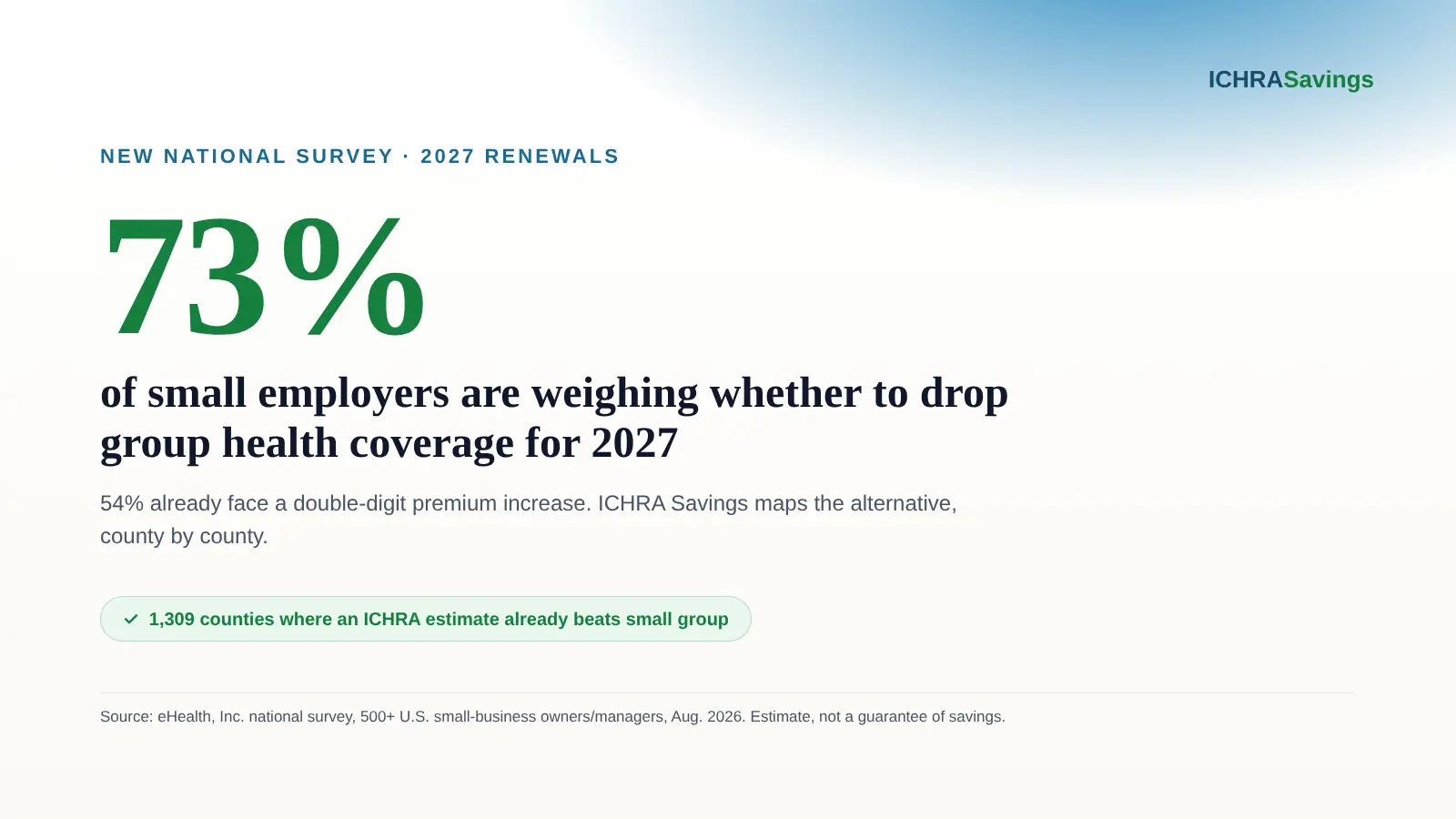
A new survey finds 73% of small employers are weighing whether to drop group health coverage for 2027. See the ICHRA alternative and your county numbers.
The short version
- 54% of small employers offering group coverage face a double-digit 2027 premium increase; 73% are considering dropping coverage entirely (eHealth, Sept. 2026).
- The IRS affordability bar keeps rising too: 10.22% of household income for 2027 plan years, up from 9.96% for 2026 (Rev. Proc. 2026-26).
- Dropping coverage is not the only alternative to absorbing the renewal. An ICHRA lets you keep offering a real benefit on a budget you set.
- Whether it saves you money is a county question, not a national one — it works in 1,309 U.S. counties and not in others.
What small employers just told eHealth
If your 2027 renewal letter already landed and the number made you wince, you are not imagining a trend. A national survey of more than 500 U.S. small-business owners and managers at companies with 500 or fewer employees, fielded by eHealth, Inc. between August 24 and 28, 2026 and published September 16, 2026, found that 54% of businesses currently offering group health coverage face a double-digit premium increase for 2027, and more than one in five face an increase of 15% or more. Eighty percent of employers facing a hike said they were surprised by its size, including 44% who called themselves "very surprised."
The headline number is what employers say they're weighing in response: 73% of businesses that currently offer group coverage are considering dropping traditional health insurance benefits for 2027, with cost cited as the primary reason. That is not a fringe reaction. It sits alongside 72% of employers reporting at least one point of real dissatisfaction with their current plan — high premiums, unpredictable year-to-year costs, and the difficulty of finding one plan that fits a whole team — and 79% who say administering group coverage is a burden on its own, separate from the price.
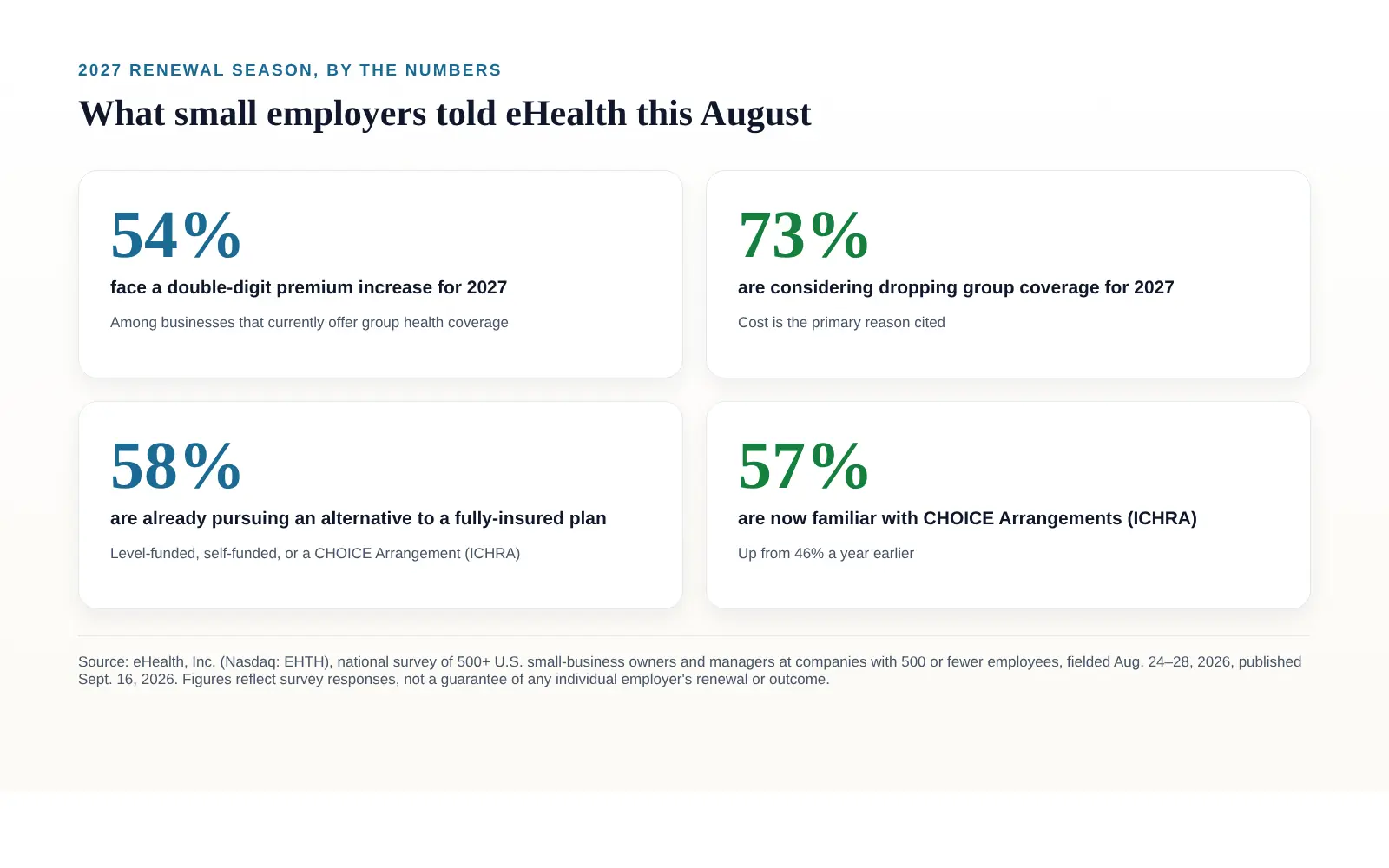
Two more findings matter for what comes next in this article. First, employers are not just complaining, many are already moving: 58% say they are already pursuing some alternative to a fully-insured group plan, whether that's level-funded, self-funded, or an Individual Coverage HRA. Second, awareness of the ICHRA option specifically is climbing fast. eHealth found 57% of small- to mid-sized employers are now familiar with CHOICE Arrangements — the name CMS and the SBA began using for the ICHRA starting in September 2026, which we cover in detail in our rename explainer — up from 46% a year earlier.
| Finding | Share of respondents |
|---|---|
| Face a double-digit 2027 premium increase | 54% |
| Face an increase of 15% or more | More than 1 in 5 |
| Surprised by the size of their increase | 80% |
| Considering dropping group coverage for 2027 | 73% |
| Already pursuing an alternative to fully-insured coverage | 58% |
| Familiar with CHOICE Arrangements (ICHRA), up from 46% a year earlier | 57% |
Source: eHealth, Inc., national survey of 500+ U.S. small-business owners and managers at companies with ≤500 employees, fielded Aug. 24–28, 2026, published Sept. 16, 2026.
Why the renewal keeps climbing
None of this is random. Two separate mechanisms are pushing in the same direction at once, and understanding both explains why "wait for next year to be better" is not a strategy.
The first is ordinary small-group rating. A fully-insured small-group plan prices your renewal against your group's claims experience and the carrier's broader block of business in your state. When medical costs and utilization rise across that whole block, every small employer in it shares the increase, whether or not your own team had a quiet year. There is no individual-level negotiation available to you; the renewal is a number handed down, not a quote you can shop down to zero.
Small-group plans are priced by rating area, not by your individual company's claims history the way a self-funded plan might be. A carrier files one set of rates for every small employer inside a given rating area — often a multi-county region set by the state insurance department — and every group in that area absorbs the same percentage move at renewal. That is why a quiet claims year for your own team rarely translates into a quiet renewal: you are not being rated alone, you are being rated with everyone else buying the same kind of plan in the same region. Medical trend (the underlying rise in the price and volume of care) and pharmacy costs move the whole pool at once, and the renewal simply distributes that movement across every policyholder in it.
The second mechanism is the federal affordability math that decides whether any employer-sponsored plan, including an ICHRA, counts as "affordable" under the ACA. The IRS sets a Required Contribution Percentage each year: the share of an employee's household income they can be required to pay for self-only coverage before that coverage stops counting as affordable, and before the employee becomes eligible to decline it and claim a marketplace premium tax credit instead. For plan years beginning in 2027, the IRS set that figure at 10.22%, up from 9.96% for plan years beginning in 2026 (Rev. Proc. 2026-26 and Rev. Proc. 2025-25, respectively — we walk through the full mechanics, including the three safe harbors (W-2 wages, rate of pay, and federal poverty line), in our 2027 affordability guide). A rising percentage sounds like it should make coverage easier to call "affordable," and technically it does, the dollar ceiling an employee can be asked to pay goes up right along with it. But it moves in the same direction as rising premiums precisely because both are indexed to the same underlying cost trend. The ceiling is rising because the floor is rising.
IRS Required Contribution Percentage, by plan year
The affordability bar employer-sponsored coverage, including an ICHRA, is measured against.
Source: IRS Rev. Proc. 2025-25 (2026) and Rev. Proc. 2026-26 (2027), Required Contribution Percentage under Code §36B(c)(2)(C)(i)(II). National figure, not geography-specific.
What dropping coverage actually costs
Dropping group coverage stops the bill. It is worth being honest about what it also stops. Among businesses in eHealth's survey that don't currently offer a group plan, 65% said they would like to but can't afford it — which is a strong signal that going to zero is usually the affordable option, not the preferred one. A benefit that disappears is a real cost: in a tight labor market it shows up in recruiting, and for existing staff it shows up in the renewal conversation you have to have with them instead of with a carrier.
If your company has fewer than 50 full-time-equivalent employees, you are not subject to the ACA's employer mandate and dropping coverage carries no federal penalty. If you cross that threshold, the math changes; see our 50-employee mandate guide for the penalty structure.
There is also a cost that doesn't show up on any renewal invoice: what happens to the employee who loses coverage with no replacement. Someone who has leaned on your group plan for a decade has likely never shopped the individual market, never compared a benchmark plan to a bronze plan, and has no idea what a premium tax credit is or whether they qualify for one. If your company drops coverage with no ICHRA or stipend behind it, that employee is on their own at exactly the moment a government-run marketplace subsidy they may or may not understand becomes their only lever. We cover what changed on that side of the equation, including the 400%-of-poverty-line "subsidy cliff" that returned after enhanced ACA subsidies expired, in our subsidy cliff explainer. None of that is a reason to keep paying an uncapped renewal you can't afford. It is a reason to look at the option between absorbing and dropping before you pick either one.
Recruiting is the other place "we offer nothing" shows up, more slowly but just as really. A benefit line on a job posting is a competitive signal candidates read before they ever talk to you, and a budget of any size, even a modest one, is a real benefit at that stage. Going from "we offer coverage" to "we offer nothing" is a visible downgrade to anyone comparing offers, in a way that absorbing a renewal for one more year is not. "Drop it" and "absorb it" are not the only two options on the table, which is the point of the next section.
The three paths, worked out
Every employer facing a renewal like this is really choosing among three responses, and each one does something different to next year's budget.
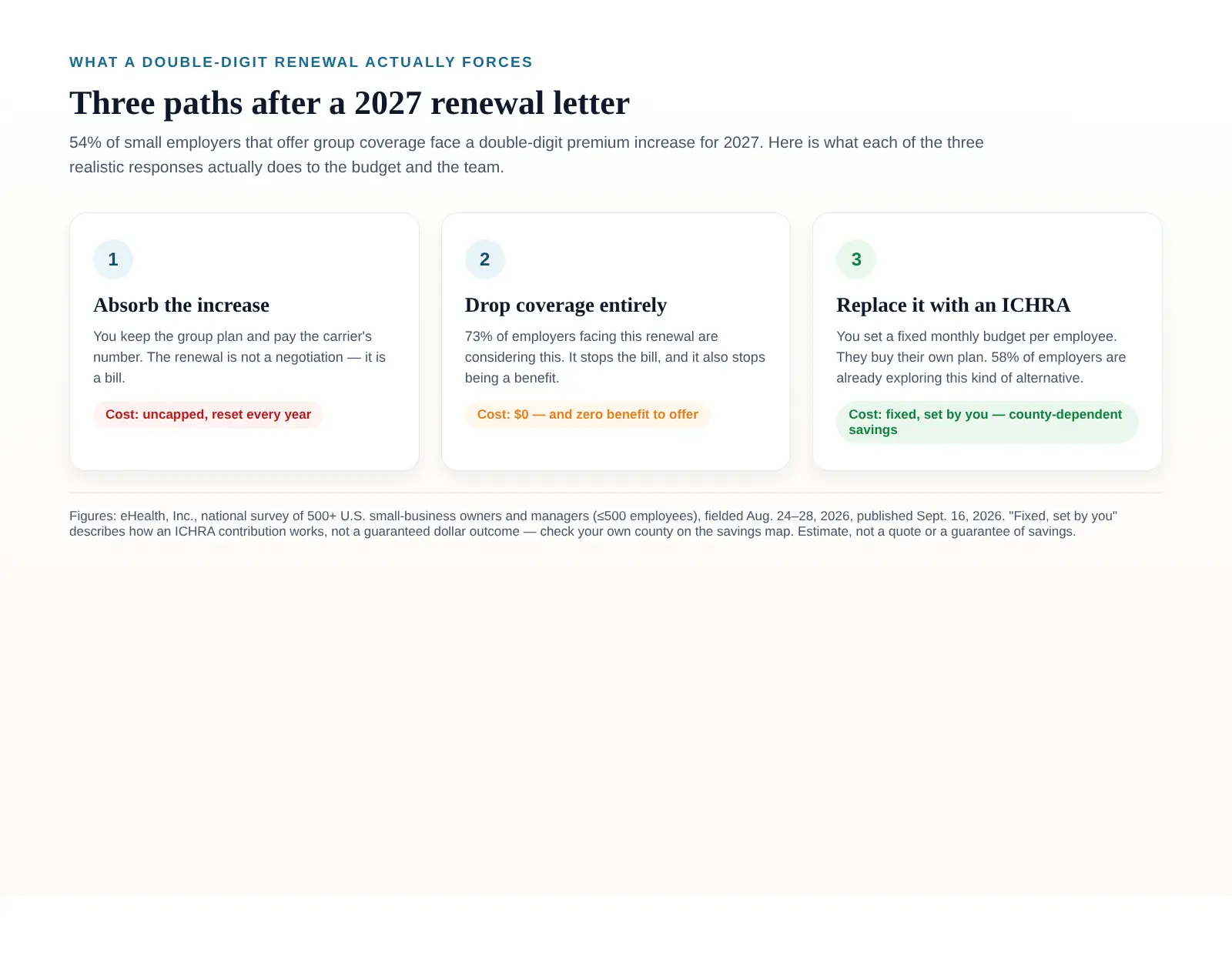
Absorb the increase
You keep the group plan and pay the carrier's number. The cost is uncapped and resets every renewal.
Drop coverage entirely
The bill stops. So does the benefit — and 65% of employers without one say they'd add one if they could afford it.
Replace it with an ICHRA
You set a fixed monthly contribution per employee. They buy their own plan. Whether it saves money depends on your counties.
The third path is the one eHealth's data says is gaining ground fastest — 58% of employers already exploring some alternative to fully-insured coverage, and rising familiarity with the ICHRA structure specifically. But "gaining ground" is not the same as "right for your team." That depends entirely on the next section.
It helps to see the shape of each path over more than one renewal cycle, since the real damage of absorbing a double-digit increase compounds. The figures below are illustrative, not a projection of your actual costs, to show the shape of the three paths side by side.
| Path | Year 1 | Year 2 (at a 12% renewal) | Employer controls the number? |
|---|---|---|---|
| Absorb the increase | $700/mo | $784/mo | No — set by the carrier |
| Drop coverage entirely | $0 | $0 | N/A — no benefit offered |
| Replace with an ICHRA | Contribution you set | Same, until you change it | Yes — set by the employer |
Illustrative only, built from a round $700/employee/month starting premium and the 12% year-two renewal eHealth reported as the threshold for a "double-digit" increase. Not a quote, a projection, or a guarantee of any employer's actual costs.
How to check your own county before you decide
An ICHRA saves money relative to small group when the individual-market benchmark premium where your employees live sits below the small-group benchmark premium for a comparable plan. That comparison is county-specific, not national, so the honest first step is pulling your team's home counties and checking each one, not reading a national percentage and assuming it applies to you.
Two real examples from the 2026 plan-year dataset show how differently this plays out even within states that qualify overall.
| County | Est. savings | Per employee / year | 12 employees / year |
|---|---|---|---|
| Franklin County, Ohio (Columbus) | 59.6% | $10,624 | $127,493 |
| Dougherty County, Georgia (Albany) | 52.4% | $8,754 | $105,044 |
| Penobscot County, Maine (Bangor) — marginal example | 0.0% | $3 | $32 |
2026 plan year. Individual-market benchmark compared against small-group benchmark, both
for a representative 50-year-old enrollee. Source: src/data/qualified_counties.json,
Ideon rate data cross-verified against CMS public-use marketplace files. Estimates, not
quotes or a guarantee of savings.
Penobscot County is the honest example, not the pitch
Penobscot County, Maine technically "qualifies" for our dataset, individual-market rates sit a hair below small-group rates there, but the gap rounds to about $3 a year per employee. That is not a reason to switch anything. It is the clearest illustration on this page of why the 20% to 62% savings range only applies in the counties where the gap is real, and why you check your own county instead of trusting a headline number.
Before anything else, spend the ten minutes: check whether your own counties are one of the 1,309 where the gap is real, or closer to Penobscot's rounding error. Check your county on the savings map.
Modeling affordability before you set a contribution
A strong county gap tells you an ICHRA can be cheaper than small group. It does not, on its own, tell you what to actually set as the contribution amount. That number has to clear the IRS affordability test for every employee you offer it to, or each of them loses eligibility for a premium tax credit even if your contribution doesn't fully cover their plan. Here is the arithmetic, worked out plainly.
Take an employee earning $45,000 a year in household income. Under the 10.22% Required Contribution Percentage that applies to plan years beginning in 2027, the most they can be required to pay out of pocket for self-only coverage, under the W-2 safe harbor, before the offer stops counting as affordable, is:
The math
$45,000 × 10.22% ÷ 12 months = $383.25 per month
For the same employee under the 9.96% threshold that applied to plan years beginning in 2026, the ceiling was $373.50 per month — about $9.75 less room than 2027 allows.
If the lowest-cost silver benchmark plan available to that employee costs more than your ICHRA contribution plus $383.25, the offer is unaffordable for them under this safe harbor, and they remain eligible to decline it and keep shopping the marketplace with their premium tax credit intact. If it costs less, the offer is affordable, and accepting or even just being offered it generally means waiving that credit for the months the offer applies. This is why "set a generous number and hope" is the most common way ICHRA rollouts go wrong: the contribution has to be modeled against each employee's income and your county's actual benchmark premium, not picked as a round number that feels fair.
Two other safe harbors exist if you'd rather not collect household income: the rate of pay safe harbor (based on wages, not full household income) and the federal poverty line safe harbor (a single fixed dollar ceiling that applies to every employee regardless of actual pay, useful for a workforce with wide income variation). Each has different tradeoffs, and we walk through all three with worked numbers in the full affordability guide. Whichever you use, model it before you announce a number, not after.
Where this isn't the answer yet
A page that only shows you the counties where this works would not be worth trusting. It does not work everywhere, and admitting that plainly is part of the data, not a hedge. As of the 2026 plan year, the individual market has not closed the gap on small group in every state: we found zero qualifying counties in Florida, only two of 254 counties in Texas, and zero counties in South Dakota. If your team is concentrated in markets like those, an ICHRA is very unlikely to beat your renewal this year, whatever the national survey numbers say about rising interest. Absorbing the increase, or shopping a level-funded alternative, may be the more honest answer for 2027.
How ICHRA Savings helps
We built the county-level dataset behind this article because "it depends on your county" is a real answer, not a dodge, and most employers have no fast way to check it. The savings map lets you look up your own counties in about ten seconds, using the same 2026 benchmark data used throughout this article. If the numbers look promising, we help design the ICHRA itself: the employee classes, the affordability modeling against the 10.22% threshold, the required notice timeline, and the rollout. If your counties don't qualify, we'll tell you that too — see how ICHRA works for the mechanics before you talk to anyone.
None of that replaces your own tax advisor or benefits attorney, and it shouldn't. What we add is the part most brokers and most AI chat answers skip: a real, dated, sourced number for your specific county instead of a national range that happens to include your state. Ohio and Georgia employers come up often in our own data because both states currently show wide, consistent gaps across most of their counties — all 88 of Ohio's counties clear a $100-a-month benchmark gap as of the 2026 dataset, and 131 of Georgia's 159 counties do too. If your team sits in either state, that is worth checking first; if your team sits somewhere else, the map answers the same question for any U.S. county.
Seventy-three percent considering a change is a real number. It is not a reason to act before you know what your own counties say.
Mike MooreWhat you get from checking first
Reacting to the renewal
- National survey numbers you can't apply to your own budget
- A choice that feels binary: absorb it or drop it
- No sense of whether your specific counties even qualify
A county-specific answer
- A real estimate for your actual counties, not a national average
- A third option between absorbing and dropping, if your counties qualify
- An honest "no" if they don't, before you spend a meeting on it
If your 2027 renewal is already in hand and you're on a deadline, it's worth a direct conversation: book time to walk through your numbers. If you're earlier in the process, start with the map, it costs nothing and commits you to nothing.
Questions employers are asking right now
Is it really true that 73% of small employers are considering dropping group coverage for 2027?
That figure comes from eHealth's survey of more than 500 U.S. small-business owners and managers at companies with 500 or fewer employees, fielded August 24-28, 2026 and published September 16, 2026. Among businesses that currently offer group health coverage, 73% said they are considering dropping traditional health insurance benefits for 2027, with cost cited as the primary motivator. It's a survey finding, not a prediction about any specific employer, and eHealth is itself a health-insurance marketplace company, so read the figure as industry-reported sentiment rather than a government statistic.
What does a 'double-digit increase' actually mean in dollars for a small employer?
It depends entirely on your current premium and your headcount, which is exactly why a national percentage is hard to act on. A 12% increase on a $700-a-month-per-employee plan is roughly $84 more per employee per month, or just over $1,000 a year, before you multiply by headcount. eHealth's survey found 54% of businesses offering group coverage face a double-digit increase for 2027, and more than one in five face 15% or more. Pull your actual renewal letter and run the real number for your team instead of applying a national average to your own budget.
Can we just drop group coverage and offer nothing instead?
You can, legally, if you're not subject to the ACA's employer mandate (generally under 50 full-time-equivalent employees). But 'nothing' is a real benefits decision with real consequences: 65% of businesses that don't currently offer a group plan told eHealth they'd like to but can't afford it, which suggests going to zero isn't usually the preferred outcome, just the affordable one. An ICHRA is the option in between — you keep offering a real, tax-free benefit, you just stop setting the budget by what the carrier bills you.
Does an ICHRA cost more to administer than a group plan?
It's a different kind of administration, not necessarily more of it. Group coverage means shopping renewals, managing a census, and negotiating with a broker or carrier every year. An ICHRA means setting a contribution, sending a notice at least 90 days before the plan year starts, and running reimbursement and substantiation, often through a third-party administrator. eHealth's survey found 79% of small employers already see running their group plan as a burden (41% called it a 'huge burden'), so the comparison isn't administration versus none. It's which administration you'd rather own.
What happens to our employees' ACA premium tax credits if we switch to an ICHRA?
An employee who is offered an ICHRA that counts as affordable generally has to waive their premium tax credit for any month that offer applies, whether they accept the ICHRA or not. Affordability is measured against the IRS Required Contribution Percentage, which is 10.22% of household income for plan years beginning in 2027 (Rev. Proc. 2026-26), up from 9.96% for 2026 (Rev. Proc. 2025-25). Model this before you set a contribution amount for anyone currently receiving a marketplace subsidy — it is the single most consequential number in the whole decision.
Will an ICHRA actually save our business money, or does that depend on where people live?
It depends on where your employees live, full stop. An ICHRA saves money relative to small group where the individual-market benchmark premium in that county runs below the small-group benchmark. As of the 2026 plan year, that's true in 1,309 U.S. counties by our count, with savings estimated from 20% to 63% in the strongest counties — and it is not true everywhere. Some states, including Florida and most of Texas, currently show the opposite pattern. A national average will mislead you either direction; check your specific counties.
What is a CHOICE Arrangement, and is it the same thing as an ICHRA?
Yes. In September 2026, CMS and the SBA began referring to the Individual Coverage HRA as the "CHOICE Arrangement" in public materials, though the underlying federal rule has not changed. eHealth found 57% of small- to mid-sized employers are now familiar with CHOICE Arrangements, up from 46% a year earlier. We cover exactly what changed, and what didn't, in our CHOICE Arrangement rename article.
We're facing a 2027 renewal right now. What's the fastest way to know if an ICHRA would help?
Pull your team's home counties, and check each one on the savings map before you do anything else. It takes about ten minutes and tells you whether the rest of this decision is worth a meeting. If your counties are strong, the next step is modeling affordability and a rollout timeline. If they're marginal or negative, you have your answer, and absorbing the renewal or shopping level-funded alternatives may be the more honest path for this year.
Sources
- eHealth, Inc., "Survey: 54% of Small- to Mid-Sized Businesses Report Double-Digit Health Plan Premium Increases for 2027" (Sept. 16, 2026) — national survey of 500+ U.S. small-business owners and managers, fielded Aug. 24–28, 2026
- Selfemployed.com, "Survey: Most Small Firms Face Double-Digit Health Cost Hikes" — corroborating trade coverage of the eHealth release
- IRS Revenue Procedure 2026-26 — Required Contribution Percentage, plan years beginning in 2027 (10.22%)
- IRS Revenue Procedure 2025-25 — Required Contribution Percentage, plan years beginning in 2026 (9.96%)
- County-level premium comparison:
src/data/qualified_counties.json, 2026 plan year (Ideon rate data, cross-verified against CMS public-use marketplace files) - ICHRA Savings, "ICHRA Affordability Jumps to 10.22% for 2027" — full affordability mechanics and worked examples
- ICHRA Savings, "ICHRA Is Now the CHOICE Arrangement: 2026 Federal Rename"
- ICHRA Savings, "ICHRA and the ACA Mandate: The 50-Employee Rule"
- ICHRA Savings, "ICHRA in Florida 2026: Why Zero Counties Qualify"
- ICHRA Savings, "ICHRA in Texas 2026: Why Only Two Counties Qualify"
- ICHRA Savings, "ICHRA in South Dakota 2026: Zero Counties Qualify"