ICHRA for Families: Spouse and Dependent Coverage in 2026
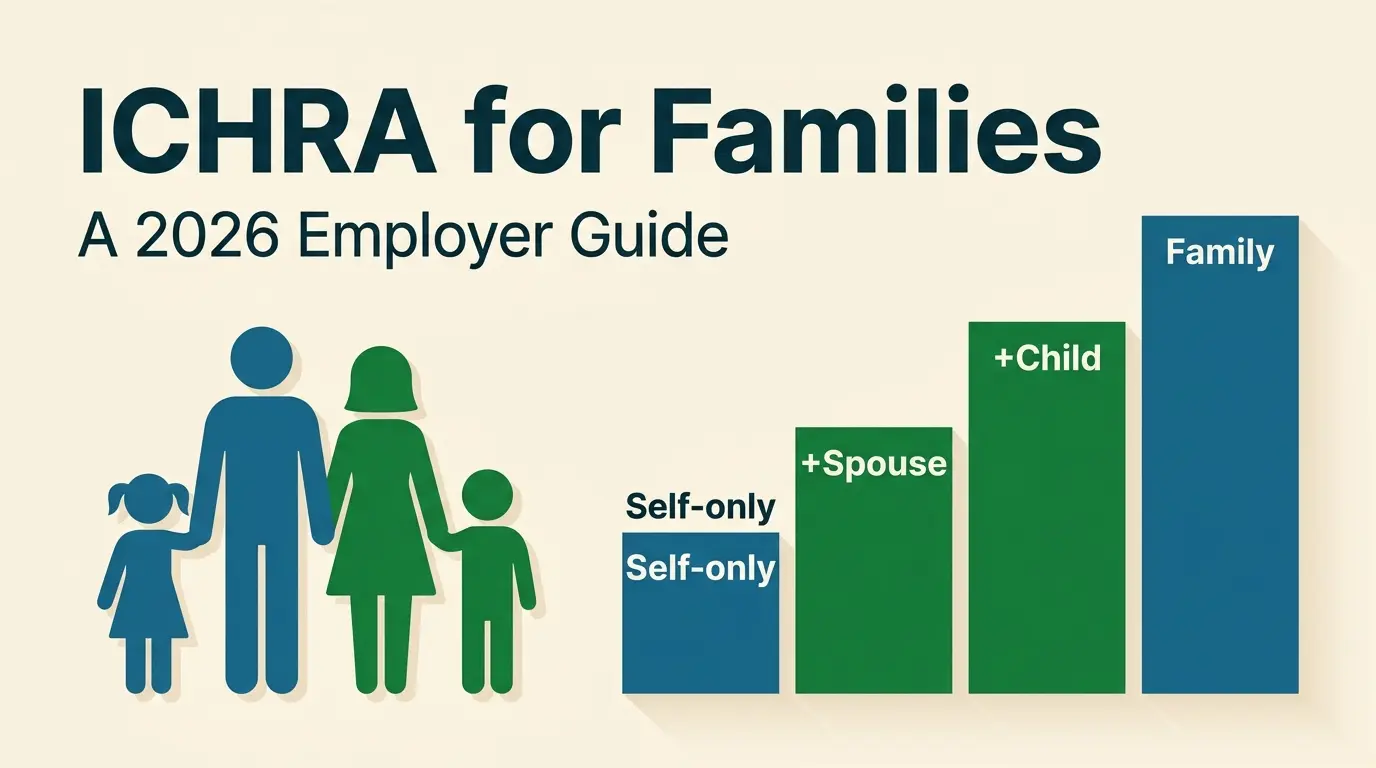
An ICHRA can cover your employee's spouse and kids. The 2026 federal rule lets you vary the budget by family size. Here is the math, sourced.
The short version
- An ICHRA can reimburse a spouse's and dependents' premiums, but only if the plan document says so and they are enrolled in their own individual coverage.
- You can legally pay more for a bigger family. The federal rule allowing it has no ratio cap, unlike the 3:1 cap on age variation.
- The affordability test always uses the self-only amount you make available, even when you also fund a richer family tier.
- A family premium is not the self-only rate times the headcount. Carriers sum each covered member's own age-rated premium.
- New dependents mid-year get the class amount or a pro-rated amount, your choice, decided in writing before the plan year starts.
Does an ICHRA cover a spouse and kids?
Yes, an Individual Coverage HRA (ICHRA) can reimburse premiums for an employee's spouse and dependents, tax-free, in addition to the employee's own coverage. It is not automatic. The employer's ICHRA plan document has to extend eligibility to the spouse and dependents by name, and each of them has to be enrolled in their own individual health insurance coverage, the kind sold on or off an ACA exchange, for their expenses to qualify for reimbursement. If the plan document only names the employee, a spouse's premium is not reimbursable, no matter how the employee understood the offer at hire.
That single fact is the one most HR teams and most new ICHRA employers get wrong on day one, and it is where this guide starts.
Why this trips up almost every first-time employer
Small-group insurance trains everyone to think in tiers: employee-only, employee-plus-spouse, employee-plus-children, family. The carrier sets those tiers and prices them. You pick a plan, and the family math is the carrier's problem.
An ICHRA removes the carrier from that part of the decision and hands it to you. You are now the one deciding whether a 24-year-old single hire and a 46-year-old parent of three get the same monthly dollar amount or different ones, and if different, how different, and whether that is even legal. Most employers have never had to answer that question before, because a group carrier always answered it for them.
The honest answer is: it is legal to vary the amount, there is a specific federal rule that tells you how, and the rule is more permissive on family size than most people assume. The rest of this article is that rule, in plain language, with the math worked out.
The three things that actually decide it
Three pieces of paper, in effect, decide what an employee's family gets under your ICHRA.
The ICHRA plan document
States which classes of employees are offered the ICHRA, whether dependents are eligible, and the dollar schedule by family size and age, if any.
The employee's individual policy
Shows who is actually enrolled and covered — the employee alone, or the employee plus a named spouse and children.
The substantiation record
The proof of coverage and the premium amount the employee submits each period, which is what the reimbursement is actually paid against.
A "class of employees" is the IRS term for the group an employer defines to offer the ICHRA to on uniform terms — full-time, part-time, salaried, by state, and so on. "Dependent" for this purpose generally means the employee's spouse and children who are enrolled in the individual coverage the ICHRA is designed to reimburse. We cover the eleven permitted class types and the age-banding rules in a separate guide; this one stays focused on dependents and family size.
The phrase doing most of the legal work here is "same terms." Every ICHRA has to be offered to all the participants in a class on the same terms — same dollar amount, same conditions — with two carved-out exceptions written directly into the regulation: the amount is allowed to increase with the number of covered dependents, and it is allowed to increase with age, each under its own rule. Everything else about the offer still has to be identical within the class. An employer cannot, for example, offer dependent coverage to some full-time employees and not others in the same class, or apply the family-size schedule to some participants and a hand-picked number to others. The class is the unit the rule is written around, not the individual employee.
That is also why defining classes carefully matters more once you add dependent variation. A class that is too broad — say, every employee in the company, regardless of role or location — forces one family-size schedule onto people in very different individual markets. A narrower class, split by full-time and part-time status or by state, lets the schedule track local cost more closely. Neither choice is required by the dependent-variation rule itself; it is a design decision that sits on top of it.
Can you legally pay more for a bigger family?
Yes. The regulation is explicit about it. Under 26 CFR 54.9802-4(c)(3)(iii)(A), an HRA does not fail to be treated as offered "on the same terms" to a class of employees solely because the maximum dollar amount made available increases as the number of a participant's covered dependents increases, so long as the same maximum dollar amount attributable to the increase in family size is made available to every participant in that class with the same number of dependents covered by the HRA.
Two things follow from that sentence. First, variation by family size is allowed outright — this is not a gray area or an aggressive interpretation, it is the plain text of a current federal regulation. Second, the only real constraint is uniformity: every employee in the class with, say, two covered dependents has to get the same dollar amount as every other employee in that class with two covered dependents. You cannot negotiate a bigger number for one employee's family and a smaller one for an otherwise identical family down the hall.
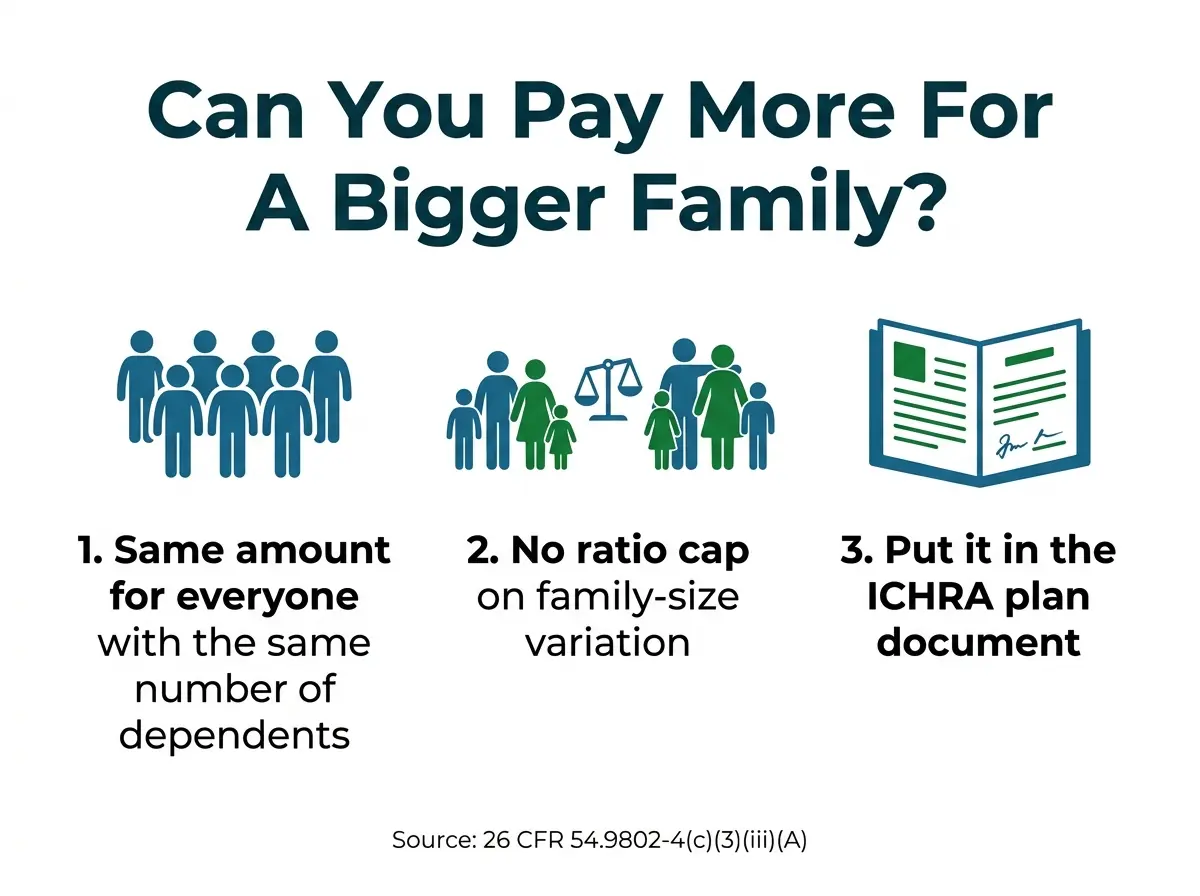
| Dimension | Family-size variation | Age variation |
|---|---|---|
| Legal basis | 26 CFR 54.9802-4(c)(3)(iii)(A) | 26 CFR 54.9802-4(c)(3)(iii)(B) |
| Ratio cap | None stated in the regulation | Oldest participant's amount capped at 3x the youngest's |
| What must stay equal | Same amount for every participant in the class with the same number of dependents | Same amount for every participant in the class who is the same age |
| Can you combine both? | Yes — the two variations are independent and can be layered in the same class. | |
| Where to read more | ICHRA Employee Classes 2026: The 11 Types, Explained | |
No ratio cap does not mean no limit
The absence of a stated ratio cap for family-size variation does not mean an employer can set an arbitrary or punitive schedule. The uniformity requirement still applies in full, the amounts still have to be documented in the plan terms before the plan year starts, and Section 105(h) nondiscrimination testing still applies if the plan is self-insured and favors highly compensated employees. Work the actual schedule through with a benefits attorney before you finalize it.
Why a family's premium isn't just the self-only rate times four
Before you can size a family tier sensibly, it helps to understand how carriers actually price family coverage, because it is not what most people assume.
Under 45 CFR 147.102(c)(1), the ACA's per-member rating rule, a carrier determines the total premium for family coverage by summing the individually age-rated premium for each covered family member, with one cap: for family members under age 21, no more than the three oldest covered children are counted. A 50-year-old employee, a 46-year-old spouse, and two kids do not get billed at some single "family rate." Each person is priced on their own age, and the four numbers are added together, with a ceiling that stops large families from paying for a fifth, sixth, or seventh child's slice of the premium.
The practical consequence for an employer: your own 50-year-old self-only benchmark premium tells you nothing about what a spouse or a child would add. A spouse close in age to the employee adds roughly another adult-sized premium; children, who are rated far more cheaply than adults in most states, add less each, and the three-child cap means a fourth or fifth child costs the family nothing extra in premium terms. This is also why a flat per-dependent dollar amount, rather than one single "family rate," tends to track the underlying cost structure more closely than a single flat family number would.
The affordability test still only looks at self-only
Here is the mistake with the most expensive downside: assuming that a bigger family contribution buys an employer more room on the ICHRA affordability test, or that a smaller one costs the employer affordability margin. It does neither.
The required-contribution methodology the Treasury Department and the IRS set out in IRS Notice 2018-88 defines the employee's required HRA contribution as the excess of (1) the monthly premium for the lowest-cost silver plan for the employee for self-only coverage in the employee's rating area, over (2) "in general, the self-only amount the employer makes available to the employee under the individual coverage HRA for the month." Not the family amount. The self-only amount, even for an employee who is also receiving a much larger family-tier contribution for a spouse and kids.
That detail matters because it means the family-size design decision and the affordability design decision are almost entirely separate problems. You can be generous on the family tier without touching your affordability math, and you cannot shore up a marginal affordability position by being generous on the family tier either. We walk through the three affordability safe harbors, and the FPL threshold they use, in a dedicated guide; this article is about what happens once affordability is already settled.
What this costs you if you get it backwards
An employer who assumes family money counts toward affordability may under-fund the self-only amount, believing the family contribution covers the gap. It does not. The result is an ICHRA that looks affordable on a spreadsheet but fails the actual federal test, which can expose the employer to an employer shared-responsibility payment under Section 4980H if the employer is an applicable large employer, and can wrongly tell employees they have lost premium tax credit eligibility when the offer was never affordable to begin with.
A worked example: Warren County, Ohio
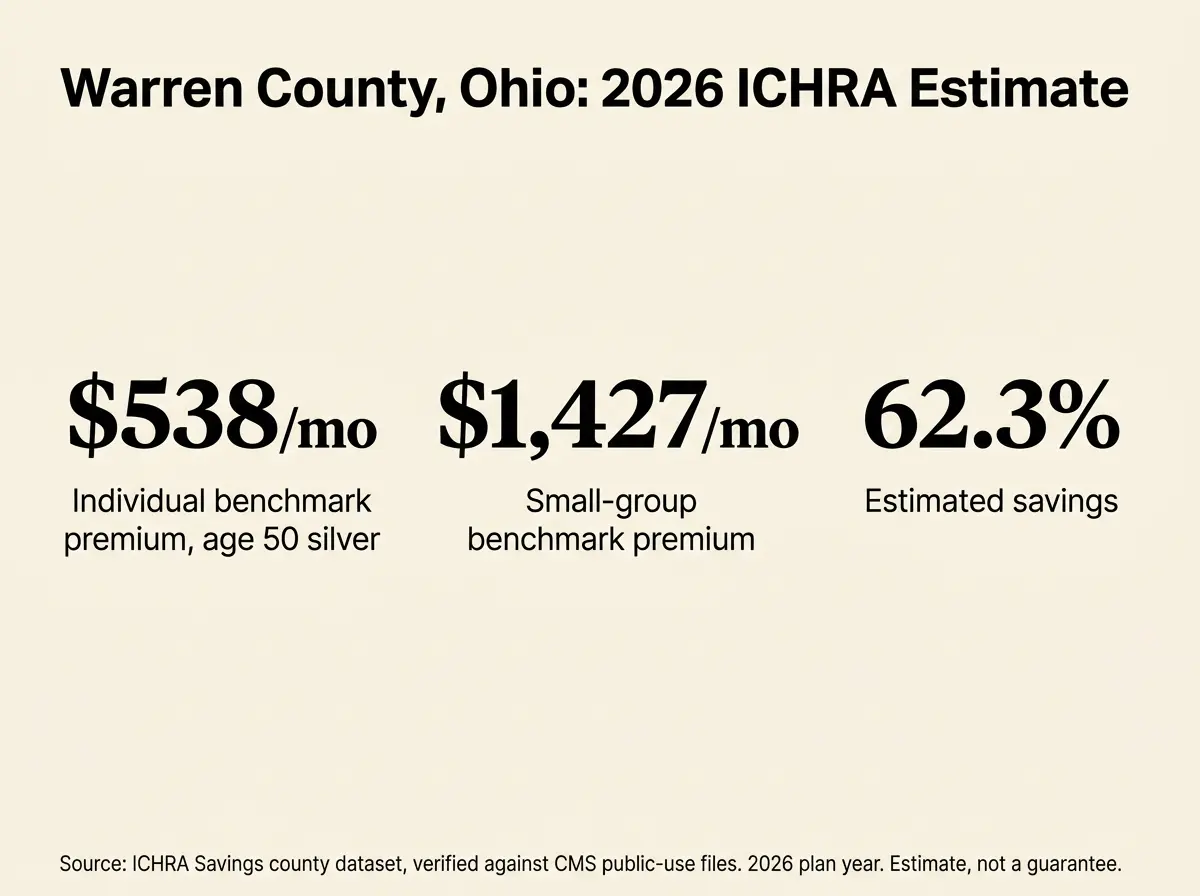
Here is how the two rules, family-size variation and the self-only affordability basis, work together in practice. Warren County, Ohio's 2026 benchmark: the self-only, age-50, silver individual-market premium runs an estimated $538 a month, against an estimated $1,427 a month for the small-group benchmark, a 62.3% estimated gap, worth about $10,675 a year per employee. That is the repo's own dataset, cross-verified against CMS public-use marketplace files for plan year 2026.
Say an employer there wants to build a class that scales with family size. A fully compliant, illustrative schedule, built with the uniformity rule in mind, might look like this. These numbers are a hypothetical design example, not a recommendation or a quote for any specific employer.
| Tier | Dependents covered | Monthly amount | Annual amount |
|---|---|---|---|
| Self-only | 0 | $550 | $6,600 |
| Employee + 1 | 1 | $900 | $10,800 |
| Employee + 2 | 2 | $1,150 | $13,800 |
| Employee + 3 or more | 3+ | $1,350 | $16,200 |
Illustrative monthly ICHRA amount by dependent tier
Hypothetical schedule for a single class of employees. Not a recommendation.
Illustrative only. Every employee in this class with the same dependent count gets the same amount, per 26 CFR 54.9802-4(c)(3)(iii)(A).
Notice what the schedule does and does not do. The self-only tier is set near the county's own individual-market benchmark, so the base offer tracks local cost. Each additional dependent adds a flat amount rather than multiplying the base, which is consistent with how per-member rating actually works under 45 CFR 147.102(c)(1): a second adult tends to add close to another full premium, while each child typically adds less. And the amount is capped at three-or-more dependents, which is the employer's own budget choice, not a federal requirement — nothing in the dependent-variation rule forces a cap at three; this employer simply chose one for budget predictability, same as the federal per-member rating cap stops at three children for a different reason entirely.
A 20-person team split across these four tiers gives the employer a single predictable annual number to budget, built up from dollar amounts the employer chose, not a renewal letter the employer received. That predictability is the same structural benefit that drives every county on our savings map, applied one layer down, to family composition instead of county.
Run the arithmetic on that 20-person team. Say 9 employees are self-only, 6 cover one dependent, 4 cover two dependents, and 1 covers three or more. At the illustrative schedule above, the annual total is 9 × $6,600, plus 6 × $10,800, plus 4 × $13,800, plus 1 × $16,200. That comes to $59,400, plus $64,800, plus $55,200, plus $16,200 — $195,600 for the year, across the whole team, known in advance, in writing, before a single renewal letter would have arrived under small group. The employer did not need a carrier's census audit or a broker's quote to produce that number. They needed the headcount by dependent tier and the schedule above.
Compare that to the small-group alternative for the same team. The carrier would price each employee's tier using the per-member method under 45 CFR 147.102(c)(1) described above, at whatever the group's underwriting and the state's rating rules produce that year, and the total would not be fully known until the renewal came back. The ICHRA total is not necessarily lower — that depends on the county, which is exactly what the savings map is for — but it is known on the employer's own terms, set before the plan year starts, not delivered to them in a renewal letter with 30 days to respond.
New babies, marriages, and a dependent turning 26
Family size does not hold still for a plan year. An employee has a baby in March, gets married in July, or has a 26-year-old child age out of dependent status in September. 26 CFR 54.9802-4(c)(3)(v) covers exactly this. When the number of a participant's dependents covered by the HRA changes during the plan year, the plan does not fail the same-terms requirement if the employer does one of two things, decided in advance and applied consistently: give the participant the same amount as everyone else in the class who had that same number of dependents on the first day of the plan year, or pro-rate the increased (or decreased) amount for the remainder of the plan year, counted from when the change in dependent count takes effect.
Either approach is compliant. What is not compliant is deciding case by case, after the fact, with no documented method — that is where a plan drifts into favoring some employees over others on terms the regulation does not permit. Pick one method, write it into the plan document before the plan year starts, and apply it the same way every time a dependent count changes.
Here is what the pro-rated approach looks like in numbers, using the illustrative schedule above. An employee on the calendar-year plan starts the year self-only, at $550 a month. Her child is born June 15, and coverage for the child takes effect July 1 under the individual policy. Moving from the self-only tier to the employee-plus-one tier adds $350 a month to the schedule ($900 minus $550). Under the pro-rated method, that $350 increase applies only to the six remaining months of the plan year, July through December, adding $2,100 for the rest of the year rather than the full $4,200 a 12-month increase would represent. Under the full-amount method, the employer could instead simply move her to the $900 tier amount for the remaining months without calculating a partial increase at all. Both are allowed. The plan document decides which one applies, and it has to say so before the year the change happens in, not after.
Pair this with the special enrollment window
A birth, marriage, or loss of other coverage also opens a 60-day special enrollment period for the employee to actually buy or change individual coverage. The dependent only becomes eligible for ICHRA reimbursement once they are enrolled in that coverage, so the contribution-amount decision and the enrollment deadline move on related but separate clocks. We cover the enrollment window in detail in a companion guide.
Where employers get the family tier wrong
- Assuming the offer covers dependents by default. It does not. If the plan document does not name spouses and dependents as eligible, their premiums are not reimbursable, regardless of what was said verbally at hiring. An employee who adds a spouse to their individual policy expecting reimbursement, based on a conversation rather than the plan document, finds out the hard way at substantiation time, and that is a bad place for either side to discover it.
- Treating the family contribution as part of the affordability math. It is not. The test runs on the self-only amount, full stop, per Notice 2018-88. An employer who nets the family contribution against the affordability threshold is running a calculation the IRS methodology does not use, and the error only surfaces when an employee disputes their premium tax credit eligibility or the employer gets audited.
- Negotiating one-off amounts per employee. The uniformity rule requires the same dollar amount for every participant in a class with the same number of dependents. A side deal for one employee's family — even a well-intentioned one, like topping up a contribution for an employee going through a hard year — breaks the same-terms requirement for the whole class and can retroactively unwind the tax-free treatment for everyone in it.
- No written method for mid-year dependent changes. Pick the full-amount approach or the pro-rated approach in the plan document before the year starts, not whenever the first baby shows up. Improvising it case by case, even with good intentions toward each individual employee, is what actually creates the disparate-terms problem the regulation is trying to prevent.
- Confusing the family-size variation rule with the age variation rule. They are two separate provisions in the same regulation, with different constraints. A 3:1 cap applies to age. It does not apply to family size. Employers who assume one ratio rule governs both end up either over-constraining a family schedule that did not need the limit, or under-checking an age schedule that did.
- Pricing a family tier as a flat multiple of the self-only rate. Carriers price family coverage by summing each member's own age-rated premium, not by multiplying a single rate by headcount. A tier schedule built on a flat multiplier — doubling the self-only amount for a spouse, tripling it for a child — will usually overshoot for large families, because of the three-child cap, and undershoot for a single added spouse close in age to the employee.
The federal rule on family size is more generous than most employers assume. The federal rule on affordability is stricter than most employers assume. Neither one moves because of the other.
Mike MooreDocumenting it correctly: six steps
None of the rules above are self-executing. An employer does not become compliant by understanding the regulation; the plan document has to say it, in writing, before the plan year begins. Here is the order that keeps the design defensible.
- Define the class or classes first. Decide who is offered the ICHRA at all — full-time, part-time, by location, by role — before you touch dependent or age variation. The class is the unit every other rule in this article attaches to.
- Decide, in writing, whether dependents are eligible. State explicitly that a spouse and dependents enrolled in their own individual coverage may be reimbursed under the plan. Silence on this point defaults to "no," not "yes."
- Choose your variation method, or methods. Flat amount for everyone, vary by family size, vary by age, or vary by both. Write the chosen method, not just the resulting dollar figures, into the plan document, since that is what the uniformity test under 26 CFR 54.9802-4(c)(3)(iii) actually looks at.
- Set the dollar schedule and check it against the ratio rules. If you vary by age, confirm the oldest participant's amount does not exceed three times the youngest's. There is no equivalent check required for family size, but document the schedule anyway so it is auditable.
- Write the mid-year proration policy before you need it. Full amount or pro-rated, picked in advance, applied the same way to every dependent-count change for the rest of the plan year.
- Run the finished schedule past a benefits attorney and confirm affordability separately. The family-size schedule and the self-only affordability calculation are two different checks. Clearing one does not clear the other.
If your employer just offered you one of these
If you are the employee reading this because HR just handed you an ICHRA summary, the question you actually have is usually simpler than anything above: does this cover my spouse and kids, and how much do I get if it does? Ask your HR contact two specific things, not one general one. First, ask whether the plan document names dependents as eligible — if it does not, your family's premiums are not reimbursable no matter what the amount is. Second, ask for the dollar amount by family-size tier, not just the number for your own coverage, since that is the figure that determines whether adding a spouse or child to your individual policy is affordable for your household. Once you have both answers, you are shopping for an individual plan the same way anyone on the ACA marketplace does, with the employer's contribution reducing what you pay out of pocket. Our for-employees page walks through the shopping and enrollment side of that process in plain language.
How ICHRA Savings helps with this
We built the county savings map so an employer can see, before designing a single class or dollar amount, whether an ICHRA beats small group where their people actually live — the input that decides whether any of this family-tier design work is worth doing at all. From there, the design work in this article (classes, family-size variation, age variation, and the affordability check) is exactly the kind of setup question our team and our data help employers work through, county by county, before a single notice goes out.
Before anything else, check whether your county is one where this works: ichrasavings.com/ichra-savings-map. The arithmetic in this article is generic; your county and your actual workforce have their own answer.
What you get right, before you launch
2
Independent CFR provisions you can legally combine: family size and age
0
Ratio cap on family-size variation, unlike the 3:1 age cap
1
Affordability basis that never changes: the self-only amount
2026
Plan year this guide's figures and citations are current for
Get the plan document language right, keep the affordability test on its own self-only track, and write down your mid-year proration method before you need it. That is most of what separates a family tier that survives a compliance review from one that does not.
If your renewal is already in hand and you are weighing this against small group with a deadline attached, it is worth a conversation: ichrasavings.com/book. And if you want the mechanics of how ICHRA works before you talk to anyone, start here: ichrasavings.com/how-ichra-works.
Questions employers actually ask
Does an ICHRA cover my employee's spouse and kids?
It can, but only if your plan document says so. A spouse and dependents are eligible to be reimbursed under an ICHRA if the employer's plan terms extend eligibility to them, and they are enrolled in their own individual health insurance coverage (most often the same policy the employee buys, with the spouse and kids added as covered family members, or a separate policy). Nothing happens automatically — if the plan document only lists the employee, a dependent's premium is not a reimbursable expense no matter what the employee assumed.
Can I give an employee more ICHRA money because they have a bigger family?
Yes. Under 26 CFR 54.9802-4(c)(3)(iii)(A), an ICHRA is still treated as offered on the same terms to a class of employees even if the maximum dollar amount increases as the number of a participant's covered dependents increases, as long as every participant in that class with the same number of dependents gets the same dollar amount. There is no ratio cap on this variation in the way there is for age.
Does giving a bigger family more money change whether the ICHRA is affordable?
No, and this is the part most employers get backwards. Under the methodology the Treasury Department and the IRS set out in Notice 2018-88 and carried into the final rule, the required contribution used in the affordability test is the self-only lowest-cost silver plan premium for the employee, minus the self-only amount the employer makes available, not the richer family-tier amount. A bigger family contribution does not buy you more affordability room, and a smaller one does not cost you any.
What happens when an employee has a baby, gets married, or gains a dependent mid-year?
Under 26 CFR 54.9802-4(c)(3)(v), the employer decides in advance, in the plan terms, which of two approaches applies: give the new dependent the same amount as everyone else in the class with that number of dependents as of the first day of the plan year, or pro-rate the increased amount for the remainder of the plan year from the date the dependent's coverage takes effect. Either is compliant. Picking neither, and improvising case by case, is the version that creates a 105(h) nondiscrimination problem.
Can I vary the ICHRA amount by age and family size at the same time?
Yes, the two variations are independent and can be layered. Age variation within a class is capped at a 3:1 ratio between the oldest and youngest participant, under 26 CFR 54.9802-4(c)(3)(iii)(B); family-size variation under subparagraph (A) has no equivalent ratio cap. We cover the age-banding mechanics and a worked example in our guide to the eleven ICHRA employee classes.
Does a family's premium cost the same as the employee's self-only premium, times the number of people covered?
No. Under 45 CFR 147.102(c)(1), a carrier prices family coverage by summing the individually age-rated premium for each covered family member, counting at most the three oldest covered children under 21. It is not a flat per-person multiplier and it is not a single family rate card. That per-member math is also why a 50-year-old employee's own premium tells you nothing about what a spouse or child's premium will add.
Is there a cap on how much more I can give a family of five versus a single employee?
Not under the federal dependent-variation rule itself. The only hard ratio cap in the regulation applies to age, at 3:1. In practice, most employers size the family tiers against what they can actually afford, the local individual-market benchmark, and what feels defensible to the rest of the team, not against a regulatory ceiling, because there isn't one for family size.
What if I don't want to deal with family tiers at all?
You do not have to. The simplest, fully compliant design gives every participant in a class the same flat amount regardless of family size, and lets employees decide whether that amount is enough to also cover a spouse or kids. Many first-time ICHRA employers start there and add family-size variation later, once they have a plan year of real usage to look at.
src/data/qualified_counties.json), cross-verified
against CMS public-use marketplace files, plan year 2026, for the Warren County, Ohio
figures. All federal sources were fetched directly and confirmed reachable the day this
article was written.